After staying at Mathurā for one month, the Gopāla Deity returned to His own place, and Śrī Rūpa Gosvāmī returned to Vṛndāvana. (54) In the course of this story, I have given a description of Lord Gopāla’s mercy. After seeing the Gopāla Deity, Śrī Caitanya Mahāprabhu went to Śrī Kāmyavana. (55) Śrī Caitanya Mahāprabhu’s touring Vṛndāvana has been previously described. In the same ecstatic way, He traveled all over Vṛndāvana. (56) After visiting the places of Kṛṣṇa’s pastimes at Kāmyavana, Śrī Caitanya Mahāprabhu went to Nandīśvara. While there, He was overwhelmed with ecstatic love. (57) Śrī Caitanya Mahāprabhu bathed in all the celebrated lakes, beginning with Lake Pāvana. Thereafter He climbed a hill and spoke to the people. (58) Śrī Caitanya Mahāprabhu asked, “Are there any deities on top of this hill?” The local people replied, “There are deities on this hill, but they are located within a cave. (59)
“There are a father and mother with well- built bodies, and between them is a very beautiful child who is curved in three places.” (60) Hearing this, Śrī Caitanya Mahāprabhu became very happy. After excavating the cave, He saw the three deities. (61) Śrī Caitanya Mahāprabhu offered His respects to Nanda Mahārāja and mother Yaśodā, and with great ecstatic love He touched the body of Lord Kṛṣṇa. (62) Every day the Lord chanted and danced in ecstatic love. Finally He went to Khadiravana. (63) After seeing the places of Lord Kṛṣṇa’s pastimes, Śrī Caitanya went to Śeṣaśāyī, where He saw Lakṣmī and recited the following verse. (64) “‘O dearly beloved! Your lotus feet are so soft that we place them gently on our breasts, fearing that Your feet will be hurt. Our life rests only in You. Our minds, therefore, are filled with anxiety that Your tender feet might be wounded by pebbles as You roam about on the forest path.’” (65)
Afterwards, Śrī Caitanya Mahāprabhu saw Khelā- tīrtha and then went to Bhāṇḍīravana. After crossing the Yamunā River, He went to Bhadravana. (66) Śrī Caitanya Mahāprabhu then visited Śrīvana and Lohavana. He then went to Mahāvana and saw Gokula, the place of Lord Kṛṣṇa’s early childhood pastimes. (67) Upon seeing the place where the twin arjuna trees had been broken by Śrī Kṛṣṇa, Śrī Caitanya Mahāprabhu was moved to great ecstatic love. (68) After seeing Gokula, Śrī Caitanya Mahāprabhu returned to Mathurā, where He saw the birthplace of the Lord. While there, He stayed at the house of the Sanoḍiyā brāhmaṇa. (69) Seeing a great crowd assemble at Mathurā, Śrī Caitanya Mahāprabhu left and went to Akrūra- tīrtha. He remained there in a solitary place. (70) The next day, Śrī Caitanya Mahāprabhu went to Vṛndāvana and took His bath at Kālīya Lake and Praskandana. (71)
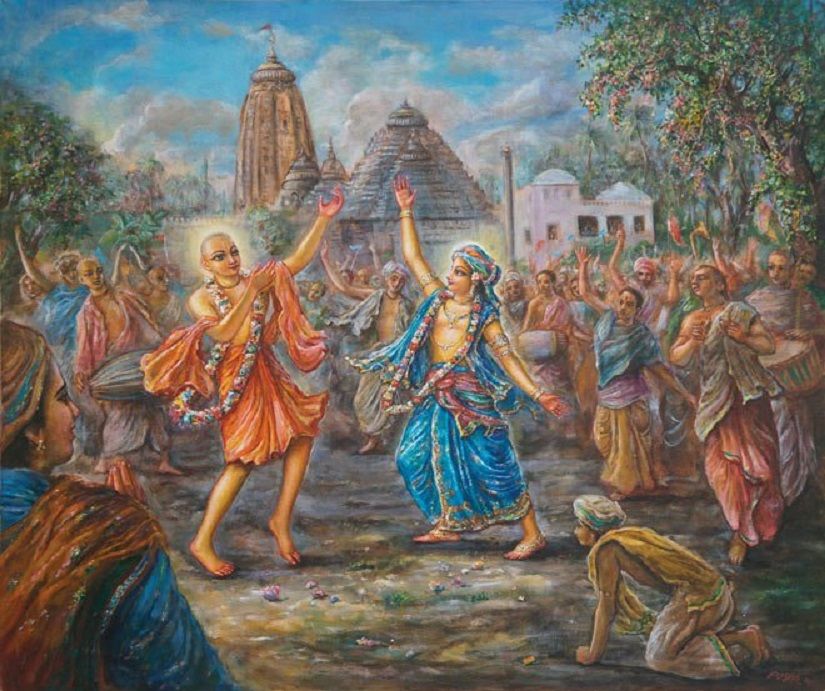
After seeing the holy place called Praskandana, Śrī Caitanya Mahāprabhu went to Dvādaśāditya. From there He went to Keśī- tīrtha, and when He saw the place where the rāsa dance had taken place, He immediately lost consciousness due to ecstatic love. (72) When the Lord regained His senses, He began to roll on the ground. He would sometimes laugh, cry, dance and fall down. He would also chant very loudly. (73) Being thus transcendentally amused, Śrī Caitanya Mahāprabhu passed that day happily at Keśī- tīrtha. In the evening He returned to Akrūra- tīrtha, where He took His meal. (74) The next morning Śrī Caitanya Mahāprabhu returned to Vṛndāvana and took His bath at Cīra- ghāṭa. He then went to Teṅtulī- talā, where He took rest. (75) The tamarind tree named Teṅtulī- talā was very old, having been there since the time of Lord Kṛṣṇa’s pastimes. Beneath the tree was a very shiny platform. (76)
Since the river Yamunā flowed near Teṅtulī- talā, a very cool breeze blew there. While there, the Lord saw the beauty of Vṛndāvana and the water of the river Yamunā. (77) Śrī Caitanya Mahāprabhu used to sit beneath the old tamarind tree and chant the holy name of the Lord. At noon He would return to Akrūra- tīrtha to take lunch. (78) All the people who lived near Akrūra- tīrtha came to see Śrī Caitanya Mahāprabhu, and due to the large crowds, the Lord could not peacefully chant the holy name. (79) Therefore Śrī Caitanya Mahāprabhu would go to Vṛndāvana and sit in a solitary place, where He would chant the holy name until noon. (80) In the afternoon, people were able to speak to Him. The Lord told everyone of the importance of chanting the holy name. (81)
During this time, a Vaiṣṇava named Kṛṣṇadāsa came to see Śrī Caitanya Mahāprabhu. He was a householder belonging to the kṣatriya caste, and his house was located on the other side of the Yamunā. (82) After bathing at Keśī- tīrtha, Kṛṣṇadāsa went toward Kālīya- daha and suddenly saw Śrī Caitanya Mahāprabhu sitting at Āmli- talā [Teṅtulī- talā]. (83) Upon seeing the Lord’s personal beauty and ecstatic love, Kṛṣṇadāsa was very much astonished. Out of ecstatic love, he offered his respectful obeisances unto the Lord. (84) Śrī Caitanya Mahāprabhu asked Kṛṣṇadāsa, “Who are you? Where is your home?” Kṛṣṇadāsa replied, “I am a most fallen householder. (85) “I belong to the Rājaputa caste, and my home is just on wish to be the servant of a Vaiṣṇava. (86)
“Today I have had a dream, and according to that dream I have come here and found You.” (87) Śrī Caitanya Mahāprabhu then bestowed upon Kṛṣṇadāsa His causeless mercy by embracing him. Kṛṣṇadāsa became mad with ecstatic love and began to dance and to chant the holy name of Hari. (88) Kṛṣṇadāsa returned to Akrūra- tīrtha with the Lord, and remnants of the Lord’s food were given to him. (89) The next morning, Kṛṣṇadāsa went with Śrī Caitanya Mahāprabhu to Vṛndāvana and carried His waterpot. Kṛṣṇadāsa thus left his wife, home and children in order to remain with Śrī Caitanya Mahāprabhu. (90) Everywhere the Lord went, all the people said, “Kṛṣṇa has again manifested at Vṛndāvana.” (91) One morning many people came to Akrūra- tīrtha. As they came from Vṛndāvana, they made a tumultuous sound. (92)
Upon seeing Śrī Caitanya Mahāprabhu, all the people offered respects at His lotus feet. The Lord then asked them, “Where are you all coming from?” (93) The people replied, “Kṛṣṇa has again manifested Himself on the waters of Kālīya Lake. He dances on the hoods of the serpent Kālīya, and the jewels on those hoods are blazing. (94) “Everyone has seen Lord Kṛṣṇa Himself. There is no doubt about it.” Hearing this, Śrī Caitanya Mahāprabhu began to laugh. He then said, “Everything is correct.” (95) For three successive nights people went to Kālīya- daha to see Kṛṣṇa, and everyone returned saying, “Now we have seen Kṛṣṇa Himself.” (96) Everyone came before Śrī Caitanya Mahāprabhu and said, “Now we have directly seen Lord Kṛṣṇa.” Thus by the mercy of the goddess of learning they were made to speak the truth. (97)
When the people saw Śrī Caitanya Mahāprabhu, they actually saw Kṛṣṇa, but because they were following their own imperfect knowledge, they accepted the wrong thing as Kṛṣṇa. (98) At that time Balabhadra Bhaṭṭācārya placed a request at the lotus feet of Śrī Caitanya Mahāprabhu. He said, “Please give me permission to go see Lord Kṛṣṇa directly.” (99) When Balabhadra Bhaṭṭācārya asked to see Kṛṣṇa at Kālīya- daha, Śrī Caitanya Mahāprabhu mercifully slapped him, saying, “You are a learned scholar, but you have become a fool, being influenced by the statements of other fools. (100) “Why would Kṛṣṇa appear in the Age of Kali? Foolish people who are mistaken are simply causing agitation and making a tumult. (101) “Do not become mad. Simply sit down here, and tomorrow night you will go see Kṛṣṇa.” (102)
The next morning some respectable gentlemen came to see Śrī Caitanya Mahāprabhu, and the Lord asked them, “Have you seen Kṛṣṇa?” (103) These respectable gentlemen replied, “At night in Kālīya Lake a fisherman lights a torch in his boat and catches many fish. (104) “From a distance, people mistakenly think that they are seeing Kṛṣṇa dancing on the body of the Kālīya serpent. (105) “These fools think that the boat is the Kālīya serpent and the torchlight the jewels on his hoods. People also mistake the fisherman for Kṛṣṇa. (106) “Actually Lord Kṛṣṇa has returned to Vṛndāvana. That is the truth, and it is also true that people have seen Him. (107) “But where they are seeing Kṛṣṇa is their mistake. It is like considering a dry tree to be a person.” (108)
Śrī Caitanya Mahāprabhu then asked them, “Where have you seen Kṛṣṇa directly?” The people replied, “You are a sannyāsī, a renunciant; therefore You are a moving Nārāyaṇa [jaṅgama- nārāyaṇa].” (109) The people then said, “You have appeared in Vṛndāvana as an incarnation of Kṛṣṇa. Just by seeing You, everyone is now liberated.” (110) Śrī Caitanya Mahāprabhu immediately exclaimed, “Viṣṇu! Viṣṇu! Do not call Me the Supreme Personality of Godhead. A jīva cannot become Kṛṣṇa at any time. Do not even say such a thing! (111) “A sannyāsī in the renounced order is certainly part and parcel of the complete whole, just as a shining molecular particle of sunshine is part and parcel of the sun itself. Kṛṣṇa is like the sun, full of six opulences, but the living entity is only a fragment of the complete whole. (112)
“A living entity and the Absolute Personality of Godhead are never to be considered equal, just as a fragmental spark can never be considered the original flame. (113) “‘The Supreme Personality of Godhead, the supreme controller, is always full of transcendental bliss and is accompanied by the potencies known as hlādinī and saṁvit. The conditioned soul, however, is always covered by ignorance and embarrassed by the threefold miseries of life. Thus he is a treasure- house of all kinds of tribulations.’ (114) “A foolish person who says that the Supreme Personality of Godhead is the same as the living entity is an atheist, and he becomes subject to punishment by the superintendent of death, Yamarāja. (115) ‘A person who considers demigods like Brahmā and Śiva to be on an equal level with Nārāyaṇa is to be considered an offender, or pāṣaṇḍī.’” (116)
Deepen your Bhakti-yoga practice, harmonize relationships, and receive guided coaching — all at Vedavarsity.com