


The Brihadeeswarar Temple stands as one of the most remarkable creations of human devotion and artistic excellence in India. Located in the fertile Cauvery belt of Tamil Nadu, this temple represents the spiritual vision and cultural commitment of the mighty Chola dynasty. While earlier temples celebrated in the hymns of saints hold great antiquity, the Brihadeeswarar Temple distinguishes itself as a monumental expression of organized devotion, architectural mastery, and disciplined statecraft aligned with dharma (righteous duty).
This sacred structure is not merely a place of worship; it is a living testimony to how human effort, guided by higher principles, can produce works that endure across centuries.
The Chola Vision and the Rise of Monumental Temples
The Legacy of Raja Raja Chola
The Brihadeeswarar Temple was built during the reign of Raja Raja Chola I (985–1014 CE), one of the greatest rulers in Indian history. His reign brought stability, prosperity, and a renewed emphasis on spiritual and cultural life. He also played a vital role in preserving the sacred Tevaram hymns of the Shaivite saints, ensuring that devotional traditions were not lost to time.
From a Vedic perspective, such actions reflect karma aligned with dharma—where governance is not merely political but also spiritual in purpose.
Expansion Under Successors
Raja Raja’s legacy was carried forward by his son Rajendra Chola and later rulers, who built other grand temples such as:
- Gangaikonda Choleeswarar Temple
- Airavateeswarar Temple
- Kambahareswarar Temple
These temples collectively represent a golden period where devotion, art, and engineering reached exceptional heights.
Brihadeeswarar Temple Architecture: A Marvel Beyond Time
The Towering Vimanam
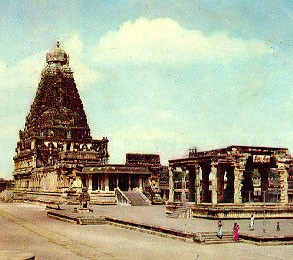
One of the most striking features of the Brihadeeswarar Temple is its towering vimanam (sanctum tower), rising to about 200 feet. It is often referred to as “Dakshina Meru,” symbolically representing the cosmic mountain described in Vedic cosmology.
At the top rests a massive granite block weighing approximately 81 tons. Tradition holds that this stone was transported using a ramp extending several kilometers—an engineering feat that continues to inspire awe.
Sacred Geometry and Structure
The temple layout follows precise proportions, reflecting the principle that the material world can be aligned with cosmic order (ṛta). The sanctum, ardhamandapam, mukhamandapam, and mahamandapam are designed as a unified structure, creating a sense of harmony and balance.
Such alignment reminds one that when human action follows divine order, the results become enduring and meaningful.
Sculptural and Artistic Excellence
Murals and Stone Narratives
The walls of the Brihadeeswarar Temple are adorned with exquisite murals and sculptures. These depict:
- Incidents from the lives of Shaivite saints (Nayanmars)
- Various forms of Lord Shiva, including Nataraja and Dakshinamurti
- Classical dance postures, including Bharatanatyam movements
These artistic elements are not mere decoration. They serve as visual scriptures, guiding the observer toward contemplation and devotion.
Expression of Devotion Through Art
The Chola artisans combined technical precision with spiritual intent. As art historian Fergusson observed, they “conceived like giants and finished like jewellers.” This balance of grandeur and detail reflects a consciousness that sees art as an offering rather than mere craftsmanship.
The Sanctum and the Divine Presence
The Great Shiva Lingam
At the heart of the Brihadeeswarar Temple lies the massive Shiva Lingam, known as Peruvudaiyar. It is housed in a two-storied sanctum, emphasizing the central importance of divine presence.
In Vedic understanding, the lingam represents the formless aspect of the Supreme—beyond material attributes yet accessible through devotion.
The Majestic Nandi
Facing the sanctum is a colossal Nandi (the sacred bull), carved from a single stone. Weighing about 25 tonnes and standing nearly 12 feet tall, it reflects both strength and humility—qualities essential for spiritual progress.
Inscriptions: A Record of Devotion and Governance
The temple walls contain extensive inscriptions detailing contributions made by Raja Raja Chola and his sister Kundavai. These inscriptions record donations, rituals, and administrative practices.
Such documentation reveals that the temple was not only a spiritual center but also a hub of organized societal activity. It reflects a culture where governance, economy, and spirituality functioned in harmony.
Cultural and Spiritual Significance
A Center of Shaivite Tradition
The Brihadeeswarar Temple is deeply connected to the Shaivite tradition. It embodies the teachings and devotional expressions of the Nayanmars, whose hymns emphasize surrender and love for the Supreme.
Integration of Art, Music, and Dance
The temple also served as a center for classical arts. Dance, music, and sculpture were integrated into worship, demonstrating that all human talents can be directed toward divine service.
This aligns with the principle that every action, when performed in the spirit of offering, becomes spiritually uplifting.
Architectural Distinction Among Chola Temples
One unique feature of the Brihadeeswarar Temple and its contemporary Chola temples is the prominence of the vimanam over the gopuram (entrance tower). This differs from later temple architecture, where gopurams became more dominant.
This design emphasizes the sanctum as the focal point, symbolically guiding the devotee inward—from the external world to the inner realization of the self (ātma).
A Reflection on Human Endeavor and Divine Inspiration
The construction of such a grand temple over a thousand years ago raises a deeper question: what inspires such dedication?
From a Vedic perspective, when human intelligence is guided by higher consciousness, it aligns with divine will. The result is not merely material achievement but spiritual legacy.
Conclusion: Brihadeeswarar Temple as a Living Legacy
The Brihadeeswarar Temple remains one of the finest examples of how devotion, discipline, and artistic excellence can come together to create something timeless. It stands not only as a monument of the Chola dynasty but also as a reminder of humanity’s higher purpose.
In observing this temple, one is gently reminded that true greatness lies not in power alone, but in aligning one’s actions with dharma and offering them in service to the Supreme.
library.vedavarsity.com | www.vedavarsity.com
Deepen your Bhakti-yoga practice, harmonize relationships, and receive guided coaching — all at Vedavarsity.com