Mail ID: contact@vedavarsity.com

Contact: +91 9634998911

Google search engineGoogle search engine
Home Blog Page 47

Chaitanya Charitamrta | Antya Lila | Chapter 5 | Section 175

0

I am infected by the germs of material activity and am suffering from the boils of envy. Therefore, falling in an ocean of humility, I take shelter of the great physician Lord Śrī Caitanya Mahāprabhu. (1) All glories to Śrī Caitanya Mahāprabhu, the son of mother Śacī! All glories to Śrī Nityānanda Prabhu! Indeed, He is the most glorious and merciful. (2) I offer my respectful obeisances unto Advaita Prabhu, the ocean of mercy, and to all the devotees, such as Svarūpa Dāmodara Gosvāmī, Gadādhara Paṇḍita, Śrī Rūpa Gosvāmī and Śrī Sanātana Gosvāmī. (3) One day Pradyumna Miśra came to see Śrī Caitanya Mahāprabhu, offering his respects and inquiring from Him with great submission. (4)

My Lord,” he said, “kindly hear me. I am a cripple- minded householder, the most fallen of men, but somehow, by my good fortune, I have received the shelter of Your lotus feet, which are rarely to be seen. (5) “I wish to hear topics concerning Lord Kṛṣṇa constantly. Be merciful unto me and kindly tell me something about Kṛṣṇa.” (6) Śrī Caitanya Mahāprabhu replied, “I do not know about topics concerning Lord Kṛṣṇa. I think that only Rāmānanda Rāya knows, for I hear these topics from him. (7) “It is your good fortune that you are inclined to hear topics regarding Kṛṣṇa. The best course for you would be to go to Rāmānanda Rāya and hear these topics from him. (8) “I see that you have acquired a taste for hearing talks regarding Kṛṣṇa. Therefore you are extremely fortunate. Not only you but anyone who has awakened such a taste is considered most fortunate. (9)

“‘A person who properly performs his regulative duties according to varṇa and āśrama but does not develop his dormant attachment for Kṛṣṇa or awaken his taste for hearing and chanting about Kṛṣṇa is certainly laboring fruitlessly.'” (10) Pradyumna Miśra, being thus advised by Śrī Caitanya Mahāprabhu, went to the home of Rāmānanda Rāya. There the servant of Rāmānanda Rāya gave him a proper place to sit down. (11) Unable to see Rāmānanda Rāya immediately, Pradyumna Miśra inquired from the servant, who then described what Śrī Rāmānanda Rāya was doing. (12) “There are two dancing girls who are extremely beautiful. They are very youthful, and they are expert in dancing and singing. (13) “Śrīla Rāmānanda Rāya has taken these two girls to a solitary place in his garden, where he is teaching and directing them to dance according to the songs he has composed for his drama. (14)

“Please sit here and wait for a few moments. As soon as he comes, he will execute whatever order you give him.” (15) While Pradyumna Miśra remained seated there, Rāmānanda Rāya took the two girls to a solitary place. (16) With his own hand, Śrī Rāmānanda Rāya massaged their bodies with oil and bathed them with water. Indeed, Rāmānanda Rāya cleansed their entire bodies with his own hand. (17) Although he dressed the two young girls and decorated their bodies with his own hand, he remained unchanged. Such is the mind of Śrīla Rāmānanda Rāya. (18) While touching the young girls, he was like a person touching wood or stone, for his body and mind were unaffected. (19) Śrīla Rāmānanda Rāya used to act in that way because he thought of himself in his original position as a maidservant of the gopīs. Thus although externally he appeared to be a man, internally, in his original spiritual position, he considered himself a maidservant and considered the two girls gopīs. (20)

The greatness of the devotees of Śrī Caitanya Mahāprabhu is exceedingly difficult to understand. Śrī Rāmānanda Rāya is unique among them all, for he showed how one can extend his ecstatic love to the extreme limit. (21) Rāmānanda Rāya directed the two girls how to dance and express the deep meaning of his songs through dramatic performances. (22) He taught them how to express the symptoms of continuous, natural and transitional ecstasies with the movements of their faces, their eyes and the other parts of their bodies. (23) Through the feminine poses and dances they were taught by Rāmānanda Rāya, the two girls precisely exhibited all these expressions of ecstasy before Lord Jagannātha. (24) Then Rāmānanda Rāya fed the two girls sumptuous prasādam and sent them to their homes unexposed. (25) Every day he trained the two deva- dāsīs how to dance. Who among the small living entities, their minds always absorbed in material sense gratification, could understand the mentality of Śrī Rāmānanda Rāya? (26)

When the servant informed Rāmānanda Rāya of Pradyumna Miśra’s arrival, Rāmānanda Rāya immediately went to the assembly room. (27) He offered his obeisances to Pradyumna Miśra with all respect and then, with great humility, spoke as follows. (28) “Sir, you came here long ago, but no one informed me. Therefore I have certainly become an offender at your lotus feet. (29) “My entire home has been purified by your arrival. Kindly order me. What can I do for you? I am your servant.” (30) Pradyumna Miśra replied, “I came simply to see you. Now I have purified myself by seeing Your Honor.” (31) Because Pradyumna Miśra saw that it was late, he did not say anything else to Rāmānanda Rāya. Instead, he took leave of him and returned to his own home. (32) The next day, when Pradyumna Miśra arrived in the presence of Śrī Caitanya Mahāprabhu, the Lord inquired, “Have you heard talks about Kṛṣṇa from Śrī Rāmānanda Rāya?” (33)

Pradyumna Miśra thereupon described the activities of Śrī Rāmānanda Rāya. After hearing about these activities, Śrī Caitanya Mahāprabhu began to speak. (34) “I am a sannyāsī,” He said, “and I certainly consider Myself renounced. But what to speak of seeing a woman, if I even hear the name of a woman, I feel changes in My mind and body. Therefore who could remain unmoved by the sight of a woman? It is very difficult. (35-36) “Everyone please hear these topics about Rāmānanda Rāya, although they are so wonderful and uncommon that they should not be spoken. (37) “The two professional dancing girls are beautiful and youthful, yet Śrī Rāmānanda Rāya personally massages their entire bodies with oil. (38) “He personally bathes and dresses them and decorates them with ornaments. In this way, he naturally sees and touches the private parts of their bodies. (39)

“Nevertheless, the mind of Śrī Rāmānanda Rāya never changes, although he teaches the girls how to physically express all the transformations of ecstasy. (40) “His mind is as steady as wood or stone. Indeed, it is wonderful that even when he touches such young girls, his mind never changes. (41) “The authority for such acts is the prerogative of Rāmānanda Rāya alone, for I can understand that his body is not material but has been completely transformed into a spiritual entity. (42) “He alone, and no one else, can understand the position of his mind. (43) “But I can make a guess in terms of directions from the śāstra. The Vedic scripture Śrīmad- Bhāgavatam gives the direct evidence in this matter. (44) “When one hears or describes with great faith the pastimes of Lord Kṛṣṇa, such as His rāsa dance with the gopīs, the disease of lusty desires in his heart and the agitation caused by the three modes of material nature are immediately nullified, and he becomes sober and silent. (45-46)

“Tasting transcendental, effulgent, sweetly ecstatic love of Kṛṣṇa, such a person can enjoy life twenty- four hours a day in the transcendental bliss of the sweetness of Kṛṣṇa’s pastimes. (47) “‘A transcendentally sober person who, with faith and love, continually hears from a realized soul about the activities of Lord Kṛṣṇa in His rāsa dance with the gopīs, or one who describes such activities, can attain full transcendental devotional service at the lotus feet of the Supreme Personality of Godhead. Thus lusty material desires, which are the heart disease of all materialistic persons, are for him quickly and completely vanquished.’ (48)

“If a transcendentally situated person, following in the footsteps of Śrīla Rūpa Gosvāmī, hears and speaks about the rāsa- līlā dance of Kṛṣṇa and is always absorbed in thoughts of Kṛṣṇa while serving the Lord day and night within his mind, what shall I say about the result? It is so spiritually exalted that it cannot be expressed in words. Such a person is an eternally liberated associate of the Lord, and his body is completely spiritualized. Although he is visible to material eyes, he is spiritually situated, and all his activities are spiritual. By the will of Kṛṣṇa, such a devotee is understood to possess a spiritual body. (49-50) “Śrīla Rāmānanda Rāya is situated on the path of spontaneous love of Godhead. Therefore he is in his spiritual body, and his mind is not materially affected. (51) “I also hear topics about Kṛṣṇa from Rāmānanda Rāya. If you want to hear such topics, go to him again. (52)

“You can mention My name before him, saying, ‘He has sent me to hear about Lord Kṛṣṇa from you.’ (53) “Go hastily, while he is in the assembly room.” Hearing this, Pradyumna Miśra immediately departed. (54) Pradyumna Miśra went to Rāmānanda Rāya, who offered him respectful obeisances and said, “Please order me. For what purpose have you come?” (55) Pradyumna Miśra answered, “Śrī Caitanya Mahāprabhu has sent me to hear topics about Lord Kṛṣṇa from you.” (56) Hearing this, Rāmānanda Rāya became absorbed in ecstatic love and began to speak with great transcendental pleasure. (57) “Following the instruction of Śrī Caitanya Mahāprabhu, you have come to hear about Kṛṣṇa. This is my great fortune. How else would I get such an opportunity?” (58)

Saying this, Śrī Rāmānanda Rāya took Pradyumna Miśra to a secluded place and inquired from him, “What kind of kṛṣṇa- kathā do you want to hear from me?” (59) Pradyumna Miśra replied, “Kindly tell me about the same topics you spoke about at Vidyānagara. (60) “You are an instructor even for Śrī Caitanya Mahāprabhu, what to speak of others. I am but a beggar brāhmaṇa, and you are my maintainer. (61) “I do not know how to inquire, for I do not know what is good and what is bad. Seeing me to be poor in knowledge, kindly speak whatever is good for me by your own good will.” (62)

ISKCON Represented In Nigerian KAICIID Fellows’ National Peace Appeal

0

The Nigerian KAICIID Fellows, representing Christian, Muslim, Vaishnava, and Traditionalist communities, joined voices in a national appeal for calm and collaborative action amid rising tensions.

The Nigerian Chapter of the KAICIID Fellows Alumni Network has issued a joint press release calling for calm, responsible leadership, and renewed national dialogue in response to escalating violence across several Nigerian states. Six Fellows co-authored the statement, including Salika Dasa, who represented ISKCON and ensured the Hare Krishna Movement’s voice was present in a national interfaith appeal for unity and non-violence.

The KAICIID Fellows network in Nigeria brings together Christian, Muslim, Vaishnava, African Traditionalist, and other religious peacebuilders trained in dialogue, conflict transformation, and intercultural engagement. With the recent rise in communal tension and public debate intensified by remarks from a world leader threatening military intervention, the Fellows decided to issue a unified response that advocates stability and rejects inflammatory narratives.

ISKCON’s Voice in a National Interfaith Statement

In his report to ISKCON News, Salika noted that the drafting process was collaborative and inclusive, creating space for ISKCON to contribute substantively to a national-level conversation on peace and security. ISKCON’s participation signals its growing recognition in Nigerian civil society as a legitimate and responsible faith-based actor committed to non-violence and social harmony.

According to Salika, ISKCON’s representation among the signatories underscores three important points. First, it confirms the movement’s place within Nigeria’s religiously diverse landscape. Second, it demonstrates ISKCON’s willingness to take part in shaping thoughtful, balanced public responses during moments of national crisis. Third, it strengthens ISKCON’s public profile as a movement aligned with peace, compassion, and constructive civic engagement, values deeply rooted in Srila Prabhupada’s teachings.

Key Themes of the Press Release

The joint statement stresses that Nigeria’s present crisis should not be framed as a religious conflict. Instead, it calls for calm, restraint, and a recommitment to justice and institutional accountability. The Fellows warn that divisive rhetoric, whether from local actors or international figures, risks deepening tensions and undermining efforts already underway to stabilize affected communities.

The release urges federal and state institutions to uphold their constitutional responsibility to protect all citizens, regardless of religious or ethnic identity. It highlights the humanitarian suffering of ordinary Nigerians, noting that families across multiple regions have endured loss, displacement, and insecurity. The Fellows point out that durable solutions must be rooted in dialogue, institutional reform, and collaborative action across sectors.

Faith leaders, the statement notes, have a particularly important role in this moment. They are encouraged to safeguard communal spaces, counter hate speech, and guide their followers toward empathy rather than suspicion. Civil society groups and the media are also reminded to steer public conversations toward accountability and constructive engagement rather than narratives that inflame religious or ethnic division.

ISKCON’s Ongoing Contribution

ISKCON’s involvement in this interfaith response builds on its ongoing participation in peace education, dialogue initiatives, and cooperation with multi-faith partners across Nigeria. As part of the KAICIID Fellows network, ISKCON supports localized approaches to conflict transformation that emphasize compassion, truthfulness, and protection of all life.

The public stance taken in this release reinforces the movement’s long-term commitment to national stability and interreligious harmony. By standing with fellow peace practitioners, ISKCON demonstrates that Vaishnava values can contribute meaningfully to conversations on justice, unity, and social responsibility.

A Collective Call for Peace

The KAICIID Fellows conclude their statement with a clear message: every Nigerian life is sacred, and peaceful coexistence requires dialogue, fairness, and shared responsibility. ISKCON’s presence in this collaborative effort signals its readiness to remain engaged at national and international levels where faith, governance, and community well-being intersect.

As Nigeria continues to navigate a period of intense social pressure, the contributions of diverse religious organizations, including ISKCON, serve as a reminder that unity and moral leadership remain essential to any sustainable path toward peace.

Meeting Dr Ali Hayder

0

“We are not preaching to Christian or Hindu or Muslim. We are preaching to human being. Every living being, his duty is to understand God.”
–Srila Prabhupada

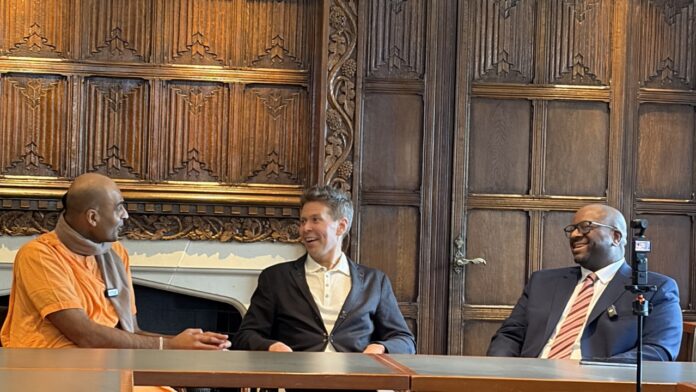
Today in Leeds, Dr Ali Hayder approached me, and we had a beautiful discussion. He conveyed that he has read the Ramayan and holds deep love for Lord Rama. He shared how he sees common values between Lord Rama & Imam Husayn, the grandson of Prophet Muhammad. For him, studying religion through these shared principles truly inspires him.

He said that although he is a Muslim, he has always believed that wisdom is never owned by one tradition. He had read a digital version of the Bhagavad Gita and spoke about how the conversation between Krishna and Arjuna felt like a universal message meant for every human being.

What resonated with him most was the call to dharma, to take responsibility, to stand in our values and to act with clarity even when life becomes difficult. He expressed that this was not about religion but about learning. Dr Ali has found his dharma in being a Digital Marketing Consultant, lecturing students at Leeds University and studying religions and the common values they share.

He explained that in Islam, they are taught to seek knowledge even if it means travelling across oceans. So he believes that studying the Bhagavad Gita is simply an extension of that belief, through which he hopes to understand different perspectives, learn from different stories, and allow the wisdom to shape how we live & behave.

He said every tradition carries something meaningful, and limiting ourselves only narrows our growth. We all share the same struggles, the same questions and the same search for purpose and that this shared journey is the real beauty of diversity.

I was so humbled by our conversation, witnessing the sincerity of Dr Ali’s search for truth and his passion to share knowledge with others.

Srila Prabhupada arranges meetings far beyond anything we can imagine. When hearts are open, Krishna sends his wisdom through any path, any culture and any soul willing to receive it. (see photo)

–Gurusakti Dasi

Nonviolent Communication Course Offered Through Karuna Care Association

0

Karuna Care Association will be offering another upcoming course beginning this January 2026, entitled “Nonviolent Communication: Living Bhakti Values in Everyday Interactions.”  The course, designed to elevate your everyday interactions, is supported by the teachings of Srila Prabhupada. It explores how Nonviolent Communication (NVC) can help us cultivate more empathic and spiritually aligned interactions. Participants will learn practical tools to strengthen relationships within family, community, and service environments, while grounding their communication in Bhakti values.

The course introduces the foundational principles of NVC and their connection to empathy, understanding, and devotional compassion. Students will work on developing self-awareness, recognizing their needs and emotions, and listening to others with genuine care. Special emphasis will be placed on compassionate expression, drawing from the Bhagavad-gita’s teachings on the austerity of speech, and learning to communicate truthfully and respectfully.

Conflict resolution will be approached through the lens of mutual needs and peaceful understanding, offering strategies that promote harmony and cooperation. Sessions will include interactive exercises, small-group discussions, and guided reflections that integrate insights from Vedic teachings. Through these practices, participants will gain tools to support clearer, kinder, and more spiritually grounded communication in daily life.

This course welcomes ISKCON members and others who wish to enhance their communication skills and cultivate more loving, supportive relationships.

Course details:

Course Title: Nonviolent Communication: Living Bhakti Values in Everyday Interactions

Dates: Saturdays – Jan 17, 24, 31, Feb 7. Break on Feb 14. Feb 21 and 28 (6 sessions)

Timing: 8:30-10:00 am CST

To register, click here.

Our Facilitators

The course will be offered by Sri Radhika Devi Dasi and Yamuna Jivana Dasi, disciples of Romapada Swami. Sri Radhika Devi Dasi is a certified Empathic Communication Trainer and a Nonviolent Communication Certification Candidate. She currently serves as Head of Human Resources for a nonprofit organization and holds both a Bachelor’s Degree and a Graduate Certificate in Human Resources Management.

Yamuna Jivana Das is trained by the Karuna Care Association to provide Compassionate Care and is a skilled mediator. He works as a Director of Engineering for the Chamberlain Group and holds a Master of Business Administration and a Bachelor of Science in Electrical Engineering.

They live in Naperville, Illinois, where they homeschool their two teenage sons.

Testimonials:

It has been a joy and honour to teach alongside Yamuna Jivan Prabhu and Sri Radhika Mataji at Karuna Care Association. I’ve seen how deeply they listen, how sensitively they respond, and how thoughtfully they address both spoken and unspoken questions. Their work goes beyond education; they nurture emotional resilience and spiritual growth in their students.

I consider both of them to be my own teachers, as I continue to learn from their wisdom, empathy, and presence. I hope many more students have the opportunity to learn under their guidance.

– Devamira das, Calcutta, India

Studying the Drama Triangle and Non-violent Communication with Yamuna Jivana and Sri Radhika Prabhus has been deeply inspiring. Their courses are thoughtfully crafted, blending scriptural pastimes with real-life experience in a warm, inclusive atmosphere. I now feel personally connected with them and trust deeply in the quality of their work.

– Mangala-candrika dasi, Radhadesh

Chaitanya Charitamrta | Antya Lila | Chapter 4 | Section 174

0

Śrīla Rūpa Gosvāmī had been delayed in Bengal for a year because he was dividing his money among his relatives to situate them in their proper positions. (214) He collected whatever money he had accumulated in Bengal and divided it among his relatives, the brāhmaṇas and the temples. (215) Thus after finishing all the tasks he had on his mind, he returned to Vṛndāvana fully satisfied. (216) The brothers met at Vṛndāvana, where they stayed to execute the will of Śrī Caitanya Mahāprabhu. (217) Śrīla Rūpa Gosvāmī and Sanātana Gosvāmī collected many revealed scriptures, and from the evidence in those scriptures they excavated all the lost sites of pilgrimage. Thus they established temples for the worship of Lord Kṛṣṇa. (218)

Śrīla Sanātana Gosvāmī compiled the Bṛhad- bhāgavatāmṛta. From this book one can understand who is a devotee, what is the process of devotional service, and who is Kṛṣṇa, the Absolute Truth. (219) Śrīla Sanātana Gosvāmī wrote a commentary on the Tenth Canto known as Daśama- ṭippanī, from which we can understand the transcendental pastimes and ecstatic love of Lord Kṛṣṇa. (220) He also compiled the Hari- bhakti- vilāsa, from which we can understand the standard behavior of a devotee and the full extent of a Vaiṣṇava’s duty. (221) Śrīla Sanātana Gosvāmī also compiled many other books. Who can enumerate them? The basic principle of all these books is to show us how to love Madana- mohana and Govindajī. (222)

Śrīla Rūpa Gosvāmī also wrote many books, the most famous of which is the Bhakti- rasāmṛta- sindhu. From that book one can understand the essence of devotional service to Kṛṣṇa and the transcendental mellows one can derive from such service. (223) Śrīla Rūpa Gosvāmī also compiled the book named Ujjvala- nīlamaṇi, from which one can understand, to the fullest limits, the loving affairs of Śrī Śrī Rādhā and Kṛṣṇa. (224) Śrīla Rūpa Gosvāmī also compiled two important dramas named Vidagdha- mādhava and Lalita- mādhava, from which one can understand all the mellows derived from the pastimes of Lord Kṛṣṇa. (225) Śrīla Rūpa Gosvāmī compiled 100,000 verses, beginning with the book Dāna- keli- kaumudī. In all these scriptures he elaborately explained the transcendental mellows of the activities of Vṛndāvana. (226)

The son of Śrī Vallabha, or Anupama, Śrīla Rūpa Gosvāmī’s younger brother, was the great learned scholar named Śrīla Jīva Gosvāmī. (227) After renouncing everything, Śrīla Jīva Gosvāmī went to Vṛndāvana. Later he also wrote many books on devotional service and expanded the work of preaching. (228) In particular, Śrīla Jīva Gosvāmī compiled the book named Bhāgavata- sandarbha, or Ṣaṭ- sandarbha, which is the essence of all scriptures. From this book one can obtain a conclusive understanding of devotional service and the Supreme Personality of Godhead. (229) He also compiled the book named Gopāla- campū, which is the essence of all Vedic literature. In this book he has exhibited the ecstatic loving transactions and pastimes of Rādhā and Kṛṣṇa in Vṛndāvana. (230)

In the Ṣaṭ- sandarbha Śrīla Jīva Gosvāmī set forth the truths about transcendental love of Kṛṣṇa. In this way he expanded 400,000 verses in all his books. (231) When Jīva Gosvāmī wanted to go to Mathurā from Bengal, he requested permission from Śrīla Nityānanda Prabhu. (232) Because of Jīva Gosvāmī’s relationship with Rūpa Gosvāmī and Sanātana Gosvāmī, who were greatly favored by Śrī Caitanya Mahāprabhu, Lord Nityānanda Prabhu placed His feet on the head of Śrīla Jīva Gosvāmī and embraced him. (233) Lord Nityānanda Prabhu ordered, “Yes, go soon to Vṛndāvana. That place has been awarded to your family, to your father and uncles, by Śrī Caitanya Mahāprabhu, and therefore you must go there immediately.” (234)

By the order of Nityānanda Prabhu, he went to Vṛndāvana and actually achieved the result of His order, for he compiled many books for a long time and preached the cult of bhakti from there. (235) These three-Rūpa Gosvāmī, Sanātana Gosvāmī and Jīva Gosvāmī-are my spiritual masters, and so also is Raghunātha dāsa Gosvāmī. I therefore offer prayers at their lotus feet, for I am their servant. (236) Thus I have described how the Lord again met with Sanātana Gosvāmī. By hearing this I can understand the Lord’s desire. (237) These characteristics of Śrī Caitanya Mahāprabhu are like sugar cane that one can chew to relish transcendental juice. (238) Praying at the lotus feet of Śrī Rūpa and Śrī Raghunātha, always desiring their mercy, I, Kṛṣṇadāsa, narrate Śrī Caitanya- caritāmṛta, following in their footsteps. (239)

Chaitanya Charitamrta | Antya Lila | Chapter 4 | Section 173

0

Hearing this, Śrī Caitanya Mahāprabhu, in an angry mood, began to chastise Jagadānanda Paṇḍita. (157) “Jagā [Jagadānanda Paṇḍita] is only a new boy, but he has become so proud that he thinks himself competent to advise a person like you. (158) “In affairs of spiritual advancement and even in ordinary dealings, you are on the level of his spiritual master. Yet not knowing his own value, he dares to advise you. (159) “My dear Sanātana, you are on the level of My advisor, for you are an authorized person. But Jagā wants to advise you. This is but the impudence of a naughty boy.” (160) When Śrī Caitanya Mahāprabhu was thus chastising Jagadānanda Paṇḍita, Sanātana Gosvāmī fell at the Lord’s feet and said, “I can now understand the fortunate position of Jagadānanda. (161)

“I can also understand my misfortune. No one in this world is as fortunate as Jagadānanda. (162) “Sir, You are making Jagadānanda drink the nectar of affectionate relationships, whereas by offering me honorable prayers, You are making me drink the bitter juice of nimba and niśindā. (163) “It is my misfortune that You have not accepted me as one of Your intimate relations. But You are the completely independent Supreme Personality of Godhead.” (164) Hearing this, Śrī Caitanya Mahāprabhu was somewhat ashamed. Just to satisfy Sanātana Gosvāmī, He spoke the following words. (165) “My dear Sanātana, please do not think that Jagadānanda is more dear to Me than you. However, I cannot tolerate transgressions of the standard etiquette. (166) “You are an experienced authority in the śāstras, whereas Jagā is just a young boy. (167) “You have the power to convince even Me. In many places you have already convinced Me about ordinary behavior and devotional service. (168) “Jagā’s advising you is intolerable for Me. Therefore I am chastising him. (169)

“I offer you praise not because I think of you as being outside an intimate relationship with Me but because you are actually so qualified that one is forced to praise your qualities. (170) “Although one has affection for many persons, different types of ecstatic love awaken according to the nature of one’s personal relationships. (171) “You consider your body dangerous and awful, but I think that your body is like nectar. (172) “Actually your body is transcendental, never material. You are thinking of it, however, in terms of a material conception. (173) “Even if your body were material, I still could not neglect it, for the material body should be considered neither good nor bad. (174) “‘Anything not conceived in relationship to Kṛṣṇa should be understood to be illusion [māyā]. None of the illusions uttered by words or conceived in the mind are factual. Because illusion is not factual, there is no distinction between what we think is good and what we think is bad. When we speak of the Absolute Truth, such speculations do not apply.’ (175)

“In the material world, conceptions of good and bad are all mental speculations. Therefore, saying ‘This is good’ and ‘This is bad’ is all a mistake. (176) “‘The humble sages, by virtue of true knowledge, see with equal vision a learned and gentle brāhmaṇa, a cow, an elephant, a dog and a dog- eater.’ (177) “‘One who is fully satisfied in knowledge obtained and practically applied in life, who is always determined and fixed in his spiritual position, who completely controls his senses, and who sees pebbles, stones and gold on the same level is understood to be a perfect yogī.’ (178) “Since I am in the renounced order, My duty is to make no distinctions and be equipoised. My knowledge must be equally disposed toward sandalwood pulp and dirty mud. (179)

“For this reason, I cannot reject you. If I hated you, I would deviate from My occupational duty.” (180) Haridāsa said, “My dear Lord, what You have spoken deals with external formalities. I do not accept it. (181) “My Lord, we are all fallen, but You have accepted us due to Your attribute of being merciful to the fallen. This is well known all over the world.” (182) Lord Caitanya smiled and said, “Listen, Haridāsa and Sanātana. Now I am speaking the truth about how My mind is attached to you. (183) “My dear Haridāsa and Sanātana, I think of you as My little boys, to be maintained by Me. The maintainer never takes seriously any faults of the maintained. (184) “I always think of Myself as deserving no respect, but because of affection I always consider you to be like My little children. (185) “When a child passes stool and urine that touch the body of the mother, the mother never hates the child. On the contrary, she takes much pleasure in cleansing him. (186)

“The stool and urine of the maintained child appear like sandalwood pulp to the mother. Similarly, when the foul moisture oozing from the sores of Sanātana touches My body, I have no hatred for him.” (187) Haridāsa Ṭhākura said, “My dear Sir, You are the Supreme Personality of Godhead and are most merciful toward us. No one can understand what is within Your deeply affectionate heart. (188) “You embraced the leper Vāsudeva, whose body was fully infected by worms. You are so kind that in spite of his condition You embraced him. (189) “By embracing him You made his body as beautiful as that of Cupid. We cannot understand the waves of Your mercy.” (190) Śrī Caitanya Mahāprabhu said, “The body of a devotee is never material. It is considered to be transcendental, full of spiritual bliss. (191) “At the time of initiation, when a devotee fully surrenders unto the service of the Lord, Kṛṣṇa accepts him to be as good as Himself. (192)

“When the devotee’s body is thus transformed into spiritual existence, the devotee, in that transcendental body, renders service to the lotus feet of the Lord. (193) “‘The living entity who is subjected to birth and death attains immortality when he gives up all material activities, dedicates his life to the execution of My order, and acts according to My directions. In this way he becomes fit to enjoy the spiritual bliss derived from exchanging loving mellows with Me.’ (194) “Kṛṣṇa somehow or other manifested these itching sores on the body of Sanātana Gosvāmī and sent him here to test Me. (195) “If I had hated Sanātana Gosvāmī and had not embraced him, I would certainly have been chastised for offenses to Kṛṣṇa. (196) “Sanātana Gosvāmī is one of the associates of Kṛṣṇa. There could not be any bad odor from his body. On the first day I embraced him, I smelled the aroma of catuḥsama [a mixture of sandalwood pulp, camphor, aguru and musk].” (197)

In fact, however, when Śrī Caitanya Mahāprabhu embraced the body of Sanātana Gosvāmī, by the Lord’s touch alone there was manifested a fragrance exactly like that of sandalwood pulp. (198) Śrī Caitanya Mahāprabhu continued, “My dear Sanātana, do not be aggrieved, for when I embrace you I actually get great pleasure. (199) “Stay with Me at Jagannātha Purī for one year, and after that I shall send you to Vṛndāvana.” (200) After saying this, Śrī Caitanya Mahāprabhu again embraced Sanātana Gosvāmī. Thus immediately Sanātana’s sores disappeared, and his entire body resembled the color of gold. (201) Seeing the change, Haridāsa Ṭhākura, greatly astonished, told the Lord, “This is Your pastime. (202) “My dear Lord, You made Sanātana Gosvāmī drink the water of Jhārikhaṇḍa, and You actually generated the consequent itching sores on his body. (203)

“After thus causing these itching sores, You examined Sanātana Gosvāmī. No one can understand Your transcendental pastimes.” (204) After embracing both Haridāsa Ṭhākura and Sanātana Gosvāmī, Śrī Caitanya Mahāprabhu returned to His residence. Then Haridāsa Ṭhākura and Sanātana Gosvāmī, in great ecstatic love, began to describe the Lord’s transcendental attributes. (205) In this way Sanātana Gosvāmī stayed under the care of Śrī Caitanya Mahāprabhu and discussed the transcendental qualities of Śrī Caitanya Mahāprabhu with Haridāsa Ṭhākura. (206) After they saw the Dola- yātrā festival, Śrī Caitanya Mahāprabhu instructed Sanātana Gosvāmī fully about what to do in Vṛndāvana and bade him farewell. (207) The scene of separation that took place when Sanātana Gosvāmī and Śrī Caitanya Mahāprabhu took leave of each other is so piteous that it cannot be described herein. (208)

Sanātana Gosvāmī decided to go to Vṛndāvana by the very forest path Śrī Caitanya Mahāprabhu had traversed. (209) Sanātana Gosvāmī noted from Balabhadra Bhaṭṭācārya all the villages, rivers and hills where Śrī Caitanya Mahāprabhu had performed His pastimes. (210) Sanātana Gosvāmī met all the devotees of Śrī Caitanya Mahāprabhu and then, traveling by that same path, visited the places through which Śrī Caitanya Mahāprabhu had passed. (211) As soon as Sanātana Gosvāmī visited a place where Śrī Caitanya Mahāprabhu had performed His pastimes on the way, he was immediately filled with ecstatic love. (212) In this way Sanātana Gosvāmī reached Vṛndāvana. Later Rūpa Gosvāmī came and met him. (213)

Chaitanya Charitamrta | Antya Lila | Chapter 4 | Section 172

0

In that month of May-June, Śrī Caitanya Mahāprabhu came to the garden of Yameśvara [Lord Śiva] and accepted prasādam there at the request of the devotees. (116) At noon, when it was time for lunch, the Lord called for Sanātana Gosvāmī, whose happiness increased because of the call. (117) At noon the sand on the beach was as hot as fire, but Sanātana Gosvāmī came by that path. (118) Overwhelmed by joy at being called by the Lord, Sanātana Gosvāmī did not feel that his feet were burning in the hot sand. (119) Although the soles of his feet were blistered because of the heat, he nevertheless went to Śrī Caitanya Mahāprabhu. There he found that the Lord, having taken His lunch, was resting. (120) Govinda gave Sanātana Gosvāmī the plate with the remnants of Lord Caitanya’s food. After taking the prasādam, Sanātana Gosvāmī approached Lord Śrī Caitanya Mahāprabhu. (121)

When the Lord inquired, “By which path have you come?” Sanātana Gosvāmī replied, “I have come on the path along the beach.” (122) Śrī Caitanya Mahāprabhu said, “How did you come along the beach, where the sand is so hot? Why didn’t you come by the path in front of the Siṁha- dvāra gate? It is very cool. (123) “The hot sand must have blistered your soles. Now you cannot walk. How did you tolerate it?” (124) Sanātana Gosvāmī replied, “I did not feel much pain, nor did I know that there were blisters because of the heat. (125) “I have no right to pass by the Siṁha- dvāra, for the servants of Jagannātha are always coming and going there. (126) “The servants are always coming and going without interval. If I touch them, I shall be ruined.” (127)

Having heard all these details, Śrī Caitanya Mahāprabhu, greatly pleased, spoke as follows. (128) “My dear Sanātana, although you are the deliverer of the entire universe and although even the demigods and great saints are purified by touching you, it is the characteristic of a devotee to observe and protect the Vaiṣṇava etiquette. Maintenance of the Vaiṣṇava etiquette is the ornament of a devotee. (129-130) “If one transgresses the laws of etiquette, people make fun of him, and thus he is vanquished in both this world and the next. (131) “By observing the etiquette, you have satisfied My mind. Who else but you could show this example?” (132) After saying this, Śrī Caitanya Mahāprabhu embraced Sanātana Gosvāmī, and the moisture oozing from the itching sores on Sanātana’s body smeared the body of the Lord. (133) Although Sanātana Gosvāmī repeatedly forbade Śrī Caitanya Mahāprabhu to embrace him, the Lord still did so. Thus His body was smeared with the moisture from Sanātana’s body, and Sanātana became greatly distressed. (134)

Thus both servant and master departed for their respective homes. The next day, Jagadānanda Paṇḍita went to meet Sanātana Gosvāmī. (135) When Jagadānanda Paṇḍita and Sanātana Gosvāmī sat together and began to discuss topics about Kṛṣṇa, Sanātana Gosvāmī submitted to Jagadānanda Paṇḍita the cause of his distress. (136) “I came here to diminish my unhappiness by seeing Lord Śrī Caitanya Mahāprabhu, but the Lord did not allow me to execute what was in my mind. (137) “Although I forbid Him to do so, Śrī Caitanya Mahāprabhu nevertheless embraces me, and therefore His body becomes smeared with the discharges from my itching sores. (138) “In this way I am committing offenses at His lotus feet, and from these offenses I shall certainly not be delivered. At the same time, I cannot see Lord Jagannātha. This is my great unhappiness. (139)

“I came here for my benefit, but now I see that I am getting just the opposite. I do not know, nor can I ascertain, how there will be benefit for me.” (140) Jagadānanda Paṇḍita said, “The most suitable place for you to reside is Vṛndāvana. After seeing the Ratha- yātrā festival, you can return there. (141) “The Lord has already ordered both of you brothers to situate yourselves in Vṛndāvana. There you will achieve all happiness. (142) “Your purpose in coming has been fulfilled, for you have seen the lotus feet of the Lord. Therefore, after seeing Lord Jagannātha on the Ratha- yātrā car, you can leave.” (143) Sanātana Gosvāmī replied, “You have given me very good advice. I shall certainly go there, for that is the place the Lord has given me for my residence.” (144)

After talking in this way, Sanātana Gosvāmī and Jagadānanda Paṇḍita returned to their respective duties. The next day, Śrī Caitanya Mahāprabhu went to see Haridāsa and Sanātana Gosvāmī. (145) Haridāsa Ṭhākura offered obeisances to the lotus feet of Śrī Caitanya Mahāprabhu, and the Lord embraced him in ecstatic love. (146) Sanātana Gosvāmī offered his obeisances and daṇḍavats from a distant place, but Śrī Caitanya Mahāprabhu called him again and again to embrace him. (147) Out of fear of committing offenses, Sanātana Gosvāmī did not come forward to meet Śrī Caitanya Mahāprabhu. The Lord, however, went forward to meet him. (148) Sanātana Gosvāmī backed away, but Śrī Caitanya Mahāprabhu caught him by force and embraced him. (149) The Lord took them both with Him and sat down in a sacred place. Then Sanātana Gosvāmī, who was advanced in renunciation, began to speak. (150)

“I came here for my benefit,” he said, “but I see that I am getting just the opposite. I am unfit to render service. I simply commit offenses day after day. (151) “By nature I am lowborn. I am a contaminated reservoir of sinful activities. If You touch me, Sir, that will be a great offense on my part. (152) “Moreover, blood is running from infected itching sores on my body, smearing Your body with moisture, but still You touch me by force. (153) “My dear Sir, You do not have even a pinch of aversion to touching my body, which is in a horrible condition. Because of this offense, everything auspicious will be vanquished for me. (154) “Therefore I see that I will get nothing auspicious by staying here. Kindly give me orders allowing me to return to Vṛndāvana after the Ratha- yātrā festival. (155) “I have consulted Jagadānanda Paṇḍita for his opinion, and he has also advised me to return to Vṛndāvana.” (156)

Chaitanya Charitamrta | Antya Lila | Chapter 4 | Section 171

0

Every day Śrī Caitanya Mahāprabhu would go there to meet these two stalwart devotees and discuss topics of Kṛṣṇa with them for some time. (52) The offerings of prasādam in the temple of Lord Jagannātha were of the highest quality. Śrī Caitanya Mahāprabhu would bring this prasādam and deliver it to the two devotees. (53) One day when the Lord came to meet them, He suddenly began speaking to Sanātana Gosvāmī. (54) “My dear Sanātana,” He said, “if I could attain Kṛṣṇa by committing suicide, I would certainly give up millions of bodies without a moment’s hesitation. (55) “You should know that one cannot attain Kṛṣṇa simply by giving up the body. Kṛṣṇa is attainable by devotional service. There is no other means for attaining Him. (56)

“Acts such as suicide are influenced by the mode of ignorance, and in ignorance and passion one cannot understand who Kṛṣṇa is. (57) “Unless one discharges devotional service, one cannot awaken one’s dormant love for Kṛṣṇa, and there is no means for attaining Him other than awakening that dormant love. (58) “[The Supreme Personality of Godhead, Kṛṣṇa, said:] ‘My dear Uddhava, neither through aṣṭāṅga- yoga [the mystic yoga system for controlling the senses], nor through impersonal monism or an analytical study of the Absolute Truth, nor through study of the Vedas, nor through austerities, charity or acceptance of sannyāsa can one satisfy Me as much as by developing unalloyed devotional service unto Me.’ (59)

“Measures like suicide are causes for sin. A devotee never achieves shelter at Kṛṣṇa’s lotus feet by such actions.(60) “Because of feelings of separation from Kṛṣṇa, an exalted devotee sometimes wants to give up his life. By such ecstatic love, however, one attains the audience of Kṛṣṇa, and at that time he cannot give up his body. (61) “One who is deeply in love with Kṛṣṇa cannot tolerate separation from the Lord. Therefore such a devotee always desires his own death. (62) “‘O lotus- eyed one, great personalities like Lord Śiva desire to bathe in the dust of Your lotus feet to drive away ignorance. If I do not get the mercy of Your Lordship, I shall observe vows to reduce the duration of my life, and thus I shall give up bodies for hundreds of births if it is possible to get Your mercy in that way.’ (63)

“‘O dear Kṛṣṇa, by Your smiling glances and melodious talk, You have awakened a fire of lusty desire in our hearts. Now You should extinguish that fire with a stream of nectar from Your lips by kissing us. Kindly do this. Otherwise, dear friend, the fire within our hearts will burn our bodies to ashes because of separation from You. Thus by meditation we shall claim shelter at Your lotus feet.'” (64) Caitanya Mahāprabhu told Sanātana Gosvāmī, “Give up all your nonsensical desires, for they are unfavorable for getting shelter at the lotus feet of Kṛṣṇa. Engage yourself in chanting and hearing. Then you will soon achieve the shelter of Kṛṣṇa without a doubt. (65) “A person born in a low family is not unfit for discharging devotional service to Lord Kṛṣṇa, nor is one fit for devotional service simply because he is born in an aristocratic family of brāhmaṇas. (66) “Anyone who takes to devotional service is exalted, whereas a nondevotee is always condemned and abominable. Therefore in the discharge of devotional service to the Lord, there is no consideration of the status of one’s family. (67)

“The Supreme Personality of Godhead, Kṛṣṇa, is always favorable to the humble and meek, but aristocrats, learned scholars and the wealthy are always proud of their positions. (68) “‘One may be born in a brāhmaṇa family and have all twelve brahminical qualities, but if in spite of being thus qualified he is not devoted to the lotus feet of Lord Kṛṣṇa, who has a navel shaped like a lotus, he is not as good as a caṇḍāla who has dedicated his mind, words, activities, wealth and life to the service of the Lord. Simply to take birth in a brāhmaṇa family or to have brahminical qualities is not sufficient. One must be a pure devotee of the Lord. Thus if a śva- paca, or caṇḍāla, is a devotee, he delivers not only himself but his entire family as well, whereas a brāhmaṇa who is not a devotee but simply has brahminical qualifications cannot even purify himself, what to speak of his family.’ (69)

“Among the ways of executing devotional service, the nine prescribed methods are the best, for these processes have great potency to deliver Kṛṣṇa and ecstatic love for Him. (70) “Of the nine processes of devotional service, the most important is to always chant the holy name of the Lord. If one does so, avoiding the ten kinds of offenses, one very easily obtains the most valuable love of Godhead.” (71) After hearing this, Sanātana Gosvāmī was exceedingly astonished. He could understand, “My decision to commit suicide has not been greatly appreciated by Śrī Caitanya Mahāprabhu.” (72) Sanātana Gosvāmī concluded, “Lord Śrī Caitanya Mahāprabhu, who knows everything-past, present and future-has forbidden me to commit suicide.” He then fell down, touching the lotus feet of the Lord, and spoke to Him as follows. (73) “My Lord, You are the omniscient, merciful, independent Supreme Lord. Exactly like an instrument of wood, I dance as You make me do so. (74) “I am lowborn. Indeed, I am the lowest. I am condemned, for I have all the characteristics of a sinful man. If You keep me alive, what will be the profit?” (75)

Lord Śrī Caitanya Mahāprabhu said, “Your body is My property. You have already surrendered unto Me. Therefore you no longer have any claim to your body. (76) “Why should you want to destroy another’s property? Can’t you consider what is right and wrong? (77) “Your body is My principal instrument for executing many necessary functions. By your body I shall carry out many tasks. (78) “You shall have to ascertain the basic principles of a devotee, devotional service, love of Godhead, Vaiṣṇava duties and Vaiṣṇava characteristics. (79) “You will also have to explain Kṛṣṇa’s devotional service, establish centers for cultivation of love of Kṛṣṇa, excavate lost places of pilgrimage and teach people how to adopt the renounced order. (80) “Mathurā- Vṛndāvana is My own very dear abode. I want to do many things there to preach Kṛṣṇa consciousness. (81) “By the order of My mother I am sitting here in Jagannātha Purī; therefore, I cannot go to Mathurā- Vṛndāvana to teach people how to live there according to religious principles. (82)

“I have to do all this work through your body, but you want to give it up. How can I tolerate this?” (83) At that time Sanātana Gosvāmī said to Śrī Caitanya Mahāprabhu, “I offer my respectful obeisances unto You. No one can understand the deep ideas You plan within Your heart. (84) “A wooden doll chants and dances according to the direction of a magician but does not know how he is dancing and singing. (85) “My dear Lord, as You cause one to dance, he dances accordingly, but how he dances and who is causing him to dance he does not know.” (86) Śrī Caitanya Mahāprabhu then said to Haridāsa Ṭhākura, “My dear Haridāsa, please hear Me. This gentleman wants to destroy another’s property. (87) “One who is entrusted with another’s property does not distribute it or use it for his own purposes. Therefore, tell him not to do such an unlawful thing.” (88) Haridāsa Ṭhākura replied, “We are falsely proud of our capabilities. Actually we cannot understand Your deep intentions. (89) “Unless You inform us, we cannot understand what Your purpose is or what You want to do through whom. (90)

“My dear Sir, since You, a great personality, have accepted Sanātana Gosvāmī, he is greatly fortunate; no one can be as fortunate as he.” (91) Thus Śrī Caitanya Mahāprabhu embraced both Haridāsa Ṭhākura and Sanātana Gosvāmī and then got up and left to perform His noon duties. (92) “My dear Sanātana,” Haridāsa Ṭhākura said, embracing him, “no one can find the limits of your good fortune. (93) “Śrī Caitanya Mahāprabhu has accepted your body as His own property. Therefore no one can equal you in good fortune. (94) “What Śrī Caitanya Mahāprabhu cannot do with His personal body He wants to do through you, and He wants to do it in Mathurā. (95) “Whatever the Supreme Personality of Godhead wants us to do will successfully be accomplished. This is your great fortune. That is my mature opinion. (96)

“I can understand from the words of Śrī Caitanya Mahāprabhu that He wants you to write books about the conclusive decision of devotional service and about the regulative principles ascertained from the revealed scriptures. (97) “My body could not be used in the service of Śrī Caitanya Mahāprabhu. Therefore although it took birth in the land of India, this body has been useless.” (98) Sanātana Gosvāmī replied, “O Haridāsa Ṭhākura, who is equal to you? You are one of the associates of Śrī Caitanya Mahāprabhu. Therefore you are the most fortunate. (99) “The mission of Śrī Caitanya Mahāprabhu, for which He has descended as an incarnation, is to spread the importance of chanting the holy name of the Lord. Now instead of personally doing so, He is spreading it through you. (100) “My dear sir, you are chanting the holy name 300,000 times daily and informing everyone of the importance of such chanting. (101)

“Some behave very well but do not preach the cult of Kṛṣṇa consciousness, whereas others preach but do not behave properly. (102) “You simultaneously perform both duties in relation to the holy name by your personal behavior and by your preaching. Therefore you are the spiritual master of the entire world, for you are the most advanced devotee in the world.” (103) In this way the two of them passed their time discussing subjects concerning Kṛṣṇa. Thus they enjoyed life together. (104) During the time of Ratha- yātrā, all the devotees arrived from Bengal to visit the car festival as they had done previously. (105) During the Ratha- yātrā festival, Śrī Caitanya Mahāprabhu again danced before the car of Jagannātha. When Sanātana Gosvāmī saw this, his mind was astonished. (106)

The Lord’s devotees from Bengal stayed at Jagannātha Purī during the four months of the rainy season, and Lord Śrī Caitanya Mahāprabhu introduced Sanātana Gosvāmī to them all. (107) Śrī Caitanya Mahāprabhu introduced Sanātana Gosvāmī to these and other selected devotees: Advaita Ācārya, Nityānanda Prabhu, Śrīvāsa Ṭhākura, Vakreśvara Paṇḍita, Vāsudeva Datta, Murāri Gupta, Rāghava Paṇḍita, Dāmodara Paṇḍita, Paramānanda Purī, Brahmānanda Bhāratī, Svarūpa Dāmodara, Gadādhara Paṇḍita, Sārvabhauma Bhaṭṭācārya, Rāmānanda Rāya, Jagadānanda Paṇḍita, Śaṅkara Paṇḍita, Kāśīśvara and Govinda. (108 110)

The Lord asked Sanātana Gosvāmī to offer obeisances to all the devotees in a way that befitted each one. Thus He introduced Sanātana Gosvāmī to them all, just to make him an object of their mercy. (111) Sanātana Gosvāmī was dear to everyone because of his exalted qualities and learning. Suitably, therefore, they bestowed upon him mercy, friendship and honor. (112) When all the other devotees returned to Bengal after the Ratha- yātrā festival, Sanātana Gosvāmī stayed under the care of the lotus feet of Śrī Caitanya Mahāprabhu. (113) Sanātana Gosvāmī observed the Dola- yātrā ceremony with Lord Śrī Caitanya Mahāprabhu. In this way, his pleasure increased in the company of the Lord. (114) Sanātana Gosvāmī had come to see Śrī Caitanya Mahāprabhu at Jagannātha Purī during the month of April-May, and during the month of May June Śrī Caitanya Mahāprabhu tested him. (115)

Chaitanya Charitamrta | Antya Lila | Chapter 4 | Section 170

0

When Sanātana Gosvāmī returned from Vṛndāvana, Śrī Caitanya Mahāprabhu affectionately saved him from his determination to commit suicide. Then, after testing him, Śrī Caitanya Mahāprabhu purified his body.(1) All glories to Lord Caitanya! All glories to Lord Nityānanda! All glories to Advaitacandra! And all glories to all the devotees of Lord Śrī Caitanya Mahāprabhu! (2) When Śrīla Rūpa Gosvāmī returned from Jagannātha Purī to Bengal, Sanātana Gosvāmī went from Mathurā to Jagannātha Purī to see Śrī Caitanya Mahāprabhu. (3) Sanātana Gosvāmī walked alone on the path through the Jhārikhaṇḍa forest in central India. Sometimes he fasted, and sometimes he would eat. (4)

Because of bad water in the Jhārikhaṇḍa forest and because of fasting, Sanātana Gosvāmī contracted a disease that made his body itch. Thus he was afflicted with itching sores from which fluid oozed. (5) In disappointment, Sanātana Gosvāmī considered, “I am of a low caste, and my body is useless for devotional service. (6) “When I go to Jagannātha Purī, I shall not be able to see Lord Jagannātha, nor shall I always be able to see Śrī Caitanya Mahāprabhu. (7) “I have heard that the residential quarters of Śrī Caitanya Mahāprabhu are near the temple of Jagannātha. But I shall not have the power to go near the temple. (8) “The servants of Lord Jagannātha generally move about tending to their duties, but if they touch me I shall be an offender. (9)

“Therefore if I sacrifice this body in a good place, my unhappiness will be mitigated and I shall attain an exalted destination. (10) “During the Ratha- yātrā festival, when Lord Jagannātha comes out of the temple, I shall give up this body under the wheel of His car. (11) “After seeing Lord Jagannātha, I shall give up my body under the wheel of the car in the presence of Śrī Caitanya Mahāprabhu. This will be the highest benediction of my life.” (12) Having made this resolution, Sanātana Gosvāmī went to Nīlācala, where he asked directions from people and approached the residence of Haridāsa Ṭhākura. (13) He offered his respects to the lotus feet of Haridāsa Ṭhākura, who knew him and thus embraced him. (14) Sanātana Gosvāmī was very eager to see the lotus feet of Śrī Caitanya Mahāprabhu. Therefore Haridāsa Ṭhākura said, “The Lord is coming here very soon.” (15)

At that very moment, Śrī Caitanya Mahāprabhu, after visiting the temple of Jagannātha to see the offering of upala- bhoga [morning refreshments], came with His other devotees to see Haridāsa Ṭhākura. (16) Seeing Śrī Caitanya Mahāprabhu, both Haridāsa Ṭhākura and Sanātana Gosvāmī immediately fell flat like rods to offer obeisances. The Lord then lifted Haridāsa and embraced him. (17) Haridāsa Ṭhākura said to Śrī Caitanya Mahāprabhu, “Here is Sanātana Gosvāmī offering his obeisances.” Seeing Sanātana Gosvāmī, the Lord was greatly surprised. (18) When Śrī Caitanya Mahāprabhu came forward to embrace him, Sanātana backed away and spoke as follows. (19) “My Lord, please do not touch me. I fall at Your lotus feet. I am the lowest of men, having been born of a low caste. Besides that, I have infections on my body.” (20) Śrī Caitanya Mahāprabhu, however, embraced Sanātana Gosvāmī by force. Thus the moisture oozing from the itching sores touched the transcendental body of Śrī Caitanya Mahāprabhu. (21)

The Lord introduced all the devotees to Sanātana Gosvāmī, who offered his respectful obeisances unto the lotus feet of them all. (22) The Lord and His devotees sat on a raised platform, and below that sat Haridāsa Ṭhākura and Sanātana Gosvāmī. (23) Śrī Caitanya Mahāprabhu inquired from Sanātana about news of his well- being. Sanātana replied, “Everything is auspicious because I have seen Your lotus feet.” (24) When the Lord asked about all the Vaiṣṇavas at Mathurā, Sanātana Gosvāmī informed Him of their good health and fortune. (25) Śrī Caitanya Mahāprabhu informed Sanātana Gosvāmī, “Śrīla Rūpa Gosvāmī was here for ten months. He left for Bengal just ten days ago. (26) “Your brother Anupama is now dead. He was a very good devotee who had firm conviction in Raghunātha [Lord Rāmacandra].” (27)

Sanātana Gosvāmī said, “I was born in a low family, for my family commits all kinds of irreligious acts that violate the scriptural injunctions. (28) “My Lord, without hatred for my family You have accepted me as Your servant. Only by Your mercy is there good fortune in my family. (29) “From the very beginning of his childhood, my younger brother Anupama was a great devotee of Raghunātha [Lord Rāmacandra], and he worshiped Him with great determination. (30) “He always chanted the holy name of Raghunātha and meditated upon Him. He continuously heard about the activities of the Lord from the Rāmāyaṇa and chanted about them. (31) “Rūpa and I are his elder brothers. He stayed with us continuously. (32) “He heard Śrīmad- Bhāgavatam and talks about Lord Kṛṣṇa with us, and both of us examined him. (33)

“‘Dear Vallabha,’ we said, ‘please hear from us. Lord Kṛṣṇa is supremely attractive. His beauty, sweetness and pastimes of love are without limit. (34) “‘Engage yourself in devotional service to Kṛṣṇa with the two of us. We three brothers shall stay together and enjoy discussing the pastimes of Lord Kṛṣṇa.’ (35) “In this way we spoke to him again and again, and because of this persuasion and his respect for us, his mind turned somewhat toward our instructions. (36) “Vallabha replied, ‘My dear brothers, how can I disobey your orders? Initiate me into the Kṛṣṇa mantra so that I may perform devotional service to Lord Kṛṣṇa.’ (37) “After saying this, at night he began to think, ‘How shall I give up the lotus feet of Lord Raghunātha?’ (38)

“He stayed up all night and cried. In the morning, he came to us and submitted the following plea. (39) “‘I have sold my head at the lotus feet of Lord Rāmacandra. I cannot take it away. That would be too painful for me. (40) “‘The two of you please be merciful to me and order me in such a way that life after life I may serve the lotus feet of Lord Raghunātha. (41) “‘It is impossible for me to give up the lotus feet of Lord Raghunātha. When I even think of giving them up, my heart breaks.’ (42) “Upon hearing this, we each embraced him and encouraged him by saying, ‘You are a great saintly devotee, for your determination in devotional service is fixed.’ In this way we praised him. (43) “My dear Lord, the family upon which You bestow even a little mercy is always fortunate, for such mercy makes all miseries disappear.” (44)

Śrī Caitanya Mahāprabhu said, “There was a similar incident concerning Murāri Gupta. Formerly I examined him, and his determination was similar. (45) “Glorious is that devotee who does not give up the shelter of his Lord, and glorious is that Lord who does not abandon His servant. (46) “If by chance a servant falls down and goes somewhere else, glorious is that master who captures him and brings him back by the hair. (47) “It is very good that you have arrived here. Now stay in this room with Haridāsa Ṭhākura. (48) “Both of you are expert in understanding the mellows of Lord Kṛṣṇa’s devotional service. Therefore you should both continue relishing the taste for such activities and chanting the Hare Kṛṣṇa mahā- mantra.” (49) Having said this, Śrī Caitanya Mahāprabhu got up and left, and through Govinda He sent prasādam for them to eat. (50) In this way, Sanātana Gosvāmī stayed under the care of Śrī Caitanya Mahāprabhu. He would see the wheel on the pinnacle of the Jagannātha temple and offer respectful obeisances. (51)

Chaitanya Charitamrta | Antya Lila | Chapter 3 | Section 169

0

Although Haridāsa Ṭhākura, as a Vaiṣṇava, did not take seriously the brāhmaṇa’s offense, the Supreme Personality of Godhead could not tolerate it, and thus he made the brāhmaṇa suffer the consequences. (212) A characteristic of a pure devotee is that he excuses any offense by an ignorant rascal. A characteristic of Kṛṣṇa, however, is that He cannot tolerate blasphemy of His devotees. (213) Haridāsa Ṭhākura was unhappy when he heard that the brāhmaṇa Gopāla Cakravartī had been attacked by leprosy. Thus after informing Balarāma Ācārya, the priest of Hiraṇya Majumadāra, he went to Śāntipura, the home of Advaita Ācārya. (214) Upon meeting Advaita Ācārya, Haridāsa Ṭhākura offered Him respect and obeisances. Advaita Ācārya embraced him and showed respect to him in return. (215)

On the bank of the Ganges, in a solitary place, Advaita Ācārya made a cavelike home for Haridāsa Ṭhākura and spoke to him about the real meaning of Śrīmad- Bhāgavatam and the Bhagavad- gītā in terms of devotional service. (216) Haridāsa Ṭhākura accepted food daily at the house of Advaita Ācārya. Meeting together, the two of them would taste the nectar of discourses on the subject matter of Kṛṣṇa. (217) Haridāsa Ṭhākura said, “My dear Advaita Ācārya, let me submit something before Your Honor. Every day You give me alms of food to eat. What is the necessity of this? (218) “Sir, You are living within a society of great, great brāhmaṇas and aristocrats, but without fear or shame You adore a lower- class man like me. (219) “My dear Sir, Your behavior is uncommon. Indeed, sometimes I am afraid to speak to You. But please favor me by protecting me from the behavior of society.” (220)

Advaita Ācārya replied, “My dear Haridāsa, do not be afraid. I shall behave strictly according to the principles of the revealed scriptures. (221) “Feeding you is equal to feeding ten million brāhmaṇas,” Advaita Ācārya said. “Therefore, accept this śrāddha- pātra.” Thus Advaita Ācārya made him eat. (222) Advaita Ācārya was always absorbed in thoughts of how to deliver the fallen souls of the entire world. “The entire world is full of nondevotees,” He thought. “How will they be delivered?” (223) Determined to deliver all the fallen souls, Advaita Ācārya decided to cause Kṛṣṇa to descend. With this vow, He began to offer Ganges water and tulasī leaves to worship the Lord. (224) Similarly, Haridāsa Ṭhākura chanted in his cave on the bank of the Ganges with the intention of causing Kṛṣṇa’s descent. (225) Because of the devotional service of these two persons, Lord Śrī Caitanya Mahāprabhu descended as an incarnation. Thus He preached the holy name of the Lord and ecstatic love of Kṛṣṇa to deliver the entire world. (226)

There is another incident concerning Haridāsa Ṭhākura’s uncommon behavior. One will be astonished to hear about it. (227) Hear about such incidents without putting forth dry arguments, for these incidents are beyond our material reasoning. One must believe in them with faith. (228) One day Haridāsa Ṭhākura was sitting in his cave, reciting the holy name of the Lord very loudly. (229) The night was full of moonlight, which made the waves of the Ganges look dazzling. All directions were clear and bright. (230) Thus everyone who saw the beauty of the cave, with the tulasī plant on a clean altar, was astonished and satisfied at heart. (231) At that time, in that beautiful scene, a woman appeared in the courtyard. The beauty of her body was so bright that it tinged the entire place with a yellow hue. (232) The scent of her body perfumed all directions, and the tinkling of her ornaments startled the ear. (233)

After coming there, the woman offered obeisances to the tulasī plant, and after circumambulating the tulasī plant she came to the door of the cave where Haridāsa Ṭhākura was sitting. (234) With folded hands she offered obeisances at the lotus feet of Haridāsa Ṭhākura. Sitting at the door, she then spoke in a very sweet voice. (235) “My dear friend,” she said, “you are the friend of the entire world. You are so beautiful and qualified. I have come here only for union with you. (236) “My dear sir, kindly accept me and be merciful toward me, for it is a characteristic of all saintly persons to be kind toward the poor and fallen.” (237) After saying this, she began to manifest various postures, which even the greatest philosopher would lose his patience upon seeing. (238) Haridāsa Ṭhākura was immovable, for he was deeply determined. He began to speak to her, being very merciful toward her. (239)

“I have been initiated into a vow to perform a great sacrifice by chanting the holy name a certain number of times every day. (240) “As long as the vow to chant is unfulfilled, I do not desire anything else. When I finish my chanting, then I have an opportunity to do anything. (241) “Sit down at the door and hear the chanting of the Hare Kṛṣṇa mahā- mantra. As soon as the chanting is finished, I shall satisfy you as you desire.” (242) After saying this, Haridāsa Ṭhākura continued to chant the holy name of the Lord. Thus the woman sitting before him began to hear the chanting of the holy name. (243) In this way, as he chanted and chanted, the morning approached, and when the woman saw that it was morning, she got up and left. (244) For three days she approached Haridāsa Ṭhākura in this way, exhibiting various feminine postures that would bewilder the mind of even Lord Brahmā. (245)

Haridāsa Ṭhākura was always absorbed in thoughts of Kṛṣṇa and the holy name of Kṛṣṇa. Therefore the feminine poses the woman exhibited were just like crying in the forest. (246) At the end of the night of the third day, the woman spoke to Haridāsa Ṭhākura as follows. (247) “My dear sir, for three days you have cheated me by giving me false assurances, for I see that throughout the entire day and night your chanting of the holy name is never finished.” (248) Haridāsa Ṭhākura said, “My dear friend, what can I do? I have made a vow. How, then, can I give it up?” (249) After offering obeisances to Haridāsa Ṭhākura, the woman said, “I am the illusory energy of the Supreme Personality of Godhead. I came here to test you. (250) “I have previously captivated the mind of even Brahmā, what to speak of others. Your mind alone have I failed to attract. (251) “My dear sir, you are the foremost devotee. Simply seeing you and hearing you chant the holy name of Kṛṣṇa has purified my consciousness. Now I want to chant the holy name of the Lord. Please be kind to me by instructing me about the ecstasy of chanting the Hare Kṛṣṇa mahā- mantra. (252-253)

“There is now a flood of the eternal nectar of love of Godhead due to the incarnation of Lord Caitanya. All living entities are floating in that flood. The entire world is now thankful to the Lord. (254) “Anyone who does not float in this inundation is most condemned. Such a person cannot be delivered for millions of kalpas. (255) “Formerly I received the holy name of Lord Rāma from Lord Śiva, but now, due to your association, I am greatly eager to chant the holy name of Lord Kṛṣṇa. (256) “The holy name of Lord Rāma certainly gives liberation, but the holy name of Kṛṣṇa transports one to the other side of the ocean of nescience and at last gives one ecstatic love of Kṛṣṇa. (257) “Please give me the holy name of Kṛṣṇa and thus make me fortunate, so that I also may float in the flood of love of Godhead inaugurated by Śrī Caitanya Mahāprabhu.” (258) After speaking in this way, Māyā worshiped the lotus feet of Haridāsa Ṭhākura, who initiated her by saying, “Just perform chanting of the Hare Kṛṣṇa mahā- mantra.” (259)

After thus being instructed by Haridāsa Ṭhākura, Māyā left with great pleasure. Unfortunately, some people have no faith in these narrations. (260) Therefore I shall explain the reasons why people should have faith. Everyone who hears this will be faithful. (261) During the incarnation of Lord Caitanya to inaugurate the Kṛṣṇa consciousness movement, even such personalities as Lord Brahmā, Lord Śiva and the four Kumāras took birth upon this earth, being allured by ecstatic love of Lord Kṛṣṇa. (262) All of them, including the great sage Nārada and devotees like Prahlāda, came here in the guise of human beings, chanting the holy names of Lord Kṛṣṇa together and dancing and floating in the inundation of love of Godhead. (263) The goddess of fortune and others, allured by love of Kṛṣṇa, also came down in the form of human beings and tasted the holy name of the Lord in love. (264)

What to speak of others, even Kṛṣṇa, the son of Nanda Mahārāja, personally descends to taste the nectar of love of Godhead in the form of the chanting of Hare Kṛṣṇa. (265) What is the wonder if the maidservant of Kṛṣṇa, His external energy, begs for love of Godhead? Without the mercy of a devotee and without the chanting of the holy name of the Lord, love of Godhead cannot be possible. (266) In the activities of Lord Śrī Caitanya Mahāprabhu, the three worlds dance and chant, having come in touch with love of Godhead. This is the characteristic of His pastimes. (267) The holy name of Kṛṣṇa is so attractive that anyone who chants it-including all living entities, moving and nonmoving, and even Lord Kṛṣṇa Himself-becomes imbued with love of Kṛṣṇa. This is the effect of chanting the Hare Kṛṣṇa mahā- mantra.(268)

I have heard from the mouth of Raghunātha dāsa Gosvāmī all that Svarūpa Dāmodara Gosvāmī recorded in his notes about the pastimes of Śrī Caitanya Mahāprabhu. (269) I have briefly described those pastimes. Whatever I have written is by the mercy of Śrī Caitanya Mahāprabhu, since I am an insignificant living being. (270) I have described but a fragment of the glories of Haridāsa Ṭhākura. Hearing this satisfies the aural reception of every devotee. (271) Praying at the lotus feet of Śrī Rūpa and Śrī Raghunātha, always desiring their mercy, I, Kṛṣṇadāsa, narrate Śrī Caitanya- caritāmṛta, following in their footsteps. (272)

Stay Connected

16,985FansLike
12,500FollowersFollow
61,453SubscribersSubscribe