Mail ID: contact@vedavarsity.com

Contact: +91 9634998911

Google search engineGoogle search engine
Home Blog Page 166

Srimad Bhagavatam | Canto 1 Chapter 17 | Kali: Receiving Both Punishment And Reward

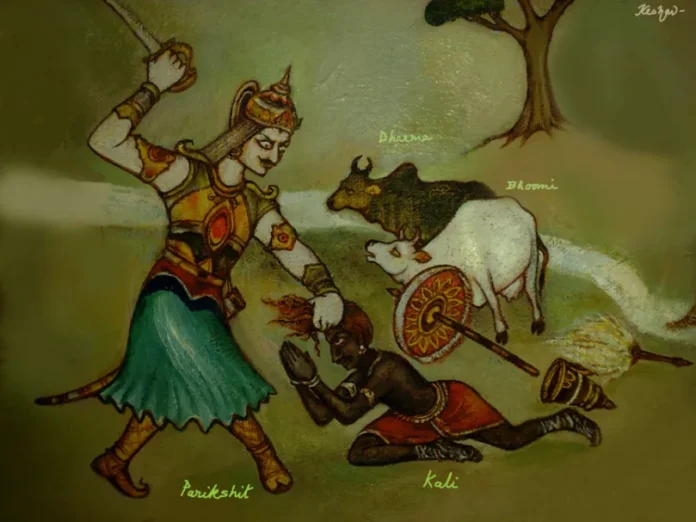
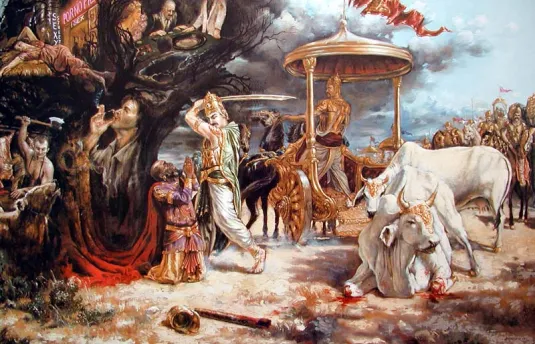
Sūta Gosvāmī said: After reaching that place, Mahārāja Parīkṣit observed that a lower caste śūdra, dressed like a king, was beating a cow and a bull with a club, as if they had no owner (1).The bull was as white as a white lotus flower. He was terrified of the śūdra who was beating him, and he was so afraid that he was standing on one leg, trembling and urinating (2).

Although the cow is beneficial because one can draw religious principles from her, she was now rendered poor and calfless. Her legs were being beaten by a śūdra. There were tears in her eyes, and she was distressed and weak. She was hankering after some grass in the field (3).Mahārāja Parīkṣit, well equipped with ar rows and bow and seated on a goldembossed chariot, spoke to him [the śūdra] with a deep voice sounding like thunder (4).Oh, who are you? You appear to be strong and yet you dare kill, within my protection, those who are help less! By your dress you pose yourself to be a godly man [king], but by your deeds you are opposing the principles of the twiceborn kṣatri yas (5).

You rogue, do you dare beat an innocent cow because Lord Kṛṣṇa and Arjuna, the carrier of the Gāṇḍīva bow, are out of sight? Since you are beating the innocent in a secluded place, you are considered a culprit and therefore de serve to be killed (6). Then he [Mahārāja Parīkṣit] asked the bull: Oh, who are you? Are you a bull as white as a white lotus, or are you a demigod? You have lost three of your legs and are moving on only one. Are you some demigod causing us grief in the form of a bull?(7) Now for the first time in a kingdom well protected by the arms of the kings of the Kuru dynasty, I see you grieving with tears in your eyes. Up till now no one on earth has ever shed tears because of royal negligence (8).O son of Surabhi, you need lament no longer now. There is no need to fear this lowclass śūdra. And, O mother cow, as long as I am living as the ruler and subduer of all envious men, there is no cause for you to cry. Everything will be good for you (9).

O chaste one, the king’s good name, duration of life and good rebirth vanish when all kinds of living beings are terrified by miscreants in his kingdom. It is certainly the prime duty of the king to subdue first the sufferings of those who suffer. Therefore I must kill this most wretched man because he is violent against other living beings (10-11).He [Mahārāja Parīkṣit] repeat edly addressed and questioned the bull thus: O son of Surabhi, who has cut off your three legs? In the state of the kings who are obedient to the laws of the Supreme Personality of Godhead, Kṛṣṇa, there is no one as unhappy as you (12).

O bull, you are offenseless and thoroughly hon est; therefore I wish all good to you. Please tell me of the perpetrator of these mutilations, which blacken the reputation of the sons of Pṛthā (13).Whoever causes offenseless living beings to suffer must fear me anywhere and everywhere in the world. By curbing dishonest miscreants, one automatically benefits the of fenseless (14).An upstart living being who commits offenses by torturing those who are offenseless shall be directly uprooted by me, even though he be a denizen of heaven with ar mor and decorations (15).The supreme duty of the ruling king is to give all protection to lawa biding persons and to chastise those who stray from the ordinances of the scriptures in ordi nary times, when there is no emergency (16).

 The personality of religion said: These words just spoken by you befit a person of the Pāṇḍava dynasty. Captivated by the devotional qualities of the Pāṇḍavas, even Lord Kṛṣṇa, the Personality of Godhead, performed duties as a messenger (17).O greatest among human be ings, it is very difficult to ascertain the particu lar miscreant who has caused our sufferings, because we are bewildered by all the different opinions of theoretical philosophers (18).

Some of the philosophers, who deny all sorts of dual ity, declare that one’s own self is responsible for his personal happiness and distress. Others say that superhuman powers are responsible, while yet others say that activity is responsible, and the gross materialists maintain that nature is the ultimate cause (19).There are also some thinkers who believe that no one can ascertain the cause of distress by argumentation, nor know it by imagination, nor express it by words. O sage amongst kings, judge for your self by thinking over all this with your own in telligence (20). Sūta Gosvāmī said: O best among the brāhmaṇas, the Emperor Parīkṣit, thus hearing the personality of religion speak, was fully sat isfied, and without mistake or regret he gave his reply (21).

 The King said: O you, who are in the form of a bull! You know the truth of religion, and you are speaking according to the principle that the destination intended for the perpetrator of irreligious acts is also intended for one who identifies the perpetrator. You are no other than the personality of religion (22).Thus it is con cluded that the Lord’s energies are inconceiva ble. No one can estimate them by mental spec ulation or by word jugglery (23).In the age of Satya [truthfulness] your four legs were estab lished by the four principles of austerity, clean liness, mercy and truthfulness. But it appears that three of your legs are broken due to ram pant irreligion in the form of pride, lust for women, and intoxication (24).

You are now standing on one leg only, which is your truth fulness, and you are somehow or other hob bling along. But quarrel personified [Kali], flourishing by deceit, is also trying to destroy that leg (25).The burden of the earth was cer tainly diminished by the Personality of God head and by others as well. When He was pre sent as an incarnation, all good was performed because of His auspicious footprints (26).Now she, the chaste one, being unfortunately for saken by the Personality of Godhead, laments her future with tears in her eyes, for now she is being ruled and enjoyed by lowerclass men who pose as rulers (27). Mahārāja Parīkṣit, who could fight one thousand enemies singlehandedly, thus paci fied the personality of religion and the earth. Then he took up his sharp sword to kill the per sonality of Kali, who is the cause of all irreli gion (28).

When the personality of Kali under stood that the King was willing to kill him, he at once abandoned the dress of a king and, un der pressure of fear, completely surrendered to him, bowing his head (29).Mahārāja Parīkṣit, who was qualified to accept surrender and wor thy of being sung in history, did not kill the poor surrendered and fallen Kali, but smiled compassionately, for he was kind to the poor (30). The King thus said: We have inherited the fame of Arjuna; therefore since you have sur rendered yourself with folded hands you need not fear for your life. But you cannot remain in my kingdom, for you are the friend of irreligion (31).If the personality of Kali, irreligion, is al lowed to act as a mangod or an executive head, certainly irreligious principles like greed, false hood, robbery, incivility, treachery, misfortune, cheating, quarrel and vanity will abound (32).

Therefore, O friend of irreligion, you do not deserve to remain in a place where experts perform sacrifices according to truth and reli gious principles for the satisfaction of the Su preme Personality of Godhead (33).In all sacri ficial ceremonies, although sometimes a demi god is worshiped, the Supreme Lord Personal ity of Godhead is worshiped because He is the Supersoul of everyone, and exists both inside and outside like the air. Thus it is He only who awards all welfare to the worshiper (34).

Śrī Sūta Gosvāmī said: The personality of Kali, thus being ordered by Mahārāja Parīkṣit, began to tremble in fear. Seeing the King be fore him like Yamarāja, ready to kill him, Kali spoke to the King as follows (35). O Your Majesty, though I may live any where and everywhere under your order, I shall but see you with bow and arrows wherever I look (36).Therefore, O chief amongst the pro tectors of religion, please fix some place for me where I can live permanently under the protec tion of your government (37). Sūta Gosvāmī said: Mahārāja Parīkṣit, thus being petitioned by the personality of Kali, gave him permission to reside in places where gambling, drinking, prostitution and animal slaughter were performed (38).The personality of Kali asked for something more, and because of his begging, the King gave him permission to live where there is gold because wherever there is gold there is also falsity, intoxication, lust, envy and enmity (39).Thus the personality of Kali, by the directions of Mahārāja Parīkṣit, the son of Uttarā, was allowed to live in those five places (40).

Therefore, whoever desires progressive wellbeing, especially kings, reli gionists, public leaders, brāhmaṇas and sannyāsīs, should never come in contact with the four abovementioned irreligious principles (41).Thereafter the King reestablished the lost legs of the personality of religion [the bull], and by encouraging activities he sufficiently im proved the condition of the earth (42).The most fortunate emperor Mahārāja Parīkṣit, who was entrusted with the kingdom of Hastināpura by Mahārāja Yudhiṣṭhira when he desired to retire to the forest, is now ruling the world with great success due to his being glorified by the deeds of the kings of the Kuru dynasty (43 44).Mahārāja Parīkṣit, the son of Abhimanyu, is so experienced that by dint of his expert ad ministration and patronage, it has been possible for you to perform a sacrifice such as this (45).
Srimad Bhagavatam | Canto 1 Chapter 16 | Parikshit’s Encounter With The Age Of Kali

Sūta Gosvāmī said: O learned brāhmaṇas, Mahārāja Parīkṣit then began to rule over the world as a great devotee of the Lord under the instructions of the best of the twiceborn brāhmaṇas. He ruled by those great qualities which were foretold by expert astrologers at the time of his birth (1).King Parīkṣit married the daughter of King Uttara and begot four sons, headed by Mahārāja Janamejaya (2).

Mahārāja Parīkṣit, after having selected Kṛpācārya for guidance as his spiritual master, performed three horse sacrifices on the banks of the Gan ges. These were executed with sufficient re wards for the attendants. And at these sacri fices, even the common man could see demi gods (3).Once, when Mahārāja Parīkṣit was on his way to conquer the world, he saw the master of Kaliyuga, who was lower than a śūdra, dis guised as a king and hurting the legs of a cow and bull. The King at once caught hold of him to deal sufficient punishment (4).

 Śaunaka Ṛṣi inquired: Why did Mahārāja Parīkṣit simply punish him, since he was the lowest of the śūdras, having dressed as a king and having struck a cow on the leg? Please de scribe all these incidents if they relate to the topics of Lord Kṛṣṇa.The devotees of the Lord are accustomed to licking up the honey availa ble from the lotus feet of the Lord. What is the use of topics which simply waste one’s valua ble life?(5-6)O Sūta Gosvāmī, there are those amongst men who desire freedom from death and get eternal life. They escape the slaughter ing process by calling the controller of death, Yamarāja (7).

As long as Yamarāja, who causes everyone’s death, is present here, no one shall meet with death. The great sages have invited the controller of death, Yamarāja, who is the representative of the Lord. Living beings who are under his grip should take advantage by hearing the deathless nectar in the form of this narration of the transcendental pastimes of the Lord (8).Lazy human beings with paltry intelli gence and a short duration of life pass the night sleeping and the day performing activities that are for naught (9). Sūta Gosvāmī said: While Mahārāja Parīkṣit was residing in the capital of the Kuru empire, the symptoms of the Age of Kali began to infiltrate within the jurisdiction of his state. When he learned about this, he did not think the matter very palatable. This did, however, give him a chance to fight. He took up his bow and arrows and prepared himself for military activ ities (10).

 Mahārāja Parīkṣit sat on a chariot drawn by black horses. His flag was marked with the sign of a lion. Being so decorated and surrounded by charioteers, cavalry, elephants and infantry soldiers, he left the capital to con quer in all directions (11).Mahārāja Parīkṣit then conquered all parts of the earthly planet Bhadrāśva, Ketumāla, Bhārata, the northern Kuru, Kimpuruṣa, etc. and exacted tributes from their respective rulers (12).Wherever the King visited, he continuously heard the glories of his great forefathers, who were all devotees of the Lord, and also of the glorious acts of Lord Kṛṣṇa. He also heard how he himself had been protected by the Lord from the powerful heat of the weapon of Aśvatthāmā. People also mentioned the great affection between the de scendants of Vṛṣṇi and Pṛthā due to the latter’s great devotion to Lord Keśava. The King, being very pleased with the singers of such glories, opened his eyes in great satisfaction. Out of magnanimity he was pleased to award them very valuable necklaces and clothing (13 15).

Mahārāja Parīkṣit heard that out of His causeless mercy Lord Kṛṣṇa [Viṣṇu], who is universally obeyed, rendered all kinds of ser vice to the malleable sons of Pāṇḍu by accept ing posts ranging from chariot driver to presi dent to messenger, friend, night watchman, etc., according to the will of the Pāṇḍavas, obeying them like a servant and offering obei sances like one younger in years. When he heard this, Mahārāja Parīkṣit became over whelmed with devotion to the lotus feet of the Lord (16).Now you may hear from me of what happened while Mahārāja Parīkṣit was passing his days hearing of the good occupations of his forefathers and being absorbed in thought of them (17).

The personality of religious princi ples, Dharma, was wandering about in the form of a bull. And he met the personality of earth in the form of a cow who appeared to grieve like a mother who had lost her child. She had tears in her eyes, and the beauty of her body was lost. Thus Dharma questioned the earth as follows (18). Dharma [in the form of a bull] asked: Madam, are you not hale and hearty? Why are you covered with the shadow of grief? It ap pears by your face that you have become black. Are you suffering from some internal disease, or are you thinking of some relative who is away in a distant place?(19)I have lost my three legs and am now standing on one only. Are you lamenting for my state of existence? Or are you in great anxiety because henceforward the un lawful meateaters will exploit you? Or are you in a sorry plight because the demigods are now bereft of their share of sacrificial offerings be cause no sacrifices are being performed at pre sent? Or are you grieving for living beings be cause of their sufferings due to famine and drought?(20)

Are you feeling compunction for the unhappy women and children who are left forlorn by unscrupulous persons? Or are you unhappy because the goddess of learning is be ing handled by brāhmaṇas addicted to acts against the principles of religion? Or are you sorry to see that the brāhmaṇas have taken shel ter of administrative families that do not respect brahminical culture?(21) The socalled adminis trators are now bewildered by the influence of this Age of Kali, and thus they have put all state affairs into disorder. Are you now lamenting this disorder? Now the general populace does not follow the rules and regulations for eating, sleeping, drinking, mating, etc., and they are in clined to perform such anywhere and every where. Are you unhappy because of this? (22)

O mother earth, the Supreme Personality of God head, Hari, incarnated Himself as Lord Śrī Kṛṣṇa just to unload your heavy burden. All His activities here are transcendental, and they ce ment the path of liberation. You are now bereft of His presence. You are probably now think ing of those activities and feeling sorry in their absence (23).Mother, you are the reservoir of all riches. Please inform me of the root cause of your tribulations by which you have been re duced to such a weak state. I think that the pow erful influence of time, which conquers the most powerful, might have forcibly taken away all your fortune, which was adored even by the demigods (24).

The earthly deity [in the form of a cow] thus replied to the personality of religious principles [in the form of a bull]: O Dharma, whatever you have inquired from me shall be known to you. I shall try to reply to all those questions. Once you too were maintained by your four legs, and you increased happiness all over the universe by the mercy of the Lord.In Him reside (1) truthfulness, (2) cleanliness, (3) intolerance of another’s unhappiness, (4) the power to control anger, (5) selfsatisfaction, (6) straightforwardness, (7) steadiness of mind, (8) control of the sense organs, (9) responsibility, (10) equality, (11) tolerance, (12) equanimity, (13) faithfulness, (14) knowledge, (15) absence of sense enjoyment, (16) leadership, (17) chiv alry, (18) influence, (19) the power to make everything possible, (20) the discharge of proper duty, (21) complete independence, (22) dexterity, (23) fullness of all beauty, (24) seren ity, (25) kindheartedness, (26) ingenuity, (27) gentility, (28) magnanimity, (29) determina tion, (30) perfection in all knowledge, (31) proper execution, (32) possession of all objects of enjoyment, (33) joyfulness, (34) immovabil ity, (35) fidelity, (36) fame, (37) worship, (38) pridelessness, (39) being (as the Personality of Godhead), (40) eternity, and many other tran scendental qualities which are eternally present and never to be separated from Him. That Per sonality of Godhead, the reservoir of all good ness and beauty, Lord Śrī Kṛṣṇa, has now closed His transcendental pastimes on the face of the earth. In His absence the Age of Kali has spread its influence everywhere, so I am sorry to see this condition of existence (25-30).

I am thinking about myself and also, O best amongst the demigods, about you, as well as about all the demigods, sages, denizens of Pitṛloka, dev otees of the Lord and all men obedient to the system of varṇa and āśrama in human society (31).Lakṣmījī, the goddess of fortune, whose glance of grace was sought by demigods like Brahmā and for whom they surrendered many a day unto the Personality of Godhead, gave up her own abode in the forest of lotus flowers and engaged herself in the service of the lotus feet of the Lord. I was endowed with specific pow ers to supersede the fortune of all the three planetary systems by being decorated with the impressions of the flag, thunderbolt, elephant driving rod and lotus flower, which are signs of the lotus feet of the Lord. But at the end, when I felt I was so fortunate, the Lord left me (32 33).

O personality of religion, I was greatly over burdened by the undue military phalanxes ar ranged by atheistic kings, and I was relieved by the grace of the Personality of Godhead. Simi larly you were also in a distressed condition, weakened in your standing strength, and thus He also incarnated by His internal energy in the family of the Yadus to relieve you (34).Who, therefore, can tolerate the pangs of separation from that Supreme Personality of Godhead? He could conquer the gravity and passionate wrath of His sweethearts like Satyabhāmā by His sweet smile of love, pleasing glance and hearty appeals. When He traversed my [earth’s] sur face, I would be immersed in the dust of His lotus feet and thus would be sumptuously cov ered with grass which appeared like hairs standing on me out of pleasure (35). While the earth and the personality of reli gion were thus engaged in conversation, the saintly King Parīkṣit reached the shore of the Sarasvatī River, which flowed towards the east (36).

Srimad Bhagavatam | Canto 1 Chapter 15 |The Pandavas Embrace Timely Retirement

Sūta Gosvāmī said: Arjuna, the celebrated friend of Lord Kṛṣṇa, was griefstricken because of his strong feeling of separation from Kṛṣṇa, over and above all Mahārāja Yudhiṣṭhira’s speculative inquiries (1).Due to grief, Arjuna’s mouth and lotuslike heart had dried up. There fore his body lost all luster. Now, remembering the Supreme Lord, he could hardly utter a word in reply (2).

With great difficulty he checked the tears of grief that smeared his eyes. He was very distressed because Lord Kṛṣṇa was out of his sight, and he increasingly felt affection for Him.Remembering Lord Kṛṣṇa and His well wishes, benefactions, intimate familial rela tions and His chariot driving, Arjuna, over whelmed and breathing very heavily, began to speak (3-4). Arjuna said: O King! The Supreme Person ality of Godhead, Hari, who treated me exactly like an intimate friend, has left me alone. Thus my astounding power, which astonished even the demigods, is no longer with me (5).

I have just lost Him whose separation for a moment would render all the universes unfavorable and void, like bodies without life (6).Only by His merciful strength was I able to vanquish all the lusty princes assembled at the palace of King Drupada for the selection of the bridegroom. With my bow and arrow I could pierce the fish target and thereby gain the hand of Draupadī (7).Because He was near me, it was possible for me to conquer with great dexterity the powerful King of heaven, Indradeva, along with his dem igod associates and thus enable the firegod to devastate the Khāṇḍava Forest. And only by His grace was the demon named Maya saved from the blazing Khāṇḍava Forest, and thus we could build our assembly house of wonderful architectural workmanship, where all the princes assembled during the performance of Rājasūyayajña and paid you tributes (8).

Your respectable younger brother, who possesses the strength of ten thousand elephants, killed, by His grace, Jarāsandha, whose feet were wor shiped by many kings. These kings had been brought for sacrifice in Jarāsandha’s Mahābhairavayajña, but they were thus re leased. Later they paid tribute to Your Majesty (9).It was He only who loosened the hair of all the wives of the miscreants who dared open the cluster of your Queen’s hair, which had been nicely dressed and sanctified for the great Rājasūya sacrificial ceremony. At that time she fell down at the feet of Lord Kṛṣṇa with tears in her eyes (10).

During our exile, Durvāsā Muni, who eats with his ten thousand disciples, in trigued with our enemies to put us in dangerous trouble. At that time He [Lord Kṛṣṇa], simply by accepting the remnants of food, saved us. By His accepting food thus, the assembly of munis, while bathing in the river, felt sumptuously fed. And all the three worlds were also satisfied (11).It was by His influence only that in a fight I was able to astonish the personality of god Lord Śiva and his wife, the daughter of Mount Himālaya. Thus he [Lord Śiva] became pleased with me and awarded me his own weapon. Other demigods also delivered their respective weapons to me, and in addition I was able to reach the heavenly planets in this present body and was allowed a halfelevated seat (12).

When I stayed for some days as a guest in the heav enly planets, all the heavenly demigods, includ ing King Indradeva, took shelter of my arms, which were marked with the Gāṇḍīva bow, to kill the demon named Nivātakavaca. O King, descendant of Ajamīḍha, at the present moment I am bereft of the Supreme Personality of God head, by whose influence I was so powerful (13). The military strength of the Kauravas was like an ocean in which there dwelled many in vincible existences, and thus it was insur mountable. But because of His friendship, I, seated on the chariot, was able to cross over it. And only by His grace was I able to regain the cows and also collect by force many helmets of the kings, which were bedecked with jewels that were sources of all brilliance (14).

It was He only who withdrew the duration of life from everyone and who, in the battlefield, withdrew the speculative power and strength of enthusi asm from the great military phalanx made by the Kauravas, headed by Bhīṣma, Karṇa, Droṇa, Śalya, etc. Their arrangement was ex pert and more than adequate, but He [Lord Śrī Kṛṣṇa], while going forward, did all this (15).Great generals like Bhīṣma, Droṇa, Karṇa, Bhūriśravā, Suśarmā, Śalya, Jayadratha and Bāhlika all directed their invincible weapons against me. But by His [Lord Kṛṣṇa’s] grace they could not even touch a hair on my head. Similarly, Prahlāda Mahārāja, the supreme devotee of Lord Nṛsiṁhadeva, was unaffected by the weapons the demons used against him (16).

It was by His mercy only that my enemies neglected to kill me when I descended from my chariot to get water for my thirsty horses. And it was due to my lack of esteem for my Lord that I dared engage Him as my chariot driver, for He is worshiped and offered services by the best men to attain salvation (17).O King! His jokings and frank talks were pleasing and beau tifully decorated with smiles. His addresses unto me as “O son of Pṛthā, O friend, O son of the Kuru dynasty,” and all such heartiness are now remembered by me, and thus I am over whelmed (18).

Generally both of us used to live together and sleep, sit and loiter together. And at the time of advertising oneself for acts of chivalry, sometimes, if there were any irregu larity, I used to reproach Him by saying, “My friend, You are very truthful.” Even in those hours when His value was minimized, He, be ing the Supreme Soul, used to tolerate all those utterings of mine, excusing me exactly as a true friend excuses his true friend, or a father ex cuses his son (19).O Emperor, now I am sepa rated from my friend and dearmost wellwisher, the Supreme Personality of Godhead, and therefore my heart appears to be void of every thing. In His absence I have been defeated by a number of infidel cowherd men while I was guarding the bodies of all the wives of Kṛṣṇa (20).

I have the very same Gāṇḍīva bow, the same arrows, the same chariot drawn by the same horses, and I use them as the same Arjuna to whom all the kings offered their due re spects. But in the absence of Lord Kṛṣṇa, all of them, at a moment’s notice, have become null and void. It is exactly like offering clarified butter on ashes, accumulating money with a magic wand or sowing seeds on barren land (21).O King, since you have asked me about our friends and relatives in the city of Dvārakā, I will inform you that all of them were cursed by the brāhmaṇas, and as a result they all be came intoxicated with wine made of putrefied rice and fought among themselves with sticks, not even recognizing one another. Now all but four or five of them are dead and gone (22 23).

Factually this is all due to the supreme will of the Lord, the Personality of Godhead. Some times people kill one another, and at other times they protect one another (24).O King, as in the ocean the bigger and stronger aquatics swallow up the smaller and weaker ones, so also the Su preme Personality of Godhead, to lighten the burden of the earth, has engaged the stronger Yadu to kill the weaker, and the bigger Yadu to kill the smaller (25-26).Now I am attracted to those instructions imparted to me by the Per sonality of Godhead [Govinda] because they are impregnated with instructions for relieving the burning heart in all circumstances of time and space (27).

Sūta Gosvāmī said: Thus being deeply ab sorbed in thinking of the instructions of the Lord, which were imparted in the great inti macy of friendship, and in thinking of His lotus feet, Arjuna’s mind became pacified and free from all material contamination (28).Arjuna’s constant remembrance of the lotus feet of Lord Śrī Kṛṣṇa rapidly increased his devotion, and as a result all the trash in his thoughts subsided (29).Because of the Lord’s pastimes and activ ities and because of His absence, it appeared that Arjuna forgot the instructions left by the Personality of Godhead. But factually this was not the case, and again he became lord of his senses (30).

Because of his possessing spiritual assets, the doubts of duality were completely cut off. Thus he was freed from the three modes of material nature and placed in transcendence. There was no longer any chance of his becom ing entangled in birth and death, for he was freed from material form (31). Upon hearing of Lord Kṛṣṇa’s returning to His abode, and upon understanding the end of the Yadu dynasty’s earthly manifestation, Mahārāja Yudhiṣṭhira decided to go back home, back to Godhead (32).Kuntī, after over hearing Arjuna’s telling of the end of the Yadu dynasty and disappearance of Lord Kṛṣṇa, en gaged in the devotional service of the transcen dental Personality of Godhead with full atten tion and thus gained release from the course of material existence (33).

The supreme unborn, Lord Śrī Kṛṣṇa, caused the members of the Yadu dynasty to relinquish their bodies, and thus He relieved the burden of the world. This action was like picking out a thorn with a thorn, though both are the same to the controller (34).The Supreme Lord relinquished the body which He manifested to diminish the burden of the earth. Just like a magician, He relinquishes one body to accept different ones, like the fish incarnation and others (35).When the Personal ity of Godhead, Lord Kṛṣṇa, left this earthly planet in His selfsame form, from that very day Kali, who had already partially appeared, be came fully manifest to create inauspicious con ditions for those who are endowed with a poor fund of knowledge (36).Mahārāja Yudhiṣṭhira was intelligent enough to understand the influ ence of the Age of Kali, characterized by in creasing avarice, falsehood, cheating and vio lence throughout the capital, state, home and among individuals. So he wisely prepared him self to leave home, and he dressed accordingly (37).

Thereafter, in the capital of Hastināpura, he enthroned his grandson, who was trained and equally qualified, as the emperor and mas ter of all land bordered by the seas (38).Then he posted Vajra, the son of Aniruddha [grandson of Lord Kṛṣṇa], at Mathurā as the King of Śūrasena. Afterwards Mahārāja Yudhiṣṭhira performed a Prājāpatya sacrifice and placed in himself the fire for quitting household life (39).Mahārāja Yudhiṣṭhira at once relinquished all his garments, belt and ornaments of the royal order and became completely disinter ested and unattached to everything (40).Then he amalgamated all the sense organs into the mind, then the mind into life, life into breath ing, his total existence into the embodiment of the five elements, and his body into death. Then, as pure self, he became free from the ma terial conception of life (41).

Thus annihilating the gross body of five elements into the three qualitative modes of material nature, he merged them in one nescience and then absorbed that nescience in the self, Brahman, which is inex haustible in all circumstances (42).After that, Mahārāja Yudhiṣṭhira dressed himself in torn clothing, gave up eating all solid foods, volun tarily became dumb and let his hair hang loose. All this combined to make him look like an ur chin or madman with no occupation. He did not depend on his brothers for anything. And, just like a deaf man, he heard nothing (43).He then started towards the north, treading the path ac cepted by his forefathers and great men, to de vote himself completely to the thought of the Supreme Personality of Godhead. And he lived in that way wherever he went (44).

 The younger brothers of Mahārāja Yudhiṣṭhira observed that the Age of Kali had already arrived throughout the world and that the citizens of the kingdom were already af fected by irreligious practice. Therefore they decided to follow in the footsteps of their elder brother (45).They all had performed all the principles of religion and as a result rightly de cided that the lotus feet of the Lord Śrī Kṛṣṇa are the supreme goal of all. Therefore they meditated upon His feet without interruption (46).Thus by pure consciousness due to con stant devotional remembrance, they attained the spiritual sky, which is ruled over by the Su preme Nārāyaṇa, Lord Kṛṣṇa. This is attained only by those who meditate upon the one Su preme Lord without deviation. This abode of the Lord Śrī Kṛṣṇa, known as Goloka Vṛndāvana, cannot be attained by persons who are absorbed in the material conception of life. But the Pāṇḍavas, being completely washed of all material contamination, attained that abode in their very same bodies (47-48).

Vidura, while on pilgrimage, left his body at Prabhāsa. Be cause he was absorbed in thought of Kṛṣṇa, he was received by the denizens of the Pitṛloka planet, where he returned to his original post (49).Draupadī also saw that her husbands, without caring for her, were leaving home. She knew well about Lord Vāsudeva, Kṛṣṇa, the Personality of Godhead. Both she and Sub hadrā became absorbed in thoughts of Kṛṣṇa and attained the same results as their husbands (50). The subject of the departure of the sons of Pāṇḍu for the ultimate goal of life, back to God head, is fully auspicious and is perfectly pure. Therefore anyone who hears this narration with devotional faith certainly gains the devotional service of the Lord, the highest perfection of life (51).

Srimad Bhagavatam | Canto 1 Chapter 14 | The Disappearance Of Lord Krishna

Śrī Sūta Gosvāmī said: Arjuna went to Dvārakā to see Lord Śrī Kṛṣṇa and other friends and also to learn from the Lord of His next ac tivities (1).A few months passed, and Arjuna did not return. Mahārāja Yudhiṣṭhira then be gan to observe some inauspicious omens, which were fearful in themselves (2).He saw that the direction of eternal time had changed, and this was very fearful. There were disrup tions in the seasonal regularities. The people in general had become very greedy, angry and de ceitful. And he saw that they were adopting foul means of livelihood (3).

All ordinary trans actions and dealings became polluted with cheating, even between friends. And in familial affairs, there was always misunderstanding be tween fathers, mothers and sons, between well wishers, and between brothers. Even between husband and wife there was always strain and quarrel (4).In course of time it came to pass that people in general became accustomed to greed, anger, pride, etc. Mahārāja Yudhiṣṭhira, ob serving all these omens, spoke to his younger brother (5). Mahārāja Yudhiṣṭhira said to his younger brother Bhīmasena: I sent Arjuna to Dvārakā to meet his friends and to learn from the Person ality of Godhead, Kṛṣṇa, of His program of work (6).

Since he departed, seven months have passed, yet he has not returned. I do not know factually how things are going there (7).Is He going to quit His earthly pastimes, as Devarṣi Nārada indicated? Has that time already ar rived?(8)From Him only, all our kingly opu lence, good wives, lives, progeny, control over our subjects, victory over our enemies, and fu ture accommodations in higher planets have be come possible. All this is due to His causeless mercy upon us (9).Just see, O man with a tiger’s strength, how many miseries due to ce lestial influences, earthly reactions and bodily pains all very dangerous in themselves are foreboding danger in the near future by delud ing our intelligence (10).The left side of my body my thighs, arms and eyes are all quiver ing again and again. I am having heart palpita tions due to fear. All this indicates undesirable happenings (11).Just see, O Bhīma, how the shejackal cries at the rising sun and vomits fire, and how the dog barks at me fearlessly (12).

O Bhīmasena, tiger amongst men, now useful an imals like cows are passing me on my left side, and lower animals like the asses are circumam bulating me. My horses appear to weep upon seeing me (13).Just see! This pigeon is like a messenger of death. The shrieks of the owls and their rival crows make my heart tremble. It ap pears that they want to make a void of the whole universe (14).Just see how the smoke en circles the sky. It appears that the earth and mountains are throbbing. Just hear the cloud less thunder and see the bolts from the blue (15).The wind blows violently, blasting dust everywhere and creating darkness. Clouds are raining everywhere with bloody disasters (16).The rays of the sun are declining, and the stars appear to be fighting amongst themselves. Confused living entities appear to be ablaze and weeping (17).Rivers, tributaries, ponds, reser voirs and the mind are all perturbed. Butter no longer ignites fire. What is this extraordinary time? What is going to happen?(18)

The calves do not suck the teats of the cows, nor do the cows give milk. They are standing, crying, tears in their eyes, and the bulls take no pleasure in the pasturing grounds (19).The Deities seem to be crying in the temple, lamenting and perspir ing. They seem about to leave. All the cities, villages, towns, gardens, mines and hermitages are now devoid of beauty and bereft of all hap piness. I do not know what sort of calamities are now awaiting us (20).I think that all these earthly disturbances indicate some greater loss to the good fortune of the world. The world was fortunate to have been marked with the foot prints of the lotus feet of the Lord. These signs indicate that this will no longer be (21).O Brāhmaṇa Śaunaka, while Mahārāja Yudhiṣṭhira, observing the inauspicious signs on the earth at that time, was thus thinking to himself, Arjuna came back from the city of the Yadus [Dvārakā] (22).

When he bowed at his feet, the King saw that his dejection was un precedented. His head was down, and tears glided from his lotus eyes. Seeing Arjuna pale due to heartfelt anxieties, the King, remember ing the indications of the sage Nārada, ques tioned him in the midst of friends (23-24). Mahārāja Yudhiṣṭhira said: My dear brother, please tell me whether our friends and relatives, such as Madhu, Bhoja, Daśārha, Ārha, Sātvata, Andhaka and the members of the Yadu family are all passing their days in happi ness (25).Is my respectable grandfather Śūrasena in a happy mood? And are my mater nal uncle Vasudeva and his younger brothers all doing well?(26)

His seven wives, headed by Devakī, are all sisters. Are they and their sons and daughtersinlaw all happy?(27)Are Ugrasena, whose son was the mischievous Kaṁsa, and his younger brother still living? Are Hṛdīka and his son Kṛtavarmā happy? Are Akrūra, Jayanta, Gada, Sāraṇa and Śatrujit all happy? How is Balarāma, the Personality of Godhead and the protector of devotees?(28 29)How is Pradyumna, the great general of the Vṛṣṇi family? Is He happy? And is Aniruddha, the plenary expansion of the Personality of Godhead, faring well?(30)Are all the chieftain sons of Lord Kṛṣṇa, such as Suṣeṇa, Cārudeṣṇa, Sāmba the son of Jāmbavatī, and Ṛṣabha, along with their sons, all doing well?(31)Also, Śru tadeva, Uddhava and others, Nanda, Sunanda and other leaders of liberated souls who are constant companions of the Lord are protected by Lord Balarāma and Kṛṣṇa. Are they all do ing well in their respective functions? Do they, who are all eternally bound in friendship with us, remember our welfare?(32-33) Is Lord Kṛṣṇa, the Supreme Personality of Godhead, who gives pleasure to the cows, the senses and the brāhmaṇas, who is very affec tionate towards His devotees, enjoying the pi ous assembly at Dvārakā Purī surrounded by friends?(34)

The original Personality of God head, the enjoyer, and Balarāma, the primeval Lord Ananta, are staying in the ocean of the Yadu dynasty for the welfare, protection and general progress of the entire universe. And the members of the Yadu dynasty, being protected by the arms of the Lord, are enjoying life like the residents of the spiritual sky (35-36).Simply by administering comforts at the lotus feet of the Lord, which is the most important of all ser vices, the queens at Dvārakā, headed by Satyabhāmā, induced the Lord to conquer the demigods. Thus the queens enjoy things which are prerogatives of the wives of the controller of thunderbolts (37).The great heroes of the Yadu dynasty, being protected by the arms of Lord Śrī Kṛṣṇa, always remain fearless in every respect. And therefore their feet trample over the Sudharmā assembly house, which the best demigods deserved but which was taken away from them (38).

 My brother Arjuna, please tell me whether your health is all right. You appear to have lost your bodily luster. Is this due to others disre specting and neglecting you because of your long stay at Dvārakā?(39) Has someone ad dressed you with unfriendly words or threat ened you? Could you not give charity to one who asked, or could you not keep your promise to someone?(40)

You are always the protector of the deserving living beings, such as brāhmaṇas, children, cows, women and the dis eased. Could you not give them protection when they approached you for shelter? (41)Have you contacted a woman of impeach able character, or have you not properly treated a deserving woman? Or have you been defeated on the way by someone who is inferior or equal to you?(42)Have you not taken care of old men and boys who deserve to dine with you? Have you left them and taken your meals alone? Have you committed some unpardonable mis take which is considered to be abomina ble?(43)Or is it that you are feeling empty for all time because you might have lost your most intimate friend, Lord Kṛṣṇa? O my brother Ar juna, I can think of no other reason for your be coming so dejected (44).

Srimad Bhagavatam | Canto 1 Chapter 13 | Dhritarashtra Renounces His Home

Śrī Sūta Gosvāmī said: While traveling on a pilgrimage, Vidura received knowledge of the destination of the self from the great sage Mait reya and then returned to Hastināpura. He be came as well versed in the subject as he desired (1).After asking various questions and becom ing established in the transcendental loving ser vice of Lord Kṛṣṇa, Vidura retired from putting questions to Maitreya Muni (2).

When they saw Vidura return to the palace, all the inhabitants Mahārāja Yudhiṣṭhira, his younger brothers, Dhṛtarāṣṭra, Sātyaki, Sañjaya, Kṛpācārya, Kuntī, Gāndhārī, Draupadī, Subhadrā, Uttarā, Kṛpī, many other wives of the Kauravas, and other ladies with children all hurried to him in great delight. It so appeared that they had re gained their consciousness after a long period. With great delight they all approached him, as if life had returned to their bodies. They ex changed obeisances and welcomed each other with embraces.Due to anxieties and long sepa ration, they all cried out of affection. King Yudhiṣṭhira then arranged to offer sitting ac commodations and a reception (3-6).

After Vidura ate sumptuously and took sufficient rest, he was comfortably seated. Then the King began to speak to him, and all who were present there listened (7). Mahārāja Yudhiṣṭhira said: My uncle, do you remember how you always protected us, along with our mother, from all sorts of calam ities? Your partiality, like the wings of a bird, saved us from poisoning and arson (8).While traveling on the surface of the earth, how did you maintain your livelihood? At which holy places and pilgrimage sites did you render ser vice? (9)My lord, devotees like your good self are verily holy places personified. Because you carry the Personality of Godhead within your heart, you turn all places into places of pilgrim age (10).My uncle, you must have visited Dvārakā. In that holy place are our friends and wellwishers, the descendants of Yadu, who are always rapt in the service of the Lord Śrī Kṛṣṇa. You might have seen them or heard about them. Are they all living happily in their abodes?(11)

 Thus being questioned by Mahārāja Yudhiṣṭhira, Mahātmā Vidura gradually de scribed everything he had personally experi enced, except news of the annihilation of the Yadu dynasty (12).Compassionate Mahātmā Vidura could not stand to see the Pāṇḍavas dis tressed at any time. Therefore he did not dis close this unpalatable and unbearable incident because calamities come of their own accord (13). Thus Mahātmā Vidura, being treated just like a godly person by his kinsmen, remained there for a certain period just to rectify the men tality of his eldest brother and in this way bring happiness to all the others (14).As long as Vidura played the part of a śūdra, being cursed by Maṇḍūka Muni, Aryamā officiated at the post of Yamarāja to punish those who commit ted sinful acts (15).

Having won his kingdom and observed the birth of one grandson compe tent to continue the noble tradition of his fam ily, Mahārāja Yudhiṣṭhira reigned peacefully and enjoyed uncommon opulence in coopera tion with his younger brothers, who were all ex pert administrators to the common people (16).Insurmountable eternal time impercepti bly overcomes those who are too much at tached to family affairs and are always en grossed in their thought (17). Mahātmā Vidura knew all this, and there fore he addressed Dhṛtarāṣṭra, saying: My dear King, please get out of here immediately. Do not delay. Just see how fear has overtaken you (18).This frightful situation cannot be remedied by any person in this material world. My lord, it is the Supreme Personality of Godhead as eternal time [kāla] that has approached us all (19).

Whoever is under the influence of su preme kāla [eternal time] must surrender his most dear life, and what to speak of other things, such as wealth, honor, children, land and home (20).Your father, brother, wellwish ers and sons are all dead and passed away. You yourself have expended the major portion of your life, your body is now overtaken by inva lidity, and you are living in the home of an other.You have been blind from your very birth, and recently you have become hard of hearing. Your memory is shortened, and your intelligence is disturbed. Your teeth are loose, your liver is defective, and you are coughing up mucus (21).

Alas, how powerful are the hopes of a living being to continue his life. Verily, you are living just like a household dog and are eating remnants of food given by Bhīma (22).There is no need to live a degraded life and subsist on the charity of those whom you tried to kill by arson and poisoning. You also in sulted their married wife and usurped their kingdom and wealth (23).Despite your unwill ingness to die and your desire to live even at the cost of honor and prestige, your miserly body will certainly dwindle and deteriorate like an old garment (24).He is called undisturbed who goes to an unknown, remote place and, freed from all obligations, quits his material body when it has become useless (25).He is certainly a firstclass man who awakens and understands, either by himself or from others, the falsity and misery of this material world and thus leaves home and depends fully on the Personality of Godhead residing within his heart (26).

Please, therefore, leave for the North immediately, without letting your relatives know, for soon that time will approach which will diminish the good qualities of men (27). Thus Mahārāja Dhṛtarāṣṭra, the scion of the family of Ajamīḍha, firmly convinced by intro spective knowledge [prajñā], broke at once the strong network of familial affection by his res olute determination. Thus he immediately left home to set out on the path of liberation, as di rected by his younger brother Vidura (28).The gentle and chaste Gāndhārī, who was the daughter of King Subala of Kandahar [or Gāndhāra], followed her husband, seeing that he was going to the Himālaya Mountains, which are the delight of those who have ac cepted the staff of the renounced order like fighters who have accepted a good lashing from the enemy (29). Mahārāja Yudhiṣṭhira, whose enemy was never born, performed his daily morning duties by praying, offering fire sacrifice to the sungod, and offering obeisances, grains, cows, land and gold to the brāhmaṇas. He then entered the pal ace to pay respects to the elderly. However, he could not find his uncles or aunt, the daughter of King Subala (30).

Mahārāja Yudhiṣṭhira, full of anxiety, turned to Sañjaya, who was sitting there, and said: O Sañjaya, where is our uncle, who is old and blind?(31)Where is my well wisher, uncle Vidura, and mother Gāndhārī, who is very afflicted due to all her sons’ de mise? My uncle Dhṛtarāṣṭra was also very mor tified due to the death of all his sons and grand sons. Undoubtedly I am very ungrateful. Did he, therefore, take my offenses very seriously and, along with his wife, drown himself in the Ganges?(32). When my father, Pāṇḍu, fell down and we were all small children, these two uncles gave us protection from all kinds of ca lamities. They were always our good wellwish ers. Alas, where have they gone from here?(33). Sūta Gosvāmī said: Because of compas sion and mental agitation, Sañjaya, not having seen his own master, Dhṛtarāṣṭra, was ag grieved and could not properly reply to Mahārāja Yudhiṣṭhira (34).First he slowly pac ified his mind by intelligence, and wiping away his tears and thinking of the feet of his master, Dhṛtarāṣṭra, he began to reply to Mahārāja Yudhiṣṭhira (35).

 Sañjaya said: My dear descendant of the Kuru dynasty, I have no information of the de termination of your two uncles and Gāndhārī. O King, I have been cheated by those great souls (36).While Sañjaya was thus speaking, Śrī Nārada, the powerful devotee of the Lord, appeared on the scene carrying his tumburu. Mahārāja Yudhiṣṭhira and his brothers received him properly by getting up from their seats and offering obeisances (37). Mahārāja Yudhiṣṭhira said: O godly per sonality, I do not know where my two uncles have gone. Nor can I find my ascetic aunt who is griefstricken by the loss of all her sons (38).You are like a captain of a ship in a great ocean and you can direct us to our destination. Thus addressed, the godly personality, Devarṣi Nārada, greatest of the philosopher devotees, began to speak (39).

Śrī Nārada said: O pious King, do not lament for anyone, for everyone is under the control of the Supreme Lord. There fore all living beings and their leaders carry on worship to be well protected. It is He only who brings them together and disperses them (40).As a cow, bound through the nose by a long rope, is conditioned, so also human beings are bound by different Vedic injunctions and are conditioned to obey the orders of the Su preme (41).As a player sets up and disperses his playthings according to his own sweet will, so the supreme will of the Lord brings men to gether and separates them (42).O King, in all circumstances, whether you consider the soul to be an eternal principle, or the material body to be perishable, or everything to exist in the impersonal Absolute Truth, or everything to be an inexplicable combination of matter and spirit, feelings of separation are due only to il lusory affection and nothing more (43).There fore give up your anxiety due to ignorance of the self. You are now thinking of how they, who are helpless poor creatures, will exist with out you (44).

This gross material body made of five elements is already under the control of eternal time [kāla], action [karma] and the modes of material nature [guṇa]. How then can it, being already in the jaws of the serpent, pro tect others?(45)Those who are devoid of hands are prey for those who have hands; those de void of legs are prey for the fourlegged. The weak are the subsistence of the strong, and the general rule holds that one living being is food for another (46)Therefore, O King, you should look to the Supreme Lord only, who is one without a second and who manifests Himself by different energies and is both within and without (47).That Supreme Personality of God head, Lord Śrī Kṛṣṇa, in the guise of alldevour ing time [kālarūpa] has now descended to the earth to eliminate the envious from the world (48).The Lord has already performed His duties to help the demigods, and He is awaiting the rest. You Pāṇḍavas may wait as long as the Lord is here on earth (49).

 O King, your uncle Dhṛtarāṣṭra, his brother Vidura and his wife Gāndhārīhave gone to the southern side of the Himālaya Mountains, where there are shelters of the great sages.The place is called Saptasrota [“divided by seven”] because there the waters of the sacred Ganges were divided into seven branches. This was done for the satisfaction of the seven great ṛṣis (51).On the banks at Saptasrota, Dhṛtarāṣṭra is now engaged in beginning aṣṭāṅgayoga by bathing three times daily, in the morning, noon and evening, by performing the Agnihotra sac rifice with fire and by drinking only water. This helps one control the mind and the senses and frees one completely from thoughts of familial affection (52).One who has controlled the sit ting postures [the yogic āsanas] and the breath ing process can turn the senses toward the Ab solute Personality of Godhead and thus become immune to the contaminations of the modes of material nature, namely mundane goodness, passion and ignorance (53).

Dhṛtarāṣṭra will have to amalgamate his pure identity with in telligence and then merge into the Supreme Be ing with knowledge of his qualitative oneness, as a living entity, with the Supreme Brahman. Being freed from the blocked sky, he will have to rise to the spiritual sky.He will have to sus pend all the actions of the senses, even from the outside, and will have to be impervious to in teractions of the senses, which are influenced by the modes of material nature. After renounc ing all material duties, he must become immov ably established, beyond all sources of hin drances on the path (54-55).O King, he will quit his body, most probably on the fifth day from today. And his body will turn to ashes (56).

While outside observing her husband, who will burn in the fire of mystic power along with his thatched cottage, his chaste wife will enter the fire with rapt attention (57).Vidura, being affected with delight and grief, will then leave that place of sacred pilgrimage (58).Having spoken thus, the great sage Nārada, along with his vīṇā, ascended into outer space. Yudhiṣṭhira kept his instruction in his heart and so was able to get rid of all lamentations (59).

Srimad Bhagavatam | Canto 1 Chapter 12 | The Birth Of Emperor Parikshit

The sage Śaunaka said: The womb of Ut tarā, mother of Mahārāja Parīkṣit, was spoiled by the dreadful and invincible brahmāstra weapon released by Aśvatthāmā. But Mahārāja Parīkṣit was saved by the Supreme Lord (1).How was the great emperor Parīkṣit, who was a highly intelligent and great devotee, born in that womb? How did his death take place, and what did he achieve after his death?We all respectfully want to hear about him [Mahārāja Parīkṣit] to whom Śukadeva Gosvāmī imparted transcendental knowledge. Please speak on this matter (2-3).

 Śrī Sūta Gosvāmī said: Emperor Yudhiṣṭhira administered generously to every one during his reign. He was exactly like his father. He had no personal ambition and was freed from all sorts of sense gratification be cause of his continuous service unto the lotus feet of the Lord Śrī Kṛṣṇa (4). News even reached the celestial planets about Mahārāja Yudhiṣṭhira’s worldly posses sions, the sacrifices by which he would attain a better destination, his queen, his stalwart broth ers, his extensive land, his sovereignty over the planet earth, his fame, etc (5).O brāhmaṇas, the opulence of the King was so enchanting that the denizens of heaven aspired for it. But because he was absorbed in the service of the Lord, nothing could satisfy him except the Lord’s ser vice (6).

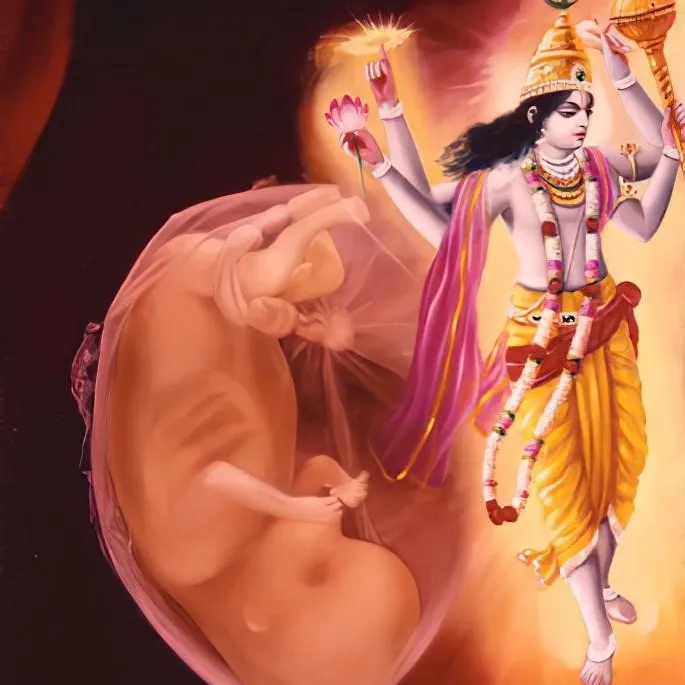
 O son of Bhṛgu [Śaunaka], when the child Parīkṣit, the great fighter, was in the womb of his mother, Uttarā, and was suffering from the burning heat of the brahmāstra [thrown by Aśvatthāmā], he could observe the Supreme Lord coming to him (7).He [the Lord] was only thumb high, but He was all transcendental. He had a very beautiful, blackish, infallible body, and He wore a dress of lightning yellow and a helmet of blazing gold. Thus He was seen by the child.The Lord was enriched with four hands, earrings of molten gold and eyes blood red with fury. As He loitered about, His club constantly encircled Him like a shooting star (8-9).The Lord was thus engaged in vanquish ing the radiation of the brahmāstra, just as the sun evaporates a drop of dew. He was observed by the child, who thought about who He was (10).

While thus being observed by the child, the Supreme Lord Personality of Godhead, the Supersoul of everyone and the protector of the righteous, who stretches in all directions and who is unlimited by time and space, disap peared at once (11). Thereupon, when all the good signs of the zodiac gradually evolved, the heir apparent of Pāṇḍu, who would be exactly like him in prow ess, took birth (12).King Yudhiṣṭhira, who was very satisfied with the birth of Mahārāja Parīkṣit, had the purificatory process of birth performed. Learned brāhmaṇas, headed by Dhaumya and Kṛpa, recited auspicious hymns (13).

Upon the birth of a son, the King, who knew how, where and when charity should be given, gave gold, land, villages, elephants, horses and good food grains to the brāhmaṇas (14).The learned brāhmaṇas, who were very satisfied with the charities of the King, ad dressed him as the chief amongst the Pūrus and informed him that his son was certainly in the line of descent from the Pūrus.The brāhmaṇas said: This spotless son has been restored by the allpowerful and allpervasive Lord Viṣṇu, the Personality of Godhead, in order to oblige you. He was saved when he was doomed to be de stroyed by an irresistible supernatural weapon (15-16).

For this reason this child will be well known in the world as one who is protected by the Personality of Godhead. O most fortunate one, there is no doubt that this child will be come a firstclass devotee and will be qualified with all good qualities (17). The good King [Yudhiṣṭhira] inquired: O great souls, will he become as saintly a king, as pious in his very name and as famous and glo rified in his achievements, as others who ap peared in this great royal family?(18) The learned brāhmaṇas said: O son of Pṛthā, this child shall be exactly like King Ikṣvāku, son of Manu, in maintaining all those who are born. And as for following the brah minical principles, especially in being true to his promise, he shall be exactly like Rāma, the Personality of Godhead, the son of Mahārāja Daśaratha (19).

This child will be a munificent donor of charity and protector of the surren dered, like the famous King Śibi of the Uśīnara country. And he will expand the name and fame of his family like Bharata, the son of Mahārāja Duṣyanta (20).Amongst great bowmen, this child will be as good as Arjuna. He will be as irresistible as fire and as unsurpassable as the ocean (21).This child will be as strong as a lion, and as worthy a shelter as the Himālaya Moun tains. He will be forbearing like the earth, and as tolerant as his parents (22).

This child will be like his grandfather Yudhiṣṭhira or Brahmā in equanimity of mind. He will be munificent like the lord of the Kailāsa Hill, Śiva. And he will be the resort of everyone, like the Supreme Per sonality of Godhead, Nārāyaṇa, who is even the shelter of the goddess of fortune (23).This child will be almost as good as Lord Śrī Kṛṣṇa by fol lowing in His footsteps. In magnanimity he will become as great as King Rantideva. And in re ligion he will be like Mahārāja Yayāti (24).This child will be like Bali Mahārāja in patience, a staunch devotee of Lord Kṛṣṇa like Prahlāda Mahārāja, a performer of many aśvamedha [horse] sacrifices and a follower of the old and experienced men (25).This child will be the fa ther of kings who will be like sages. For world peace and for the sake of religion, he will be the chastiser of the upstarts and the quarrelsome (26).After hearing about his death, which will be caused by the bite of a snakebird sent by a son of a brāhmaṇa, he will get himself freed from all material attachment and surrender unto the Personality of Godhead, taking shelter of Him (27).

After inquiring about proper selfknowledge from the son of Vyāsadeva, who will be a great philosopher, he will renounce all material attachment and achieve a life of fear lessness (28). Thus those who were expert in astrological knowledge and in performance of the birth cer emony instructed King Yudhiṣṭhira about the future history of his child. Then, being sumptu ously remunerated, they all returned to their re spective homes (29).So his son would become famous in the world as Parīkṣit [examiner] be cause he would come to examine all human be ings in his search after that personality whom he saw before his birth. Thus he would come to constantly contemplate Him (30).

As the moon, in its waxing fortnight, develops day after day, so the royal prince [Parīkṣit] very soon devel oped luxuriantly under the care and full facili ties of his guardian grandfathers (31). Just at this time, King Yudhiṣṭhira was con sidering performing a horse sacrifice to get freed from sins incurred from fighting with kinsmen. But he became anxious to get some wealth, for there were no surplus funds outside of fines and tax collection (32).Understanding the hearty wishes of the King, his brothers, as advised by the infallible Lord Kṛṣṇa, collected sufficient riches from the north [left by King Marutta] (33).By those riches, the King could procure the ingredients for three horse sacri fices. Thus the pious King Yudhiṣṭhira, who was very fearful after the Battle of Kurukṣetra, pleased Lord Hari, the Personality of Godhead (34).

Lord Śrī Kṛṣṇa, the Personality of God head, being invited to the sacrifices by Mahārāja Yudhiṣṭhira, saw to it that they were performed by qualified [twiceborn] brāhmaṇas. After that, for the pleasure of the relatives, the Lord remained a few months (35).O Śaunaka, thereafter the Lord, having bade farewell to King Yudhiṣṭhira, Draupadī and other relatives, started for the city of Dvārakā, accompanied by Arjuna and other members of the Yadu dynasty (36).

Srimad Bhagavatam | Canto 1 Chapter 11 | Lord Krishna Arrives In Dvaraka

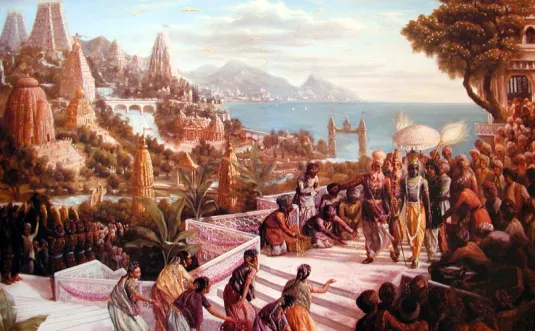
Sūta Gosvāmī said: Upon reaching the bor der of His most prosperous metropolis, known as the country of the Ānartas [Dvārakā], the Lord sounded His auspicious conchshell, her alding His arrival and apparently pacifying the dejection of the inhabitants (1).The white and fatbowled conchshell, being gripped by the hand of Lord Kṛṣṇa and sounded by Him, ap peared to be reddened by the touch of His tran scendental lips. It seemed that a white swan was playing in the stems of red lotus flowers (2).

The citizens of Dvārakā, having heard that sound which threatens fear personified in the material world, began to run towards Him fast, just to have a long desired audience with the Lord, who is the protector of all devotees (3).The citizens arrived before the Lord with their respective presentations, offering them to the fully satisfied and selfsufficient one, who, by His own potency, incessantly supplies oth ers (4). These presentations were like the offer ing of a lamp to the sun. Yet the citizens began to speak in ecstatic language to receive the Lord, just as wards welcome their guardian and father (5).

The citizens said: O Lord, You are worshiped by all demigods like Brahmā, the four Sanas and even the King of heaven. You are the ultimate rest for those who are really as piring to achieve the highest benefit of life. You are the supreme transcendental Lord, and inev itable time cannot exert its influence upon You (6).O creator of the universe, You are our mother, wellwisher, Lord, father, spiritual mas ter and worshipable Deity. By following in Your footsteps we have become successful in every respect. We pray, therefore, that You continue to bless us with Your mercy (7).Oh, it is our good luck that we have come again today under Your protection by Your presence, for Your Lordship rarely visits even the denizens of heaven. Now it is possible for us to look into Your smiling face, which is full of affectionate glances. We can now see Your transcendental form, full of all auspiciousness (8).

O lotuseyed Lord, whenever You go away to Mathu rāVṛndāvana or Hastināpura to meet Your friends and relatives, every moment of Your absence seems like millions of years. O infalli ble one, at that time our eyes become useless, as if bereft of sun (9).O master, if You live abroad all the time, then we cannot look at Your attractive face, whose smiles vanquish all our sufferings. How can we exist without Your presence?(10) As Bhogavatī, the capital of Nāgaloka, is protected by the Nāgas, so was Dvārakā pro tected by the descendants of Vṛṣṇi Bhoja, Madhu, Daśārha, Arha, Kukura, Andhaka, etc. who were as strong as Lord Kṛṣṇa (11).The city of Dvārakāpurī was filled with the opulences of all seasons. There were hermitages, orchards, flower gardens, parks and reservoirs of water breeding lotus flowers all over (12).The city gateway, the household doors and festooned arches along the roads were all nicely decorated with festive signs like plantain trees and mango leaves, all to welcome the Lord. Flags, garlands and painted signs and slogans all combined to shade the sunshine (13).

The highways, sub ways, lanes, markets and public meeting places were all thoroughly cleansed and then mois tened with scented water. And to welcome the Lord, fruits, flowers and unbroken seeds were strewn everywhere (14).In each and every door of the residential houses, auspicious things like curd, unbroken fruits, sugarcane and full water pots with articles for worship, incense and can dles were all displayed (15).

 On hearing that the most dear Kṛṣṇa was ap proaching Dvārakādhāma, magnanimous Vasudeva, Akrūra, Ugrasena, Balarāma (the superhumanly powerful), Pradyumna, Cārudeṣṇa and Sāmba the son of Jāmbavatī, all extremely happy, abandoned resting, sitting and dining.They hastened toward the Lord on chariots with brāhmaṇas bearing flowers. Be fore them were elephants, emblems of good fortune. Conchshells and bugles were sounded, and Vedic hymns were chanted. Thus they of fered their respects, which were saturated with affection (16-18).

At the same time, many hun dreds of wellknown prostitutes began to pro ceed on various vehicles. They were all very eager to meet the Lord, and their beautiful faces were decorated with dazzling earrings, which enhanced the beauty of their foreheads (19).Ex pert dramatists, artists, dancers, singers, histo rians, genealogists and learned speakers all gave their respective contributions, being in spired by the superhuman pastimes of the Lord. Thus they proceeded on and on (20). Lord Kṛṣṇa, the Personality of Godhead, ap proached them and offered due honor and re spect to each and every one of the friends, rel atives, citizens and all others who came to re ceive and welcome Him (21).

The almighty Lord greeted everyone present by bowing His head, exchanging greetings, embracing, shak ing hands, looking and smiling, giving assur ances and awarding benedictions, even to the lowest in rank.Then the Lord personally en tered the city accompanied by elderly relatives and invalid brāhmaṇas with their wives, all of fering benedictions and singing the glories of the Lord. Others also praised the glories of the Lord (22-23). When Lord Kṛṣṇa passed over the public roads, all the ladies from the respectable fami lies of Dvārakā went up to the roofs of their pal aces just to have a look at the Lord. They con sidered this to be the greatest festival (24).

The inhabitants of Dvārakā were regularly accus tomed to look upon the reservoir of all beauty, the infallible Lord, yet they were never sati ated.The Lord’s chest is the abode of the god dess of fortune. His moonlike face is the drink ing vessel for eyes which hanker after all that is beautiful. His arms are the resting places for the administrative demigods. And His lotus feet are the refuge of pure devotees who never talk or sing of any subject except His Lordship (25 26).As the Lord passed along the public road of Dvārakā, His head was protected from the sun shine by a white umbrella. White feathered fans moved in semicircles, and showers of flowers fell upon the road. His yellow garments and garlands of flowers made it appear as if a dark cloud were surrounded simultaneously by sun, moon, lightning and rainbows (27).

After entering the house of His father, He was embraced by the mothers present, and the Lord offered His obeisances unto them by plac ing His head at their feet. The mothers were headed by Devakī [His real mother].The moth ers, after embracing their son, sat Him on their laps. Due to pure affection, milk sprang from their breasts. They were overwhelmed with de light, and the tears from their eyes wetted the Lord (28-29).Thereafter, the Lord entered His palaces, which were perfect to the fullest ex tent. His wives lived in them, and they num bered over sixteen thousand (30).The queens of Lord Śrī Kṛṣṇa rejoiced within their minds to see their husband home after a long period abroad. The queens got up at once from their seats and meditations. As was socially custom ary, they covered their faces shyly and looked about coyly (31).

The insuperable ecstasy was so strong that the queens, who were shy, first embraced the Lord in the innermost recesses of their hearts. Then they embraced Him visually, and then they sent their sons to embrace Him [which is equal to personal embracing]. But, O chief amongst the Bhṛgus, though they tried to restrain their feelings, they inadvertently shed tears (32).Although Lord Śrī Kṛṣṇa was con stantly by their sides, as well as exclusively alone, His feet appeared to them to be newer and newer. The goddess of fortune, although by nature always restless and moving, could not quit the Lord’s feet. So what woman can be de tached from those feet, having once taken shel ter of them?(33)

The Lord was pacified after killing those kings who were burdensome to the earth. They were puffed up with their military strength, their horses, elephants, chariots, infantry, etc. He Himself was not a party in the fight. He simply created hostility between the powerful administrators, and they fought amongst them selves. He was like the wind which causes fric tion between bamboos and so sparks a fire (34).That Supreme Personality of Godhead, Śrī Kṛṣṇa, out of His causeless mercy, appeared on this planet by His internal potency and enjoyed Himself amongst competent women as if He were engaging in mundane affairs (35).

Alt hough the queens’ beautiful smiles and furtive glances were all spotless and exciting, and alt hough they could conquer Cupid himself by making him give up his bow in frustration, and although even the tolerant Śiva could fall vic tim to them, still, despite all their magical feats and attractions, they could not agitate the senses of the Lord.The common materialistic conditioned souls speculate that the Lord is one of them. Out of their ignorance they think that the Lord is affected by matter, although He is unattached(36-37).This is the divinity of the Personality of Godhead: He is not affected by the qualities of material nature, even though He is in contact with them. Similarly, the devotees who have taken shelter of the Lord do not be come influenced by the material qualities (38).The simple and delicate women truly thought that Lord Śrī Kṛṣṇa, their beloved hus band, followed them and was dominated by them. They were unaware of the extent of the glories of their husband, as the atheists are un aware of Him as the supreme controller (39).

Srimad Bhagavatam | Canto 1 Chapter 10 |Lord Krishna Leaves For Dvaraka

Śaunaka Muni asked: After killing his en emies who desired to usurp his rightful inher itance, how did the greatest of all religious men, Mahārāja Yudhiṣṭhira, assisted by his brothers, rule his subjects? Surely he could not freely en joy his kingdom with unrestricted conscious ness (1). Sūta Gosvāmī said: Lord Śrī Kṛṣṇa, the Su preme Personality of Godhead, who is the maintainer of the world, became pleased after reestablishing Mahārāja Yudhiṣṭhira in his own kingdom and after restoring the Kuru dynasty, which had been exhausted by the bamboo fire of anger (2).Mahārāja Yudhiṣṭhira, after being enlightened by what was spoken by Bhīṣmadeva and Lord Śrī Kṛṣṇa, the infallible, engaged himself in matters of perfect knowledge because all his misgivings were eradicated. Thus he ruled over the earth and seas and was followed by his younger brothers (3).

During the reign of Mahārāja Yudhiṣṭhira, the clouds showered all the water that people needed, and the earth produced all the necessi ties of man in profusion. Due to its fatty milk bag and cheerful attitude, the cow used to mois ten the grazing ground with milk (4).The rivers, oceans, hills, mountains, forests, creepers and active drugs, in every season, paid their tax quota to the King in profusion (5).Because of the King’s having no enemy, the living beings were not at any time disturbed by mental ago nies, diseases, or excessive heat or cold (6). Śrī Hari, Lord Śrī Kṛṣṇa, resided at Hastināpura for a few months to pacify His rel atives and please His own sister [Subhadrā] (7).

Afterwards, when the Lord asked permis sion to depart and the King gave it, the Lord offered His respects to Mahārāja Yudhiṣṭhira by bowing down at his feet, and the King em braced Him. After this the Lord, being em braced by others and receiving their obei sances, got into His chariot (8).At that time Subhadrā, Draupadī, Kuntī, Uttarā, Gāndhārī, Dhṛtarāṣṭra, Yuyutsu, Kṛpācārya, Nakula, Sa hadeva, Bhīmasena, Dhaumya and Satyavatī all nearly fainted because it was impossible for them to bear separation from Lord Kṛṣṇa (9 10).The intelligent, who have understood the Supreme Lord in association with pure devo tees and have become freed from bad material istic association, can never avoid hearing the glories of the Lord, even though they have heard them only once. How then could the Pāṇḍavas tolerate His separation, for they had been intimately associated with His person, seeing Him face to face, touching Him, con versing with Him, and sleeping, sitting and din ing with Him?(11-12)

All their hearts were melting for Him on the pot of attraction. They looked at Him without blinking their eyes, and they moved hither and thither in perplexity (13).The female relatives, whose eyes were flooded with tears out of anxiety for Kṛṣṇa, came out of the palace. They could stop their tears only with great difficulty. They feared that tears would cause misfortune at the time of de parture (14). While the Lord was departing from the pal ace of Hastināpura, different types of drums like the mṛdaṅga, dhola, nagra, dhundhurī and dundubhi and flutes of different types, the vīṇā, gomukha and bherī, all sounded together to show Him honor (15).Out of a loving desire to see the Lord, the royal ladies of the Kurus got up on top of the palace, and smiling with affec tion and shyness, they showered flowers upon the Lord (16).

At that time Arjuna, the great warrior and conqueror of sleep, who is the inti mate friend of the most beloved Supreme Lord, took up an umbrella which had a handle of jew els and was embroidered with lace and pearls (17).Uddhava and Sātyaki began to fan the Lord with decorated fans, and the Lord, as the master of Madhu, seated on scattered flowers, commanded them along the road (18).It was be ing heard here and there that the benedictions being paid to Kṛṣṇa were neither befitting nor unbefitting because they were all for the Abso lute, who was now playing the part of a human being (19).Absorbed in the thought of the tran scendental qualities of the Lord, who is sung in select poetry, the ladies on the roofs of all the houses of Hastināpura began to talk of Him. This talk was more attractive than the hymns of the Vedas (20).

 They said: Here He is, the original Person ality of Godhead as we definitely remember Him. He alone existed before the manifested creation of the modes of nature, and in Him only, because He is the Supreme Lord, all liv ing beings merge, as if sleeping at night, their energy suspended (21).The Personality of God head, again desiring to give names and forms to His parts and parcels, the living entities, placed them under the guidance of material nature. By His own potency, material nature is empowered to recreate (22).Here is the same Supreme Per sonality of Godhead whose transcendental form is experienced by the great devotees who are completely cleansed of material conscious ness by dint of rigid devotional service and full control of life and the senses. And that is the only way to purify existence (23).

O dear friends, here is that very Personality of God head whose attractive and confidential pas times are described in the confidential parts of Vedic literature by His great devotees. It is He only who creates, maintains and annihilates the material world and yet remains unaffected (24).Whenever there are kings and administra tors living like animals in the lowest modes of existence, the Lord in His transcendental form manifests His supreme power, the Truth Posi tive, shows special mercy to the faithful, per forms wonderful activities and manifests vari ous transcendental forms as is necessary in dif ferent periods and ages (25).Oh, how su premely glorified is the dynasty of King Yadu, and how virtuous is the land of Mathurā, where the supreme leader of all living beings, the hus band of the goddess of fortune, has taken His birth and wandered in His childhood (26).

Un doubtedly it is wonderful that Dvārakā has de feated the glories of the heavenly planets and has enhanced the celebrity of the earth. The in habitants of Dvārakā are always seeing the soul of all living beings [Kṛṣṇa] in His loving fea ture. He glances at them and favors them with sweet smiles (27).O friends, just think of His wives, whose hands He has accepted. How they must have undergone vows, baths, fire sacri fices and perfect worship of the Lord of the uni verse to constantly relish now the nectar from His lips [by kissing]. The damsels of Vra jabhūmi would often faint just by expecting such favors (28).The children of these ladies are Pradyumna, Sāmba, Amba, etc. Ladies like Rukmiṇī, Satyabhāmā and Jāmbavatī were for cibly taken away by Him from their svayaṁvara ceremonies after He defeated many powerful kings, headed by Śiśupāla. And other ladies were also forcibly taken away by Him after He killed Bhaumāsura and thousands of his assistants. All of these ladies are glori ous.All these women auspiciously glorified their lives despite their being without individu ality and without purity. Their husband, the lo tuseyed Personality of Godhead, never left them alone at home. He always pleased their hearts by making valuable presentations (29 30).

 While the ladies of the capital [Hastināpura] were greeting Him and talking in this way, the Lord, smiling, accepted their good greetings, and casting the grace of His glance over them, He departed from the city (31).Mahārāja Yudhiṣṭhira, although no one’s enemy, en gaged four divisions of defense [horse, ele phant, chariot and army] to accompany Lord Kṛṣṇa, the enemy of the asuras [demons]. The Mahārāja did this because of the enemy, and also out of affection for the Lord (32).Out of profound affection for Lord Kṛṣṇa, the Pāṇḍa vas, who were of the Kuru dynasty, accompa nied Him a considerable distance to see Him off. They were overwhelmed with the thought of future separation. The Lord, however, per suaded them to return home, and He proceeded towards Dvārakā with His dear companions (33).

O Śaunaka, the Lord then proceeded to wards Kurujāṅgala, Pāñcālā, Śūrasenā, the land on the bank of the river Yamunā, Brahmāvarta, Kurukṣetra, Matsya, Sārasvata, the province of the desert and the land of scanty water. After crossing these provinces He gradually reached the Sauvīra and Ābhīra provinces, then, west of these, reached Dvārakā at last (34-35).On His journey through these provinces He was wel comed, worshiped and given various presenta tions. In the evening, in all places, the Lord sus pended His journey to perform evening rites. This was regularly observed after sunset (36).

Srimad Bhagavatam | Canto 1 Chapter 9 | Bhishma Departs In The Presence Of Lord Krishna

Sūta Gosvāmī said: Being afraid for having killed so many subjects on the Battlefield of Kurukṣetra, Mahārāja Yudhiṣṭhira went to the scene of the massacre. There, Bhīṣmadeva was lying on a bed of arrows, about to pass away (1).At that time all his brothers followed him on beautiful chariots drawn by firstclass horses decorated with gold ornaments. With them were Vyāsa and ṛṣis like Dhaumya [the learned priest of the Pāṇḍavas] and others (2).

O sage amongst the brāhmaṇas, Lord Śrī Kṛṣṇa, the Personality of Godhead, also followed, seated on a chariot with Arjuna. Thus King Yudhiṣṭhira appeared very aristocratic, like Kuvera surrounded by his companions [the Guhyakas] (3).Seeing him [Bhīṣma] lying on the ground, like a demigod fallen from the sky, the Pāṇḍava King Yudhiṣṭhira, along with his younger brothers and Lord Kṛṣṇa, bowed down before him (4).Just to see the chief of the de scendants of King Bharata [Bhīṣma], all the great souls in the universe, namely the ṛṣis amongst the demigods, brāhmaṇas and kings, all situated in the quality of goodness, were as sembled there (5).

All the sages like Parvata Muni, Nārada, Dhaumya, Vyāsa the incarna tion of God, Bṛhadaśva, Bharadvāja and Paraśurāma and disciples, Vasiṣṭha, In drapramada, Trita, Gṛtsamada, Asita, Kakṣīvān, Gautama, Atri, Kauśika and Sudar śana were present (6-7).And many others like Śukadeva Gosvāmīand other purified souls, Kaśyapa and Āṅgirasa and others, all accompa nied by their respective disciples, arrived there (8).Bhīṣmadeva, who was the best amongst the eight Vasus, received and welcomed all the great and powerful ṛṣis who were assembled there, for he knew perfectly all the religious principles according to time and place (9).Lord Śrī Kṛṣṇa is situated in everyone’s heart, yet He manifests His transcendental form by His inter nal potency. This very Lord was sitting before Bhīṣmadeva, and since Bhīṣmadeva knew of His glories, he worshiped Him duly (10).

The sons of Mahārāja Pāṇḍu were sitting si lently nearby, overtaken with affection for their dying grandfather. Seeing this, Bhīṣmadeva congratulated them with feeling. There were tears of ecstasy in his eyes, for he was over whelmed by love and affection (11).Bhīṣmadeva said: Oh, what terrible suffer ings and what terrible injustices you good souls suffer for being the sons of religion personified. You did not deserve to remain alive under those tribulations, yet you were protected by the brāhmaṇas, God and religion (12).As far as my daughterinlaw Kuntī is concerned, upon the great General Pāṇḍu’s death, she became a widow with many children, and therefore she suffered greatly. And when you were grown up she suffered a great deal also because of your actions (13).In my opinion, this is all due to in evitable time, under whose control everyone in every planet is carried, just as the clouds are carried by the wind (14).Oh, how wonderful is the influence of inevitable time! It is irreversi ble otherwise, how can there be reverses in the presence of King Yudhiṣṭhira, the son of the demigod controlling religion; Bhīma, the great fighter with a club; the great bowman Arjuna with his mighty weapon Gāṇḍīva; and above all, the Lord, the direct wellwisher of the Pāṇḍavas? (15)

O King, no one can know the plan of the Lord [Śrī Kṛṣṇa]. Even though great philosophers inquire exhaustively, they are be wildered (16).O best among the descendants of Bharata [Yudhiṣṭhira], I maintain, therefore, that all this is within the plan of the Lord. Ac cepting the inconceivable plan of the Lord, you must follow it. You are now the appointed ad ministrative head, and, my lord, you should now take care of those subjects who are now rendered helpless (17). This Śrī Kṛṣṇa is no other than the incon ceivable, original Personality of Godhead. He is the first Nārāyaṇa, the supreme enjoyer. But He is moving amongst the descendants of King Vṛṣṇi just like one of us, and He is bewildering us with His selfcreated energy (18).

O King, Lord Śiva, Nārada the sage amongst the demi gods, and Kapila, the incarnation of Godhead, all know very confidentially about His glories through direct contact (19).O King, that per sonality whom, out of ignorance only, you thought to be your maternal cousin, your very dear friend, wellwisher, counselor, messenger, benefactor, etc., is that very Personality of God head Śrī Kṛṣṇa (20).Being the Absolute Person ality of Godhead, He is present in everyone’s heart. He is equally kind to everyone, and He is free from the false ego of differentiation. Therefore whatever He does is free from mate rial inebriety. He is equibalanced (21).Yet, de spite His being equally kind to everyone, He has graciously come before me while I am end ing my life, for I am His unflinching servitor (22).The Personality of Godhead, who appears in the mind of the devotee by attentive devotion and meditation and by chanting of the holy name, releases the devotee from the bondage of fruitive activities at the time of his quitting the material body (23).

May my Lord, who is fourhanded and whose beautifully decorated lotus face, with eyes as red as the rising sun, is smiling, kindly await me at that moment when I quit this material body (24). Sūta Gosvāmī said: Mahārāja Yudhiṣṭhira, after hearing Bhīṣmadeva speak in that appeal ing tone, asked him, in the presence of all the great ṛṣis, about the essential principles of var ious religious duties (25).At Mahārāja Yudhiṣṭhira’s inquiry, Bhīṣmadeva first de fined all the classifications of castes and orders of life in terms of the individual’s qualifica tions. Then he systematically, in twofold divi sions, described counteraction by detachment and interaction by attachment.He then ex plained, by divisions, acts of charity, the prag matic activities of a king and activities for sal vation. Then he described the duties of women and devotees, both briefly and exten sively.Then he described the occupational du ties of different orders and statuses of life, cit ing instances from history, for he was himself well acquainted with the truth (26-28).

While Bhīṣmadeva was describing occupational du ties, the sun’s course ran into the northern hem isphere. This period is desired by mystics who die at their will (29).Thereupon that man who spoke on different subjects with thousands of meanings, and who fought on thousands of bat tlefields and protected thousands of men, stopped speaking and, being completely freed from all bondage, withdrew his mind from eve rything else and fixed his wideopen eyes upon the original Personality of Godhead, Śrī Kṛṣṇa, who stood before him, fourhanded, dressed in yellow garments that glittered and shined (30).By pure meditation, looking at Lord Śrī Kṛṣṇa, he at once was freed from all material inauspiciousness and was relieved of all bodily pains caused by the arrow wounds. Thus all the external activities of his senses at once stopped, and he prayed transcendentally to the controller of all living beings while quitting his material body (31).

 Bhīṣmadeva said: Let me now invest my thinking, feeling and willing, which were so long engaged in different subjects and occupa tional duties, in the allpowerful Lord Śrī Kṛṣṇa. He is always selfsatisfied, but sometimes, be ing the leader of the devotees, He enjoys tran scendental pleasure by descending to the mate rial world, although from Him only the material world is created (32).Śrī Kṛṣṇa is the intimate friend of Arjuna. He has appeared on this earth in His transcendental body, which resembles the bluish color of the tamāla tree. His body at tracts everyone in the three planetary systems [upper, middle and lower]. May His glittering yellow dress and His lotus face, covered with paintings of sandalwood pulp, be the object of my attraction, and may I not desire fruitive re sults (33).

On the battlefield [where Śrī Kṛṣṇa attended Arjuna out of friendship], the flowing hair of Lord Kṛṣṇa turned ashen due to the dust raised by the hoofs of the horses. And because of His labor, beads of sweat wetted His face. All these decorations, intensified by the wounds dealt by my sharp arrows, were en joyed by Him. Let my mind thus go unto Śrī Kṛṣṇa (34).In obedience to the command of His friend, Lord Śrī Kṛṣṇa entered the arena of the Battlefield of Kurukṣetra between the soldiers of Arjuna and Duryodhana, and while there He shortened the life spans of the opposite party by His merciful glance. This was done simply by His looking at the enemy. Let my mind be fixed upon that Kṛṣṇa (35).When Arjuna was seem ingly polluted by ignorance upon observing the soldiers and commanders before him on the battlefield, the Lord eradicated his ignorance by delivering transcendental knowledge. May His lotus feet always remain the object of my attraction (36).

Fulfilling my vow and sacrific ing His own promise, He got down from the chariot, took up its wheel, and ran towards me hurriedly, just as a lion goes to kill an elephant. He even dropped His outer garment on the way (37).May He, Lord Śrī Kṛṣṇa, the Personality of Godhead, who awards salvation, be my ulti mate destination. On the battlefield He charged me, as if angry because of the wounds dealt by my sharp arrows. His shield was scattered, and His body was smeared with blood due to the wounds (38).At the moment of death, let my ul timate attraction be to Śrī Kṛṣṇa, the Personal ity of Godhead. I concentrate my mind upon the chariot driver of Arjuna who stood with a whip in His right hand and a bridle rope in His left, who was very careful to give protection to Ar juna’s chariot by all means. Those who saw Him on the Battlefield of Kurukṣetra attained their original forms after death (39).Let my mind be fixed upon Lord Śrī Kṛṣṇa, whose mo tions and smiles of love attracted the damsels of Vrajadhāma [the gopīs]. The damsels imi tated the characteristic movements of the Lord [after His disappearance from the rāsa dance] (40).

At the Rājasūyayajña [sacrifice] per formed by Mahārāja Yudhiṣṭhira, there was the greatest assembly of all the elite men of the world, the royal and learned orders, and in that great assembly Lord Śrī Kṛṣṇa was worshiped by one and all as the most exalted Personality of Godhead. This happened during my pres ence, and I remembered the incident in order to keep my mind upon the Lord (41).Now I can meditate with full concentration upon that one Lord, Śrī Kṛṣṇa, now present before me be cause now I have transcended the misconcep tions of duality in regard to His presence in eve ryone’s heart, even in the hearts of the mental speculators. He is in everyone’s heart. The sun may be perceived differently, but the sun is one (42). Sūta Gosvāmī said: Thus Bhīṣmadeva merged himself in the Supersoul, Lord Śrī Kṛṣṇa, the Supreme Personality of Godhead, with his mind, speech, sight and actions, and thus he became silent, and his breathing stopped (43).

Knowing that Bhīṣmadeva had merged into the unlimited eternity of the Su preme Absolute, all present there became silent like birds at the end of the day (44).Thereafter, both men and demigods sounded drums in honor, and the honest royal order commenced demonstrations of honor and respect. And from the sky fell showers of flowers (45).

O descend ant of Bhṛgu [Śaunaka], after performing fu neral rituals for the dead body of Bhīṣmadeva, Mahārāja Yudhiṣṭhira was momentarily over taken with grief (46).All the great sages then glorified Lord Śrī Kṛṣṇa, who was present there, by confidential Vedic hymns. Then all of them returned to their respective hermitages, bearing always Lord Kṛṣṇa within their hearts (47).Thereafter, Mahārāja Yudhiṣṭhira at once went to his capital, Hastināpura, accompanied by Lord Śrī Kṛṣṇa, and there he consoled his uncle and aunt Gāndhārī, who was an ascetic (48).After this, the great religious King, Mahārāja Yudhiṣṭhira, executed the royal power in the kingdom strictly according to the codes of royal principles approved by his uncle and confirmed by Lord Śrī Kṛṣṇa (49).

Srimad Bhagavatam | Canto 1 Chapter 8 | Queen Kunti’s Prayers And The Rescue Of Parikshit

Sūta Gosvāmī said: Thereafter the Pāṇḍa vas, desiring to deliver water to the dead rela tives who had desired it, went to the Ganges with Draupadī. The ladies walked in front (1).Having lamented over them and sufficiently offered Ganges water, they bathed in the Gan ges, whose water is sanctified due to being mixed with the dust of the lotus feet of the Lord (2).

There sat the King of the Kurus, Mahārāja Yudhiṣṭhira, along with his younger brothers and Dhṛtarāṣṭra, Gāndhārī, Kuntī and Draupadī, all overwhelmed with grief. Lord Kṛṣṇa was also there.Citing the stringent laws of the Almighty and their reactions upon living beings, Lord Śrī Kṛṣṇa and the munis began to pacify those who were shocked and affected (3 4). The clever Duryodhana and his party cun ningly usurped the kingdom of Yudhiṣṭhira, who had no enemy. By the grace of the Lord, the recovery was executed, and the unscrupu lous kings who joined with Duryodhana were killed by Him. Others also died, their duration of life having decreased for their rough han dling of the hair of Queen Draupadī (5).

Lord Śrī Kṛṣṇa caused three wellperformed aśva medhayajñas [horse sacrifices] to be conducted by Mahārāja Yudhiṣṭhira and thus caused his virtuous fame to be glorified in all directions, like that of Indra, who had performed one hun dred such sacrifices (6).Lord Śrī Kṛṣṇa then prepared for His departure. He invited the sons of Pāṇḍu, after having been worshiped by the brāhmaṇas, headed by Śrīla Vyāsadeva. The Lord also reciprocated greetings.As soon as He seated Himself on the chariot to start for Dvārakā, He saw Uttarā hurrying toward Him in fear (7-8). Uttarā said: O Lord of lords, Lord of the universe! You are the greatest of mystics. Please protect me, protect me, for there is no one else who can save me from the clutches of death in this world of duality (9).

O my Lord, You are allpowerful. A fiery iron arrow is com ing towards me fast. My Lord, let it burn me personally, if You so desire, but please do not let it burn and abort my embryo. Please do me this favor, my Lord (10). Sūta Gosvāmī said: Having patiently heard her words, Lord Śrī Kṛṣṇa, who is always very affectionate to His devotees, could at once un derstand that Aśvatthāmā, the son of Droṇācārya, had thrown the brahmāstra to fin ish the last life in the Pāṇḍava family (11).O foremost among the great thinkers [munis] [Śaunaka], seeing the glaring brahmāstra pro ceeding towards them, the Pāṇḍavas took up their five respective weapons (12).The al mighty Personality of Godhead, Śrī Kṛṣṇa, hav ing observed that a great danger was befalling His unalloyed devotees, who were fully surren dered souls, at once took up His Sudarśana disc to protect them (13).The Lord of supreme mys ticism, Śrī Kṛṣṇa, resides within everyone’s heart as the Paramātmā. As such, just to protect the progeny of the Kuru dynasty, He covered the embryo of Uttarā by His personal energy (14).

O Śaunaka, glory of Bhṛgu’s family, alt hough the supreme brahmāstra weapon re leased by Aśvatthāmā was irresistible and with out check or counteraction, it was neutralized and foiled when confronted by the strength of Viṣṇu [Lord Kṛṣṇa] (15).O brāhmaṇas, do not think this to be especially wonderful in the ac tivities of the mysterious and infallible Person ality of Godhead. By His own transcendental energy He creates, maintains and annihilates all material things, although He Himself is unborn (16).Thus saved from the radiation of the brahmāstra, Kuntī, the chaste devotee of the Lord, and her five sons and Draupadī addressed Lord Kṛṣṇa as He started for home (17).

 Śrīmatī Kuntī said: O Kṛṣṇa, I offer my obeisances unto You because You are the orig inal personality and are unaffected by the qual ities of the material world. You are existing both within and without everything, yet You are invisible to all (18).Being beyond the range of limited sense perception, You are the eter nally irreproachable factor covered by the cur tain of deluding energy. You are invisible to the foolish observer, exactly as an actor dressed as a player is not recognized (19).You Yourself descend to propagate the transcendental sci ence of devotional service unto the hearts of the advanced transcendentalists and mental specu lators, who are purified by being able to dis criminate between matter and spirit. How then can we women know You perfectly? (20)

Let me therefore offer my respectful obeisances unto the Lord, who has become the son of Vasudeva, the pleasure of Devakī, the boy of Nanda and the other cowherd men of Vṛndāvana, and the enlivener of the cows and the senses (21).My respectful obeisances are unto You, O Lord, whose abdomen is marked with a depression like a lotus flower, who are always decorated with garlands of lotus flow ers, whose glance is as cool as the lotus and whose feet are engraved with lotuses (22).O Hṛṣīkeśa, master of the senses and Lord of lords, You have released Your mother, Devakī, who was long imprisoned and distressed by the envious King Kaṁsa, and me and my children from a series of constant dangers (23).My dear Kṛṣṇa, Your Lordship has protected us from a poisoned cake, from a great fire, from canni bals, from the vicious assembly, from suffer ings during our exile in the forest and from the battle where great generals fought. And now You have saved us from the weapon of Aśvat thāmā (24).I wish that all those calamities would happen again and again so that we could see You again and again, for seeing You means that we will no longer see repeated births and deaths (25).

My Lord, Your Lordship can easily be approached, but only by those who are ma terially exhausted. One who is on the path of [material] progress, trying to improve himself with respectable parentage, great opulence, high education and bodily beauty, cannot ap proach You with sincere feeling (26).My obei sances are unto You, who are the property of the materially impoverished. You have nothing to do with the actions and reactions of the ma terial modes of nature. You are selfsatisfied, and therefore You are the most gentle and are master of the monists (27). My Lord, I consider Your Lordship to be eternal time, the supreme controller, without beginning and end, the allpervasive one. In dis tributing Your mercy, You are equal to every one. The dissensions between living beings are due to social intercourse (28).O Lord, no one can understand Your transcendental pastimes, which appear to be human and so are mislead ing. You have no specific object of favor, nor do You have any object of envy. People only imagine that You are partial (29).

Of course it is bewildering, O soul of the universe, that You work, though You are inactive, and that You take birth, though You are the vital force and the unborn. You Yourself descend amongst an imals, men, sages and aquatics. Verily, this is bewildering (30).My dear Kṛṣṇa, Yaśodā took up a rope to bind You when You committed an offense, and Your perturbed eyes overflooded with tears, which washed the mascara from Your eyes. And You were afraid, though fear personified is afraid of You. This sight is be wildering to me (31).Some say that the Unborn is born for the glorification of pious kings, and others say that He is born to please King Yadu, one of Your dearest devotees. You appear in his family as sandalwood appears in the Malaya hills (32).

Others say that since both Vasudeva and Devakī prayed for You, You have taken Your birth as their son. Undoubtedly You are unborn, yet You take Your birth for their wel fare and to kill those who are envious of the demigods (33).Others say that the world, being overburdened like a boat at sea, is much ag grieved, and that Brahmā, who is Your son, prayed for You, and so You have appeared to diminish the trouble (34).And yet others say that You appeared for the sake of rejuvenating the devotional service of hearing, remember ing, worshiping and so on in order that the con ditioned souls suffering from material pangs might take advantage and gain liberation (35).

O Kṛṣṇa, those who continuously hear, chant and repeat Your transcendental activities, or take pleasure in others’ doing so, certainly see Your lotus feet, which alone can stop the repetition of birth and death(36). O my Lord, You have executed all duties Yourself. Are you leaving us today, though we are completely dependent on Your mercy and have no one else to protect us, now when all kings are at enmity with us?(37)As the name and fame of a particular body is finished with the disappearance of the living spirit, similarly if You do not look upon us, all our fame and activities, along with the Pāṇḍavas and Yadus, will end at once (38).O Gadādhara [Kṛṣṇa], our kingdom is now being marked by the impres sions of Your feet, and therefore it appears beautiful. But when You leave, it will no longer be so (39).All these cities and villages are flour ishing in all respects because the herbs and grains are in abundance, the trees are full of fruits, the rivers are flowing, the hills are full of minerals and the oceans full of wealth. And this is all due to Your glancing over them (40).

O Lord of the universe, soul of the universe, O personality of the form of the universe, please, therefore, sever my tie of affection for my kins men, the Pāṇḍavas and the Vṛṣṇis (41).O Lord of Madhu, as the Ganges forever flows to the sea without hindrance, let my attraction be con stantly drawn unto You without being diverted to anyone else (42).O Kṛṣṇa, O friend of Ar juna, O chief amongst the descendants of Vṛṣṇi, You are the destroyer of those political parties which are disturbing elements on this earth. Your prowess never deteriorates. You are the proprietor of the transcendental abode, and You descend to relieve the distresses of the cows, the brāhmaṇas and the devotees. You possess all mystic powers, and You are the preceptor of the entire universe. You are the almighty God, and I offer You my respectful obeisances (43).

 Sūta Gosvāmī said: The Lord, thus hearing the prayers of Kuntīdevī, composed in choice words for His glorification, mildly smiled. That smile was as enchanting as His mystic power (44).Thus accepting the prayers of Śrīmatī Kuntīdevī, the Lord subsequently informed other ladies of His departure by entering the palace of Hastināpura. But upon preparing to leave, He was stopped by King Yudhiṣṭhira, who implored Him lovingly (45).King Yudhiṣṭhira, who was much aggrieved, could not be convinced, despite instructions by great sages headed by Vyāsa and the Lord Kṛṣṇa Himself, the performer of superhuman feats, and despite all historical evidence (46).

King Yudhiṣṭhira, son of Dharma, overwhelmed by the death of his friends, was aggrieved just like a common, materialistic man. O sages, thus de luded by affection, he began to speak.King Yudhiṣṭhira said: O my lot! I am the most sinful man! Just see my heart, which is full of igno rance! This body, which is ultimately meant for others, has killed many, many phalanxes of men (47-48).

I have killed many boys, brāhmaṇas, wellwishers, friends, parents, pre ceptors and brothers. Though I live millions of years, I will not be relieved from the hell that awaits me for all these sins (49).There is no sin for a king who kills for the right cause, who is engaged in maintaining his citizens. But this in junction is not applicable to me (50).I have killed many friends of women, and I have thus caused enmity to such an extent that it is not possible to undo it by material welfare work (51).As it is not possible to filter muddy water through mud, or purify a winestained pot with wine, it is not possible to counteract the killing of men by sacrificing animals (52).

Stay Connected

16,985FansLike
12,500FollowersFollow
61,453SubscribersSubscribe