Mail ID: contact@vedavarsity.com

Contact: +91 9634998911

Google search engineGoogle search engine
Home Blog Page 156

The Opinion of Western Scholars

0

This agreement between Vedic and Western astronomy will seem surprising to anyone who is familiar with the cosmology described in the Fifth Canto of the Śrīmad-Bhāgavatam and in the other Purāṇas, the Mahābhārata, and the Rāmāyaṇa. The astronomical siddhāntas seem to have much more in common with Western astronomy than they do with Purāṇic cosmology, and they seem to be even more closely related with the astronomy of the Alexandrian Greeks.

Indeed, in the opinion of modern Western scholars, the astronomical school of the siddhāntas was imported into India from Greek sources in the early centuries of the Christian era. Since the siddhāntas themselves do not acknowledge this, these scholars claim that Indian astronomers, acting out of chauvinism and religious sentiment, Hinduized their borrowed Greek knowledge and claimed it as their own. According to this idea, the cosmology of the Purāṇas represents an earlier, indigenous phase in the development of Hindu thought, which is entirely mythological and unscientific.


This, of course, is not the traditional Vaiṣṇava viewpoint. The traditional viewpoint is indicated by our observations regarding the astronomical studies of Śrīla Bhaktisiddhānta Sarasvatī Ṭhākura, who founded a school for “teaching Hindu Astronomy nicely calculated independently of Greek and other European astronomical findings and calculations.”


The Bhāgavatam commentary of the Vaiṣṇava scholar Vaṁśīdhara also sheds light on the traditional understanding of the jyotiṣa śāstras. His commentary appears in the book of Bhāgavatam commentaries Śrīla Prabhupāda used when writing his purports. In Appendix 1 we discuss in detail Vaṁśīdhara’s commentary on SB 5.20.38. Here we note that Vaṁśīdhara declares the jyotiṣa śāstra to be the “eye of the Vedas,” in accord with verse 1.4 of the Nārada-saṁhitā, which says, “The excellent science of astronomy comprising siddhānta, saṁhitā, and horā as its three branches is the clear eye of the Vedas” (BJS, xxvi).


Vaiṣṇava tradition indicates that the jyotiṣa śāstra is indigenous to Vedic culture, and this is supported by the fact that the astronomical siddhāntas do not acknowledge foreign source material. The modern scholarly view that all important aspects of Indian astronomy were transmitted to India from Greek sources is therefore tantamount to an accusation of fraud. Although scholars of the present day do not generally declare this openly in their published writings, they do declare it by implication, and the accusation was explicitly made by the first British Indologists in the early nineteenth century.


John Bentley was one of these early Indologists, and it has been said of his work that “he thoroughly misapprehended the character of the Hindu astronomical literature, thinking it to be in the main a mass of forgeries framed for the purpose of deceiving the world respecting the antiquity of the Hindu people” (HA, p. 3). Yet the modern scholarly opinion that the Bhāgavatam was written after the ninth century A.D. is tantamount to accusing it of being a similar forgery. In fact, we would suggest that the scholarly assessment of Vedic astronomy is part of a general effort on the part of Western scholars to dismiss the Vedic literature as a fraud.


A large book would be needed to properly evaluate all of the claims made by scholars concerning the origins of Indian astronomy. In Appendix 2 we indicate the nature of many of these claims by analyzing three cases in detail. Our observation is that scholarly studies of Indian astronomy tend to be based on imaginary historical reconstructions that fill the void left by an almost total lack of solid historical evidence.


Here we will simply make a few brief observations indicating an alternative to the current scholarly view. We suggest that the similarity between the Sūrya-siddhānta and the astronomical system of Ptolemy is not due to a one-sided transfer of knowledge from Greece and Alexandrian Egypt to India. Due partly to the great social upheavals following the fall of the Roman Empire, our knowledge of ancient Greek history is extremely fragmentary. However, although history books do not generally acknowledge it, evidence does exist of extensive contact between India and ancient Greece. (For example, see PA, where it is suggested that Pythagoras was a student of Indian philosophy and that brāhmaṇas and yogīs were active in the ancient Mediterranean world.)


We therefore propose the following tentative scenario for the relations between ancient India and ancient Greece: SB 1.12.24p says that the Vedic king Yayāti was the ancestor of the Greeks, and SB 2.4.18p says that the Greeks were once classified among the kṣatriya kings of Bhārata but later gave up brahminical culture and became known as mlecchas. We therefore propose that the Greeks and the people of India once shared a common culture, which included knowledge of astronomy. Over the course of time, great cultural divergences developed, but many common cultural features remained as a result of shared ancestry and later communication. Due to the vicissitudes of the Kali-yuga, astronomical knowledge may have been lost several times in Greece over the last few thousand years and later regained through communication with India, discovery of old texts, and individual creativity. This brings us down to the late Roman period, in which Greece and India shared similar astronomical systems. The scenario ends with the fall of Rome, the burning of the famous library at Alexandria, and the general destruction of records of the ancient past.


According to this scenario, much creative astronomical work was done by Greek astronomers such as Hipparchus and Ptolemy. However, the origin of many of their ideas is simply unknown, due to a lack of historical records. Many of these ideas may have come from indigenous Vedic astronomy, and many may also have been developed independently in India and the West. Thus we propose that genuine traditions of astronomy existed both in India and the eastern Mediterranean, and that charges of wholesale unacknowledged cultural borrowing are unwarranted.

Mayapur Acting Workshop Bridges Devotion and Creative Expression

0

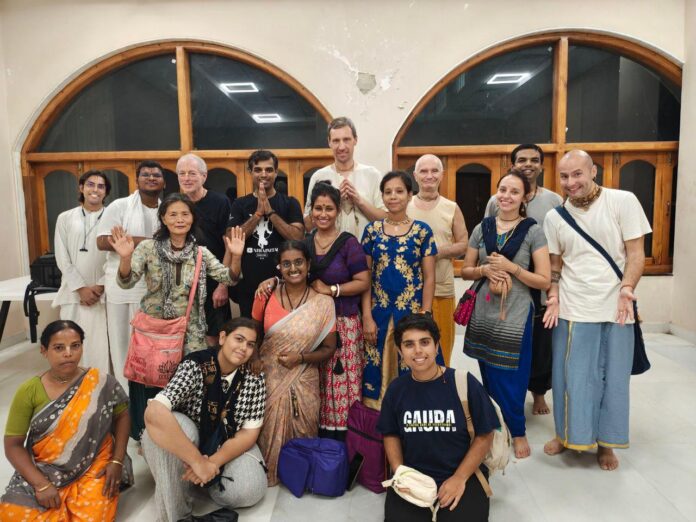
Participants of the workshop with Shyamsundar Das (wearing black in folded hands).

A four-day acting workshop recently concluded in Mayapur, marking a significant step in engaging devotees through creative preaching. Organized by Shyamsundar Das of Omnilight Films, it brought together devotees eager to explore dramatic arts as a medium for expressing and sharing Krishna consciousness.

Sharing his inspiration, Shyamsundar Das said his vision was to create a platform in Mayapur where devotees with creative talents could collaborate and serve through art. “Mayapur has a lot of potential, but there is no platform,” he noted, emphasizing the need for a space where creative devotees can express their abilities in Krishna’s service. He highlighted the urgency of offering spiritual alternatives in today’s digital age. “Because of this whole digital revolution, people are engaging themselves in all these different social media platforms,” he observed. Without providing devotional avenues for engagement, young people will naturally drift toward material entertainment.

Each day of the workshop built progressively on acting fundamentals while maintaining spiritual context. Sessions ran three hours daily, from 3 PM to 6 PM, beginning with warm-up exercises and games designed to help participants become fully present both physically and mentally.

Day One introduced participants to the actor’s instrument through icebreakers, mirror exercises where partners mimicked each other’s body language and expressions, and discussions on observation and imagination. The day included improvisation basics and concluded with an assignment to observe real people’s behavior and body language.

Day Two focused on character development and emotional expression. Participants performed their observations from the previous day, then engaged in “Who am I?” exercises to build complete character backgrounds with specific names, ages, habits, and goals. Through card-based activities, they practiced expressing emotional range by delivering simple lines in different moods. Each participant wrote a short five-line dialogue for their created character.

Day Three emphasized scene work and collaboration. Through trust exercises and improvisation games, participants developed listening and reacting skills. Pairs and trios rehearsed scenes using their previously written dialogues, focusing on emotional truth, pacing, and blocking before performing for their peers.

Day Four brought everything together in final performances in front of a camera. After focused rehearsal with directorial feedback on expression, movement, and timing, participants performed short scenes before their peers and invited guests, including senior devotees. The workshop concluded with constructive feedback, individual instructor notes, and reflection on growth and key takeaways.Workshop attendeees practicing the breathing exercise for calmness and focus.Participants doing warm up exercises before each day began.

The workshop featured expert trainers who combined professional skill with spiritual depth. Kamalakshi Rupini, a Bharatanatyam-trained actress from Brazil, led sessions on character work, explaining that an actor must enter into an emotion to portray it sincerely and then withdraw from it without attachment. “This way, we learn not to get attached to any character we are playing, including the one we are playing in this body. It is like many reincarnations in one lifetime,” she reflected, beautifully connecting the art of acting to the philosophy of self-realization.

Egidijus, a teacher at the Lithuanian Music and Theatre Academy, led modules that included exercises, skill development, and guidance on on-screen performance. He shared that the purpose of acting was not to become an actor but to understand oneself more deeply, which in turn supports one’s journey on the path of bhakti. Chintamani Devi Dasi led calming breathing exercises to help participants center themselves, while Gaura Nitai Das inspired everyone with his expressive acting and heartfelt participation. Professional actor and sound engineer Baldev Nitai Das provided constructive feedback to all participants, offering valuable insights on how they could continue to refine their craft.

His inspiration was strengthened by encouragement from senior devotees, including disciples of Srila Prabhupada, who sent him direct quotes from Srila Prabhupada highlighting his consistent support for the use of dramas and films to spread Krishna consciousness. “Sankarshan Prabhu specifically wrote that Srila Prabhupada would have encouraged Hindi film productions as well, had such opportunities been available in his time,” Shyamsundar said. He added that several senior devotees reminded him how Sri Chaitanya Mahaprabhu Himself participated in dramatic performances during His pastimes—affirming that devotional theatre and creative expression have always been cherished mediums for sharing spiritual wisdom.

While the workshop primarily prepared participants for film work, Shyamsundar Das emphasized that its value extended far beyond acting. “Even if someone is not interested in being in front of the camera, they still benefit from this workshop,” he explained. The process helps devotees step out of their comfort zones, overcome personal limitations, and discover unexplored dimensions of their own personalities.

One participant, Malini Sugopi Devi Dasi, shared her transformative experience: “This four-day acting workshop was really great. For anyone who is interested in acting but is a complete beginner or wants to gain confidence, this workshop is a must. It helped me in so many ways—I discovered aspects of my personality I never knew existed and came out of my little shell under the right guidance.”A trust game establishes cooperation amongst participants.Shyamsundar Das explaininng one of the activities to workshop goers.

Organizing the workshop came with challenges. Finding a suitable venue was the first hurdle, and the limited time made it difficult to cover all modules. Yet, as Shyamsundar Das humbly noted, “Somehow Krishna managed—Krishna helped us complete the workshop without any issues.”

Looking ahead, Shyamsundar Das shared plans for a second workshop in early December and a broader vision to establish a six-month diploma course in acting at Mayapur in collaboration with a recognized university. Future plans also include courses in makeup, hairdressing, singing, 3D animation, and computer graphics, supported by a dedicated facility. The production roadmap will begin with short films and gradually expand to full-length projects aimed at spreading Krishna consciousness through impactful visual storytelling.

Shyamsundar Das emphasized that the vision extends beyond the devotee community, aiming to create meaningful content that introduces Krishna consciousness and Vedic culture to a wider audience. He concluded with a humble appeal for devotees’ blessings and support to collaborate in serving Srila Prabhupada’s mission, noting that even spreading the word would be a valuable contribution.

Mild earthquake in Mayapur

0

It was a 5.5 magnitude, located in Narsingdi, Bangladesh, about 300kms away from Mayapur.
Three dead, several injured, tremors felt across West Bengal. Preliminary reports suggest that the earthquake was felt between 10.08 to 10.10 am for a few seconds and it was felt in Kolkata, Malda, Nadia, Cooch Behar and several other districts.

Mild earthquake in Mayapur. It was a 5.5 magnitude, located in Narsingdi, Bangladesh, about 300kms away from Mayapur. https://earthquaketrack.com/quakes/2025-11-21-04-38-26-utc-5-5-10

The Solar System According to the Sūrya-siddhānta

0

By Dr. T. D. Singh (Bhaktisvarüpa Dämodara Swami)

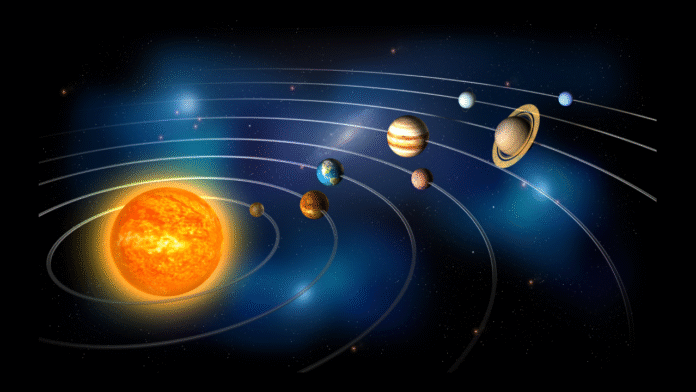
The Sūrya-siddhānta treats the earth as a globe fixed in space, and it describes the seven traditional planets (the sun, the moon, Mars, Mercury, Jupiter, Venus, and Saturn) as moving in orbits around the earth. It also describes the orbit of the planet Rāhu, but it makes no mention of Uranus, Neptune, and Pluto. The main function of the Sūrya-siddhānta is to provide rules allowing us to calculate the positions of these planets at any given time. Given a particular date, expressed in days, hours, and minutes since the beginning of Kali-yuga, one can use these rules to compute the direction in the sky in which each of the seven planets will be found at that time. All of the other calculations described above are based on these fundamental rules.


The basis for these rules of calculation is a quantitative model of how the planets move in space. This model is very similar to the modern Western model of the solar system. In fact, the only major difference between these two models is that the Sūrya-siddhānta’s is geocentric, whereas the model of the solar system that forms the basis of modern astronomy is heliocentric.


To determine the motion of a planet such as Venus using the modern heliocentric system, one must consider two motions: the motion of Venus around the sun and the motion of the earth around the sun. As a crude first approximation, we can take both of these motions to be circular. We can also imagine that the earth is stationary and that Venus is revolving around the sun, which in turn is revolving around the earth. The relative motions of the earth and Venus are the same, whether we adopt the heliocentric or geocentric point of view.


In the Sūrya-siddhānta the motion of Venus is also described, to a first approximation, by a combination of two motions, which we can call cycles 1 and 2. The first motion is in a circle around the earth, and the second is in a circle around a point on the circumference of the first circle. This second circular motion is called an epicycle.


It so happens that the period of revolution for cycle 1 is one earth year, and the period for cycle 2 is one Venusian year, or the time required for Venus to orbit the sun according to the heliocentric model. Also, the sun is located at the point on the circumference of cycle 1 which serves as the center of rotation for cycle 2. Thus we can interpret the Sūrya-siddhānta as saying that Venus is revolving around the sun, which in turn is revolving around the earth (see Figure 1). According to this interpretation, the only difference between the Sūrya-siddhānta model and the modern heliocentric model is one of relative point of view.


Table 1
Planetary Years, Distances, and Diameters,
According to Modern Western Astronomy

Planet Length of year Mean Distance from Sun Mean Distance from Earth Diameter
Sun – 0. 1.00 865,110
Mercury 87.969 .39 1.00 3,100
Venus 224.701 .72 1.00 7,560
Earth 365.257 1.00 0. 7,928
Mars 686.980 1.52 1.52 4,191
Jupiter 4,332.587 5.20 5.20 86,850
Saturn 10,759.202 9.55 9.55 72,000
Uranus 30,685.206 19.2 19.2 30,000
Neptune 60,189.522 30.1 30.1 28,000
Pluto 90,465.38 39.5 39.5 ?


Years are equal to the number of earth days required for the planet to revolve once around the sun. Distances are given in astronomical units (AU), and 1 AU is equal to 92.9 million miles, the mean distance from the earth to the sun. Diameters are given in miles. (The years are taken from the standard astronomy text TSA, and the other figures are taken from EA.)


In Tables 1 and 2 we list some modern Western data concerning the sun, the moon, and the planets, and in Table 3 we list some data on periods of planetary revolution taken from the Sūrya-siddhānta. The periods for cycles 1 and 2 are given in revolutions per divya-yuga. One divya-yuga is 4,320,000 solar years, and a solar year is the time it takes the sun to make one complete circuit through the sky against the background of stars. This is the same as the time it takes the earth to complete one orbit of the sun according to the heliocentric model.


TABLE 2
Data pertaining to the Moon,
According to Modern Western Astronomy

Siderial Period 27.32166 days
Synodic Period 29.53059 days
Nodal Period 27.2122 days
Siderial Period of Nodes -6,792.28 days
Mean Distance from Earth 238,000 miles = .002567 AU
Diameter 2,160 miles

The sidereal period is the time required for the moon to complete one orbit against the background of stars. The synodic period, or month, is the time from new moon to new moon. The nodal period is the time required for the moon to pass from ascending node back to ascending node. The sidereal period of the nodes is the time for the ascending node to make one revolution with respect to the background of stars. (This is negative since the motion of the nodes is retrograde.) (EA)


For Venus and Mercury, cycle 1 corresponds to the revolution of the earth around the sun, and cycle 2 corresponds to the revolution of the planet around the sun. The times for cycle 1 should therefore be one revolution per solar year, and, indeed, they are listed as 4,320,000 revolutions per divya-yuga.


The times for cycle 2 of Venus and Mercury should equal the modern heliocentric years of these planets. According to the Sūrya-siddhānta, there are 1,577,917,828 solar days per divya-yuga. (A solar day is the time from sunrise to sunrise.) The cycle-2 times can be computed in solar days by dividing this number by the revolutions per divya-yuga in cycle 2. The cycle-2 times are listed as “SS [Sūrya-siddhānta] Period,” and they are indeed very close to the heliocentric years, which are listed as “W [Western] Period” in Table 3.


For Mars, Jupiter, and Saturn, cycle 1 corresponds to the revolution of the planet around the sun, and cycle 2 corresponds to the revolution of the earth around the sun. Thus we see that cycle 2 for these planets is one solar year (or 4,320,000 revolutions per divya-yuga). The times for cycle 1 in solar days can also be computed by dividing the revolutions per divya-yuga of cycle 1 into 1,577,917,828, and they are listed under “SS Period.” We can again see that they are very close to the corresponding heliocentric years.


For the sun and moon, cycle 2 is not specified. But if we divide 1,577,917,828 by the numbers of revolutions per divya-yuga for cycle 1 of the sun and moon, we can calculate the number of solar days in the orbital periods of these planets. Table 3 shows that these figures agree well with the modern values, especially in the case of the moon. (Of course, the orbital period of the sun is simply one solar year.)


TABLE 3
Planetary Periods According to the Sūrya-siddhānta

Planet Cycle 1 Cycle 2 SS Period W Period
Moon 57,753,336 * 27.322 27.32166
Mercury 4,320,000 17,937,000 87.97 87.969
Venus 4,320,000 7,022,376 224.7 224.701
Sun 4,320,000 * 365.26 365.257
Mars 2,296,832 4,320,000 687.0 686.980
Jupiter 364,220 4,320,000 4,332.3 4,332.587
Saturn 146,568 4,320,000 10,765.77 10,759.202
Rāhu -232,238 * -6,794.40 -6,792.280


The figures for cycles 1 and 2 are in revolutions per divya-yuga. The “SS Period” is equal to 1,577,917,828, the number of solar days in a yuga cycle, divided by one of the two cycle figures (see the text). This should give the heliocentric period for Mercury, Venus, the earth (under sun) Mars, Jupiter, and Saturn, and it shold give the geocentric period for the moon and Rāhu. These periods can be compared with the years in Table 1 and the sidereal periods of the moon and its nodes in Table 2. These quantities have been reproduced from Tables 1 and 2 in the column labeled “W Period.”


In Table 3 a cycle-1 value is also listed for the planet Rāhu. Rāhu is not recognized by modern Western astronomers, but its position in space, as described in the Sūrya-siddhānta, does correspond with a quantity that is measured by modern astronomers. This is the ascending node of the moon.


From a geocentric perspective, the orbit of the sun defines one plane passing through the center of the earth, and the orbit of the moon defines another such plane. These two planes are slightly tilted with respect to each other, and thus they intersect on a line. The point where the moon crosses this line going from celestial south to celestial north is called the ascending node of the moon. According to the Sūrya-siddhānta, the planet Rāhu is located in the direction of the moon’s ascending node.


From Table 3 we can see that the modern figure for the time of one revolution of the moon’s ascending node agrees quite well with the time for one revolution of Rāhu. (These times have minus signs because Rāhu orbits in a direction opposite to that of all the other planets.)


TABLE 4
Heliocentric Distances of Planets, According to the Sūrya-siddhānta

Planet Cycle 1 Cycle 2 SS Distance W Distance
Mercury 360 133 132 .368 .39
Venus 360 262 260 .725 .72
Mars 360 235 232 1.54 1.52
Jupiter 360 70 72 5.07 5.20
Saturn 360 39 40 9.11 9.55


These are the distances of the planets from the sun. The mean heliocentric distance of Mercury and Venus in AU should be given by its mean cycle-2 circumference divided by its cycle-1 circumference. (The cycle-2 circumferences vary between the indicated limits, and we use their average values.) For the other planets the mean heliocentric distance should be the reciprocal of this (see the text). These figures are listed as “SS Distance,” and the corresponding modern Western heliocentric distances are listed under “W Distance.”


If cycle 1 for Venus corresponds to the motion of the sun around the earth (or of the earth around the sun), and cycle 2 corresponds to the motion of Venus around the sun, then we should have the following equation:
circumference of cycle 2 = Venus-to-Sun distance
circumference of cycle 1 Earth-to-Sun distance


Here the ratio of distances equals the ratio of circumferences, since the circumference of a circle is 2 pi times its radius. The ratio of distances is equal to the distance from Venus to the sun in astronomical units (AU), or units of the earth-sun distance. The modern values for the distances of the planets from the sun are listed in Table 1. In Table 4, the ratios on the left of our equation are computed for Mercury and Venus, and we can see that they do agree well with the modern distance figures. For Mars, Jupiter, and Saturn, cycles 1 and 2 are switched, and thus we are interested in comparing the heliocentric distances with the reciprocal of the ratio on the left of the equation. These quantities are listed in the table, and they also agree well with the modern values. Thus, we can conclude that the Sūrya-siddhānta presents a picture of the relative motions and positions of the planets Mercury, Venus, Earth, Mars, Jupiter, and Saturn that agrees quite well with modern astronomy.

Accepting a Bona Fide Spiritual Master

0

By Dr. T. D. Singh (Bhaktisvarüpa Dämodara Swami)

Any sincere soul who is searching for spiritual science must try to seek out a bona fide spiritual master in disciplic succession (paramparā). Lord Śrī Kṛṣṇa is the original spiritual master. The Vedic knowledge, as it is, has been handed down from master to disciple, one after another. Even on the mundane platform, if someone wants to learn chemistry, he has to approach a professor of chemistry; how much greater, then, is the need to approach a bona fide spiritual master to attain the supreme spiritual perfection, Kṛṣṇa consciousness.

It is absolutely necessary for a sincere soul to approach a bona fide spiritual master and surrender unto the lotus feet of the spiritual master without reservation. Lord Śrī Caitanya Mahāprabhu instructed Sanātana Gosvāmī thus: “The first and foremost thing is that one should accept a bona fide spiritual master. That is the beginning of spiritual life.”1


The symptoms of a bona fide guru (spiritual master) and devotee are described in the Padma Purāṇa. “A person who is a qualified brāhmaṇa, and at the same time qualified with all the symptoms of a devotee, can become the spiritual master of all classes of men, and such a devotee and spiritual master must be respected as God Himself. But a person, even though he may be born of a very respected brāhmaṇa family, cannot become a bona fide spiritual master if he is not a devotee of the Lord.”2 It is further stated: “Whatever he may be, whatever position he may have, if a person is fully conversant with the science of Kṛṣṇa, Kṛṣṇa consciousness, he can become a bona fide spiritual master, initiator, or teacher of the science.

In other words, his capability to become a bona fide spiritual master depends on his sufficient knowledge of the science of Kṛṣṇa, Kṛṣṇa consciousness; it does not depend on birth or a particular position in society.”3 The qualifications of a bona fide spiritual master are also described in the Śrīmad-Bhāgavatam, Eleventh Canto, where the sage Prabuddha tells Mahārāja Nimi: “My dear King, please know for certain that in the material world there is no happiness. It is simply a mistake to think that there is happiness here because this place is full of nothing but miserable conditions. Any person who is seriously desirous of achieving real happiness must seek out a bona fide spiritual master and take shelter of him by initiation.

The qualification of a spiritual master is that he must have realized the conclusion of the scriptures by deliberation and arguments and thus be able to convince others of these conclusions. Such great personalities who have taken shelter of the Supreme Godhead, leaving aside all material considerations, are to be understood as bona fide spiritual masters. Everyone should try to find such a bona fide spiritual master in order to furfill his mission of life, which is to transfer himself to the place of spiritual bliss.”4 The sage further continued: “My dear King, a disciple has to accept the spiritual master not only as spiritual master, but also as the representative of the Supreme Personality of Godhead and the Supersoul. In other words, the disciple should accept the spiritual master as God because he is the external manifestation of Kṛṣṇa.”5


Indeed, this material world is a vast ocean of sufferings and miseries, and the waves of māyā (illusion) are constantly kicking the living entities. Therefore, undoubtedly, all human beings urgently need the kind and able guidance of an expert captain to cross this vast ocean of Kali-yuga. If we are in the hands of an expert captain, our position is quite safe. The bona fide spiritual master in disciplic succession is, unquestionably, an expert captain. Our material bodies are the ships, and the words of Kṛṣṇa are the favorable winds. If one takes shelter of such a spiritual master, there is no difficulty in crossing this vast ocean of Kali-yuga. In Bhagavad-gītā Lord Kṛṣṇa instructs Arjuna: “Just try to learn the truth by approaching a spiritual master. Inquire from him submissively and render service unto him. The self-realized soul can impart knowledge unto you because he has seen the truth.” [Bg 4.34] Also in the Vedic literatures we find:


yasya deve parā bhaktir yathā deve tathā gurau
tasyaite kathitā hy arthāḥ prakaśānte mahātrnanaḥ


“Only unto those great souls who have implicit faith in both the Lord and the spiritual master are all the imports of Vedic knowledge automatically revealed.”7


Therefore, we simply have to depend on the kind and causeless mercy of the spiritual master and the Supreme Personality of Godhead, Lord Śrī Kṛṣṇa. Lord Caitanya Mahāprabhu says: “By the mercy of Kṛṣṇa one gets a spiritual master, and by the mercy of the spiritual master one gets Kṛṣṇa.” In Bhagavad-gītā it is stated: “The Supreme Lord is situated in everyone’s heart, O Arjuna, and is directing the wanderings of all living entities, who are seated as on a machine, made of the material energy.” [Bg 18.61] When the Supreme Lord within the heart sees the sincerity of the conditioned soul, He mercifully gives all opportunities for the deliverance of the fallen soul. “Out of compassion for them, I, dwelling in their hearts, destroy with the shining lamp of knowledge the darkness born of ignorance [Bg 10.11] … When one is enlightened with the knowledge by which nescience is destroyed, then his knowledge reveals everything, as the sun lights up everything in the daytime.” [Bg 5.16]


It is an unquestionable fact that neither doctors, nor social and political leaders, nor philanthropists can solve the basic problems of life, namely, birth, death, old age and disease. At any moment the material body will be finished. Everyone, therefore, should prepare for inevitable death. But without the background of the transcendental science, Kṛṣṇa consciousness, and without the merciful guidance of the expert spiritual master, how can one prepare for impending death? Parīkṣit Mahārāja, a great king and devotee of the Lord, had seven days’ time to prepare for death, but we do not even know for sure whether we have seven minutes to prepare for death.

King Parīkṣit spent those days exclusively hearing the great sage Śukadeva Gosvāmī speak the Śrīmad-Bhāgavatam, which describes the transcendental qualities of the Supreme Personality of Godhead, Lord Śrī Kṛṣṇa. In this way, he perfected his life. Material scientists and philosophers cannot give transcendental knowledge to their students. They have no qualifications to do so. However, a bona fide spiritual master who is one hundred percent Kṛṣṇa conscious can impart complete transcendental knowledge, the science of Kṛṣṇa, to his disciples, and thus he can solve all their problems in life.


Lord Śrī Kṛṣṇa is the Supreme Absolute Truth. “The Absolute Truth must descend from the absolute platform. It is not to be understood by the ascending process.”11 One cannot, therefore, approach the Supreme Personality of Godhead, Lord Śrī Kṛṣṇa, directly. In the Ādi Purāṇa, Lord Kṛṣṇa addresses Arjuna: “My dear Pārtha, one who claims to be My devotee is not so. Only a person who claims to be the devotee of My devotee is actually My devotee.”12 Lord Śrī Caitanya Mahāprabhu also says: “I am not a brāhmaṇa [teacher], I am not a kṣatriya [administrator], I am not a gṛhastha [householder] and I am not a vānaprastha [retired man]. I do not belong to any of the eight varṇāśramas [occupational and spiritual divisions of society]. I am the servant of the servant of the servant of the servant-one hundred times the servant-of the maintainer of the gopīs, Kṛṣṇa.” This is the perfect example given by the perfect master, Lord Śrī Kṛṣṇa Caitanya Himself.


The spiritual master is, therefore, the transparent via medium through which to approach the Supreme Lord, Śrī Kṛṣṇa. Śrīla Viśvanātha Cakravartī Ṭhākura, a great ācārya (holy teacher), kindly gives us the following sublime instructions in his famous prayers for the glorification of the spiritual master:


yasya prasādād bhagavat-prasādo yasyāprasādān na gatiḥ kuto ‘pi
dhyāyan stuvaṁs tasya yaśas tri-sandhyaṁ vande guroḥ śrī-caraṇāravindam


“If one satisfies the spiritual master, the Supreme Personality of Godhead becomes satisfied. If one does not satisfy the spiritual master, there is no chance of one’s being promoted to the plane of Kṛṣṇa consciousness. I should therefore meditate upon him, pray for his mercy three times a day, and offer my respectful obeisances unto him, my spiritual master.”13


This is the great Vaiṣṇava (Kṛṣṇa conscious) tradition. The duty of the disciple is to always think and act to satisfy the spiritual master in all circumstances. Therefore, one should execute the orders of the spiritual master one hundred per cent, without any tinge of personal motivation.

Śāstric (Authoritative Scriptural) Injunctions Are the Supreme Judgement

0

By Dr. T. D. Singh (Bhaktisvarüpa Dämodara Swami)

We understand that our knowledge and intelligence are extremely limited. Our brains are tiny, our senses and scientific equipment are imperfect, and our vision is limited. With all these imperfect means, how will it be possible to comprehend the knowledge (science) beyond? Attempting to understand unlimited knowledge by one’s own limited means in the name of doing research is simply a waste of valuable time and energy. Śrīla Prabhupāda very kindly explains that by the mature research work of Śrīla Vyāsadeva, an avatāra (incarnation) of the Supreme Personality of Godhead Himself, Lord Śrī Kṛṣṇa, complete and perfect knowledge (science) is available in the Vedic literatures.


The Vedas were originally spoken by the Supreme Lord Himself to Brahmā, the first living being in the material universe, from within his heart. Vedic knowledge is called śruti, indicating that it is learned by aural reception. Therefore the Vedic knowledge has to be received from higher authorities by hearing (śravaṇam). In previous ages people were very intelligent. Their memories were extremely sharp. Just by hearing once from a spiritual master, disciples could remember everything. Therefore, there was no necessity for keeping the Vedas in written form during those ages. However, Śrīla Vyāsadeva could see beforehand that people in this present Age of Kali, the age of quarrel and misunderstanding, situated amidst the disturbing noise of science and technology, would be much less intelligent, possessing extremely short memories. Therefore about 5,000 years ago he compiled the Vedas in written form for the benefit of all inquisitive souls of this present age.


Veda actually means knowledge, and Vedānta means the end of knowledge, which is to know the Supreme Personality of Godhead, Lord Śrī Kṛṣṇa. Bhagavad-gītā is the essence of all Vedic knowledge. It was spoken by the Supreme Lord, Śrī Kṛṣṇa Himself, to His intimate friend and disciple Arjuna. Śrīmad-Bhāgavatam is the ripened fruit of all the Vedic literatures. It is the summum bonum of life, Lord Śrī Kṛṣṇa personified. It describes the unlimited transcendental qualities of the Lord. Lord Śrī Caitanya Mahāprabhu explained to Sanātana Gosvāmī, “Śrīmad-Bhāgavatam is the sound representation of the Supreme Lord, Kṛṣṇa. So, as Kṛṣṇa is unlimited, similarly, in each word and each letter of Śrīmad-Bhāgavatam there are unlimited meanings, and one can understand them by the association of devotees.

”1 Lord Śrī Kṛṣṇa says: “I am situated in everyone’s heart, and from Me come remembrance, knowledge and forgetfulness. By all the Vedas am I to be known; indeed I am the compiler of Vedānta, and I am the knower of the Vedas.” [Bg 15.15] Thus the words of the Vedas are the supreme authority.


One may ask, “How may one accept authority?” The answer is given by Śrīla Prabhupāda: “The answer of the genuine mother to the question of who is one’s father is authoritative.” One cannot argue about or object to this point. Similarly, when a child learns that two times two is equal to four from his father and he tells the same thing to a professor of mathematics, the professor has to agree that the child is speaking perfectly. The child may not be perfect, but the knowledge that he is speaking is perfect because he has taken it from an authority. Similarly, all the Vedic knowledge is infallible. For example, it has been mentioned in the Vedas that cow dung is pure whereas other stool is impure, and modern science has found this to be true. It has been scientifically confirmed by chemical analysis that cow dung indeed contains various antiseptic properties.


There are four principal defects inherent in the conditioned soul, namely, imperfect senses, the propensity to cheat, surety of committing mistakes and surety of being illusioned. Therefore, the conditioned soul is completely unfit to make any rules and regulations. The injunctions laid down in the śāstras (authoritative scriptures) are above these four defects. Therefore, all the great saints and ācāryas (holy teachers) accept the scriptural injunctions completely, without adulteration. Our position is simply to accept the supreme authority without question. In this way, one can understand the Supreme Lord and supreme scientist, Lord Śrī Kṛṣṇa, through authority. One can perceive or detect Him through authority, one can see Him through authority, and one can associate with Him through authority. Similarly, one can also speak through authority, argue and defend through authority, and prove and demonstrate through authority. The supreme authority is the ultimate judgement, and Śrī Kṛṣṇa is that supreme authority.
Men who have a poor fund of understanding further ask, “How does one know that Kṛṣṇa is the supreme authority?” Lord Brahmā, the first living being and the engineer who creates all the living entities in the material universe, sings as follows:


īśvaraḥ paramaḥ kṛṣṇaḥ sac-cid-ānanda-vigrahaḥ
anādir ādir govindaḥ sarva-kāraṇa-kāraṇam


“Kṛṣṇa is the Supreme Personality of Godhead. He is the very form of eternal being, full of knowledge and bliss. He is the primeval Lord Govinda and the cause of all causes.” [Bs 5.1] Śrīmad-Bhāgavatam says, kṛṣṇas tu bhagavān svayam: “Kṛṣṇa is the Supreme Personality of Godhead Himself.”[S.B. 1.3.28] Arjuna, the great devotee of the Lord, also says to Lord Kṛṣṇa: “You are the Supreme Brahman, the ultimate, the supreme abode and purifier, the Absolute Truth and the eternal divine person. You are the primal God, transcendental and original, and You are the unborn and all-pervading beauty.

All the great sages such as Nārada, Asita, Devala, and Vyāsa proclaim this of You, and now You Yourself are declaring it to me.” [Bg 10.12-13] In the same way, all the mahājanas (great self-realized personalities) like Prahlāda Mahārāja, Śukadeva Gosvāmī and Bali Mahārāja, the great ācāryas (holy teachers) like Madhvācārya, Rāmānujācārya and Lord Śrī Caitanya Mahāprabhu, all my predecessor gurus (spiritual masters) in disciplic succession and now my spiritual master and eternal father, His Divine Grace A.C. Bhaktivedanta Swami Prabhupāda, declare the same thing-that Kṛṣṇa is the Supreme Personality of Godhead. Therefore there should be no tinge of doubt. Our duty is just to follow the kind footsteps of these greatest of saintly personalities. In this way we can understand the science of Kṛṣṇa.


In spite of this, the project to control nature continues. Rather than researching to find out the plan of the Supreme Being, rather than accepting the laws of nature as laws of God, the scientific mentality seeks to put mankind in the place of God in order to improve on nature. But when we inspect these activities closely, we can see that the two admitted goals, knowledge and pleasure, have not been achieved after so many years of trying. The materialists enjoin us to be patient, saying that very shortly the answer will be known and the pleasure will be available for all. To keep us amused in the meantime, there are technological trinkets galore. If it happens that we die waiting, still the scientist does not admit the tragedy, since for him life is only a molecular peculiarity anyway.


Thus the insensitive fritter away the valuable time of human life, time meant for discovering the answer to the most pressing of all questions-“Why am I suffering?” In fact, they won’t even admit that they are suffering. Life thus wasted becomes a painful paradox, in which each minute that passes increases the misery, until finally the body collapses in agonized bewilderment.


In a jeep, in the 1940’s, several scientists rode through the New Mexico desert. They were tense, trying to resolve the nerve-wracking conflict of fear and dizzy elation in their minds. The Manhattan Project had come to an end, and they were to witness the first explosion of a nuclear device, which was being considered for use as the “ultimate weapon” to win the war.

In their bunker, as they confronted the terrifying, spectacular power of the bomb, Dr. Oppenheimer quoted a verse from the Bhagavad-gītā, “Time I am, the destroyer of the worlds…,” no doubt fearing that it would take a person as intelligent as God to be able to use atomic energy properly, and that humanity might not be equal to the task. To know that answer for certain, which evidence will be sufficient for us? The sublime words of the Gītā, or the brute force of history?

Complete and Perfect Knowledge of Evolution

0

By Dr. T. D. Singh (Bhaktisvarüpa Dämodara Swami)

Complete and perfect knowledge of evolution in minute detail is available in the Vedic literatures. His Divine Grace Śrīla Prabhupāda has kindly supplied the following Vedic quotations:


aśītiṁ caturaś caiva lakṣāṁs tāñ jīva-jātiṣu
bhramadbhiḥ puruṣaiḥ prāpyaṁ mānuṣyaṁ janma-paryayāt
tad apy aphalatāṁ jātaḥ teṣām ātmābhimānināṁ
varākāṇām anāśritya govinda-caraṇa-dvayam


“One attains the human form of life after transmigrating through 8,400,000 species of life by the process of gradual evolution. That human form of life is spoiled for those conceited fools who do not take shelter of the lotus feet of Govinda [Kṛṣṇa].”1


jalajā nava-lakṣāṇi sthāvarā lakṣa-viṁśati
kṛmayo rudra-saṅkhyakāḥ pakṣiṇāṁ daśa-lakṣaṇam
triṁśal-lakṣāṇi paśavaḥ catur-lakṣāṇi mānuṣāḥ


“There are 900,000 species of aquatic life; 2,000,000 species of plants and trees; 1,100,000 species of insects; 1,000,000 species of bird life; 3,000,000 species of beasts, and 400,000 species of human life.”2

The meaning of “species” understood by biologists is different from the meaning implied here. The meaning used by biologists applies to the gross physical appearance or the gross morphological feature of the living material bodies. The Vedic meaning, however, which is derived after thorough and careful analysis, is based on the level of consciousness of the living being. For example, biologists say that all human beings belong to one species, whereas the Vedic literatures list 400,000 species. In other words, there are 400,000 grades of human beings on different levels of consciousness.


The process of evolution through these 8,400,000 species of life has been going on since time immemorial. As we noted earlier, the spirit soul never dies and is never born; it is eternal. It transmigrates from one body to another. Lord Śrī Kṛṣṇa, the supreme knower of everything, says: “As a person puts on new garments, giving up old ones, similarly, the soul accepts new material bodies, giving up the old and useless ones.” [Bg 2.22] In this way the transmigration of the soul is going on.


As we noted from Brahma-vaivarta Purāṇa, the most important species of life is the human being. The Vedānta-sūtra instructs, athāto brahma-jijñāsā: “Now, therefore, in this human form of life, it is time to inquire about spiritual realization.”4 Who am I? What is the real mission of human life? What is the ultimate purpose of our existence? Every intelligent person must ask these questions and should search for the right answers from the right source. So-called modern educators claim that the purpose of education is to solve the problems of life.

But in actuality they are teaching their students how to increase sense gratification more and more, thereby creating more and more paths to degradation. “Thus perplexed by various anxieties and bound by a network of illusions [in terms of increased sense gratification], one becomes too strongly attached to sense enjoyment and falls down into hell.” [Bg 16.16] In modern universities and colleges no one teaches the science by which to answer the question “Who am I?” Śrīla Prabhupāda kindly points out, “There are so many departments in a university: technological, medical, engineering, etc.

But where is the department to know and understand what this life is, what God is, and what our relationship is?”6 The most important department of education, that which teaches the real mission of human life, is completely left out. Scientists claim that modern science is a product of man’s curiosity to know. Why aren’t they curious to know who we are and what our relationship is with the Supreme Lord, the supreme scientist, Śrī Kṛṣṇa? The Vedas give all the answers perfectly.


Lower forms of life such as animals, birds and plants do not suffer from sinful activities because they never violate the laws of nature. A tiger, for instance, does not commit sinful activity by killing its prey because his body is meant to act in that way; it is properly equipped for that purpose. However, when the spirit soul comes to the level of a human being, the living entity is then subject to the results of his actions (karma-phala). From this human platform the living entity has, therefore, a choice. If the spirit soul wants to leave his material body and attain a spiritual body, he can do so from this human platform; otherwise, at the time of death he can transmigrate to one of the 8,400,000 species according to the desires and consciousness he has developed.

Lord Kṛṣṇa says: “Whatever state of being one remembers when he quits his body, that state he will attain without fail.” [Bg 8.6] From the human platform the spirit soul can escape the miserable wheel of birth and death by developing Kṛṣṇa consciousness. “And whoever, at the time of death, quits his body, remembering Me alone, at once attains My nature. Of this there is no doubt.” [Bg 8.5] This is evolution from the material platform to the spiritual platform.


Lower forms of life (animals, birds, plants, etc.) are not favorably situated for taking to Kṛṣṇa consciousness because they are not intelligent enough to understand this great science. On the other hand, it is understood from Vedic literature that there are demigods who are more elevated than human beings, but their position is also not favorable for taking to Kṛṣṇa consciousness because they are too materially opulent. Too much material opulence is also a disqualification for taking up Kṛṣṇa consciousness.

“In the minds of those who are too attached to sense enjoyment and material opulence, and who are bewildered by such things, the resolute determination of devotional service to the Supreme Lord does not take place.” [Bg 2.44] That is why it is an absolute necessity for all sane human beings to take up Kṛṣṇa consciousness from this human platform, which is the intermediate birth between the demigods and the lower forms of life. Otherwise, the precious human form of life will simply be wasted.

The Incomplete and Speculative Knowledge of Darwin’s Theory of Evolution

0

By Dr. T. D. Singh (Bhaktisvarüpa Dämodara Swami)

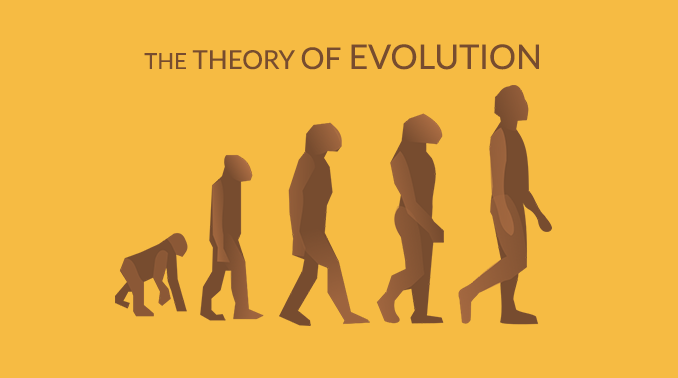
Before Charles Darwin published his theory of evolution in 1859, he frequently corresponded with A.R. Wallace, one of his contemporary naturalists. In one of his letters to A.R. Wallace (December 22, 1857), Darwin wrote, “… I am a firm believer that without speculation there is no good and original observation….’1 Thus, one does not need to make an extensive study in order to understand his theory. His theory was completely based on his own speculation and mental manipulation, based on some data collected during his “Voyage of the Beagle” (1831-1836). Every sensible person knows that speculative knowledge is quite fallible.


How his theory was developed is given in his own words: “When onboard H.M.S. Beagle as naturalist, I was much struck with certain facts in the distribution of the organic beings inhabiting South America, and in the geological relations of the present to the past inhabitants of that continent. These facts … seemed to throw some light on the origin of species, that mystery of mysteries. On my return home, it occurred to me, in 1837, that something might perhaps be made out on this question by patiently accumulating and reflecting on all sorts of facts which could possibly have any bearing on it. After five years work I allowed myself to speculate on the subject, and drew up some short notes; these I enlarged in 1844 into a sketch of the conclusions, which seemed to me probable: from that period to the present day I have steadily pursued the same object. In considering the Origin of Species, it is quite conceivable that a naturalist might come to the conclusion that species had not been independently created, but had descended, like varieties from other species.”2


Darwin has no knowledge about the nature of the spirit soul. He has no clear information as to how the living entity (spirit soul) is transmigrating from one species to another. He does not know whether there is further evolution from the human platform, and he hasn’t the slightest idea as to the total number of species through which the cycle of evolution goes on. He also has no infonnation whether the spirit soul can transmigrate from the human platform to lower species of life.


There has been great confusion regarding Darwin’s Theory. His critics are very legitimately asking, “If the theory of natural selection of Darwin is correct, why can’t we see the intermediate forms of species, the connecting links?” Darwin himself was completely confused in this respect. He could not provide any logical answer except his speculative argumentation. His own answer was that “extinction and natural selection will … go hand in hand.”3 He did not know that all the species of life have been existing since the dawn of creation. “The different species of life are created immediately along with the universe.

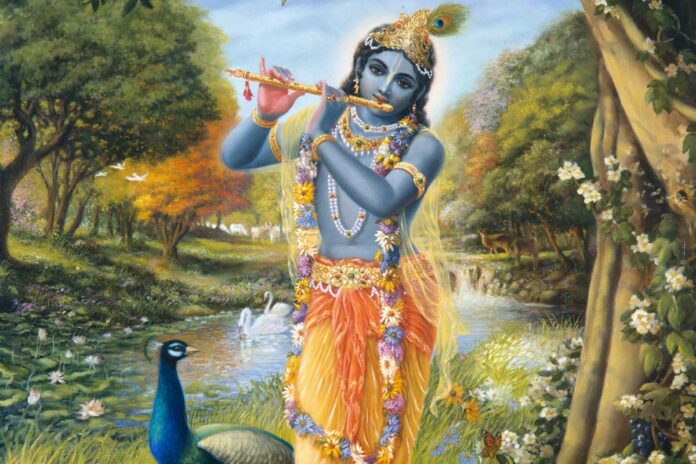
Men, animals, beasts, birds-everything is simultaneously created, because whatever desires the living entities had at the last annihilation are again manifested.”4 As a crude example, the species portrayed in the ancient Egyptian pyramids were the same as those we meet at the present day. Similarly, since time immemorial the peacock, whose colorful feathers so nicely decorate the transcendental head of the Supreme Personality of Godhead Śri Kṛṣṇa, has been the same as the species we find today. With his poor fund of knowledge, Darwin concluded that some species became extinct in the process of evolution. This is completely wrong.

What is the Difficulty?

0

By Dr. T. D. Singh (Bhaktisvarüpa Dämodara Swami)

The greatest disease in the minds of the scientists is that they do not believe that something is a fact unless it is proved by scientific experiments. When a scientist makes a statement and he supports that statement with scientific experiments, everyone is completely convinced, and no questions are asked. When we talk about the spirit soul to these scientists, their usual response is, “How can one detect the presence of the soul?” Because they have been conditioned to working with machines, they wonder whether the soul can be detected by scientific experiments. However, scientists have to agree that even in their own scientific realm there are many facts that cannot be proved by experiments. The fact is that the soul is there, but in order to understand its existence we have to accept knowledge from the right person, Śrī Kṛṣṇa, or God, and His representative in disciplic succession, the spiritual master.


Everyone in the scientific community knows that mathematicians work with an imaginary number called “i,” which is the square root of minus one. This number does not figure among the natural numbers (1,2,3, etc.). However, important branches of mathematics-for example, the theory of analytical functions-are based on this imaginary unit. Without the help of this branch of mathematics, various complex theories and problems cannot be solved. Thus the existence of this number cannot be denied; yet there is no experiment to prove it. In a similar manner, scientists in the field of statistical mechanics also utilize various conceptual models-ensembles, for example-to explain their theories and arguments. These are all beyond the realm of experimental science. If scientists are willing to accept these imaginary and conceptual models, what is the difficulty in accepting the perfect knowledge given by Lord Kṛṣṇa, the supreme scientist?


Another scientific theory that is beyond the limit of experimental science is Heisenberg’s uncertainty principle. The statement of this principle is that it is impossible to simultaneously determine the position and momentum of any object. In mathematical language, it is stated that the product of the uncertainties in the measured values of the position and momentum (product of mass and velocity) cannot be smaller than Planck’s constant. No existing experimental technique can prove this principle. However, scientists all over the world accept this statement as a fact, knowing that the experimental proof is beyond their ability. Similarly, there is no scientific experiment to prove the Third Law of Thermodynamics. This law, as formulated by Planck, states that the entropy of a perfect crystal at absolute zero degrees is equal to zero. Factually, there is no means available for measuring directly the absolute entropies. Therefore the proof of this law is beyond the realm of experimental science.


It is also to be noted that so-called scientific theories are changing constantly. For example, at the beginning of the Nineteenth Century (1808), John Dalton, in developing his atomic theory, stated that atoms could not be further divided. However, toward the end of the Nineteenth Century and the beginning of the Twentieth Century, it was found that Dalton’s atomic theory could no longer be considered correct. It was observed that atoms could be further divided into fundamental particles like electrons, protons and neutrons. It was also found that some atoms could emit alpha and beta particles, thereby producing new atoms, and so on. As a matter of fact, the so-called nuclear bombs are a result of these findings.

In a similar manner, during the Eighteenth and Nineteenth Centuries Newton’s mechanics had a tremendous influence on the minds of scientists, since they could be applied to gross material objects. However, at the beginning of the Twentieth Century, with the discoveries of the fundamental particles, it was realized that Newton’s mechanics failed in describing the motions of these particles. Thus quantum mechanics has been developed to explain the phenomena they exhibit. These theories are filled with speculation, and they are also changing. Just as past and present scientific theories are changing, so we can understand that future scientific theories will also change.


This simply shows that the brains of the highly honored material scientists are imperfect, and, as a result, the theories proposed by these brains will always be imperfect. Actually, perfect knowledge cannot be changed. In order to get perfect knowledge, one has to take knowledge from the perfect scientist, Lord Kṛṣṇa, and His bona fide representative, the spiritual master. Kṛṣṇa says: “I am the source of all spiritual and material worlds. Everything emanates from Me. The wise who know this perfectly engage in My devotional service and worship Me with all their hearts.” [Bg 10.8] Furthermore: “Of all creations I am the beginning and the end and also the middle, O Arjuna. Of all sciences I am the spiritual science of the Self, and among logicians I am the conclusive truth.” [Bg 10.32]


Scientists have to understand that the knowledge and ability they have is extremely limited and in fact quite insignificant. With this insignificant and limited knowledge, how will it be possible to understand knowledge beyond the material context? Actually there is no question about the existence of the soul. The living entities are fragmental spirit souls, whereas Lord Kṛṣṇa is the supreme soul, supreme person and supreme scientist. Kṛṣṇa says: “The living entities in this conditioned world are My eternal, fragmental parts. Due to conditioned life, they are struggling very hard with the six senses, which include the mind.” [Bg 15.7] Also: “It should be understood that all species of life, O son of Kuntī, are made possible by birth in this material nature, and that I am the seed-giving father.” [Bg 14.4]


Just as the existence of air can be felt by touch and the existence of certain molecules by fragrance and aroma, similarly consciousness is the clear symptom of the existence of the soul. “O son of Bharata, as the sun alone illuminates all this universe, so does the living entity, one within the body, illuminate the entire body by consciousness.” [Bg 13.34] Biologists also confirm that even the smallest microorganisms, such as bacteria, have consciousness. When consciousness enters into a material body. we call it a living body.

However, when there is no consciousness in the body-in other words, when the spirit soul leaves the body-simply a lump of matter is left over. This phenomenon we call death. Therefore the spirit soul never dies and is never born. It is eternal. What we call birth and death are nothing but the changing of different material bodies, the replacement of old bodies with new ones. “The living entity in the material world carries his different conceptions of life from one body to another, as the air carries aromas.” [Bg 15.8] Thus birth, death, old age and disease are the signals of the changing of the material body.


When our scientific friends readily accept Heisenberg’s uncertainty principle, the imaginary unit and the various conceptual models of statistical mechanics, which are all beyond experimental science, what is the difficulty in accepting the existence of the spirit soul? The supreme scientist Śrī Kṛṣṇa says: “For the soul there is never birth nor death. Nor, having once been, does he ever cease to be. He is unborn, eternal, ever-existing, undying and primeval. He is not slain when the body is slain.” [Bg 2.20] Its size has been described thus: “When the upper point of a hair is divided into one hundred parts and again each of such parts is divided into one hundred parts, each such part is the measurement of the dimension of the spirit soul.”8


Scientists are familiar with the law of conservation of energy which states that energy can be neither created nor destroyed. The living entities are the superior energy of the Supreme Lord, Śrī Kṛṣṇa. Therefore the soul is eternal. “Know that which pervades the entire body is indestructible. No one is able to destroy the imperishable soul.” [Bg 2.17] The nature of the spirit soul is elaborately described in the Second and Thirteenth Chapters of Bhagavad-gītā. One simply has to take the knowledge from the supreme scientist, Śrī Kṛṣṇa, the speaker of Bhagavad-gītā.
KCSB 4: The Incomplete and Speculative Knowledge of Darwin’s Theory of Evolution

Perceiving the Existence of the Supreme Scientist, Lord Śrī Kṛṣṇa

0
  1. By Dr. T. D. Singh (Bhaktisvarüpa Dämodara Swami)
  2. When we think calmly and carefully about this wonderful universe, we can see that everything is working under the control of a supreme brain. The arrangements in nature are perfectly ordered. Things would be at random without the careful planning of a scientific and engineering brain. It is a common understanding that there is a cause behind each action. A machine cannot run without an operator.
  3. Modern scientists are very proud of automation, but there is a scientific brain behind automation also. Even Albert Einstein agreed that there is a perfect brain behind all the natural physical laws. When we talk about “brain” and “operator,” these terms imply a person. They cannot be impersonal. One may inquire who this person is. He is Lord Śrī Kṛṣṇa, the supreme scientist and supreme engineer, under whose kind will the whole cosmos is working. Śrī Kṛṣṇa says: “The whole cosmic order is under Me. By My will it is manifested again and again, and by My will it is annihilated at the end.” [Bg 9.8]

  4. Now let us look into a few samples from the Lord’s creation, and upon contemplating these exemplary aspects, one should develop a better understanding and appreciation of the existence of the most powerful brain, Lord Śrī Kṛṣṇa. The sun that we see daily is the nearest star. It is one hundred earth diameters across and is ninety-three million miles away from the earth. Every day the sun supplies the solar system with a tremendous amount of heat, light and energy. “The very tiny fraction of the sun’s energy that falls on the earth-estimated at about five parts in a hundred million million-is about I 00,000 times greater than all the energy used in the world’s industries. The total energy the sun emits in a single second would be sufficient to keep a one kilowatt electric fire burning for 10,000 million million years.
  5. Put in a different way, the energy the sun emits in one second is greater than the whole amount of energy the human species has consumed throughout its entire history.”2 Yet it is only one of the countless number of stars floating in the sky in every direction. With the material scientific brain, the thermal, electrical and nuclear powerhouses have been made. These can supply heat, light and energy to a small, limited extent, but Lord Kṛṣṇa is supplying the whole planet with an unlimited source of energy just from one sun. Kṛṣṇa says: “The splendor of the sun, which dissipates the darkness of this whole world, comes from Me. And the splendor of the moon and the splendor of fire are also from Me.” [Bg 15.12] The planets are revolving in a systematic path around the sun. Even within the smallest atom, the electrons are orbiting around the nucleus in a perfect manner.

  6. Thus, from the submicroscopic realm of the atom to the expanding reaches of the galactic objects, this material universe is running like intricate, well-oiled clockwork according to great natural physical laws and principles. Scientists have gained great acclaim for making a few spaceships, whereas Kṛṣṇa effortlessly produces gigantic spaceships, such as planets and stars, which are perfectly equipped and maintained. In Bhagavad-gītā Kṛṣṇa says, gām āviśya ca bhūtāni dhārayāmy aham ojāsa: “I enter into each planet, and by My energy they stay in orbit.” [Bg 15.13] The laws made by the supreme brain always remain perfect; they are never violated. We never see the sun rising in the west and setting in the east. The colorful rainbow that we observe when the sun is shining during a shower is only visible when the sun is behind the observer, due to the laws of refraction. Also, each year the seasons change quite periodically, producing symptoms unique to each season.

  7. Now let us look into some aspects of the Lord’s creation at the molecular level. Chemists find that the different colors in flowers are due to chemicals called anthocyanins, and the different aromas are mostly due to chemicals called terpenes and terpenoid compounds. The molecular frameworks for these compounds range from very simple structures to very complex networks. Camphor, for example, is a terpenoid compound, and the characteristic odor of lemons is due to the molecule called limonene, which is one of the simple terpenes. Similarly, the characteristic colors in carrots and tomatoes are due to molecules called carotenoids, which are higher forms of terpenes. The molecular framework for each definite color or aroma is wonderfully unique.
  8. A little change in position of a few atoms in the molecule, a little variation in the geometry of the molecule or a slight change in the size of the molecule can cause a color to change from orange to red, a mild, pleasing aroma to become repellent and pungent, and a flavor to change from sweet to bitter. On one extreme we find the smallest molecule, the hydrogen molecule, which contains only two atoms of hydrogen. On the other extreme we find giant molecules such as the proteins and nucleic acids (DNA and RNA), the building blocks of all living material bodies, which contain innumerable atoms made for a definite function. Similarly, the crystalline pattern of each different molecule is unique. The geometrical shape for sodium chloride (common salt), for example, is cubical. Charcoal, graphite and diamonds are all derived from the same element, carbon, and yet the shining and transparent diamond is extremely hard, whereas graphite is soft, black and opaque.
  9. This is due to the difference in the crystalline forms of these molecules. In the crystal lattice of the diamond, each carbon atom is tetrahedrally surrounded by four other carbon atoms at a distance of 1.54 angstroms (one angstrom = 10<-8> cm.). In graphite, by contrast, the three bonds of each carbon atom are distorted so as to lie in the same plane, the fourth bond being directed perpendicularly to this plane to link with a carbon atom of the neighboring layer.

  10. In this way we can cite innumerable examples of molecular networks so fantastically and delicately arranged that chemists cannot but wonder about the most expert hand and brain who is making all these wonderful artistic arrangements in His laboratory. Indeed, the intelligence and ability of the supreme scientist, Śrī Kṛṣṇa, are inconceivable (acintya). There is no scientist who can deny it. How then can any chemist abstain from appreciating the wonderful works of the Supreme Lord, Śrī Kṛṣṇa? In Bhagavad-gītā we find: “One should meditate upon the Supreme Person as the one who knows everything, as He who is the oldest, who is the controller, who is smaller than the smallest, who is the maintainer of everything, who is beyond all material conception, who is inconceivable, and who is always a person. He is luminous like the sun and, being transcendental, is beyond this material nature.” [Bg 8.9]

  11. At best, scientists can only try to imitate the wonderful artistic works of the Supreme Lord. They cannot even do this properly, and most of their attempts lead to failure and disappointment. Even when they are partly successful, it is only with the greatest difficulty. For example, Professor R.B. Woodward of Harvard, a Nobel Prize winner in chemistry (1965) and Professor A. Eschenmoser of Zurich took eleven years to synthesize the vitamin B12 molecule. Altogether, ninety-nine scientists from nineteen different countries were involved just to accomplish this one small task.6 Yet Kṛṣṇa is making all these complex molecules at will.

  12. Interestingly enough, when scientists fail again and again in their attempts to make something, they consciously or unconsciously pray to God for help. Does this not indicate the existence of the supreme scientist, Lord Śrī Kṛṣṇa, and the natural subordinate position of all other living entities? A crude example is the explosion that occurred inside the Apollo 13 spacecraft during its attempt to land on the moon on April 11, 1970. The Apollo capsule was made by hundreds of scientific and technological brains and cost millions of dollars. No one could predict that there would be an explosion. When it happened, however, and the lives of the three astronauts were in danger, those involved in the mission requested all the people on earth to pray to God for the safe return of the astronauts. Such is the situation.
  13. At times of danger, most people tend to remember God, although at other times they forget Him.
    Now, let us look into some very simple and graphic examples of the artistry of the Lord’s creation. We see that among the lower forms of living entities, social organization is very smoothly maintained. For example, in a bee colony the queen bee is nicely taken care of by the drones (male bees), while the workers collect nectar from flowers all day long. It is quite amazing to consider how the bees, with their tiny bodies, can collect such a great amount of honey for themselves as well as for other living entities. In this way, the colony is maintained with beautiful order. Similarly, the loving relationship between a mother and her baby is quite clearly visible even in very small forms of living entities.
  14. During the monsoon season in tropical countries, when there are torrents of rain, the small ants run to find shelter, carrying their eggs on their heads. The spider makes its wonderful webs with great architectural skill to serve as a shelter as well as to catch its prey for survival. Silkworms spin hundreds of yards of fine threads to form cocoons for their shelter during the pupa stage. Inside a tiny seed, smaller than the size of a mustard seed, the whole potency of a big banyan tree is present. In this way, we can see the wonderful arrangements of the Supreme Lord, who is creating, maintaining and guiding all living entities, small or big. Kṛṣṇa says: “Furthermore, O Arjuna, I am the generating seed of all existences.
  15. There is no being-moving or unmoving-that can exist without Me.” [Bg 10.39]
    The main trouble with material scientists is that they generally neglect the most important and fundamental aspect of their inquiries. For example, when Newton saw the falling of the apple, he asked why and how the apple fell. However, he did not inquire who caused the falling of the apple. As an answer to his inquiry, he discovered the laws of gravitation. His answer was that the apple fell because of the laws of gravitation. But who made the laws of gravitation? Śrīla Prabhupāda kindly explains that the apple did not fall while green but while ripe.
  16. Therefore Newton’s gravitational theory was not enough to explain the falling of the apple. There is some other cause behind the total scene of the falling and, thereby, behind the law of gravitation. That cause is Lord Śrī Kṛṣṇa. In Bhagavad-gītā we find, vasudevaḥ sarvam iti: “Kṛṣṇa is the cause of all causes.” [Bg 7.19] Furthermore, scientists have to know that the little ability they have is also given by the Lord. Kṛṣṇa says, pauruṣaṁ nṛṣu. “I am the ability in man.” [Bg 7.8]

  17. By various mechanical means (telescopes, etc.), assumptions, empiric theories and conceptual models, cosmologists and astronomers are trying with tremendous vigor to understand what the universe is, what its size is, and the time scale of its creation. At the present time they are speculating that there may be a tenth planet in the solar system, and they are trying to locate it.10 How far they will be successful in finding a real answer to their attempts only time can tell. But the fact is that they will never be able to fully discover the secrets of nature, which is the product of creation of Kṛṣṇa, the supreme scientist.
  18. Any thoughtful person can understand how foolish he is even to dream of measuring the size of this universe, since he does not know completely the nature of the sun, the nearest star. Śrīla Prabhupāda cites the example of the philosophy of Dr. Frog, who lives in a well of three feet and has no idea how vast the Pacific Ocean is but who speculates that the Pacific Ocean might be five feet wide, ten feet wide, etc., comparing it to his well. The point is that comprehending the unlimited knowledge beyond by our limited means is simply a waste of time and energy. All the knowledge is already there in the authorized scriptures, the Vedas. One simply has to take the knowledge from the supreme authority, Kṛṣṇa.

  19. The details of the creation of this material universe and the living entities like demigods, men and others have been given in the Śrīmad-Bhāgavatam, First Canto, Chapter Three, verses 1-5. The description of the material and spiritual universes is completely given in the Brahma-saṁhitā, Fifth Chapter, and from Bhagavad-gītā we get the clear information that the entire material universe is only one fourth of the creative energy of the Supreme Lord, Śrī Kṛṣṇa. The other three fourths of the creative energy of the Lord are manifested in the spiritual sky, called the Vaikuṇṭhaloka.

  20. Lord Śrī Caitanya Mahāprabhu, the golden avatāra (incarnation) of the Supreme Personality of Godhead Śrī Kṛṣṇa, clearly explained to Sanātana Gosvāmī, one of the Lord’s intimate disciples, about the nature of these universes. The Lord explained that the material universes have a limited length and breadth, whereas no one can measure the length and breadth of all the Vaikuṇṭha planets. These Vaikuṇṭha planets are like the petals of a lotus flower, and the principal part of that flower is the center of all the Vaikuṇṭhas. This part is called Kṛṣṇaloka, or Goloka Vṛndāvana. The Supreme Lord, Śrī Kṛṣṇa, has His original eternal abode on this planet. The other Vaikuṇṭhas are also inhabited by residents who are full with six opulences-wealth, strength, knowledge, beauty, fame and renunciation-and in each and every Vaikuṇṭha planet a different expansion of Kṛṣṇa has His eternal abode.11 Material scientists have no information of this vast knowledge.

  21. Certainly, the secrets of the universe cannot be unfolded by the tiny brains of material scientists. We should agree without a doubt that man’s vision in all directions is extremely limited by the inadequacies of his senses, his technology and his intellect. None can deny the existence of the supreme scientist, Śrī Kṛṣṇa. He is the proprietor and knower of everything. Kṛṣṇa says: “O son of Pṛthā, know that I am the original seed of all existences, the intelligence of the intelligent, and the prowess of all powerful men [Bg 7.10] … O conqueror of wealth [Arjuna], there is no truth superior to Me. Everything rests upon Me, as pearls are strung on a thread.” [Bg 7.7] Only fools would argue about the existence of the Supreme Lord, Śrī Kṛṣṇa. In Bhagavad-gītā, Śrī Kṛṣṇa says: “Those miscreants who are grossly foolish, lowest among mankind, whose knowledge is stolen by illusion, and who partake of the atheistic nature of demons do not surrender unto Me.” [Bg 7.15]

  22. Therefore, instead of denying and challenging the existence of the supreme scientist, Lord Śrī Kṛṣṇa or God, it should be the prime duty of all our scientist friends to appreciate the inconceivable brain of the Lord and His wonderful manifestations everywhere. One may falsely claim the credit for the discovery of radio, television, computers, penicillin, etc. But the fact is that everything was already there because nothing can come out of nothing. If someone claims that anything belongs to him, he is the greatest thief. He is stealing property from the supreme father, Śrī Kṛṣṇa, and claiming it to be his. Nothing belongs to us. Everything belongs to Kṛṣṇa. Śrī Īśopaniṣad says: “Everything animate or inanimate that is within the universe is controlled and owned by the Lord. One should therefore accept only those things necessary for himself, which are set aside as his quota, and one must not accept other things, knowing well to whom they belong.15

Stay Connected

16,985FansLike
12,500FollowersFollow
61,453SubscribersSubscribe