Mail ID: contact@vedavarsity.com

Contact: +91 9634998911

Google search engineGoogle search engine
Home Blog Page 142

Chaitanya Charitamrta | Adi Lila | Chapter 9 | Section 28

0

Let me offer my respectful obeisances unto the spiritual master of the entire world, Lord Śrī Kṛṣṇa Caitanya Mahāprabhu, by whose mercy even a dog can swim across a great ocean. (1) All glories to Śrī Kṛṣṇa Caitanya, who is known as Gaurahari! All glories to Advaita Ācārya and Nityānanda Prabhu! (2) All glories to the devotees of Lord Caitanya, headed by Śrīvāsa Ṭhākura! In order to fulfill all my desires, I remember their lotus feet. (3) I also remember the six Gosvāmīs-Rūpa, Sanātana, Bhaṭṭa Raghunātha, Śrī Jīva, Gopāla Bhaṭṭa and Dāsa Raghunātha. (4)

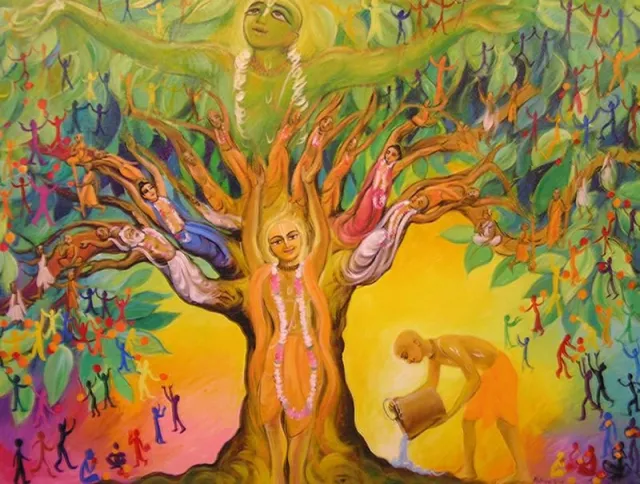
 It is by the mercy of all these Vaiṣṇavas and gurus that I attempt to write about the pastimes and qualities of Lord Caitanya Mahāprabhu. Whether I know it or know not, it is for self- purification that I write this book. (5) I take shelter of the Supreme Personality of Godhead Śrī Caitanya Mahāprabhu, who Himself is the tree of transcendental love of Kṛṣṇa, its gardener and also the bestower and enjoyer of its fruits. (6) Lord Caitanya thought, “My name is Viśvambhara, ‘one who maintains the entire universe.’ Its meaning will be actualized if I can fill the whole universe with love of Godhead.” (7) Thinking in this way, He accepted the duty of a planter and began to grow a garden in Navadvīpa. (8)

 Thus the Lord brought the desire tree of devotional service to this earth and became its gardener. He sowed the seed and sprinkled upon it the water of His will. (9) All glories to Śrī Mādhavendra Purī, the storehouse of all devotional service unto Kṛṣṇa! He is a desire tree of devotional service, and it is in him that the seed of devotional service first fructified. (10) The seed of devotional service next fructified in the form of Śrī Īśvara Purī, and then the gardener Himself, Caitanya Mahāprabhu, became the main trunk of the tree of devotional service. (11) By His inconceivable powers, the Lord became the gardener, the trunk and the branches simultaneously. (12)

Paramānanda Purī, Keśava Bhāratī, Brahmānanda Purī and Brahmānanda Bhāratī, Śrī Viṣṇu Purī, Keśava Purī, Kṛṣṇānanda Purī, Śrī Nṛsiṁha Tīrtha and Sukhānanda Purī-these nine sannyāsī roots all sprouted from the trunk of the tree. Thus the tree stood steadfastly on the strength of these nine roots. (13-15) With the sober and grave Paramānanda Purī as the central root and the other eight roots in the eight directions, the tree of Caitanya Mahāprabhu stood firmly. (16) From the trunk grew many branches, and above them innumerable others. (17) Thus the branches of the Caitanya tree formed a cluster or society, with great branches covering all the universe. (18) From each branch grew many hundreds of subbranches. No one can count how many branches thus grew. (19)

 I shall try to name the foremost of the innumerable branches. Please hear the description of the Caitanya tree. (20) At the top of the tree the trunk branched into two. One trunk was named Śrī Advaita Prabhu and the other Śrī Nityānanda Prabhu. (21) From these two trunks grew many branches and subbranches that covered the entire world. (22) These branches and subbranches and their subbranches became so numerous that no one can actually write about them. (23) Thus the disciples and the granddisciples and their admirers spread throughout the entire world, and it is not possible to enumerate them all. (24) As a big fig tree bears fruits all over its body, each part of the tree of devotional service bore fruit. (25)

Since Śrī Kṛṣṇa Caitanya Mahāprabhu was the original trunk, the taste of the fruits that grew on the branches and subbranches surpassed the taste of nectar. (26) The fruits ripened and became sweet and nectarean. The gardener, Śrī Caitanya Mahāprabhu, distributed them without asking any price. (27) All the wealth in the three worlds cannot equal the value of one such nectarean fruit of devotional service. (28) Not considering who asked for it and who did not, nor who was fit and who unfit to receive it, Caitanya Mahāprabhu distributed the fruit of devotional service. (29)

The transcendental gardener, Śrī Caitanya Mahāprabhu, distributed handful after handful of fruit in all directions, and when the poor, hungry people ate the fruit, the gardener smiled with great pleasure. (30) Lord Caitanya thus addressed the multifarious varieties of branches and subbranches of the tree of devotional service: (31) “Since the tree of devotional service is transcendental, every one of its parts can perform the action of all the others. Although a tree is supposed to be immovable, this tree nevertheless moves. (32) “All the parts of this tree are spiritually cognizant, and thus as they grow they spread all over the world. (33) “I am the only gardener. How many places can I go? How many fruits can I pick and distribute? (34)

 “It would certainly be a very laborious task to pick the fruits and distribute them alone, and still I suspect that some would receive them and others would not. (35) “Therefore I order every man within this universe to accept this Kṛṣṇa consciousness movement and distribute it everywhere. (36) “I am the only gardener. If I do not distribute these fruits, what shall I do with them? How many fruits can I alone eat? (37) “By the transcendental desire of the Supreme Personality of Godhead, water has been sprinkled all over the tree, and thus there are innumerable fruits of love of Godhead. (38) “Distribute this Kṛṣṇa consciousness movement all over the world. Let people eat these fruits and ultimately become free from old age and death. (39)

“If the fruits are distributed all over the world, My reputation as a pious man will be known everywhere, and thus all people will glorify My name with great pleasure. (40) “One who has taken his birth as a human being in the land of India [Bhārata- varṣa] should make his life successful and work for the benefit of all other people. (41) “‘It is the duty of every living being to perform welfare activities for the benefit of others with his life, wealth, intelligence and words.’ (42) “‘By his work, thoughts and words, an intelligent man must perform actions which will be beneficial for all living entities in this life and the next.’ (43) “I am merely a gardener. I have neither a kingdom nor very great riches. I simply have some fruits and flowers that I wish to utilize to achieve piety in My life. (44)

 “Although I am acting as a gardener, I also want to be the tree, for thus I can bestow benefit upon all. (45) “‘Just see how these trees are maintaining every living entity! Their birth is successful. Their behavior is just like that of great personalities, for anyone who asks anything from a tree never goes away disappointed.'” (46) The descendants of the tree [the devotees of Śrī Caitanya Mahāprabhu] were very glad to receive this order directly from the Lord. (47) The fruit of love of God is so delicious that wherever a devotee distributes it, those who relish the fruit, anywhere in the world, immediately become intoxicated. (48) The fruit of love of Godhead distributed by Caitanya Mahāprabhu is such a great intoxicant that anyone who eats it, filling his belly, immediately becomes maddened by it, and automatically he chants, dances, laughs and enjoys. (49)

When Śrī Caitanya Mahāprabhu, the great gardener, sees that people are chanting, dancing and laughing and that some of them are rolling on the floor and some are making loud humming sounds, He smiles with great pleasure. (50) The great gardener, Lord Caitanya, personally eats this fruit, and as a result He constantly remains mad, as if helpless and bewildered. (51) With His saṅkīrtana movement the Lord made everyone mad like Himself. We do not find anyone who was not intoxicated by His saṅkīrtana movement. (52) Persons who had formerly criticized Lord Caitanya Mahāprabhu, calling Him a drunkard, also ate the fruit and began to dance, saying, “Very good! Very good!” (53)

After describing the Lord’s distribution of the fruit of love of Godhead, I now wish to describe the different branches of the tree of Lord Caitanya Mahāprabhu. (54) Praying at the lotus feet of Śrī Rūpa and Śrī Raghunātha, always desiring their mercy, I, Kṛṣṇadāsa, narrate Śrī Caitanya- caritāmṛta, following in their footsteps. (55)

Chaitanya Charitamrta | Adi Lila | Chapter 8 | Section 27

0

In Vṛndāvana, in a great place of pilgrimage underneath the desire trees, is a golden throne bedecked with jewels. (50) On that throne sits the son of Nanda Mahārāja, Śrī Govindadeva, the transcendental Cupid. (51) Varieties of majestic service are rendered to Govinda there. His garments, ornaments and paraphernalia are all transcendental. (52)

 In that temple of Govindajī, thousands of servitors always render service to the Lord in devotion. Even with thousands of mouths, one could not describe this service. (53) In that temple the chief servitor was Śrī Haridāsa Paṇḍita. His qualities and fame are known all over the world. (54) He was gentle, tolerant, peaceful, magnanimous, grave, sweet in his words and very sober in his endeavors. (55) He was respectful to everyone and worked for the benefit of all. Diplomacy, envy and jealousy were unknown to his heart. (56) The fifty qualities of Lord Kṛṣṇa were all present in his body. (57)

 “In one who has unflinching devotional faith in Kṛṣṇa, all the good qualities of Kṛṣṇa and the demigods are consistently manifested. However, one who has no devotion to the Supreme Personality of Godhead has no good qualifications because he is engaged by mental concoction in material existence, which is the external feature of the Lord.” (58) Ananta Ācārya was a disciple of Gadādhara Paṇḍita. His body was always absorbed in love of Godhead. He was magnanimous and advanced in all respects. (59) Ananta Ācārya was a reservoir of all good qualities. No one can estimate how great he was. Paṇḍita Haridāsa was his beloved disciple. (60)

Paṇḍita Haridāsa had great faith in Lord Caitanya and Nityānanda. Therefore he took great satisfaction in knowing about Their pastimes and qualities. (61) He always accepted the good qualities of Vaiṣṇavas and never found fault in them. He engaged his heart and soul only to satisfy the Vaiṣṇavas. (62) He always heard the reading of Śrī Caitanya- maṅgala, and all the other Vaiṣṇavas used to hear it by his grace. (63) Like the full moon, he illuminated the entire assembly of Vaiṣṇavas by speaking Śrī Caitanya- maṅgala, and by the nectar of his qualities he increased their transcendental bliss. (64) By his causeless mercy he ordered me to write about the last pastimes of Śrī Caitanya Mahāprabhu. (65)

 Govinda Gosāñi, the priest engaged in the service of Lord Govinda in Vṛndāvana, was a disciple of Kāśīśvara Gosāñi. There was no servant more dear to the Govinda Deity. (66) Śrī Yādavācārya Gosāñi, a constant associate of Śrīla Rūpa Gosvāmī, was also very enthusiastic in hearing and chanting about Lord Caitanya’s pastimes. (67) Bhugarbha Gosāñi, a disciple of Paṇḍita Gosāñi, was always engaged in topics regarding Lord Caitanya, knowing nothing else. (68) Among his disciples were Caitanya dāsa, who was a priest of the Govinda Deity, as well as Mukundānanda Cakravartī and the great devotee Kṛṣṇadāsa. (69) Among the disciples of Ananta Ācārya was Śivānanda Cakravartī, in whose heart Lord Caitanya and Nityānanda constantly dwelled. (70)

 In Vṛndāvana there were also many other great devotees, all of whom desired to hear the last pastimes of Lord Caitanya. (71) By their mercy, all these devotees ordered me to write of the last pastimes of Śrī Caitanya Mahāprabhu. Because of their order only, although I am shameless, I have attempted to write this Caitanya- caritāmṛta. (72) Having received the order of the Vaiṣṇavas but being anxious within my heart, I went to the temple of Madana- mohana in Vṛndāvana to ask His permission also. (73) When I visited the temple of Madana- mohana, the priest Gosāñi dāsa was serving the feet of the Lord, and I also prayed at the Lord’s lotus feet. (74)

 When I prayed to the Lord for permission, a garland from His neck immediately slipped down. (75) As soon as this happened, the Vaisnavas standing there all loudly chanted, “Haribol!” and the priest, Gosañi dasa, brought me the garland and put it around my neck. (76) I was greatly pleased to have the garland signifying the order of the Lord, and then and there I comme nced to write this book. (77) Actually Śrī Caitanya- caritāmṛta is not my writing but the dictation of Śrī Madana- mohana. My writing is like the repetition of a parrot. (78) As a wooden doll is made to dance by a magician, I write as Madana- gopāla orders me to do so. (79)

 I accept as my family Deity Madana- mohana, whose worshipers are Raghunātha dāsa Gosvāmī, Śrī Rūpa Gosvāmī and Sanātana Gosvāmī. (80) I took permission from Śrīla Vṛndāvana dāsa Ṭhākura by praying at his lotus feet, and upon receiving his order I have attempted to write this auspicious literature. (81) Śrīla Vṛndāvana dāsa Ṭhākura is the authorized writer on the pastimes of Lord Caitanya. Without his mercy, therefore, one cannot describe these pastimes. (82)

I am foolish, lowborn and insignificant, and I always desire material enjoyment; yet by the order of the Vaiṣṇavas I am greatly enthusiastic to write this transcendental literature. (83) The lotus feet of Śrī Rūpa Gosvāmī and Raghunātha dāsa Gosvāmī are my source of strength. Remembering their lotus feet can fulfill all one’s desires. (84) Praying at the lotus feet of Śrī Rūpa and Śrī Raghunātha, always desiring their mercy, I, Kṛṣṇadāsa, narrate Śrī Caitanya- caritāmṛta, following in their footsteps. (85)

Chaitanya Charitamrta | Adi Lila | Chapter 8 | Section 26

0

I offer my respects to the Supreme Personality of Godhead, Śrī Caitanya Mahāprabhu, by whose desire I have become like a dancing dog and suddenly taken to the writing of Śrī Caitanya- caritāmṛta, although I am a fool. (1) Let me offer my respectful obeisances unto Śrī Kṛṣṇa Caitanya Mahāprabhu, who is known as Gaurasundara. I also offer my respectful obeisances unto Nityānanda Prabhu, who is always very joyful. (2) Let me offer my respectful obeisances unto Advaita Ācārya, who is very merciful, and also to that great personality Gadādhara Paṇḍita, the learned scholar. (3)

Let me offer my respectful obeisances unto Śrīvāsa Ṭhākura and all the other devotees of the Lord. I fall down to offer them respect. I worship their lotus feet. (4) By remembering the lotus feet of the Pañca- tattva, a dumb man can become a poet, a lame man can cross mountains, and a blind man can see the stars in the sky. (5) The education cultivated by so- called learned scholars who do not believe these statements of Śrī Caitanya- caritāmṛta is like the tumultuous croaking of frogs. (6) One who does not accept the glories of the Pañca- tattva but still makes a show of devotional service to Kṛṣṇa can never achieve the mercy of Kṛṣṇa or advance to the ultimate goal. (7)

 Formerly kings like Jarāsandha [the father- in- law of Kaṁsa] strictly followed the Vedic rituals, thus worshiping Lord Viṣṇu. (8) One who does not accept Kṛṣṇa as the Supreme Personality of Godhead is certainly a demon. Similarly, anyone who does not accept Śrī Caitanya Mahāprabhu as Kṛṣṇa, the same Supreme Lord, is also to be considered a demon. (9) Lord Śrī Caitanya Mahāprabhu thought, “Unless people accept Me they will all be destroyed.” Thus the merciful Lord accepted the sannyāsa order. (10) “If a person offers obeisances to Me, even due to accepting Me only as an ordinary sannyāsī, his material distresses will diminish, and he will ultimately get liberation.” (11) One who does not show respect unto this merciful Lord, Caitanya Mahāprabhu, or does not worship Him should be considered a demon, even if he is very much exalted in human society. (12)

Therefore I say again, lifting my arms: O fellow human beings, please worship Śrī Caitanya and Nityānanda without false arguments! (13) Logicians say, “Unless one gains understanding through logic and argument, how can one decide upon a worshipable Deity?”(14) If you are indeed interested in logic and argument, kindly apply it to the mercy of Śrī Caitanya Mahāprabhu. If you do so, you will find it to be strikingly wonderful. (15) If one is infested with the ten offenses in the chanting of the Hare Kṛṣṇa mahā- mantra, despite his endeavor to chant the holy name for many births, he will not get the love of Godhead that is the ultimate goal of this chanting. (16) “By cultivating philosophical knowledge one can understand his spiritual position and thus be liberated, and by performing sacrifices and pious activities one can achieve sense gratification in a higher planetary system, but the devotional service of the Lord is so rare that even by executing hundreds and thousands of such sacrifices one cannot obtain it.” (17)

 If a devotee wants liberation or material sense gratification from the Lord, Kṛṣṇa immediately delivers it, but pure devotional service He keeps hidden. (18) [The great sage Nārada said:] “My dear Mahārāja Yudhiṣṭhira, the Supreme Personality of Godhead Kṛṣṇa is always ready to help you. He is your master, guru, God, very dear friend and head of your family. Yet sometimes He agrees to act as your servant or order- carrier. You are greatly fortunate because this relationship is possible only by bhakti- yoga. The Lord can give liberation [mukti] very easily, but He does not very easily give one bhakti- yoga, because by that process He is bound to the devotee.” (19)

Lord Śrī Caitanya Mahāprabhu has freely given this love of Kṛṣṇa everywhere and anywhere, even to the most fallen, such as Jagāi and Mādhāi. What then to speak of those who are already pious and elevated? (20) Śrī Caitanya Mahāprabhu, as the Supreme Personality of Godhead Himself, is fully independent. Therefore, although it is the most confidentially stored benediction, He can distribute love of Godhead to anyone and everyone without consideration. (21) Whether he is offensive or inoffensive, anyone who even now chants śrī- kṛṣṇa- caitanya prabhu- nityānanda is immediately overwhelmed with ecstasy, and tears fill his eyes. (22)

 Simply by talking of Nityānanda Prabhu one awakens his love for Kṛṣṇa. Thus all his bodily limbs are agitated by ecstasy, and tears flow from his eyes like the waters of the Ganges. (23) There are offenses to be considered while chanting the Hare Kṛṣṇa mantra. Therefore simply by chanting Hare Kṛṣṇa one does not become ecstatic. (24) “If one’s heart does not change, tears do not flow from his eyes, his body does not shiver, and his bodily hairs do not stand on end as he chants the Hare Kṛṣṇa mahā- mantra, it should be understood that his heart is as hard as iron. This is due to his offenses at the lotus feet of the Lord’s holy name.” (25)

Simply chanting the Hare Kṛṣṇa mahā- mantra without offenses vanquishes all sinful activities. Thus pure devotional service, which is the cause of love of Godhead, becomes manifest. (26) When one’s transcendental loving service to the Lord is actually awakened, it generates transformations in the body such as perspiration, trembling, throbbing of the heart, faltering of the voice and tears in the eyes. (27) As a result of chanting the Hare Kṛṣṇa mahā- mantra, one makes such great advancement in spiritual life that simultaneously his material existence terminates and he receives love of Godhead. The holy name of Kṛṣṇa is so powerful that by chanting even one name, one very easily achieves these transcendental riches. (28)

 If one chants the exalted holy name of the Lord again and again and yet his love for the Supreme Lord does not develop and tears do not appear in his eyes, it is evident that because of his offenses in chanting, the seed of the holy name of Kṛṣṇa does not sprout. (29-30) But if one only chants, with some slight faith, the holy names of Lord Caitanya and Nityānanda, very quickly he is cleansed of all offenses. Thus as soon as he chants the Hare Kṛṣṇa mahā- mantra, he feels the ecstasy of love for God. (31) Śrī Caitanya Mahāprabhu, the independent Supreme Personality of Godhead, is greatly magnanimous. Unless one worships Him, one can never be liberated. (32) O fools, just read Śrī Caitanya- maṅgala! By reading this book you can understand all the glories of Śrī Caitanya Mahāprabhu. (33)

 As Vyāsadeva has compiled all the pastimes of Lord Kṛṣṇa in Śrīmad- Bhāgavatam, Ṭhākura Vṛndāvana dāsa has depicted the pastimes of Lord Caitanya. (34) Ṭhākura Vṛndāvana dāsa has composed Śrī Caitanya- maṅgala. Hearing this book annihilates all misfortune. (35) By reading Śrī Caitanya- maṅgala one can understand all the glories and truths of Lord Caitanya and Nityānanda and come to the ultimate conclusion of devotional service to Lord Kṛṣṇa. (36) In Śrī Caitanya- maṅgala [later known as Śrī Caitanya- bhāgavata] Śrīla Vṛndāvana dāsa Ṭhākura has given the conclusion and essence of devotional service by quoting the authoritative statements of Śrīmad- Bhāgavatam. (37) If even a great atheist hears Śrī Caitanya- maṅgala, he immediately becomes a great devotee. (38)

The subject matter of this book is so sublime that it appears that Śrī Caitanya Mahāprabhu has personally spoken through the writings of Śrī Vṛndāvana dāsa Ṭhākura. (39) I offer millions of obeisances unto the lotus feet of Vṛndāvana dāsa Ṭhākura. No one else could write such a wonderful book for the deliverance of all fallen souls. (40) Nārāyaṇī eternally eats the remnants of the food of Caitanya Mahāprabhu. Śrīla Vṛndāvana dāsa Ṭhākura was born of her womb. (41) What a wonderful description he has given of the pastimes of Lord Caitanya! Anyone in the three worlds who hears it is purified. (42) I fervently appeal to everyone to adopt the method of devotional service given by Lord Caitanya and Nityānanda and thus be freed from the miseries of material existence and ultimately achieve the loving service of the Lord. (43)

 Śrīla Vṛndāvana dāsa Ṭhākura has written Śrī Caitanya- maṅgala and therein described in all respects the pastimes of Lord Caitanya. (44) He first summarized all the pastimes of the Lord and later described them vividly in detail. (45) The pastimes of Lord Caitanya are unlimited and unfathomable. Therefore, in describing all those pastimes, the book became voluminous. (46) He saw them to be so extensive that he later felt that some had not been properly described. (47) He ecstatically described the pastimes of Lord Nityānanda, but the later pastimes of Caitanya Mahāprabhu remained untold. (48) The devotees of Vṛndāvana were all very anxious to hear those pastimes. (49)

Chaitanya Charitamrta | Adi Lila | Chapter 7 | Section 25

0
CREATOR: gd-jpeg v1.0 (using IJG JPEG v62), quality = 100

While Lord Caitanya Mahāprabhu was passing through Vārāṇasī on His way to Vṛndāvana, the Māyāvādī sannyāsī philosophers blasphemed against Him in many ways. (40) The blasphemers said, “Although a sannyāsī, He does not take interest in the study of Vedānta but instead always engages in chanting and dancing in saṅkīrtana. (41) “This Caitanya Mahāprabhu is an illiterate sannyāsī and therefore does not know His real function. Guided only by His sentiments, He wanders about in the company of other sentimentalists.” (42) Hearing all this blasphemy, Lord Caitanya Mahāprabhu merely smiled to Himself, rejected all these accusations and did not talk with the Māyāvādīs. (43)

 Thus neglecting the blasphemy of the Vārāṇasī Māyāvādīs, Lord Caitanya Mahāprabhu proceeded to Mathurā, and after visiting Mathurā He returned to meet the situation. (44) This time Lord Caitanya stayed at the house of Candraśekhara, although he was regarded as a śūdra or kāyastha, for the Lord, as the Supreme Personality of Godhead, is completely independent. (45) As a matter of principle, Lord Caitanya regularly accepted His food at the house of Tapana Miśra. He never mixed with other sannyāsīs, nor did He accept invitations from them. (46) When Sanātana Gosvāmī came from Bengal, he met Lord Caitanya at the house of Tapana Miśra, where Lord Caitanya remained continuously for two months to teach him devotional service. (47)

 On the basis of scriptures like Śrīmad- Bhāgavatam, which reveal these confidential directions, Śrī Caitanya Mahāprabhu instructed Sanātana Gosvāmī regarding all the regular activities of a devotee. (48) While Lord Caitanya Mahāprabhu was instructing Sanātana Gosvāmī, both Candraśekhara and Tapana Miśra became very unhappy. Therefore they submitted an appeal unto the lotus feet of the Lord. (49) “How long can we tolerate the blasphemy by Your critics against Your conduct? We should give up our lives rather than hear such blasphemy. (50) “The Māyāvādī sannyāsīs are all criticizing Your Holiness. We cannot tolerate hearing such criticism, for this blasphemy breaks our hearts.” (51)

 While Tapana Miśra and Candraśekhara were thus talking with Śrī Caitanya Mahāprabhu, He only smiled slightly and remained silent. At that time a brāhmaṇa came there to meet the Lord. (52) The brāhmaṇa immediately fell at the lotus feet of Caitanya Mahāprabhu and requested Him to accept his proposal in a joyful mood. (53) “My dear Lord, I have invited all the sannyāsīs of Benares to my home. My desires will be fulfilled if You also accept my invitation.” (54) “My dear Lord, I know that You never mix with other sannyāsīs, but please be merciful unto me and accept my invitation. (55)

 Lord Caitanya smiled and accepted the invitation of the brāhmaṇa. He made this gesture to show His mercy to the Māyāvādī sannyāsīs. (56) The brāhmaṇa knew that Lord Caitanya Mahāprabhu never went to anyone else’s house, yet due to inspiration from the Lord he earnestly requested Him to accept this invitation. (57) The next day, when Lord Śrī Caitanya Mahāprabhu went to the house of that brāhmaṇa, He saw all the sannyāsīs of Benares sitting there. (58) As soon as Śrī Caitanya Mahāprabhu saw the sannyāsīs He immediately offered obeisances, and then He went to wash His feet. After washing His feet, He sat down by the place where He had done so. (59)

 After sitting on the ground, Caitanya Mahāprabhu exhibited His mystic power by manifesting an effulgence as brilliant as the illumination of millions of suns. (60) When the sannyāsīs saw the brilliant illumination of the body of Śrī Caitanya Mahāprabhu, their minds were attracted, and they all immediately gave up their sitting places and stood in respect. (61) The leader of all the Māyāvādī sannyāsīs present was named Prakāśānanda Sarasvatī, and after standing up he addressed Lord Caitanya Mahāprabhu as follows with great respect. (62)

“Please come here. Please come here, Your Holiness. Why do You sit in that unclean place? What has caused Your lamentation?” (63) The Lord replied, “I belong to a lower order of sannyāsīs. Therefore I do not deserve to sit with you.” (64) Prakāśānanda Sarasvatī, however, caught Śrī Caitanya Mahāprabhu personally by the hand and seated Him with great respect in the midst of the assembly. (65) Prakāśānanda Sarasvatī then said, “I understand that Your name is Śrī Kṛṣṇa Caitanya. You are a disciple of Śrī Keśava Bhāratī, and therefore You are glorious. (66)

“You belong to our Śaṅkara- sampradāya and live in our village, Vārāṇasī. Why then do You not associate with us? Why is it that You avoid even seeing us? (67) “You are a sannyāsī. Why then do You indulge in chanting and dancing, engaging in Your saṅkīrtana movement in the company of fanatics? (68) “Meditation and the study of Vedānta are the sole duties of a sannyāsī. Why do You abandon these to dance with fanatics? (69) “You look as brilliant as if You were Nārāyaṇa Himself. Will You kindly explain the reason that You have adopted the behavior of lower- class people?” (70) Śrī Caitanya Mahāprabhu replied to Prakāśānanda Sarasvatī, “My dear sir, kindly hear the reason. My spiritual master considered Me a fool, and therefore he chastised Me. (71)

 “‘You are a fool,’ he said. ‘You are not qualified to study Vedānta philosophy, and therefore You must always chant the holy name of Kṛṣṇa. This is the essence of all mantras, or Vedic hymns. (72) “Simply by chanting the holy name of Kṛṣṇa one can obtain freedom from material existence. Indeed, simply by chanting the Hare Kṛṣṇa mantra one will be able to see the lotus feet of the Lord. (73) “‘In this Age of Kali there is no religious principle other than the chanting of the holy name, which is the essence of all Vedic hymns. This is the purport of all scriptures.’ (74)

 “After describing the potency of the Hare Kṛṣṇa mahā- mantra, My spiritual master taught Me another verse, advising Me to always keep it within My throat. (75) “‘For spiritual progress in this Age of Kali, there is no alternative, there is no alternative, there is no alternative to the holy name, the holy name, the holy name of the Lord.’ (76) “Since I received this order from My spiritual master, I always chant the holy name, but I thought that by chanting and chanting the holy name I had been bewildered. (77) “While chanting the holy name of the Lord in pure ecstasy, I lose myself, and thus I laugh, cry, dance and sing just like a madman. (78) “Collecting My patience, therefore, I began to consider that chanting the holy name of Kṛṣṇa had covered all My spiritual knowledge. (79)

 “I saw that I had become mad by chanting the holy name, and I immediately submitted this at the lotus feet of my spiritual master. (80) “‘My dear lord, what kind of mantra have you given Me? I have become mad simply by chanting this mahā- mantra! (81) “’Chanting the holy name in ecstasy causes Me to dance, laugh and cry.’ When My spiritual master heard all this, he smiled and then began to speak. (82) “‘It is the nature of the Hare Kṛṣṇa mahā- mantra that anyone who chants it immediately develops his loving ecstasy for Kṛṣṇa. (83) “‘Religiosity, economic development, sense gratification and liberation are known as the four goals of life, but before love of Godhead, the fifth and highest goal, these appear as insignificant as straw in the street. (84)

“‘For a devotee who has actually developed bhāva, the pleasure derived from dharma, artha, kāma and mokṣa appears like a drop in the presence of the sea. (85) “‘The conclusion of all revealed scriptures is that one should awaken his dormant love of Godhead. You are greatly fortunate to have already done so. (86) “‘It is a characteristic of love of Godhead that by nature it induces transcendental symptoms in one’s body and makes one more and more greedy to achieve the shelter of the lotus feet of the Lord. (87) ‘When one actually develops love of Godhead, he naturally sometimes cries, sometimes laughs, sometimes chants and sometimes runs here and there just like a madman. (88)

 “‘Perspiration, trembling, standing on end of one’s bodily hairs, tears, faltering voice, fading complexion, madness, melancholy, patience, pride, joy and humility-these are various natural symptoms of ecstatic love of Godhead, which causes a devotee to dance and float in an ocean of transcendental bliss while chanting the Hare Kṛṣṇa mantra. (89-90) “‘It is very good, my dear child, that You have attained the supreme goal of life by developing love of Godhead. Thus You have pleased me very much, and I am very much obliged to You. (91) “‘My dear child, continue dancing, chanting and performing saṅkīrtana in association with devotees. Furthermore, go out and preach the value of chanting kṛṣṇa- nāma, for by this process You will be able to deliver all fallen souls.’ (92)

 “Saying this, My spiritual master taught Me a verse from Śrīmad- Bhāgavatam. It is the essence of all the Bhāgavatam’s instructions; therefore he recited this verse again and again. (93) “‘When a person is actually advanced and takes pleasure in chanting the holy name of the Lord, who is very dear to him, he is agitated and loudly chants the holy name. He also laughs, cries, becomes agitated and chants just like a madman, not caring for outsiders.’ (94) “I firmly believe in these words of My spiritual master, and therefore I always chant the holy name of the Lord, alone and in the association of devotees. That holy name of Lord Kṛṣṇa sometimes causes Me to chant and dance, and therefore I chant and dance. Please do not think that I intentionally do it. I do it automatically. (95-96)

“Compared to the ocean of transcendental bliss that one tastes by chanting the Hare Kṛṣṇa mantra, the pleasure derived from impersonal Brahman realization [brahmānanda] is like the shallow water in a canal. (97) “‘My dear Lord, O master of the universe, since I have directly seen You, my transcendental bliss has taken the shape of a great ocean. Being situated in that ocean, I now realize all other so- called happiness to be like the water contained in the hoofprint of a calf.'” (98) After hearing Lord Śrī Caitanya Mahāprabhu, all the Māyāvādī sannyāsīs were moved. Their minds changed, and thus they spoke with pleasing words. (99) “Dear Śrī Caitanya Mahāprabhu, what You have said is all true. Only one who is favored by fortune attains love of Godhead. (100)

 “Dear Sir, there is no objection to Your being a great devotee of Lord Kṛṣṇa. Everyone is satisfied with this. But why do You avoid discussion on the Vedānta- sūtra? What is the fault in it?” (101) After hearing the Māyāvādī sannyāsīs speak in that way, Lord Caitanya Mahāprabhu smiled slightly and said, “My dear sirs, if you don’t mind I can say something to you regarding Vedānta philosophy.” (102) Hearing this, the Māyāvādī sannyāsīs became somewhat humble and addressed Caitanya Mahāprabhu as Nārāyaṇa Himself, who they all agreed He was. (103)

“Dear Caitanya Mahāprabhu,” they said, “to tell You the truth, we are greatly pleased to hear Your words, and furthermore Your bodily features are so pleasing that we feel extraordinary satisfaction in seeing You. (104) “Dear Sir, by Your influence our minds are greatly satisfied, and we believe that Your words will never be unreasonable. Therefore You may speak on the Vedānta- sūtra.” (105) The Lord said, “Vedānta philosophy consists of words spoken by the Supreme Personality of Godhead Nārāyaṇa in the form of Vyāsadeva. (106) “The material defects of mistakes, illusions, cheating and sensory inefficiency do not exist in the words of the Supreme Personality of Godhead. (107)

 “The Absolute Truth is described in the Upaniṣads and Brahma- sūtra, but one must understand the verses as they are. That is the supreme glory in understanding. (108) “Śrīpāda Śaṅkarācārya has described all the Vedic literatures in terms of indirect meanings. One who hears such explanations is ruined. (109) “Śaṅkarācārya is not at fault, for it is under the order of the Supreme Personality of Godhead that he has covered the real purpose of the Vedas. (110) “According to direct understanding, the Absolute Truth is the Supreme Personality of Godhead, who has all spiritual opulences. No one can be equal to or greater than Him. (111)

“Everything about the Supreme Personality of Godhead is spiritual, including His body, opulence and paraphernalia. Māyāvāda philosophy, however, covering His spiritual opulence, advocates the theory of impersonalism. (112) “The Supreme Personality of Godhead is full of spiritual potencies. Therefore His body, name, fame and entourage are all spiritual. The Māyāvādī philosopher, due to ignorance, says that these are all merely transformations of the material mode of goodness. (113) “Śaṅkarācārya, who is an incarnation of Lord Śiva, is faultless because he is a servant carrying out the orders of the Lord. But those who follow his Māyāvādī philosophy are doomed. They will lose all their advancement in spiritual knowledge. (114) “One who considers the transcendental body of Lord Viṣṇu to be made of material nature is the greatest offender at the lotus feet of the Lord. There is no greater blasphemy against the Supreme Personality of Godhead. (115)

 “The Lord is like a great blazing fire, and the living entities are like small sparks of that fire. (116) “The living entities are energies, not the energetic. The energetic is Kṛṣṇa. This is very vividly described in the Bhagavad- gītā, the Viṣṇu Purāṇa and other Vedic literatures. (117) “‘Besides these inferior energies, O mighty- armed Arjuna, there is another, superior energy of Mine, which comprises the living entities who are exploiting the resources of this material, inferior nature.’ (118) “‘The potency of Lord Viṣṇu is summarized in three categories-namely, the spiritual  potency, the living entities and ignorance. The spiritual potency is full of knowledge; the living entities, although belonging to the spiritual potency, are subject to bewilderment; and the third energy, which is full of ignorance, is always visible in fruitive activities.’ (119)

“The Māyāvāda philosophy is so degraded that it has taken the insignificant living entities to be the Lord, the Supreme Truth, thus covering the glory and supremacy of the Absolute Truth with monism. (120) “In his Vedānta- sūtra Śrīla Vyāsadeva has described that everything is but a transformation of the energy of the Lord. Śaṅkarācārya, however, has misled the world by commenting that Vyāsadeva was mistaken. Thus he has raised great opposition to theism throughout the entire world. (121) “According to Śaṅkarācārya, by accepting the theory of the transformation of the energy of the Lord, one creates an illusion by indirectly accepting that the Absolute Truth is transformed. (122)

 “Transformation of energy is a proven fact. It is the false bodily conception of the self that is an illusion. (123) “The Supreme Personality of Godhead is opulent in all respects. Therefore by His inconceivable energies He has transformed the material cosmic manifestation. (124) “Using the example of a touchstone, which by its energy turns iron to gold and yet remains the same, we can understand that although the Supreme Personality of Godhead transforms His innumerable energies, He remains unchanged. (125) “Although a touchstone produces many varieties of valuable jewels, it nevertheless remains the same. It does not change its original form. (126)

 “If there is such inconceivable potency in material objects, why should we not believe in the inconceivable potency of the Supreme Personality of Godhead? (127)”The Vedic sound vibration oṁkāra, the principal word in the Vedic literatures, is the basis of all Vedic vibrations. Therefore one should accept oṁkāra as the sound representation of the Supreme Personality of Godhead and the reservoir of the cosmic manifestation. (128) “It is the purpose of the Supreme Personality of Godhead to present praṇava [oṁkāra] as the reservoir of all Vedic knowledge. The words ‘tat tvam asi’ are only a partial explanation of the Vedic knowledge. (129)

“Praṇava [oṁkāra] is the mahā- vākya [mahā- mantra] in the Vedas. Śaṅkarācārya’s followers cover this to stress without authority the mantra tat tvam asi. (130) “In all the Vedic sūtras and literatures, it is Lord Kṛṣṇa who is to be understood, but the followers of Śaṅkarācārya have covered the real meaning of the Vedas with indirect explanations. (131) “The self- evident Vedic literatures are the highest evidence of all, but if these literatures are interpreted, their self- evident nature is lost. (132) “To prove their philosophy, the members of the Māyāvāda school have given up the real, easily understood meaning of the Vedic literature and introduced indirect meanings based on their imaginative powers.” (133)

 When Śrī Caitanya Mahāprabhu thus showed for each and every sūtra the defects in Śaṅkarācārya’s explanations, all the assembled Māyāvādī sannyāsīs were struck with wonder. (134) All the Māyāvādī sannyāsīs said, “Your Holiness, kindly know from us that we actually have no quarrel with Your refutation of these meanings, for You have given a clear understanding of the sūtras. (135) “We know that all this word jugglery springs from the imagination of Śaṅkarācārya, and yet because we belong to his sect, we accept it although it does not satisfy us. (136) “Now let us see,” the Māyāvādī sannyāsīs continued, “how well You can describe the sūtras in terms of their direct meaning.” Hearing this, Lord Caitanya Mahāprabhu began His direct explanation of the Vedānta- sūtra. (137)

“Brahman, who is greater than the greatest, is the Supreme Personality of Godhead. He is full in six opulences, and therefore He is the reservoir of ultimate truth and absolute knowledge. (138) “In His original form the Supreme Personality of Godhead is full with transcendental opulences, which are free from the contamination of the material world. It is to be understood that in all Vedic literature the Supreme Personality of Godhead is the ultimate goal. (139) “When we speak of the Supreme as impersonal, we deny His spiritual potencies. Logically, if you accept half of the truth, you cannot understand the whole. (140)

“It is only by devotional service, beginning with hearing, that one can approach the Supreme Personality of Godhead. That is the only means to approach Him. (141) “By practicing this regulated devotional service under the direction of the spiritual master, certainly one awakens his dormant love of Godhead. This process is called abhidheya. (142) “If one develops his love of Godhead and becomes attached to the lotus feet of Kṛṣṇa, gradually he loses his attachment to everything else. (143) “Love of Godhead is so exalted that it is considered to be the fifth goal of human life. By awakening one’s love of Godhead, one can attain the platform of conjugal love, tasting it even during the present span of life. (144)

 “The Supreme Lord, who is greater than the greatest, becomes submissive to even a very insignificant devotee because of his devotional service. It is the beautiful and exalted nature of devotional service that the infinite Lord becomes submissive to the infinitesimal living entity because of it. In reciprocal devotional activities with the Lord, the devotee actually enjoys the transcendental mellow of devotional service. (145) “One’s relationship with the Supreme Personality of Godhead, activities in terms of that relationship, and the ultimate goal of life [to develop love of God]-these three subjects are explained in every aphorism of the Vedānta- sūtra, for they form the culmination of the entire Vedānta philosophy.” (146) When all the Māyāvādī sannyāsīs thus heard the explanation of Caitanya Mahāprabhu on the basis of sambandha, abhidheya and prayojana, they spoke very humbly. (147)

“Dear Sir, You are Vedic knowledge personified and are directly Nārāyaṇa Himself. Kindly excuse us for the offenses we previously committed by criticizing You.” (148) From that moment when the Māyāvādī sannyāsīs heard the explanation of the Vedānta- sūtra from the Lord, their minds changed, and on the instruction of Caitanya Mahāprabhu, they too chanted “Kṛṣṇa! Kṛṣṇa!” always. (149) Thus Lord Caitanya excused all the offenses of the Māyāvādī sannyāsīs and very mercifully blessed them with kṛṣṇa- nāma. (150) After this, all the sannyāsīs took the Lord into their midst, and thus they all took their meal together. (151)

 After taking lunch among the Māyāvādī sannyāsīs, Śrī Caitanya Mahāprabhu, who is known as Gaurasundara, returned to His residence. Thus the Lord performs His wonderful pastimes. (152) Hearing the arguments of Śrī Caitanya Mahāprabhu and seeing His victory, Candraśekhara, Tapana Miśra and Sanātana Gosvāmī were all extremely pleased. (153) Many Māyāvādī sannyāsīs of Vārāṇasī came to see the Lord after this incident, and the entire city praised Him. (154) Śrī Caitanya Mahāprabhu visited the city of Vārāṇasī, and all of its people were very thankful. (155) The crowd at the door of His residence was so great that it numbered hundreds of thousands. (156) When the Lord went to visit the temple of Viśveśvara, hundreds of thousands of people assembled to see Him. (157)

 Whenever Lord Caitanya went to the banks of the Ganges to take His bath, big crowds of many hundreds of thousands of people assembled there. (158) Whenever the crowds were too great, Śrī Caitanya Mahāprabhu stood up, raised His hands and chanted, “Hari! Hari!” to which all the people responded, filling both the land and sky with the vibration. (159) After thus delivering the people in general, the Lord desired to leave Vārāṇasī. After instructing Śrī Sanātana Gosvāmī, He sent him toward Vṛndāvana. (160) Because the city of Vārāṇasī was always full of tumultuous crowds, Śrī Caitanya Mahāprabhu, after sending Sanātana to Vṛndāvana, returned to Jagannātha Purī. (161)

 I have here given a brief account of these pastimes of Lord Caitanya, but later I shall describe them in an extensive way. (162) Śrī Kṛṣṇa Caitanya Mahāprabhu and His associates of the Pañca- tattva distributed the holy name of the Lord to invoke love of Godhead throughout the universe, and thus the entire universe was thankful. (163) Lord Caitanya dispatched the two generals Rūpa Gosvāmī and Sanātana Gosvāmī to Vṛndāvana to preach the bhakti cult. (164) As Rūpa Gosvāmī and Sanātana Gosvāmī were sent toward Mathurā, so Nityānanda Prabhu was sent to Bengal to preach extensively the cult of Caitanya Mahāprabhu. (165) Śrī Caitanya Mahāprabhu personally went to South India, and He broadcast the holy name of Lord Kṛṣṇa in every village and town. (166)

 Thus the Lord went to the southernmost tip of the Indian peninsula, known as Setubandha [Cape Comorin]. Everywhere He distributed the bhakti cult and love of Kṛṣṇa, and in this way He delivered everyone. (167) I have thus explained the truth of the Pañca- tattva. One who hears this explanation increases in knowledge of Śrī Caitanya Mahāprabhu. (168) While chanting the Pañca- tattva mahā- mantra, one must chant the names of Śrī Caitanya, Nityānanda, Advaita, Gadādhara and Śrīvāsa with their many devotees. This is the process. (169) I again and again offer obeisances unto the Pañca- tattva. Thus I think that I will be able to describe something about the pastimes of Lord Caitanya Mahāprabhu. (170) Praying at the lotus feet of Śrī Rūpa and Śrī Raghunātha, always desiring their mercy, I, Kṛṣṇadāsa, narrate Śrī Caitanya- caritāmṛta, following in their footsteps. (171)


Chaitanya Charitamrta | Adi Lila | Chapter 7 | Section 24

0
CREATOR: gd-jpeg v1.0 (using IJG JPEG v62), quality = 100

Let me first offer my respectful obeisances unto Lord Caitanya Mahāprabhu, who is the ultimate goal of life for one bereft of all possessions in this material world and is the only meaning for one advancing in spiritual life. Thus let me write about His magnanimous contribution of devotional service in love of God. (1) Let me offer glorification to the Supreme Lord Śrī Caitanya Mahāprabhu. One who has taken shelter of His lotus feet is the most glorified person. (2) In the beginning I have discussed the truth about the spiritual master. Now I shall try to explain the Pañca- tattva. (3)

 These five tattvas incarnate with Lord Caitanya Mahāprabhu, and thus the Lord executes His saṅkīrtana movement with great pleasure. (4) Spiritually there are no differences between these five tattvas, for on the transcendental platform everything is absolute. Yet there are also varieties in the spiritual world, and in order to taste these spiritual varieties one should distinguish between them. (5) Let me offer my obeisances unto Lord Śrī Kṛṣṇa, who has manifested Himself in five as a devotee, expansion of a devotee, incarnation of a devotee, pure devotee and devotional energy. (6) Kṛṣṇa, the reservoir of all pleasure, is the Supreme Personality of Godhead Himself, the supreme controller. No one is greater than or equal to Śrī Kṛṣṇa, yet He appears as the son of Mahārāja Nanda. (7)

 Lord Śrī Kṛṣṇa, the Supreme Personality of Godhead, is the supreme enjoyer in the rāsa dance. He is the leader of the damsels of Vraja, and all others are simply His associates. (8) The selfsame Lord Kṛṣṇa advented Himself as Śrī Caitanya Mahāprabhu with all His eternal associates, who are also equally glorious. (9) Śrī Caitanya Mahāprabhu, who is the supreme controller, the one Personality of Godhead, has ecstatically become a devotee, yet His body is transcendental and not materially tinged. (10) The transcendental mellow of conjugal love of Kṛṣṇa is so wonderful that Kṛṣṇa Himself accepts the form of a devotee to relish and taste it fully. (11) For this reason Śrī Caitanya Mahāprabhu, the supreme teacher, accepts the form of a devotee and accepts Lord Nityānanda as His elder brother. (12)

 Śrī Advaita Ācārya is Lord Caitanya’s incarnation as a devotee. Therefore these three tattvas [Caitanya Mahāprabhu, Nityānanda Prabhu and Advaita Gosāñi] are the predominators, or masters. (13) One of Them is Mahāprabhu, and the other two are prabhus. These two prabhus serve the lotus feet of Mahāprabhu. (14) The three predominators [Caitanya Mahāprabhu, Nityānanda Prabhu and Advaita Prabhu] are worshipable by all living entities, and the fourth principle [Śrī Gadādhara Prabhu] is to be understood as Their worshiper. (15) There are innumerable pure devotees of the Lord, headed by Śrīvāsa Ṭhākura, who are known as unalloyed devotees. (16)

The devotees headed by Gadādhara Paṇḍita are to be considered incarnations of the internal potency of the Lord. They are confidential devotees engaged in the service of the Lord. (17) The internal devotees or potencies are all eternal associates in the pastimes of the Lord. Only with them does the Lord advent to propound the saṅkīrtana movement, only with them does the Lord taste the mellow of conjugal love, and only with them does He distribute this love of God to people in general. (18-19) The characteristics of Kṛṣṇa are understood to be a storehouse of transcendental love. Although that storehouse of love certainly came with Kṛṣṇa when He was present, it was sealed. But when Śrī Caitanya Mahāprabhu came with His associates of the Pañca- tattva, they broke the seal and plundered the storehouse to taste transcendental love of Kṛṣṇa. The more they tasted it, the more their thirst for it grew. (20-21)

 Śrī Pañca- tattva themselves danced again and again and thus made it easier to drink nectarean love of Godhead. They danced, cried, laughed and chanted like madmen, and in this way they distributed love of Godhead. (22) In distributing love of Godhead, Caitanya Mahāprabhu and His associates did not consider who was a fit candidate and who was not, nor where such distribution should or should not take place. They made no conditions. Wherever they got the opportunity, the members of the Pañca- tattva distributed love of Godhead. (23)

Although the members of the Pañca- tattva plundered the storehouse of love of Godhead and ate and distributed its contents, there was no scarcity, for this wonderful storehouse is so complete that as the love is distributed, the supply increases hundreds of times. (24) The flood of love of Godhead swelled in all directions, and thus young men, old men, women and children were all immersed in that inundation. (25) The Kṛṣṇa consciousness movement will inundate the entire world and drown everyone, whether one be a gentleman, a rogue or even lame, invalid or blind. (26) When the five members of the Pañca- tattva saw the entire world drowned in love of Godhead and the seed of material enjoyment in the living entities completely destroyed, they all became exceedingly happy. (27)

 The more the five members of the Pañca- tattva cause the rains of love of Godhead to fall, the more the inundation increases and spreads all over the world. (28) The impersonalists, fruitive workers, false logicians, blasphemers, nondevotees and lowest among the student community are very expert in avoiding the Kṛṣṇa consciousness movement, and therefore the inundation of Kṛṣṇa consciousness cannot touch them. (29-30) Seeing that the Māyāvādīs and others were fleeing, Lord Caitanya thought, “I wanted everyone to be immersed in this inundation of love of Godhead, but some of them have escaped. Therefore I shall devise a trick to drown them also.” (31-32)

Thus the Lord accepted the sannyāsa order of life after full consideration. (33) Śrī Caitanya Mahāprabhu remained in householder life for twenty- four years, and on the verge of His twenty- fifth year He accepted the sannyāsa order. (34) After accepting the sannyāsa order, Śrī Caitanya Mahāprabhu attracted the attention of all those who had evaded Him, beginning with the logicians. (35) Thus the students, infidels, fruitive workers and critics all came to surrender unto the lotus feet of the Lord. (36) Lord Caitanya excused them all, and they merged into the ocean of devotional service, for no one can escape the unique loving network of Śrī Caitanya Mahāprabhu. (37) Śrī Caitanya Mahāprabhu appeared in order to deliver all the fallen souls. Therefore He devised many methods to liberate them from the clutches of māyā. (38) All were converted into devotees of Lord Caitanya, even the mlecchas and yavanas. Only the impersonalist followers of Śaṅkarācārya evaded Him. (39)

Chaitanya Charitamrta | Adi Lila | Chapter 6 | Section 23

0

Lord Kṛṣṇa considers His devotees greater than Himself. In this connection the scriptures provide an abundance of evidence. (101) “O Uddhava! Neither Brahmā, nor Śaṅkara, nor Saṅkarṣaṇa, nor Lakṣmī, nor even My own self is as dear to Me as you.” (102) The sweetness of Lord Kṛṣṇa is not to be tasted by those who consider themselves equal to Kṛṣṇa. It is to be tasted only through the sentiment of servitude. (103) This conclusion of the revealed scriptures is also the realization of experienced devotees. Fools and rascals, however, cannot understand the opulences of devotional emotions. (104)

Baladeva, Lakṣmaṇa, Advaita Ācārya, Lord Nityānanda, Lord Śeṣa and Lord Saṅkarṣaṇa taste the nectarean mellows of the transcendental bliss of Lord Kṛṣṇa by recognizing Themselves as being His devotees and servants. They are all mad with that happiness, and they know nothing else. (105-106) What to speak of others, even Lord Kṛṣṇa Himself becomes thirsty to taste His own sweetness. (107) He tries to taste His own sweetness, but He cannot do so without accepting the emotions of a devotee. (108) Therefore Lord Kṛṣṇa accepted the position of a devotee and descended in the form of Lord Caitanya, who is complete in every respect. (109)

 He tastes His own sweetness through the various emotions of a devotee. I have formerly explained this conclusion. (110) All the incarnations are entitled to the emotions of devotees. There is no higher bliss than this. (111) The original bhakta- avatāra is Saṅkarṣaṇa. Śrī Advaita is counted among such incarnations. (112) The glories of Śrī Advaita Ācārya are boundless, for His sincere vibrations brought about Lord Caitanya’s descent upon this earth. (113) He liberated the universe by preaching saṅkīrtana. Thus the people of the world received the treasure of love of Godhead through the mercy of Śrī Advaita. (114) Who can describe the unlimited glories of Advaita Ācārya? I write here as much as I have known from great authorities. (115)

 I offer my obeisances ten million times to the lotus feet of Śrī Advaita Ācārya. Please do not take offense at this. (116) Your glories are as fathomless as millions of oceans and seas. Speaking of its measure is a great offense indeed. (117) All glories, all glories to Śrī Advaita Ācārya! All glories to Lord Caitanya Mahāprabhu and the superior Lord Nityānanda! (118) Thus in two verses I have described the truth concerning Advaita Ācārya. Now, O devotees, please hear about the five truths [pañca- tattva]. (119) Praying at the lotus feet of Śrī Rūpa and Śrī Raghunātha, always desiring their mercy, I, Kṛṣṇadāsa, narrate Śrī Caitanya- caritāmṛta, following in their footsteps. (120)

Chaitanya Charitamrta | Adi Lila | Chapter 6 | Section 22

0

Love for Kṛṣṇa has this one unique effect: it imbues superiors, equals and inferiors with the spirit of service to Lord Kṛṣṇa. (53) For evidence, please listen to the examples described in the revealed scriptures, which are corroborated by the realization of great souls. (54) Although no one is a more respected elder for Kṛṣṇa than Nanda Mahārāja in Vraja, who in transcendental paternal love has no knowledge that his son is the Supreme Personality of Godhead, still ecstatic love makes him, what to speak of others, feel himself to be a servant of Lord Kṛṣṇa. (55-56)

He too prays for attachment and devotion to the lotus feet of Lord Kṛṣṇa, as the words from his own mouth give evidence. (57) “My dear Uddhava, please hear me. In truth Kṛṣṇa is my son, but even if you think that He is God, I would still bear toward Him my own feelings for my son. May my mind be attached to your Lord Kṛṣṇa. (58-59) “May our minds be attached to the lotus feet of your Lord Kṛṣṇa, may our tongues chant His holy names, and may our bodies lie prostrate before Him. (60) “Wherever we wander in the material universe under the influence of karma by the will of the Lord, may our auspicious activities cause our attraction to Lord Kṛṣṇa to increase.” (61)

 Lord Kṛṣṇa’s friends in Vṛndāvana, headed by Śr īdāmā, have pure fraternal affection for Lord Kṛṣṇa and have no idea of His opulences. (62) Although they fight with Him and climb upon His shoulders, they worship His lotus feet in a spirit of servitude. (63) “Some of the friends of Śrī Kṛṣṇa, the Supreme Personality of Godhead, massaged His feet, and others whose sinful reactions had been destroyed fanned Him with hand- held fans.” (64) Even the beloved girlfriends of Lord Kṛṣṇa in Vṛndāvana, the gopīs, the dust of whose feet was desired by Śrī Uddhava and who are more dear to Kṛṣṇa than anyone else, regard themselves as Kṛṣṇa’s maidservants. (65-66)

 “O Lord, remover of the afflictions of the inhabitants of Vṛndāvana! O hero of all women! O Lord who destroy the pride of Your devotees by Your sweet, gentle smile! O friend! We are Your maidservants. Please fulfill our desires and show us Your attractive lotus face.” (67) “O Uddhava! It is indeed regrettable that Kṛṣṇa resides in Mathurā. Does He remember His father’s household affairs and His friends, the cowherd boys? O great soul! Does He ever talk about us, His maidservants? When will He lay on our heads His aguru- scented hand?” (68) What to speak of the other gopīs, even Śrī Rādhikā, who in every respect is the most elevated of them all and who has bound Śrī Kṛṣṇa forever by Her loving attributes, serves His feet as His maidservant. (69-70)

 “O My Lord, O My husband, O most dearly beloved! O mighty- armed Lord! Where are You? Where are You? O My friend, reveal Yourself to Your maidservant, who is very much aggrieved by Your absence.” (71) In Dvārakā- dhāma, all the queens, headed by Rukmiṇī, also consider themselves maidservants of Lord Kṛṣṇa. (72) “When Jarāsandha and other kings, bows and arrows upraised, stood ready to deliver me in charity to Śiśupāla, He forcibly took me from their midst, as a lion takes its share of goats and sheep. The dust of His lotus feet is therefore the crown of unconquerable soldiers. May those lotus feet, which are the shelter of the goddess of fortune, be the object of my worship.” (73)

 “Knowing me to be performing austerities with the desire to touch His feet, He came with His friend Arjuna and accepted my hand. Yet I am but a maidservant engaged in sweeping the floor of the house of Śrī Kṛṣṇa.” 6.75 – “Through austerity and through renunciation of all attachments, we have become maidservants in the home of the Supreme Personality of Godhead, who is satisfied in Himself.” (74) What to speak of others, even Lord Baladeva, the Supreme Personality of Godhead, is full of emotions like pure friendship and paternal love. (76)

He also considers Himself a servant of Lord Kṛṣṇa. Indeed, who is there who does not have this conception of being a servant of Lord Kṛṣṇa? (77) He who is Śeṣa, Saṅkarṣaṇa, with His thousands of mouths, serves Śrī Kṛṣṇa by assuming ten forms. (78) Rudra, who is an expansion of Sadāśiva and who appears in unlimited universes, is also a guṇāvatāra [qualitative incarnation] and is the ornament of all the demigods in the endless universes. (79) He also desires only to be a servant of Lord Kṛṣṇa. Śrī Sadāśiva always says, “I am a servant of Lord Kṛṣṇa.” (80) Intoxicated by ecstatic love for Lord Kṛṣṇa, he becomes overwhelmed and incessantly dances without clothing and sings about Lord Kṛṣṇa’s qualities and pastimes. (81) All the emotions, whether those of father, mother, teacher or friend, are full of sentiments of servitude. That is the nature of love of Kṛṣṇa. (82)

 Lord Kṛṣṇa, the one master and the Lord of the universe, is worthy of being served by everyone. Indeed, everyone is but a servant of His servants. (83) That same Lord Kṛṣṇa has descended as Lord Caitanya, the Supreme Personality of Godhead. Everyone, therefore, is His servant. (84) Some accept Him whereas others do not, yet everyone is His servant. One who does not accept Him, however, will be ruined by his sinful activities. (85) “I am a servant of Lord Caitanya, a servant of Lord Caitanya. I am a servant of Lord Caitanya, and a servant of His servants.” (86) Saying this, Advaita Prabhu dances and loudly sings. Then at the next moment He quietly sits down. (87)

The source of the sentiment of servitude is indeed Lord Balarāma. The plenary expansions who follow Him are all influenced by that ecstasy. (88) Lord Saṅkarṣaṇa, who is one of His incarnations, always considers Himself a devotee. (89) Another of His incarnations, Lakṣmaṇa, who is very beautiful and opulent, always serves Lord Rāma. (90) The Viṣṇu who lies on the Causal Ocean is an incarnation of Lord Saṅkarṣaṇa, and, accordingly, the emotion of being a devotee is always present in His heart. (91) Advaita Ācārya is a separate expansion of Him. He always engages in devotional service with His thoughts, words and actions. (92) By His words He declares, “I am a servant of Lord Caitanya.” Thus with His mind He always thinks, “I am His devotee.” (93)

 With His body He worshiped the Lord by offering Ganges water and tulasī leaves, and by preaching devotional service He delivered the entire universe. (94) Śeṣa Saṅkarṣaṇa, who holds all the planets on His heads, expands Himself in different bodies to render service to Lord Kṛṣṇa. (95) These are all incarnations of Lord Kṛṣṇa, yet we always find that they act as devotees. (96) The scriptures call them incarnations as devotees [bhakta- avatāra]. The position of being such an incarnation is above all others. (97) Lord Kṛṣṇa is the source of all incarnations, and all others are His parts or partial incarnations. We find that the whole and the part behave as superior and inferior. (98)

The source of all incarnations has the emotions of a superior when He considers Himself the master, and He has the emotions of an inferior when He considers Himself a devotee. (99) The position of being a devotee is higher than that of equality with Lord Kṛṣṇa, for the devotees are dearer to Lord Kṛṣṇa than His own self. (100)

Chaitanya Charitamrta | Adi Lila | Chapter 6 | Section 21

0

I offer my respectful obeisances to Śrī Advaita Ācārya, whose activities are all wonderful. By His mercy, even a foolish person can describe His characteristics. (1) All glories to Lord Śrī Caitanya Mahāprabhu! All glories to Lord Nityānanda! All glories to Advaita Ācārya! And all glories to all the devotees of Lord Śrī Caitanya Mahāprabhu! (2) In five verses I have described the principle of Lord Nityānanda. Then in the following two verses I describe the glories of Śrī Advaita Ācārya. (3)

 Lord Advaita Ācārya is the incarnation of Mahā- Viṣṇu, whose main function is to create the cosmic world through the actions of māyā. (4) Because He is nondifferent from Hari, the Supreme Lord, He is called Advaita, and because He propagates the cult of devotion, He is called Ācārya. He is the Lord and the incarnation of the Lord’s devotee. Therefore I take shelter of Him. (5) Śrī Advaita Ācārya is indeed directly the Supreme Personality of Godhead Himself. His glory is beyond the conception of ordinary living beings. (6) Mahā- Viṣṇu performs all the functions for the creation of the universes. Śrī Advaita Ācārya is His direct incarnation. (7) That puruṣa creates and maintains with His external energy. He creates innumerable universes in His pastimes. (8)

 By His will He manifests Himself in unlimited forms, in which He enters each and every universe. (9) Śrī Advaita Ācārya is a plenary part of that puruṣa and so is not different from Him. Indeed, Śrī Advaita Ācārya is not separate but is another form of that puruṣa. (10) He [Advaita Ācārya] helps in the pastimes of the puruṣa, with whose material energy and by whose will He creates innumerable universes. (11) Being a reservoir of all auspicious attributes, Śrī Advaita Ācārya is all- auspicious for the world. His characteristics, activities and name are always auspicious. (12) Mahā- Viṣṇu creates the entire material world with millions of His parts, energies and incarnations. (13)

 Just as the external energy consists of two parts-the efficient cause [nimitta] and the material cause [upādāna], māyā being the efficient cause and pradhāna the material cause so Lord Viṣṇu, the Supreme Personality of Godhead, assumes two forms to create the material world with the efficient and material causes. (14-15) Lord Viṣṇu Himself is the efficient [nimitta] cause of the material world, and Nārāyaṇa in the form of Śrī Advaita is the material cause [upādāna]. (16) Lord Viṣṇu, in His efficient aspect, glances over the material energy, and Śrī Advaita, as the material cause, creates the material world. (17) Although the Sāṅkhya philosophy accepts that the material ingredients are the cause, the creation of the world never arises from dead matter. (18)

The Lord infuses the material ingredients with His own creative potency. Then, by the power of the Lord, creation takes place. (19) In the form of Advaita He infuses the material ingredients with creative energy. Therefore, Advaita is the original cause of creation. (20) Śrī Advaita Ācārya is the creator of millions and millions of universes, and by His expansions [as Garbhodakaśāyī Viṣṇu] He maintains each and every universe. (21) Śrī Advaita is the principal limb [aṅga] of Nārāyaṇa. Śrīmad- Bhāgavatam speaks of “limb” [aṅga] as “a plenary portion” [aṁśa] of the Lord. (22) “O Lord of lords, You are the seer of all creation. You are indeed everyone’s dearest life. Are You not, therefore, my father, Nārāyaṇa? ‘Nārāyaṇa’ refers to one whose abode is in the water born from Nara [Garbhodakaśāyī Viṣṇu], and that Nārāyaṇa is Your plenary portion. All Your plenary portions are transcendental. They are absolute and are not creations of māyā.” (23)

 This verse describes that the limbs and plenary portions of the Lord are all spiritual; They have no relationship with the material energy. (24) Why has Śrī Advaita been called a limb and not a part? The reason is that “limb” implies greater intimacy. (25) Śrī Advaita, who is a reservoir of virtues, is the main limb of Mahā- Viṣṇu. His full name is Advaita, for He is identical in all respects with that Lord. (26) As He had formerly created all the universes, now He descended to introduce the path of bhakti. (27) He delivered all living beings by offering the gift of kṛṣṇa- bhakti. He explained the Bhagavad- gītā and Śrīmad- Bhāgavatam in the light of devotional service. (28)

 Since He has no other occupation than to teach devotional service, His name is Advaita Ācārya. (29) He is the spiritual master of all devotees and is the most revered personality in the world. By a combination of these two names, His name is Advaita Ācārya. (30) Since He is a limb or part of the lotus- eyed Supreme Lord, He also bears the name Kamalākṣa. (31) His associates have the same bodily features as the Lord. They all have four arms and are dressed in yellow garments like Nārāyaṇa. (32) Śrī Advaita Ācārya is the principal limb of the Supreme Lord. His truths, names and attributes are all wonderful. (33)

 He worshiped Kṛṣṇa with tulasī leaves and water of the Ganges and called for Him in a loud voice. Thus Lord Caitanya Mahāprabhu appeared on earth, accompanied by His personal associates. (34) It is through Him [Advaita Ācārya] that Lord Caitanya spread the saṅkīrtana movement and through Him that He delivered the world. (35) The glory and attributes of Advaita Ācārya are unlimited. How can the insignificant living entities fathom them? (36) Śrī Advaita Ācārya is a principal limb of Lord Caitanya. Another limb of the Lord is Nityānanda Prabhu. (37)

 The devotees headed by Śrīvāsa are His smaller limbs. They are like His hands, face and eyes and His disc and other weapons. (38) With all of them Lord Caitanya performed His pastimes, and with them He spread His mission. (39) Thinking “He [Śrī Advaita Ācārya] is a disciple of Śrī Mādhavendra Purī,” Lord Caitanya obeys Him, respecting Him as His spiritual master. (40) To maintain the proper etiquette for the principles of religion, Lord Caitanya bows down at the lotus feet of Śrī Advaita Ācārya with reverential prayers and devotion. (41) Śrī Advaita Ācārya, however, considers Lord Caitanya Mahāprabhu His master, and He thinks of Himself as a servant of Lord Caitanya Mahāprabhu. (42)

 He forgets Himself in the joy of that conception and teaches all living entities, “You are servants of Śrī Caitanya Mahāprabhu.” (43) The conception of servitude to Śrī Kṛṣṇa generates such an ocean of joy in the soul that even the joy of oneness with the Absolute, if multiplied ten million times, could not compare to a drop of it. (44) He says, “Nityānanda and I are servants of Lord Caitanya.” Nowhere else is there such joy as that which is tasted in this emotion of servitude. (45) The most beloved goddess of fortune resides on the chest of Śrī Kṛṣṇa, yet she too, earnestly praying, begs for the joy of service at His feet. (46) All the associates of Lord Kṛṣṇa, such as Brahmā, Śiva, Nārada, Śuka and Sanātana Kumāra, are very pleased in the sentiment of servitude. (47)

 Śrī Nityānanda, the wandering mendicant, is the foremost of all the associates of Lord Caitanya. He became mad in the ecstasy of service to Lord Caitanya. (48) Śrīvāsa, Haridāsa, Rāmadāsa, Gadādhara, Murāri, Mukunda, Candraśekhara and Vakreśvara are all glorious and are all learned scholars, but the sentiment of servitude to Lord Caitanya makes them mad in ecstasy. (49 50) Thus they dance, sing and laugh like madmen, and they instruct everyone, “Just be loving servants of Lord Caitanya.” (51) Śrī Advaita Ācārya thinks, “Lord Caitanya considers Me His spiritual master, yet I feel Myself to be only His servant.” (52)

Chaitanya Charitamrta | Adi Lila | Chapter 5 | Section 20

0

All glory, all glory to Lord Nityānanda Balarāma, by whose mercy I have attained shelter in the transcendental abode of Vṛndāvana! (200) All glory, all glory to the merciful Lord Nityānanda, by whose mercy I have attained shelter at the lotus feet of Śrī Rūpa and Śrī Sanātana! (201) By His mercy I have attained the shelter of the great personality Śrī Raghunātha dāsa Gosvāmī, and by His mercy I have found the refuge of Śrī Svarūpa Dāmodara. (202)

 By the mercy of Sanātana Gosvāmī I have learned the final conclusions of devotional service, and by the grace of Śrī Rūpa Gosvāmī I have tasted the highest nectar of devotional service. (203) All glory, all glory to the lotus feet of Lord Nityānanda, by whose mercy I have attained Śrī Rādhā- Govinda! (204) I am more sinful than Jagāi and Mādhāi and even lower than the worms in the stool. (205) Anyone who hears my name loses the results of his pious activities. Anyone who utters my name becomes sinful. (206) Who in this world but Nityānanda could show His mercy to such an abominable person as me? (207) Because He is intoxicated by ecstatic love and is an incarnation of mercy, He does not distinguish between the good and the bad. (208)

 He delivers all those who fall down before Him. Therefore He has delivered such a sinful and fallen person as me. (209) Although I am sinful and I am the most fallen, He has conferred upon me the lotus feet of Śrī Rūpa Gosvāmī. (210) I am not fit to speak all these confidential words about my visiting Lord Madana Gopāla and Lord Govinda. (211) Lord Madana Gopāla, the chief Deity of Vṛndāvana, is the enjoyer of the rāsa dance and is directly the son of the King of Vraja. (212) He enjoys the rāsa dance with Śrīmatī Rādhārāṇī, Śrī Lalitā and others. He manifests Himself as the Cupid of Cupids. (213)

“Wearing yellow garments and decorated with a flower garland, Lord Kṛṣṇa, appearing among the gopīs with His smiling lotus face, looked directly like the charmer of the heart of Cupid.” (214) With Rādhā and Lalitā serving Him on His two sides, He attracts the hearts of all by His own sweetness. (215) The mercy of Lord Nityānanda showed me Śrī Madana- mohana and gave me Śrī Madana- mohana as my Lord and master. (216) He granted to one as low as me the sight of Lord Govinda. Words cannot describe this, nor is it fit to be disclosed. (217)

 On an altar made of gems in the principal temple of Vṛndāvana, amidst a forest of desire trees, Lord Govinda, the son of the King of Vraja, sits upon a throne of gems and manifests His full glory and sweetness, thus enchanting the entire world. (218 219) By His left side is Śrīmatī Rādhārāṇī and Her personal friends. With them Lord Govinda enjoys the rāsa- līlā and many other pastimes. (220) Lord Brahmā, sitting on his lotus seat in his own abode, always meditates on Him and worships Him with the mantra consisting of eighteen syllables. (221)

 Everyone in the fourteen worlds meditates upon Him, and all the denizens of Vaikuṇṭha sing of His qualities and pastimes. (222) The goddess of fortune is attracted by His sweetness, which Śrīla Rūpa Gosvāmī has described in this way: (223) “My dear friend, if you are indeed attached to your worldly friends, do not look at the smiling face of Lord Govinda as He stands on the bank of the Yamunā at Keśīghāṭa. Casting sidelong glances, He places His flute to His lips, which seem like newly blossomed twigs. His transcendental body, bending in three places, appears very bright in the moonlight.” (224) Without a doubt He is directly the son of the King of Vraja. Only a fool considers Him a statue. (225)

 For that offense, he cannot be liberated. Rather, he will fall into a terrible hellish condition. What more should I say? (226) Therefore who can describe the mercy of the lotus feet of Him [Lord Nityānanda] by whom I have attained the shelter of this Lord Govinda? (227) All the groups of Vaiṣṇavas who live in Vṛndāvana are absorbed in chanting the all- auspicious name of Kṛṣṇa. (228) Lord Caitanya and Lord Nityānanda are the life and soul of those Vaiṣṇavas, who do not know anything but devotional service to Śrī Śrī Rādhā- Kṛṣṇa. (229) The dust and shade of the lotus feet of the Vaiṣṇavas have been granted to this fallen soul by the mercy of Lord Nityānanda. (230)

 Lord Nityānanda said, “In Vṛndāvana all things are possible.” Here I have explained His brief statement in detail. (231) I have attained all this by coming to Vṛndāvana, and this was made possible by the mercy of Lord Nityānanda. (232) I have described my own story without reservations. The attributes of Lord Nityānanda, making me like a madman, force me to write these things. (233) The glories of Lord Nityānanda’s transcendental attributes are unfathomable. Even Lord Śeṣa, with His thousands of mouths, cannot find their limit. (234) Praying at the lotus feet of Śrī Rūpa and Śrī Raghunātha, always desiring their mercy, I, Kṛṣṇadāsa, narrate Śrī Caitanya- caritāmṛta, following in their footsteps. (235)

Chaitanya Charitamrta | Adi Lila | Chapter 5 | Section 18

0

I have thus explained the ninth verse, and now I shall explain the tenth. Please listen with rapt attention. (92) I offer my full obeisances unto the feet of Śrī Nityānanda Rāma, a partial part of whom is Garbhodakaśāyī Viṣṇu. From the navel of Garbhodakaśāyī Viṣṇu sprouts the lotus that is the birthplace of Brahmā, the engineer of the universe. The stem of that lotus is the resting place of the multitude of planets. (93) After creating millions of universes, the first puruṣa entered into each of them in a separate form, as Śrī Garbhodakaśāyī. (94) Entering the universe, He found only darkness, with no place in which to reside. Thus He began to consider. (95)

Then He created water from the perspiration of His own body and with that water filled half the universe. (96) The universe measures five hundred million yojanas. Its length and breadth are one and the same. (97) After filling half the universe with water, He made His own residence therein and manifested the fourteen worlds in the other half. (98) There He manifested Vaikuṇṭha as His own abode and rested in the waters on the bed of Lord Śeṣa. (99) He lay there with Ananta as His bed. Lord Ananta is a divine serpent having thousands of heads, thousands of faces, thousands of eyes and thousands of hands and feet. He is the seed of all incarnations and is the cause of the material world. (100-101)

From His navel grew a lotus flower, which became the birthplace of Lord Brahmā. (102) Within the stem of that lotus were the fourteen worlds. Thus the Supreme Lord, as Brahmā, created the entire creation. (103) And as Lord Viṣṇu He maintains the entire world. Lord Viṣṇu, being beyond all material attributes, has no touch with the material qualities. Assuming the form of Rudra, He destroys the creation. Thus creation, maintenance and dissolution are created by His will. (105) He is the Supersoul, Hiraṇyagarbha, the cause of the material world. The universal form is conceived as His expansion. (106) That Lord Nārāyaṇa is a part of a plenary part of Lord Nityānanda Balarāma, who is the source of all incarnations. (107)

I have thus explained the tenth verse. Now please listen to the meaning of the eleventh verse with all your mind. (108) I offer my respectful obeisances unto the feet of Śrī Nityānanda Rāma, whose secondary part is the Viṣṇu lying in the ocean of milk. That Kṣīrodakaśāyī Viṣṇu is the Supersoul of all living entities and the maintainer of all the universes. Śeṣa Nāga is His further subpart. (109) The material planets rest within the stem that grows from the lotus navel of Lord Nārāyaṇa. Among these planets are seven oceans. (110) There, in part of the ocean of milk, lies Śvetadvīpa, the abode of the sustainer, Lord Viṣṇu. (111) He is the Supersoul of all living entities. He maintains this material world, and He is its Lord. (112)

In the ages and millenniums of Manu, He appears as different incarnations to establish the principles of real religion and vanquish the principles of irreligion. (113) Unable to see Him, the demigods go to the shore of the ocean of milk and offer prayers to Him. (114) He then descends to maintain the material world. His unlimited opulences cannot be counted. (115) That Lord Viṣṇu is but a part of a part of a plenary portion of Lord Nityānanda, who is the source of all incarnations. (116) That same Lord Viṣṇu, in the form of Lord Śeṣa, holds the planets upon His heads, although He does not know where they are, for He cannot feel their existence upon His heads. (117) His thousands of extended hoods are adorned with dazzling jewels surpassing the sun. (118)

The universe, which measures five hundred million yojanas in diameter, rests on one of His hoods like a mustard seed. (119) That Ananta Śeṣa is the devotee incarnation of Godhead. He knows nothing but service to Lord Kṛṣṇa. (120) With His thousands of mouths He sings the glories of Lord Kṛṣṇa, but although He always sings in that way, He does not find an end to the qualities of the Lord. (121) The four Kumāras hear Śrīmad- Bhāgavatam from His lips, and they in turn repeat it in the transcendental bliss of love of Godhead. (122) He serves Lord Kṛṣṇa, assuming all the following forms: umbrella, slippers, bedding, pillow, garments, resting chair, residence, sacred thread and throne. (123) He is thus called Lord Śeṣa, for He has attained the ultimate end of servitude to Kṛṣṇa. He takes many forms for the service of Kṛṣṇa, and thus He serves the Lord. (124)

That person of whom Lord Ananta is a kalā, or part of a plenary part, is Lord Nityānanda Prabhu. Who, therefore, can know the pastimes of Lord Nityānanda? (125) From these conclusions we can know the limit of the truth of Lord Nityānanda. But what glory is there in calling Him Ananta? (126) But I accept it as the truth because it has been said by devotees. Since He is the source of all incarnations, everything is possible in Him. (127) They know that there is no difference between the incarnation and the source of all incarnations. Previously Lord Kṛṣṇa was regarded in the light of different principles by different people. (128) Some said that Kṛṣṇa was directly Lord Nara- Nārāyaṇa, and some called Him Lord Vāmanadeva incarnate. (129) Some called Lord Kṛṣṇa an incarnation of Lord Kṣīrodakaśāyī. All these names are true; nothing is impossible. (130)

When the Supreme Personality of Godhead Kṛṣṇa appears, He is the shelter of all plenary parts. Thus at that time all His plenary portions join in Him. (131) In whatever form one knows the Lord, one speaks of Him in that way. In this there is no falsity, since everything is possible in Kṛṣṇa. (132) Therefore Lord Caitanya Mahāprabhu has exhibited to everyone all the pastimes of all the various incarnations. (133) Thus Lord Nityānanda has unlimited incarnations. In transcendental emotion He calls Himself a servant of Lord Caitanya. (134) Sometimes He serves Lord Caitanya as His guru, sometimes as His friend and sometimes as His servant, just as Lord Balarāma played with Lord Kṛṣṇa in these three different moods in Vraja. (135) Playing like a bull, Lord Balarāma fights with Kṛṣṇa head to head. And sometimes Lord Kṛṣṇa massages the feet of Lord Balarāma. (136)

He considers Himself a servant and knows Kṛṣṇa to be His master. Thus He regards Himself as a fragment of His plenary portion. (137) “Acting just like ordinary boys, They played like roaring bulls as They fought each other, and They imitated the calls of various animals.” (138) “Sometimes when Lord Kṛṣṇa’s elder brother, Lord Balarāma, felt tired after playing and lay His head on the lap of a cowherd boy, Lord Kṛṣṇa Himself served Him by massaging His feet.” (139)”Who is this mystic power, and where has she come from? Is she a demigod or a demoness? She must be the illusory energy of My master, Lord Kṛṣṇa, for who else can bewilder Me?” (140) “What is the value of a throne to Lord Kṛṣṇa? The masters of the various planetary systems accept the dust of His lotus feet on their crowned heads. That dust makes the holy places sacred, and even Lord Brahmā, Lord Śiva, Lakṣmī and I Myself, who are all portions of His plenary portion, eternally carry that dust on our heads.” (141)

Lord Kṛṣṇa alone is the supreme controller, and all others are His servants. They dance as He makes them do so. (142) Thus Lord Caitanya is also the only controller. All others are His associates or servants. (143) His elders such as Lord Nityānanda, Advaita Ācārya and Śrīvāsa Ṭhākura, as well as His other devotees whether His juniors, equals or superiors are all His associates who help Him in His pastimes. Lord Gaurāṅga fulfills His aims with their help. (144-145) Śrī Advaita Ācārya and Śrīla Nityānanda Prabhu, who are plenary parts of the Lord, are His principal associates. With these two the Lord performs His pastimes in various ways. (146) Lord Advaita Ācārya is directly the Supreme Personality of Godhead. Although Lord Caitanya accepts Him as His preceptor, Advaita Ācārya is a servant of the Lord. (147) I cannot describe the truth of Advaita Ācārya. He has delivered the entire world by making Lord Kṛṣṇa descend. (148)

Stay Connected

16,985FansLike
12,500FollowersFollow
61,453SubscribersSubscribe
Have a question?Send us an enquiry. We usually reply within a day.