Mail ID: contact@vedavarsity.com

Contact: +91 9634998911

Google search engineGoogle search engine
Home Blog Page 133

Chaitanya Charitamrta | Adi Lila | Chapter 13 | Section 37

0

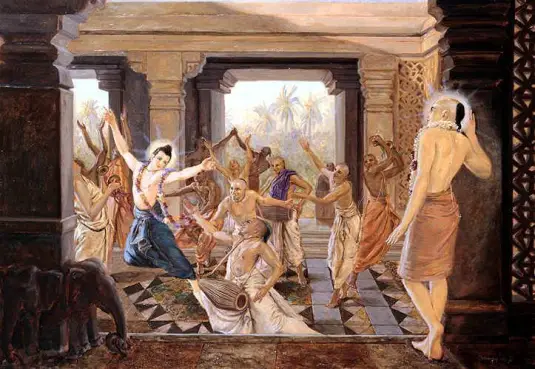
Seeing the lunar eclipse and laughing, Advaita Ācārya and Haridāsa Ṭhākura immediately went to the bank of the Ganges and bathed in the river in great jubilation. Taking advantage of the occasion of the lunar eclipse, Advaita Ācārya, by His mental strength, distributed various types of charity to the brāhmaṇas. (100) When he saw that the whole world was jubilant, Haridāsa Ṭhākura, his mind astonished, directly and indirectly expressed himself to Advaita Ācārya: “Your dancing and distributing charity are very pleasing to me. I can understand that there is some special purpose in these actions.” (101)

Ācāryaratna [Candraśekhara] and Śrīvāsa Ṭhākura were overwhelmed with joy, and immediately they went to the bank of the Ganges to bathe in her waters. Their minds full of happiness, they chanted the Hare Kṛṣṇa mantra and gave charity by mental strength. (102) In this way all the devotees, wherever they were situated, in every city and every country, danced, performed saṅkīrtana and gave charity by mental strength on the plea of the lunar eclipse, their minds overwhelmed with joy. (103) All sorts of respectable brāhmaṇa gentlemen and ladies, carrying plates filled with various gifts, came with their presentations. Seeing the newborn child, whose form resembled natural glaring gold, all of them happily offered their blessings. (104)

Dressing themselves as the wives of brāhmaṇas, all the celestial ladies, including the wives of Lord Brahmā, Lord Śiva, Lord Nṛsiṁhadeva, King Indra and Vasiṣṭha Ṛṣi, along with Rambhā, a dancing girl of heaven, came there with varieties of gifts. (105) In outer space all the demigods, including the inhabitants of Gandharvaloka, Siddhaloka and Cāraṇaloka, offered their prayers and danced to the accompaniment of music, songs and the beating of drums. Similarly, in Navadvīpa city all the professional dancers, musicians and blessers gathered together, dancing in great jubilation. (106) No one could understand who was coming and who was going, who was dancing and who was singing. Nor could they understand one another’s language. Yet all unhappiness and lamentation were immediately dissipated, and people became all- jubilant. Thus Jagannātha Miśra was also overwhelmed with joy. (107)

Candraśekhara Ācārya and Śrīvāsa Ṭhākura both came to Jagannātha Miśra and drew his attention in various ways. They performed the ritualistic ceremonies prescribed at the time of birth according to religious principles. Jagannātha Miśra also gave varieties of charity. (108) Whatever riches Jagannātha Miśra collected in the form of gifts and presentations, and whatever he had in his house, he distributed among the brāhmaṇas, professional singers, dancers, bhāṭas and the poor. He honored them all by giving them riches in charity. (109) The wife of Śrīvāsa Ṭhākura, whose name was Mālinī, accompanied by the wife of Candraśekhara [Ācāryaratna] and other ladies, came there in great happiness to worship the baby with paraphernalia such as vermilion, turmeric, oil, fused rice, bananas and coconuts. (110)

One day shortly after Lord Caitanya Mahāprabhu was born, Advaita Ācārya’s wife, Sītādevī, who is worshipable by the whole world, took her husband’s permission and went to see that topmost child with all kinds of gifts and presentations. (111) She brought different kinds of golden ornaments, including armlets, necklaces, anklets and bangles for the hands. (112) There were also tiger nails set in gold, waist decorations of silk and lace, ornaments for the hands and legs, nicely printed silken saris, and a child’s garment, also made of silk. Many other riches, including gold and silver coins, were also presented to the child. (113)

Riding in a palanquin covered with cloth and accompanied by maidservants, Sītā Ṭhākurāṇī came to the house of Jagannātha Miśra, bringing with her many auspicious articles such as fresh grass, paddy, gorocana, turmeric, kuṅkuma and sandalwood. All these presentations filled a large basket. (114) When Sītā Ṭhākurāṇī came to the house of Śacīdevī, bringing with her many kinds of eatables, dresses and other gifts, she was astonished to see the newborn child, for she appreciated that except for a difference in color, the child was directly Kṛṣṇa of Gokula Himself. (115) Seeing the transcendental bodily effulgence of the child, each of His nicely constructed limbs full of auspicious signs and resembling a form of gold, Sītā Ṭhākurāṇī was very pleased, and because of her maternal affection, she felt as if her heart were melting. (116)

She blessed the newborn child by placing fresh grass and paddy on His head and saying, “May You be blessed with a long duration of life.” But being afraid of ghosts and witches, she gave the child the name Nimāi. (117) On the day the mother and son bathed and left the maternity home, Sītā Ṭhākurāṇī gave them all kinds of ornaments and garments and then also honored Jagannātha Miśra. Then Sītā Ṭhākurāṇī, being honored by mother Śacīdevī and Jagannātha Miśra, was greatly happy within her mind, and thus she returned home. (118) In this way mother Śacīdevī and Jagannātha Miśra, having obtained a son who was the husband of the goddess of fortune, had all their desires fulfilled. Their house was always filled with riches and grains. As they saw the beloved body of Śrī Caitanya Mahāprabhu, day after day their pleasure increased. (119)

Jagannātha Miśra was an ideal Vaiṣṇava. He was peaceful, restrained in sense gratification, pure and controlled. Therefore he had no desire to enjoy material opulence. Whatever money came because of the influence of his transcendental son, he gave it in charity to the brāhmaṇas for the satisfaction of Viṣṇu. (120) After calculating the birth moment of Lord Caitanya Mahāprabhu, Nīlāmbara Cakravartī privately said to Jagannātha Miśra that he saw all the different symptoms of a great personality in both the body and birth moment of the child. Thus he understood that in the future this child would deliver all the three worlds. (121) In this way Lord Caitanya Mahāprabhu, out of His causeless mercy, made His advent in the house of Śacīdevī. Lord Caitanya is very merciful to anyone who hears this narration of His birth, and thus such a person attains the lotus feet of the Lord. (122)

Anyone who attains a human body but does not take to the cult of Śrī Caitanya Mahāprabhu is baffled in his opportunity. Amṛtadhunī is a flowing river of the nectar of devotional service. If after getting a human body one drinks the water in a poison pit of material happiness instead of the water of such a river, it would be better for him not to have lived, but to have died long ago. (123) Taking on my head as my own property the lotus feet of Śrī Caitanya Mahāprabhu, Nityānanda Prabhu, Ācārya Advaitacandra, Svarūpa Dāmodara, Rūpa Gosvāmī and Raghunātha dāsa Gosvāmī, I, Kṛṣṇadāsa Kavirāja Gosvāmī, have thus described the advent of Śrī Caitanya Mahāprabhu.(124)

Chaitanya Charitamrta | Adi Lila | Chapter 13 | Section 36

0

My dear devotees of Lord Caitanya, let me now write the codes of the Adi-lila in brief because it is not possible to describe these pastimes in full. (51) To fulfill a particular desire within His mind, Lord Kṛṣṇa, Vrajendra- kumāra, decided to descend to this planet after mature contemplation. (52) Lord Kṛṣṇa therefore first allowed His family of superiors to descend to the earth. I shall try to describe them in brief because it is not possible to describe them fully. (53)

Lord Śrī Kṛṣṇa, before appearing as Lord Caitanya, requested these devotees to precede Him: Śrī Śacīdevī, Jagannātha Miśra, Mādhavendra Purī, Keśava Bhāratī, Īśvara Purī, Advaita Ācārya, Śrīvāsa Paṇḍita, Ācāryaratna, Vidyānidhi and Ṭhākura Haridāsa. (54-55) There was also Śrī Upendra Miśra, a resident of the district of Śrīhaṭṭa. He was a great devotee of Lord Viṣṇu, a learned scholar, a rich man and a reservoir of all good qualities. (56)

Upendra Miśra had seven sons, who were all saintly and most influential: (1) Kaṁsāri, (2) Paramānanda, (3) Padmanābha, (4) Sarveśvara, (5) Jagannātha, (6) Janārdana and (7) Trailokyanātha. Jagannātha Miśra, the fifth son, decided to reside on the bank of the Ganges at Nadia.(57-58) Jagannātha Miśra was designated as Purandara. Exactly like Nanda Mahārāja and Vasudeva, he was an ocean of all good qualities. (59) His wife, Śrīmatī Śacīdevī, was a chaste woman highly devoted to her husband. Śacīdevī’s father’s name was Nīlāmbara, and his surname was Cakravartī. (60)

In Rāḍhadeśa, the part of Bengal where the Ganges is not visible, Nityānanda Prabhu, Gaṅgādāsa Paṇḍita, Murāri Gupta and Mukunda took birth. (61) Lord Kṛṣṇa, Vrajendra- kumāra, first caused countless devotees to appear, and at last He appeared Himself. (62) Before the appearance of Lord Caitanya Mahāprabhu, all the devotees of Navadvīpa used to gather in the house of Advaita Ācārya.(63) In these meetings of the Vaiṣṇavas, Advaita Ācārya used to recite the Bhagavad- gītā and Śrīmad- Bhāgavatam, decrying the paths of philosophical speculation and fruitive activity and establishing the superexcellence of devotional service. (64)

In all the revealed scriptures of Vedic culture, devotional service to Lord Kṛṣṇa is explained throughout. Therefore devotees of Lord Kṛṣṇa do not recognize the processes of philosophical speculation, mystic yoga, unnecessary austerity and so- called religious rituals. They do not accept any process but devotional service. (65) In the house of Advaita Ācārya, all the Vaiṣṇavas took pleasure in always talking of Kṛṣṇa, always worshiping Kṛṣṇa and always chanting the Hare Kṛṣṇa mahā- mantra. (66) But Śrī Advaita Ācārya Prabhu felt pained to see all the people without Kṛṣṇa consciousness simply merging in material sense enjoyment. (67) Seeing the condition of the world, He began to think seriously of how all these people could be delivered from the clutches of māyā. (68)

Śrīla Advaita Ācārya Prabhu thought, “If Kṛṣṇa Himself appears in order to distribute the cult of devotional service, then only will liberation be possible for all people.” (69) With this consideration, Advaita Ācārya Prabhu, promising to cause Lord Kṛṣṇa to descend, began to worship the Supreme Personality of Godhead, Kṛṣṇa, with tulasī leaves and water of the Ganges. (70) By loud cries He invited Kṛṣṇa to appear, and this repeated invitation attracted Lord Kṛṣṇa to descend. (71) Before the birth of Lord Caitanya Mahāprabhu, eight daughters took birth one after another from the womb of Śacīmātā, the wife of Jagannātha Miśra. But just after their birth, they all died. (72)

Jagannātha Miśra was very unhappy at the death of his children one after another. Therefore, desiring a son, he worshiped the lotus feet of Lord Viṣṇu. (73) After this, Jagannātha Miśra got a son of the name Viśvarūpa, who was most powerful and highly qualified because He was an incarnation of Baladeva. (74) The expansion of Baladeva known as Saṅkarṣaṇa in the spiritual world is the ingredient and immediate cause of this material cosmic manifestation. (75) The gigantic universal form is called the Viśvarūpa incarnation of Mahā- saṅkarṣaṇa. Thus we do not find anything within this cosmic manifestation except the Lord Himself. (76)

“As the threads in a cloth spread both lengthwise and breadthwise, so the Supreme Personality of Godhead exists directly and indirectly within everything we see in this cosmic manifestation. This is not very wonderful for Him.” (77) Because Mahā- saṅkarṣaṇa is the ingredient and efficient cause of the cosmic manifestation, He is present in every detail of it. Lord Caitanya therefore called Him His elder brother. The two brothers are known as Kṛṣṇa and Balarāma in the spiritual world, but at the present moment they are Caitanya and Nitāi. Therefore the conclusion is that Nityānanda Prabhu is the original Saṅkarṣaṇa, Baladeva. (78)

The husband and wife [Jagannātha Miśra and Śacīmātā], having gotten Viśvarūpa as their son, were very pleased within their minds. Because of their pleasure, they specifically began to serve the lotus feet of Govinda. (79) In the month of January in the year 1406 of the Śaka Era (A.D. 1485), Lord Kṛṣṇa entered the bodies of both Jagannātha Miśra and Śacī. (80) Jagannātha Miśra said to Śacīmātā, “I see wonderful things! Your body is effulgent, and it appears as if the goddess of fortune were now staying personally in my home. (81) “Anywhere and everywhere I go, all people offer me respect. Even without my asking, they voluntarily give me riches, clothing and paddy.” (82)

Śacīmātā told her husband, “I see wonderfully brilliant human beings appearing in outer space, as if offering prayers.” (83) Jagannātha Miśra then replied, “In a dream I saw the effulgent abode of the Lord enter my heart. (84) “From my heart it entered your heart. I therefore understand that a great personality will soon take birth.” (85) After this conversation, both husband and wife were very jubilant, and together they rendered service to the household śālagrāma- śilā. (86)In this way the pregnancy approached its thirteenth month, but still there was no sign of the delivery of the child. Thus Jagannātha Miśra became greatly apprehensive. (87)

Nīlāmbara Cakravartī [the grandfather of Śrī Caitanya Mahāprabhu] then did an astrological calculation and said that in that very month, taking advantage of an auspicious moment, the child would take birth. (88) Thus in the year 1407 of the Śaka Era [A.D. 1486], in the month of Phālguna [February March], in the evening of the full- moon day, the desired auspicious moment arrived. (89)[According to the Jyotir- veda, or Vedic astrology, the auspicious birth moment is described as follows:] The moon was in Leo [the figure of the lion in the zodiac], Leo was the ascendant, several planets were strongly positioned, and the ṣaḍ- varga and aṣṭa- varga showed all- auspicious influences. (90)

When the spotless moon of Caitanya Mahāprabhu became visible, what would be the need for a moon full of black marks on its body? (91) Considering this, Rāhu, the black planet, covered the full moon, and immediately vibrations of “Kṛṣṇa! Kṛṣṇa! Hari!” inundated the three worlds. (92) All people thus chanted the Hare Kṛṣṇa mahā- mantra during the lunar eclipse, and their minds were struck with wonder. (93) When the whole world was thus chanting the holy name of the Supreme Personality of Godhead, Kṛṣṇa in the form of Gaurahari advented Himself on the earth. (94)

The whole world was pleased. While the Hindus chanted the holy name of the Lord, the non- Hindus, especially the Muslims, jokingly imitated the words. (95) While all the ladies vibrated the holy name of Hari on earth, in the heavenly planets dancing and music were going on, for the demigods were very curious. (96) In this atmosphere, all the ten directions became jubilant, as did the waves of the rivers. Moreover, all beings, moving and nonmoving, were overwhelmed with transcendental bliss. (97)

Thus by His causeless mercy the full moon, Gaurahari, rose in the district of Nadia, which is compared to Udayagiri, where the sun first becomes visible. His rising in the sky dissipated the darkness of sinful life, and thus the three worlds became joyful and chanted the holy name of the Lord. (98) At that time Śrī Advaita Ācārya Prabhu, in His own house at Śāntipura, was dancing in a pleasing mood. Taking Haridāsa Ṭhākura with Him, He danced and loudly chanted Hare Kṛṣṇa. But why they were dancing, no one could understand. (99)

Chaitanya Charitamrta | Adi Lila | Chapter 12 | Section 34

0

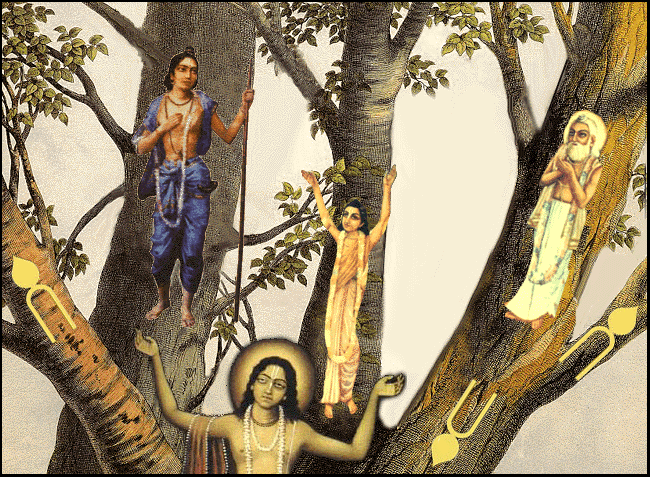
The followers of Śrī Advaita Prabhu were of two kinds. Some were real followers, and the others were false. Rejecting the false followers, I offer my respectful obeisances to Śrī Advaita Ācārya’s real followers, whose life and soul was Śrī Caitanya Mahāprabhu. (1) All glories to Śrī Caitanya Mahāprabhu! All glories to Lord Nityānanda! All glories to Śrī Advaita Prabhu! All of Them are glorious. (2) I offer my respectful obeisances to the all- glorious Advaita Prabhu, who forms the second branch of the eternal Caitanya tree, and to His followers, who form His subbranches. (3)

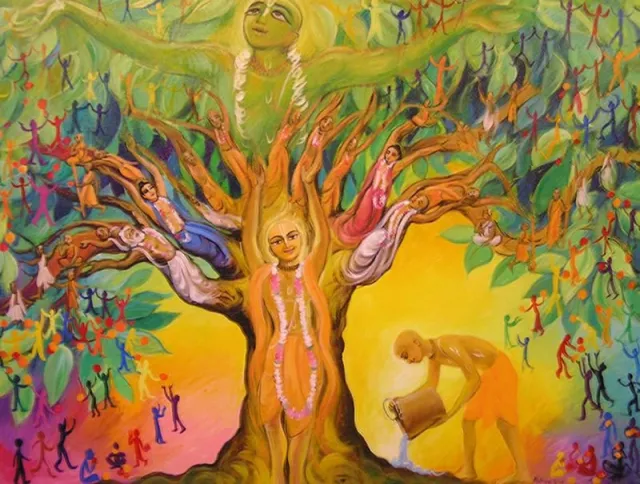
Śrī Advaita Prabhu was the second big branch of the tree. There are many subbranches, but it is impossible to mention them all. (4) Śrī Caitanya Mahāprabhu was also the gardener, and as He poured the water of His mercy on the tree, all the branches and subbranches grew, day after day. (5) The fruits of love of Godhead that grew on those branches of the Caitanya tree were so large that they flooded the entire world with love of Kṛṣṇa. (6) As the trunk and branches were watered, the branches and subbranches spread lavishly, and the tree grew full with fruits and flowers. (7) At first all the followers of Advaita Ācārya shared a single opinion. But later they followed two different opinions, as ordained by providence. (8)

Some of the disciples strictly accepted the orders of the ācārya, and others deviated, independently concocting their own opinions under the spell of daivī- māyā. (9) The order of the spiritual master is the active principle in spiritual life. Anyone who disobeys the order of the spiritual master immediately becomes useless. (10) There is no need to name those who are useless. I have mentioned them only to distinguish them from the useful devotees. (11) Paddy is mixed with straw at first, and one must fan it to separate the paddy from the straw. (12)

A big branch of Advaita Ācārya was His son Acyutānanda. From the beginning of his life he engaged in the service of the lotus feet of Lord Caitanya. (13) When Acyutānanda heard from his father that Keśava Bhāratī was the spiritual master of Lord Caitanya Mahāprabhu, he was very unhappy. (14) He told his father, “Your instruction that Keśava Bhāratī is the spiritual master of Caitanya Mahāprabhu will spoil the entire country. (15) “Lord Caitanya Mahāprabhu is the spiritual master of the fourteen worlds, but You say that someone else is His spiritual master. This is not supported by any revealed scripture.” (16)

When Advaita Ācārya heard this statement from His five- year- old son Acyutānanda, He felt great satisfaction because of his conclusive judgment. (17) Kṛṣṇa Miśra was a son of Advaita Ācārya. Lord Caitanya Mahāprabhu always sat in his heart. (18) Śrī Gopāla was another son of Śrī Advaita Ācārya Prabhu. Now just hear about his characteristics, for they are all very wonderful. (19) When Lord Caitanya personally cleansed the Guṇḍicā- mandira in Jagannātha Purī, Gopāla danced in front of the Lord with great love and happiness. (20)

While Lord Caitanya Mahāprabhu and Advaita Prabhu chanted the Hare Kṛṣṇa mantra and danced, there were various ecstatic symptoms in Their bodies, and Their minds were very pleased. (21) While all of them danced, Gopāla, dancing and dancing, fainted and fell to the ground unconscious. (22) Advaita Ācārya Prabhu became very unhappy. Taking His son on His lap, He began to chant the Nṛsiṁha mantra for his protection. (23) Advaita Ācārya chanted various mantras, but Gopāla did not come to consciousness. Thus all the Vaiṣṇavas present cried in sorrow at His plight. (24)

Lord Caitanya Mahāprabhu then put His hand on the chest of Gopāla and told him, “My dear Gopāla, get up and chant the holy name of the Lord!” (25) When he heard this sound and felt the touch of the Lord, Gopāla immediately got up, and all the Vaiṣṇavas chanted the Hare Kṛṣṇa mahā- mantra in jubilation. (26) The other sons of Advaita Ācārya were Śrī Balarāma, Svarūpa and Jagadīśa. (27) Advaita Ācārya’s very confidential servant named Kamalākānta Viśvāsa knew all the dealings of Advaita Ācārya. (28) When Kamalākānta Viśvāsa was in Jagannātha Purī, he sent a note through someone to Mahārāja Pratāparudra. (29)

No one knew of that note, but somehow or other it reached the hands of Śrī Caitanya Mahāprabhu. (30) That note established Advaita Ācārya as an incarnation of the Supreme Personality of Godhead. (31) But it also mentioned that Advaita Ācārya had recently incurred a debt of about three hundred rupees that Kamalākānta Viśvāsa wanted to liquidate. (32) Lord Caitanya Mahāprabhu became unhappy upon reading the note, although His face still shone as brightly as the moon. Thus, smiling, He spoke as follows. (33)

“He has established Advaita Ācārya as an incarnation of the Supreme Personality of Godhead. There is nothing wrong in this, for He is indeed the Lord Himself. (34) “But he has made the incarnation of Godhead a poverty- stricken beggar. Therefore I shall punish him in order to correct him.” (35) The Lord ordered Govinda, “From today on, do not allow that bāuliyā Kamalākānta Viśvāsa to come here.” (36) When Kamalākānta Viśvāsa heard about this punishment by Śrī Caitanya Mahāprabhu, he was very unhappy, but when Advaita Prabhu heard about it, He was greatly pleased. (37)

Seeing Kamalākānta Viśvāsa unhappy, Advaita Ācārya Prabhu told him, “You are greatly fortunate to have been punished by the Supreme Lord, the Personality of Godhead, Lord Caitanya Mahāprabhu. (38) “Formerly Lord Caitanya Mahāprabhu always respected Me as His senior, but I did not like such respect. Therefore, My mind being afflicted by unhappiness, I made a plan. (39) “Thus I expounded the Yoga- vāśiṣṭha, which considers liberation the ultimate goal of life. For this the Lord became angry at Me and treated Me with apparent disrespect. (40) “When chastised by Lord Caitanya, I was very happy to receive a punishment similar to that awarded Śrī Mukunda. (41)

“A similar punishment was awarded to mother Śacīdevī. Who could be more fortunate than she to receive such punishment?” (42) After pacifying Kamalākānta Viśvāsa in this way, Śrī Advaita Ācārya Prabhu went to see Caitanya Mahāprabhu. (43) Śrī Advaita Ācārya told Lord Caitanya, “I cannot understand Your transcendental pastimes. You have shown more favor to Kamalākānta than You generally show to Me. (44) “The favor You have shown Kamalākānta is so great that even to Me You have never shown such favor. What offense have I committed at Your lotus feet so as not to be shown such favor?” (45)

Hearing this, Lord Caitanya Mahāprabhu laughed with satisfaction and immediately called Kamalākānta Viśvāsa. (46) Advaita Ācārya then said to Caitanya Mahāprabhu, “Why have You called back this man and allowed him to see You? He has cheated Me in two ways.” (47) When Caitanya Mahāprabhu heard this, His mind was satisfied. Only They could understand each other’s minds. (48) Lord Caitanya Mahāprabhu instructed Kamalākānta, “You are a bāuliyā, one who does not know things as they are. Why do you act in this way? Why do you invade the privacy of Advaita Ācārya and damage His religious principles? (49)

“Advaita Ācārya, My spiritual master, should never accept charity from rich men or kings, because if a spiritual master accepts money or grains from such materialists his mind becomes polluted. (50) “When one’s mind is polluted, it is very difficult to remember Kṛṣṇa, and when remembrance of Lord Kṛṣṇa is hampered, one’s life is unproductive. (51) “Thus one becomes unpopular in the eyes of the people in general, for this damages his religiosity and fame. A Vaiṣṇava, especially one who acts as a spiritual master, must not act in such a way. One should always be conscious of this fact.” (52)

When Caitanya Mahāprabhu gave this instruction to Kamalākānta, all present considered it to be meant for everyone. Thus Advaita Ācārya was greatly pleased. (53) Only Lord Caitanya Mahāprabhu could understand the intentions of Advaita Ācārya, and Advaita Ācārya appreciated the grave instruction of Lord Caitanya Mahāprabhu. (54) In this statement there are many confidential considerations. I do not write of them all, fearing an unnecessary increase in the volume of the book. (55) The fifth branch of Advaita Ācārya was Śrī Yadunandana Ācārya, who had so many branches and subbranches that it is impossible to write of them. (56)

Śrī Yadunandana Ācārya was a student of Vāsudeva Datta, and he received all his mercy. Therefore he could accept Lord Caitanya’s lotus feet, from all angles of vision, as the supreme shelter. (57) Bhāgavata Ācārya, Viṣṇudāsa Ācārya, Cakrapāṇi Ācārya and Ananta Ācārya were the sixth, seventh, eighth and ninth branches of Advaita Ācārya. (58) Nandinī, Kāmadeva, Caitanya dāsa, Durlabha Viśvāsa and Vanamālī dāsa were the tenth, eleventh, twelfth, thirteenth and fourteenth branches of Śrī Advaita Ācārya. (59) Jagannātha Kara, Bhavanātha Kara, Hṛdayānanda Sena and Bholānātha dāsa were the fifteenth, sixteenth, seventeenth and eighteenth branches of Advaita Ācārya. (60)

Yādava dāsa, Vijaya dāsa, Janārdana dāsa, Ananta dāsa, Kānu Paṇḍita and Nārāyaṇa dāsa were the nineteenth, twentieth, twenty- first, twenty- second, twenty- third and twenty- fourth branches of Advaita Ācārya. (61) Śrīvatsa Paṇḍita, Haridāsa Brahmacārī, Puruṣottama Brahmacārī and Kṛṣṇadāsa were the twenty- fifth, twenty- sixth, twenty- seventh and twenty- eighth branches of Advaita Ācārya. (62) Puruṣottama Paṇḍita, Raghunātha, Vanamālī Kavicandra and Vaidyanātha were the twenty- ninth, thirtieth, thirty- first and thirty- second branches of Advaita Ācārya. (63)

Lokanātha Paṇḍita, Murāri Paṇḍita, Śrī Haricaraṇa and Mādhava Paṇḍita were the thirty- third, thirty- fourth, thirty- fifth and thirty- sixth branches of Advaita Ācārya. (64) Vijaya Paṇḍita and Śrīrāma Paṇḍita were two important branches of Advaita Ācārya. There are innumerable branches, but I am unable to mention them all. (65) The Advaita Ācārya branch received the water supplied by the original gardener, Śrī Caitanya Mahāprabhu. In this way, the subbranches were nourished, and their fruits and flowers grew luxuriantly. (66) After the disappearance of Lord Caitanya Mahāprabhu, some of the branches, for unfortunate reasons, deviated from His path. (67)

Some branches did not accept the original trunk that vitalized and maintained the entire tree. When they thus became ungrateful, the original trunk was angry at them. (68) Thus Lord Caitanya did not sprinkle upon them the water of His mercy, and they gradually withered and died. (69) A person without Kṛṣṇa consciousness is no better than dry wood or a dead body. He is understood to be dead while living, and after death he is punishable by Yamarāja. (70)

Not only the misguided descendants of Advaita Ācārya but anyone who is against the cult of Śrī Caitanya Mahāprabhu should be considered an atheist subject to be punished by Yamarāja. (71) Be he a learned scholar, a great ascetic, a successful householder or a famous sannyāsī, one who is against the cult of Śrī Caitanya Mahāprabhu is destined to suffer the punishment meted out by Yamarāja. (72) The descendants of Advaita Ācārya who accepted the path of Śrī Acyutānanda were all great devotees. (73) By the mercy of Advaita Ācārya, the devotees who strictly followed the path of Caitanya Mahāprabhu attained the shelter of Lord Caitanya’s lotus feet without difficulty. (74)

It should be concluded, therefore, that the path of Acyutānanda is the essence of spiritual life. Those who did not follow this path simply scattered. (75) I therefore offer my respectful obeisances millions of times to Acyutānanda’s actual followers, whose life and soul was Śrī Caitanya Mahāprabhu. (76) Thus I have briefly described the three branches [Acyutānanda, Kṛṣṇa Miśra and Gopāla] of Śrī Advaita Ācārya’s descendants. (77) There are multifarious branches and subbranches of Advaita Ācārya. It is very difficult to enumerate them fully. I have simply given a glimpse of the whole trunk and its branches and subbranches. (78)

After describing the branches and subbranches of Advaita Ācārya, I shall now attempt to describe some of the descendants of Śrī Gadādhara Paṇḍita, the most important among the branches. (79) The chief branches of Śrī Gadādhara Paṇḍita were (1) Śrī Dhruvānanda, (2) Śrīdhara Brahmacārī, (3) Haridāsa Brahmacārī and (4) Raghunātha Bhāgavata Ācārya. (80) The fifth branch was Ananta Ācārya; the sixth, Kavi Datta; the seventh, Nayana Miśra; the eighth, Gaṅgāmantrī; the ninth, Māmu Ṭhākura; and the tenth, Kaṇṭhābharaṇa. (81) The eleventh branch of Gadādhara Gosvāmī was Bhūgarbha Gosāñi, and the twelfth was Bhāgavata dāsa. Both of them went to Vṛndāvana and resided there for life. (82)

The thirteenth branch was Vāṇīnātha Brahmacārī, and the fourteenth was Vallabha- caitanya dāsa. Both of these great personalities were always filled with love of Kṛṣṇa. (83) The fifteenth branch was Śrīnātha Cakravartī; the sixteenth, Uddhava; the seventeenth, Jitāmitra; and the eighteenth, Jagannātha dāsa. (84) The nineteenth branch was Śrī Hari Ācārya; the twentieth, Sādipuriyā – Puṣpagopāla. Gopāla; the twenty first, Kṛṣṇadāsa Brahmacārī; and the twenty- second, Puṣpagopāla (85) The twenty- third branch was Śrīharṣa; the twenty- fourth, Raghu Miśra; the twenty- fifth, Lakṣmīnātha Paṇḍita; the twenty- sixth, Baṅgavāṭī Caitanya dāsa; and the twenty- seventh, Raghunātha. (86)

The twenty- eighth branch was Amogha Paṇḍita; the twenty- ninth, Hastigopāla; the thirtieth, Caitanya- vallabha; the thirty- first, Yadu Gāṅguli; and the thirty- second, Maṅgala Vaiṣṇava. (87) Śivānanda Cakravartī, the thirty- third branch, who always lived in Vṛndāvana with firm conviction, is considered an important branch of Gadādhara Paṇḍita. (88) Thus I have briefly described the branches and subbranches of Gadādhara Paṇḍita. There are still many more that I have not mentioned here. (89) All the followers of Gadādhara Paṇḍita are considered great devotees because they have Lord Śrī Caitanya Mahāprabhu as their life and soul. (90)

Simply by remembering the names of all these branches and subbranches of the three trunks I have described [Nityānanda, Advaita and Gadādhara], one attains freedom from the entanglement of material existence. (91) Simply by remembering the names of all these Vaiṣṇavas, one can attain the lotus feet of Śrī Caitanya Mahāprabhu. Indeed, simply by remembering their holy names, one achieves the fulfillment of all desires. (92)

Therefore, offering my obeisances at the lotus feet of them all, I shall describe the pastimes of the gardener, Śrī Caitanya Mahāprabhu, in chronological order. (93) The ocean of the pastimes of Lord Caitanya Mahāprabhu is immeasurable and unfathomable. Who can have the courage to measure that great ocean? (94) It is not possible to dip into that great ocean, but its sweet mellow fragrance attracts my mind. I therefore stand on the shore of that ocean to try to taste but a drop of it. (95) Praying at the lotus feet of Śrī Rūpa and Śrī Raghunātha, always desiring their mercy, I, Kṛṣṇadāsa, narrate Śrī Caitanya- caritāmṛta, following in their footsteps. (96)


Chaitanya Charitamrta | Adi Lila | Chapter 11 | Section 33

0

After offering my obeisances unto all the devotees of Śrī Nityānanda Prabhu, who are like bumblebees collecting honey from His lotus feet, I shall try to describe those who are the most prominent. (1) All glories to Śrī Caitanya Mahāprabhu! Anyone who has taken shelter at His lotus feet is glorious. (2) All glories to Śrī Advaita Prabhu, Nityānanda Prabhu and all the devotees of Lord Caitanya Mahāprabhu! (3) Śrī Nityānanda Prabhu is the topmost branch of the indestructible tree of eternal love of Godhead, Śrī Kṛṣṇa Caitanya Mahāprabhu. I offer my respectful obeisances to all the subbranches of that topmost branch. (4)

Śrī Nityānanda Prabhu is an extremely heavy branch of the Śrī Caitanya tree. From that branch grow many branches and subbranches. (5) Watered by the desire of Śrī Caitanya Mahāprabhu, these branches and subbranches have grown unlimitedly and covered the entire world with fruits and flowers. (6) These branches and subbranches of devotees are innumerable and unlimited. Who could count them? For my personal purification I shall try to enumerate only the most prominent among them. (7) After Nityānanda Prabhu, the greatest branch is Vīrabhadra Gosāñi, who also has innumerable branches and subbranches. It is not possible to describe them all. (8)

Although Vīrabhadra Gosāñi was the Supreme Personality of Godhead, He presented Himself as a great devotee. And although the Supreme Godhead is transcendental to all Vedic injunctions, He strictly followed the Vedic rituals. (9) He is the main pillar in the hall of devotional service erected by Śrī Caitanya Mahāprabhu. He knew within Himself that He acted as the Supreme Lord Viṣṇu, but externally He was prideless. (10) It is by the glorious mercy of Śrī Vīrabhadra Gosāñi that people all over the world now have the chance to chant the names of Caitanya and Nityānanda. (11)

I therefore take shelter of the lotus feet of Vīrabhadra Gosāñi, so that by His mercy my great desire to write Śrī Caitanya- caritāmṛta will be properly guided. (12) Two devotees of Lord Caitanya named Śrī Rāmadāsa and Gadādhara dāsa always lived with Śrī Vīrabhadra Gosāñi. (13)When Nityānanda Prabhu was ordered to go to Bengal to preach, these two devotees [Śrī Rāmadāsa and Gadādhara dāsa] were ordered to go with Him. Thus they are sometimes counted among the devotees of Lord Caitanya and sometimes among the devotees of Lord Nityānanda. Similarly, Mādhava Ghoṣa and Vāsudeva Ghoṣa belonged to both groups of devotees simultaneously. (14-15)

Rāmadāsa, one of the chief branches, was full of fraternal love of Godhead. He made a flute from a stick with sixteen knots. (16) Srīla Gadādhara dāsa was always fully absorbed in ecstasy as a gopī. In his house Lord Nityānanda enacted the drama Dāna- keli. (17) Śrī Mādhava Ghoṣa was a principal performer of kīrtana. While he sang, Nityānanda Prabhu danced. (18) When Vāsudeva Ghoṣa described Lord Caitanya and Nityānanda while performing kīrtana, even wood and stone would melt upon hearing it. (19) There were many extraordinary activities performed by Murāri, a great devotee of Lord Caitanya Mahāprabhu. Sometimes in his ecstasy he would slap the cheek of a tiger, and sometimes he would play with a venomous snake. (20)

All the associates of Lord Nityānanda were formerly cowherd boys in Vrajabhūmi. Their symbolic representations were the horns and sticks they carried, their cowherd dress and the peacock plumes on their heads. (21) The physician Raghunātha, also known as Upādhyāya, was so great a devotee that simply by seeing him one would awaken his dormant love of Godhead. (22) Sundarānanda, another branch of Śrī Nityānanda Prabhu, was Lord Nityānanda’s most intimate servant. Lord Nityānanda Prabhu perceived the life of Vrajabhūmi in his company. (23)

Kamalākara Pippalāi is said to have been the third gopāla. His behavior and love of Godhead were uncommon, and thus he is celebrated all over the world. (24) Sūryadāsa Sarakhela and his younger brother Kṛṣṇadāsa Sarakhela both possessed firm faith in Nityānanda Prabhu. They were a reservoir of love of Godhead. (25) Gaurīdāsa Paṇḍita, the emblem of the most elevated devotional service in love of Godhead, had the greatest potency to receive and deliver such love. (26) Making Lord Caitanya and Lord Nityānanda the Lords of his life, Gaurīdāsa Paṇḍita sacrificed everything for the service of Lord Nityānanda, even the fellowship of his own family. (27)

The thirteenth important devotee of Śrī Nityānanda Prabhu was Paṇḍita Purandara, who moved in the ocean of love of Godhead just like the Mandara Hill. (28) Parameśvara dāsa, said to be the fifth gopāla of kṛṣṇa- līlā, completely surrendered to the lotus feet of Nityānanda. Anyone who remembers his name, Parameśvara dāsa, will get love of Kṛṣṇa very easily. (29) Jagadīśa Paṇḍita, the fifteenth branch of Lord Nityānanda’s followers, was the deliverer of the entire world. Devotional love of Kṛṣṇa showered from him like torrents of rain. (30) The sixteenth dear servant of Nityānanda Prabhu was Dhanañjaya Paṇḍita. He was very much renounced and always merged in love of Kṛṣṇa. (31)

Maheśa Paṇḍita, the seventh of the twelve gopālas, was very liberal. In great love of Kṛṣṇa he danced to the beating of a kettledrum like a madman. (32) Puruṣottama Paṇḍita, a resident of Navadvīpa, was the eighth gopāla. He would become almost mad as soon as he heard the holy name of Nityānanda Prabhu. (33) Balarāma dāsa always fully tasted the nectar of love of Kṛṣṇa. Upon hearing the name of Nityānanda Prabhu, formerly cowherd boys in Vrajabhūmi. Their symbolic representations were the horns and sticks they carried, their cowherd dress and the peacock plumes on their heads. (21) The physician Raghunātha, also known as Upādhyāya, was so great a devotee that simply by seeing him one would awaken his dormant love of Godhead. (22)

Sundarānanda, another branch of Śrī Nityānanda Prabhu, was Lord Nityānanda’s most intimate servant. Lord Nityānanda Prabhu perceived the life of Vrajabhūmi in his company. (23) Kamalākara Pippalāi is said to have been the third gopāla. His behavior and love of Godhead were uncommon, and thus he is celebrated all over the world. (24) Sūryadāsa Sarakhela and his younger brother Kṛṣṇadāsa Sarakhela both possessed firm faith in Nityānanda Prabhu. They were a reservoir of love of Godhead. (25) Gaurīdāsa Paṇḍita, the emblem of the most elevated devotional service in love of Godhead, had the greatest potency to receive and deliver such love. (26) Making Lord Caitanya and Lord Nityānanda the Lords of his life, Gaurīdāsa Paṇḍita sacrificed everything for the service of Lord Nityānanda, even the fellowship of his own family. (27)

The thirteenth important devotee of Śrī Nityānanda Prabhu was Paṇḍita Purandara, who moved in the ocean of love of Godhead just like the Mandara Hill. (28) Parameśvara dāsa, said to be the fifth gopāla of kṛṣṇa- līlā, completely surrendered to the lotus feet of Nityānanda. Anyone who remembers his name, Parameśvara dāsa, will get love of Kṛṣṇa very easily. (29) Jagadīśa Paṇḍita, the fifteenth branch of Lord Nityānanda’s followers, was the deliverer of the entire world. Devotional love of Kṛṣṇa showered from him like torrents of rain. (30) The sixteenth dear servant of Nityānanda Prabhu was Dhanañjaya Paṇḍita. He was very much renounced and always merged in love of Kṛṣṇa. (31)

Maheśa Paṇḍita, the seventh of the twelve gopālas, was very liberal. In great love of Kṛṣṇa he danced to the beating of a kettledrum like a madman. (32) Puruṣottama Paṇḍita, a resident of Navadvīpa, was the eighth gopāla. He would become almost mad as soon as he heard the holy name of Nityānanda Prabhu. (33) Balarāma dāsa always fully tasted the nectar of love of Kṛṣṇa. Upon hearing the name of Nityānanda Prabhu, Nakaḍi was the thirty- seventh, Mukunda the thirty- eighth, Sūrya the thirty- ninth, Mādhava the fortieth, Śrīdhara the forty- first, Rāmānanda the forty- second, Jagannātha the forty- third and Mahīdhara the forty- fourth. (48)

Śrīmanta was the forty- fifth, Gokula dāsa the forty- sixth, Hariharānanda the forty- seventh, Śivāi the forty- eighth, Nandāi the forty- ninth and Paramānanda the fiftieth. (49) Vasanta was the fifty- first, Navanī Hoḍa the fifty- second, Gopāla the fifty- third, Sanātana the fifty- fourth, Viṣṇāi the fifty- fifth, Kṛṣṇānanda the fifty- sixth and Sulocana the fifty- seventh. (50) The fifty- eighth great devotee of Lord Nityānanda Prabhu was Kaṁsāri Sena, the fifty- ninth was Rāmasena, the sixtieth was Rāmacandra Kavirāja, and the sixty- first, sixty- second and sixty- third were Govinda, Śrīraṅga and Mukunda, who were all physicians. (51) Among the devotees of Lord Nityānanda Prabhu, Pītāmbara was the sixty- fourth, Mādhavācārya the sixty- fifth, Dāmodara dāsa the sixty- sixth, Śaṅkara the sixty- seventh, Mukunda the sixty- eighth, Jñāna dāsa the sixty- ninth and Manohara the seventieth. (52)

The dancer Gopāla was the seventy- first, Rāmabhadra the seventy- second, Gaurāṅga dāsa the seventy- third, Nṛsiṁha- caitanya the seventy- fourth and Mīnaketana Rāmadāsa the seventy- fifth. (53) Vṛndāvana dāsa Ṭhākura, the son of Śrīmatī Nārāyaṇī, composed Śrī Caitanya- maṅgala [later known as Śrī Caitanya- bhāgavata]. (54) Śrīla Vyāsadeva described the pastimes of Kṛṣṇa in Śrīmad- Bhāgavatam. The Vyāsa of the pastimes of Lord Caitanya Mahāprabhu was Vṛndāvana dāsa. (55) Among all the branches of Śrī Nityānanda Prabhu, Vīrabhadra Gosāñi was the topmost. His subbranches were unlimited. (56) No one can count the unlimited followers of Nityānanda Prabhu. I have mentioned some of them just for my self- purification. (57)

All these branches, the devotees of Lord Nityānanda Prabhu, being full of ripened fruits of love of Kṛṣṇa, distributed these fruits to all they met, flooding them with love of Kṛṣṇa. (58) All these devotees had unlimited strength to deliver unobstructed, unceasing love of Kṛṣṇa. By their own strength they could offer anyone Kṛṣṇa and love of Kṛṣṇa. (59) Nakaḍi was the thirty- seventh, Mukunda the thirty- eighth, Sūrya the thirty- ninth, Mādhava the fortieth, Śrīdhara the forty- first, Rāmānanda the forty- second, Jagannātha the forty- third and Mahīdhara the forty- fourth. (48) Śrīmanta was the forty- fifth, Gokula dāsa the forty- sixth, Hariharānanda the forty- seventh, Śivāi the forty- eighth, Nandāi the forty- ninth and Paramānanda the fiftieth. (49)

Vasanta was the fifty- first, Navanī Hoḍa the fifty- second, Gopāla the fifty- third, Sanātana the fifty- fourth, Viṣṇāi the fifty- fifth, Kṛṣṇānanda the fifty- sixth and Sulocana the fifty- seventh. (50) The fifty- eighth great devotee of Lord Nityānanda Prabhu was Kaṁsāri Sena, the fifty- ninth was Rāmasena, the sixtieth was Rāmacandra Kavirāja, and the sixty- first, sixty- second and sixty- third were Govinda, Śrīraṅga and Mukunda, who were all physicians. (51) Among the devotees of Lord Nityānanda Prabhu, Pītāmbara was the sixty- fourth, Mādhavācārya the sixty- fifth, Dāmodara dāsa the sixty- sixth, Śaṅkara the sixty- seventh, Mukunda the sixty- eighth, Jñāna dāsa the sixty- ninth and Manohara the seventieth. (52)

The dancer Gopāla was the seventy- first, Rāmabhadra the seventy- second, Gaurāṅga dāsa the seventy- third, Nṛsiṁha- caitanya the seventy- fourth and Mīnaketana Rāmadāsa the seventy- fifth. (53) Vṛndāvana dāsa Ṭhākura, the son of Śrīmatī Nārāyaṇī, composed Śrī Caitanya- maṅgala [later known as Śrī Caitanya- bhāgavata]. (54) Śrīla Vyāsadeva described the pastimes of Kṛṣṇa in Śrīmad- Bhāgavatam. The Vyāsa of the pastimes of Lord Caitanya Mahāprabhu was Vṛndāvana dāsa. (55) Among all the branches of Śrī Nityānanda Prabhu, Vīrabhadra Gosāñi was the topmost. His subbranches were unlimited. (56)

No one can count the unlimited followers of Nityānanda Prabhu. I have mentioned some of them just for my self- purification. (57) All these branches, the devotees of Lord Nityānanda Prabhu, being full of ripened fruits of love of Kṛṣṇa, distributed these fruits to all they met, flooding them with love of Kṛṣṇa. (58) All these devotees had unlimited strength to deliver unobstructed, unceasing love of Kṛṣṇa. By their own strength they could offer anyone Kṛṣṇa and love of Kṛṣṇa. (59)

Chaitanya Charitamrta | Adi Lila | Chapter 10 | Section 32

0

I have given a brief description of the devotees of Lord Caitanya in Bengal. Actually His devotees are innumerable. (121) I have especially mentioned all these devotees because they accompanied Lord Caitanya Mahāprabhu in Bengal and Orissa and served Him in many ways. (122) Let me briefly describe some of the devotees of Lord Caitanya Mahāprabhu in Jagannātha Purī. (123) Among the devotees who accompanied the Lord in Jagannātha Purī, two of them-Paramānanda Purī and Svarūpa Dāmodara-were the heart and soul of the Lord. Among the other devotees were Gadādhara, Jagadānanda, Śaṅkara, Vakreśvara, Dāmodara Paṇḍita, Ṭhākura Haridāsa, Raghunātha Vaidya and Raghunātha dāsa. (124-126)

All these devotees were associates of the Lord from the very beginning, and when the Lord took up residence in Jagannātha Purī, they remained there to serve Him faithfully. (127) All the devotees who resided in Bengal used to visit Jagannātha Purī every year to see the Lord. (128) Now let me enumerate the devotees of Bengal who first came to see the Lord at Jagannātha Purī. (129) There was Sārvabhauma Bhaṭṭācārya, one of the biggest branches of the tree of the Lord, and his sister’s husband, Śrī Gopīnātha Ācārya. (130) In the list of devotees at Jagannātha Purī [which begins with Paramānanda Purī, Svarūpa Dāmodara, Sārvabhauma Bhaṭṭācārya and Gopīnātha Ācārya], Kāśī Miśra was the fifth, Pradyumna Miśra the sixth and Bhavānanda Rāya the seventh. Lord Caitanya took great pleasure in meeting with them. (131)

 Embracing Rāya Bhavānanda, the Lord declared to him, “You formerly appeared as Pāṇḍu, and your five sons appeared as the five Pāṇḍavas.” (132) The five sons of Bhavānanda Rāya were Rāmānanda Rāya, Paṭṭanāyaka Gopīnātha, Kalānidhi, Sudhānidhi and Nāyaka Vāṇīnātha. (133) Śrī Caitanya Mahāprabhu told Bhavānanda Rāya, “Your five sons are all My dear devotees. Rāmānanda Rāya and I are one, although our bodies are different.” (134) King Pratāparudra of Orissa, the Oriyā devotees Kṛṣṇānanda and Śivānanda, and Paramānanda Mahāpātra, Bhagavān Ācārya, Brahmānanda Bhāratī, Śrī Śikhi Māhiti and Murāri Māhiti constantly associated with Caitanya Mahāprabhu while He resided in Jagannātha Purī. (135 136) Mādhavīdevī, the seventeenth of the prominent devotees, was the younger sister of Śikhi Māhiti. She is considered to have formerly been a maidservant of Śrīmatī Rādhārāṇī. (137)

 Brahmacārī Kāśīśvara was a disciple of Īśvara Purī, and Śrī Govinda was another of his dear disciples. (138) In the list of prominent devotees at Nīlācala [Jagannātha Purī], Kāśīśvara was the eighteenth and Govinda the nineteenth. They both came to see Caitanya Mahāprabhu at Jagannātha Purī, being thus ordered by Īśvara Purī at the time of his passing away. (139) Both Kāśīśvara and Govinda were Godbrothers of Śrī Caitanya Mahāprabhu, and thus the Lord duly honored them as soon as they arrived. But because Īśvara Purī had ordered them to give Caitanya Mahāprabhu personal service, the Lord accepted their service. (140)

 Govinda cared for the body of Śrī Caitanya Mahāprabhu, whereas Kāśīśvara went in front of the Lord when He went to see Jagannātha in the temple. (141) When Caitanya Mahāprabhu went to the temple of Jagannātha, Kāśīśvara, being very strong, cleared the crowds aside with his hands so that Caitanya Mahāprabhu could pass untouched. (142) Rāmāi and Nandāi, the twentieth and twenty- first among the important devotees in Jagannātha Purī, always assisted Govinda twenty- four hours a day in rendering service to the Lord. (143) Every day Rāmāi filled twenty- two big waterpots, whereas Nandāi personally assisted Govinda. (144)

 The twenty- second devotee, Kṛṣṇadāsa, was born of a pure and respectable brāhmaṇa family. While touring southern India, Lord Caitanya took Kṛṣṇadāsa with Him. (145) As a bona fide devotee, Balabhadra Bhaṭṭācārya, the twenty- third principal associate, acted as the brahmacārī of Śrī Caitanya Mahāprabhu when He toured Mathurā. (146) Baḍa Haridāsa and Choṭa Haridāsa, the twenty- fourth and twenty- fifth devotees in Nīlācala, were good singers who always accompanied Lord Caitanya. (147) Among the devotees who lived with Lord Caitanya Mahāprabhu at Jagannātha Purī, Rāmabhadra Ācārya was the twenty- sixth, Siṁheśvara the twenty- seventh, Tapana Ācārya the twenty- eighth, Raghunātha Bhaṭṭācārya the twenty- ninth and Nīlāmbara the thirtieth. (148)

Siṅgābhaṭṭa was the thirty- first, Kāmābhaṭṭa the thirty- second, Śivānanda the thirty- third and Kamalānanda the thirty- fourth. They all formerly served Śrī Caitanya Mahāprabhu in Bengal, but later these servants left Bengal to live with the Lord in Jagannātha Purī. (149) Acyutānanda, the thirty- fifth devotee, was the son of Advaita Ācārya. He also lived with Lord Caitanya, taking shelter of His lotus feet at Jagannātha Purī. (150) Nirloma Gaṅgādāsa and Viṣṇudāsa were the thirty- sixth and thirty- seventh among the devotees who lived at Jagannātha Purī as servants of Śrī Caitanya Mahāprabhu. (151)

 The prominent devotees at Vārāṇasī were the physician Candraśekhara, Tapana Miśra and Raghunātha Bhaṭṭācārya, Tapana Miśra’s son. When Lord Caitanya came to Vārāṇasī after seeing Vṛndāvana, for two months He lived at the residence of Candraśekhara Vaidya and accepted prasādam at the house of Tapana Miśra. (152-154) When Śrī Caitanya Mahāprabhu stayed at the house of Tapana Miśra, Raghunātha Bhaṭṭa, who was then a boy, washed His dishes and massaged His legs. (155) When Raghunātha grew to be a young man, he visited Lord Caitanya Mahāprabhu at Jagannātha Purī and stayed there for eight months. Sometimes he offered prasādam to the Lord. (156)

Later, by the order of Lord Caitanya, Raghunātha went to Vṛndāvana and remained there under the shelter of Śrīla Rūpa Gosvāmī. (157) While he stayed with Śrīla Rūpa Gosvāmī, his engagement was to recite Śrīmad- Bhāgavatam for him to hear. As a result of this Bhāgavatam recitation, he attained perfectional love of Kṛṣṇa, by which he remained always maddened. (158) I list in this way only a portion of the innumerable devotees of Lord Caitanya. To describe them all fully is not possible. (159) From each branch of the tree have grown hundreds and thousands of subbranches of disciples and granddisciples. (160)

Every branch and subbranch of the tree is full of innumerable fruits and flowers. They inundate the world with the waters of love of Kṛṣṇa. (161) Each and every branch of Śrī Caitanya Mahāprabhu’s devotees has unlimited spiritual power and glory. Even if one had thousands of mouths, it would be impossible to describe the limits of their activities. (162) I have briefly described the devotees of Lord Caitanya Mahāprabhu in different places. Even Lord Śeṣa, who has thousands of mouths, could not list them all. (163) Praying at the lotus feet of Śrī Rūpa and Śrī Raghunātha, always desiring their mercy, I, Kṛṣṇadāsa, narrate Śrī Caitanya- caritāmṛta, following in their footsteps. (164)

Chaitanya Charitamrta | Adi Lila | Chapter 10 | Section 31

0

Śrīla Raghunātha dāsa Gosvāmī, the forty- sixth branch of the tree, was one of the most dear servants of Lord Caitanya Mahāprabhu. He left all his material possessions to surrender completely unto the Lord and live at His lotus feet. (91) When Raghunātha dāsa Gosvāmī approached Śrī Caitanya Mahāprabhu at Jagannātha Purī, the Lord entrusted him to the care of Svarūpa Dāmodara, His secretary. Thus they both engaged in the confidential service of the Lord. (92) He rendered confidential service to the Lord for sixteen years at Jagannātha Purī, and after the disappearance of both the Lord and Svarūpa Dāmodara, he left Jagannātha Purī and went to Vṛndāvana. (93)

 Śrīla Raghunātha dāsa Gosvāmī intended to go to Vṛndāvana to see the lotus feet of Rūpa and Sanātana and then give up his life by jumping from Govardhana Hill. (94) Thus Śrīla Raghunātha dāsa Gosvāmī came to Vṛndāvana, visited Śrīla Rūpa Gosvāmī and Sanātana Gosvāmī and offered them his obeisances. (95) These two brothers, however, did not allow him to die. They accepted him as their third brother and kept him in their company. (96) Because Raghunātha dāsa Gosvāmī was an assistant to Svarūpa Dāmodara, he knew much about the external and internal features of the pastimes of Lord Caitanya. Thus the two brothers Rūpa and Sanātana always used to hear of this from him. (97)

 Raghunātha dāsa Gosvāmī gradually gave up all food and drink but a few drops of buttermilk. (98) As a daily duty, he regularly offered one thousand obeisances to the Lord, chanted at least one hundred thousand holy names and offered obeisances to two thousand Vaiṣṇavas. (99) Day and night he rendered service within his mind to Rādhā- Kṛṣṇa, and for three hours a day he discoursed about the character of Lord Caitanya Mahāprabhu. (100) Śrī Raghunātha dāsa Gosvāmī took three baths daily in the Rādhā- kuṇḍa lake. As soon as he found a Vaiṣṇava residing in Vṛndāvana, he would embrace him and give him all respect. (101)

 He engaged himself in devotional service for more than twenty- two and a half hours a day, and for less than two hours he slept, although on some days that also was not possible. (102) I am struck with wonder when I hear about the devotional service he executed. I accept Śrīla Rūpa Gosvāmī and Raghunātha dāsa Gosvāmī as my guides. (103) I shall later explain very elaborately how all these devotees met Śrī Caitanya Mahāprabhu. (104) Śrī Gopāla Bhaṭṭa Gosvāmī, the forty- seventh branch, was one of the great and exalted branches of the tree. He always engaged in discourses about love of Godhead in the company of Rūpa Gosvāmī and Sanātana Gosvāmī. (105)

 The ācārya Śaṅkarāraṇya was considered the forty- eighth branch of the original tree. From him proceeded the subbranches known as Mukunda, Kāśīnātha and Rudra. (106) Śrīnātha Paṇḍita, the forty- ninth branch, was the beloved recipient of all the mercy of Śrī Caitanya Mahāprabhu. Everyone in the three worlds was astonished to see how he worshiped Lord Kṛṣṇa. (107) Jagannātha Ācārya, the fiftieth branch of the Caitanya tree, was an extremely dear servant of the Lord, by whose order he decided to live on the bank of the Ganges. (108) The fifty- first branch of the Caitanya tree was Kṛṣṇadāsa Vaidya, the fifty- second was Paṇḍita Śekhara, the fifty- third was Kavicandra, and the fifty- fourth was Ṣaṣṭhīvara, who was a great saṅkīrtana performer. (109)

 The fifty- fifth branch was Śrīnātha Miśra, the fifty- sixth was Śubhānanda, the fifty- seventh was Śrīrāma, the fifty- eighth was Īśāna, the fifty- ninth was Śrīnidhi, the sixtieth was Śrī Gopīkānta, and the sixty- first was Miśra Bhagavān. (110)The sixty- second branch of the tree was Subuddhi Miśra, the sixty- third was Hṛdayānanda, the sixty- fourth was Kamala- nayana, the sixty- fifth was Maheśa Paṇḍita, the sixty- sixth was Śrīkara, and the sixty- seventh was Śrī Madhusūdana. (111)

The sixty- eighth branch of the original tree was Puruṣottama, the sixty- ninth was Śrī Gālīma, the seventieth was Jagannātha dāsa, the seventy- first was Śrī Candraśekhara Vaidya, and the seventy- second was Dvija Haridāsa. (112) The seventy- third branch of the original tree was Rāmadāsa, the seventy- fourth was Kavicandra, the seventy- fifth was Śrī Gopāla dāsa, the seventy- sixth was Bhāgavata Ācārya, and the seventy- seventh was Ṭhākura Sāraṅga dāsa. (113) The seventy- eighth branch of the original tree was Jagannātha Tīrtha, the seventy- ninth was the brāhmaṇa Śrī Jānakīnātha, the eightieth was Gopāla Ācārya, and the eighty- first was the brāhmaṇa Vāṇīnātha. (114)

The three brothers Govinda, Mādhava and Vāsudeva were the eighty- second, eighty- third and eighty- fourth branches of the tree. Lord Caitanya and Nityānanda used to dance in their kīrtana performances. (115) Rāmadāsa Abhirāma was fully absorbed in the mellow of friendship. He made a flute of a bamboo stick with sixteen knots. (116) By the order of Śrī Caitanya Mahāprabhu, three devotees accompanied Lord Nityānanda Prabhu when He returned to Bengal to preach. (117)

These three were Rāmadāsa, Mādhava Ghoṣa and Vāsudeva Ghoṣa. Govinda Ghoṣa, however, remained with Śrī Caitanya Mahāprabhu at Jagannātha Purī and thus felt great satisfaction. (118) Bhāgavata Ācārya, Cirañjīva, Śrī Raghunandana, Mādhavācārya, Kamalākānta and Śrī Yadunandana were all among the branches of the Caitanya tree. (119) Jagāi and Mādhāi, the eighty- ninth and ninetieth branches of the tree, were the greatest recipients of Lord Caitanya’s mercy. These two brothers were the witnesses who proved that Lord Caitanya was rightly named Patita- pāvana, “the deliverer of the fallen souls.” (120)

Chaitanya Charitamrta | Adi Lila | Chapter 10 | Section 30

0

Lord Śrī Caitanya Mahāprabhu bestows His causeless mercy upon His devotees in three features: His own direct appearance [sākṣāt], His prowess within someone He empowers [āveśa], and His manifestation [āvirbhāva]. (56) The appearance of Lord Śrī Caitanya Mahāprabhu in every devotee’s presence is called sākṣāt. His appearance in Nakula Brahmacārī as a symptom of special prowess is an example of āveśa. (57) The former Pradyumna Brahmacārī was given the name Nṛsiṁhānanda Brahmacārī by Śrī Caitanya Mahāprabhu. (58)

 In his body there were symptoms of āvirbhāva. Such appearances are uncommon, but Lord Caitanya Mahāprabhu displayed many such pastimes through His different features. (59) Śrīla Śivānanda Sena experienced the three features of sākṣāt, āveśa and āvirbhāva. Later I shall vividly describe this transcendentally blissful subject.(60) The sons, servants and family members of Śivānanda Sena constituted a subbranch. They were all sincere servants of Lord Śrī Caitanya Mahāprabhu. (61) The three sons of Śivānanda Sena, named Caitanya dāsa, Rāmadāsa and Karṇapūra, were all heroic devotees of Lord Caitanya. (62)

 Śrīvallabha Sena and Śrīkānta Sena were also subbranches of Śivānanda Sena, for they were not only his nephews but also unalloyed devotees of Śrī Caitanya Mahāprabhu. (63) Govindānanda and Govinda Datta, the twenty- fifth and twenty- sixth branches of the tree, were performers of kīrtana in the company of Śrī Caitanya Mahāprabhu. Govinda Datta was the principal singer in Lord Caitanya’s kīrtana party. (64) Śrī Vijaya dāsa, the twenty- seventh branch, another of the Lord’s chief singers, gave the Lord many books written by hand. (65)

Śrī Caitanya Mahāprabhu gave Vijaya dāsa the name Ratnabāhu [“jewel- handed”] because he copied many manuscripts for Him. The twenty- eighth branch was Kṛṣṇadāsa, who was very dear to the Lord. He was known as Akiñcana Kṛṣṇadāsa. (66) The twenty- ninth branch was Śrīdhara, a trader in banana- tree bark. He was a very dear servant of the Lord. On many occasions, the Lord played jokes on him. (67) Every day Lord Caitanya Mahāprabhu jokingly snatched fruits, flowers and pulp from Śrīdhara and drank from his broken iron pot. (68) The thirtieth branch was Bhagavān Paṇḍita. He was an extremely dear servant of the Lord, but even previously he was a great devotee of Lord Kṛṣṇa who always kept the Lord within his heart. (69)

 The thirty- first branch was Jagadīśa Paṇḍita, and the thirty- second was Hiraṇya Mahāśaya, unto whom Lord Caitanya in His childhood showed His causeless mercy. (70) In their two houses Lord Caitanya Mahāprabhu begged food on the Ekādaśī day and personally ate it. (71) The thirty- third and thirty- fourth branches were the two students of Caitanya Mahāprabhu named Puruṣottama and Sañjaya, who were stalwart students in grammar. They were very great personalities. (72) Vanamālī Paṇḍita, the thirty- fifth branch of the tree, was very much celebrated in this world. He saw a golden club and plow in the hands of the Lord. (73) The thirty- sixth branch, Buddhimanta Khān, was extremely dear to Lord Caitanya Mahāprabhu. He was always prepared to carry out the Lord’s orders, and therefore he was considered to be a chief servant of the Lord. (74)

 Garuḍa Paṇḍita, the thirty- seventh branch of the tree, always engaged in chanting the auspicious name of the Lord. Because of the strength of this chanting, even the effects of poison could not touch him. (75) Gopīnātha Siṁha, the thirty- eighth branch of the tree, was a faithful servant of Lord Caitanya Mahāprabhu. The Lord jokingly addressed him as Akrūra. (76) Devānanda Paṇḍita was a professional reciter of Śrīmad- Bhāgavatam, but by the mercy of Vakreśvara Paṇḍita and the grace of the Lord he understood the devotional interpretation of the Bhāgavatam. (77)

 Śrī Khaṇḍavāsī Mukunda and his son Raghunandana were the thirty- ninth branch of the tree, Narahari was the fortieth, Cirañjīva the forty- first and Sulocana the forty- second. They were all big branches of the all- merciful tree of Caitanya Mahāprabhu. They distributed the fruits and flowers of love of Godhead anywhere and everywhere. (78-79) Satyarāja, Rāmānanda, Yadunātha, Puruṣottama, Śaṅkara and Vidyānanda all belonged to the twentieth branch. They were inhabitants of the village known as Kulīna- grāma. (80) All the inhabitants of Kulīna- grāma village, headed by Vāṇīnātha Vasu, were servants of Lord Caitanya, who was their only life and wealth. (81) The Lord said, “What to speak of others, even a dog in the village of Kulīna- grāma is My dear friend. (82)

 “No one can describe the fortunate position of Kulīna- grāma. It is so sublime that even sweepers who tend their hogs there also chant the Hare Kṛṣṇa mahā- mantra.” (83) On the western side were the forty- third, forty- fourth and forty- fifth branches-Śrī Sanātana, Śrī Rūpa and Anupama. They were the best of all. (84) Among these branches, Rūpa and Sanātana were principal. Anupama, Jīva Gosvāmī and others, headed by Rājendra, were their subbranches. (85) By the will of the supreme gardener, the branches of Śrīla Rūpa Gosvāmī and Sanātana Gosvāmī grew many times over, expanding throughout the western countries and covering the entire region. (86) Extending to the borders of the river Sindhu and the Himalayan Mountain valleys, these two branches expanded throughout India, including all the places of pilgrimage, such as Vṛndāvana, Mathurā and Haridvāra. (87)

 The fruits of love of Godhead which fructified on these two branches were distributed in abundance. Tasting these fruits, everyone became mad after them. (88) The people in general on the western side of India were neither intelligent nor well behaved, but by the influence of Śrīla Rūpa Gosvāmī and Sanātana Gosvāmī they were trained in devotional service and good behavior. (89) In accordance with the directions of the revealed scriptures, both Gosvāmīs excavated the lost places of pilgrimage and inaugurated the worship of Deities in Vṛndāvana. (90)

Chaitanya Charitamrta | Adi Lila | Chapter 10 | Section 29

0

Let me repeatedly offer my respectful obeisances unto the beelike devotees who always taste the honey of the lotus feet of Lord Caitanya Mahāprabhu. If even a doggish nondevotee somehow takes shelter of such devotees, he enjoys the aroma of the lotus flower. (1) All glories to Lord Caitanya Mahāprabhu and Lord Nityānanda! All glories to Advaita Prabhu, and all glories to the devotees of Lord Caitanya, headed by Śrīvāsa! (2) The description of Lord Caitanya as the gardener and the tree is inconceivable. Now hear with attention about the branches of this tree. (3)

The associates of Śrī Caitanya Mahāprabhu were many, but none of them should be considered lower or higher. This cannot be ascertained. (4) All the great personalities in the line of Lord Caitanya enumerated these devotees, but they could not distinguish between the greater and the lesser. (5) I offer my obeisances unto them as a token of respect. I request them not to consider my offenses. (6) I offer my obeisances to all the dear devotees of Śrī Caitanya Mahāprabhu, the eternal tree of love of Godhead. I offer my respects to all the branches of the tree, the devotees of the Lord who distribute the fruit of love of Kṛṣṇa. (7) The two brothers Śrīvāsa Paṇḍita and Śrī Rāma Paṇḍita started two branches that are well known in the world. (8)

Their two brothers were named Śrīpati and Śrīnidhi. These four brothers and their servants and maidservants are considered one big branch. (9) There is no counting the subbranches of these two branches. Śrī Caitanya Mahāprabhu held congregational chanting daily at the house of Śrīvāsa Paṇḍita. (10) These four brothers and their family members fully engaged in the service of Lord Caitanya. They knew no other god or goddess. (11) Another big branch was Ācāryaratna, and his associates were subbranches. (12) Ācāryaratna was also named Śrī Candraśekhara Ācārya. In a drama in his house, Lord Caitanya played the goddess of fortune. (13)

Puṇḍarīka Vidyānidhi, the third big branch, was so dear to Lord Caitanya Mahāprabhu that in his absence Lord Caitanya Himself would sometimes cry. (14) Gadādhara Paṇḍita, the fourth branch, is described as an incarnation of the pleasure potency of Śrī Kṛṣṇa. No one, therefore, can equal him. (15) His disciples and granddisciples are his subbranches. To describe them all would be difficult. (16) Vakreśvara Paṇḍita, the fifth branch of the tree, was a very dear servant of Lord Caitanya’s. He could dance with constant ecstasy for seventy- two hours. (17)

Śrī Caitanya Mahāprabhu personally sang while Vakreśvara Paṇḍita danced, and thus Vakreśvara Paṇḍita fell at the lotus feet of the Lord and spoke as follows. (18) “O Candramukha! Please give me ten thousand Gandharvas. Let them sing as I dance, and then I will be greatly happy.” (19) Lord Caitanya replied, “I have only one wing like you, but if I had another, certainly I would fly in the sky!” (20) Paṇḍita Jagadānanda, the sixth branch of the Caitanya tree, was celebrated as the life and soul of the Lord. He is known to have been an incarnation of Satyabhāmā [one of the chief queens of Lord Kṛṣṇa]. (21)

Jagadānanda Paṇḍita [as an incarnation of Satyabhāmā] always wanted to see to the comfort of Lord Caitanya, but since the Lord was a sannyāsī He did not accept the luxuries that Jagadānanda Paṇḍita offered. (22) They sometimes appeared to fight over trifles, but these quarrels were based on their affection, of which I shall speak later. (23) Rāghava Paṇḍita, Lord Śrī Caitanya Mahāprabhu’s original follower, is understood to have been the seventh branch. From him proceeded another subbranch, headed by Makaradhvaja Kara. (24)

Rāghava Paṇḍita’s sister Damayantī was the dear maidservant of the Lord. She always collected various ingredients with which to cook for Lord Caitanya. (25) The foods Damayantī cooked for Lord Caitanya when He was at Purī were carried in bags by her brother Rāghava without the knowledge of others. (26) The Lord accepted these foods throughout the entire year. Those bags are still celebrated as rāghavera jhāli [“the bags of Rāghava Paṇḍita”]. (27) I shall describe the contents of the bags of Rāghava Paṇḍita later in this book. Hearing this narration, devotees generally cry, and tears glide down from their eyes. (28) Paṇḍita Gaṅgādāsa was the eighth dear branch of the tree of Śrī Caitanya Mahāprabhu. One who remembers his activities attains freedom from all bondage. (29)

 Śrī Ācārya Purandara, the ninth branch, was a constant associate of Lord Caitanya’s. The Lord accepted him as His father.(30) Dāmodara Paṇḍita, the tenth branch of the Caitanya tree, was so elevated in love of Lord Caitanya that he once unhesitatingly chastised the Lord with strong words. (31) Later in the Caitanya- caritāmṛta I shall describe this incident of chastisement in detail. The Lord, being very much satisfied by this chastisement, sent Dāmodara Paṇḍita to Navadvīpa. (32) The eleventh branch, the younger brother of Dāmodara Paṇḍita, was known as Śaṅkara Paṇḍita. He was celebrated as the shoes of the Lord. (33)

Sadāśiva Paṇḍita, the twelfth branch, was always eager to serve the lotus feet of the Lord. It was his good fortune that when Lord Nityānanda came to Navadvīpa He resided at his house. (34) The thirteenth branch was Pradyumna Brahmacārī. Since he was a worshiper of Lord Nṛsiṁhadeva, Śrī Caitanya Mahāprabhu changed his name to Nṛsiṁhānanda Brahmacārī. (35) Nārāyaṇa Paṇḍita, the fourteenth branch, a great and liberal devotee, did not know any shelter but Lord Caitanya’s lotus feet. (36) The fifteenth branch was Śrīmān Paṇḍita, who was a constant servitor of Lord Caitanya Mahāprabhu. He used to carry a torch while the Lord danced. (37) The sixteenth branch, Śuklāmbara Brahmacārī, was very fortunate because Lord Caitanya Mahāprabhu jokingly or seriously begged food from him or sometimes snatched it from him forcibly and ate it. (38)

Nandana Ācārya, the seventeenth branch of the Caitanya tree, is celebrated within the world because the two Prabhus [Lord Caitanya and Nityānanda] sometimes hid in his house. (39) Mukunda Datta, a class friend of Lord Caitanya’s, was another branch of the Caitanya tree. Lord Caitanya danced while he sang. (40) Vāsudeva Datta, the nineteenth branch of the Śrī Caitanya tree, was a great personality and a most confidential devotee of the Lord. One could not describe his qualities even with thousands of mouths. (41) Śrīla Vāsudeva Datta Ṭhākura wanted to suffer for the sinful activities of all the people of the world so that Lord Caitanya Mahāprabhu might deliver them. (42)

The twentieth branch of the Caitanya tree was Haridāsa Ṭhākura. His character was wonderful. He used to chant the holy name of Kṛṣṇa 300,000 times a day without fail. (43) There was no end to the transcendental qualities of Haridāsa Ṭhākura. Here I mention but a fraction of his qualities. He was so exalted that Advaita Gosvāmī, when performing the śrāddha ceremony of his father, offered him the first plate. (44) The waves of his good qualities were like those of Prahlāda Mahārāja. He did not even slightly raise an eyebrow when persecuted by the Muslim ruler. (45)

After the passing away of Haridāsa Ṭhākura, the Lord Himself took his body on His lap and danced with it in great ecstasy. (46) Śrīla Vṛndāvana dāsa Ṭhākura has vividly described the pastimes of Haridāsa Ṭhākura in his Caitanya- bhāgavata. Whatever has remained undescribed I shall try to explain later in this book. (47) One subbranch of Haridāsa Ṭhākura consisted of the residents of Kulīna- grāma. The most important among them was Satyarāja Khān, or Satyarāja Vasu, who was a recipient of all the mercy of Haridāsa Ṭhākura. (48)

Murāri Gupta, the twenty- first branch of the tree of Śrī Caitanya Mahāprabhu, was a storehouse of love of Godhead. His great humility and meekness melted the heart of Lord Caitanya. (49) Śrīla Murāri Gupta never accepted charity from friends, nor did he accept money from anyone. He practiced as a physician and maintained his family with his earnings. (50) As Murāri Gupta treated his patients, by his mercy both their bodily and spiritual diseases subsided. (51) Śrīmān Sena, the twenty- second branch of the Caitanya tree, was a very faithful servant of Lord Caitanya. He knew nothing else but the lotus feet of Śrī Caitanya Mahāprabhu. (52)

Śrī Gadādhara dāsa, the twenty- third branch, was understood to be the topmost, for he induced all the Muslim Kazis to chant the holy name of Lord Hari. (53) Śivānanda Sena, the twenty- fourth branch of the tree, was an extremely confidential servant of Lord Caitanya Mahāprabhu. Everyone who went to Jagannātha Purī to visit Lord Caitanya took shelter and guidance from Śrī Śivānanda Sena. (54) Every year he took a party of devotees from Bengal to Jagannātha Purī to visit Lord Caitanya. He maintained the entire party as they journeyed on the road. (55)

Chaitanya Charitamrta | Adi Lila | Chapter 9 | Section 28

0

Let me offer my respectful obeisances unto the spiritual master of the entire world, Lord Śrī Kṛṣṇa Caitanya Mahāprabhu, by whose mercy even a dog can swim across a great ocean. (1) All glories to Śrī Kṛṣṇa Caitanya, who is known as Gaurahari! All glories to Advaita Ācārya and Nityānanda Prabhu! (2) All glories to the devotees of Lord Caitanya, headed by Śrīvāsa Ṭhākura! In order to fulfill all my desires, I remember their lotus feet. (3) I also remember the six Gosvāmīs-Rūpa, Sanātana, Bhaṭṭa Raghunātha, Śrī Jīva, Gopāla Bhaṭṭa and Dāsa Raghunātha. (4)

 It is by the mercy of all these Vaiṣṇavas and gurus that I attempt to write about the pastimes and qualities of Lord Caitanya Mahāprabhu. Whether I know it or know not, it is for self- purification that I write this book. (5) I take shelter of the Supreme Personality of Godhead Śrī Caitanya Mahāprabhu, who Himself is the tree of transcendental love of Kṛṣṇa, its gardener and also the bestower and enjoyer of its fruits. (6) Lord Caitanya thought, “My name is Viśvambhara, ‘one who maintains the entire universe.’ Its meaning will be actualized if I can fill the whole universe with love of Godhead.” (7) Thinking in this way, He accepted the duty of a planter and began to grow a garden in Navadvīpa. (8)

 Thus the Lord brought the desire tree of devotional service to this earth and became its gardener. He sowed the seed and sprinkled upon it the water of His will. (9) All glories to Śrī Mādhavendra Purī, the storehouse of all devotional service unto Kṛṣṇa! He is a desire tree of devotional service, and it is in him that the seed of devotional service first fructified. (10) The seed of devotional service next fructified in the form of Śrī Īśvara Purī, and then the gardener Himself, Caitanya Mahāprabhu, became the main trunk of the tree of devotional service. (11) By His inconceivable powers, the Lord became the gardener, the trunk and the branches simultaneously. (12)

Paramānanda Purī, Keśava Bhāratī, Brahmānanda Purī and Brahmānanda Bhāratī, Śrī Viṣṇu Purī, Keśava Purī, Kṛṣṇānanda Purī, Śrī Nṛsiṁha Tīrtha and Sukhānanda Purī-these nine sannyāsī roots all sprouted from the trunk of the tree. Thus the tree stood steadfastly on the strength of these nine roots. (13-15) With the sober and grave Paramānanda Purī as the central root and the other eight roots in the eight directions, the tree of Caitanya Mahāprabhu stood firmly. (16) From the trunk grew many branches, and above them innumerable others. (17) Thus the branches of the Caitanya tree formed a cluster or society, with great branches covering all the universe. (18) From each branch grew many hundreds of subbranches. No one can count how many branches thus grew. (19)

 I shall try to name the foremost of the innumerable branches. Please hear the description of the Caitanya tree. (20) At the top of the tree the trunk branched into two. One trunk was named Śrī Advaita Prabhu and the other Śrī Nityānanda Prabhu. (21) From these two trunks grew many branches and subbranches that covered the entire world. (22) These branches and subbranches and their subbranches became so numerous that no one can actually write about them. (23) Thus the disciples and the granddisciples and their admirers spread throughout the entire world, and it is not possible to enumerate them all. (24) As a big fig tree bears fruits all over its body, each part of the tree of devotional service bore fruit. (25)

Since Śrī Kṛṣṇa Caitanya Mahāprabhu was the original trunk, the taste of the fruits that grew on the branches and subbranches surpassed the taste of nectar. (26) The fruits ripened and became sweet and nectarean. The gardener, Śrī Caitanya Mahāprabhu, distributed them without asking any price. (27) All the wealth in the three worlds cannot equal the value of one such nectarean fruit of devotional service. (28) Not considering who asked for it and who did not, nor who was fit and who unfit to receive it, Caitanya Mahāprabhu distributed the fruit of devotional service. (29)

The transcendental gardener, Śrī Caitanya Mahāprabhu, distributed handful after handful of fruit in all directions, and when the poor, hungry people ate the fruit, the gardener smiled with great pleasure. (30) Lord Caitanya thus addressed the multifarious varieties of branches and subbranches of the tree of devotional service: (31) “Since the tree of devotional service is transcendental, every one of its parts can perform the action of all the others. Although a tree is supposed to be immovable, this tree nevertheless moves. (32) “All the parts of this tree are spiritually cognizant, and thus as they grow they spread all over the world. (33) “I am the only gardener. How many places can I go? How many fruits can I pick and distribute? (34)

 “It would certainly be a very laborious task to pick the fruits and distribute them alone, and still I suspect that some would receive them and others would not. (35) “Therefore I order every man within this universe to accept this Kṛṣṇa consciousness movement and distribute it everywhere. (36) “I am the only gardener. If I do not distribute these fruits, what shall I do with them? How many fruits can I alone eat? (37) “By the transcendental desire of the Supreme Personality of Godhead, water has been sprinkled all over the tree, and thus there are innumerable fruits of love of Godhead. (38) “Distribute this Kṛṣṇa consciousness movement all over the world. Let people eat these fruits and ultimately become free from old age and death. (39)

“If the fruits are distributed all over the world, My reputation as a pious man will be known everywhere, and thus all people will glorify My name with great pleasure. (40) “One who has taken his birth as a human being in the land of India [Bhārata- varṣa] should make his life successful and work for the benefit of all other people. (41) “‘It is the duty of every living being to perform welfare activities for the benefit of others with his life, wealth, intelligence and words.’ (42) “‘By his work, thoughts and words, an intelligent man must perform actions which will be beneficial for all living entities in this life and the next.’ (43) “I am merely a gardener. I have neither a kingdom nor very great riches. I simply have some fruits and flowers that I wish to utilize to achieve piety in My life. (44)

 “Although I am acting as a gardener, I also want to be the tree, for thus I can bestow benefit upon all. (45) “‘Just see how these trees are maintaining every living entity! Their birth is successful. Their behavior is just like that of great personalities, for anyone who asks anything from a tree never goes away disappointed.'” (46) The descendants of the tree [the devotees of Śrī Caitanya Mahāprabhu] were very glad to receive this order directly from the Lord. (47) The fruit of love of God is so delicious that wherever a devotee distributes it, those who relish the fruit, anywhere in the world, immediately become intoxicated. (48) The fruit of love of Godhead distributed by Caitanya Mahāprabhu is such a great intoxicant that anyone who eats it, filling his belly, immediately becomes maddened by it, and automatically he chants, dances, laughs and enjoys. (49)

When Śrī Caitanya Mahāprabhu, the great gardener, sees that people are chanting, dancing and laughing and that some of them are rolling on the floor and some are making loud humming sounds, He smiles with great pleasure. (50) The great gardener, Lord Caitanya, personally eats this fruit, and as a result He constantly remains mad, as if helpless and bewildered. (51) With His saṅkīrtana movement the Lord made everyone mad like Himself. We do not find anyone who was not intoxicated by His saṅkīrtana movement. (52) Persons who had formerly criticized Lord Caitanya Mahāprabhu, calling Him a drunkard, also ate the fruit and began to dance, saying, “Very good! Very good!” (53)

After describing the Lord’s distribution of the fruit of love of Godhead, I now wish to describe the different branches of the tree of Lord Caitanya Mahāprabhu. (54) Praying at the lotus feet of Śrī Rūpa and Śrī Raghunātha, always desiring their mercy, I, Kṛṣṇadāsa, narrate Śrī Caitanya- caritāmṛta, following in their footsteps. (55)

Chaitanya Charitamrta | Adi Lila | Chapter 8 | Section 27

0

In Vṛndāvana, in a great place of pilgrimage underneath the desire trees, is a golden throne bedecked with jewels. (50) On that throne sits the son of Nanda Mahārāja, Śrī Govindadeva, the transcendental Cupid. (51) Varieties of majestic service are rendered to Govinda there. His garments, ornaments and paraphernalia are all transcendental. (52)

 In that temple of Govindajī, thousands of servitors always render service to the Lord in devotion. Even with thousands of mouths, one could not describe this service. (53) In that temple the chief servitor was Śrī Haridāsa Paṇḍita. His qualities and fame are known all over the world. (54) He was gentle, tolerant, peaceful, magnanimous, grave, sweet in his words and very sober in his endeavors. (55) He was respectful to everyone and worked for the benefit of all. Diplomacy, envy and jealousy were unknown to his heart. (56) The fifty qualities of Lord Kṛṣṇa were all present in his body. (57)

 “In one who has unflinching devotional faith in Kṛṣṇa, all the good qualities of Kṛṣṇa and the demigods are consistently manifested. However, one who has no devotion to the Supreme Personality of Godhead has no good qualifications because he is engaged by mental concoction in material existence, which is the external feature of the Lord.” (58) Ananta Ācārya was a disciple of Gadādhara Paṇḍita. His body was always absorbed in love of Godhead. He was magnanimous and advanced in all respects. (59) Ananta Ācārya was a reservoir of all good qualities. No one can estimate how great he was. Paṇḍita Haridāsa was his beloved disciple. (60)

Paṇḍita Haridāsa had great faith in Lord Caitanya and Nityānanda. Therefore he took great satisfaction in knowing about Their pastimes and qualities. (61) He always accepted the good qualities of Vaiṣṇavas and never found fault in them. He engaged his heart and soul only to satisfy the Vaiṣṇavas. (62) He always heard the reading of Śrī Caitanya- maṅgala, and all the other Vaiṣṇavas used to hear it by his grace. (63) Like the full moon, he illuminated the entire assembly of Vaiṣṇavas by speaking Śrī Caitanya- maṅgala, and by the nectar of his qualities he increased their transcendental bliss. (64) By his causeless mercy he ordered me to write about the last pastimes of Śrī Caitanya Mahāprabhu. (65)

 Govinda Gosāñi, the priest engaged in the service of Lord Govinda in Vṛndāvana, was a disciple of Kāśīśvara Gosāñi. There was no servant more dear to the Govinda Deity. (66) Śrī Yādavācārya Gosāñi, a constant associate of Śrīla Rūpa Gosvāmī, was also very enthusiastic in hearing and chanting about Lord Caitanya’s pastimes. (67) Bhugarbha Gosāñi, a disciple of Paṇḍita Gosāñi, was always engaged in topics regarding Lord Caitanya, knowing nothing else. (68) Among his disciples were Caitanya dāsa, who was a priest of the Govinda Deity, as well as Mukundānanda Cakravartī and the great devotee Kṛṣṇadāsa. (69) Among the disciples of Ananta Ācārya was Śivānanda Cakravartī, in whose heart Lord Caitanya and Nityānanda constantly dwelled. (70)

 In Vṛndāvana there were also many other great devotees, all of whom desired to hear the last pastimes of Lord Caitanya. (71) By their mercy, all these devotees ordered me to write of the last pastimes of Śrī Caitanya Mahāprabhu. Because of their order only, although I am shameless, I have attempted to write this Caitanya- caritāmṛta. (72) Having received the order of the Vaiṣṇavas but being anxious within my heart, I went to the temple of Madana- mohana in Vṛndāvana to ask His permission also. (73) When I visited the temple of Madana- mohana, the priest Gosāñi dāsa was serving the feet of the Lord, and I also prayed at the Lord’s lotus feet. (74)

 When I prayed to the Lord for permission, a garland from His neck immediately slipped down. (75) As soon as this happened, the Vaisnavas standing there all loudly chanted, “Haribol!” and the priest, Gosañi dasa, brought me the garland and put it around my neck. (76) I was greatly pleased to have the garland signifying the order of the Lord, and then and there I comme nced to write this book. (77) Actually Śrī Caitanya- caritāmṛta is not my writing but the dictation of Śrī Madana- mohana. My writing is like the repetition of a parrot. (78) As a wooden doll is made to dance by a magician, I write as Madana- gopāla orders me to do so. (79)

 I accept as my family Deity Madana- mohana, whose worshipers are Raghunātha dāsa Gosvāmī, Śrī Rūpa Gosvāmī and Sanātana Gosvāmī. (80) I took permission from Śrīla Vṛndāvana dāsa Ṭhākura by praying at his lotus feet, and upon receiving his order I have attempted to write this auspicious literature. (81) Śrīla Vṛndāvana dāsa Ṭhākura is the authorized writer on the pastimes of Lord Caitanya. Without his mercy, therefore, one cannot describe these pastimes. (82)

I am foolish, lowborn and insignificant, and I always desire material enjoyment; yet by the order of the Vaiṣṇavas I am greatly enthusiastic to write this transcendental literature. (83) The lotus feet of Śrī Rūpa Gosvāmī and Raghunātha dāsa Gosvāmī are my source of strength. Remembering their lotus feet can fulfill all one’s desires. (84) Praying at the lotus feet of Śrī Rūpa and Śrī Raghunātha, always desiring their mercy, I, Kṛṣṇadāsa, narrate Śrī Caitanya- caritāmṛta, following in their footsteps. (85)

Stay Connected

16,985FansLike
12,500FollowersFollow
61,453SubscribersSubscribe