Mail ID: contact@vedavarsity.com

Contact: +91 9634998911

Google search engineGoogle search engine
Home Blog Page 131

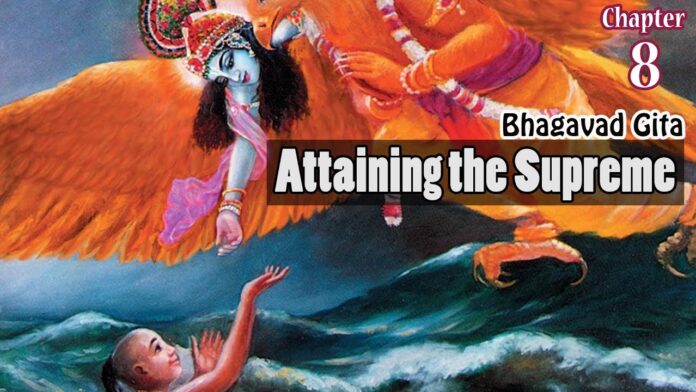
The Glories of Chapter Eight

0

Lord Siva said, “My dear Parvati, now please listen to the glories of the Eighth Chapter of Srimad Bhagavad-gita. After listening to this, you will feel great joy.


In the South is an important town of the name Amardhkapur in which one brahmana of the name Bhavasharma lived, who had taken a prostitute as his wife. Bhavasharma enjoyed eating meat, drinking wine, stealing, going with other’s wives; and hunting. One day, that sinful Bhavasharma was invited to a party, where he drank so much alcohol that it started to come out of his mouth. After the party, he became very sick and suffered from chronic dysentery, and after many days of suffering he died and attained the body of a date-palm-tree.
One day, two brahma-rakshasas (ghosts) came and took shelter under that tree. Their previous life-story was as follows:


There was a brahmana by the name of Kushibal, who was very learned in the Vedas and had studied all branches of knowledge. His wife’s name was Kumati, who was very evil-minded. Although that brahmana was very learned, he was also very greedy. Along with his wife, he used to collect lots of charity everyday, but he would never give charity to any other Brahmana. When their time came to die, they both attained the forms of brahma-rakshasas. As brahma-rakshasas, they continuously wandered here and there over the earth suffering from hunger and thirst.

One day they rested under that date-palm-tree. At that time, the wife inquired from the husband “How can we get free from this curse of being brahma-rakshasas?” He replied, “By knowledge of Brahma, by knowledge of the Self, by knowledge of fruitive activities. Without such knowledge it is not possible to get free from our sinful reactions.” Upon hearing this, the wife inquired, “Oh, my Lord, what is Brahma, what is the Self? What are fruitive activities? (kim tad brahma kim adhyatmam kim karma purusottama)”Completely by accident, the wife happened to chant half of the first sloka of the Eighth Chapter of Srimad Bhagavad-gita. At that time, having heard that half sloka, Bhavasharma broke free from that form as a tree, and again attained a body of a brahmana, completely free from all sin. Suddenly from the sky came a flower-airplane, which took that husband and wife back home, back to Godhead, Vaikuntha.


Afterwards, that Brahmana, Bhavasharma, with great respect, wrote down that half sloka (kim tad brahma kim adhyatmam-kim karma purusottama) and with the intention of worshipping Lord Krishna, he went to Kashipuri and started performing great austerities, while continuously chanting that half sloka.


Meanwhile in Vaikuntha, Lakshmi seeing Lord Visnu, had risen suddenly from taking rest, inquired with folded hands “Why have You risen so suddenly from Your sleep?” Lord Vishnu said, “My dear Lakshmi, in Kashipuri, on the bank of the river Ganges, my devotee is performing great austerities continuously chanting half a sloka of the Eighth Chapter of Srimad Bhagavad-gita. For a long time I have been thinking how to award his devotion”. Parvati inquired from Lord Siva, “when Lord Visnu was so pleased with His devotee, what benediction did He bestow upon him?”


Lord Siva said, “Bhavasharma went to Vaikuntha, to engage in the eternal service of the lotus-feet of Lord Visnu. Not only that, but all of his ancestors also attained the lotus feet of Lord Visnu.
My dear Parvati, I have described to you just a little of the glories of the Eighth Chapter of Srimad Bhagavad-gita

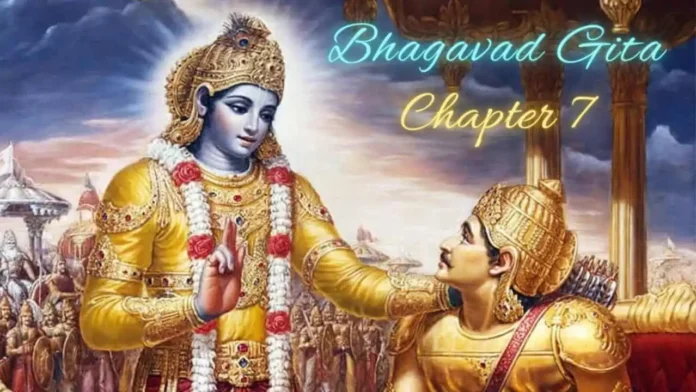
The Glories of Chapter Seven

0

Lord Siva said, “My dear Parvati, now I will tell you the glories of the Seventh Chapter of the Srimad Bhagavad-gita, hearing which, one feels his ears have been filled with divine nectar.


Pataliputra is the name of one large town, which has many large gates. In that town lived a brahmana of the name Shankukama He had taken to the occupation of a businessman, and had amassed a very large wealth. But he had never performed any type of devotional activities, nor had he performed the necessary ritualistic performances for the sake of his forefathers. He became very rich, so much that even great kings would dine at his house. Shankukarna was also the most miserly of persons, and he kept his wealth buried under the ground.


Once, when that brahmana was going along with his children and other relatives for the purpose of his fourth marriage, they stopped at one place to rest for the night. While he was sleeping, a snake came and bit him. When his sons and relatives realized that a snake had bitten him, they called for the doctors and mantra-chanters. But no one was able to help Shankukarna, and shortly he died. After that he attained the body of a Preta-Sarp, a snake-ghost. The only thing he was able to think about was his wealth, which was buried close to the house where he had lived. He had not even informed his own family of the whereabouts of his wealth. Even in the form of a Preta-Sarp he resided at the place where his wealth was buried, so that no one else could take that wealth.

After some time he became tired of being trapped in the form of a Preta-Sarp and he appeared in dreams to his sons and requested them to help him. In the morning, when his lazy sons woke up, they told each other about the dream they had seen. One of his sons took a large digging instrument in his hands and went to the place the father had indicated that he was living. When he reached that place he realized that he was not aware of the exact spot where the wealth was buried. That son was exceptionally greedy, and he searched for a long time, until he came across a snake-hole, which he promptly started to dig out.


Shortly a very large and fearful looking snake came out of that hole and spoke the following, “Oh, fool, who are you? Why have you come here? Who has sent you? And why are you digging at this place? Reply to my questions at once.”


The son replied, “I am your son. My name is Shiva. In a dream last night. I saw that there were hidden treasures buried at this place and I came to take them. When he heard Shiva speaking that way the Preta-Sarp started to laugh and said, “If you are my son, then why are you not performing the necessary rituals to free me from this hellish situation. Due to greed in my last life, I attained this body and now you are heading the same way.”
The son inquired, “My dear father, kindly tell me how you can be freed from this hellish situation?” The Preta-Sarp said, “Not by any kind of charity, tapasya or yajna, only by reciting of the Seventh Chapter of the Bhagavad-gita will I be able to become free from the wheel of birth and death. My dear son kindly perform the shraddha ceremony and on that day, invite a Brahmana, who is in the habit of chanting the Seventh Chapter of Bhagavad-gita and feed him very sumptuously.”


Thereafter, Shiva, along with his other brother fulfilled the instructions of their father and while the Brahmana was chanting the Seventh Chapter of Srimad Bhagavad-gita, Sankukarna gave up that frightful body of a Preta-Sarp and attained a divine four-armed body. At that time he blessed his sons and informed them where his wealth was and then left for Vaikuntha.


Those sons, whose minds had become fixed in devotion to Lord Krishna, used that wealth for building temples, digging wells and kinds, and distributing foodstuffs. They all engaged daily in the recitation of the Seventh Chapter of the Srimad Bhagavad-gita. And very quickly they attained the lotus feet of Lord Krishna.
Lord Siva said, “My dear Parvati, I have told you the wonderful glories of the Seventh Chapter of Bhagavad-gita. Anyone, who hears this description, will be freed from all sinful reactions.”

The Glories of Chapter Six

0

Lord Visnu said, “Now I will tell you the glories of the Sixth Chapter of the Srimad Bhagavad-gita. Whoever hears this description, will be liberated from the material world.


On the bank of the Godavari river, there is a beautiful town of the name Pratishthanpur (Paithan), where I am famous by the name of Pippalesh. In that town there was a king of the name Janshruti, Whom the people loved very much and whose qualities were unlimited. He performed daily fire sacrifices, which were so opulent and large that the smoke from them reached the Heavenly pleasure garden known as Nandanvan, and made the leaves of the Kalpavrksa trees black. Those trees appeared as if they were offering their respects to king Janashruti. Due to the pious activities of that great king, demigods always resided in Pratishthanpur.


When Janshruti would give charity, he would distribute just as the clouds distribute the rain. Due to Janshruti’s pure religious activities, rain always comes at the right time. And the fields were always full of crops, which were not disturbed by the six types of rodents. He was always digging wells and lakes for the welfare of the citizens. The demigods, being very pleased with Janashruti, went to his palace in the form of swans to bless him. They were flying through the sky, one behind the other, talking together. Bhadrashva, along with two or three other swans, flew ahead of the rest. At that time, the other swans addressed Bhadrashva, “Oh, brother, why are you flying ahead? Do you not see in front of you the great king Janashruti, who is so powerful that he can burn up his enemies by his desire.” When Bhadrashva heard the words of the other swans, he started to laugh and said, “Oh brothers, is this king Janashruti as powerful as the great sage Raikva?”


When the king heard the words of the swans, he immediately came down from the roof of his high palace and happily sat on his throne. At that time he called his chariot driver and instructed him to go and find the great sage Raikva. When the chariot driver of the name Maha heard the king’s instructions, he became very happy, and left immediately to search out Raikva. First he traveled to Kashipuri, where Lord Vishvanath resides, for the welfare of all beings. Next, he went to Gaya, where the lotus-eyed Lord Gadadhara who is capable of freeing all beings from the bondage of birth and death, stays.

After having traveled to many holy places, he came to Mathura, which is capable of destroying all sins. In this place the Supreme Personality of Godhead, Lord Krishna, resides. All of the great sages, demigods, also the Vedas, and other shastras, in their personal forms, perform austerities, and render service to Lord Krishna. Mathura which is in the shape of a half-moon, and is situated on the bank of the beautiful devotion-giving river Jamuna. In that area is the beautiful Govardhana hill, which adds to the splendor and glory of Mathura-Mandala like a large jewel in a crown. It is surrounded by pure trees and creepers. There are twelve wonderful forests surrounding Mathura in which Lord Krishna enjoys His wonderful pastimes.


After leaving Mathura, Maha traveled to the West, and then to the North. One day, he came to a town known as Kashmir in which he saw a very large and shining white place. At that place all of the people, even the foolish men, looked as beautiful demigods due to the fact that many sacrificial fires were burning continuously. It looked as if a row of clouds always hung over the town. The Deity of Lord Siva, known as Manikeshvara, resided in that town. The king of Kashmir had just returned from defeating many kings, and was engaged in worshipping Lord Siva. Due to his great devotion to Lord Siva, that king was known as Manikeshvar. Just close to the door of the temple, sitting on a small cart, underneath a tree, Maha saw the great sage Raikva.

When he recognized Raikva from the description of Janashruti, he immediately fell at his feet and inquired from him. “Oh, great sage, where do you live? And what is your full name? You are such a highly elevated person. Why are you sitting in this place?” When Raikva heard the words of Maha, he thought for some time, and then replied, “I am fully satisfied, I do not require anything.”


When Maha heard this reply, in his heart he could understand everything. He immediately left on the long journey, back to Pratishthanpur. When he reached his destination, he immediately went and offered his respects to the king, and with folded hands informed the king of all the events, which had taken place. After the king had heard everything from Maha he decided to leave at once, to take the darshan of the great sage Raikva. Sitting in a beautiful chariot, and taking with him many valuable gifts, he left for Kashmir. When he reached the place, where the sage Raikva was staying, he fell at his feet and placed the entire valuable silks and jewels, which he had brought with him before Raikva. At that time, the great sage Raikva became very angry.

He said, “Oh foolish king, you take all these useless things and put them in your chariot, and leave from this place”. The king immediately with great devotion, fell at the feet of Raikva, and begged his forgiveness, asking him to be merciful upon him. He inquired from Raikva, “Oh, sage, how have you attained such a high state of renunciation and devotion to the Lord?”


Becoming pleased with the king’s submissive attitude, Raikva replied “Daily I recite the Sixth Chapter of Srimad Bhagavad-gita ”. After that, king Janashruti heard from Raikva the Sixth Chapter of Srimad Bhagavad-gita. And thereafter, he engaged in daily reciting that Sixth Chapter. And in course of time a flower airplane arrived and took him to Vaikuntha. Meanwhile, that great sage, who was reciting the Sixth Chapter of Srimad Bhagavad-gita daily, went to Vaikuntha, where he engaged in the service of the lotus-feet of the Supreme Lord Visnu.
Anyone, who recites this Sixth Chapter of Srimad Bhagavad-gita, will very soon attain service to the lotus-feet of Lord Visnu, of this there is no doubt.

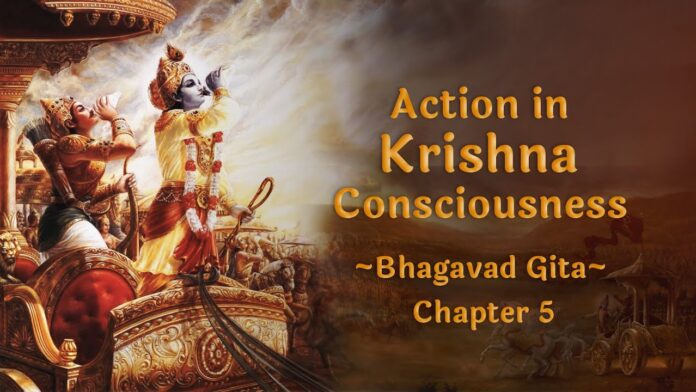
The Glories of Chapter Five

0

Lord Visnu said, “Now I will describe to you the unlimited glories of the Fifth Chapter of Bhagavad-gita. Listen very carefully.


In the state of Madra, there is a town of the name Puru Kutsapur. There lived a brahmana by the name of Pingala. During his childhood he was trained in various brahminical activities and was taught the Vedas. But he had no interest in his studies. When he reached his youth he gave up his brahminical pursuits and started to learn how to play instruments as well as singing and dancing. Slowly he became so famous in this field that the king himself invited him to live in the palace. While he was living there he slowly degraded more and more into sinful life. He started to enjoy with other men’s wives and engage in all kinds of sinful activities and intoxication.


He became so proud of his position as he gained more and more intimacy with the king. He especially enjoyed criticizing others to the king in private. Pingala had a wife whose name was Aruna, who was born in a low-class family. She was very lusty and enjoyed relationships with many other men. When her husband found out about her activities, she decided to kill him. Late one night she chopped off his head and buried his body in the garden. After his death Pingala fell into the deepest regions of hell and after having suffered there for a long time he took birth as a vulture. Aruna, after freely enjoying with many men contacted venereal disease and her youthful body very soon became ugly and unattractive. When she died she went on to hell and after having suffered for a long time, she, attained the body of a female parrot. One day that parrot was searching here and there for food. In the meantime the vulture, who in his previous life had been Pingala, saw the female parrot and remembering his last life and understanding that this parrot had been his wife, he attacked her with his sharp beaks. The parrot fell down into the water contained in a human skull and drowned. Just then a hunter came and shot the vulture with an arrow. The vulture fell and his head dropped into the water of that skull and he drowned.


Then the messengers of Yamaraja came and took them to the abode of death. At that time they became very afraid remembering their past sinful lives.
When they came in front of Yamaraja he told them, “You are now free of all sins and you may go to Vaikuntha”. When Pingala and Aruna heard this they inquired from Yamaraja how two sinful persons such as they had attained the right to go to Vaikuntha.


Yamaraja replied, “On the banks of the river Ganga lived a great devotee; of Lord Visnu by the name of Vat, he was free from lust and greed. Daily he recited the Fifth Chapter of Bhagavad-gita and when Vat gave up his body he went straight to Vaikuntha. Due to his reciting the Fifth Chapter of Bhagavad-gita daily, his body became completely pure, and because of your coming in contact with the skull of the body of that devotee you both have attained Vaikuntha. This is the glory of the Fifth Chapter of the Bhagavad-gita ”


Lord Visnu said, “My dear Lakshmi, when they both heard the glories of Bhagavad-gita from Yamaraja they became very happy and sat down in the flower airplane which had come to take them to Vaikuntha.”
Anyone who hears the Fifth Chapter of Bhagavad-gita, even the most sinful, will attain Vaikuntha.

The Glories of Chapter Four

0

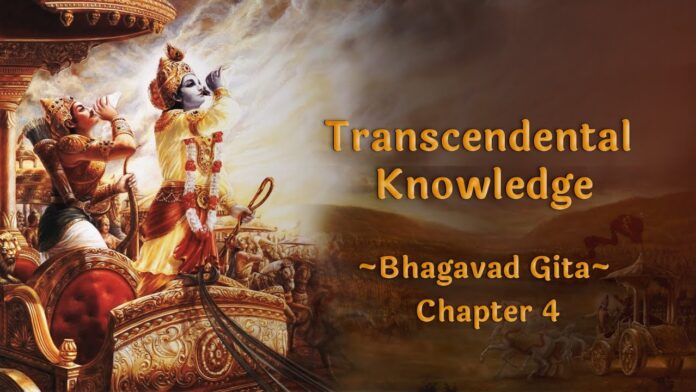
Lord Visnu said, “My dear Lakshmi, now I will describe the glories of the Fourth Chapter of the Srimad Bhagavad-gita.
On the bank of the river Ganges there is a town of the name Kasi, (Banaras), where at the temple of Vishvanath, a great saint of the name Bharata lived. Daily with the greatest devotion, he would recite the fourth Chapter of Srimad Bhagavad-gita. Previously, when Bharat had been travelling on pilgrimage he had gone to the town of Tapodan to take darshan of the Deity of Lord Krishna there. While leaving that town, he saw two Bael fruit trees. Deciding to take rest under the shade of those trees, he lay down, using the root of one of the tree as a pillow. and a root of the other to rest his feet upon.


After some time, when Bharat left from that place, those two trees started to dry up. Within five or six days both trees completely dried up and died. The two souls, who had been living in those trees, took their next birth as the daughters of a very pious Brahmana. Once, when those girls had reached the age of seven years, they had gone on pilgrimage to Kasi (Banaras). While wandering in Kasi, they happened to see the great sage Bharata. When they saw Bharata Maharaja they immediately went and fell at his feet and in sweet words said, “Oh. Maharaja Bharat, due to your mercy we both became freed from the tree form of life.” When Bharata Maharaja heard their statement, he became surprised. He inquired from them, “My dear daughters, where and when did I come in contact with you, and free you from the form of trees? Also kindly inform me, how you attained the form of trees? Because I do not know anything of this matter.” Thereafter, those two girls first informed Bharata Maharaja the reason for their attaining the form of trees.


The two girls said, “Maharaja, on the bank of the river Godavari there is a sacred place of the name Chinnapaap. At that place, there was a rishi of the name, Sachatapa. He was performing very great and difficult austerities. In the hot season he would sit in between many fires, and in the cold season, he would stand in the cold river. In the course of time, he became completely pure, and had complete control of his senses, and slowly he attained the Lotus-Feet of the Supreme Personality of Godhead, Lord Krishna. Lord Brahma started visiting daily to take the darshan of Sachatapa and put questions before him about the devotional service of Lord Krishna. Lord Indra meanwhile, was becoming very worried seeing the elevated position of Sachatapa, thinking that he might one day usurp his own position as king of heaven. At that time, Lord Indra called the two of us, who in that birth were apsaras in the heavenly kingdom, an instructed us, ‘Go and cause the fall down of Sachatapa, before he tries to usurp me from my position.”


After receiving Lord Indra’s instructions, we left from his presence and went to the bank of the Godavari River, where Sachatapa was performing austerities. At that place, we both started to sing and dance very provocatively close to Sachatapa, with the intention of causing that sage to engage in a sexual relationship with us. While dancing, our covering cloth slipped down and our breasts became visible. At that time, taking water in his hand, that sage cursed us in the following words.


“You both go and become Bael trees on the bank of the river Ganga.” upon hearing his curse, we both fell at his feet and begged his forgiveness. “My dear sage, please forgive us, for we are simply the servants of Lord Indra.” Seeing our submissive attitude that sage became pleased and informed us that we would remain as trees until Maharaja Bharata came in contact with us. And he also blessed us, that we would be able to, remember our previous births.


“My dear Maharaja Bharata at the time when you visited Tapodan, you rested beneath us. When we were in the form of Bael trees, you were reciting the Fourth Chapter of Srimad Bhagavad-gita, and by hearing that recitation, we not only became free from that tree form of life and attained birth in a devotee family, also we lost all desire for enjoying in this material world.”


Lord Visnu said, “My dear Lakshmi, when those two girls recited their history before Bharata Maharaja, he became very happy, and left for his ashram. Those two girls throughout their life carefully recited the Fourth Chapter of Srimad Bhagavad-gita daily and attained devotion to My lotus-feet.”

The Glories of Chapter Three

0

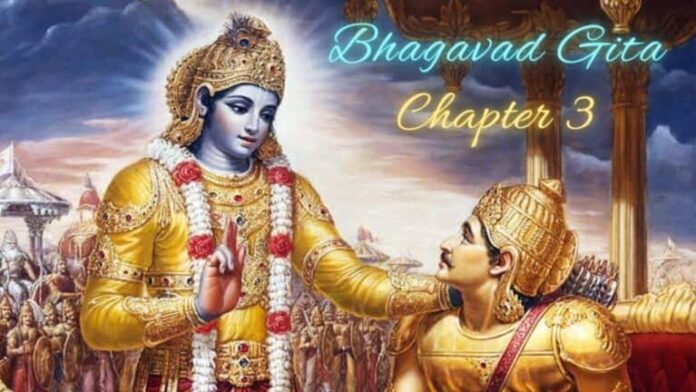
Lord Visnu said, “My dear Lakshmi, in the town of Janasthan was a brahmana of the name Jada, who was born in the dynasty of Kaushik. That brahmana gave up the religious activities enjoined in the shastras to be followed by the brahmana class, and took to many irreligious activities. He was very fond of gambling and drinking, hunting, and visiting the prostitutes. In this way, he wasted his wealth. He went to the northern countries on a business trip. While there, he gained much wealth and decided to return to Janasthan. After having traveled a long distance he found himself in a very deserted place. One day, as the sun set, and everywhere became engulfed by darkness, he decided to take rest for the night under a tree. While resting, some robbers came and beat him to death, and stole his wealth. Because Jada had given up all religious activities and led a sinful life, after his death he attained the form of a ghost.


The son of Jada was very religious and learned in the Vedic shastras. When he saw that his father had not returned to Janasthan after a long time, he decided to go and search for him. For many days he traveled here and there, in search of his father, and whatever travelers he would meet, he would inquire from them, about his father. One day, he met one person who knew his father, and informed him of the events that had taken place. When the son of Jada heard the news of his father’s death, he decided to go to Kasi (Banaras) to offer pinda (worship) for the release of his father from his hellish condition. On the ninth day of his journey, he happened to take rest under the same tree under which his father had been killed.

At that place, in the evening, he performed his daily worship to Lord Krishna, and he also recited the Third Chapter of Srimad Bhagavad-gita. As he completed his recitation, a loud sound came from the sky. When he looked up, he saw his father there, and in front of his eyes, his father’s form changed into one of the most beautiful beings, who had four hands, and was wearing a yellow dhoti. His body was the color of a dark rain cloud and his bodily effulgence was lightening up all the directions. At that time, his father offered his blessing to him. The son inquired from the father, as to the meaning of these wonderful happenings. The father said, “My dear son, you recited the Third chapter of Srimad Bhagavad-gita, and thus freed me from the ghost form which I had received, due to my sinful activities. Now you should return to your home, because the purpose for which you were travelling to Kasi (Banaras) has been achieved by your reciting the Third Chapter of Bhagavad-gita”.


When the son inquired from the father, if there were any further instructions from him, the father said, “My brother also had led a very sinful life and he is suffering some where in the darkest regions of hell. So if you wish to free him, and our other ancestors, who are suffering here and there, in different species in the material universe, then kindly, recite the Third Chapter of Srimad Bhagavad-gita. And by that recitation they will all attain a form similar to Lord Vishnu’s, and go to Vaikuntha”.


When the son heard the father’s instructions he replied, “If that is the case, then I will recite the Third Chapter until all the souls, who are trapped in the hellish life, are freed” At that time his father blessed him with the words, “Let it be.” Then an airplane arrived from the spiritual world of Vaikuntha and took the father to his destination.
Thereafter, the son returned to Janasthan and sat in front of the Deity of Lord Krishna, and with a desire to free all of the conditioned souls in the hellish condition, started reciting the Third Chapter of Srimad Bhagavad-gita. While his recitation was continuing, day after day, Lord Visnu sent His messengers, the Visnudutas, to the kingdom of Yamaraja, who is in charge of administering punishment to the sinful living entities. When the Visnudutas arrived in front of Yamaraja, they informed him, that they had a message from Lord Visnu, who is lying on the bed of Ananta-Sesa in the ocean of milk. They told him that Lord Visnu was inquiring as to his welfare, and also was ordering him to free all of the conditioned souls, who were suffering in hell.


When Yamaraja heard this instruction from Lord Visnu, he immediately had all of the conditioned souls released from hell and then personally went with those Visnudutas to the ocean of milk, known as Svetadwipa, to have the darshan of Lord Visnu. When he arrived there, he saw Lord Visnu, lying on the bed of Ananta-Sesa. His body had the effulgence of suns, and Lakshmi-Devi, the Goddess of Fortune, was massaging His feet. He was surrounded on all sides by rishis, sages, and demigods, headed by Lord Indra, who were all singing the Praises of Lord Visnu. Lord Brahma was also present, reciting the Vedas. Yamaraja fell down and offered his respects before Lord Visnu, and offered the following praise, “My dear Visnu, You are the well-wisher of all the conditioned souls. There is no Limit of Your glories. From You the Vedas have come, You are time. And in The course of time You will destroy all things. You are the cause and maintainer of the three worlds and You are the Supersoul in every one’s heart, who is directing their activities. You are the Guru of the whole universe, and the goal of all devotees. Oh, lotus-eyed one, please accept my obeisances again and again. Your glories are unlimited.”


In this way Yamaraja with folded hands offered his respects to Lord Visnu. Yamaraja continued, “As per Your instructions, I have released all the conditioned souls from hell. So kindly instruct me, what work You wish me to perform now” Lord Visnu replied in a voice as deep as thunder, and as sweet as nectar, “My dear Dharmaraja (Yamaraja), you are equal to every one, and I do not need to instruct you on your duties. Kindly return to your abode with my full blessings, and continue your duty”


At that time, Lord Visnu disappeared from the vision of Yamaraja, and Yamaraja returned to his own abode. After that brahmana had successfully freed all of his ancestors and the rest of the conditioned souls from hell, the Visnudutas came, and took him to the abode of Lord Visnu, where he was able to engage in the service of the lotus-feet of the Supreme Personality of Godhead eternally.

The Glories of Chapter Two

0

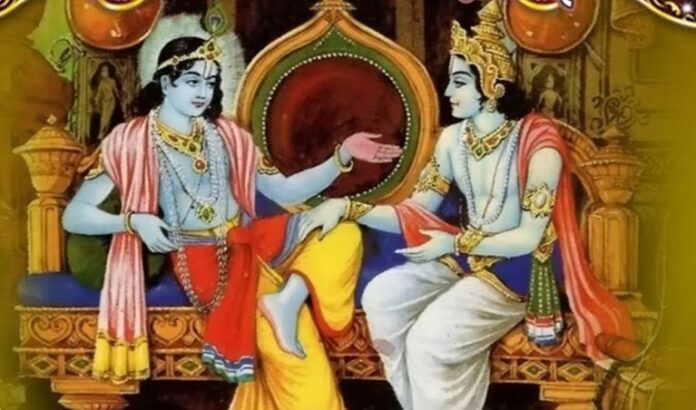
Lord Visnu said, “My dear Lakshmi, you have heard from Me the glories of the First Chapter of Bhagavad-gita Now please listen carefully, as I tell you the glories of the Second Chapter.
Once in the South in the town of Pandharpur, a very learned brahmana by the name of Devashyama lived. He was able to perform all kinds of fire sacrifices. He also knew the importance of receiving guest. And by his activities he managed to satisfy all the demigods. But he was not happy and peaceful in his heart and mind. He had the desire to attain knowledge of the soul’s relationship with the Supersoul, Paramatma, and towards this end he would invite many yogis and tapasvis, and render all kinds of service to them and inquire from them about the Absolute Truth. In this way he passed many years of his life.


One day, while he was walking, he saw one yogi in front of him, sitting cross-legged with his eyes fixed on the tip of his nose, totally absorbed in meditation. Devashyama could perceive that this yogi was completely peaceful, and without any material desires. Devashyama, with the greatest respect and reverence, fell at the feet of that yogi, and inquired from him, how he could attain complete peace of mind. At that time, that yogi, who had complete knowledge of the Supreme Personality of Godhead, Lord Krishna, advised Devashyama to go to the village of Sowpur and meet one Mitravan; who was a goat-herder by profession, and take instructions in the science of God-realization from him. After hearing this, Devashyama again and again offered his respectful obeisances at the feet of that yogi and immediately left for Sowpur. When he arrived there he found on the northern side, one beautiful forest where he was informed that Mitravan lived. When he entered that forest, he saw on the bank of a small river, Mitravan seated on top of some rocks.


Mitravan looked very beautiful and totally peaceful. In that forest the wind was blowing very gently and a beautiful aroma was emanating from every direction. The goats were peacefully moving here and there, totally unafraid. Some were seen to be sitting next to tigers and other ferocious animals very peacefully.


When Devashyama saw this scene, his mind became very peaceful, and he respectfully approached Mitravan and sat close to him. Mitravan appeared to be fully absorbed in his meditation. After some time Devashyama inquired from him, how he would be able to attain devotion to Lord Krishna. When Mitravan heard this question, for a moment he was lost in deep thought. Then he replied, “My dear learned Devashyama, once long ago, I was in the forest looking after the goats, when a very ferocious tiger attacked. At that time all the goats ran here and there to save themselves. I also ran off, due to fear of that tiger. From some distance I looked back and saw that that tiger on the bank of this river encountered one of my goats. At that time a strange and wonderful thing happened. That tiger lost all his anger and desire to eat my goat. Thereupon, my goat inquired from that tiger, “You have attained your food, so why are you not eating the meat of my body? You should immediately kill me, and with great relish eat up my flesh. Why are you hesitating?”


That tiger said, “My dear goat, since I have come to this place, all anger has left me, and I have no hunger or thirst”. The goat said, “I also do not know why I am feeling so fearless and peaceful. What can be the reason for this? If you know, then kindly inform me”.
The tiger replied, “I also do not know. Let us inquire from that person” When I saw this change take place in the activities of that tiger and goat, I become very much astonished. At that time they both approached me, and inquired as to the reason. I noticed that a monkey was sitting on the branch of a nearby tree. I went along with the two of them and inquired from that monkey-king. That monkey replied to our question with great respect.
“Listen, I will tell you, it is a very old story. In that forest, just in front of you, there is a very large temple in which Lord Brahma installed a Shivalinga. Long ago, a learned sage of the name Sukama, who had performed many austerities, lived there. Daily he would bring flowers from the forest and water from the river, and worship Lord Shiva.


In this way he was living here for many years, when one day one sage arrived. At that time, Sukama brought fruits and water and fed that sage. After the sage had eaten and rested, Sukama spoke to him. “Oh learned one, only for the reason of obtaining knowledge of Lord Krishna, am I living here, performing austerities and worship. But the results of my austerities have been attained today by coming in contact with you.”


When the sage heard the words of Sukama, which were full of submission, he became greatly pleased. And he wrote on one piece of stone the Second Chapter Srimad Bhagavad-gita. He then instructed Sukama to daily read those verses. “By so doing, you will quickly attain your goal.” After having spoken thus, that sage disappeared from that place while Sukama was looking on. After that, following the instructions of that sage, Sukama recited those verses daily for the rest of his life. Very quickly he attained complete knowledge of Lord Krishna. And from the day he started reciting those verses, he felt no more thirst or hunger.


And due to this austerities and devotion, at this place, any one who visits here does not, feel the pangs of hunger and thirst, and immediately attains complete peace.”
Mitravan said, “My dear Devashyama, after the monkey had finished telling us that wonderful story, I along with the tiger and goat went to that temple. We found there written on a piece of stone the Second Chapter of Srimad Bhagavad-gita. And I started to recite those verses daily. In this way, we were able to attain very quickly devotion to Lord Krishna. My dear brahmana, if you also start reciting the verses of the Second Chapter of Srimad Bhagavad-gita, you will very quickly attain the mercy of Lord Krishna.”


Lord Vishnu said, “My dear Lakshmi, in this way Devashyama attained knowledge from Mitravan and after worshipping that great soul, he returned to Pandharpur and daily recited that Second Chapter. And whoever visited Pandharpur, Devashyama would first recite before him the Second Chapter of Srimad Bhagavad-gita. In this way Devashsyama attained the lotus feet of Lord Krishna.


My dear Lakshmi these are the glories of the Second Chapter of Srimad Bhagavad-gita.

The Glories of Chapter One

0

Parvati said “My dear husband, You know all the transcendental truths, and by your mercy I have heard the glories of the Supreme Personality of Godhead, Lord Krishna. Oh Lord, now I long to hear from You the glories of the Srimad Bhagavad-gita, which was spoken by Lord Krishna, and by hearing which, one’s devotion to Lord Krishna increases”


Lord Siva replied “That person, Whose body is the color of a dark rain cloud, whose carrier is the king of birds, Garuda, and Who is lying on Ananta-Sesa, the thousand headed serpent, that Lord Vishnu, Whose glories have no limit, I am always worshipping.
My dear Parvati once after Lord Visnu had killed the demon Mura, He was resting peacefully on Ananta-Sesa, when the bestower of all good fortune of the universe, Sri Lakshmi, respectfully inquired from Him.
“Bhagavan, You are the controller and maintainer of the whole universe, but yet You are sleeping unhappily on this ocean of milk. What is the reason?”


Lord Visnu said, “My dear Lakshmi, I am not sleeping, but I am watching how wonderfully My energy is working. It is by this wonderful energy of Mine, by which I am controlling all things, and yet remain separate. And it is by remembering these divine activities of Mine, that the great devotees and yogis manage to free themselves from the wheel of birth and death, and attain that transcendental nature of Mine, which is eternal and free from all qualities”
Lakshmi said, “O, controller of all things. You are the goal of the meditation of great yogis. Nothing can go on without You. And yet You are separate. You are the cause of creation, maintenance and destruction of all the material universes. Kindly inform me about the workings of Your wonderful energies, which are so attractive, that even You are lying here, meditating upon them”


Lord Vishnu said, “My dear Lakshmi, the workings of My multi-fold energies, and how to become free from the bonds of birth and death, and attain My eternal Nature, can only be understood by one of pure intelligence, who has an inclination to render service unto Me. This transcendental knowledge is fully explained in the Srimad Bhagavad-gita”


Lakshmi inquired, “My dear Lord, if you yourself are amazed, by the workings of Your energies, and are ever trying to fathom their limit, then how is it possible that the Bhagavad-gita can describe those unlimited energies of Yours, and how to cross over them, and attain the transcendental nature?”


Lord Visnu said, “I Myself have manifested in the Form of Bhagavad-gita. Please understand that the first five chapters are My five heads, the next ten chapters are My ten Arms, and the Sixteenth Chapter is My stomach. The last two chapters are My lotus-feet. In this way you should understand the transcendental Deity of the Bhagavad-gita. This Bhagavad-gita is the destroyer of all sins. And that intelligent man who daily recites one chapter or even one sloka, one half sloka, or at least one quarter sloka, will attain the same position as Susharma had attained.”
Lakshmi inquired, “Who was Susharma? What class did he belong to? And what destination did he attain?”
Lord Vishnu said, “My dear Lakshmi, Susharma was a very wicked and a most sinful man. Although he was born in a brahmana family, his family had no Vedic knowledge. And he only took pleasure from hurting others. He never engaged in the chanting of, My names, in giving charity, or receiving guests. In fact, he never performed any pious activities. For his livelihood he collected leaves, and sold them in the bazaar. He especially enjoyed drinking wine, and eating flesh. In this way he passed his life.


“One day that foolish Susharma had gone to the garden of one sage for collecting leaves, when a snake came and bit him, and he died. After his death he was cast into many hells, where he suffered for a long time. After which he attained the body of a bull. That bull was purchased by a crippled man, who engaged him in his service. For about seven or eight years he was carrying extremely heavy loads. One day that crippled man had piled a very heavy load onto the back of his bull. Very quickly he was forcing that bull along when suddenly the bull fell over and became unconscious. Many persons gathered there, to see what was happening, feeling sorry for that bull. One pious man bestowed upon that bull the results of some of his pious activities. Seeing that, other persons standing there started remembering their pious activities, and offered the results of some of those activities to that bull.

In that crowd there was also one prostitute who did not know if she had ever performed any pious activities, but seeing everyone else offering their pious credits to that bull, she also offered the results of any pious activities she might have performed After that, the bull died, and was taken to the abode of Yamaraja, the God of Death.
There, Yamaraja informed him, “You are now free from the reactions of all your previous sinful deeds, due to the pious credits given to you by that prostitute.” Then he took birth in a very high brahmana family. In that birth, he was able to remember his past lives. After many days, he decided to search out that prostitute, who had been the cause of freeing him from his hellish situation.


After he had found and introduced himself to that lady he inquired from her “ What were the pious activities performed by you, the fruits of which freed me from my hellish situation?” The prostitute replied to him, “My dear sir, in that cage is one parrot, which recites something everyday. Hearing that recitation, my heart has become completely pure. The results of hearing that recitation I had given to you.” Thereafter they both inquired from that parrot about that recitation. That parrot. remembering his previous life, started to narrate his history. “Previously, I had been a very learned brahmana. But due to my pride, I used to insult other learned persons. I was also extremely jealous. After I died, I was cast into many hells, and after a long time of suffering, I achieved this body of a parrot. Due to my past sinful activities, my mother and father died while I was a baby.

One day, while I was lying on the hot sands, with no protection, some rishis saw me, and took me to their ashram, and put me in a cage. At that same place, the children of those rishis were learning the recitation of the First Chapter of the Srimad Bhagavad-gita, Hearing them repeat those slokas, I also. started repeating those slokas along with them.


“Shortly after, one thief stole me from that place and sold me to this pious lady.” Lord Vishnu continued, “By reciting the First Chapter of the Bhagavad-gita, that parrot had become completely pure. And by hearing that recitation, that prostitute also became completely pure. And by receiving some of the pious results of hearing that recitation, Susharma also become completely pure.


After discussing for some time the glories of the first chapter of Bhagavad-gita, Susharma returned to his home, and the three of them individually engaged in reciting the First Chapter of Srimad Bhagavad-gita, and very quickly attained the supreme destination, Vaikuntha.” Anyone who recites, who hears, or studies the First Chapter of Bhagavad-gita, will very easily cross over the ocean of material miseries, and attain the service of the lotus-feet of Lord Krishna.

The Glories of Śrīmad Bhagavad-gītā

0

The greatness of the Śrīmad Bhagavad-gītā is impossible to properly describe by mundane speech. The Gītā is not an ordinary book; it is the supremely sacred and confidential message of the Supreme Personality of Godhead, Lord Śrī Kṛṣṇa Himself. Within its seven hundred verses, the essence of all Vedic knowledge has been perfectly presented for the ultimate welfare of human society.

The Sanskrit of the Gītā is simple and lucid, enabling even a newcomer to understand its basic meaning. Yet its inner significance is so deep that even a lifetime of study cannot exhaust its nectarean wisdom. Every sincere reader experiences fresh realizations each day, for the Gītā is nitya-nava—ever fresh and ever new. When approached with humility, faith, and devotion, every word becomes illuminated with profound spiritual insight.

Unlike many scriptures that combine spiritual matters with temporary material topics, the Bhagavad-gītā is pure transcendental knowledge, spoken directly by the Lord for the upliftment of all conditioned souls. Thus, after presenting the Gītā in the Mahābhārata, Śrīla Vyāsadeva declares:

गीता सुगीता कर्तव्या किमन्यैः शास्त्रविस्तरैः ।

या स्वयं पद्मनाभस्य मुखपद्माद्विनिःसृता ॥

“One should certainly study the Bhagavad-gītā. What need is there for any other scripture?
It has emanated from the lotus mouth of the Lord, Padmanābha Himself.”

The conclusion is clear: the Bhagavad-gītā must be studied thoroughly—not merely read, but understood, realized, and adopted in one’s life—because these teachings have flowed from the very lips of Śrī Kṛṣṇa. Thus, no other scripture is required to understand the essence of spiritual life.

The Supreme Lord Himself glorifies the Gītā, especially in the concluding portion of His instructions:

Verse Quotation (BG 18.66)

सर्वधर्मान्परित्यज्य मामेकं शरणं व्रज ।
अहं त्वां सर्वपापेभ्यो मोक्षयिष्यामि मा शुचः ॥

“Abandon all varieties of religion and just surrender unto Me.
I shall deliver you from all sinful reactions. Do not fear.”

And further:

Verse Quotation (BG 18.68–69)

य इदं परमं गुह्यं मद्‍भक्तेष्वभिधास्यति…
न च तस्मान्मनुषेषु कश्चिन्मे प्रियकृत्तमः ॥

“One who explains this supreme secret to the devotees is most dear to Me.”

In the Gītā, the Lord makes it abundantly clear that everyone—regardless of birth, social position, or occupation—can attain the highest perfection. He specifically says:

Verse Quotation (BG 9.32)

मां हि पार्थ व्यपाश्रित्य येऽपि स्यु: पापयोनयः ।
स्त्रियो वैश्यास्तथा शूद्रास्तेऽपि यान्ति परां गतिम् ॥

“O son of Pṛthā, even those born in sinful families—women, merchants, and laborers—can attain the supreme destination by taking shelter of Me.”

Thus, the Gītā is universal, meant for every human being.

Yet due to ignorance, some say that the Gītā is meant only for renunciates. Out of fear or misconception, they hesitate to teach it to their children, thinking the knowledge will drive them toward a life of asceticism. Such misunderstanding is most unfortunate.

Consider Arjuna. At the beginning of the Gītā, overwhelmed by sorrow and illusion, he was ready to abandon his duty and take to begging. But after hearing Kṛṣṇa’s divine instructions, he became enlightened and returned to his responsibilities as a perfect gṛhastha, fully dedicated to the Lord. Therefore, how can one say that study of the Gītā leads one to neglect family life? Arjuna is the perfect example that true Gītā knowledge strengthens one’s duty and devotion.

Hence those who desire true auspiciousness should, with great faith and devotion, study the Bhagavad-gītā themselves and teach it to their children, explaining its meanings and conclusions in accordance with the disciplic succession.

The human form of life is extremely rare and offers a unique chance for self-realization. Therefore it is not wise to waste even a single moment in temporary pleasures that end in frustration. Rather, one should utilize this precious life to understand the Lord’s instructions in the Bhagavad-gītā and thus perfect one’s existence.

Your servant,

Brajsundar Das

Uddhava, Krishna And Maitreya

0

By

BrajSundar Das &

BhajaGovindam Das

Introduction

The topic of Krishna’s departure and the corresponding transcendental discussions between Krishna, Uddhava and Maitreya is a topic of great debate. Understandably, the Uddhava Gita, a profound conversation between Lord Krishna and his intimate devotee, Uddhava, is mistakenly thought to be the very discussion that took place in Prabhasa-ksetra at the scene of Krishna’s departure. However, a careful examination of the Srimad Bhagavatam, particularly Canto 11, reveals that this sacred discussion of the Uddhava Gita occurred in Dvaraka before the Yadu dynasty departed for Prabhasa-ksetra, and an examination of Canto 3 reveals that a second discussion took place at Prabhasa-ksetra which Maitreya Rishi also heard.

The Yadavas Decide to Go to Prabhasa-ksetra

In Srimad Bhagavatam Canto 11 Chapter 6, we hear of an elaborate set of prayers offered by Brahma and the demigods to Lord Krishna, requesting the Lord to return to his own abode in the spiritual world. On receiving this request, the Supreme Lord, understanding their heart and desire, affirms that he is ready to wind up his pastimes on the Earth, but just wanted to bring about equilibrium of power within the material world before his own departure.

Using the arrival of many disturbing omens looming over the city of Dvaraka, Krishna encourages the Yadava elders that it would be appropriate to leave the city and proceed towards Prabhasa-ksetra to perform various penances, austerities and sacrifices to please the forefathers and demigods, and resultantly, free the Yadu dynasty of the terrible dangers.

na vastavyam ihāsmābhir

jijīviṣubhir āryakāḥ

prabhāsaṁ su-mahat-puṇyaṁ

yāsyāmo ’dyaiva mā ciram

“My dear respected elders, we must not remain any longer in this place if we wish to keep our lives intact. Let us go this very day to the most pious place Prabhāsa. We have no time to delay.”

SB 11.6.35

Hearing this, the Yadavas follow Lord Krishna’s instructions and prepare to leave for Prabhasa-ksetra:

śrī-śuka uvāca

evaṁ bhagavatādiṣṭā

yādavāḥ kuru-nandana

gantuṁ kṛta-dhiyas tīrthaṁ

syandanān samayūyujan

“Śukadeva Gosvāmī said: O favorite son of the Kurus, thus advised by the Personality of Godhead, the Yādavas made up their minds to go to that holy place, Prabhāsa-kṣetra, and thus yoked their horses to their chariots.”

SB 11.6.39

Uddhava Approaches Krishna Before Leaving Dvaraka

Upon seeing the imminent departure of the Yadavas as inspired by the Supreme Lord, Uddhava, in a submissive and despondent mood approaches Krishna in a secluded place to put forward his heart’s desire and realisation:

śrī-uddhava uvāca

deva-deveśa yogeśa

puṇya-śravaṇa-kīrtana

saṁhṛtyaitat kulaṁ nūnaṁ

lokaṁ santyakṣyate bhavān

vipra-śāpaṁ samartho ’pi

pratyahan na yad īśvaraḥ

“Śrī Uddhava said: O my Lord, O supreme God among all the demigods, real piety is invoked simply by hearing and chanting Your transcendental glories. My Lord, it appears that You will now withdraw Your dynasty, and thus You Yourself will finally give up Your pastimes within this universe. You are the supreme controller and the master of all mystic power. But although You are fully capable of counteracting the brāhmaṇas’ curse against Your dynasty, You are not doing so, and Your disappearance is imminent.“

SB 11.6.42

In the purport to this verse, Srila Prabhupada’s disciples share an illuminating passage indicating the realisation Uddhava had prior to the departure for Prabhasa-ksetra:

Having insured the transcendental bliss and liberation of all of His devotees, even those who would be born in the future, Kṛṣṇa decided the time had come for Him to leave this material universe. Uddhava could understand the Lord’s desire and said to Kṛṣṇa, “You have instructed the Yādavas to counteract the brāhmaṇas’ curse by taking bath at Prabhāsakṣetra, but how could mere bathing in a holy place be of greater value than seeing You, the Personality of Godhead, face to face? Since the Yādavas are always seeing Your transcendental form, and since You are the Supreme Lord, what is the use of their taking bath in a so-called holy place? Therefore You obviously have some other purpose. If You actually wanted to counteract the curse, You could simply say, ‘Let this curse not act,’ and the curse would immediately be neutralized. Therefore You must be preparing to leave this universe, and that is why You have not counteracted the curse.”

SB 11.6.42 purport

Here, we very clearly see that Uddhava has approached the Lord in seclusion, anticipating the Lord’s departure before the Yadavas have been annihilated.

In the remaining verses of Srimad Bhagavatam Canto 11 Chapter 6, we hear of Uddhava’s magnificent prayer, glorifying the supreme position of Lord Krishna as the Supreme Soul, the greatest of all beings, the one with the most wonderful and loving, yet bewildering pastimes. All of this, due to Uddhava sensing the Lord’s imminent departure, and just to put forth his heartfelt desire:

nāhaṁ tavāṅghri-kamalaṁ

kṣaṇārdham api keśava

tyaktuṁ samutsahe nātha

sva-dhāma naya mām api

“O Lord Keśava, my dear master, I cannot tolerate giving up Your lotus feet even for a fraction of a moment. I urge You to take me along with You to Your own abode.”

SB 11.6.43

This marks the beginning of the remarkable Uddhava Gita, spoken by Lord Krishna to Uddhava before the Yadavas depart for Prabhasa-ksetra:

śrī-śuka uvāca

evaṁ vijñāpito rājan

bhagavān devakī-sutaḥ

ekāntinaṁ priyaṁ bhṛtyam

uddhavaṁ samabhāṣata

“Śukadeva Gosvāmī said: O King Parīkṣit, thus addressed, the Supreme Personality of Godhead, Kṛṣṇa, the son of Devakī, began to reply confidentially to His dear, unalloyed servant Uddhava.”

SB 11.6.50

Devotees Depart From Dvaraka

As the Uddhava Gita concludes, Uddhava is seen making a request for an instruction from Krishna so that he may remain attached to Krishna’s lotus feet. As such, by the orders of Krishna, Uddhava makes his way to Badarikasrama:

tatas tam antar hṛdi sanniveśya

gato mahā-bhāgavato viśālām

yathopadiṣṭāṁ jagad-eka-bandhunā

tapaḥ samāsthāya harer agād gatim

“Thereupon, placing the Lord deeply within his heart, the great devotee Uddhava went to Badarikāśrama. By engaging there in austerities, he attained to the Lord’s personal abode, which had been described to him by the only friend of the universe, Lord Kṛṣṇa Himself.”

SB 11.29.47

In Srimad Bhagavatam Canto 11 Chapter 30, we get insight into the disappearance of the Yadu dynasty. This narration is explained by Sukadeva Goswami off the back of Pariksit’s question on what happens after Uddhava leaves Dvaraka:

śrī-rājovāca

tato mahā-bhāgavata

uddhave nirgate vanam

dvāravatyāṁ kim akarod

bhagavān bhūta-bhāvanaḥ

“King Parīkṣit said: After the great devotee Uddhava left for the forest, what did the Supreme Personality of Godhead, the protector of all living beings, do in the city of Dvārakā?”

SB 11.30.1

This question is followed by a detailed narrative of how the disturbing signs observed in Dvaraka led to the Supreme Lord’s suggestion of leaving Dvaraka and going to Prabhasa-ksetra.

iti sarve samākarṇya

yadu-vṛddhā madhu-dviṣaḥ

tatheti naubhir uttīrya

prabhāsaṁ prayayū rathaiḥ

“Having heard these words from Lord Kṛṣṇa, the enemy of Madhu, the elders of the Yadu dynasty gave their assent, saying, “So be it.” After crossing over the ocean in boats, they proceeded on chariots to Prabhāsa.”

SB 11.30.10

This shows that the Yadavas depart from Dvaraka after the Uddhava Gita is spoken. At Prabhasa, the Yadus, intoxicated and bewildered by the Lord’s illusory potency, violently attack and kill each other. Once the Yadu dynasty is annihilated, Balarama gives up the mortal world by meditating on the Supreme Lord and merging within himself, following which Krishna prepares for his own departure by the shot of the hunter, Jara’s arrow:

śrī-bhagavān uvāca

mā bhair jare tvam uttiṣṭha

kāma eṣa kṛto hi me

yāhi tvaṁ mad-anujñātaḥ

svargaṁ su-kṛtināṁ padam

“The Supreme Personality of Godhead said: My dear Jarā, do not fear. Please get up. What has been done is actually My own desire. With My permission, go now to the abode of the pious, the spiritual world.”

SB 11.30.39

Uddhava Follows Krishna

In Srimad Bhagavatam Canto 3 Chapter 4, we get insight into the travels of Uddhava after he departs from Dvaraka. As Uddhava wraps up his outpour of Krishna’s pastimes to Vidura, the final parts of their conversation reiterate the instruction Uddhava received to go to Badarikasrama:

ahaṁ cokto bhagavatā

prapannārti-hareṇa ha

badarīṁ tvaṁ prayāhīti

sva-kulaṁ sañjihīrṣuṇā

“The Lord is the vanquisher of the distresses of one who is surrendered unto Him. Thus He who desired to destroy His family told me previously to go to Badarikāśrama.”

SB 3.4.4

But Uddhava, unable to bear separation from the Lord, follows Krishna to Prabhasa-ksetra:

tathāpi tad-abhipretaṁ

jānann aham arindama

pṛṣṭhato ’nvagamaṁ bhartuḥ

pāda-viśleṣaṇākṣamaḥ

“Yet in spite of my knowing His desire [to destroy the dynasty], O Arindama [Vidura], I followed Him because it was impossible for me to bear separation from the lotus feet of the master.”

SB 3.4.5

There, he follows Krishna to the spot where he’s about to leave the world:

adrākṣam ekam āsīnaṁ

vicinvan dayitaṁ patim

śrī-niketaṁ sarasvatyāṁ

kṛta-ketam aketanam

“Thus following, I saw my patron and master [Lord Śrī Kṛṣṇa] sitting alone and deeply thinking, taking shelter on the bank of the river Sarasvatī although He is the shelter of the goddess of fortune.”

SB 3.4.6

It is at this occasion that the final conversation between Krishna and Uddhava takes place, and it is this dialogue which is heard by Maitreya Muni, a great personality whom Uddhava directs Vidura to hear from:

tasmin mahā-bhāgavato

dvaipāyana-suhṛt-sakhā

lokān anucaran siddha

āsasāda yadṛcchayā

“At that time, after traveling in many parts of the world, Maitreya, a great devotee of the Lord and a friend and well-wisher of the great sage Kṛṣṇa-dvaipāyana Vyāsa, reached that spot out of his own perfect accord.”

SB 3.4.9

Conclusion

From the texts of the Srimad Bhagavatam, particularly Canto 11 Chapters 6, 29 and 30, and Canto 3 Chapter 4, we can understand that Uddhava had two insightful dialogues with Lord Krishna before his departure. The first is the Uddhava Gita in Dvaraka, prior to the Yadavas going to Prabhasa-ksetra, and where Uddhava was instructed to go to Badarikasrama. The second was when Uddhava followed Krishna to Prabhasa*, which was also heard by Maitreya Muni. This detailed analysis clarifies a common misconception in relation to when the Uddhava Gita was spoken, aligning with the scriptural evidence.

*Prabhasa, also known as Prabhas Patan, is located near the bank of the Hiran River in Saurashtra, Gujarat, India.

Article jointly produced by:
Brajsundar Das, Vrindavan, India (http://vedavarsity.com/)
Bhaja Govindam Das, London, UK (https://www.youtube.com/@bhajagovindamdas)


Stay Connected

16,985FansLike
12,500FollowersFollow
61,453SubscribersSubscribe