


Mail ID: contact@vedavarsity.com

Contact: +91 9634998911

Google search engineGoogle search engine
Home Blog Page 113

Chaitanya Charitamrta | Antya Lila | Chapter 19 | Section 211

0

Svarūpa Dāmodara and Rāmānanda Rāya then devised various means to pacify the Lord. They sang songs of meeting that transformed His heart and made His mind peaceful. (54) As Śrī Caitanya Mahāprabhu lamented in this way, half the night passed. Then Svarūpa Dāmodara made the Lord lie down in the room known as the Gambhīrā. (55) After the Lord was made to lie down, Rāmānanda Rāya returned home, and Svarūpa Dāmodara and Govinda lay down at the door of the Gambhīrā. (56) Śrī Caitanya Mahāprabhu stayed awake all night, chanting the Hare Kṛṣṇa mahā- mantra, His mind overwhelmed by spiritual ecstasy. (57) Feeling separation from Kṛṣṇa, Śrī Caitanya Mahāprabhu was so distraught that in great anxiety He stood up and began rubbing His face against the walls of the Gambhīrā. (58) Blood oozed from the many injuries on His mouth, nose and cheeks, but due to His ecstatic emotions, the Lord did not know it. (59)

In ecstasy, Śrī Caitanya Mahāprabhu rubbed His face against the walls all night long, making a peculiar sound, “goṅ- goṅ,” which Svarūpa Dāmodara could hear through the door. (60) Lighting a lamp, Svarūpa Dāmodara and Govinda entered the room. When they saw the Lord’s face, they were filled with sorrow. (61) They brought the Lord to His bed, calmed Him and then asked, “Why have You done this to Yourself?” (62) Śrī Caitanya Mahāprabhu replied, “I was in such anxiety that I could not stay in the room. I wanted to go out, and therefore I wandered about the room, looking for the door. (63) “Unable to find the door, I kept hitting the four walls with My face. My face was injured, and it bled, but I still could not get out.” (64) In this state of madness, Śrī Caitanya Mahāprabhu’s mind was unsteady. Whatever He said or did was all symptomatic of madness. (65)

Svarūpa Dāmodara was very anxious, but then he had an idea. The following day, he and the other devotees considered it together. (66) After consulting with one another, they entreated Śrī Caitanya Mahāprabhu to allow Śaṅkara Paṇḍita to lie down in the same room with Him. (67) Thus Śaṅkara Paṇḍita lay at the feet of Śrī Caitanya Mahāprabhu, and the Lord placed His legs upon Śaṅkara’s body. (68) Śaṅkara became celebrated by the name Prabhu- pādopādhāna [“the pillow of Śrī Caitanya Mahāprabhu”]. He was like Vidura, as Śukadeva Gosvāmī previously described him. (69) “When submissive Vidura, the resting place of the legs of Lord Kṛṣṇa, had thus spoken to Maitreya, Maitreya began speaking, his hair standing on end due to the transcendental pleasure of discussing topics concerning Lord Kṛṣṇa.” (70) Śaṅkara massaged the legs of Śrī Caitanya Mahāprabhu, but while massaging he would fall asleep and thus lie down. (71)

He would lie asleep without a covering on his body, and Śrī Caitanya Mahāprabhu would get up and wrap him with His own quilt. (72) Śaṅkara Paṇḍita would always fall asleep, but he would quickly awaken, sit up and again begin massaging the legs of Śrī Caitanya Mahāprabhu. In this way he would stay awake the entire night. (73) Out of fear of Śaṅkara, Śrī Caitanya Mahāprabhu could neither leave His room nor rub His lotuslike face against the walls. (74) This pastime of Śrī Caitanya Mahāprabhu’s has been described very nicely by Raghunātha dāsa Gosvāmī in his book known as Gaurāṅga- stava- kalpavṛkṣa. (75) “Because of separation from His many friends in Vṛndāvana, who were like His own life, Śrī Caitanya Mahāprabhu spoke like a madman. His intelligence was transformed. Day and night He rubbed His moonlike face against the walls, and blood flowed from the injuries. May that Śrī Caitanya Mahāprabhu rise in my heart and make me mad with love.” (76) In this way Śrī Caitanya Mahāprabhu stayed immersed day and night in an ocean of ecstatic love for Kṛṣṇa. Sometimes He was submerged, and sometimes He floated. (77)

One full- moon night in the month of Vaiśākha [April May], Śrī Caitanya Mahāprabhu went to a garden. (78) The Lord, along with His devotees, entered one of the nicest gardens, called Jagannātha- vallabha. (79) In the garden were fully blossomed trees and creepers exactly like those in Vṛndāvana. Bumblebees and birds like the śuka, śārī and pika talked with one another. (80) A mild breeze was blowing, carrying the fragrance of aromatic flowers. The breeze had become a guru and was teaching all the trees and creepers how to dance. (81) Brightly illuminated by the full moon, the trees and creepers glittered in the light. (82) The six seasons, especially spring, seemed present there. Seeing the garden, Śrī Caitanya Mahāprabhu, the Supreme Personality of Godhead, was very happy. (83) In this atmosphere, the Lord had His associates sing the verse from the Gīta- govinda beginning with the words “lalita- lavaṅga- latā” as He danced and wandered about with them. (84)

As He thus wandered around every tree and creeper, He came beneath an aśoka tree and suddenly saw Lord Kṛṣṇa. (85) When He saw Kṛṣṇa, Śrī Caitanya Mahāprabhu began running very swiftly, but Kṛṣṇa smiled and disappeared. (86) Having gotten Kṛṣṇa and then lost Him, Śrī Caitanya Mahāprabhu fell to the ground unconscious. (87) The entire garden was filled with the scent of Lord Śrī Kṛṣṇa’s transcendental body. When Śrī Caitanya Mahāprabhu smelled it, He fell unconscious at once. (88) But the scent of Kṛṣṇa’s body incessantly entered His nostrils, and the Lord became mad to relish it. (89) Śrīmatī Rādhārāṇī once spoke a verse to Her gopī friends describing how She hankers for the transcendental scent of Kṛṣṇa’s body. Śrī Caitanya Mahāprabhu recited that same verse and made its meaning clear. (90)

“‘The scent of Kṛṣṇa’s transcendental body surpasses the aroma of musk and attracts the minds of all women. The eight lotuslike parts of His body distribute the fragrance of lotuses mixed with that of camphor. His body is anointed with aromatic substances like musk, camphor, sandalwood and aguru. O My dear friend, that Personality of Godhead, also known as the enchanter of Cupid, always increases the desire of My nostrils.’ (91) “The scent of Kṛṣṇa’s body surpasses the fragrances of musk and the bluish lotus flower. Spreading throughout the fourteen worlds, it attracts everyone and makes the eyes of all women blind. (92) “My dear friend, the scent of Kṛṣṇa’s body enchants the entire world. It especially enters the nostrils of women and remains seated there. Thus it captures them and forcibly brings them to Kṛṣṇa. (93) “Kṛṣṇa’s eyes, navel and face, hands and feet are like eight lotus flowers on His body. From those eight lotuses emanates a fragrance like a mixture of camphor and lotus. That is the scent associated with His body. (94)

“When sandalwood pulp is mixed with aguru, kuṅkuma, musk and camphor and spread on Kṛṣṇa’s body, it combines with Kṛṣṇa’s own original bodily perfume and seems to cover it. (95)”The scent of Kṛṣṇa’s transcendental body is so attractive that it enchants the bodies and minds of all women. It bewilders their nostrils, loosens their belts and hair, and makes them madwomen. All the women of the world come under its influence, and therefore the scent of Kṛṣṇa’s body is like a plunderer. (96) “Falling completely under its influence, the nostrils yearn for it continuously, although sometimes they obtain it and sometimes not. When they do they drink their fill, though they still want more and more, but if they don’t, out of thirst they die. (97)

“The dramatic actor Madana- mohana has opened a shop of scents that attract the women of the world to be His customers. He delivers the scents freely, but they make the women all so blind they cannot find the path returning home.” (98) Śrī Caitanya Mahāprabhu, His mind thus stolen by the scent of Kṛṣṇa’s body, ran here and there like a bumblebee. He ran to the trees and plants, hoping that Lord Kṛṣṇa would appear, but instead He found only that scent. (99) Both Svarūpa Dāmodara and Rāmānanda Rāya sang to the Lord, who danced and enjoyed happiness until the morning arrived. Then the Lord’s two associates devised a plan to bring Him to external consciousness. (100) Thus, I, Kṛṣṇadāsa, the servant of Śrīla Rūpa Gosvāmī, have sung of four divisions of the Lord’s pastimes in this chapter: the Lord’s devotion to His mother, His words of madness, His rubbing His face against the walls at night, and His dancing at the appearance of Lord Kṛṣṇa’s fragrance. (101) Śrī Caitanya Mahāprabhu thus returned to external consciousness. He then bathed and went to see Lord Jagannātha. (102)

The pastimes of Lord Kṛṣṇa are uncommonly full of transcendental potency. It is a characteristic of such pastimes that they do not fall within the jurisdiction of experimental logic and arguments. (103) When transcendental love of Kṛṣṇa awakens in someone’s heart, even a learned scholar cannot comprehend his activities. (104) “The activities and symptoms of that exalted personality in whose heart love of Godhead has awakened cannot be understood even by the most learned scholar.” (105) The activities of Śrī Caitanya Mahāprabhu are undoubtedly uncommon, especially His talking like a madman. Therefore, one who hears of these pastimes should not put forward mundane arguments. He should simply hear the pastimes with full faith. (106) The evidence of the truth of these talks is found in Śrīmad- Bhāgavatam. There, in the section of the Tenth Canto known as the Bhramara- gīta, “The Song to the Bumblebee,” Śrīmatī Rādhārāṇī speaks insanely in ecstatic love for Kṛṣṇa. (107)

The songs of the queens at Dvārakā, which are mentioned at the end of the Tenth Canto of Śrīmad- Bhāgavatam, have a very special meaning. They are not understood even by the most learned scholars. (108) If one becomes a servant of the servants of Śrī Caitanya Mahāprabhu and Lord Nityānanda Prabhu and is favored by Them, he can believe in all these discourses. (109) Just try to hear these topics with faith, for there is great pleasure even in hearing them. That hearing will destroy all miseries pertaining to the body, mind and other living entities, and the unhappiness of false arguments as well. (110) Śrī Caitanya- caritāmṛta is ever- increasingly fresh. For one who hears it again and again, the heart and ear become pacified. (111) Praying at the lotus feet of Śrī Rūpa and Śrī Raghunātha, always desiring their mercy, I, Kṛṣṇadāsa, narrate Śrī Caitanya- caritāmṛta, following in their footsteps. (112)
Chaitanya Charitamrta | Antya Lila | Chapter 19 | Section 210

0

Lord Śrī Caitanya Mahāprabhu, the most exalted of all devotees of mothers, spoke like a madman and rubbed His face against the walls. Overwhelmed by emotions of ecstatic love, He would sometimes enter the Jagannātha- vallabha garden to perform His pastimes. I offer my respectful obeisances unto Him. (1) All glories to Śrī Caitanya Mahāprabhu! All glories to Lord Nityānanda! All glories to Advaita Ācārya! And all glories to all the devotees of Lord Caitanya Mahāprabhu! (2) In the ecstasy of love of Kṛṣṇa, Śrī Caitanya Mahāprabhu thus behaved like a madman, talking insanely all day and night. (3) Jagadānanda Paṇḍita was a very dear devotee of Śrī Caitanya Mahāprabhu. The Lord derived great pleasure from his activities. (4) Knowing His mother to be greatly afflicted by separation from Him, the Lord would send Jagadānanda Paṇḍita to Navadvīpa every year to console her. (5)

Śrī Caitanya Mahāprabhu told Jagadānanda Paṇḍita, “Go to Nadia and offer My obeisances to My mother. Touch her lotus feet in My name. (6) “Tell her for Me, ‘Please remember that I come here every day and offer My respects to your lotus feet. (7) “‘Any day you desire to feed Me, I certainly come and accept what you offer. (8) “‘I have given up service to you and have accepted the vow of sannyāsa. I have thus become mad and have destroyed the principles of religion. (9) “‘Mother, please do not take this as an offense, for I, your son, am completely dependent upon you. (10) “‘I am staying here at Nīlācala, Jagannātha Purī, according to your order. As long as I live, I shall not leave this place.'” (11) Following the order of Paramānanda Purī, Śrī Caitanya Mahāprabhu sent His mother the prasāda clothing left by Lord Jagannātha after His pastimes as a cowherd boy. (12)

Śrī Caitanya Mahāprabhu very carefully brought first- class prasādam from Lord Jagannātha and sent it in separate packages to His mother and the devotees at Nadia. (13) Śrī Caitanya Mahāprabhu is the topmost gem of all devotees of mothers. He rendered service to His mother even after He had accepted the vow of sannyāsa. (14) Jagadānanda Paṇḍita thus went to Nadia, and when he met Śacīmātā, he conveyed to her all the Lord’s salutations. (15) He then met all the other devotees, headed by Advaita Ācārya, and gave them the prasādam of Jagannātha. After staying for one month, he took permission from mother Śacī to leave. (16) When he went to Advaita Ācārya and also asked His permission to return, Advaita Prabhu gave him a message to deliver to Śrī Caitanya Mahāprabhu. (17) Advaita Ācārya had written a sonnet in equivocal language with an import that Śrī Caitanya Mahāprabhu could understand but others could not. (18)

In His sonnet, Advaita Prabhu first offered His obeisances hundreds and thousands of times unto the lotus feet of Lord Śrī Caitanya Mahāprabhu. He then submitted the following statement at His lotus feet. (19) “Please inform Śrī Caitanya Mahāprabhu, who is acting like a madman, that everyone here has become mad like Him. Inform Him also that in the marketplace rice is no longer in demand. (20) “Further tell Him that those now mad in ecstatic love are no longer interested in the material world. Also tell Śrī Caitanya Mahāprabhu that one who has also become a madman in ecstatic love [Advaita Prabhu] has spoken these words.” (21) When he heard Advaita Ācārya’s statement, Jagadānanda Paṇḍita began to laugh, and when he returned to Jagannātha Purī, Nīlācala, he informed Caitanya Mahāprabhu of everything. (22) After hearing the equivocal sonnet by Advaita Ācārya, Śrī Caitanya Mahāprabhu quietly smiled. “That is His order,” He said. Then He fell silent. (23) Although he knew the secret, Svarūpa Dāmodara Gosvāmī inquired from the Lord, “What is the meaning of this sonnet? I could not understand it.” (24)

Śrī Caitanya Mahāprabhu replied, “Advaita Ācārya is a great worshiper of the Lord and is very expert in the regulative principles enjoined in the Vedic literatures. (25) “Advaita Ācārya invites the Lord to come and be worshiped, and to perform the worship He keeps the Deity for some time. (26) “After the worship is completed, He sends the Deity somewhere else. I do not know the meaning of this sonnet, nor do I know what is in Advaita Prabhu’s mind. (27) “Advaita Ācārya is a great mystic. No one can understand Him. He is expert in writing sonnets that even I Myself cannot understand.” (28) Hearing this, all the devotees were astonished, especially Svarūpa Dāmodara, who became somewhat morose. (29) From that day on, Śrī Caitanya Mahāprabhu’s emotional state changed markedly; His feelings of separation from Kṛṣṇa doubled in intensity. (30) As His feelings of separation in the ecstasy of Śrīmatī Rādhārāṇī increased at every moment, the Lord’s activities, both day and night, were now wild, insane performances. (31)

Suddenly there awoke within Śrī Caitanya Mahāprabhu the scene of Lord Kṛṣṇa’s departure to Mathurā, and He began exhibiting the symptom of ecstatic madness known as udghūrṇā. (32) Śrī Caitanya Mahāprabhu spoke like a madman, holding Rāmānanda Rāya by the neck, and He questioned Svarūpa Dāmodara, thinking him to be His gopī friend. (33) Just as Śrīmatī Rādhārāṇī inquired from Her personal friend Viśākhā, Śrī Caitanya Mahāprabhu, reciting that very verse, began speaking like a madman. (34) “‘My dear friend, where is Kṛṣṇa, who is like the moon rising from the ocean of Mahārāja Nanda’s dynasty? Where is Kṛṣṇa, His head decorated with a peacock feather? Where is He? Where is Kṛṣṇa, whose flute produces such a deep sound? Oh, where is Kṛṣṇa, whose bodily luster is like the luster of the blue indranīla jewel? Where is Kṛṣṇa, who is so expert in rāsa dancing? Oh, where is He, who can save My life? Kindly tell Me where to find Kṛṣṇa, the treasure of My life and best of My friends. Feeling separation from Him, I hereby condemn Providence, the shaper of My destiny.’ (35)

“The family of Mahārāja Nanda is just like an ocean of milk, wherein Lord Kṛṣṇa has arisen like the full moon to illuminate the entire universe. The eyes of the residents of Vraja are like cakora birds that continuously drink the nectar of His bodily luster and thus live peacefully. (36) “My dear friend, where is Kṛṣṇa? Kindly let Me see Him. My heart breaks at not seeing His face even for a moment. Kindly show Him to Me immediately; otherwise I cannot live. (37) “The women of Vṛndāvana are just like lilies growing hot in the sun of lusty desires. But moonlike Kṛṣṇa makes them all jubilant by bestowing upon them the nectar of His hands. O My dear friend, where is My moon now? Save My life by showing Him to Me! (38) “My dear friend, where is that beautiful helmet with a peacock feather upon it like a rainbow upon a new cloud? Where are those yellow garments, shining like lightning? And where is that necklace of pearls that resemble flocks of ducks flying in the sky? The blackish body of Kṛṣṇa triumphs over the new blackish rain cloud. (39)

“If a person’s eyes even once capture that beautiful body of Kṛṣṇa, it remains always prominent within his heart. Kṛṣṇa’s body resembles the sap of the mango tree, for when it enters the minds of women, it will not come out, despite great endeavor. Thus Kṛṣṇa’s extraordinary body is like a thorn of the seyā berry tree. (40) “Kṛṣṇa’s bodily luster shines like the indranīla gem and surpasses the luster of the tamāla tree. The luster of His body drives the entire world mad because Providence has made it transparent by refining the essence of the mellow of conjugal love and mixing it with moonshine. (41) “The deep vibration of Kṛṣṇa’s flute surpasses the thundering of new clouds and attracts the aural reception of the entire world. Thus the inhabitants of Vṛndāvana rise and pursue that sound, drinking the showering nectar of Kṛṣṇa’s bodily luster like thirsty cātaka birds. (42) “Kṛṣṇa is the reservoir of art and culture, and He is the panacea that saves My life. O My dear friend, since I live without Him, who is the best among My friends, I condemn the duration of My life. I think that Providence has cheated Me in many ways. (43)

“Why does Providence continue the life of one who does not wish to live?” This thought aroused anger and lamentation in Śrī Caitanya Mahāprabhu, who then recited a verse from Śrīmad- Bhāgavatam that chastises Providence and makes an accusation against Kṛṣṇa. (44) “‘O Providence, you have no mercy! You bring embodied souls together through friendship and affection, but before their desires are fulfilled, you separate them. Your activities are like the foolish pranks of children.’ (45) “Providence, you do not know the purport of loving affairs, and therefore you baffle all Our endeavors. This is very childish of you. If We could catch you, We would give you such a lesson that you would never again make such arrangements. (46)

“Oh, cruel Providence! You are very unkind, for you bring together in love people who are rarely in touch with each other. Then, after you have made Them meet but before They are fulfilled, you again spread Them far apart. (47) “O Providence, you are so unkind! You reveal the beautiful face of Kṛṣṇa and make the mind and eyes greedy, but after they have drunk that nectar for only a moment, you whisk Kṛṣṇa away to another place. This is a great sin because you thus take away what you have given as charity. (48) “O misbehaved Providence! If you reply to Us, ‘Akrūra is actually at fault; why are You angry with me?’ then I say to you, ‘Providence, you have taken the form of Akrūra and have stolen Kṛṣṇa away. No one else would behave like this.’ (49)

“But this is the fault of My own destiny. Why should I needlessly accuse you? There is no intimate relationship between you and Me. Kṛṣṇa, however, is My life and soul. It is We who live together, and it is He who has become so cruel. (50) “He for whom I have left everything is personally killing Me with His own hands. Kṛṣṇa has no fear of killing women. Indeed, I am dying for Him, but He doesn’t even turn back to look at Me. Within a moment, He has broken off Our loving affairs. (51) “Yet why should I be angry with Kṛṣṇa? It is the fault of My own misfortune. The fruit of My sinful activities has ripened, and therefore Kṛṣṇa, who has always been dependent on My love, is now indifferent. This means that My misfortune is very strong.” (52) In this way, Śrī Caitanya Mahāprabhu lamented in the mood of separation, “Alas, alas! O Kṛṣṇa, where have You gone?” Feeling in His heart the ecstatic emotions of the gopīs, Śrī Caitanya Mahāprabhu agonized in their words, saying, “O Govinda! O Dāmodara! O Mādhava!” (53)

Chaitanya Charitamrta | Antya Lila | Chapter 18 | Section 209

0

Hearing this, Svarūpa Dāmodara could understand the full truth of the matter. He spoke sweetly to the fisherman. (60) “I am a famous exorcist,” he said, “and I know how to rid you of this ghost.” He then chanted some mantras and placed his hand on top of the fisherman’s head. (61) He slapped the fisherman three times and said, “Now the ghost has gone away. Do not be afraid.” By saying this, he pacified the fisherman. (62) The fisherman was affected by ecstatic love, but he was also fearful. He had thus become doubly agitated. Now that his fear had subsided, however, he had become somewhat normal. (63) Svarūpa Dāmodara said to the fisherman, “My dear sir, the person you are thinking is a ghost is not actually a ghost but is the Supreme Personality of Godhead, Śrī Kṛṣṇa Caitanya Mahāprabhu. (64) “Because of ecstatic love, the Lord fell into the sea, and you have caught Him in your net and rescued Him. (65)

“Simply touching Him has awakened your dormant love of Kṛṣṇa, but because you thought Him a ghost, you were very much afraid of Him. (66) “Now that your fear has gone and your mind is peaceful, please show me where He is.” (67) The fisherman replied, “I have seen the Lord many times, but this is not He. This body is very much deformed.” (68) Svarūpa Dāmodara said, “The Lord’s body becomes transformed in His love for God. Sometimes the joints of His bones separate, and His body becomes very much elongated.” (69) Hearing this, the fisherman became very happy. He brought all the devotees with him and showed them Śrī Caitanya Mahāprabhu. (70) The Lord was lying on the ground, His body elongated and bleached white by the water. He was covered from head to foot with sand. (71)

The Lord’s body was stretched, and His skin was slack and hanging loose. To lift Him and take Him the long distance home would have been impossible. (72) The devotees removed His wet undergarment and replaced it with a dry one. Then, laying the Lord on an outer cloth, they cleaned the sand from His body. (73) They all performed saṅkīrtana, loudly chanting the holy name of Kṛṣṇa into the Lord’s ear. (74) After some time the sound of the holy name entered the ear of the Lord, who immediately got up, making a great noise. (75) As soon as He got up, His bones assumed their proper places. With half- external consciousness, the Lord looked here and there. (76) The Lord remained in one of three different states of consciousness at all times: internal, external and half- external. (77)

When the Lord was deeply absorbed in internal consciousness but He nevertheless exhibited some external consciousness, devotees called His condition ardha- bāhya, or half- external consciousness. (78) In this half- external consciousness, Śrī Caitanya Mahāprabhu talked like a madman. The devotees could distinctly hear Him speaking to the sky. (79) “Seeing the river Yamunā,” He said, “I went to Vṛndāvana. There I saw the son of Nanda Mahārāja performing His sporting pastimes in the water. (80) “Lord Kṛṣṇa was in the water of the Yamunā in the company of the gopīs, headed by Śrīmatī Rādhārāṇī. They were performing pastimes in a great sporting manner. (81) “I saw this pastime as I stood on the bank of the Yamunā in the company of the gopīs. One gopī was showing some other gopīs the pastimes of Rādhā and Kṛṣṇa in the water. (82) “All the gopīs entrusted their silken garments and ornaments to the care of their friends and then put on fine white cloth. Lord Kṛṣṇa, taking His beloved gopīs with Him, bathed and performed very nice pastimes in the water of the Yamunā. (83)

“My dear friends, just see Lord Kṛṣṇa’s sporting pastimes in the water! Kṛṣṇa’s restless palms resemble lotus flowers. He is just like the chief of mad elephants, and the gopīs who accompany Him are like she- elephants. (84) “The sporting pastimes in the water began, and everyone started splashing water back and forth. In the tumultuous showers of water, no one could be certain which party was winning and which was losing. This sporting water fight increased unlimitedly. (85) “The gopīs were like steady streaks of lightning, and Kṛṣṇa resembled a blackish cloud. The lightning began sprinkling water upon the cloud, and the cloud upon the lightning. Like thirsty cātaka birds, the eyes of the gopīs joyously drank the nectarean water from the cloud. (86) “As the fight began, they splashed water on one another. Then they fought hand to hand, then face to face, then chest to chest, teeth to teeth and finally nail to nail. (87)

“Thousands of hands splashed water, and the gopīs saw Kṛṣṇa with thousands of eyes. With thousands of legs they came near Him, and they kissed Him with thousands of faces. Thousands of bodies embraced Him. The gopīs heard His joking words with thousands of ears. (88) “Kṛṣṇa forcibly swept Rādhārāṇī away and took Her into water up to Her neck. Then He released Her where the water was very deep. She grasped Kṛṣṇa’s neck, however, and floated on the water like a lotus flower plucked by the trunk of an elephant. (89) “Kṛṣṇa expanded Himself into as many forms as there were gopīs and then took away all the garments that covered them. The water of the river Yamunā was crystal clear, and Kṛṣṇa saw the glittering bodies of the gopīs in great happiness. (90)

“The lotus stems were friends of the gopīs and therefore helped them by offering them lotus leaves. The lotuses pushed their large, round leaves over the surface of the water with their hands, the waves of the Yamunā, to cover the gopīs’ bodies. Some gopīs undid their hair and kept it in front of them as dresses to cover the lower portions of their bodies and used their hands as bodices to cover their breasts. (91) “Then Kṛṣṇa quarreled with Rādhārāṇī, and all the gopīs hid themselves in a cluster of white lotus flowers. They submerged their bodies up to their necks in the water. Only their faces floated above the surface, and the faces were indistinguishable from the lotuses. (92) “In the absence of the other gopīs, Lord Kṛṣṇa behaved with Śrīmatī Rādhārāṇī as freely as He desired. When the gopīs began searching for Kṛṣṇa, Śrīmatī Rādhārāṇī, being of very fine intelligence and thus knowing the situation of Her friends, immediately mingled in their midst. (93)

“Many white lotus flowers were floating in the water, and as many bluish lotus flowers came nearby. As they came close together, the white and blue lotuses collided and began fighting with one another. The gopīs on the bank of the Yamunā watched with great amusement. (94) “When the raised breasts of the gopīs, which resembled the globelike bodies of cakravāka birds, emerged from the water in separate couples, the bluish lotuses of Kṛṣṇa’s hands rose to cover them. (95) “The hands of the gopīs, which resembled red lotus flowers, arose from the water in pairs to obstruct the bluish flowers. The blue lotuses tried to plunder the white cakravāka birds, and the red lotuses tried to protect them. Thus there was a fight between the two. (96) “Blue and red lotus flowers are unconscious objects, whereas cakravākas are conscious and alive. Nevertheless, in ecstatic love, the blue lotuses began to taste the cakravākas. This is a reversal of their natural behavior, but in Lord Kṛṣṇa’s kingdom such reversals are a principle of His pastimes. (97)

“The blue lotuses are friends of the sun- god, and though they all live together, the blue lotuses plunder the cakravākas. The red lotuses, however, blossom at night and are therefore strangers or enemies to the cakravākas. Yet in Kṛṣṇa’s pastimes the red lotuses, which are the hands of the gopīs, protect their cakravāka breasts. This is a metaphor of contradiction.” (98) Śrī Caitanya Mahāprabhu continued, “In His pastimes, Kṛṣṇa displayed the two ornaments of hyperbole and reverse analogy. Tasting them brought gladness to My mind and fully satisfied My ears and eyes. (99) “After performing such wonderful pastimes, Lord Śrī Kṛṣṇa went up on the shore of the Yamunā River, taking with Him all His beloved gopīs. Then the gopīs on the riverbank rendered service by massaging Kṛṣṇa and the other gopīs with scented oil and smearing paste of āmalakī fruit on their bodies. (100)

“Then they all bathed again, and after putting on dry clothing, they went to a small jeweled house, where the gopī Vṛndā arranged to dress them in forest clothing by decorating them with fragrant flowers, green leaves and all kinds of other ornaments. (101) “In Vṛndāvana, the trees and creepers are wonderful because throughout the entire year they produce all kinds of fruits and flowers. The gopīs and maidservants in the bowers of Vṛndāvana picked these fruits and flowers and brought them before Rādhā and Kṛṣṇa. (102) “The gopīs peeled all the fruits and placed them together on large plates on a platform in the jeweled cottage. They arranged the fruit in orderly rows for eating, and in front of it they made a place to sit. (103) “Among the fruits were many varieties of coconuts and mangoes, bananas, berries, jackfruits, dates, tangerines, oranges, blackberries, santarās, grapes, almonds and all kinds of dried fruit. (104)

“There were cantaloupes, kṣīrikās, palm fruits, keśuras, water fruits, lotus fruits, bel, pīlus, pomegranates and many others. Some of them are variously known in different places, but in Vṛndāvana all of them are always available in so many thousands of varieties that no one can fully describe them. (105) “At home Śrīmatī Rādhārāṇī had made various types of sweetmeats from milk and sugar, such as gaṅgājala, amṛtakeli, pīyūṣagranthi, karpūrakeli, sarapūrī, amṛti, padmacini and khaṇḍa- kṣīrisāra- vṛkṣa. She had then brought them all for Kṛṣṇa. (106) “When Kṛṣṇa saw the very nice arrangement of food, He happily sat down and had a forest picnic. Then, after Śrīmatī Rādhārāṇī and Her gopī friends partook of the remnants, Rādhā and Kṛṣṇa lay down together in the jeweled house. (107) “Some of the gopīs fanned Rādhā and Kṛṣṇa, others massaged Their feet, and some fed Them betel leaves to chew. When Rādhā and Kṛṣṇa fell asleep, all the gopīs also lay down. When I saw this, My mind was very happy. (108)

“Suddenly, all of you created a great tumult and picked Me up and brought Me back here. Where now is the river Yamunā? Where is Vṛndāvana? Where are Kṛṣṇa and the gopīs? You have broken My happy dream!” (109) Speaking in this way, Śrī Caitanya Mahāprabhu fully returned to external consciousness. Seeing Svarūpa Dāmodara Gosvāmī, the Lord questioned him. (110) “Why have you brought Me here?” He asked. Then Svarūpa Dāmodara answered Him. (111) “You mistook the sea for the Yamunā River,” he said, “and You jumped into it. You have been carried this far by the waves of the sea. (112) “This fisherman caught You in his net and rescued You from the water. Because of Your touch, he is now mad with ecstatic love for Kṛṣṇa. (113) “Throughout the night, we all walked about in search of You. After hearing from this fisherman, we came here and found You. (114)

“While apparently unconscious, You witnessed the pastimes in Vṛndāvana, but when we saw You unconscious, we suffered great agony in our minds. (115) “When we chanted the holy name of Kṛṣṇa, however, You came to semiconsciousness, and we have all been hearing You speak like a madman.” (116) Śrī Caitanya Mahāprabhu said, “In My dream I went to Vṛndāvana, where I saw Lord Kṛṣṇa perform the rāsa dance with all the gopīs. (117) “After sporting in the water, Kṛṣṇa enjoyed a picnic. I can understand that after seeing this I must certainly have talked like a madman.” (118 )  Thereafter, Svarūpa Dāmodara Gosvāmī had Lord Śrī Caitanya Mahāprabhu bathe in the sea, and then he very happily brought Him back home. (119) Thus I have described the incident of Lord Śrī Caitanya Mahāprabhu’s falling into the ocean. Anyone who listens to this pastime will certainly attain shelter at the lotus feet of Śrī Caitanya Mahāprabhu. (120) Praying at the lotus feet of Śrī Rūpa and Śrī Raghunātha, always desiring their mercy, I, Kṛṣṇadāsa, narrate Śrī Caitanya- caritāmṛta, following in their footsteps. (121)

Chaitanya Charitamrta | Antya Lila | Chapter 18 | Section 208

0

In the brilliant autumn moonlight, Śrī Caitanya Mahāprabhu mistook the sea for the river Yamunā. Greatly afflicted by separation from Kṛṣṇa, He ran and dove into the sea and remained unconscious in the water the entire night. In the morning, He was found by His personal devotees. May that Śrī Caitanya Mahāprabhu, the son of mother Śacī, protect us by His transcendental pastimes. (1) All glories to Śrī Caitanya Mahāprabhu! All glories to Nityānanda Prabhu! All glories to Advaita Ācārya! And all glories to all the devotees of Śrī Caitanya Mahāprabhu! (2) While thus living at Jagannātha Purī, Śrī Caitanya Mahāprabhu floated all day and night in an ocean of separation from Kṛṣṇa. (3) During a night of the autumn season when a full moon brightened everything, Śrī Caitanya Mahāprabhu wandered all night long with His devotees. (4)

He walked from garden to garden, seeing the pastimes of Lord Kṛṣṇa and hearing and reciting songs and verses concerning the rāsa- līlā. (5) He sang and danced in ecstatic love and sometimes imitated the rāsa dance in emotional ecstasy. (6) He sometimes ran here and there in the madness of ecstasy and sometimes fell and rolled on the ground. Sometimes He became completely unconscious. (7) When He heard Svarūpa Dāmodara recite a verse concerning the rāsa- līlā or He Himself recited one, He would personally explain it, as He had previously done. (8) In this way, He explained the meaning of all the verses concerning the rāsa- līlā. Sometimes He would be very sad and sometimes very happy. (9) To explain fully all those verses and all the transformations that took place in the Lord’s body would require a very large volume. (10) So as not to increase the size of this book, I have not written about all the Lord’s pastimes, for He performed them every moment of every day for twelve years. (11)

As I have previously indicated, I am describing the mad speeches and bodily transformations of the Lord only in brief. (12) If Ananta, with His one thousand hoods, tried to describe even one day’s pastimes of Śrī Caitanya Mahāprabhu, He would find them impossible to describe fully. (13) If Gaṇeśa, Lord Śiva’s son and the expert scribe of the demigods, tried for millions of millenniums to fully describe one day of the Lord’s pastimes, he would be unable to find their limit. (14) Even Lord Kṛṣṇa is struck with wonder at seeing the transformations of ecstasy in His devotees. If Kṛṣṇa Himself cannot estimate the limits of such emotions, how could others? (15) Kṛṣṇa Himself cannot fully understand the conditions, the mode of progress, the happiness and unhappiness, and the moods of ecstatic love of His devotees. He therefore accepts the role of a devotee to taste these emotions fully. (16 17) Ecstatic love of Kṛṣṇa makes Kṛṣṇa and His devotees dance, and it also dances personally. In this way, all three dance together in one place. (18)

One who wants to describe the transformations of ecstatic love of Kṛṣṇa is like a dwarf trying to catch the moon in the sky. (19) As the wind can carry away but a drop of the water in the ocean, a living entity can touch only a particle of the ocean of love of Kṛṣṇa. (20) Endless waves arise moment after moment in that ocean of love. How could an insignificant living entity estimate their limits? (21) Only a person on the level of Svarūpa Dāmodara Gosvāmī can fully know what Lord Śrī Caitanya Mahāprabhu tastes in His love for Kṛṣṇa. (22) When an ordinary living entity describes the pastimes of Śrī Caitanya Mahāprabhu, he purifies himself by touching one drop of that great ocean. (23) Thus all the verses about the rāsa- līlā dance were recited. Then finally the verse concerning the pastimes in the water was recited. (24)

“As an independent leader among elephants enters the water with its female elephants, Kṛṣṇa, who is transcendental to the Vedic principles of morality, entered the water of the Yamunā with the gopīs. His chest had brushed against their breasts, crushing His flower garland and coloring it with red kuṅkuma powder. Attracted by the fragrance of that garland, humming bumblebees followed Kṛṣṇa like celestial beings of Gandharvaloka. In this way, Lord Kṛṣṇa mitigated the fatigue of the rāsa dance.” (25) While thus wandering near the temple of Āiṭoṭā, Śrī Caitanya Mahāprabhu suddenly saw the sea. (26) Brightened by the shining light of the moon, the high waves of the sea glittered like the waters of the river Yamunā. (27) Mistaking the sea for the Yamunā, the Lord ran swiftly and jumped into the water, unseen by the others. (28) Falling into the sea, He lost consciousness and could not understand where He was. Sometimes He sank beneath the waves, and sometimes He floated above them. (29)

The waves carried Him here and there like a piece of dry wood. Who can understand this dramatic performance by Śrī Caitanya Mahāprabhu? (30) Keeping the Lord sometimes submerged and sometimes afloat, the waves carried Him toward the Koṇārka temple. (31) Śrī Caitanya Mahāprabhu fully merged in the pastimes Lord Kṛṣṇa performed with the gopīs in the waters of the Yamunā. (32) Meanwhile, all the devotees, headed by Svarūpa Dāmodara, lost sight of Śrī Caitanya Mahāprabhu. Astonished, they began searching for Him, asking, “Where has the Lord gone?” (33) Śrī Caitanya Mahāprabhu had run off at the speed of the mind. No one could see Him. Thus everyone was puzzled as to His whereabouts. (34) “Has the Lord gone to the temple of Jagannātha, or has He fallen down in madness in some garden? (35) “Perhaps He went to the Guṇḍicā temple, or to Lake Narendra, or to the Caṭaka- parvata. Maybe He went to the temple at Koṇārka.” (36)

Talking like this, the devotees wandered here and there looking for the Lord. Finally they came to the shore, accompanied by many others. (37) While they were searching for the Lord, the night ended, and thus they all decided, “Lord Śrī Caitanya Mahāprabhu has now disappeared.” (38) In separation from the Lord, everyone felt as though he had lost his very life. The devotees concluded that there must have been some mishap. They could not think of anything else. (39) “A relative or intimate friend is always fearful of some injury to his beloved.” (40) When they arrived at the seashore, they conferred among themselves. Then some of them sought out Śrī Caitanya Mahāprabhu at Caṭaka- parvata. (41) Svarūpa Dāmodara proceeded east with others, looking for the Lord on the beach or in the water. (42)

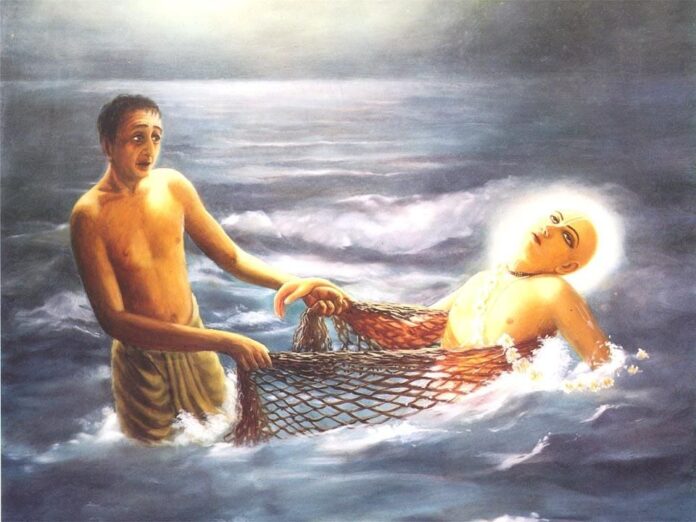
Everyone was overwhelmed with moroseness and almost unconscious, but out of ecstatic love they continued to wander here and there, searching for the Lord. (43) Passing along the beach, they saw a fisherman approaching with his net over his shoulder. Laughing, crying, dancing and singing, he kept repeating the holy name “Hari, Hari.” (44) Seeing the activities of the fisherman, everyone was astonished. Svarūpa Dāmodara Gosvāmī, therefore, asked him for information. (45) “My dear fisherman,” he said, “why are you behaving like this? Have you seen someone hereabouts? What is the cause of your behavior? Please tell us.” (46) The fisherman replied, “I have not seen a single person here, but while casting my net in the water, I captured a dead body. (47)

“I lifted it with great care, thinking it a big fish, but as soon as I saw that it was a corpse, great fear arose in my mind. (48) “As I tried to release the net, I touched the body, and as soon as I touched it, a ghost entered my heart. (49) “I shivered in fear and shed tears. My voice faltered, and all the hairs on my body stood up. (50) “I do not know whether the corpse I found was the ghost of a dead brāhmaṇa or an ordinary man, but as soon as one looks upon it, the ghost enters his body. (51) The body of this ghost is very long, five to seven cubits. Each of its arms and legs is as much as three cubits long. (52) “Its joints are all separated beneath the skin, which is completely slack. No one could see it and remain alive in his body. (53)

“That ghost has taken the form of a corpse, but He keeps his eyes open. Sometimes He utters the sounds ‘goṅ- goṅ,’ and sometimes He remains unconscious. (54) “I have seen that ghost directly, and He is haunting me. But if I die, who will take care of my wife and children? (55) “The ghost is certainly very difficult to talk about, but I am going to find an exorcist and ask him if he can release me from it. (56) “I wander alone at night killing fish in solitary places, but because I remember the hymn to Lord Nṛsiṁha, ghosts do not touch me. (57) This ghost, however, overcomes me with redoubled strength when I chant the Nṛsiṁha mantra. When I even see the form of this ghost, great fear arises in my mind. (58) “Do not go near there. I forbid you. If you go, that ghost will catch you all.” (59)

Chaitanya Charitamrta | Antya Lila | Chapter 17 | Section 207

0

I am simply trying to write about Lord Gauracandra’s transcendental activities and spiritual madness, which are very wonderful and uncommon. I dare to write of them only because I have heard from the mouths of those who have personally seen the Lord’s activities. (1) All glories to Śrī Caitanya Mahāprabhu! All glories to Lord Nityānanda! All glories to Advaitacandra! And all glories to all the devotees of the Lord! (2) Absorbed in ecstasy, Śrī Caitanya Mahāprabhu acted and talked like a madman day and night. (3) In the company of Svarūpa Dāmodara Gosvāmī and Rāmānanda Rāya, Śrī Caitanya Mahāprabhu once passed half the night talking about the pastimes of Lord Kṛṣṇa. (4) As they talked of Kṛṣṇa, Svarūpa Dāmodara Gosvāmī would sing songs exactly suitable for Śrī Caitanya Mahāprabhu’s transcendental emotions. (5) To complement the ecstasy of Śrī Caitanya Mahāprabhu, Rāmānanda Rāya would quote verses from the books of Vidyāpati and Caṇḍīdāsa, and especially from the Gīta- govinda, by Jayadeva Gosvāmī. (6)

At intervals, Śrī Caitanya Mahāprabhu would also recite a verse. Then, in great lamentation, He would explain it. (7) In this way Śrī Caitanya Mahāprabhu passed half the night experiencing varieties of emotions. Finally, after making the Lord lie down on His bed, Svarūpa Dāmodara and Rāmānanda Rāya returned to their homes. (8) Śrī Caitanya Mahāprabhu’s personal servant, Govinda, lay down at the door of His room, and the Lord very loudly chanted the Hare Kṛṣṇa mahā- mantra all night. (9) Suddenly, Śrī Caitanya Mahāprabhu heard the vibration of Kṛṣṇa’s flute. Then, in ecstasy, He began to depart to see Lord Kṛṣṇa. (10) All three doors were fastened as usual, but Śrī Caitanya Mahāprabhu, in great ecstasy, nevertheless got out of the room and left the house. (11) He went to a cow shed on the southern side of the Siṁha- dvāra. There the Lord fell down unconscious among cows from the district of Tailaṅga. (12) Meanwhile, not hearing any sounds from Śrī Caitanya Mahāprabhu, Govinda immediately sent for Svarūpa Dāmodara and opened the doors. (13)

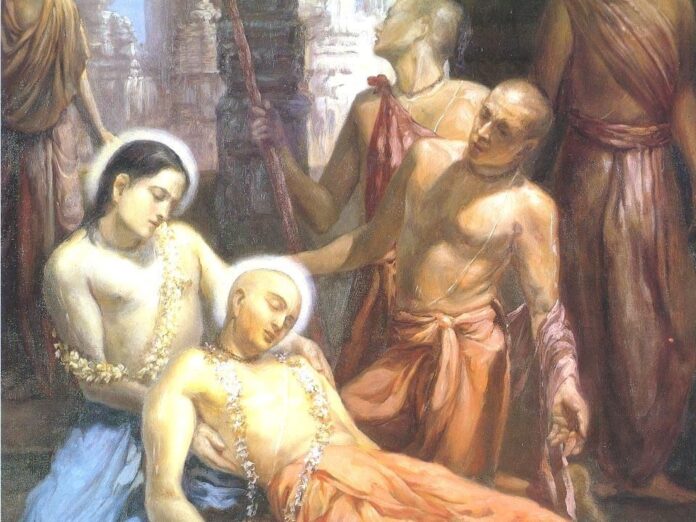
Then Svarūpa Dāmodara Gosvāmī lit a torch and went out with all the devotees to search for Śrī Caitanya Mahāprabhu. (14) After searching here and there, they finally came to the cow shed near the Siṁha- dvāra. There they saw Śrī Caitanya Mahāprabhu lying unconscious among the cows. (15) His arms and legs had entered the trunk of His body, exactly like those of a tortoise. His mouth was foaming, there were eruptions on His body, and tears flowed from His eyes. (16) As the Lord lay there unconscious, His body resembled a large pumpkin. Externally He was completely inert, but within He felt overwhelming transcendental bliss. (17) All the cows around the Lord were sniffing His transcendental body. When the devotees tried to check them, they refused to give up their association with the transcendental body of Śrī Caitanya Mahāprabhu. (18) The devotees tried to rouse the Lord by various means, but His consciousness did not return. Therefore they all lifted Him and brought Him back home. (19)

All the devotees began to chant the Hare Kṛṣṇa mantra very loudly in the Lord’s ears, and after a considerable time Śrī Caitanya Mahāprabhu regained consciousness. (20) When He regained consciousness, His arms and legs came out of His body, and His whole body returned to normal. (21) Śrī Caitanya Mahāprabhu stood up and then sat down again. Looking here and there, He inquired from Svarūpa Dāmodara, “Where have you brought Me? (22) “After hearing the vibration of a flute, I went to Vṛndāvana, and there I saw that Kṛṣṇa, the son of Mahārāja Nanda, was playing on His flute in the pasturing grounds. (23) “He brought Śrīmatī Rādhārāṇī to a bower by signaling with His flute. Then He entered within that bower to perform pastimes with Her. (24) “I entered the bower just behind Kṛṣṇa, My ears captivated by the sound of His ornaments. (25) “I saw Kṛṣṇa and the gopīs enjoying all kinds of pastimes while laughing and joking together. Hearing their vocal expressions enhanced the joy of My ears. (26)

“Just then, all of you made a tumultuous sound and brought Me back here by force. (27) “Because you brought Me back here, I could no longer hear the nectarean voices of Kṛṣṇa and the gopīs, nor could I hear the sounds of their ornaments or the flute.” (28) In great ecstasy, Śrī Caitanya Mahāprabhu said to Svarūpa Dāmodara in a faltering voice, “My ears are dying of thirst. Please recite something to quench this thirst. Let Me hear it.” (29) Understanding the ecstatic emotions of Śrī Caitanya Mahāprabhu, Svarūpa Dāmodara, in a sweet voice, recited the following verse from Śrīmad- Bhāgavatam. (30) “[The gopīs said:] ‘My dear Lord Kṛṣṇa, where is that woman within the three worlds who would not be captivated by the rhythms of the sweet songs coming from Your wonderful flute? Who would not fall down from the path of chastity in this way? Your beauty is the most sublime within the three worlds. Upon seeing Your beauty, even cows, birds, animals and trees in the forest are stunned in jubilation.’ (31)

Upon hearing this verse, Śrī Caitanya Mahāprabhu, overwhelmed with the ecstasy of the gopīs, began to explain it. (32) Śrī Caitanya Mahāprabhu said, “The gopīs entered the arena of the rāsa dance in ecstasy, but after hearing Kṛṣṇa’s words of negligence and detachment, they understood that He was going to renounce them. Thus they began to chastise Him in anger. (33) “‘O dear lover,’ they said, ‘please answer just one question. Who among all the youthful women within this universe is not attracted by the sound of Your flute? (34) “‘When You play Your flute, the vibration acts like a messenger in the form of a yoginī perfect in the art of chanting mantras. This messenger enchants all the women in the universe and attracts them to You. Then she increases their great anxiety and induces them to give up the regulative principle of obeying superiors. Finally, she forcibly brings them to You to surrender in amorous love. (35)

“‘The vibration of Your flute, accompanied by Your glance, which pierces us forcibly with the arrows of lust, induces us to ignore the regulative principles of religious life. Thus we become excited by lusty desires and come to You, giving up all shame and fear. But now You are angry with us. You are finding fault with our violating religious principles and leaving our homes and husbands. And as You instruct us about religious principles, we become helpless. (36) “‘We know that this is all a well- planned trick. You know how to make jokes that cause the complete annihilation of women, but we can understand that Your real mind, words and behavior are different. Therefore please give up all these clever tricks. (37) “‘The nectarean buttermilk of Your flute’s vibration, the nectar of Your sweet words and the nectarean sound of Your ornaments mix together to attract our ears, minds and lives. In this way You are killing us.'” (38)

Śrī Caitanya Mahāprabhu spoke these words in a mood of anger as He floated on waves of ecstatic love. Merged in an ocean of anxiety, He recited a verse spoken by Śrīmatī Rādhārāṇī expressing the same emotion. Then He personally explained the verse and thus tasted the sweetness of Kṛṣṇa. (39) Śrī Caitanya Mahāprabhu continued, “‘My dear friend, the Supreme Personality of Godhead, Kṛṣṇa, has a voice as deep as a cloud resounding in the sky. With the tinkling of His ornaments He attracts the ears of the gopīs, and with the sound of His flute He attracts even the goddess of fortune and other beautiful women. That Personality of Godhead, known as Madana- mohana, whose joking words carry many indications and deep meanings, is increasing the lusty desires of My ears.’ (40) “Kṛṣṇa’s deep voice is more resonant than newly arrived clouds, and His sweet song defeats even the sweet voice of the cuckoo. Indeed, His song is so sweet that even one particle of its sound can inundate the entire world. If such a particle enters one’s ear, one is immediately bereft of all other types of hearing. (41)

“My dear friend, please tell Me what to do. My ears have been plundered by the qualities of Kṛṣṇa’s sound. Now, however, I cannot hear His transcendental sound, and I am almost dead for want of it. (42) “The tinkling of Kṛṣṇa’s ankle bells surpasses the songs of even the swan and crane, and the sound of His bangles puts the singing of the caṭaka bird to shame. Having allowed these sounds to enter the ears even once, one cannot tolerate hearing anything else. (43) “Kṛṣṇa’s speech is far sweeter than nectar. Each of His jubilant words is full of meaning, and when His speech mixes with His smile, which is like camphor, the resultant sound and the deep meaning of Kṛṣṇa’s words create various transcendental mellows. (44) “One particle of that transcendental, blissful nectar is the life and soul of the ear, which is like a cakora bird that lives in hope of tasting that nectar. Sometimes, by good fortune, the bird can taste it, but at other times he unfortunately cannot and therefore almost dies of thirst. (45)

“The transcendental vibration of Kṛṣṇa’s flute disturbs the hearts of women all over the world, even if they hear it only once. Thus their fastened belts become loose, and these women become the unpaid maidservants of Kṛṣṇa. Indeed, they run toward Kṛṣṇa exactly like madwomen. (46) “When she hears the vibration of Kṛṣṇa’s flute, even the goddess of fortune comes to Him, greatly hoping for His association, but nevertheless she does not get it. When the waves of thirst for His association increase, she performs austerities, but still she cannot meet Him. (47) “Only the most fortunate can hear these four nectarean sounds-Kṛṣṇa’s words, the tinkling of His ankle bells and bangles, His voice and the vibration of His flute. If one does not hear these sounds, his ears are as useless as small conchshells with holes.” (48) While Śrī Caitanya Mahāprabhu lamented in this way, agitation and ecstasy awoke in His mind, and He became very restless. Many transcendental ecstasies combined in Him, including anxiety, lamentation, attention, eagerness, fear, determination and remembrance. (49)

The aggregate of all these ecstasies once awoke a statement by Śrīmatī Rādhārāṇī in the mind of Bilvamaṅgala Ṭhākura [Līlā- śuka]. In the same ecstatic mood, Śrī Caitanya Mahāprabhu now recited that verse, and on the strength of madness He described its meaning, which is unknown to people in general. (50) Śrī Caitanya Mahāprabhu said, “‘Alas, what shall I do? To whom shall I speak? Let whatever I have done in hopes of meeting Kṛṣṇa be finished now. Please say something auspicious, but do not speak about Kṛṣṇa. Alas, Kṛṣṇa is lying within My heart like Cupid; therefore how can I possibly give up talking of Him? I cannot forget Kṛṣṇa, whose smile is sweeter than sweetness itself and who gives pleasure to My mind and eyes. Alas, My great thirst for Kṛṣṇa is increasing moment by moment!’ (51) “The anxiety caused by separation from Kṛṣṇa has made Me impatient, and I can think of no way to meet Him. O My friends, you are also deranged by lamentation. Who, therefore, will tell Me how to find Him? (52)

“O My dear friends, how shall I find Kṛṣṇa? What shall I do? Where shall I go? Where can I meet Him? Because I cannot find Kṛṣṇa, My life is leaving Me.” (53) Suddenly, Śrī Caitanya Mahāprabhu became calm and considered His state of mind. He remembered the words of Piṅgalā, and this aroused an ecstasy that moved Him to speak. Thus He explained the meaning of the verse. (54) Śrī Caitanya Mahāprabhu said, “If I give up hope of meeting Kṛṣṇa, I shall then be happy. Therefore, let us stop this most inglorious discussion of Kṛṣṇa. It would be better for us to talk of glorious topics and forget Him.” (55) While speaking in this way, Śrīmatī Rādhārāṇī suddenly remembered Kṛṣṇa. Indeed, He appeared within Her heart. Greatly astonished, She told Her friends, “The person I want to forget is lying in My heart.” (56) Śrīmatī Rādhārāṇī’s ecstasy also made Her think of Kṛṣṇa as Cupid, and this understanding frightened Her. She said, “This Cupid, who has conquered the whole world and entered My heart, is My greatest enemy, for He does not allow Me to forget Him.” (57)

Then great eagerness conquered all the other soldiers of ecstasy, and an uncontrollable desire arose in the kingdom of Śrīmatī Rādhārāṇī’s mind. Greatly unhappy, She then chastised Her own mind. (58) “If I do not think of Kṛṣṇa, My impoverished mind will die within a moment like a fish out of water. But when I see Kṛṣṇa’s sweetly smiling face, My mind and eyes are so pleased that My desire for Him redoubles. (59) “Alas! Where is Kṛṣṇa, the treasure of My life? Where is the lotus- eyed one? Alas! Where is the divine ocean of all transcendental qualities? Alas! Where is the beautiful blackish youth dressed in yellow garments? Alas! Where is the hero of the rāsa dance? (60) “Where shall I go? Where can I find You? Please tell Me. I shall go there.” Speaking in this way, Śrī Caitanya Mahāprabhu began running. But Svarūpa Dāmodara Gosvāmī stood up, caught Him and took Him on his lap. Then Svarūpa Dāmodara brought Him back to His place and made Him sit down. (61)

Suddenly Śrī Caitanya Mahāprabhu returned to external consciousness and said to Svarūpa Dāmodara Gosvāmī, “My dear Svarūpa, please sing some sweet songs.” The Lord’s ears were satisfied when He heard Svarūpa Dāmodara sing songs from the Gīta- govinda and those by the poet Vidyāpati. (62) Each day and night, Śrī Caitanya Mahāprabhu would become deranged in this way and talk like a madman. (63) Even Anantadeva, who possesses thousands of mouths, cannot fully describe the ecstatic transformations that Śrī Caitanya Mahāprabhu experienced in a single day. (64) What can a poor creature like me describe of those transformations? I can give only a hint of them, as if showing the moon through the branches of a tree. (65) This description, however, will satisfy the mind and ears of anyone who hears it, and he will be able to understand these uncommon activities of deep ecstatic love for Kṛṣṇa. (66)

Ecstatic love for Kṛṣṇa is wonderfully deep. By personally tasting the glorious sweetness of that love, Śrī Caitanya Mahāprabhu showed us its extreme limit. (67) Śrī Caitanya Mahāprabhu is wonderfully merciful and wonderfully magnanimous. We have heard of no one else within this world so merciful and charitable. (68) O people of the world, worship the lotus feet of Śrī Caitanya Mahāprabhu in all respects. Only in this way will you achieve the nectarean treasure of ecstatic love for Kṛṣṇa. (69) Thus I have described Śrī Caitanya Mahāprabhu’s ecstatic transformation of becoming like a tortoise. In that ecstasy, He talked and acted like a madman. (70)

Śrīla Raghunātha dāsa Gosvāmī has fully described this pastime in his book Gaurāṅga- stava- kalpavṛkṣa. (71) “How wonderful it is! Śrī Caitanya Mahāprabhu left His residence without opening the three strongly bolted doors. Then He crossed over three high walls, and later, because of strong feelings of separation from Kṛṣṇa, He fell down amidst the cows of the Tailaṅga district and retracted all the limbs of His body like a tortoise. Śrī Caitanya Mahāprabhu, who appeared in that way, rises in my heart and maddens me.” (72) Praying at the lotus feet of Śrī Rūpa and Śrī Raghunātha, always desiring their mercy, I, Kṛṣṇadāsa, narrate Śrī Caitanya- caritāmṛta, following in their footsteps. (73)

Chaitanya Charitamrta | Antya Lila | Chapter 16 | Section 206

0

Therefore, giving up hatred and hesitation, try to eat the remnants of the food of Vaiṣṇavas, for you will thus be able to achieve your desired goal of life. (58) The remnants of food offered to Lord Kṛṣṇa are called mahā- prasādam. After this same mahā- prasādam has been taken by a devotee, the remnants are elevated to mahā- mahā- prasādam. (59) The dust of the feet of a devotee, the water that has washed the feet of a devotee, and the remnants of food left by a devotee are three very powerful substances. (60) By rendering service to these three, one attains the supreme goal of ecstatic love for Kṛṣṇa. In all the revealed scriptures this is loudly declared again and again. (61)

Therefore, my dear devotees, please hear from me, for I insist again and again: please keep faith in these three and render service to them without hesitation. (62) From these three one achieves the highest goal of life-ecstatic love of Kṛṣṇa. This is the greatest mercy of Lord Kṛṣṇa. The evidence is Kālidāsa himself. (63) In this way Śrī Caitanya Mahāprabhu remained at Jagannātha Purī, Nīlācala, and He invisibly bestowed great mercy upon Kālidāsa. (64) That year, Śivānanda Sena brought with him his wife and youngest son, Purī dāsa. (65) Taking his son, Śivānanda Sena went to see Śrī Caitanya Mahāprabhu at His residence. He made his son offer respectful obeisances at the lotus feet of the Lord. (66) Again and again Śrī Caitanya Mahāprabhu asked the boy to chant the name of Kṛṣṇa, but the boy would not utter the holy name. (67) Although Śivānanda Sena tried with much endeavor to get his boy to speak Kṛṣṇa’s holy name, the boy would not utter it. (68) Śrī Caitanya Mahāprabhu said, “I have induced the whole world to take to the holy name of Kṛṣṇa. I have induced even the trees and immovable plants to chant the holy name. (69)

“But I could not induce this boy to chant the holy name of Kṛṣṇa.” Hearing this, Svarūpa Dāmodara Gosvāmī began to speak. (70) “My Lord,” he said, “You have given him initiation into the name of Kṛṣṇa, but after receiving the mantra he will not express it in front of everyone. (71) “This boy chants the mantra within his mind but does not say it aloud. That is his intention, as far as I can guess.” (72) Another day, when Śrī Caitanya Mahāprabhu said to the boy, “Recite, My dear Purī dāsa,” the boy composed the following verse and expressed it before everyone. (73) “Lord Śrī Kṛṣṇa is just like a bluish lotus flower for the ears; He is ointment for the eyes, a necklace of indranīla gems for the chest, and universal ornaments for the gopī damsels of Vṛndāvana. Let that Lord Śrī Hari, Kṛṣṇa, be glorified.” (74) Although the boy was only seven years old and still had no education, he composed such a nice verse. Everyone was struck with wonder. (75) This is the glory of Śrī Caitanya Mahāprabhu’s causeless mercy, which even the demigods, headed by Lord Brahmā, cannot estimate. (76) All the devotees remained with Śrī Caitanya Mahāprabhu continuously for four months. Then the Lord ordered them back to Bengal, and therefore they returned. (77)

As long as the devotees were in Nīlācala, Jagannātha Purī, Śrī Caitanya Mahāprabhu maintained His external consciousness, but after their departure His chief engagement was again the madness of ecstatic love for Kṛṣṇa. (78) Throughout the entire day and night, Śrī Caitanya Mahāprabhu directly relished Kṛṣṇa’s beauty, fragrance and taste as if He were touching Kṛṣṇa hand to hand. (79) One day, when Śrī Caitanya Mahāprabhu went to visit the temple of Lord Jagannātha, the gatekeeper at the Siṁha- dvāra approached Him and offered respectful obeisances. (80) The Lord asked him, “Where is Kṛṣṇa, My life and soul? Please show Me Kṛṣṇa.” Saying this, He caught the doorkeeper’s hand. (81) The doorkeeper replied, “The son of Mahārāja Nanda is here; please come along with me, and I shall show You.” (82) Lord Caitanya said to the doorman, “You are My friend. Please show Me where the Lord of My heart is.” After the Lord said this, they both went to the place known as Jagamohana, where everyone views Lord Jagannātha. (83)

“Just see!” the doorkeeper said. “Here is the best of the Personalities of Godhead. From here You may see the Lord to the full satisfaction of Your eyes.” (84) Śrī Caitanya Mahāprabhu stayed behind the huge column called the Garuḍa- stambha and looked upon Lord Jagannātha, but as He looked He saw that Lord Jagannātha had become Lord Kṛṣṇa, with His flute to His mouth. (85) In his book known as Gaurāṅga- stava- kalpavṛkṣa, Raghunātha dāsa Gosvāmī has described this incident very nicely. (86) “‘My dear friend the doorkeeper, where is Kṛṣṇa, the Lord of My heart? Kindly show Him to Me quickly.’ With these words, Lord Śrī Caitanya Mahāprabhu addressed the doorkeeper like a madman. The doorkeeper grasped His hand and replied very hastily, ‘Come, see Your beloved!’ May that Lord Śrī Caitanya Mahāprabhu rise within my heart and thus make me mad also.” (87) The offering of food known as gopāla- vallabha- bhoga was then given to Lord Jagannātha, and ārati was performed with the sound of the conch and the ringing of bells. (88) When the ārati finished, the prasādam was taken out, and the servants of Lord Jagannātha came to offer some to Śrī Caitanya Mahāprabhu. (89)

The servants of Lord Jagannātha first garlanded Śrī Caitanya Mahāprabhu and then offered Him Lord Jagannātha’s prasādam. The prasādam was so nice that its aroma alone, to say nothing of its taste, would drive the mind mad. (90) The prasādam was made of very valuable ingredients. Therefore the servant wanted to feed Śrī Caitanya Mahāprabhu a portion of it. (91) Śrī Caitanya Mahāprabhu tasted a portion of the prasādam. Govinda took the rest and bound it in the end of his wrapper. (92) To Śrī Caitanya Mahāprabhu the prasādam tasted millions upon millions of times better than nectar, and thus He was fully satisfied. The hair all over His body stood on end, and incessant tears flowed from His eyes. (93) Śrī Caitanya Mahāprabhu considered, “Where has such a taste in this prasādam come from? Certainly it is due to its having been touched by the nectar of Kṛṣṇa’s lips.” (94) Understanding this, Śrī Caitanya Mahāprabhu felt an emotion of ecstatic love for Kṛṣṇa, but upon seeing the servants of Lord Jagannātha, He restrained Himself. (95)

The Lord said again and again, “Only by great fortune may one come by a particle of the remnants of food offered to the Lord.” The servants of the Jagannātha temple inquired, “What is the meaning of this?” (96) Śrī Caitanya Mahāprabhu replied, “These are remnants of food that Kṛṣṇa has eaten and thus turned to nectar with His lips. It surpasses heavenly nectar, and even such demigods as Lord Brahmā find it difficult to obtain. (97) “Remnants left by Kṛṣṇa are called phelā. Anyone who obtains even a small portion must be considered very fortunate. (98) “One who is only ordinarily fortunate cannot obtain such mercy. Only persons who have the full mercy of Kṛṣṇa can receive such remnants.(99) “The word ‘sukṛti’ refers to pious activities performed by the mercy of Kṛṣṇa. One who is fortunate enough to obtain such mercy receives the remnants of the Lord’s food and thus becomes glorious.” (100)

After saying this, Śrī Caitanya Mahāprabhu bade farewell to all the servants. After seeing the next offering of food to Lord Jagannātha, a function known as upala- bhoga, He returned to His own quarters. (101) After finishing His noon duties, Śrī Caitanya Mahāprabhu ate His lunch, but He constantly remembered the remnants of Kṛṣṇa’s food. (102) Śrī Caitanya Mahāprabhu performed His external activities, but His mind was filled with ecstatic love. With great difficulty He tried to restrain His mind, but it would always be overwhelmed by very deep ecstasy. (103) After finishing His evening duties, Śrī Caitanya Mahāprabhu sat down with His personal associates in a secluded place and discussed the pastimes of Kṛṣṇa in great jubilation. (104) Following the indications of Śrī Caitanya Mahāprabhu, Govinda brought the prasādam of Lord Jagannātha. The Lord sent some to Paramānanda Purī and Brahmānanda Bhāratī. (105)

Śrī Caitanya Mahāprabhu then gave shares of the prasādam to Rāmānanda Rāya, Sārvabhauma Bhaṭṭācārya, Svarūpa Dāmodara Gosvāmī and all the other devotees. (106) As they tasted the uncommon sweetness and fragrance of the prasādam, everyone’s mind was struck with wonder. (107) Śrī Caitanya Mahāprabhu said, “These ingredients, such as sugar, camphor, black pepper, cardamom, cloves, butter, spices and licorice, are all material. Everyone has tasted these material substances before. (108-109) “However,” the Lord continued, “in these ingredients there are extraordinary tastes and uncommon fragrances. Just taste them and see the difference in the experience. (110) “Apart from the taste, even the fragrance pleases the mind and makes one forget any other sweetness besides its own. (111)

“Therefore, it is to be understood that the spiritual nectar of Kṛṣṇa’s lips has touched these ordinary ingredients and transferred to them all their spiritual qualities. (112) “A fragrance and taste that are uncommon and greatly enchanting and that make one forget all other experiences are attributes of Kṛṣṇa’s lips. (113) “This prasādam has been made available only as a result of many pious activities. Now taste it with great faith and devotion.” (114) Loudly chanting the holy name of Hari, all of them tasted the prasādam. As they tasted it, their minds became mad in the ecstasy of love. (115) In ecstatic love, Śrī Caitanya Mahāprabhu ordered Rāmānanda Rāya to recite some verses. Thus Rāmānanda Rāya spoke as follows. (116) “‘O hero of charity, please deliver unto us the nectar of Your lips. That nectar increases lusty desires for enjoyment and diminishes lamentation in the material world. Kindly give us the nectar of Your lips, which are touched by Your transcendentally vibrating flute, for that nectar makes all human beings forget all other attachments.'” (117)

Upon hearing Rāmānanda Rāya quote this verse, Śrī Caitanya Mahāprabhu was very satisfied. Then He recited the following verse, which had been spoken by Śrīmatī Rādhārāṇī in great anxiety. (118) “‘My dear friend, the all- surpassing nectar from the lips of the Supreme Personality of Godhead, Kṛṣṇa, can be obtained only after many, many pious activities. For the beautiful gopīs of Vṛndāvana, that nectar vanquishes the desire for all other tastes. Madana- mohana always chews pan that surpasses the nectar of heaven. He is certainly increasing the desires of My tongue.'” (119) After saying this, Śrī Caitanya Mahāprabhu was overwhelmed by ecstatic loving emotions. Talking like a madman, He began to explain the meaning of the two verses. (120) “My dear lover,” Lord Caitanya said in the mood of Śrīmatī Rādhārāṇī, “let Me describe some of the characteristics of Your transcendental lips. They agitate the mind and body of everyone, they increase lusty desires for enjoyment, they destroy the burden of material happiness and lamentation, and they make one forget all material tastes. The whole world falls under their control. They vanquish shame, religion and patience, especially in women. Indeed, they inspire madness in the minds of all women. Your lips increase the greed of the tongue and thus attract it. Considering all this, We see that the activities of Your transcendental lips are always paradoxical. (121-122)

“My dear Kṛṣṇa, since You are a male, it is not very extraordinary that the attraction of Your lips can disturb the minds of women. But I am ashamed to say that Your impudent lips sometimes attract even Your flute, which is also considered a male. It likes to drink the nectar of Your lips, and thus it also forgets all other tastes. (123) “Aside from conscious living beings, even unconscious matter is sometimes made conscious by Your lips. Therefore, Your lips are great magicians. Paradoxically, although Your flute is nothing but dry wood, Your lips constantly make it drink their nectar. They create a mind and senses in the dry wooden flute and give it transcendental bliss. (124) “That flute is a very cunning male who drinks again and again the taste of another male’s lips. It advertises its qualities and says to the gopīs, ‘O gopīs, if you are so proud of being women, come forward and enjoy your property-the nectar of the lips of the Supreme Personality of Godhead.’ (125)

“Thereupon, the flute said angrily to Me, ‘Give up Your shame, fear and religion and come drink the lips of Kṛṣṇa. On that condition, I shall give up my attachment for them. If You do not give up Your shame and fear, however, I shall continuously drink the nectar of Kṛṣṇa’s lips. I am slightly fearful because You also have the right to drink that nectar, but as for the others, I consider them like straw.’ (126) “The nectar of Kṛṣṇa’s lips, combined with the vibration of His flute, attracts all the people of the three worlds. But if we gopīs remain patient out of respect for religious principles, the flute then criticizes us. (127) “The nectar of Your lips and the vibration of Your flute join together to loosen our belts and induce us to give up shame and religion, even before our superiors. As if catching us by our hair, they forcibly take us away and deliver us unto You to become Your maidservants. Hearing of these incidents, people laugh at us. We have thus become completely subordinate to the flute. (128)

“This flute is nothing but a dry stick of bamboo, but it becomes our master and insults us in so many ways that it forces us into a predicament. What can we do but tolerate it? The mother of a thief cannot cry loudly for justice when the thief is punished. Therefore we simply remain silent. (129) “Such is the policy of these lips. Just consider some other injustices. Everything that touches those lips-including food, drink or betel-becomes just like nectar. It is then called kṛṣṇa- phelā, or remnants left by Kṛṣṇa. (130) “Even after much prayer, the demigods themselves cannot obtain even a small portion of the remnants of such food. Just imagine the pride of those remnants! Only a person who has acted piously for many, many births and has thus become a devotee can obtain the remnants of such food. (131) “The betel chewed by Kṛṣṇa is priceless, and the remnants of such chewed betel from His mouth are said to be the essence of nectar. When the gopīs accept these remnants, their mouths become His spittoons. (132)

“Therefore, My dear Kṛṣṇa, please give up all the tricks You have set up so expertly. Do not try to kill the life of the gopīs with the vibration of Your flute. Because of Your joking and laughing, You are becoming responsible for the killing of women. It would be better for You to satisfy us by giving us the charity of the nectar of Your lips.” (133) While Śrī Caitanya Mahāprabhu was talking like this, His mind changed. His anger subsided, but His mental agitation increased. (134) Śrī Caitanya Mahāprabhu continued, “This nectar from Kṛṣṇa’s lips is supremely difficult to obtain, but if one gets some, his life becomes successful. (135) “When a person competent to drink that nectar does not do so, that shameless person continues his life uselessly. (136) “There are persons who are unfit to drink that nectar but who nevertheless drink it continuously, whereas some who are suitable never get it and thus die of greed. (137)

“It is therefore to be understood that such an unfit person must have obtained the nectar of Kṛṣṇa’s lips on the strength of some austerity.” (138) Again Śrī Caitanya Mahāprabhu said to Rāmānanda Rāya, “Please say something. I want to hear.” Understanding the situation, Rāmānanda Rāya recited the following words of the gopīs. (139) “‘My dear gopīs, what auspicious activities must the flute have performed to enjoy the nectar of Kṛṣṇa’s lips independently and leave only a taste for us gopīs, for whom that nectar is actually meant. The forefathers of the flute, the bamboo trees, shed tears of pleasure. His mother, the river on whose bank the bamboo was born, feels jubilation, and therefore her blooming lotus flowers are standing like hair on her body.'” (140)

Upon hearing the recitation of this verse, Śrī Caitanya Mahāprabhu became absorbed in ecstatic love, and with a greatly agitated mind He began to explain its meaning like a madman. (141) “Some gopīs said to other gopīs, ‘Just see the astonishing pastimes of Kṛṣṇa, the son of Vrajendra! He will certainly marry all the gopīs of Vṛndāvana. Therefore, the gopīs know for certain that the nectar of Kṛṣṇa’s lips is their own property and cannot be enjoyed by anyone else. (142) “‘My dear gopīs, fully consider how many pious activities this flute performed in his past life. We do not know what places of pilgrimage he visited, what austerities he performed, or what perfect mantra he chanted. (143) “‘This flute is utterly unfit because it is merely a dead bamboo stick. Moreover, it belongs to the male sex. Yet this flute is always drinking the nectar of Kṛṣṇa’s lips, which surpasses nectarean sweetness of every description. Only by hoping for that nectar do the gopīs continue to live. (144)

“‘Although the nectar of Kṛṣṇa’s lips is the absolute property of the gopīs, the flute, which is just an insignificant stick, is forcibly drinking that nectar and loudly inviting the gopīs to come drink it also. Just imagine the strength of the flute’s austerities and good fortune! Even great devotees drink the nectar of Kṛṣṇa’s lips after the flute has done so. (145) “‘When Kṛṣṇa takes His bath in universally purifying rivers like the Yamunā and the Ganges of the celestial world, the great personalities of those rivers greedily and jubilantly drink the remnants of the nectarean juice from His lips. (146) “‘Aside from the rivers, the trees standing on the banks like great ascetics and engaging in welfare activities for all living entities drink the nectar of Kṛṣṇa’s lips by drawing water from the river with their roots. We cannot understand why they drink like that. (147)

“‘The trees on the bank of the Yamunā and Ganges are always jubilant. They appear to be smiling with their flowers and shedding tears in the form of flowing honey. Just as the forefathers of a Vaiṣṇava son or grandson feel transcendental bliss, the trees feel blissful because the flute is a member of their family.’ (148) “The gopīs considered, ‘The flute is completely unfit for his position. We want to know what kind of austerities the flute executed, so that we may also perform the same austerities. Although the flute is unfit, he is drinking the nectar of Kṛṣṇa’s lips. Seeing this, we qualified gopīs are dying of unhappiness. Therefore, we must consider the austerities the flute underwent in his past life.'” (149)

While thus speaking like a madman, Śrī Caitanya Mahāprabhu became full of ecstatic emotion. In the company of His two friends, Svarūpa Dāmodara Gosvāmī and Rāmānanda Rāya, He sometimes danced, sometimes sang and sometimes became unconscious in ecstatic love. Śrī Caitanya Mahāprabhu passed His days and nights in this way. (150) Expecting the mercy of Svarūpa, Rūpa, Sanātana and Raghunātha dāsa, and taking their lotus feet on my head, I, the most fallen Kṛṣṇadāsa, continue chanting the epic Śrī Caitanya- caritāmṛta, which is sweeter than the nectar of transcendental bliss. (151)

Chaitanya Charitamrta | Antya Lila | Chapter 16 | Section 205

0

Let me offer my respectful obeisances unto Śrī Caitanya Mahāprabhu, who personally tasted the nectar of ecstatic love for Kṛṣṇa and then instructed His devotees how to taste it. Thus He enlightened them about ecstatic love of Kṛṣṇa to initiate them into transcendental knowledge. (1) All glories to Śrī Caitanya Mahāprabhu! All glories to Lord Nityānanda! All glories to Advaita Ācārya! And all glories to all the devotees of the Lord! (2) Śrī Caitanya Mahāprabhu thus stayed at Jagannātha Purī in the association of His devotees, always merged in ecstatic devotional love. (3) The next year, as usual, all the devotees from Bengal went to Jagannātha Purī, and, as in previous years, there was a meeting between Śrī Caitanya Mahāprabhu and the devotees. (4)

Along with the devotees from Bengal came a gentleman named Kālidāsa. He never uttered anything but the holy name of Kṛṣṇa. (5) Kālidāsa was a very advanced devotee, yet he was simple and liberal. He would chant the holy name of Kṛṣṇa while performing all his ordinary dealings. (6) When he used to throw dice in jest, he would chant Hare Kṛṣṇa while throwing the dice. (7) Kālidāsa was an uncle of Raghunātha dāsa Gosvāmī. Throughout his entire life, even in his old age, he tried to eat the remnants of food left by Vaiṣṇavas. (8) Kālidāsa ate the remnants of food of as many Vaiṣṇavas as there were in Bengal. (9) He would go to all the Vaiṣṇavas born in brāhmaṇa families, be they neophyte or advanced devotees, and present them with gifts of first- class eatables. (10) He would beg remnants of food from such Vaiṣṇavas, and if he did not receive any, he would hide. (11) After the Vaiṣṇavas finished eating, they would throw away their leaf dishes, and Kālidāsa would come out of hiding, take the leaves and lick up the remnants. (12)

He would also take gifts to the homes of Vaiṣṇavas born in śūdra families. Then he would hide and in this manner eat the remnants of food they threw away. (13) There was a great Vaiṣṇava named Jhaḍu Ṭhākura, who belonged to the bhūṅimāli caste. Kālidāsa went to his home, taking mangoes with him. (14) Kālidāsa presented the mangoes to Jhaḍu Ṭhākura and offered him respectful obeisances. Then he also offered respectful obeisances to the Ṭhākura’s wife. (15) When Kālidāsa went to Jhaḍu Ṭhākura, he saw that saintly person sitting with his wife. As soon as Jhaḍu Ṭhākura saw Kālidāsa, he likewise offered his respectful obeisances unto him. (16) After a discussion with Kālidāsa that lasted for some time, Jhaḍu Ṭhākura spoke the following sweet words. (17) “I belong to a low caste, and you are a very respectable guest. How shall I serve you? (18) “If you will permit me, I shall send some food to a brāhmaṇa’s house, and there you may take prasādam. If you do so, I shall then live very comfortably.” (19)

Kālidāsa replied, “My dear sir, please bestow your mercy upon me. I have come to see you, although I am very fallen and sinful. (20) “Simply by seeing you, I have become purified. I am very much obligated to you, for my life is now successful. (21) “My dear sir, I have one desire. Please be merciful to me by kindly placing your feet upon my head so that the dust on your feet may touch it.” (22) Jhaḍu Ṭhākura replied, “It does not befit you to ask this of me. I belong to a very low- caste family, whereas you are a respectable rich gentleman.” (23) Kālidāsa then recited some verses, which Jhaḍu Ṭhākura was very happy to hear. (24) “‘Even though one is a very learned scholar in Sanskrit literature, if he is not engaged in pure devotional service, he is not accepted as My devotee. But if someone born in a family of dog- eaters is a pure devotee with no motives for enjoyment through fruitive activity or mental speculation, he is very dear to Me. All respect should be given to him, and whatever he offers should be accepted, for such devotees are indeed as worshipable as I am.’ (25)

“‘A person may be born in a brāhmaṇa family and have all twelve brahminical qualities, but if in spite of being qualified he is not devoted to the lotus feet of Lord Kṛṣṇa, who has a navel shaped like a lotus, he is not as good as a caṇḍāla who has dedicated his mind, words, activities, wealth and life to the service of the Lord. Simply to take birth in a brāhmaṇa family or to have brahminical qualities is not sufficient. One must become a pure devotee of the Lord. If a śva- paca or caṇḍāla is a devotee, he delivers not only himself but his whole family, whereas a brāhmaṇa who is not a devotee but simply has brahminical qualifications cannot even purify himself, what to speak of his family.’ (26)

“‘My dear Lord, anyone who always keeps Your holy name on his tongue is greater than an initiated brāhmaṇa. Although he may be born in a family of dog- eaters and therefore, by material calculations, be the lowest of men, he is glorious nevertheless. That is the wonderful power of chanting the holy name of the Lord. One who chants the holy name is understood to have performed all kinds of austerities. He has studied all the Vedas, he has performed all the great sacrifices mentioned in the Vedas, and he has already taken his bath in all the holy places of pilgrimage. It is he who is factually the Āryan.'” (27) Hearing these quotations from the revealed scripture Śrīmad- Bhāgavatam, Jhaḍu Ṭhākura replied, “Yes, this is true, for it is the version of śāstra. It is true, however, for one who is genuinely advanced in devotion to Kṛṣṇa. (28) “Such a position may befit others, but I do not possess such spiritual power. I belong to a lower class and have not even a pinch of devotion to Kṛṣṇa.” (29)

Kālidāsa again offered his obeisances to Jhaḍu Ṭhākura and asked his permission to go. The saint Jhaḍu Ṭhākura followed him as he left. (30) After bidding farewell to Kālidāsa, Jhaḍu Ṭhākura returned to his home, leaving the marks of his feet plainly visible in many places. (31) Kālidāsa smeared the dust from those footprints all over his body. Then he hid in a place near Jhaḍu Ṭhākura’s home. (32) Upon returning home, Jhaḍu Ṭhākura saw the mangoes Kālidāsa had presented. Within his mind he offered them to Kṛṣṇa- candra. (33) Jhaḍu Ṭhākura’s wife then took the mangoes from their covering of banana tree leaves and bark and offered them to Jhaḍu Ṭhākura, who began to suck and eat them. (34) When he finished eating, he left the seeds on the banana leaf, and his wife, after feeding her husband, later began to eat. (35) After she finished eating, she filled the banana leaves and bark with the seeds, picked up the refuse and then threw it into the ditch where all the refuse was thrown. (36)

Kālidāsa licked the banana bark and the mango seeds and skins, and while licking them he was overwhelmed with jubilation in ecstatic love. (37) In this way Kālidāsa ate the remnants of food left by all the Vaiṣṇavas residing in Bengal. (38) When Kālidāsa visited Jagannātha Purī, Nīlācala, Śrī Caitanya Mahāprabhu bestowed great mercy upon him. (39) Śrī Caitanya Mahāprabhu would regularly visit the temple of Jagannātha every day, and at that time Govinda, His personal servant, used to carry His waterpot and go with Him. (40) On the northern side of the Siṁha- dvāra, behind the door, there are twenty- two steps leading to the temple, and at the bottom of those steps is a ditch. (41) Śrī Caitanya Mahāprabhu would wash His feet in this ditch, and then He would enter the temple to see Lord Jagannātha. (42) Śrī Caitanya Mahāprabhu ordered His personal servant Govinda that no one should take the water that had washed His feet. (43)

Because of the Lord’s strict order, no living being could take the water. Some of His intimate devotees, however, would take it by some trick. (44) One day as Śrī Caitanya Mahāprabhu was washing His feet in that place, Kālidāsa came and extended his palm to take the water. (45) Kālidāsa drank one palmful and then a second and a third. Then Śrī Caitanya Mahāprabhu forbade him to drink more. (46) “Do not act in this way any more. I have fulfilled your desire as far as possible.” (47) Śrī Caitanya Mahāprabhu is the most exalted, omniscient Supreme Personality of Godhead, and therefore He knew that Kālidāsa, in the core of his heart, had full faith in Vaiṣṇavas. (48) Because of this quality, Śrī Caitanya Mahāprabhu satisfied him with mercy not attainable by anyone else. (49) On the southern side, behind and above the twenty- two steps, is a Deity of Lord Nṛsiṁhadeva. It is on the left as one goes up the steps toward the temple. (50)

Śrī Caitanya Mahāprabhu, His left side toward the Deity, offered obeisances to Lord Nṛsiṁha as He proceeded toward the temple. He recited the following verses again and again while offering obeisances. (51) “‘I offer my respectful obeisances unto You, Lord Nṛsiṁhadeva. You are the giver of pleasure to Mahārāja Prahlāda, and Your nails cut the chest of Hiraṇyakaśipu like a chisel cutting stone. (52) “‘Lord Nṛsiṁhadeva is here, and He is also there on the opposite side. Wherever I go, there I see Lord Nṛsiṁhadeva. He is outside and within my heart. Therefore I take shelter of Lord Nṛsiṁhadeva, the original Supreme Personality of Godhead.'” (53)

Having offered obeisances to Lord Nṛsiṁhadeva, Śrī Caitanya Mahāprabhu visited the temple of Lord Jagannātha. Then He returned to His residence, finished His noon duties and took His lunch. (54) Kālidāsa was standing outside the door, expecting the remnants of food from Śrī Caitanya Mahāprabhu. Knowing this, Mahāprabhu gave an indication to Govinda. (55) Govinda understood all the indications of Śrī Caitanya Mahāprabhu. Therefore he immediately delivered the remnants of Śrī Caitanya Mahāprabhu’s food to Kālidāsa. (56) Taking the remnants of the food of Vaiṣṇavas is so valuable that it induced Śrī Caitanya Mahāprabhu to offer Kālidāsa His supreme mercy. (57)

Chaitanya Charitamrta | Antya Lila | Chapter 15 | Section 204

0

When Śrī Caitanya Mahāprabhu saw the transcendental beauty of Kṛṣṇa, He fell down on the ground unconscious. At that time, all the devotees, headed by Svarūpa Dāmodara Gosvāmī, joined Him in the garden. (57) Just as before, they saw all the symptoms of transcendental ecstatic love manifested in the body of Śrī Caitanya Mahāprabhu. Although externally He appeared bewildered, He was tasting transcendental bliss within. (58) Once again all the devotees brought Śrī Caitanya Mahāprabhu back to consciousness by a concerted effort. Then the Lord got up and began wandering here and there, looking all around. (59) Caitanya Mahāprabhu said, “Where has My Kṛṣṇa gone? I saw Him just now, and His beauty has captivated My eyes and mind. (60)

“Why can’t I again see Kṛṣṇa holding His flute to His lips? My eyes are wandering in hopes of seeing Him once more.” (61) Śrī Caitanya Mahāprabhu then recited the following verse, which was spoken by Śrīmatī Rādhārāṇī to Her dear friend Viśākhā. (62) “‘My dear friend, the luster of Kṛṣṇa’s body is more brilliant than that of a newly formed cloud, and His yellow dress is more attractive than newly arrived lightning. A peacock feather decorates His head, and on His neck hangs a lovely necklace of brilliant pearls. As He holds His charming flute to His lips, His face looks as beautiful as the full autumn moon. By such beauty, Madana- mohana, the enchanter of Cupid, is increasing the desire of My eyes to see Him.'” (63)

Caitanya Mahāprabhu continued, “Śrī Kṛṣṇa’s complexion is as polished as powdered eye ointment. It surpasses the beauty of a newly formed cloud and is softer than a blue lotus flower. Indeed, His complexion is so pleasing that it attracts the eyes and minds of everyone, and it is so powerful that it defies all comparison. (64) “My dear friend, please tell Me what I should do. Kṛṣṇa is as attractive as a wonderful cloud, and My eyes are just like cātaka birds, which are dying of thirst because they do not see such a cloud. (65) “Kṛṣṇa’s yellow garments look exactly like restless lightning in the sky, and the pearl necklace on His neck appears like a line of ducks flying below a cloud. Both the peacock feather on His head and His vaijayantī garland [containing flowers of five colors] resemble rainbows. (66)

“The luster of Kṛṣṇa’s body is as beautiful as the glow of a spotless full moon that has just risen, and the vibration of His flute sounds exactly like the sweet thundering of a newly formed cloud. When the peacocks in Vṛndāvana hear that vibration, they all begin to dance. (67) “The cloud of Kṛṣṇa’s pastimes is drenching the fourteen worlds with a shower of nectar. Unfortunately, when that cloud appeared, a whirlwind arose and blew it away from Me. Being unable to see the cloud, the cātaka bird of My eyes is almost dead from thirst.” (68) In a faltering voice, Śrī Caitanya Mahāprabhu again said, “Alas, go on reciting, Rāma Rāya.” Thus Rāmānanda Rāya began to recite a verse. While listening to this verse, the Lord was sometimes very jubilant and sometimes overcome by lamentation. Afterwards the Lord personally explained the verse. (69)

“‘Dear Kṛṣṇa, by seeing Your beautiful face decorated with tresses of hair, by seeing the beauty of Your earrings falling on Your cheeks, and by seeing the nectar of Your lips, the beauty of Your smiling glances, Your two arms, which assure complete fearlessness, and Your broad chest, whose beauty arouses conjugal attraction, we have simply surrendered ourselves to becoming Your maidservants.'” (70) Śrī Caitanya Mahāprabhu said, “After conquering the moon and the lotus flower, Kṛṣṇa wished to capture the doelike gopīs. Thus He spread the noose of His beautiful face, and within that noose He placed the bait of His sweet smile to misguide the gopīs. The gopīs fell prey to that trap and became Kṛṣṇa’s maidservants, giving up their homes, families, husbands and prestige. (71) “My dear friend, Kṛṣṇa acts just like a hunter. This hunter does not care for piety or impiety; He simply creates many devices to conquer the cores of the hearts of the doelike gopīs. (72)

“The earrings dancing on Kṛṣṇa’s cheeks are shaped like sharks, and they shine very brightly. These dancing earrings attract the minds of all women. Over and above this, Kṛṣṇa pierces the hearts of women with the arrows of His sweetly smiling glances. He is not at all afraid to kill women in this way. (73) “On Kṛṣṇa’s chest are the ornaments of the Śrīvatsa marks, indicating the residence of the goddess of fortune. His chest, which is as broad as a plunderer’s, attracts thousands upon thousands of damsels of Vraja, conquering their minds and breasts by force. Thus they all become maidservants of the Supreme Personality of Godhead. (74) “The two very beautiful arms of Kṛṣṇa are just like long bolts. They also resemble the bodies of black snakes that enter the space between the two hill- like breasts of women and bite their hearts. The women then die from the burning poison. (75)

“The combined cooling effect of camphor, roots of khasakhasa and sandalwood is surpassed by the coolness of Kṛṣṇa’s palms and the soles of His feet, which are cooler and more pleasing than millions upon millions of moons. If women are touched by them even once, their minds are enticed, and the burning poison of lusty desire for Kṛṣṇa is immediately vanquished.” (76) Lamenting in ecstatic love, Śrī Caitanya Mahāprabhu then recited the following verse, which was spoken by Śrīmatī Rādhārāṇī while exposing the lamentation of Her heart to Her friend Śrīmatī Viśākhā. (77) “‘My dear friend, Kṛṣṇa’s chest is as broad and attractive as a door made of indranīla gems, and His two arms, as strong as bolts, can relieve the mental anguish of young girls distressed by lusty desires for Him. His body is cooler than the moon, sandalwood, the lotus flower and camphor. In this way, Madana- mohana, the attractor of Cupid, is increasing the desire of My breasts.'” (78) Śrī Caitanya Mahāprabhu then said, “I just now had Kṛṣṇa, but unfortunately I have lost Him again. (79)

“By nature, Kṛṣṇa is very restless; He does not stay in one place. He meets with someone, enchants his mind and then disappears. (80) “‘The gopīs became proud of their great fortune. To subdue their sense of superiority and show them special favor, Keśava, the subduer of even Lord Brahmā and Lord Śiva, disappeared from the rāsa dance.'” (81) Śrī Caitanya Mahāprabhu then said to Svarūpa Dāmodara Gosvāmī, “Please sing a song that will bring consciousness to My heart.” (82) Thus for the pleasure of Śrī Caitanya Mahāprabhu, Svarūpa Dāmodara Gosvāmī began very sweetly singing the following verse from the Gīta- govinda. (83) “‘Here in the arena of the rāsa dance, I remember Kṛṣṇa, who is always fond of joking and performing pastimes.'” (84) When Svarūpa Dāmodara Gosvāmī sang this special song, Śrī Caitanya Mahāprabhu immediately got up and began to dance in ecstatic love. (85)

At that time, all eight kinds of spiritual transformations became manifest in Lord Caitanya’s body. The thirty- three symptoms of vyabhicāri- bhāva, beginning with lamentation and jubilation, became prominent as well. (86) All the ecstatic symptoms, such as bhāvodaya, bhāva- sandhi and bhāva- śābalya, awakened in the body of Śrī Caitanya Mahāprabhu. A great fight arose between one emotion and another, and each of them became prominent. (87) Lord Caitanya Mahāprabhu had Svarūpa Dāmodara sing the same verse again and again. Each time he sang it, the Lord tasted it anew, and thus He danced again and again. (88) After the Lord had been dancing for a long time, Svarūpa Dāmodara Gosvāmī stopped singing the verse. (89) Over and over again Śrī Caitanya Mahāprabhu said, “Go on! Sing! Sing!” But Svarūpa Dāmodara, seeing the Lord’s fatigue, did not resume singing. (90)

When the devotees heard Śrī Caitanya Mahāprabhu say “Go on singing!” they all gathered around Him and began to chant the holy name of Hari in unison. (91) At that time, Rāmānanda Rāya made the Lord sit down and dissipated His fatigue by fanning Him. (92) Then all the devotees took Śrī Caitanya Mahāprabhu to the beach and bathed Him. Finally, they brought Him back home. (93) After they fed Him lunch, they made Him lie down. Then all the devotees, headed by Rāmānanda Rāya, returned to their respective homes. (94) Thus I have described Śrī Caitanya Mahāprabhu’s pastimes in the garden, which He entered, mistaking it for Vṛndāvana. (95) There He exhibited transcendental madness and ecstatic ravings, which Śrī Rūpa Gosvāmī has described very nicely in his Stava- mālā as follows. (96)

“Śrī Caitanya Mahāprabhu is the topmost of all devotees. Sometimes, while walking on the beach, He would see a beautiful garden nearby and mistake it for the forest of Vṛndāvana. Thus He would be completely overwhelmed by ecstatic love of Kṛṣṇa and begin to chant the holy name and dance. His tongue worked incessantly as He chanted, ‘Kṛṣṇa! Kṛṣṇa!’ Will He again become visible before the path of my eyes?” (97) The pastimes of Śrī Caitanya Mahāprabhu are unlimited; it is not possible to write of them properly. I can give only an indication of them as I try to introduce them. (98) Praying at the lotus feet of Śrī Rūpa and Śrī Raghunātha, always desiring their mercy, I, Kṛṣṇadāsa, narrate Śrī Caitanya- caritāmṛta, following in their footsteps. (99)

Chaitanya Charitamrta | Antya Lila | Chapter 15 | Section 203

0

The ocean of ecstatic love for Kṛṣṇa is very difficult to understand, even for such demigods as Lord Brahmā. By enacting His pastimes, Śrī Caitanya Mahāprabhu submerged Himself in that ocean, and His heart was absorbed in that love. Thus He exhibited in various ways the exalted position of transcendental love for Kṛṣṇa. (1) All glories to Śrī Kṛṣṇa Caitanya, the Supreme Personality of Godhead! All glories to Lord Nityānanda, whose body is always filled with transcendental bliss! (2) All glories to Śrī Advaita Ācārya, who is very dear to Lord Caitanya! And all glories to all the devotees of the Lord, headed by Śrīvāsa Ṭhākura! (3) Thus Śrī Caitanya Mahāprabhu forgot Himself throughout the entire day and night, being merged in an ocean of ecstatic love for Kṛṣṇa. (4)

The Lord would maintain Himself in three states of consciousness: sometimes He merged totally in ecstatic emotion, sometimes He was in partial external consciousness, and sometimes He was in full external consciousness. (5) Actually, Śrī Caitanya Mahāprabhu was always merged in ecstatic emotion, but just as a potter’s wheel turns without the potter’s touching it, the Lord’s bodily activities, like bathing, going to the temple to see Lord Jagannātha, and taking lunch, went on automatically. (6) One day, while Śrī Caitanya Mahāprabhu was looking at Lord Jagannātha in the temple, Lord Jagannātha appeared to be personally Śrī Kṛṣṇa, the son of Nanda Mahārāja. (7) When Śrī Caitanya Mahāprabhu realized Lord Jagannātha to be Kṛṣṇa Himself, Lord Caitanya’s five senses immediately became absorbed in attraction for the five attributes of Lord Kṛṣṇa. (8)

Just as in a tug- of- war, the single mind of Lord Caitanya was attracted in five directions by the five transcendental attributes of Lord Kṛṣṇa. Thus the Lord became unconscious. (9) Just then, the upala- bhoga ceremony of Lord Jagannātha concluded, and the devotees who had accompanied Lord Caitanya to the temple took Him back home. (10) That night, Śrī Caitanya Mahāprabhu was attended by Svarūpa Dāmodara Gosvāmī and Rāmānanda Rāya. Keeping His hands around their necks, the Lord began to lament. (11) When Śrīmatī Rādhārāṇī was very much agitated due to feeling great separation from Kṛṣṇa, She spoke a verse to Viśākhā explaining the cause of Her great anxiety and restlessness. (12) Reciting that verse, Śrī Caitanya Mahāprabhu expressed His burning emotions. Then, with great lamentation, He explained the verse to Svarūpa Dāmodara and Rāmānanda Rāya. (13)

Śrī Caitanya Mahāprabhu said, “‘Though the hearts of the gopīs are like high- standing hills, they are inundated by the waves of the nectarean ocean of Kṛṣṇa’s beauty. His sweet voice enters their ears and gives them transcendental bliss, the touch of His body is cooler than millions and millions of moons together, and the nectar of His bodily fragrance overfloods the entire world. O My dear friend, that Kṛṣṇa, who is the son of Nanda Mahārāja and whose lips are exactly like nectar, is attracting My five senses by force.’ (14) “Lord Śrī Kṛṣṇa’s beauty, the sound of His words and the vibration of His flute, His touch, His fragrance and the taste of His lips are full of an indescribable sweetness. When all these features attract My five senses at once, My senses all ride together on the single horse of My mind but want to go in five different directions. (15)

“O My dear friend, please hear the cause of My misery. My five senses are actually extravagant rogues. They know very well that Kṛṣṇa is the Supreme Personality of Godhead, but they still want to plunder Kṛṣṇa’s property. (16) “My mind is just like a single horse being ridden by the five senses of perception, headed by sight. Each of My senses wants to ride that horse, and thus they pull My mind in five directions simultaneously. In what direction will it go? If they all pull at one time, certainly the horse will lose its life. How can I tolerate this atrocity? (17) “My dear friend, if you say, ‘Just try to control Your senses,’ what shall I say? I cannot become angry at My senses. Is it their fault? Kṛṣṇa’s beauty, sound, touch, fragrance and taste are by nature extremely attractive. These five features are attracting My senses, and each wants to drag My mind in a different direction. In this way the life of My mind is in great danger, just like a horse ridden in five directions at once. Thus I am also in danger of dying. (18)

“The consciousness of each woman within the three worlds is certainly like a high hill, but the sweetness of Kṛṣṇa’s beauty is like an ocean. Even a drop of water from that ocean can flood the entire world and submerge all the high hills of consciousness. (19) “The sweetness of Kṛṣṇa’s joking words plays indescribable havoc with the hearts of all women. His words bind a woman’s ear to the qualities of their sweetness. Thus there is a tug- of- war, and the life of the ear departs. (20) “Kṛṣṇa’s transcendental body is so cool that it cannot be compared even to sandalwood pulp or to millions upon millions of moons. It expertly attracts the breasts of all women, which resemble high hills. Indeed, the transcendental body of Kṛṣṇa attracts the minds of all women within the three worlds. (21) “The fragrance of Kṛṣṇa’s body is more maddening than the aroma of musk, and it surpasses the fragrance of the bluish lotus flower. It enters the nostrils of all the women of the world and, making a nest there, thus attracts them. (22)

“Kṛṣṇa’s lips are so sweet when combined with the camphor of His gentle smile that they attract the minds of all women, forcing them to give up all other attractions. If the sweetness of Kṛṣṇa’s smile is unobtainable, great mental difficulties and lamentation result. That sweetness is the only wealth of the gopīs of Vṛndāvana.” (23) After speaking in this way, Śrī Caitanya Mahāprabhu caught hold of the necks of Rāmānanda Rāya and Svarūpa Dāmodara. Then the Lord said, “My dear friends, please listen to Me. What shall I do? Where shall I go? Where can I go to get Kṛṣṇa? Please, both of you, tell Me how I can find Him.” (24) Thus absorbed in transcendental pain, Śrī Caitanya Mahāprabhu lamented day after day in the company of Svarūpa Dāmodara Gosvāmī and Rāmānanda Rāya. (25) To enhance the ecstatic mood of the Lord, Svarūpa Dāmodara Gosvāmī would sing appropriate songs and Rāmānanda Rāya would recite suitable verses. In this way they were able to pacify Him. (26)

The Lord especially liked to hear Bilvamaṅgala Ṭhākura’s Kṛṣṇa- karṇāmṛta, the poetry of Vidyāpati, and Śrī Gīta- govinda, by Jayadeva Gosvāmī. Śrī Caitanya Mahāprabhu felt great pleasure in His heart when His associates chanted verses and sang songs from these books. (27) One day, while going to the beach by the sea, Śrī Caitanya Mahāprabhu suddenly saw a flower garden. (28) Lord Caitanya mistook that garden for Vṛndāvana and very quickly entered it. Absorbed in ecstatic love of Kṛṣṇa, He wandered throughout the garden, searching for Him. (29) After Kṛṣṇa disappeared with Rādhārāṇī during the rāsa dance, the gopīs wandered in the forest looking for Him. In the same way, Śrī Caitanya Mahāprabhu wandered in that garden by the sea. (30) Absorbed in the ecstatic mood of the gopīs, Śrī Caitanya Mahāprabhu wandered here and there. He began to inquire after Kṛṣṇa by quoting verses to all the trees and creepers. (31)

“[The gopīs said:] ‘O cūta tree, priyāla tree, panasa, āsana and kovidāra! O jambu tree, O arka tree, O bel, bakula and mango! O kadamba tree, O nīpa tree and all other trees living on the bank of the Yamunā for the welfare of others, please let us know where Kṛṣṇa has gone. We have lost our minds and are almost dead. (32) “‘O all- auspicious tulasī plant, you are very dear to Govinda’s lotus feet, and He is very dear to you. Have you seen Kṛṣṇa walking here wearing a garland of your leaves, surrounded by a swarm of bumblebees? (33) “‘O plants of mālatī flowers, mallikā flowers, jātī and yūthikā flowers, have you seen Kṛṣṇa passing this way, touching you with His hand to give you pleasure?'” (34) Śrī Caitanya Mahāprabhu continued, “‘O mango tree, O jackfruit tree, O piyāla, jambu and kovidāra trees, you are all inhabitants of a holy place. Therefore kindly act for the welfare of others. (35)

“‘Have you seen Kṛṣṇa coming this way? Kindly tell us which way He has gone and save our lives.'” (36) When the trees did not reply, the gopīs guessed, “‘Since all of these trees belong to the male class, all of them must be friends of Kṛṣṇa. (37) “‘Why should the trees tell us where Kṛṣṇa has gone? Let us rather inquire from the creepers; they are female and are therefore like friends to us. (38) “‘They will certainly tell us where Kṛṣṇa has gone, since they have seen Him personally.'” Guessing in this way, the gopīs inquired from the plants and creepers, headed by tulasī. (39) “‘O tulasī! O mālatī! O yūthī, mādhavī and mallikā! Kṛṣṇa is very dear to you; therefore He must have come near you. (40) “‘You are all just like dear friends to us. Kindly tell us which way Kṛṣṇa has gone and save our lives.'” (41) When they still received no reply, the gopīs thought, “‘These plants are all Kṛṣṇa’s maidservants, and out of fear they will not speak to us.'” (42)

The gopīs then came upon a group of she- deer. Smelling the aroma of Kṛṣṇa’s body and seeing the faces of the deer, the gopīs inquired from them to ascertain if Kṛṣṇa was nearby. (43) Śrī Caitanya Mahāprabhu said, “‘O wife of the deer, Lord Kṛṣṇa has been embracing His beloved, and thus the kuṅkuma powder on Her raised breasts has covered His garland of kunda flowers. The fragrance of this garland is flowing here. O my dear friend, have you seen Kṛṣṇa passing this way with His dearmost companion, increasing the pleasure of the eyes of all of you?’ (44) “‘O dear doe, Śrī Kṛṣṇa is always very pleased to give you pleasure. Kindly inform us whether He passed this way in the company of Śrīmatī Rādhārāṇī. We think They must certainly have come this way. (45) “‘We are not outsiders. Being very dear friends of Śrīmatī Rādhārāṇī, we can perceive the bodily fragrance of Kṛṣṇa from a distance. (46)

“‘Kṛṣṇa has been embracing Śrīmatī Rādhārāṇī, and the kuṅkuma powder on Her breasts has mixed with the garland of kunda flowers decorating His body. The fragrance of the garland has scented the entire atmosphere. (47) “‘Lord Kṛṣṇa has left this place, and therefore the deer are feeling separation. They do not hear our words; therefore how can they reply?'” (48) The gopīs then came upon many trees so laden with fruits and flowers that their branches were bent down to the ground. (49) The gopīs thought that because all the trees must have seen Kṛṣṇa pass by they were offering respectful obeisances to Him. To be certain, the gopīs inquired from the trees. (50) Lord Caitanya continued, “‘O trees, kindly tell us whether Balarāma’s younger brother, Kṛṣṇa, welcomed your obeisances with loving glances as He passed this way, resting one hand on the shoulder of Śrīmatī Rādhārāṇī, holding a lotus flower in the other, and being followed by a swarm of bumblebees maddened by the fragrance of tulasī flowers. (51)

“‘To stop the bumblebees from landing on the face of His beloved, He whisked them away with the lotus flower in His hand, and thus His mind was slightly diverted. (52) “‘Did He or did He not pay attention while you offered Him obeisances? Kindly give evidence supporting your words. (53) “‘Separation from Kṛṣṇa has made these servants very unhappy. Having lost consciousness, how can they answer us?'” (54) Saying this, the gopīs stepped onto the beach by the Yamunā River. There they saw Lord Kṛṣṇa beneath a kadamba tree. (55) Standing there with His flute to His lips, Kṛṣṇa, who enchants millions upon millions of Cupids, attracted the eyes and minds of all the world with His unlimited beauty. (56)

Chaitanya Charitamrta | Antya Lila | Chapter 14 | Section 202

0

Thus I have described the uncommon transformations of the body of Śrī Caitanya Mahāprabhu. When people hear about this, they are very much astonished. (80) No one has witnessed such bodily changes elsewhere, nor has anyone read of them in the revealed scriptures. Yet Śrī Caitanya Mahāprabhu, the supreme sannyāsī, exhibited these ecstatic symptoms. (81) These ecstasies are not described in the śāstras, and they are inconceivable to common men. Therefore people in general do not believe in them. (82) Raghunātha dāsa Gosvāmī lived continuously with Śrī Caitanya Mahāprabhu. I am simply recording whatever I have heard from him. Although common men do not believe in these pastimes, I believe in them totally. (83)

One day, while Śrī Caitanya Mahāprabhu was going to the sea to bathe, He suddenly saw a sand dune named Caṭaka- parvata. (84) Śrī Caitanya Mahāprabhu mistook the sand dune for Govardhana Hill and ran toward it. (85) “[Lord Caitanya said:] ‘Of all the devotees, this Govardhana Hill is the best! O my friends, this hill supplies Kṛṣṇa and Balarāma, as well as Their calves, cows and cowherd friends, with all kinds of necessities-water for drinking, very soft grass, caves, fruits, flowers and vegetables. In this way the hill offers respect to the Lord. Being touched by the lotus feet of Kṛṣṇa and Balarāma, Govardhana Hill appears very jubilant.'” (86) Reciting this verse, Śrī Caitanya Mahāprabhu ran toward the sand dune as fast as the wind. Govinda ran after Him, but he could not approach Him. (87) First one devotee shouted loudly, and then a tumultuous uproar arose as all the devotees stood up and began to run after the Lord. (88)

Svarūpa Dāmodara Gosvāmī, Jagadānanda Paṇḍita, Gadādhara Paṇḍita, Rāmāi, Nandāi and Śaṅkara Paṇḍita are some of the devotees who ran after Śrī Caitanya Mahāprabhu. (89) Paramānanda Purī and Brahmānanda Bhāratī also went toward the beach, and Bhagavān Ācārya, who was lame, followed them very slowly. (90) Śrī Caitanya Mahāprabhu was running with the speed of the wind, but He suddenly became stunned in ecstasy and lost all strength to proceed further. (91) The flesh at each of His pores erupted like pimples, and His bodily hairs, standing on end, appeared like kadamba flowers. (92) Blood and perspiration flowed incessantly from every pore of His body, and He could not speak a word but simply produced a gargling sound within His throat. (93) The Lord’s eyes filled and overflowed with unlimited tears, like the Ganges and Yamunā meeting in the sea. (94)

His entire body faded to the color of a white conchshell, and then He began to quiver like the waves in the ocean. (95) While quivering in this way, Śrī Caitanya Mahāprabhu fell down on the ground. Then Govinda approached Him. (96) Govinda sprinkled water from a karaṅga waterpot all over the Lord’s body, and then, taking His own outer garment, he began to fan Śrī Caitanya Mahāprabhu. (97) When Svarūpa Dāmodara and the other devotees reached the spot and saw the condition of Śrī Caitanya Mahāprabhu, they began to cry. (98) All eight kinds of transcendental transformations were visible in the Lord’s body. All the devotees were struck with wonder to see such a sight. (99) The devotees loudly chanted the Hare Kṛṣṇa mantra near Śrī Caitanya Mahāprabhu and washed His body with cold water. (100) After the devotees had been chanting for a long time, Śrī Caitanya Mahāprabhu suddenly stood up and shouted, “Haribol!” (101)

When Śrī Caitanya Mahāprabhu stood up, all the Vaiṣṇavas loudly chanted, “Hari! Hari!” in great jubilation. The auspicious sound filled the air in all directions. (102) Astonished, Śrī Caitanya Mahāprabhu stood up and began looking here and there, trying to see something. But He could not catch sight of it. (103) When Śrī Caitanya Mahāprabhu saw all the Vaiṣṇavas, He returned to partial external consciousness and spoke to Svarūpa Dāmodara. (104) Śrī Caitanya Mahāprabhu said, “Who has brought Me here from Govardhana Hill? I was seeing Lord Kṛṣṇa’s pastimes, but now I cannot see them. (105) “Today I went from here to Govardhana Hill to find out if Kṛṣṇa was tending His cows there. (106) “I saw Lord Kṛṣṇa climbing Govardhana Hill and playing His flute, surrounded on all sides by grazing cows. (107) “Hearing the vibration of Kṛṣṇa’s flute, Śrīmatī Rādhārāṇī and all Her gopī friends came there to meet Him. They were all very nicely dressed. (108)

“When Kṛṣṇa and Śrīmatī Rādhārāṇī entered a cave together, the other gopīs asked Me to pick some flowers. (109) “Just then, all of you made a tumultuous sound and carried Me from there to this place. (110) “Why have you brought Me here, causing Me unnecessary pain? I had a chance to see Kṛṣṇa’s pastimes, but I could not see them.” (111) Saying this, Śrī Caitanya Mahāprabhu began to weep. When all the Vaiṣṇavas saw the Lord’s condition, they also wept. (112) At that time, Paramānanda Purī and Brahmānanda Bhāratī arrived. Seeing them, Śrī Caitanya Mahāprabhu became somewhat respectful. (113)

Śrī Caitanya Mahāprabhu returned to complete external consciousness and immediately offered prayers to them. Then these two elderly gentlemen both embraced the Lord with loving affection. (114) Śrī Caitanya Mahāprabhu said to Purī Gosvāmī and Brahmānanda Bhāratī, “Why have the two of you come so far?” Purī Gosvāmī replied, “Just to see Your dancing.” (115) When He heard this, Śrī Caitanya Mahāprabhu felt somewhat ashamed. Then He went to bathe in the sea with all the Vaiṣṇavas. (116) After bathing in the sea, Śrī Caitanya Mahāprabhu returned to His residence with all the devotees. Then they all lunched on the remnants of food offered to Lord Jagannātha. (117) Thus I have described the transcendental ecstatic emotions of Śrī Caitanya Mahāprabhu. Even Lord Brahmā cannot describe their influence. (118)

In his book Gaurāṅga- stava- kalpavṛkṣa, Raghunātha dāsa Gosvāmī has very vividly described Śrī Caitanya Mahāprabhu’s pastime of running toward the Caṭaka- parvata sand dune. (119) “Near Jagannātha Purī is a great sand dune known as Caṭaka- parvata. Seeing that hill, Śrī Caitanya Mahāprabhu said, ‘Oh, I shall go to the land of Vraja to see Govardhana Hill!’ Then He began running madly toward it, and all the Vaiṣṇavas ran after Him. This scene awakens in my heart and maddens me.” (120) Who can properly describe all the uncommon pastimes of Śrī Caitanya Mahāprabhu? They are all simply His play. (121) I have briefly described them just to give an indication of His transcendental pastimes. Nevertheless, anyone who hears this will certainly attain the shelter of Lord Kṛṣṇa’s lotus feet. (122) Praying at the lotus feet of Śrī Rūpa and Śrī Raghunātha, always desiring their mercy, I, Kṛṣṇadāsa, narrate Śrī Caitanya- caritāmṛta, following in their footsteps. (123)

Stay Connected

16,985FansLike
12,500FollowersFollow
61,453SubscribersSubscribe
Have a question?Send us an enquiry. We usually reply within a day.