


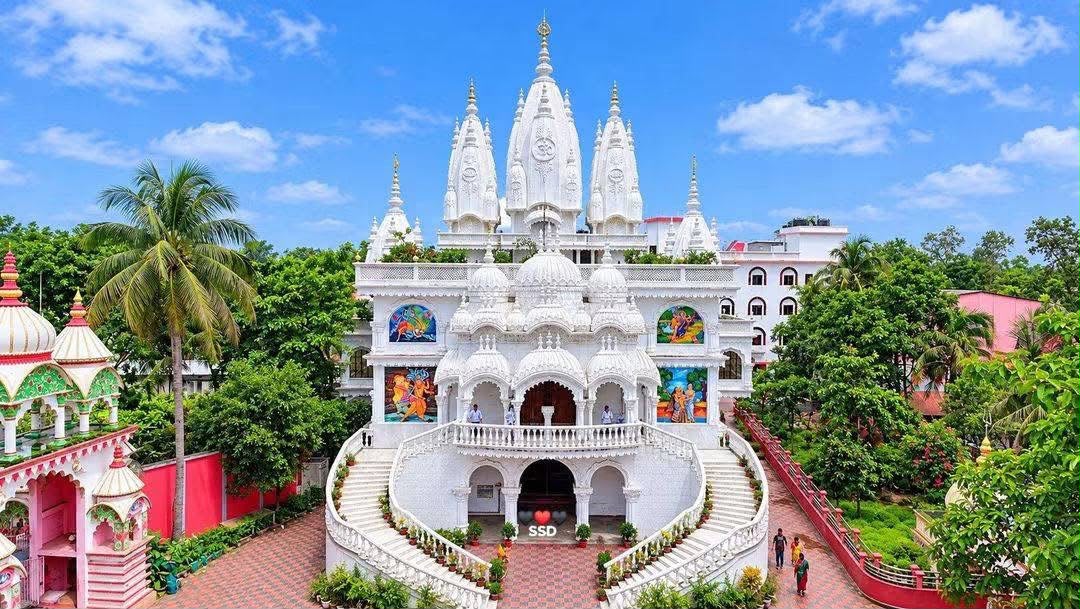
A significant milestone in the spread of Krishna consciousness was marked on November 13, 2026, with the inauguration of a magnificent new ISKCON temple in Bangladesh. The newly constructed Sri Sri Nrsimha Jiu Temple, situated on Nrsimha Akhra Road in the Boglabazar area of Habiganj town, welcomed an estimated 50,000 devotees and visitors from different parts of the country.
The inauguration represents more than the completion of a religious building. It reflects years of dedication, collective service and the sincere desire of devotees to establish a spiritual centre where people can come together to hear about the Supreme Personality of Godhead, chant His holy names and cultivate devotional service.
Constructed at an estimated cost of BDT 69.3 million (Tk 6.93 crore), the temple was formally inaugurated virtually by His Holiness Srila Jayapataka Swami, a senior spiritual leader of the International Society for Krishna Consciousness (ISKCON) and a member of its Governing Body Commission (GBC).
A Grand Inauguration of the ISKCON Temple in Bangladesh
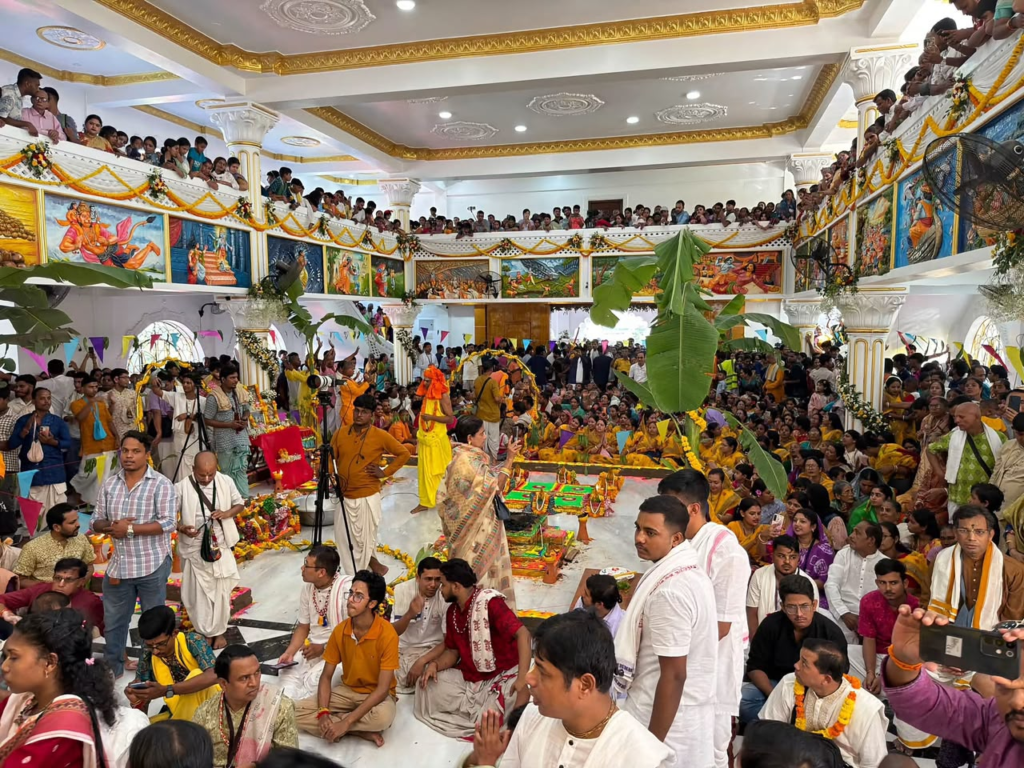
The inauguration ceremony was celebrated with great enthusiasm and devotional spirit. Thousands of devotees, spiritual leaders, government representatives and distinguished guests gathered to witness this important occasion.
The day-long programme featured several traditional Vedic and Vaishnava ceremonies, including:
- Vedic fire sacrifices (Yajnas).
- Harinama Sankirtana, the congregational chanting of the holy names of Krishna.
- Spiritual discourses and discussions.
- A grand Kirtan festival.
- Distribution of Krishna Prasadam, sanctified food offered to the Supreme Lord.
A special commemorative programme was also organised to mark the 49th disappearance anniversary of His Divine Grace A.C. Bhaktivedanta Swami Prabhupada, the Founder-Acharya of ISKCON.
The occasion was particularly meaningful because the temple inauguration coincided with the remembrance of Srila Prabhupada, whose tireless efforts carried the teachings of Lord Sri Krishna across the world.
His mission was to make the timeless wisdom of the Vedic scriptures accessible to people everywhere and encourage them to take up the process of devotional service.
Distinguished Spiritual Leaders and Government Representatives Attend
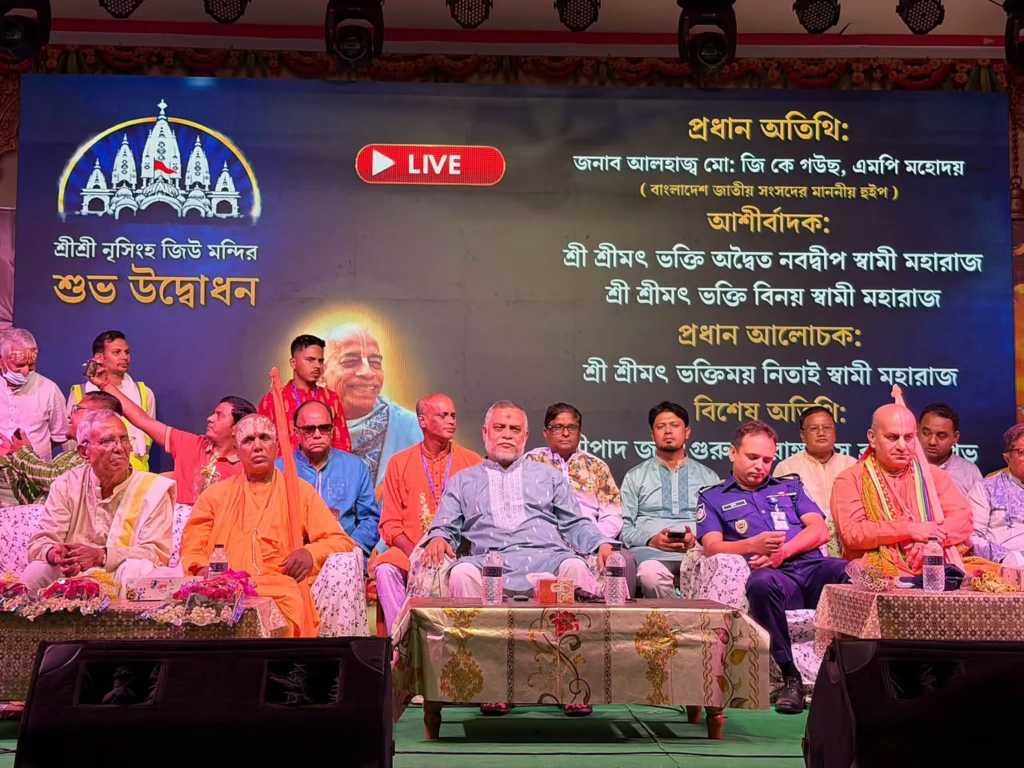
The afternoon session brought together prominent spiritual leaders, distinguished personalities and representatives of ISKCON from Bangladesh and other countries.
The Chief Guest was Alhaj G. K. Gaus, Government Whip and Member of Parliament representing the Habiganj-3 constituency. The session was chaired by Sripad Shuddhasatva Govinda Das, President of ISKCON Bangladesh and a former Deputy Inspector General of Bangladesh Police.
Several senior ISKCON leaders were present, including Bhaktimay Nitai Swami, General Secretary of ISKCON Bangladesh; Bhakti Advaita Navadwip Swami, Vice President of ISKCON Bangladesh; and Bhakti Binay Swami.
Other distinguished international spiritual personalities included Srila Subhag Swami, Srila Bhakti Purushottam Swami, Gauranga Prem Swami, Bhakti Prem Swami, Sripad Nadugopal Das, Bhakti Vijay Bhagavat Swami, Bhakti Parivrajak Swami, Bhaktisar Govindananda and Sripad Yudhishthir Govinda Das.
The programme also witnessed the participation of Hrishikesh Gauranga Das, Country Director of ISKCON Communications Bangladesh; Sripad Yugadharma Das, Chairman of Resolve; members of the ISKCON Executive Committee; Advocate Swaraj Ranjan Biswas, Adviser to ISKCON Habiganj; and representatives of the local administration.
Sripad Uday Gaur Das Brahmachari, Secretary of ISKCON Sylhet Division and President of ISKCON Habiganj, delivered the welcome address. Advocate Promoth Sarkar moderated the session.

ISKCON’s International Mission and Social Contributions Highlighted
One of the significant moments of the inauguration was a special virtual address delivered from the United States by Anuttama Das, ISKCON’s International Minister of Communications and a member of the GBC.
His presentation highlighted ISKCON’s worldwide activities, international communication initiatives, interfaith dialogue and humanitarian programmes.
The address helped bring attention to the broader purpose of the Krishna consciousness movement, which extends beyond temple worship to spiritual education, community development and service to humanity.
ISKCON’s activities are founded upon the teachings of the Vedic scriptures, particularly the Bhagavad-gita and Srimad-Bhagavatam. Through its temples, educational initiatives, food distribution programmes and spiritual communities, the organisation seeks to introduce people to the principles of a God-centred life.
Government Guest Appreciates ISKCON’s Contribution to Society
In his keynote address, Chief Guest G. K. Gaus spoke about the importance of understanding religious institutions through proper study, research and factual information.
He urged people not to participate in misinformation or negative propaganda about ISKCON. Instead, he encouraged the public to examine allegations carefully and verify information before presenting it through the media.
He also emphasised the importance of associating with spiritually minded and morally upright people. According to him, participation in spiritual fellowship can contribute significantly to building a peaceful and responsible society.
Gaus appreciated ISKCON’s religious discipline and ethical principles, observing that such practices can help individuals cultivate self-discipline, moral values and a sense of responsibility.
He further acknowledged that ISKCON’s contributions extend beyond religious activities to humanitarian service and public welfare.
Recalling his long association with the Habiganj temple, he explained that the institution once had very limited infrastructure. At that time, devotees and monks had envisioned establishing a large temple at the same location.
He expressed happiness that this long-cherished vision had finally become a reality.
As a contribution towards the temple’s further development, he announced a donation of Tk 1 million (10 lakh taka).
Emphasising religious harmony and equal rights for all communities, he remarked:
“Religion is individual, but the state belongs to everyone.”
His statement highlighted the importance of mutual respect, peaceful coexistence and harmony among different religious communities.
Sri Sri Nrsimha Jiu Temple: A Centre for Spiritual Education and Devotional Service
The newly constructed Sri Sri Nrsimha Jiu Temple features three architecturally designed domes and facilities capable of accommodating more than a thousand devotees for worship at a time.
However, the true significance of a Vaishnava temple extends far beyond its architectural beauty and physical infrastructure.
According to the teachings of the Vedic scriptures, a temple is a sacred place where people can reconnect with the Supreme Lord through devotional activities.
The Bhagavad-gita (9.26) explains that the Supreme Lord accepts offerings made with devotion and love:
“patram puspam phalam toyam
yo me bhaktya prayacchati”
This verse teaches that Krishna accepts even a simple offering of a leaf, flower, fruit or water when it is presented with genuine devotion.
Such devotional principles form the foundation of temple worship and spiritual life.
The Sri Sri Nrsimha Jiu Temple is expected to serve as a centre for several activities, including:
- Regular Deity worship and spiritual ceremonies.
- Harinama Sankirtana and congregational chanting.
- Bhagavad-gita and Srimad-Bhagavatam discussions.
- Religious and spiritual education.
- Community gatherings and devotional programmes.
- Social welfare and humanitarian initiatives.
Through these activities, the temple aims to provide opportunities for people of different backgrounds to understand the teachings of Lord Sri Krishna and develop their spiritual lives.
The Importance of Temples in Spreading Krishna Consciousness
In the present age of Kali-yuga, human society faces numerous challenges arising from material attachment, conflict, anxiety and forgetfulness of the Supreme Lord.
The Vedic scriptures repeatedly emphasise that the chanting of the holy names is the most effective spiritual process for this age.
The Srimad-Bhagavatam (12.3.51) describes the special opportunity available in Kali-yuga through the chanting of the holy names of the Lord.
The congregational chanting of the Hare Krishna maha-mantra is therefore a central activity in the mission of ISKCON.
Harinama Sankirtana is not merely a musical or cultural gathering. It is a spiritual process through which people can purify their consciousness and gradually awaken their dormant love for Krishna.
Temples provide an organised environment where this process can be practised collectively. They also create opportunities for children, young people, families and elderly persons to receive spiritual guidance and associate with devotees.
In this way, a temple becomes a centre for both individual spiritual advancement and the spiritual welfare of society.
A New Chapter for Krishna Consciousness in Habiganj
The completion of Sri Sri Nrsimha Jiu Temple represents the collective dedication of spiritual leaders, devotees and well-wishers who contributed to making the project possible.
Years of planning, financial contributions and dedicated service have transformed an earlier vision into a substantial spiritual institution.
The participation of approximately 50,000 devotees and visitors in the inauguration reflects the enthusiasm surrounding this development.
The organisers hope that the temple will become an important centre for spiritual awareness, moral education, humanitarian values and social harmony in the region.
Conclusion
The inauguration of the ISKCON temple in Bangladesh marks an important development in the continued expansion of Krishna consciousness. The Sri Sri Nrsimha Jiu Temple is not simply a new architectural landmark in Habiganj; it represents the faith, dedication and devotional aspirations of countless devotees.
As Srila Prabhupada repeatedly emphasised, the purpose of human life is to revive our forgotten relationship with Krishna. Institutions dedicated to spiritual education, Deity worship, Sankirtana and the study of Vedic scriptures can play an important role in helping people understand this eternal purpose.
May Sri Sri Nrsimha Jiu bless the devotees and residents of Habiganj, and may this sacred temple become a centre from which the message of bhakti, spiritual knowledge and devotion to Lord Sri Krishna continues to reach many more hearts.
Deepen your Bhakti-yoga practice, harmonize relationships, and receive guided coaching — all at Vedavarsity.com