


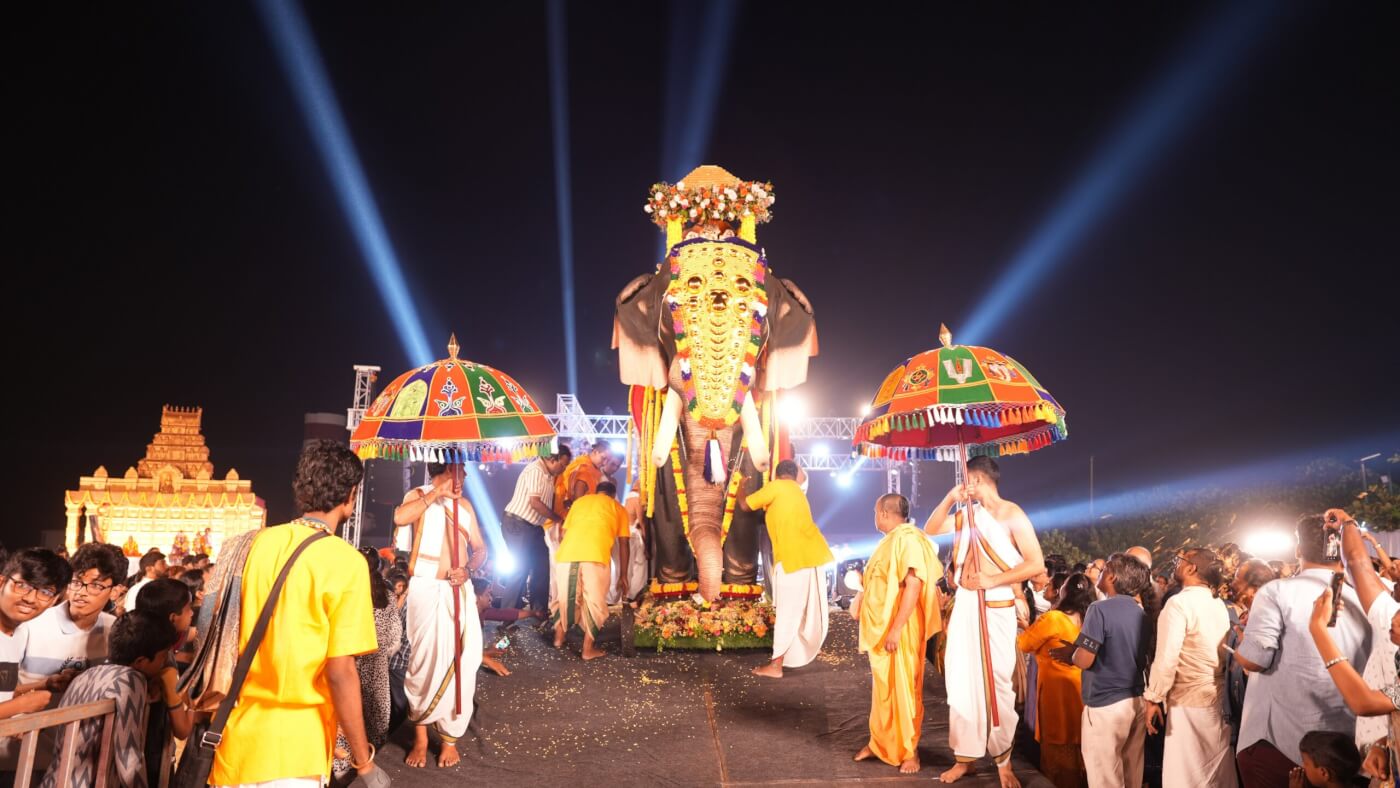
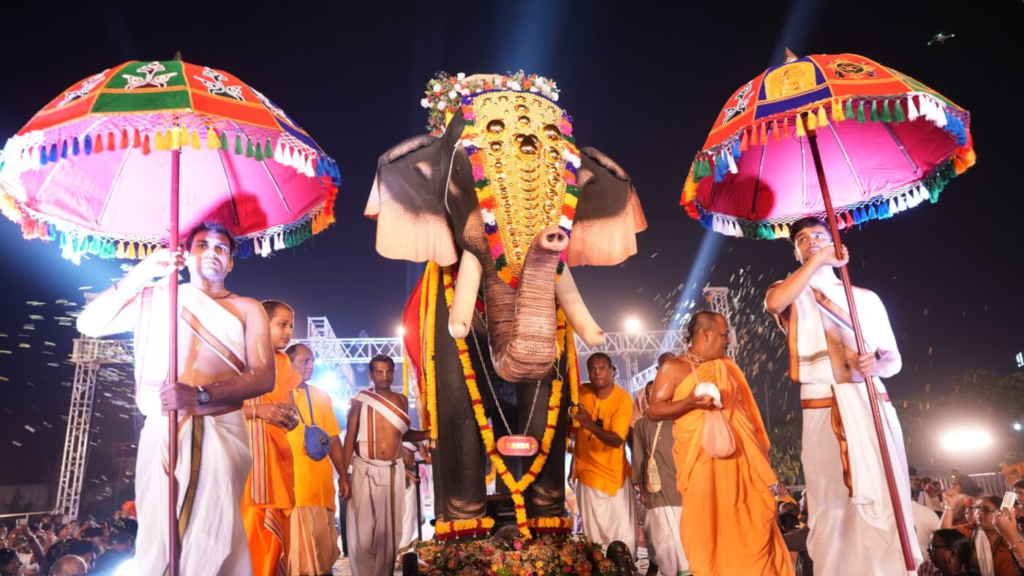
The ISKCON Visakhapatnam mechanical elephant initiative marks a meaningful development in the way traditional temple festivals can be celebrated while maintaining concern for all living beings. During the auspicious occasion of Sharad Purnima on October 25, 2026, ISKCON Visakhapatnam welcomed Ranga, a life-size mechanical elephant, offering an alternative to the use of live elephants in religious ceremonies.
Donated by Indian actor Adivi Sesh in collaboration with PETA India, Ranga is the first mechanical elephant of its kind introduced in Andhra Pradesh. This initiative reflects an important principle of Vedic culture: genuine spirituality must be accompanied by compassion towards all living entities.
The introduction of Ranga demonstrates that religious traditions can be preserved while adopting practices that avoid unnecessary suffering to animals.
ISKCON Visakhapatnam Mechanical Elephant: Welcoming Ranga on Sharad Purnima
The inauguration of Ranga took place during the Sharad Purnima celebrations at MGM Park on Beach Road in Visakhapatnam, Andhra Pradesh.
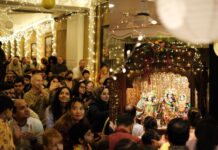
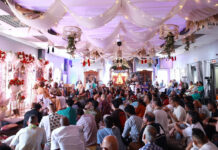
Devotees assembled for the celebrations, which included a ceremonial procession, devotional bhajans, and other spiritual activities. The mechanical elephant was formally inaugurated by Madhusevita Dasa, Chairman of ISKCON’s Governing Body Commission (GBC), alongside temple president Samba Dasa, Nitai Sevini Devi Dasi, and other representatives.
The occasion was significant because it brought together devotion, cultural heritage, and concern for animal welfare.
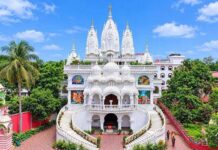
ISKCON Visakhapatnam, which is home to Their Lordships Sri Sri Radha Damodar, has maintained a commitment not to own or hire live elephants for religious ceremonies. The arrival of Ranga represents a practical expression of this commitment.
Rather than abandoning traditional processions, the temple has adopted an alternative that allows devotees to continue participating in festive celebrations without depending upon captive elephants.
The Vedic Principle of Compassion Towards All Living Beings
The foundation of Vedic spirituality is not merely the performance of religious ceremonies but the development of genuine love and compassion.
According to Vedic teachings, every living entity is an eternal spiritual being, or jīva-ātmā. The external body may differ, but the spiritual identity of every living entity remains the same.
Śrīla Prabhupāda repeatedly emphasized that Krishna consciousness involves understanding the spiritual equality of all living beings.
In the Bhagavad-gītā (5.18), Lord Krishna describes the vision of a spiritually enlightened person:
vidyā-vinaya-sampanne brāhmaṇe gavi hastini
A learned person endowed with spiritual knowledge sees with equal vision a learned and gentle brāhmaṇa, a cow, an elephant, a dog, and a dog-eater.
This does not mean that all living beings have identical bodily characteristics or requirements. Rather, it teaches that the soul within every body is spiritually equal.
Ahimsa: The Principle of Non-Violence
The Sanskrit term ahiṁsā means non-violence or refraining from causing unnecessary harm to other living beings.
In Vedic culture, compassion is not restricted to human society. It extends to animals, birds, and all forms of life.
A devotee understands that every living entity belongs to Krishna and that the Lord is the Supreme Father of all.
Therefore, causing unnecessary suffering to animals for the sake of human enjoyment, prestige, or convenience is inconsistent with the cultivation of spiritual consciousness.
The adoption of a mechanical elephant offers one practical way to express this principle during religious celebrations.
How Ranga the Mechanical Elephant Preserves Festival Traditions
The mechanical elephant Ranga has been designed to reproduce several natural movements of a real elephant.
Unlike a stationary decorative structure, this electrically operated model is capable of performing movements that make it suitable for temple processions and public celebrations.
Its features include:
- Movement of the head, ears, eyes, trunk, and tail.
- Ability to spray water.
- Electrically operated mechanical functions.
- A life-size structure designed for ceremonial use.
- Wheels that allow it to participate in religious processions.
These features enable temples to maintain the visual and ceremonial aspects of traditional celebrations without requiring live elephants.
For devotees, the purpose of a religious procession is to glorify the Supreme Personality of Godhead, Sri Krishna, through kirtana, offerings, and devotional participation.
The mechanical elephant provides an alternative means of preserving the festive atmosphere while avoiding the challenges associated with keeping elephants in captivity.
Adivi Sesh and PETA India Support Animal Welfare
The introduction of Ranga was made possible through the collaborative efforts of Indian actor Adivi Sesh and PETA India.
Adivi Sesh supported the initiative by donating the mechanical elephant to ISKCON Visakhapatnam. His contribution reflects an effort to encourage religious institutions to consider alternatives to using live elephants during ceremonial occasions.
PETA India has been facilitating the donation of mechanical elephants to temples across the country.
According to the announcement, Ranga is the 33rd mechanical elephant donated through this initiative. The programme has now reached temples in seven Indian states.
The initiative seeks to encourage institutions to adopt alternatives that allow cultural and religious traditions to continue without requiring elephants to be maintained in captivity.
Adivi Sesh also expressed hope that the example set by ISKCON Visakhapatnam would inspire other religious institutions to consider similar alternatives.
True Spirituality Is Rooted in Compassion
Speaking during the inauguration, Madhusevita Dasa emphasized the relationship between spiritual practice and compassion towards other living beings.
He expressed the principle that true spirituality must be rooted in compassion and encouraged greater kindness and respect towards Krishna’s creation.
This understanding is central to the teachings of Lord Krishna.
In the Bhagavad-gītā (12.13), the Lord describes the qualities of His dear devotee:
adveṣṭā sarva-bhūtānāṁ maitraḥ karuṇa eva ca
A devotee is non-envious, friendly, and compassionate towards all living entities.
The word karuṇa refers to compassion. It is not simply a feeling of sympathy but an attitude expressed through one’s conduct and decisions.
A person may perform elaborate religious ceremonies, visit holy places, and participate in festivals. However, spiritual advancement also requires the cultivation of kindness, humility, and respect for all living beings.
Samba Dasa, president of ISKCON Visakhapatnam, also welcomed the development. He explained that the temple could continue its religious traditions while adopting practices that do not place demands on captive elephants.
He expressed hope that other temples would consider similar approaches.
ISKCON Visakhapatnam: Preserving Devotional Culture and Service
ISKCON Visakhapatnam, situated along the Bay of Bengal in Andhra Pradesh, has been serving the local community through various devotional and educational activities.
The temple is dedicated to the worship of Their Lordships Sri Sri Radha Damodar and provides opportunities for people to participate in Krishna consciousness.
Its activities include:
- Daily worship and devotional programmes.
- Celebration of important Vaishnava festivals.
- Harinama Sankirtana and bhajans.
- Spiritual education and dissemination of Vedic knowledge.
- Prasadam distribution and community service.
- Public programmes promoting Krishna consciousness.
The introduction of Ranga adds another dimension to these celebrations.
It demonstrates how religious institutions can thoughtfully preserve cultural traditions while considering the welfare of other living entities.
Such initiatives also provide an opportunity to educate future generations about the relationship between spiritual values, responsible conduct, and respect for nature.
The Broader Significance of Compassion in Vedic Culture
Vedic civilization places great importance on living in harmony with nature and recognizing the spiritual identity of all creatures.
The concept of sarva-bhūta-hita refers to the welfare of all living beings. A person progressing in spiritual knowledge naturally develops concern for the well-being of others.
This principle is particularly relevant in the present age, when human society increasingly recognizes the importance of responsible treatment of animals.
Religious institutions have an important role to play in demonstrating how spiritual principles can be applied in practical life.
The example of ISKCON Visakhapatnam illustrates that preserving religious heritage does not necessarily require retaining every traditional external arrangement. When a suitable alternative is available, institutions can adopt it while maintaining the devotional purpose of their celebrations.
The ultimate objective of every religious ceremony is to please the Supreme Lord. When devotees perform their activities with sincerity, devotion, and compassion, their celebrations become meaningful expressions of Krishna consciousness.
Conclusion: ISKCON Visakhapatnam Mechanical Elephant Sets an Example of Compassion
The introduction of Ranga through the ISKCON Visakhapatnam mechanical elephant initiative represents a thoughtful step towards combining devotional traditions with compassion for animals.
By welcoming a mechanical elephant during Sharad Purnima, the temple has demonstrated that traditional religious celebrations can continue without depending upon live elephants in captivity.
This development also reminds devotees that Krishna consciousness is not limited to rituals and ceremonies. It involves developing a compassionate attitude towards all living entities, understanding that every soul is part and parcel of the Supreme Lord.
As Lord Krishna teaches, a devotee should cultivate friendliness and compassion towards all beings.
May this initiative inspire more religious institutions to embrace compassionate alternatives and make their celebrations an expression of genuine spiritual understanding.
Deepen your Bhakti-yoga practice, harmonize relationships, and receive guided coaching — all at Vedavarsity.com