
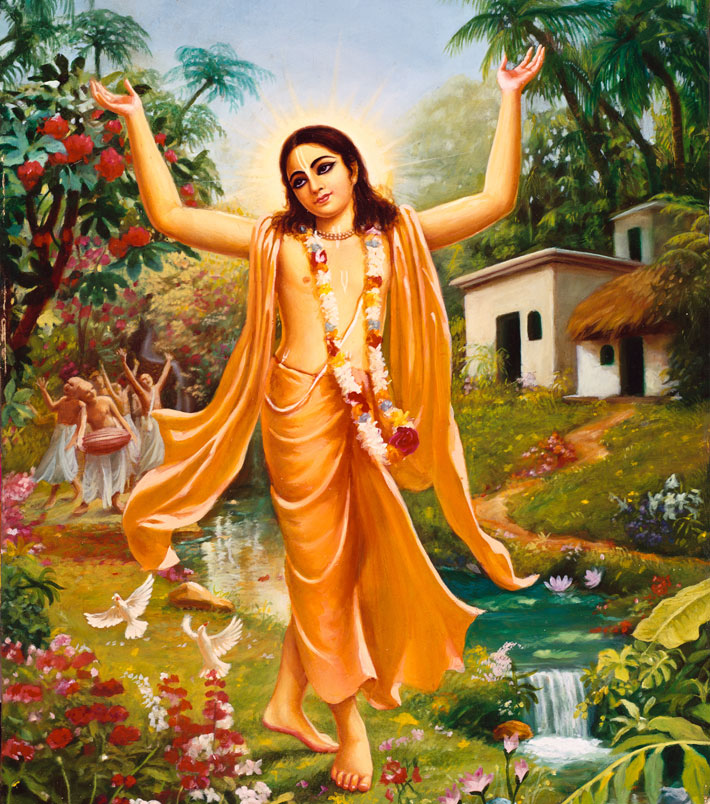
The history of the Hare Krishna movement contains many examples of how the congregational chanting of the holy names (saṅkīrtana) transcends material obstacles. One remarkable incident took place in London during the Christmas season, when a group of devotees of Lord Caitanya Mahāprabhu were arrested while chanting on the streets. What appeared to be a legal confrontation ultimately became a profound demonstration of Lord Caitanya’s mercy, touching not only the devotees but also the police officers, the courtroom, and even the presiding judge.
The incident illustrates an essential principle taught throughout the Vedic scriptures: sincere devotional service offered to the Supreme Lord never goes in vain. Even when external circumstances appear unfavorable, divine arrangements often reveal a higher purpose.
Lord Caitanya’s Mercy Reaches London’s Busy Streets
It was the Thursday before Christmas, and London’s famous Oxford Street was overflowing with shoppers. Earlier that week, plainclothes police officers had already arrested devotees twice for publicly chanting the Hare Krishna mahā-mantra. Hoping to avoid further confrontation, five devotees selected a different route through Piccadilly Circus and Regent Street while softly chanting the holy names.
As they approached Oxford Circus on their return journey, the atmosphere inspired them to resume loud congregational chanting. The sacred vibration of the Hare Krishna mahā-mantra echoed through the streets as curious shoppers paused, smiled, and turned to witness the joyful procession.
Just as the devotees neared Tottenham Court Road, three plainclothes officers suddenly blocked their path and placed them under arrest, alleging that they were causing an obstruction.
The devotees respectfully questioned the accusation, pointing out that they were walking along the edge of a wide pavement with little pedestrian traffic. Despite their explanation, the officers escorted them toward the nearby police station.
Mercy Begins to Transform the Arresting Officers
As they walked under police escort, the devotees quietly began chanting prayers to Lord Nṛsiṁhadeva for protection. Gradually the chanting grew louder, accompanied by the rhythmic sounds of the mṛdaṅga and karatālas.
To everyone’s surprise, the officers made no attempt to stop them.
Instead, the devotees noticed something extraordinary. The same policemen who had repeatedly arrested saṅkīrtana parties during the week were now smiling broadly and appearing to relish the chanting. Their repeated contact with devotees had begun to soften their hearts.
When the procession reached a crowded bus queue, one officer instructed them to stop chanting temporarily to avoid obstructing pedestrians. After they had passed the crowd, however, he unexpectedly gave another instruction:
“Okay, start chanting again.”
The devotees continued chanting all the way into the police station itself, filling its corridors and charging room with the transcendental sound of the holy names. Although the duty sergeant reacted with initial anger, many officers displayed genuine curiosity and engaged the devotees in philosophical discussions while formal charges were prepared.
What began as an arrest had quietly become an opportunity for spiritual association.
A Court Appearance on Lord Nityananda’s Appearance Day
The following morning, the devotees pleaded not guilty, and the hearing was postponed until February 2.
Only later did they realize the significance of the date. It coincided with the appearance day of Lord Nityānanda Prabhu, the eternal associate of Lord Caitanya Mahāprabhu and the personification of divine compassion.
Following the traditional observance, the devotees fasted during the morning, participated in devotional worship, and honored prasāda before traveling to Great Marlborough Street Magistrates Court.
Among those accompanying them was Reverend Norman Morehouse, a respected Christian minister who wished to observe the proceedings firsthand.
Presenting Spiritual Truth in the Courtroom
Inside the courtroom, the arresting officer testified that the devotees had caused an obstruction. During questioning, however, inconsistencies appeared in his account regarding the number of participants and the surrounding circumstances.
The magistrate then invited the devotees to present their own explanation.
Speaking respectfully, the devotees explained that their public chanting was not an act of disturbance but the fulfillment of a sacred religious duty. They emphasized that all genuine scriptures encourage glorification of God, whether He is addressed as Allah, Jehovah, Rāma, Govinda, or Kṛṣṇa.
The spokesperson then quoted the celebrated verse from the Bṛhan-nāradīya Purāṇa:
harer nāma harer nāma harer nāmaiva kevalam
kalau nāsty eva nāsty eva nāsty eva gatir anyathā
He translated its meaning:
“In this age of Kali there is no alternative, no alternative, no alternative for spiritual advancement other than chanting the holy names of the Lord.”
The courtroom listened attentively.
The devotees further explained that despite remarkable material progress, society continues to struggle with violence, addiction, crime, and dissatisfaction because humanity has largely forgotten its spiritual identity. According to Vedic wisdom, lasting peace begins when individuals recognize themselves as eternal souls (ātma) and revive their forgotten relationship with the Supreme Lord.
To support this point, they quoted the distinguished historian Arnold Toynbee, who observed that modern civilization’s greatest crisis is fundamentally spiritual rather than material.
The devotees concluded by explaining that their lives were guided by four foundational principles: mercy, truthfulness, cleanliness, and austerity. Public chanting and spiritual education, they said, form an essential part of genuine welfare work for society.
The Judge’s Decision
After hearing both sides, the magistrate carefully considered the case.
He acknowledged that, in a strict legal sense, there had been a minor technical obstruction. Nevertheless, he also recognized the devotees’ sincerity and peaceful intentions.
He therefore dismissed the case.
Before leaving, the devotees requested permission to donate a copy of Śrī Īśopaniṣad, translated and commented upon by His Divine Grace A. C. Bhaktivedanta Swami Prabhupāda, to the court library.
The judge gladly accepted the gift.
Outside the courtroom, Reverend Morehouse warmly congratulated the devotees. Having witnessed the judge’s unusually compassionate response, he remarked that divine providence had surely played a role in the outcome.
Lord Caitanya’s Mercy Works Beyond Material Boundaries
This memorable incident beautifully demonstrates that Lord Caitanya’s mercy extends beyond social, political, and legal boundaries. The purpose of saṅkīrtana is never to oppose society but to awaken dormant spiritual consciousness within every living being.
Those who initially opposed the devotees—including the arresting officers—gradually experienced transformation through repeated association with the holy name. The courtroom itself became a place where transcendental knowledge was respectfully heard, illustrating that sincere devotional service can touch hearts in the most unexpected settings.
The Vedic principle of dharma, or righteous duty, teaches that actions performed in service to the Supreme Lord ultimately produce auspicious results. Although external circumstances may sometimes appear challenging, the workings of divine arrangement often become visible only in retrospect.
Conclusion
The London saṅkīrtana arrest stands as an enduring testimony to the unlimited reach of Lord Caitanya’s mercy. What began as a police arrest concluded with smiling officers, philosophical discussions inside a police station, a favorable court ruling, and the placement of transcendental literature in a court library.
The devotees later reflected upon a verse from Śrī Caitanya-caritāmṛta, which perfectly summarized the experience:
aparādha kṣamāila, ḍubila prema-jale
keba eḍāibe prabhura prema-mahājāle
“Lord Caitanya forgave all the offenders, and they became immersed in the ocean of love of God, for no one can escape the wonderful network of His divine mercy.”
This extraordinary account reminds us that sincere devotion is never defeated by external opposition. When the holy names of the Lord are chanted with faith and humility, Lord Caitanya’s mercy has the power to transform hearts, dissolve hostility, and reveal the higher purpose guiding all events.
Deepen your Bhakti-yoga practice, harmonize relationships, and receive guided coaching — all at Vedavarsity.com