


For many people, gambling appears to be harmless entertainment—a lottery ticket, a casino visit, or a friendly wager. Modern society often promotes these activities as exciting opportunities to gain wealth with little effort. Yet Vedic wisdom presents a profoundly different understanding. It explains that gambling is not merely a financial risk but a subtle habit that gradually weakens truthfulness, self-control, and spiritual consciousness. The relationship between gambling and spiritual life is therefore much deeper than avoiding monetary loss.
According to the Vedic scriptures, gambling disturbs the mind, nourishes greed, and diverts one’s intelligence from higher spiritual goals. Rather than cultivating qualities such as honesty, discipline, and satisfaction, it encourages dependence upon chance and speculation. A simple incident illustrates this reality.
When Hope Turns into Despair
During the busy holiday season, a convenience store was filled with customers purchasing last-minute groceries. Amid the long lines stood an elderly woman whose attention was fixed entirely upon lottery tickets.
One after another, she purchased instant lottery cards, scratching each one with anxious anticipation. Every disappointment only increased her determination to buy another ticket. Five dollars became ten, then fifteen, until eventually every dollar she carried had disappeared.
Finally, with empty pockets and visible disappointment, she quietly walked away.
To an outside observer, it appeared to be only a few lottery tickets. Yet beneath the surface was something far more troubling. Perhaps those few dollars represented money intended for groceries, rent, or essential living expenses. The promise of immediate fortune had replaced sound judgment.
Such scenes have become increasingly common throughout the world. Gambling often offers hope but leaves many people with financial hardship, emotional distress, and broken trust.
Why Gambling Is Discouraged in Vedic Culture
When one accepts the path of bhakti-yoga, or devotional service to Lord Krishna, one voluntarily avoids four activities that obstruct spiritual advancement:
- Meat-eating
- Intoxication
- Illicit sexual activity
- Gambling
These four practices are described by Śrīla Prabhupāda as the principal pillars of sinful life because each one disturbs the consciousness and strengthens material attachment.
Among them, gambling occupies a unique position. While intoxication clouds intelligence and illicit relationships disturb purity, gambling primarily attacks one of the most valuable qualities of human character—truthfulness.
A spiritually progressive life depends upon honesty with oneself, with others, and ultimately with the Supreme Lord. When truthfulness weakens, genuine spiritual advancement becomes increasingly difficult.
Gambling and Spiritual Life in the Śrīmad-Bhāgavatam
The Śrīmad-Bhāgavatam presents a powerful allegory to explain the decline of religion in the present age.
Religion is compared to a bull standing upon four strong legs:
- Mercy
- Truthfulness
- Cleanliness
- Austerity
These four principles sustain both individual character and civilized society.
The scriptures explain that four sinful activities gradually destroy these pillars:
| Sinful Activity | Spiritual Quality Weakened |
|---|---|
| Meat-eating | Mercy |
| Illicit sex | Cleanliness |
| Intoxication | Austerity |
| Gambling | Truthfulness |
In the present age of Kali-yuga, three of these pillars have been severely weakened, leaving truthfulness struggling to survive.
This decline is visible throughout modern society. Public distrust has become widespread. Political scandals, corporate dishonesty, fraudulent business practices, and broken personal relationships all reflect a gradual erosion of honesty.
Vedic wisdom explains that these are not isolated social problems but symptoms of a deeper spiritual decline.
Why Gambling Destroys Truthfulness
The destructive nature of gambling extends well beyond financial loss.
Those who become attached to gambling frequently begin concealing their activities from family members, employers, and friends. Losses are hidden behind excuses, borrowed money is explained through fabricated stories, and promises are repeatedly broken.
Such dishonesty becomes habitual.
An example illustrates this progression.
A middle-aged man, newly married and sincerely hoping for a happy family life, secretly spent much of his salary at casinos. Each visit required another deception. He invented stories to explain his absence and fabricated emergencies whenever money disappeared.
Eventually, the truth emerged. He admitted that he was not merely an occasional gambler but a compulsive addict.
His greatest loss was not financial.
It was trust.
Years of deception had nearly destroyed his marriage.
This illustrates a timeless Vedic principle: once truthfulness is sacrificed for temporary pleasure, all meaningful relationships begin to deteriorate.
Gambling Is an Ancient Human Weakness
Although modern casinos and lotteries appear contemporary, gambling itself is thousands of years old.
The Vedic literature records numerous historical examples demonstrating how gambling influences human behavior.
One such incident involves Lord Balarāma and Prince Rukmī, the brother of Rukmiṇī Devī.
During a game involving increasingly valuable wagers, Balarāma eventually won decisively. Unable to tolerate defeat, Rukmī falsely claimed victory.
Even when a divine voice from the heavens declared Balarāma the rightful winner, Rukmī stubbornly refused to acknowledge the truth.
His attachment to wealth overpowered his commitment to honesty.
The lesson remains highly relevant today.
Greed often blinds intelligence, making even respectable individuals willing to abandon integrity for temporary gain.
The Great Gambling Match of the Mahābhārata
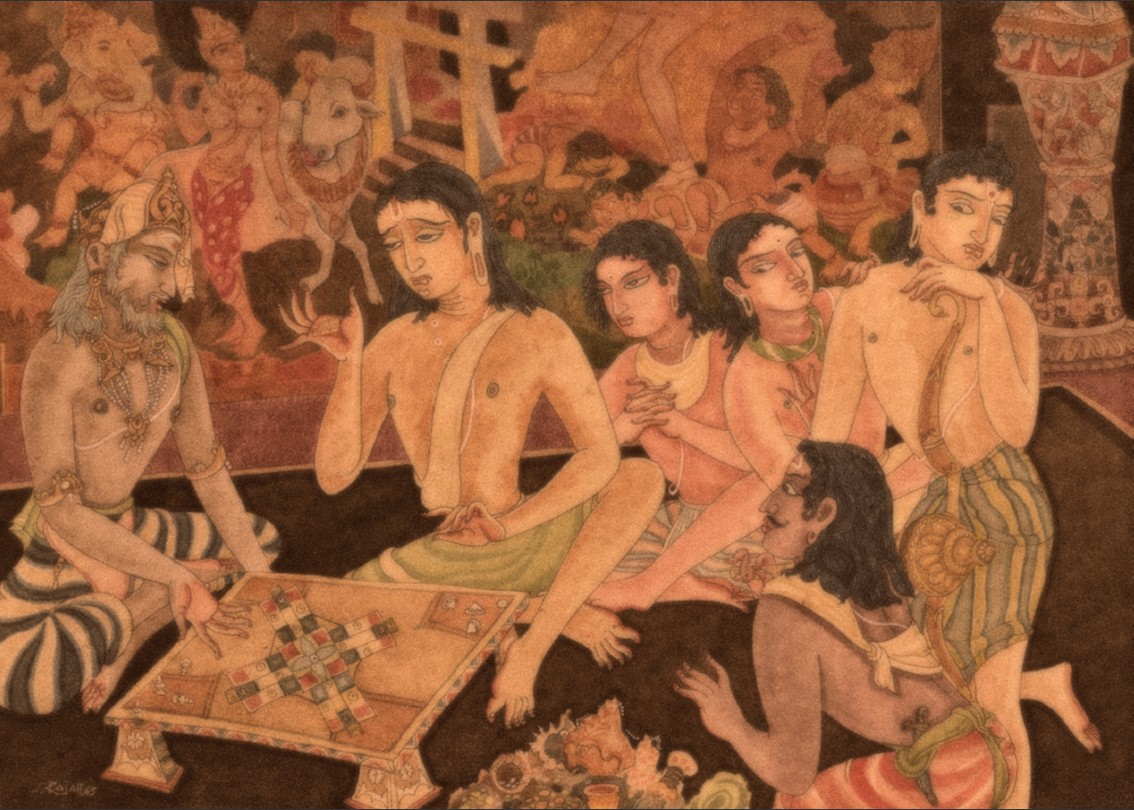
Perhaps the most famous example of gambling appears in the Mahābhārata.
The righteous King Yudhiṣṭhira Mahārāja, renowned for his commitment to dharma (righteous duty), was challenged to a gambling match orchestrated by his envious cousin Duryodhana and manipulated by the cunning Śakuni.
As a member of the royal order, Yudhiṣṭhira was obliged to accept such a challenge.
However, the contest was not conducted honestly.
Through deception and manipulation, Yudhiṣṭhira temporarily lost his kingdom, wealth, brothers, and even the freedom of his queen, Draupadī.
This tragic event eventually culminated in the historic Battle of Kurukṣetra, where millions of warriors lost their lives.
The Vedic conclusion is unmistakable.
A single act rooted in greed and dishonesty can create consequences extending far beyond the individual, affecting entire families, kingdoms, and generations.
The Subtle Forms of Gambling
Most people associate gambling with casinos, lotteries, betting, or games of chance. However, Vedic wisdom explains that gambling also exists in subtle forms that may not involve money at all.
Śrīla Prabhupāda often broadened the definition of gambling to include any activity driven by speculative hope rather than sound knowledge and disciplined effort. Such tendencies gradually divert the mind from reality and weaken one’s determination to pursue genuine spiritual progress.
Understanding these subtle forms helps us recognize that gambling is fundamentally a mentality—a desire to gain something valuable without following the proper process.
Mental Speculation: Gambling with the Truth
One of the most subtle forms of gambling is mental speculation regarding spiritual knowledge.
The Vedic scriptures repeatedly explain that the Absolute Truth cannot be understood merely through imperfect human reasoning or personal imagination. Conditioned souls possess limited senses and imperfect intelligence. Therefore, attempting to discover transcendental reality solely through speculation is compared to gambling with the truth.
Many sincere seekers initially try to understand the soul, God, and liberation through their own theories. Although they may occasionally arrive at partial truths, speculation often leads to dangerous misconceptions.
For example, one may correctly understand that the self (ātmā) is distinct from the temporary material body. Yet without proper guidance from scripture and authentic spiritual teachers, one might wrongly conclude that ending the body is the path to liberation. Such mistaken conclusions demonstrate the limitations of unaided speculation.
The Vedic process is therefore based not upon guesswork but upon śruti—hearing transcendental knowledge through authorized disciplic succession (paramparā). This method replaces uncertainty with genuine realization.
Gambling and Spiritual Life in Business Decisions
Another subtle aspect of gambling and spiritual life concerns reckless financial ventures.
Business itself is not condemned in Vedic culture. Honest enterprise performed responsibly can become devotional service when its fruits are offered in the service of the Supreme Lord. Śrīla Prabhupāda himself maintained a business before accepting the renounced order, and he encouraged qualified devotees to conduct ethical businesses to support spiritual projects.
However, there is an important distinction between responsible entrepreneurship and speculative greed.
High-risk schemes promising extraordinary profits with minimal effort often appeal to the same mentality that drives gambling. Pyramid schemes, fraudulent investments, and unrealistic financial promises encourage people to risk substantial resources in hopes of effortless wealth.
Such ventures are motivated not by honest work but by the expectation of disproportionate gain.
The Vedic principle is straightforward: wealth earned through integrity, diligence, and lawful occupation supports peace of mind, whereas wealth sought through speculation often produces anxiety, disappointment, and conflict.
Wasting Time Is Also a Form of Gambling
Śrīla Prabhupāda occasionally described another surprising form of gambling—wasting valuable time.
At first glance, this comparison may seem unusual. Yet the principle is profound.
Every human being possesses a limited span of life. Each passing moment represents an irreplaceable opportunity for spiritual growth, self-realization, and service.
When time is invested in frivolous entertainment, endless distraction, idle gossip, or purposeless habits, one is effectively gambling with life’s greatest asset.
Money lost through gambling may eventually be earned again.
Time can never be recovered.
Therefore, thoughtful individuals carefully examine how they invest their days. Activities that nourish wisdom, character, devotion, and meaningful relationships yield lasting benefits, whereas temporary distractions rarely produce enduring satisfaction.
The Vedic tradition encourages using one’s valuable human life for pursuits that awaken eternal consciousness rather than merely stimulating temporary excitement.
A Lesson from Hiraṇyakaśipu and Prahlāda Mahārāja
The Śrīmad-Bhāgavatam provides two contrasting examples illustrating how one’s investment of time determines one’s ultimate destination.
Hiraṇyakaśipu, the powerful demon king, performed extraordinary austerities for one hundred celestial years. His goal was not self-realization but material immortality and universal domination.
Although he acquired immense power, his ambition ultimately failed. No material arrangement can overcome the supreme laws established by the Lord. Despite all his efforts, Hiraṇyakaśipu eventually met his end at the hands of Lord Nṛsiṁhadeva.
His entire life’s endeavor proved to be a failed gamble.
In striking contrast stood his saintly son, Prahlāda Mahārāja.
Rather than seeking wealth, prestige, or power, Prahlāda invested every moment in remembering and glorifying Lord Viṣṇu. Even as a young child, he encouraged his classmates to utilize the rare human form of life for devotional service instead of temporary pleasures.
Prahlāda expected no material reward.
His happiness arose naturally from loving service to the Supreme Lord.
Unlike speculative pursuits, devotional service yields permanent spiritual benefit because it awakens the soul’s eternal relationship with Kṛṣṇa.
Progress Comes Gradually
For many practitioners, overcoming deeply rooted habits does not happen overnight.
One may easily avoid obvious forms of gambling while still struggling with subtler tendencies such as idle conversation, unnecessary curiosity, excessive entertainment, or mental speculation.
Vedic wisdom acknowledges this gradual process of purification.
Just as a beginner cannot immediately perform the intricate compositions of an accomplished musician, spiritual advancement also develops steadily through sincere practice.
The essential principle is perseverance.
Every sincere effort to chant the holy names, study sacred literature, associate with devotees, and engage in devotional service gradually purifies the heart.
As unwanted desires diminish, activities that once seemed attractive naturally lose their influence.
Rather than becoming discouraged by temporary shortcomings, one should remain grateful for every step forward while continuing to seek shelter in devotional service.
The Real Investment That Never Fails
Human life constantly requires choices about where to invest our attention, energy, wealth, and time.
Material investments may produce profit or loss. Speculative ventures promise uncertain rewards. Gambling offers excitement but often ends in disappointment.
Devotional service, however, is never a losing investment.
The Bhagavad-gītā explains that even a small amount of sincere spiritual practice protects one from the greatest fear and brings permanent benefit. Every act of hearing about Kṛṣṇa, chanting His holy names, serving others, and cultivating genuine spiritual knowledge enriches the soul beyond the temporary fluctuations of material success and failure.
From this perspective, the greatest victory is not winning a lottery or accumulating wealth but awakening pure love for the Supreme Personality of Godhead.
Conclusion
The Vedic understanding of gambling and spiritual life extends far beyond games of chance or financial risk. Gambling represents a mentality of speculation, greed, and dependence upon uncertain material gain. Whether expressed through lotteries, dishonest business schemes, speculative philosophy, or the careless misuse of valuable time, it gradually weakens truthfulness—the final remaining pillar of religion in this age of Kali-yuga.
In contrast, bhakti-yoga teaches disciplined living, honest work, responsible action, and unwavering faith in the Supreme Lord’s guidance. Every sincere effort in devotional service produces lasting spiritual benefit and gradually frees the heart from both gross and subtle forms of gambling.
Śrīla Prabhupāda therefore encouraged his followers not merely to avoid gambling but to invest their lives wisely. By chanting the Hare Kṛṣṇa mahā-mantra, studying revealed scriptures, and engaging in loving devotional service, one exchanges uncertain material wagers for the eternal treasure of God consciousness.
Ultimately, the safest and most rewarding investment is not made with money but with one’s life, offered in the service of Śrī Kṛṣṇa. Such an investment never ends in loss, for it leads the soul toward lasting peace, spiritual fulfillment, and pure love of God.
Deepen your Bhakti-yoga practice, harmonize relationships, and receive guided coaching — all at Vedavarsity.com