


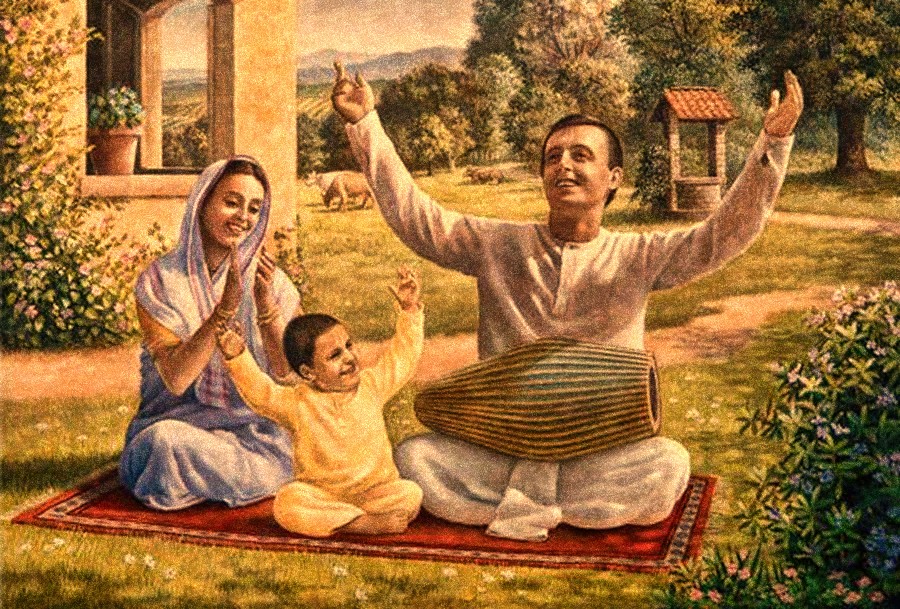
Family life is often viewed as a path centered on material responsibilities and social obligations. However, the Vedic scriptures present a higher vision. According to Śrīmad-Bhāgavatam, Ideal Family Life is not measured by wealth, prestige, or comfort, but by how sincerely one’s home becomes a place of devotion, compassion, self-discipline, and service to the Supreme Lord, Śrī Kṛṣṇa.
In a profound dialogue, Mahārāja Yudhiṣṭhira respectfully asks Nārada Muni how ordinary householders—engaged in family duties and worldly occupations—can attain liberation. Nārada Muni’s reply reveals that spiritual perfection is not reserved only for renunciants. A sincere householder who performs prescribed duties in the proper consciousness can also attain the highest goal of life.
The teachings presented in this discussion remain practical and relevant today, offering timeless principles for balancing worldly responsibilities with spiritual advancement.
The Purpose of Ideal Family Life
Nārada Muni explains that a householder should honestly earn a livelihood while understanding that the fruits of all work ultimately belong to the Supreme Personality of Godhead, Śrī Kṛṣṇa (Vāsudeva). Instead of considering oneself the independent enjoyer of one’s labor, one should dedicate the results to the service of the Lord.
This understanding transforms ordinary work into an act of devotion. The principle reflects the Vedic understanding of dharma, where every duty finds perfection when connected with the Supreme.
When work is performed in this spirit, family life becomes a means of purification rather than entanglement.
Association with Saintly Persons
Nārada Muni emphasizes that the greatest wealth of a householder is the regular association of saintly devotees.
By hearing the transcendental activities of the Supreme Lord as described in Śrīmad-Bhāgavatam and the Purāṇas, one’s heart gradually becomes purified. Such hearing awakens genuine spiritual knowledge and naturally reduces excessive attachment to temporary material relationships.
Just as a person awakens from a dream and understands its temporary nature, a spiritually awakened individual gradually recognizes the temporary nature of bodily relationships while continuing to perform worldly responsibilities with sincerity and compassion.
This balance is one of the defining qualities of Ideal Family Life.
Simplicity Leads to Spiritual Progress
One of Nārada Muni’s central instructions is that householders should avoid creating unnecessarily complicated lives.
An intelligent person should maintain a simple standard of living, earning only what is necessary for maintaining the body and fulfilling essential family responsibilities. Although externally cooperating with family members and society, one should internally remain fixed on life’s ultimate purpose.
Modern society often encourages endless consumption and competition. The Bhāgavatam presents the opposite principle: contentment.
Contentment reduces anxiety, minimizes unnecessary desires, and allows more time for spiritual cultivation.
The Vedic sages consistently teach that simplicity supports clarity of mind, while excessive material ambition often increases bondage through endless obligations.
Wealth Is a Trust, Not Absolute Ownership
According to Nārada Muni, all natural resources originate from the Supreme Lord.
Rainfall, fertile land, forests, rivers, minerals, oceans, and every form of wealth are gifts provided for the maintenance of all living beings. Human beings therefore possess only a temporary stewardship over material resources rather than permanent ownership.
The Bhāgavatam teaches that one may rightfully use only as much wealth as required for maintaining body and soul together. Excessive possessiveness and greed create unnecessary suffering because they ignore the divine order established by the Supreme.
This principle remains remarkably relevant in a world facing economic inequality and environmental challenges.
Recognizing everything as the property of the Lord naturally inspires gratitude, responsibility, and generosity.
Compassion Toward Every Living Being
Another striking instruction given by Nārada Muni is that householders should extend kindness beyond their immediate family.
Animals, birds, and even the smallest creatures deserve compassion because every living being is an eternal soul residing within a temporary body.
The Vedic understanding distinguishes between the body and the ātmā, the eternal self. Since the same spiritual nature exists within all living beings, unnecessary cruelty contradicts genuine spiritual knowledge.
Householders are therefore encouraged to provide care not only for family members but also for guests, the poor, neglected persons, and even animals according to their capacity.
Such compassion reflects genuine devotion because the Supreme Lord resides within the heart of every living entity as Paramātmā, the Supersoul.
Freedom from Excessive Attachment
Nārada Muni does not instruct householders to abandon their families irresponsibly. Rather, he teaches that attachment should be purified.
Affection based solely on bodily identification inevitably leads to anxiety because every material body is temporary. The wise person understands that true relationships are centered upon the eternal soul and its relationship with the Supreme Lord.
When family members assist one another in spiritual advancement, the household becomes a sacred place where mutual affection supports lasting happiness rather than temporary enjoyment alone.
Such purified affection strengthens relationships because it is based on service rather than possessiveness.
Honest Livelihood Without Ugra-karma
The Bhāgavatam discourages engagement in ugra-karma, work performed with excessive intensity solely for material accumulation.
Householders should work diligently and responsibly but avoid allowing economic pursuits to consume their entire lives.
The goal is balance.
Livelihood should support spiritual practice, not replace it.
When economic success becomes life’s only objective, family harmony, health, and spiritual growth often decline. By contrast, a balanced life centered upon devotion creates lasting peace both within the home and within society.
Hospitality as Sacred Service
Hospitality occupies an important place within Vedic culture.
Guests should be received respectfully, fed according to one’s means, and treated with dignity. Charity should also extend to the needy, regardless of social status.
Such generosity reflects the understanding that every living being is ultimately connected to the Supreme Lord.
Serving others with humility purifies the heart and strengthens the spirit of selfless service that characterizes genuine devotional life.
Worship Through Daily Living
Nārada Muni teaches that genuine spiritual life does not depend solely on formal rituals. Rather, it is expressed through daily conduct rooted in devotion, gratitude, and responsibility. A householder should recognize that the Supreme Lord resides in the heart of every living being as Paramātmā, the Supersoul. Therefore, serving others with respect is also an indirect form of worship.
Each day, one should worship the Supreme Lord with sincerity according to one’s capacity. This worship naturally extends to honoring saintly persons, guests, forefathers, demigods, family members, and all living beings. By seeing every living entity as part of the Lord’s creation, the householder develops humility and compassion rather than pride and possessiveness.
Such a home becomes more than a place of residence; it becomes a center of spiritual culture where every activity is performed in remembrance of the Supreme.
Offering Food to the Supreme Lord
One of the most practical expressions of devotion is offering food to Śrī Kṛṣṇa before eating. Food prepared with care and offered in a spirit of love becomes prasāda, the Lord’s mercy. By honoring prasāda, one gradually becomes purified in consciousness.
Nārada Muni explains that sacrifices and offerings ultimately satisfy the Supreme Personality of Godhead, who is the true enjoyer of all yajñas (sacrifices). Although the Lord accepts offerings made into the sacred fire according to Vedic injunctions, He is especially pleased when pure food prepared from grains, vegetables, fruits, milk products, and ghee is first offered to Him and then distributed as prasāda.
The householder should not think that cooking is merely a domestic task. When performed with devotion, it becomes an act of worship that nourishes both the body and the soul.
Charity and Distribution of Prasāda
After offering food to the Lord, householders are encouraged to respectfully feed qualified brāhmaṇas, saintly persons, guests, and those in need before taking their own meal. Thereafter, prasāda should be distributed to others according to one’s ability.
This principle reflects the understanding that all living beings are children of the same Supreme Father. Sharing sanctified food cultivates generosity, gratitude, and equality while reducing selfishness.
True charity is not measured simply by the amount given but by the consciousness in which it is offered. A gift made with devotion and compassion benefits both the giver and the recipient.
In this way, the home becomes a place where spiritual nourishment is shared freely with others.
Wealth and Knowledge Should Serve the Lord
The Bhāgavatam teaches that wealth, learning, influence, and abilities are gifts entrusted by the Supreme Lord. These gifts should not become causes of pride or exploitation but instruments for serving society and pleasing the Lord.
When a person possesses sufficient resources, he or she should support religious activities, charitable works, scriptural education, and the maintenance of places of worship. Such service purifies wealth by connecting it with its divine source.
Knowledge likewise carries responsibility. Those blessed with scriptural understanding should share it with humility, encouraging others toward righteous living rather than seeking prestige or recognition.
Thus, prosperity becomes spiritually meaningful only when it contributes to the welfare of all.
Observing Sacred Duties with Reverence
Nārada Muni also describes various ceremonies prescribed in the Vedic tradition, including offerings to one’s forefathers (śrāddha) and observances performed during sacred times of the year. These ceremonies cultivate gratitude toward previous generations and remind individuals that life is part of a continuous chain of divine arrangement.
The scriptures recommend performing such rites on specific lunar days, seasonal transitions, eclipses, and other auspicious occasions. While the detailed procedures vary according to tradition and family lineage, their deeper purpose is to strengthen remembrance of the Lord, express gratitude, and encourage charitable activities.
During these sacred periods, acts such as bathing in holy rivers, chanting the holy names of the Lord, worship, charity, vows, and fire sacrifices yield especially beneficial spiritual results when performed with sincere devotion.
The value of these observances lies not merely in external ritual but in the purity of heart with which they are undertaken.
Sacred Places Inspire Spiritual Growth
Nārada Muni explains that certain places are especially conducive to spiritual advancement because they are sanctified by the presence of the Lord, His devotees, or centuries of devotional practice.
Temples where the Deity of the Lord is properly worshiped, holy rivers praised in the Vedic scriptures, and places where saintly devotees reside all provide an atmosphere that encourages remembrance of God.
Pilgrimage is therefore not simply religious tourism. Its purpose is to hear from advanced devotees, engage in worship, perform devotional service, and deepen one’s relationship with the Supreme Lord.
Wherever sincere devotees gather to glorify Śrī Kṛṣṇa, that place becomes spiritually uplifting regardless of its geographical location. A devotee benefits not merely by visiting a sacred place but by cultivating the devotional qualities that make a place truly holy.
Respect for Devotees and Deity Worship
As society gradually became more distracted from spiritual values, the worship of the Lord in His Deity form was established to help people focus their minds upon Him.
The Deity is not regarded as an idol but as the authorized worshipable manifestation of the Supreme Lord, mercifully accepting the service of His devotees.
However, Nārada Muni gives an important warning. A person may carefully perform elaborate temple worship, yet if he disrespects or envies genuine devotees of the Lord, such worship does not fully satisfy the Supreme. Devotion is complete only when reverence for the Lord is accompanied by respect for His devotees.
Humility, service, and appreciation for saintly persons remain essential qualities of authentic spiritual life.
Kṛṣṇa: The Root of All Worship
Nārada Muni concludes his instructions by establishing a central truth of Vedic philosophy: the Supreme Personality of Godhead, Śrī Kṛṣṇa, is the ultimate object of all worship. Everything within the universe—moving and nonmoving—rests upon Him and is sustained by His divine energy.
To illustrate this principle, the Bhāgavatam compares the universe to a great tree. Just as watering the root nourishes every branch, leaf, flower, and fruit, worshiping Kṛṣṇa satisfies all living beings because He is the source of everything. One need not separately endeavor to satisfy every part of creation independently. By rendering loving service to the Supreme Lord, one naturally benefits all.
This teaching harmonizes the principles of dharma (righteous duty), karma (responsible action), and bhakti (loving devotion), revealing that life’s activities attain perfection when centered on the Supreme.
The Lord Resides in Every Hear
The Supreme Lord not only governs the universe from His eternal abode but also accompanies every living being as Paramātmā, the Supersoul. Within every body—human, animal, bird, or celestial being—the Lord witnesses, guides, and gives remembrance, knowledge, and direction according to each soul’s sincerity and spiritual development.
Recognizing the Lord’s presence in every heart transforms one’s outlook. Pride gives way to humility, envy to compassion, and selfishness to service. A spiritually mature householder therefore treats every living being with respect, understanding that each is an eternal soul on its own journey toward self-realization.
This vision elevates family life beyond biological relationships and expands one’s compassion to embrace all of God’s creation.
The Importance of Honoring Devotees
Nārada Muni emphasizes that devotion cannot be separated from respect for the Lord’s devotees. Worship of the Deity is sacred and beneficial, but it reaches perfection only when accompanied by humility toward those who dedicate their lives to spreading the Lord’s glories.
A person may perform elaborate rituals with great attention to external detail, yet if that person criticizes or envies sincere devotees, the essence of devotional service is lost. Genuine bhakti is characterized by purity of heart, gratitude, and appreciation for those who faithfully represent the teachings of the Lord.
Association with saintly devotees inspires spiritual growth, strengthens faith, and helps householders apply scriptural principles in daily life.
The Glory of Qualified Brāhmaṇas
The Bhāgavatam praises qualified brāhmaṇas not on the basis of birth alone, but because of their character, learning, austerity, compassion, and dedication to Vedic wisdom.
Such saintly persons preserve sacred knowledge and guide society toward righteousness. Through scriptural study, teaching, and exemplary conduct, they help others understand the eternal relationship between the individual soul and the Supreme Lord.
Nārada Muni declares that those who sincerely preach the glories of the Lord are especially dear to Him because they awaken spiritual consciousness in others. Their service benefits not only individuals but society as a whole by reminding humanity of life’s ultimate purpose.
The Timeless Relevance of Ideal Family Life
The instructions given by Nārada Muni to Mahārāja Yudhiṣṭhira remain as relevant today as they were thousands of years ago. Although modern circumstances have changed, the essential challenges of human life remain the same: attachment, anxiety, greed, and the search for lasting happiness.
The Bhāgavatam teaches that an ideal home is not defined by luxury or material success. Rather, it is characterized by honesty, simplicity, devotion, compassion, hospitality, self-control, and remembrance of the Supreme Lord.
A family centered on spiritual values cultivates peace within the home and contributes positively to society. Parents become guides in character and wisdom, children grow with moral and spiritual foundations, and daily responsibilities become opportunities for service rather than sources of bondage.
When family life is connected to Kṛṣṇa through hearing His glories, chanting His holy names, honoring prasāda, serving devotees, and living according to dharma, even ordinary household duties become a path toward liberation.
Conclusion
The dialogue between Mahārāja Yudhiṣṭhira and Nārada Muni presents a complete vision of Ideal Family Life grounded in the timeless wisdom of Śrīmad-Bhāgavatam. It demonstrates that spiritual perfection is not reserved for those who renounce the world but is equally attainable for sincere householders who perform their duties in a spirit of devotion.
By earning honestly, living simply, using wealth responsibly, caring for all living beings, honoring sacred traditions, associating with saintly devotees, and offering every aspect of life to Śrī Kṛṣṇa, the home itself becomes a place of spiritual cultivation.
Ultimately, the purpose of family life is not merely material comfort but awakening eternal love for the Supreme Lord. When this higher purpose guides every responsibility, the household becomes an āśrama—a sacred place where worldly duties and spiritual realization exist in perfect harmony.
Deepen your Bhakti-yoga practice, harmonize relationships, and receive guided coaching — all at Vedavarsity.com