


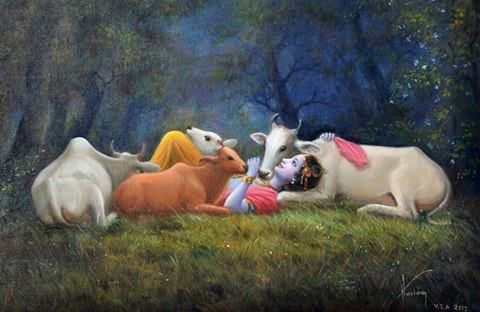
In the Visnu-rahasya it is said that Vraja Mandala is non-different from the Lord’s own form. Therefore, just as Govardhana Hill is considered to be the transcendental form of Lord Krishna, Vraja Mandala is also another form of the Lord. The Visnu-rahasya reveals that this particular form of the Lord has fifty-five parts which are represented by fifty-five different forest of Vraja. Amongst the fifty-five forests that form the Lord’s body are the twelve sacred dwadashavanas while others are; upavanas, prativanas and adhivanas.
The Visnu-rahasya says, “Mathura is the heart, Madhuvana is the navel, Kumudavana and Talavana are the two parts of the chest, Vrindavana and Mayuravana are the forehead, Bahulavana and Mahavana are the biceps, Bhandiravana and Kokilavana are the hands, Khadiravana and Bhadrakavana are the shoulders, Chattravana and Lohajanghavana are the lotus eyes, Bilvavana and Bhadravana are the ears, Kamyavana is the chin, Triveni and Sakhi-kupa are the lips, Vihvala and others are the teeth, Surabhivana is the tongue, Manengitavana is the nose, Sesasayi and Paramanandavana are the nostrils, Karela and Kamai are the hips, Karnavana is the genitals, Krishna-ksipanak is the rectum, Nandanavana is the head, and Indravana is the back.
The five fingers of the right hand are Siksavana, Candravana, Lohavana, Nanda-grama, and Sri-kunda. The five fingers of the left hand are Garhasthana, Lalita-grama, Varsana, Gokula, and Baladeva. The five toes of the left foot are Govardhana, Javata, Sanketavana, Naradavana, and Madhuvana. The five toes of the right foot are Mridavana, Jahnuvana, Menakavana, Kajalavana, and Nandakupavana.” The Puranas like the Padma Purana, Adi-Varaha Purana, Vishnu Purana, and Bhavishya Purana, mention one hundred thirty-two most important forests of Vraja Mandala where Lord Krishna performed His transcendental pastimes.
Out of these, twelve forests are called the dwadashavanas and are revered as being the most sacred. The Adi-Varaha Purana lists the twelve sacred forests (dwadashavanas) by number: 1.Madhuvana 2.Talavana 3.Kamudavana 4.Kamyavana 5.Bahulavana 6.Bhadravana 7.Khadiravana 8.Mahavana 9.Lauhajangavana 10.Bilvavana 11.Bhandiravana 12, Vrindavana. Of the twelve sacred forests, seven are situated on the western bank of the Yamuna River including: Madhuvana, Talavana, Kamudavana, Bahulavana, Kamyavana, Khadiravana and Vrindavana, and five forests are situated on the eastern bank of the Yamuna including: Bhadravana, Bhandiravana, Bilvavana (Belvana), Lohavana (Lauhajangavana), and Mahavana.
It is said that Lord Krishna is the predominating Deity of the forests on the western bank of Yamuna and Lord Balarama is the predominating Deity of the forests on the eastern bank of the Yamuna. Both Krishna and Balarama are said to be the predominating Deities of Brihadvana (Mahavana). The Vraja Mandala Parikrama is also known as the Vana-yatra, because it circumambulates the dwadashavanas, the twelve primary forests of Vrindavana Dhama. The Sanskrit word dwadasha means twelve, the word is ‘vana’ means ‘forest’ and ‘yatra’ means ‘pilgrimage’.
Out of the twelve primary forests, the forest of Vrindavana is considered the most sacred and important. The Vraja-bhakti-vilasa has divided the sacred forests of Vrindavana into eleven groups with twelve forests in each group totaling 132 forests. Besides the original 12 dwadashvanas, there are 12 upavanas, 12 prativanas, 12 adhvanas, 12 sevavanas, 12 tapovanas, 12 mokshavanas, 12 kamavanas, 12 arthavanas, 12 dharmavanas and 12 siddhavanas. The word ‘upavana’ means ‘secondary forest’, ‘prativana’ means ‘replica forest’, and ‘adhivana’ means ‘half-forest’. In some Puranas the names of the sub-forests differ, but the list below from Vraja bhakti-vilasa is the most accurate.
Deepen your Bhakti-yoga practice, harmonize relationships, and receive guided coaching — all at Vedavarsity.com