Two Manifestations of the Boar Incarnation and the Chronology of Hiraṇyākṣa
| Abstract The Varāha avatāra of the Supreme Lord is one of the most celebrated manifestations of divine intervention in the Purāṇic tradition. The familiar narrative describes the earth as submerged beneath the cosmic waters, whereupon the Supreme Lord assumes the form of a mighty boar, enters the ocean, raises the earth upon His tusks, and destroys the demon Hiraṇyākṣa. Yet a careful examination of Purāṇic chronology reveals a profound and often overlooked feature of this narrative: Lord Varāha appeared twice during the day of Brahmā. The first appearance occurred during the reign of Svāyambhuva Manu, while the second occurred during the reign of Cākṣuṣa Manu. This distinction provides the key to resolving an apparent chronological difficulty concerning Hiraṇyākṣa. If Varāha’s appearance during Svāyambhuva Manu’s reign and the killing of Hiraṇyākṣa are regarded as one single historical event, a chronological contradiction appears. Hiraṇyākṣa, however, was born considerably later, through the lineage of Uttānapāda, Pracetas, Dakṣa and Diti, during the Cākṣuṣa period. Consequently, the Varāha who appeared during Svāyambhuva Manu’s reign could not have killed Hiraṇyākṣa. The demon was killed by the second manifestation of Varāha during Cākṣuṣa Manu’s reign. This distinction does not imply two different avatāras. Rather, it demonstrates how one divine avatāra may manifest at different times to fulfil related purposes. The two manifestations differ in their chronological setting, manner of appearance, colour and specific activities, while remaining one Varāha avatāra. The present study examines this chronology, the two manifestations of Varāha, the genealogy of Hiraṇyākṣa, the partial devastations associated with the two periods, and the reason Maitreya presents the activities of both appearances within a single narrative. Keywords: Varāha, Hiraṇyākṣa, Svāyambhuva Manu, Cākṣuṣa Manu, manvantara, pralaya, avatāra, Purāṇic chronology, Dakṣa, Diti. |
1. Introduction
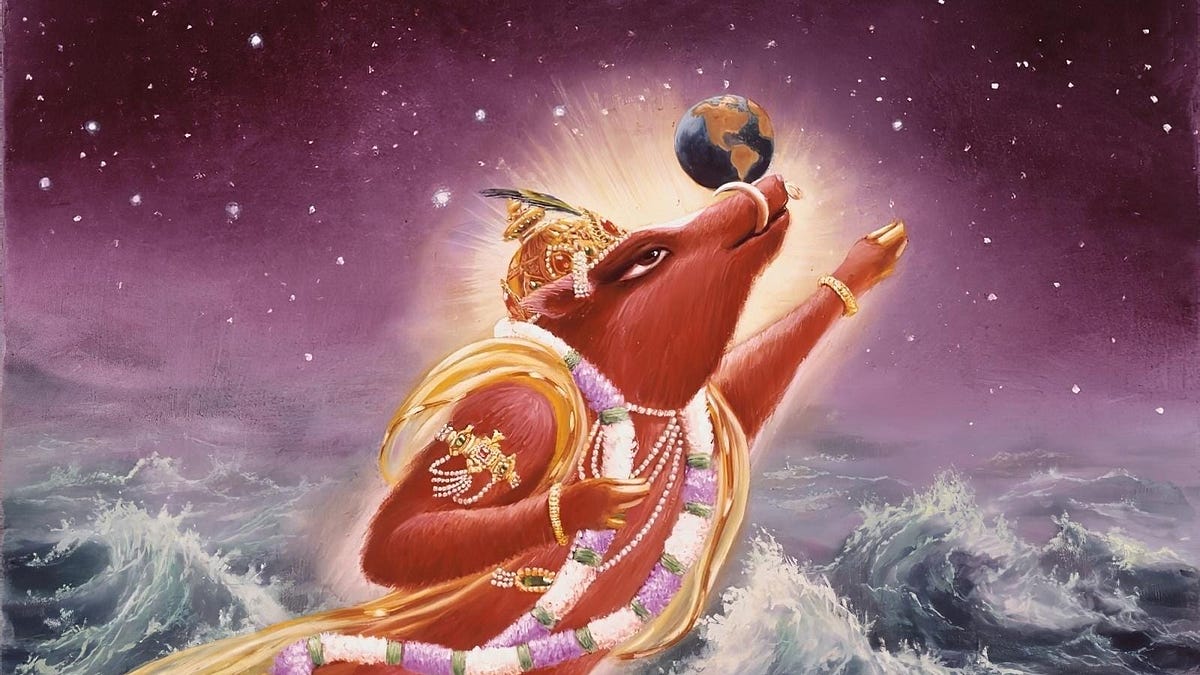
Few narratives in Purāṇic literature combine cosmology, theology, genealogy and divine intervention as dramatically as the appearance of Lord Varāha. The earth has become submerged in the cosmic waters, the universe requires restoration, and the Supreme Lord manifests Himself in an extraordinary form: that of a gigantic divine boar.
The image is striking. The Lord enters the great ocean, reaches the submerged earth and raises her upon His powerful tusks. In the celebrated continuation of the narrative, He confronts the mighty demon Hiraṇyākṣa and destroys him.
Yet beneath this familiar account lies a remarkable chronological mystery.
• How many times did Lord Varāha appear?
• When did He appear?
• Was the Varāha who lifted the earth the same Varāha who killed Hiraṇyākṣa?
• If Hiraṇyākṣa was present when Varāha appeared, why does the chronology of the descendants of Svāyambhuva Manu indicate that Hiraṇyākṣa had not yet been born?
The answer lies in recognizing that the Varāha avatāra manifested twice during the same day of Brahmā, once during Svāyambhuva Manvantara and again during Cākṣuṣa Manvantara.
The crucial verse declares:
| dvir āvirāsīt kalpe ’sminn ādye svāyambhuvāntare | ghrāṇād vidher dharoddhṛtyai cākṣuṣye tu nirātaḥ || 10 || “Within this kalpa the boar avatāra appeared twice: first during Svāyambhuva Manvantara, from the nostril of Brahmā, to lift the earth, and a second time during Cākṣuṣa Manvantara, appearing from the water.” |
This single statement opens the door to understanding the entire mystery.
2. Varāha: The Lord Who Restores the Earth
The Varāha avatāra is not presented merely as an animal form assumed by the Supreme Lord. His form itself possesses profound theological significance.
The description states:
| krauḍīṁ tanuṁ sakala-yajña-mayīm anantaḥ antar-mahārṇava upāgatam ādi-daityam taṁ daṁṣṭrayādrim iva vajra-dharo dadāra || 9 || “The Lord assumes the form of a boar, described as sakala-yajña-mayī, the form embodying the totality of sacrifice. He approaches the great cosmic ocean, and with His tusk destroys the primordial demon.” |
Varāha is therefore simultaneously:
• the rescuer of the earth,
• the destroyer of demonic opposition,
• the embodiment of sacrifice,
• and the manifestation of divine strength.
The image of the tusk is particularly significant. The earth is not restored through an ordinary natural process. She is lifted by the Supreme Lord Himself. The same instrument that raises the earth also becomes the weapon through which the demonic obstruction is overcome.
3. The First Great Revelation: Varāha Appeared Twice
The most important chronological statement is the declaration that Varāha appeared twice.
The Sanskrit is:
| dvir āvirāsīt kalpe ’sminn ādye svāyambhuvāntare | ghrāṇād vidher dharoddhṛtyai cākṣuṣye tu nirātaḥ || 10 || |
The two appearances may be distinguished as follows:
| Feature | First Appearance | Second Appearance |
| Manu | Svāyambhuva Manu | Cākṣuṣa Manu |
| Place of appearance | Nostril of Brahmā | Water |
| Colour | Black | White |
| Principal purpose | Lifting the earth | Lifting the earth and killing Hiraṇyākṣa |
| Cosmic setting | Partial devastation | Sudden deluge |
| Hiraṇyākṣa | Not yet born | Present |
This distinction is the foundation upon which the entire chronology rests.
The two appearances should not be understood as two independent incarnations of the Lord. They are two manifestations of the same Varāha avatāra at different moments in cosmic history.
4. The First Varāha: The Dark Form During Svāyambhuva Manvantara
The first Varāha appeared during the reign of Svāyambhuva Manu.
His appearance was extraordinary: He emerged from the nostril of Brahmā and assumed the form of a boar in order to lift the earth.
The first manifestation is described as black, resembling a rain cloud.
The text concerning His colour states:
| kadācij jalada-śyāmaḥ kadācic candrapāṇḍaraḥ | yajña-mūrtiḥ sthaviṣṭho ’yaṁ varṇa-dvaya-yutaḥ smṛtaḥ || 12 || “Sometimes the boar avatāra is black like a cloud and sometimes He is white like the moon. In either colour, He is the form of sacrifice and very strong.” |
The chronological explanation identifies the black form with the Svāyambhuva-manvantara and the white form with the Cākṣuṣa-manvantara.
Thus the first Varāha was: Black in colour, born from Brahmā’s nostril, and manifested during Svāyambhuva Manu’s reign.
His principal activity was to restore the earth. But an important question remains: Was Hiraṇyākṣa present at this time? The answer is no.
5. The Birth of Hiraṇyākṣa: The Key to the Mystery
The entire mystery is resolved by examining the genealogy of Hiraṇyākṣa.
The lineage is given as:
| uttānapāda-vaṁśyānāṁ tanayasya pracetasām | dakṣasyaiva ditiḥ putrī hiraṇyākṣo diteḥ sutaḥ || 15 || “Dakṣa belonged to the lineage of Uttānapāda through the Pracetas. Diti was the daughter of Dakṣa, and Hiraṇyākṣa was the son of Diti.” |
The genealogy can therefore be represented:
| Uttānapāda ↓ Pracetas ↓ Dakṣa ↓ Diti ↓ Hiraṇyākṣa |
This lineage is decisive because these generations did not yet exist during the period of the first Varāha.
The chronological problem is therefore not difficult once genealogy is taken seriously. Hiraṇyākṣa was not a contemporary of the first Varāha. He belonged to a later period.
6. The Chronological Impossibility of Hiraṇyākṣa’s Presence
The next verse makes the matter even more explicit:
| kalpārambhe tadā nāsti sutotpattir manor api | kvāsau pracetaso dakṣaḥ kva ditiḥ kva diteḥ sutaḥ || 16 || “At the beginning of the first kalpa of Brahmā, Svāyambhuva’s sons had produced no offspring. Thus the Pracetas, Dakṣa, Diti and Hiraṇyākṣa could not have existed then.” |
This verse is the decisive chronological statement. During the relevant early period:
• Pracetas had not yet appeared;
• Dakṣa had not yet appeared in the relevant lineage;
• Diti had not yet been born;
• Hiraṇyākṣa had therefore not yet been born.
Consequently, the first Varāha could not possibly have killed Hiraṇyākṣa.
The conclusion is unavoidable: The Varāha who appeared during Svāyambhuva Manu’s reign lifted the earth, but He did not kill Hiraṇyākṣa. The killing of Hiraṇyākṣa belongs to the later manifestation of Varāha.
7. The Second Varāha: The White Form During Cākṣuṣa Manvantara
The second manifestation occurred during the reign of Cākṣuṣa Manu.
Unlike the first Varāha, who appeared from the nostril of Brahmā, the second appeared from the waters.
This second manifestation is identified with the white form of Varāha, described as being like the moon.
His principal activities were twofold:
1. lifting the submerged earth;
2. killing Hiraṇyākṣa.
The relevant verse states:
| hiraṇyākṣaṁ dharoddhāre nihantuṁ daṁṣṭri-puṅgavaḥ | catuṣpāt śrī-varāho ’sau nṛ-varāhaḥ kvacin mataḥ || 11 || “The boar with tusks assumed the four-legged animal form to kill Hiraṇyākṣa and lift the earth. According to some authorities, however, this form is half man and half boar.” |
The description is therefore associated directly with the second manifestation.
The Lord is not merely recovering the earth. He is simultaneously confronting the demonic force that has become connected with the crisis.
8. Why Did the Earth Become Submerged Twice?
Once the two Varāha manifestations are distinguished, another question naturally arises: Why did the earth become submerged during two different periods?
The answer is that the two periods were associated with distinct forms of devastation.
During Svāyambhuva Manu’s reign, a partial devastation occurred. During Cākṣuṣa Manu’s reign, a sudden deluge occurred by the will of the Lord.
Thus, Varāha did not appear twice without reason. Each manifestation was associated with the restoration of the earth after a particular cosmic disturbance.
9. The Partial Pralaya During Svāyambhuva Manu
The Purāṇic account of the first manifestation refers to a devastation during Svāyambhuva Manu’s reign. It is stated:
| madhye manvantarasyaiva muneḥ śāpenāntaraṁ manum prati | pralayo ’sau bahūbhūveti purāṇe kvacid īryate || 18 || “A pralaya occurred during Svāyambhuva’s reign because of a sage’s curse upon Svāyambhuva.” |
This is important because the submergence of the earth is generally associated with large-scale cosmic dissolution. The existence of a partial devastation explains why Varāha was required during the Svāyambhuva period.
The earth became submerged, and the Lord appeared to restore her.
The first Varāha therefore belongs to a specific episode of cosmic restoration occurring during Svāyambhuva Manu’s reign.
10. The Sudden Deluge During Cākṣuṣa Manu
The second Varāha appeared in a different cosmic circumstance. The relevant verse states:
| ayaṁ ākasmiko jātaś cākṣuṣasyāntare manoḥ | pralayaḥ padmanābhasya lilayeti ca kutracit || 19 || “A sudden deluge occurred during the reign of Cākṣuṣa Manu by the will of the Lord.” |
The commentary explains that the earth became submerged during this sudden flood. At that time Varāha appeared, lifted the earth and killed Hiraṇyākṣa.
The chronology is therefore precise:
Cākṣuṣa Manu ➔ sudden deluge ➔ earth submerged ➔ Varāha appears ➔ earth lifted ➔ Hiraṇyākṣa killed
This is the Varāha episode most commonly remembered in connection with Hiraṇyākṣa.
11. The End of a Manvantara and Cosmic Devastation
The two Varāha episodes must also be understood within the recurring structure of the manvantara cycle. It is stated:
| sarva-manvantarasyānte pralayo niścitaṁ bhavet | viṣṇu-dharmottare tv etat mārkaṇḍeyena bhāṣitam || 20 || “There is a devastation of water at the end of each Manu’s reign.” |
The cosmic process therefore contains recurring periods of creation, administration and partial devastation.
At the conclusion of a Manu’s reign, the administrative order of the universe changes. The devatās who had held particular posts relinquish those positions and proceed to higher planetary regions.
This larger cosmological cycle helps explain why divine manifestations may recur.
The universe is not presented as moving through only one irreversible historical sequence. Rather, cosmic time is cyclical and contains successive manvantaras, each possessing its own Manu, devatās and cosmic circumstances.
12. The Devatās and the End of a Manvantara
The movement of the devatās at the conclusion of a Manu’s reign is described:
| manvantare pariśīne devā manvantareśvarāḥ | maharlokam athāsādya tiṣṭhanti gata-kalmaṣāḥ || 21 || “At the end of a Manu’s reign, the devatās who occupied administrative posts during that period go to Maharloka and remain there.” |
They are therefore not destroyed along with the lower planetary manifestations of the cosmic devastation. They observe the devastation from a higher planetary level.
This establishes an important distinction between destruction of a particular cosmic arrangement and absolute annihilation of existence.
13. Manu, Indra and Brahmaloka
The next verse describes the destination of Manu and the devatās:
| manuś ca saha śakreṇa devāś ca yadunandana | brahma-lokaṁ prapadyante punar āvṛtti-durlabham || 22 || “Manu and the devatās, together with Indra, go to Brahmaloka, a destination very difficult to attain.” |
Yet attainment of Brahmaloka is not necessarily synonymous with final liberation. Those whose accumulated pious results are exhausted may return.
The commentary further distinguishes those who possess a higher qualification and attain liberation along with Brahmā at the end of his life. The footnote makes the theological qualification explicit: such persons would have performed bhakti.
Thus, even within the cosmological ascent associated with the end of a manvantara, the ultimate spiritual destination remains distinguished from temporary elevation within the material universe.
14. The Cosmic Waters
The final verse in this sequence presents a dramatic image of the waters covering the lower planetary regions:
| bhūtalaṁ satalaṁ vajra-toya-rūpī maheśvaraḥ | ūrmi-mālī mahāvegaḥ sarvam āvṛtya tiṣṭhati || 23 || “The great Lord, in the form of water, greatly agitated with countless waves, covers the earth and the lower planets with water.” |
The earth and the lower planetary systems are thus enveloped by immense waters. Against this cosmic background, the significance of Varāha becomes particularly clear.
The Lord appears when the earth has become inaccessible beneath the waters. He enters the very environment in which the earth has disappeared and brings her back into her proper position.
The cosmic waters therefore provide the setting, while Varāha provides the divine response.
15. Why Are the Two Varāha Narratives Combined?
The greatest literary and theological question is this: If the two Varāha manifestations occurred during different manvantaras, why does the narrative appear to combine their activities?
The answer is given directly:
| ataḥ kāla-dvayodbhūtaṁ śrī-varāhasya ceṣṭitam | ekatraiva maitreyāḥ kṣattuḥ praśnānurodhataḥ || 17 || “Maitreya, responding to Vidura’s questions, narrated the activities arising from the two different periods in a single account.” |
This is the key to the apparent contradiction.
Maitreya was not asserting that every event occurred at precisely the same chronological moment. Rather, he was narrating the activities of the same avatāra.
This is an important principle for understanding Purāṇic narrative. The unity of a story does not necessarily mean that every event within the story belongs to one chronological moment. A single divine personality may perform related activities on separate occasions, and those activities may be narrated together because their theological subject is one.
16. One Varāha, Two Appearances
The distinction can now be stated with precision:
• There are not two unrelated Varāha avatāras.
• There is one Varāha avatāra with two manifestations.
• The first manifestation occurred during Svāyambhuva Manu’s reign.
• The second occurred during Cākṣuṣa Manu’s reign.
• The first was black and emerged from the nostril of Brahmā.
• The second was white and emerged from the waters.
• The first lifted the earth.
• The second lifted the earth and killed Hiraṇyākṣa.
This explains why different descriptions can be found without contradiction. The differences belong to the time and circumstance of manifestation. The unity belongs to the identity of the avatāra.
17. The Two Forms and Their Colours
The distinction in colour is particularly significant. Varāha is described as appearing:
jalada-śyāmaḥ — black like a cloud, and candrapāṇḍaraḥ — white like the moon.
The commentary identifies the black manifestation with Svāyambhuva Manvantara and the white manifestation with Cākṣuṣa Manvantara. This provides a remarkable internal chronological marker. The colour of Varāha is not simply an artistic detail. Within this account it helps distinguish two separate manifestations of the Lord.
At the same time, both forms are described as yajña-mūrtiḥ — the form of sacrifice. Thus, despite their differences in colour and historical setting, their essential theological identity remains unchanged.
18. The Varāha Form as Yajña-mūrti
The designation yajña-mūrti, “the form of sacrifice,” deserves particular attention.
The Lord’s appearance as Varāha is not merely an emergency intervention in cosmic geography. The form itself is identified with sacrifice. The Lord is described as sakala-yajña-mayīm — the form comprising all sacrifice.
This suggests that the restoration of the earth is itself situated within the Lord’s sacrificial and sustaining function. The earth is not merely rescued from water; cosmic order is restored.
The Varāha avatāra therefore represents divine intervention in the maintenance of the universe.
19. The Tusk as Instrument of Restoration and Destruction
The tusk of Varāha has a dual significance: It raises the earth, and it destroys Hiraṇyākṣa.
In the first manifestation, the tusk serves principally as the instrument of restoration. In the second, the same characteristic feature of the Varāha form becomes an instrument of destruction against the demon.
The narrative therefore presents the Lord’s power in two complementary dimensions: protection of the world and destruction of its demonic obstruction. The same divine power that restores order also removes the force that threatens that order.
20. The Chronology of Dakṣa and the Birth of Hiraṇyākṣa
The chronology becomes even clearer when Dakṣa is considered. The account states that during the Cākṣuṣa period Dakṣa, inspired by the supreme will, created living beings:
| yaḥ sasarja prajā iṣṭāḥ sa dakṣo daiva-coditaḥ || 14 || “Inspired by the Lord, Dakṣa created the desired living beings.” |
The expression daiva-coditaḥ is explained as “inspired by the Lord.” Diti was Dakṣa’s daughter, and Hiraṇyākṣa was born from Diti. Thus, Hiraṇyākṣa’s birth necessarily follows the appearance of Dakṣa in this genealogical sequence.
This places Hiraṇyākṣa firmly within the later chronology. The argument can be represented as:
Svāyambhuva period ➔ earlier generations
Later lineage ➔ Uttānapāda ➔ Pracetas ➔ Dakṣa ➔ Diti ➔ Hiraṇyākṣa
Cākṣuṣa period ➔ Hiraṇyākṣa is present ➔ second Varāha appears ➔ Hiraṇyākṣa is killed
This sequence eliminates the apparent contradiction.
21. The Mystery Solved
The entire mystery can now be summarized in one chronological statement:
The first Varāha lifted the earth; the second Varāha lifted the earth and killed Hiraṇyākṣa.
The reason the two activities are sometimes perceived as belonging to one episode is that Maitreya narrated the activities of both manifestations together.
The apparent contradiction arises only if the two manifestations are collapsed into one historical event. Once the two manvantaras are distinguished, the narrative becomes coherent.
22. A Chronological Reconstruction
The complete sequence may be reconstructed as follows:
First Stage: Svāyambhuva Manvantara
• A partial devastation occurs.
• The earth becomes submerged.
• The Supreme Lord manifests as Varāha.
• He emerges from the nostril of Brahmā.
• His form is black like a cloud.
• He lifts the earth from the waters.
• At this point Hiraṇyākṣa has not yet been born.
Second Stage: The Development of the Genealogy
• The lineage of Uttānapāda develops.
• The Pracetas appear.
• Dakṣa appears in the relevant lineage.
• Diti, the daughter of Dakṣa, appears.
• Hiraṇyākṣa is born from Diti.
Third Stage: Cākṣuṣa Manvantara
• A sudden deluge occurs by the will of the Lord.
• The earth becomes submerged.
• The Supreme Lord manifests again as Varāha.
• This manifestation appears from the water.
• His form is white like the moon.
• He raises the earth.
• Hiraṇyākṣa confronts the Lord.
• Varāha kills Hiraṇyākṣa with His tusks.
Fourth Stage: Maitreya’s Narration
• Maitreya responds to Vidura.
• The activities of both manifestations are narrated together because they belong to one avatāra.
• The two chronological episodes therefore become one theological narrative.
23. The Apparent Contradiction Is Therefore No Contradiction
The statement that Varāha killed Hiraṇyākṣa and the statement that Varāha appeared during Svāyambhuva Manu’s reign appear contradictory only if both are assigned to one chronological manifestation.
The chronology demonstrates otherwise:
• The first Varāha belongs to Svāyambhuva.
• The second Varāha belongs to Cākṣuṣa.
• Hiraṇyākṣa belongs to Cākṣuṣa.
Therefore: First Varāha ≠ killer of Hiraṇyākṣa, while: Second Varāha = killer of Hiraṇyākṣa.
Yet: First Varāha + Second Varāha = one Varāha avatāra. This is the central resolution.
24. The Deeper Significance of the Varāha Līlā
The Varāha narrative therefore contains more than a dramatic story of a divine boar rescuing the earth. It presents a vision of cosmic time in which:
• creation proceeds through successive manvantaras;
• genealogies unfold over vast periods;
• devastations occur at different levels and different times;
• divine manifestations recur according to cosmic necessity;
• and one avatāra may perform related activities at different points in cosmic history.
The Lord is not constrained by ordinary historical chronology. His manifestations occur according to the needs of cosmic order.
At one moment He appears to restore the earth. At another He appears to restore the earth and destroy Hiraṇyākṣa. The activities differ because the circumstances differ. The Lord remains the same.
25. Conclusion
The mystery of Lord Varāha is ultimately resolved through a careful consideration of time, genealogy and the nature of avatāra.
Varāha appeared twice during the day of Brahmā. The first appearance occurred during the reign of Svāyambhuva Manu. He appeared from the nostril of Brahmā, in a dark form resembling a rain cloud, and lifted the earth from the cosmic waters. The second appearance occurred during the reign of Cākṣuṣa Manu. He appeared from the waters, in a white form resembling the moon, lifted the earth and killed the demon Hiraṇyākṣa.
The decisive chronological fact is that Hiraṇyākṣa had not yet been born during the Svāyambhuva period. His birth followed the appearance of Dakṣa, Diti’s birth and the subsequent development of the lineage descending from Uttānapāda. Hiraṇyākṣa therefore belongs to the Cākṣuṣa period.
The first Varāha could consequently not have killed him. The second Varāha did.
There is nevertheless no division of the avatāra into two independent divine personalities. The same Varāha avatāra appeared twice, at different times and under different circumstances. Maitreya’s narration brings the activities of both manifestations together because his subject is one divine avatāra.
Thus the apparent contradiction is transformed into a deeper understanding of Purāṇic chronology.
The Varāha narrative teaches that cosmic history cannot always be read as a single linear sequence. Events may belong to different manvantaras while remaining united by their common theological subject. The Lord’s activities transcend the limitations of ordinary historical time, yet the Purāṇic tradition preserves precise chronological distinctions for those who examine the narrative carefully.
The mystery of Varāha is therefore not that the Purāṇic account contradicts itself. The mystery is that one Supreme Lord manifests repeatedly within the vast cycles of cosmic time, appearing wherever and whenever His divine purpose requires Him.
And in the case of Varāha, the two appearances reveal a particularly profound pattern:
The first Varāha rescued the earth.
The second Varāha rescued the earth and destroyed Hiraṇyākṣa.
Both were manifestations of the same Supreme Lord.
Selected Sanskrit Verses
1. Two Appearances of Varāha
| dvir āvirāsīt kalpe ’sminn ādye svāyambhuvāntare | ghrāṇād vidher dharoddhṛtyai cākṣuṣye tu nirātaḥ || |
2. Varāha and Hiraṇyākṣa
| hiraṇyākṣaṁ dharoddhāre nihantuṁ daṁṣṭri-puṅgavaḥ | catuṣpāt śrī-varāho ’sau nṛ-varāhaḥ kvacin mataḥ || |
3. The Two Colours of Varāha
| kadācij jalada-śyāmaḥ kadācic candrapāṇḍaraḥ | yajña-mūrtiḥ sthaviṣṭho ’yaṁ varṇa-dvaya-yutaḥ smṛtaḥ || |
4. The Birth of Hiraṇyākṣa
| uttānapāda-vaṁśyānāṁ tanayasya pracetasām | dakṣasyaiva ditiḥ putrī hiraṇyākṣo diteḥ sutaḥ || |
5. The Chronological Resolution
| kalpārambhe tadā nāsti sutotpattir manor api | kvāsau pracetaso dakṣaḥ kva ditiḥ kva diteḥ sutaḥ || |
6. One Narrative Containing Two Periods
| ataḥ kāla-dvayodbhūtaṁ śrī-varāhasya ceṣṭitam | ekatraiva maitreyāḥ kṣattuḥ praśnānurodhataḥ || |
References
1. Laghubhāgavatāmṛta, Description of the Līlāvatāras, discussion of Lord Varāha, Texts 9–23.
2. Śrīmad-Bhāgavatam 2.7.1, as cited in the discussion of Varāha.
3. Śrīmad-Bhāgavatam 4.30.49, as cited in the discussion of Dakṣa.
4. Bhagavad-gītā 8.16, as cited in the discussion of Brahmaloka and return.
5. Kūrma Purāṇa 1.11.284, as cited concerning those who attain the supreme destination at the time of final dissolution.
6. Matsya Purāṇa, as cited concerning the partial devastation during Svāyambhuva Manu’s reign.
7. Viṣṇu-dharmottara, as cited concerning the sudden deluge during Cākṣuṣa Manu’s reign and the devastation occurring at the end of a manvantara.
8. Padma Purāṇa, as cited concerning the man-boar form of Varāha.
Deepen your Bhakti-yoga practice, harmonize relationships, and receive guided coaching — all at Vedavarsity.com