Nārada Muni said: Although Prahlāda Mahārāja was born in a family of asuras, he was the greatest of all devotees. Having thus been questioned by his class friends, the sons of the asuras, he remembered the words spoken to him by me and replied to his friends as follows. (1) Prahlāda Mahārāja said: When our father, Hiraṇyakaśipu, went to Mandarācala Mountain to execute severe austerities, in his absence the demigods, headed by King Indra, made a se vere attempt to subdue all the demons in war fare. (2) “Alas, as a serpent is eaten by small ants, so the troublesome Hiraṇyakaśipu, who always inflicted miseries upon all types of peo ple, has now been defeated by the reactions of his own sinful activities.” Saying this, the dem igods, headed by King Indra, arranged to fight the demons. (3)
When the great leaders of the demons, who were being killed one after an other, saw the unprecedented exertion of the demigods in fighting, they began to flee, scat tering themselves in all directions. Simply to protect their lives, they hastily fled from their homes, wives, children, animals and household paraphernalia. Paying no heed to all these, the demons simply fled. (4-5) The victorious dem igods plundered the palace of Hiraṇyakaśipu, the King of the demons, and destroyed every thing within it. Then Indra, King of heaven, ar rested my mother, the Queen. (6) As she was being led away, crying in fear like a kurarī cap tured by a vulture, the great sage Nārada, who at that time had no engagement, appeared on the scene and saw her in that condition. (7) Nārada Muni said: O Indra, King of the demigods, this woman is certainly sinless. You should not drag her off in this merciless way. O greatly fortunate one, this chaste woman is the wife of another. You must immediately release her. (8)
King Indra said: In the womb of this woman, the wife of the demon Hiraṇyakaśipu, is the seed of that great demon. Therefore, let her re main in our custody until her child is delivered, and then we shall release her. (9) Nārada Muni replied: The child within this woman’s womb is faultless and sinless. Indeed, he is a great devotee, a powerful servant of the Supreme Personality of Godhead. Therefore, you will not be able to kill him. (10) When the great saint Nārada Muni had thus spoken, King Indra, being respectful to Nārada’s words, im mediately released my mother. Because of my being a devotee of the Lord, all the demigods circumambulated her. Then they returned to their celestial kingdom. (11) Prahlāda Mahārāja continued: The great saint Nārada Muni brought my mother to his āśrama and assured her of all protection, say ing, “My dear child, please remain at my āśrama until the arrival of your husband.” (12)
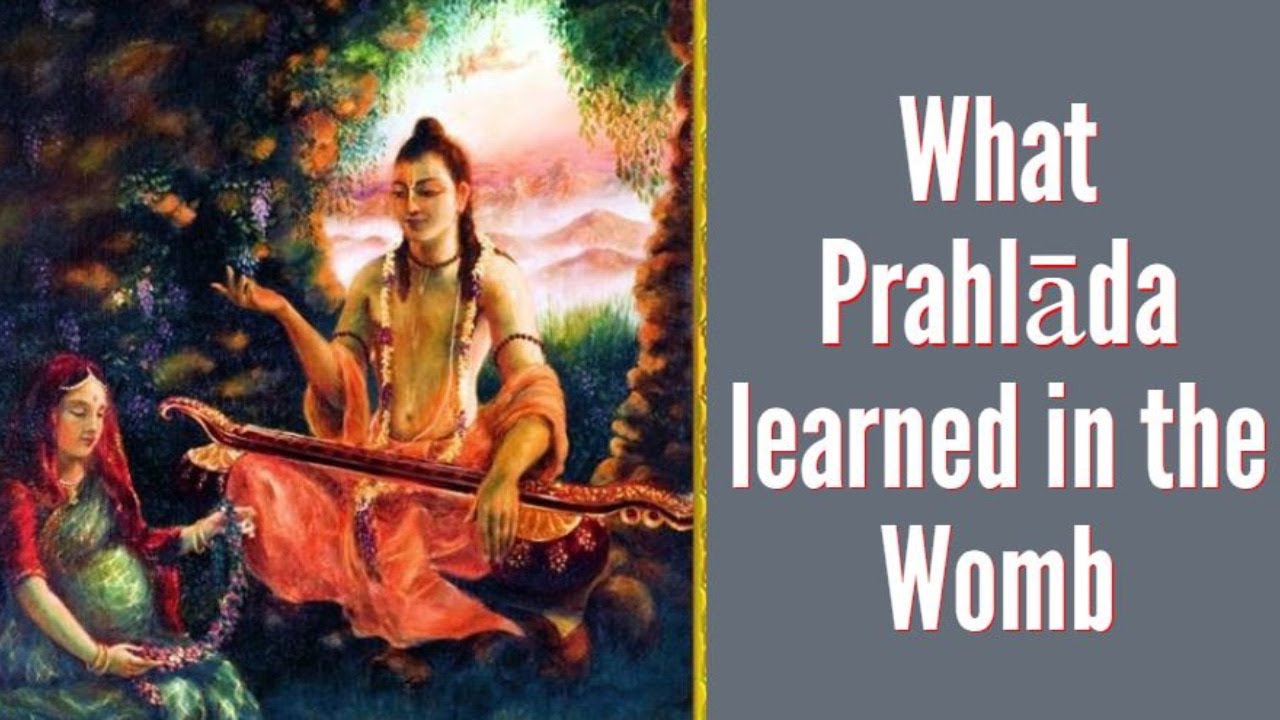
After accepting the instructions of Devarṣi Nārada, my mother stayed in his care, without fear from any direction, as long as my father, the King of the Daityas, had not become free from his severe austerities. (13) My mother, being pregnant, desired the safety of her em bryo and desired to give birth after her hus band’s arrival. Thus she stayed at Nārada Muni’s āśrama, where she rendered service unto Nārada Muni with great devotion. (14) Nārada Muni delivered his instructions both to me, who was within the womb, and to my mother, who was engaged in rendering him ser vice. Because he is naturally extremely kind to the fallen souls, being in a transcendental posi tion, he gave instructions on religion and tran scendental knowledge. These instructions were free from all material contamination. (15) Be cause of the long duration of time that has passed and because of her being a woman and therefore less intelligent, my mother has forgot ten all those instructions; but the great sage Nārada blessed me, and therefore I could not forget them. (16)
Prahlāda Mahārāja contin ued: My dear friends, if you can place your faith in my words, simply by that faith you can also understand transcendental knowledge, just like me, although you are small children. Simi larly, a woman can also understand transcen dental knowledge and know what is spirit and what is matter. (17) Just as the fruits and flow ers of a tree in due course of time undergo six changesbirth, existence, growth, transfor mation, dwindling and then deaththe material body, which is obtained by the spirit soul under different circumstances, undergoes similar changes. However, there are no such changes for the spirit soul. (18)
“Ātmā” refers to the Supreme Lord or the living entities. Both of them are spiritual, free from birth and death, free from deterioration and free from material contamination. They are individual, they are the knowers of the external body, and they are the foundation or shelter of everything. They are free from material change, they are self-il luminated, they are the cause of all causes, and they are all-pervading. They have nothing to do with the material body, and therefore they are always uncovered. With these transcendental qualities, one who is actually learned must give up the illusory conception of life, in which one thinks, “I am this material body, and everything in relationship with this body is mine.” (19-20) An expert geologist can understand where there is gold and by various processes can extract it from the gold ore. Similarly, a spiritually ad vanced person can understand how the spiritual particle exists within the body, and thus by cul tivating spiritual knowledge he can attain per fection in spiritual life. However, as one who is not expert cannot understand where there is gold, a foolish person who has not cultivated spiritual knowledge cannot understand how the spirit exists within the body. (21)
The Lord’s eight separated material ener gies, the three modes of material nature and the sixteen transformations [the eleven senses and the five gross material elements like earth and water] within all these, the one spiritual soul exists as the observer. Therefore, all the great ācāryas have concluded that the individual soul is conditioned by these material elements. (22) There are two kinds of bodies for every indi vidual soul a gross body made of five gross el ements and a subtle body made of three subtle elements. Within these bodies, however, is the spirit soul. One must find the soul by analysis, saying, “This is not it. This is not it.” Thus one must separate spirit from matter. (23) Sober and expert persons should search for the spirit soul with minds purified through analytical study in terms of the soul’s connection with and distinction from all things that undergo crea tion, maintenance and destruction. (24)
Intelligence can be perceived in three states of activ ity wakefulness, dreaming and deep sleep. The person who perceives these three is to be con sidered the original master, the ruler, the Su preme Personality of Godhead. (25) As one can understand the presence of the air by the aromas it carries, so, under the guidance of the Supreme Personality of Godhead, one can un derstand the living soul by these three divisions of intelligence. These three divisions, however, are not the soul; they are constituted of the three modes and are born of activities. (26) Through polluted intelligence one is subjected to the modes of nature, and thus one is conditioned by material existence. Like a dreaming state in which one falsely suffers, material existence, which is due to ignorance, must be considered unwanted and temporary. (27) Therefore, my dear friends, O sons of the de mons, your duty is to take to Kṛṣṇa conscious ness, which can burn the seed of fruitive activ ities artificially created by the modes of mate rial nature and stop the flow of the intelligence in wakefulness, dreaming and deep sleep. In other words, when one takes to Kṛṣṇa con sciousness, his ignorance is immediately dissi pated. (28)
Of the different processes recom mended for disentanglement from material life, the one personally explained and accepted by the Supreme Personality of Godhead should be considered all-perfect. That process is the per formance of duties by which love for the Su preme Lord develops. (29) One must accept the bona fide spiritual master and render ser vice unto him with great devotion and faith. Whatever one has in one’s possession should be offered to the spiritual master, and in the as sociation of saintly persons and devotees one should worship the Lord, hear the glories of the Lord with faith, glorify the transcendental qual ities and activities of the Lord, always meditate on the Lord’s lotus feet, and worship the Deity of the Lord strictly according to the injunctions of the śāstra and guru. (30-31) One should al ways remember the Supreme Personality of Godhead in His localized representation as the Paramātmā, who is situated in the core of every living entity’s heart. Thus one should offer re spect to every living entity according to that liv ing entity’s position or manifestation. (32)
By these activities [as mentioned above] one is able to cut down the influence of the enemies, namely lust, anger, greed, illusion, madness and jealousy, and when thus situated, one can render service to the Lord. In this way one surely attains the platform of loving service to the Supreme Personality of Godhead. (33) One who is situated in devotional service is certainly the controller of his senses, and thus he is a liberated person. When such a liberated person, the pure devotee, hears of the transcen dental qualities and activities of the Lord’s in carnations for the performance of various pas times, his hair stands on end on his body, tears fall from his eyes, and in his spiritual realiza tion his voice falters. Sometimes he very openly dances, sometimes he sings loudly, and sometimes he cries. Thus he expresses his tran scendental jubilation. (34)
When a devotee be comes like a person haunted by a ghost, he laughs and very loudly chants about the quali ties of the Lord. Sometimes he sits to perform meditation, and he offers respects to every liv ing entity, considering him a devotee of the Lord. Constantly breathing very heavily, he be comes careless of social etiquette and loudly chants like a madman, “Hare Kṛṣṇa, Hare Kṛṣṇa! O my Lord, O master of the universe!” (35) The devotee is then freed from all material contamination because he constantly thinks of the Lord’s pastimes and because his mind and body have been converted to spiritual qualities. Because of his intense devotional service, his ignorance, material consciousness and all kinds of material desires are completely burnt to ashes. This is the stage at which one can achieve the shelter of the Lord’s lotus feet. (36)
The real problem of life is the repetition of birth and death, which is like a wheel rolling repeat edly up and down. This wheel, however, com pletely stops when one is in touch with the Su preme Personality of Godhead. In other words, by the transcendental bliss realized from con stant engagement in devotional service, one is completely liberated from material existence. All learned men know this. Therefore, my dear friends, O sons of the asuras, immediately begin meditating upon and worshiping the Su persoul within everyone’s heart. (37) O my friends, sons of the asuras, the Supreme Person ality of Godhead in His Supersoul feature al ways exists within the cores of the hearts of all living entities. Indeed, He is the well-wisher and friend of all living entities, and there is no difficulty in worshiping the Lord. Why, then, should people not engage in His devotional ser vice? Why are they so addicted to unneces sarily producing artificial paraphernalia for sense gratification? (38)
One’s riches, beauti ful wife and female friends, one’s sons and daughters, one’s residence, one’s domestic an imals like cows, elephants and horses, one’s treasury, economic development and sense gratificationindeed, even the lifetime in which one can enjoy all these material opulencesare certainly temporary and flickering. Since the opportunity of human life is temporary, what benefit can these material opulences give to a sensible man who has understood himself to be eternal? (39) It is learned from Vedic literature that by performing great sacrifices one may el evate himself to the heavenly planets. How ever, although life on the heavenly planets is hundreds and thousands of times more com fortable than life on earth, the heavenly planets are not pure [nirmalam], or free from the taint of material existence. The heavenly planets are also temporary, and therefore they are not the goal of life. The Supreme Personality of God head, however, has never been seen or heard to possess inebriety. Consequently, for your own benefit and self-realization, you must worship the Lord with great devotion, as described in the revealed scriptures. (40)
A materialistic person, thinking himself very advanced in intelligence, continually acts for economic development. But again and again, as enunciated in the Vedas, he is frus trated by material activities, either in this life or in the next. Indeed, the results one obtains are inevitably the opposite of those one desires. (41) In this material world, every materialist desires to achieve happiness and diminish his distress, and therefore he acts accordingly. Ac tually, however, one is happy as long as one does not endeavor for happiness; as soon as one begins his activities for happiness, his condi tions of distress begin. (42) A living entity de sires comfort for his body and makes many plans for this purpose, but actually the body is the property of others. Indeed, the perishable body embraces the living entity and then leaves him aside. (43) Since the body itself is ulti mately meant to become stool or earth, what is the meaning of the paraphernalia related to the body, such as wives, residences, wealth, chil dren, relatives, servants, friends, kingdoms, treasuries, animals and ministers? They are also temporary. What more can be said about this? (44)
All this paraphernalia is very near and dear as long as the body exists, but as soon as the body is destroyed, all things related to the body are also finished. Therefore, actually one has nothing to do with them, but because of igno rance one accepts them as valuable. Compared to the ocean of eternal happiness, they are most insignificant. What is the use of such insignifi cant relationships for the eternal living being? (45) My dear friends, O sons of the asuras, the living entity receives different types of bodies according to his previous fruitive activities. Thus he is seen to suffer with reference to his particular body in all conditions of life, begin ning with his infusion into the womb. Please tell me, therefore, after full consideration, what is the living entity’s actual interest in fruitive activities, which result in hardship and misery? (46) The living entity, who has received his present body because of his past fruitive activ ity, may end the results of his actions in this life, but this does not mean that he is liberated from bondage to material bodies. The living en tity receives one type of body, and by perform ing actions with that body he creates another. Thus he transmigrates from one body to an other, through repeated birth and death, be cause of his gross ignorance. (47)
The four principles of advancement in spiritual lifedharma, artha, kāma and mokṣaall depend on the disposition of the Supreme Personality of Godhead. Therefore, my dear friends, follow in the footsteps of devotees. Without desire, fully depend upon the disposition of the Su preme Lord, worship Him, the Supersoul, in de votional service. (48) The Supreme Personality of Godhead, Hari, is the soul and the Supersoul of all living entities. Every living entity is a manifestation of His energy in terms of the liv ing soul and the material body. Therefore, the Lord is the most dear, and He is the supreme controller. (49) If a demigod, demon, human being, Yakṣa, Gandharva or anyone within this universe renders service to the lotus feet of Mukunda, who can deliver liberation, he is ac tually situated in the most auspicious condition of life, exactly like us [the mahājanas, headed by Prahlāda Mahārāja]. (50)
My dear friends, O sons of the demons, you cannot please the Supreme Personality of God head by becoming perfect brāhmaṇas, demi gods or great saints or by becoming perfectly good in etiquette or vast learning. None of these qualifications can awaken the pleasure of the Lord. Nor by charity, austerity, sacrifice, clean liness or vows can one satisfy the Lord. The Lord is pleased only if one has unflinching, un alloyed devotion to Him. Without sincere de votional service, everything is simply a show. (51-52) My dear friends, O sons of the demons, in the same favorable way that one sees himself and takes care of himself, take to devotional service to satisfy the Supreme Personality of Godhead, who is present everywhere as the Su persoul of all living entities. (53)
O my friends, O sons of demons, everyone, including you (the Yakṣas and Rākṣasas), the unintelligent women, śūdras and cowherd men, the birds, the lower animals and the sinful living entities, can revive his original, eternal spiritual life and ex ist forever simply by accepting the principles of bhakti-yoga. (54) In this material world, to ren der service to the lotus feet of Govinda, the cause of all causes, and to see Him everywhere, is the only goal of life. This much alone is the ultimate goal of human life, as explained by all the revealed scriptures. (55)
Deepen your Bhakti-yoga practice, harmonize relationships, and receive guided coaching — all at Vedavarsity.com