Four-headed Brahmā performed austerities at Ātopura grāma to become free from the offence he committed during Kṛṣṇa’s pastimes of stealing the cowherd boys and calves. Feeling deeply remorseful and having contemplated Śrīman Mahāprabhu’s coming pastimes and His munificence, he worshipped the Lord at this place. Mahāprabhu’s pastimes are eternal, yet sometimes they mani fest in this world and other times they do not. Conse quently, it is not against established philosophical conclusions to worship Śrīman Mahāprabhu even before He performs His pastimes in this world. Satisfied with Lord Brahmā’s worship, Śrīman Mahāprabhu appeared before him.
Brahmājī begged forgiveness for his offences, and asked for a boon: “When You exhibit Your pastimes in this world, please arrange for me to take birth in a low-class family and, thus in a mood of humility and wretched ness, fulfil Your innermost desire with my service.” Śrīman Mahāprabhu then granted Lord Brahmā his boon, saying, “You will take birth in a Muslim family and serve Me by preaching and loudly chanting the holy names of Hari. I will appear in this form of Gaurāṅga, having accepted the sentiment and bodily lustre of My beloved Rādhā for the purpose of fulfilling My three special internal desires.
I will madden all the living entities in the universe by making them dance in harināma-saṅkīrtana and by bestowing upon them the most elevated and resplendent prema, which is rarely attained even by the demigods. You will assist Me in fulfilling My heart’s desires to accomplish this.” This island (dvīpa) became known as Antardvīpa, because it was here that the Lord revealed His internal (antara) sentiments to Brahmā. In Śrīman Mahāprabhu’s pastimes this same Brahmā appeared as nāma-ācārya Śrīla Haridāsa Ṭhākura, the authority in the chanting of the holy name.
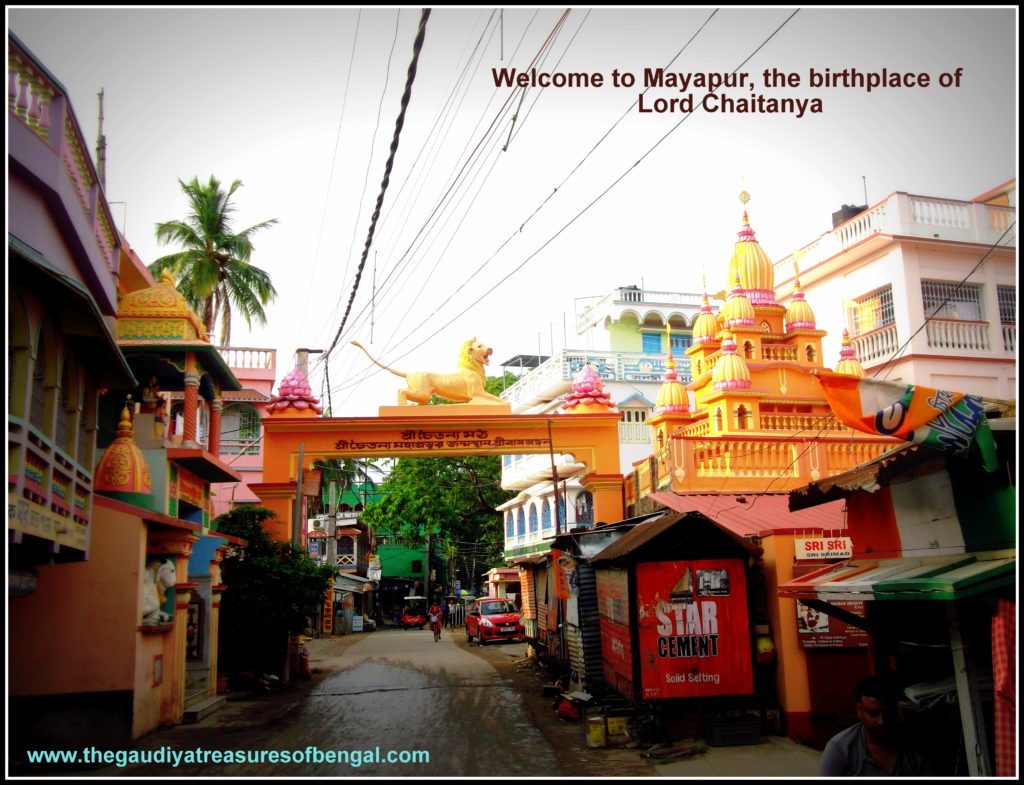
Antardvīpa is also known as Ātopura. Antardvīpa’s central point, the Mahā-yogapīṭha, is the appearance-place of the Lord, and is also known as Māyāpura. This Antardvīpa consists of Ballāla-dīghī (Pṛthu-kuṇḍa), a portion of Vāmana-pukura, Śrīnāthapura, Gaṅgā-nagara and other places. Śrī Jagannātha Miśra’s house was within the present Vāmana-pukura. Although Śrīman Mahāprabhu eternally performs pastimes here, only fortunate souls can witness them. When the foundation to the present grand Yogapīṭha Temple in Māyāpura was being dug, a small four-armed deity was found. This deity had been worshipped by Śrī Jagannātha Miśra, whose temple was located in that spot. And just nearby, under a large neem tree, Nimāī took birth from Śrī Śacī-devī’s womb.
Śacī-devī’s father, Śrī Nīlāmbara Cakravartī, was a renowned scholar of astrology and logic. Śacī-devī was highly chaste, devout and the embodiment of mercy. Her eight daughters died at birth, one after the other. She then gave birth to an extraordinary son named Śrī Viśvarūpa. He was learned in the scriptures, peaceful in nature and benevolent. He was omniscient and his intellect was unparalleled. Although he was incomparably beautiful, he was completely detached from sense enjoyment. Nimāī took birth after Viśvarūpa. Nimāī was none other than Vrajendra-nandana Śrī Kṛṣṇa Himself who had accepted the mood and lustre of Śrī Rādhā.
He chose to appear in this world for several reasons among which four are prominent:
(1) To propagate the yuga-dharma, or the religious practice for the age. This is the congregational chanting of the holy names (śrī-nāma-saṅkīrtana).
(2) To distribute what had never been given before unnatojjvala-prema, transcendental love in the elevated amorous mellow.
(3) To respond to the entreaty of Śrī Advaita Ācārya, who was perturbed by the extremely irreligious state of the world at that time. Śrī Advaita Ācārya had wor shipped Śrī Krṣṇa with Gaṅgā water and tulasī leaves, and thus induced the Lord to appear.
(4) To fulfil His three confidential desires. Kṛṣṇa, who is supremely merciful and the enjoyer of all transcenden tal mellows, accepted the mood and lustre of Śrī Rādhā and appeared as Śrī Gaurāṅga: (a) to taste the greatness of Śrīmatī Rādhikā’s prema, (b) to personally taste, as Śrīmatī Rādhikā does, all the sweetness of His form, and (c) to taste Śrīmatī Rādhikā’s happiness when She relishes His sweetness. Śrī Gaurāṅga Mahāprabhu took birth on 23rd Phālguna in the Śakābda Era 1407, that is [according to the Christian Era] 28th February, 1486.
It was a full-moon day, and He appeared at twilight. There was a lunar eclipse that evening, and everywhere hundreds of thousands of people were singing the glories of Hari. In such a glorious atmosphere, which was surcharged with the chanting of the holy name, He appeared from the womb of Śrī Śacī-devī. Because He took birth under a neem tree He was named Nimāī, and because His complexion was golden in lustre, He became known as Gaurāṅga (golden-limbed). The ladies exclaimed, “Hari Bol, Hari Bol!” and that abode re sounded continuously with the vibration of the holy names. Nimāī’s childhood nature was extremely restless, just like Śrī Kṛṣṇa’s.
Once, in the house of Jagannātha Miśra, He caught a snake and proceeded to play with it. Another time He climbed upon the shoulders of a thief and rode on them throughout the town. On an Ekādaśī day He begged for the food that was being offered to the deity in the house of a devotee. He cried often, and only stopped when someone chanted the holy names, at which He broke out into loud peals of laughter. Sometimes, on His way home from school He would play games in the Gaṅgā with the other children. When His elder brother Viśvarūpa accepted the renounced order, however, Nimāī’s behaviour became more subdued and He studied at Śrī Gaṅgādāsa’s school, which He attended with Gadādhara, Dāmodara, Jagadānanda, Mukunda and other boys.
Later He established a Sanskrit school in His own home where He taught grammar. At one of the Gaṅgā’s ghāṭas in Antardvīpa, He crushed the pride of a champion of erudition named Keśava Kāśmīrī and instructed him in bhajana. In Antardvīpa He was married twice; first to Śrī Lakṣmīpriyā-devī, and after she left this world, to Śrī Viṣṇupriyā-devī. It was from here that He travelled to Gayā, where Śrī Īśvara Purī initiated Him into the chanting of Śrī Kṛṣṇa’s names. When He returned He had become transformed into an exalted devotee who constantly tasted transcendental sentiments. Finally, in a mood of detachment, He left His aged mother and His wife Viṣṇupriyā and crossed the Gaṅgā to accept the renounced order in Kaṭavā. Later, in Śāntipura, His mother requested Him to take up His residence in Purī-dhāma instead of Vṛndāvana, and He agreed to do this.
He later left Purī to travel through out South India, where He dis cussed bhakti-tattva with Śrī Rāmānanda Rāya on the bank of the river Godāvarī. In all, He remained based in Purī-dhāma for twenty-four years, the first six of which were spent travelling to Vṛndāvana, South India and other places. During the remaining eighteen years He experienced an unceasing restlessness caused by feelings of separation from Kṛṣṇa. Svarūpa Dāmodara and Rāya Rāmānanda were able to pacify Śrīman Mahāprabhu’s specific moods by reciting appropriate verses from Śrīmad Bhāgavatam, or by singing songs by Caṇḍīdāsa, Vidyāpati or from Jayadeva Gosvāmī’s Gīta-Govinda.
He had conducted His married life as an ideal house-holder, and when He renounced it, He lived a life of complete detachment. In this way He set the example how to engage in the ideal, renounced life of bhajana. When Śrīman Mahāprabhu accepted sannyāsa, the lives of Mother Śacī and Viṣṇupriyā-devī became filled with intolerable separation from Him. At that time, they were cared for by Īśāna Ṭhākura and Śrī Vaṁśī-vadanānanda. In separation from Mahāprabhu, Viṣṇupriyā-devī forgot to eat, drink or tend to other bodily needs. Indeed, she forgot everything, and became extremely weak and frail. She simply chanted the mahā-mantra from morning to noon, and for each mantra she chanted, she put aside one grain of rice.
At noon she prepared that rice and offered it to Śrī Rādhā-Kṛṣṇa and her deity of Mahāprabhu. She then offered the prasāda to Śacī-devī, who would accept some and leave the rest, which amounted to a mere handful, for Viṣṇupriyā-devī. With a restless heart she remembered Śrī Caitanya Mahāprabhu day and night, and as she chanted the holy name, she wept. Faithful devotees received darśana of her lotus feet only after repeated requests. Unable to tolerate separation from Śrīman Mahāprabhu, Vaiṣṇavas like Śrī Nityānanda Prabhu, Śrī Advaita Ācārya and Śrīvāsa Paṇḍita gradually moved away from Navadvīpa to reside elsewhere. Later, when the Gaṅgā flooded a large part of Navadvīpa, the inhabitants of Navadvīpa moved to the western bank, called Kuliyā-Pahāḍapura.
Deepen your Bhakti-yoga practice, harmonize relationships, and receive guided coaching — all at Vedavarsity.com