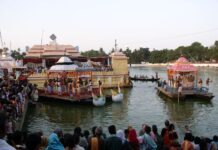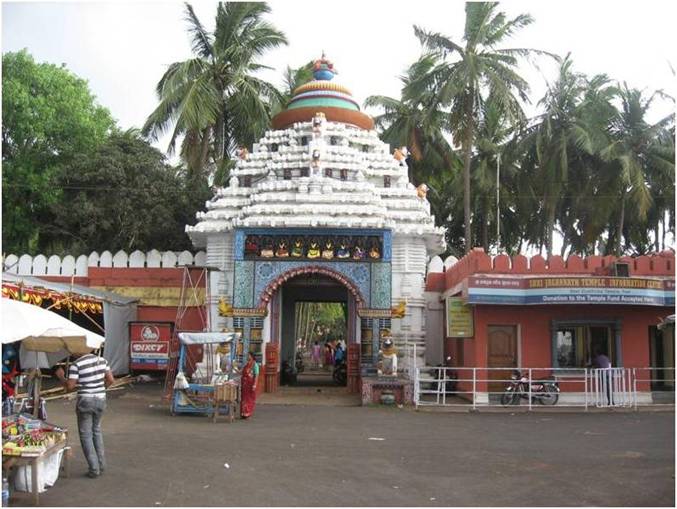
Every year the Rathayatra culminates at this temple which is surrounded by lush gardens and tall cooling coconut trees. Fragrant flowers and shady trees create a Vrindavan atmosphere which Lord Jaganantha enjoys for 7 days before returning to Sri Mandira. This temple is located at the opposite end of main road about 3 km northeast of the Jagannatha Temple. The temple at Gundica is called Sundaracala and Jagannatha Temple is called Nilacala. During Rathayatra festival, Lord Jagannatha, Baladeva and Subhadra along Sudarshan, leave Jagannatha Mandira for nine days: one day for travelling to Gundicha, Seven days spent there, and one day to return home. This Journey is known as to Gundica Yatra, Nava Dina Yatra (“nine days Journey”), or Ghosa Yatra. It is most auspicious to have darshana of Lord Jagannatha at this time.
Gundica Mandira is called the “birthplace” of Jaganantha Swami because here on a special platform called the mahavedi, a celestial carpenter carved the daru that manifested the Deities of Jagannatha, Baladeva and Subhadra during the reign of King lndradyumna. It is said that the wife of lndradyumna, the king who originally established the temple of Jagannatha, was known as Gundica. The cleansing of the Gundica Temple – Gundica-marjana – takes place the day before the Rathayatra festival as mentioned in Caitanya-Caritamrita. Darshana of Jagannatha during His stay at Gundica temple is known as Adapa Darshana. It is said in scripture that darshana of the Lord Jagannatha at Gundica temple is equal to ten darshana at Nilachala Temple (main temple). This place is compared to Vrindavana.
Deepen your Bhakti-yoga practice, harmonize relationships, and receive guided coaching — all at Vedavarsity.com