


Among the members of the Beatles, George Harrison was often known as the “Quiet Beatle.” Yet behind his reserved public image was a sincere spiritual seeker whose search for truth profoundly shaped his music and personal life. Long before spirituality became a common theme in popular culture, Harrison openly explored questions about the purpose of life, the nature of the self, and humanity’s relationship with the Divine.
The story of George Harrison spiritual songs is not merely the story of artistic experimentation. It is the story of a musician who used his global influence to direct attention toward higher consciousness. His encounter with Indian philosophy, devotional practices, and later his association with His Divine Grace A.C. Bhaktivedanta Swami Prabhupada helped introduce millions of people to the teachings of bhakti-yoga and the chanting of the Hare Krishna maha-mantra.
Several of Harrison’s most celebrated compositions reveal the depth of this spiritual journey.

“My Sweet Lord”: A Universal Call to Divine Remembrance
George Harrison achieved the first solo number-one hit by a former Beatle with “My Sweet Lord,” which topped charts in late 1970 and early 1971.
The song is notable for combining repeated chants of “Hallelujah” and “Hare Krishna.” Rather than presenting competing religious traditions, Harrison sought to express a universal longing for God. The composition reflected his growing appreciation of Eastern spiritual wisdom while maintaining respect for his Christian background.
The repeated invocation of the Divine Name is especially significant. In Vedic teachings, the holy name of God is considered non-different from God Himself. Thus, remembrance through sound becomes a direct spiritual practice.
Through its simple yet powerful message, “My Sweet Lord” brought sacred chanting into mainstream popular culture and introduced countless listeners to devotional spirituality.
“Within You Without You”: Exploring the Nature of Reality
Harrison’s contribution to the Beatles’ landmark 1967 album Sgt. Pepper’s Lonely Hearts Club Band stands among his most explicitly philosophical works.
Unlike typical Beatles recordings, “Within You Without You” relied heavily on Indian musical instruments and was recorded with musicians associated with the Asian Music Circle in London.
The song addresses themes central to Indian spiritual thought. Harrison speaks of illusion, self-realization, and the interconnected nature of existence. Its lyrics challenge the tendency to identify solely with temporary material circumstances while ignoring deeper spiritual reality.
One of the song’s central messages is that genuine peace emerges when individuals recognize their shared spiritual foundation. This concept resonates with the Vedic understanding that all living beings are eternal souls (ātmas), connected through their relationship with the Supreme.
Rather than promoting division based on bodily designations, the song points toward unity through spiritual understanding.
“While My Guitar Gently Weeps”: Reflecting on Divine Arrangement
Written for the Beatles’ 1968 self-titled album, commonly known as The White Album, “While My Guitar Gently Weeps” reflects Harrison’s growing interest in Eastern philosophical concepts.
Harrison explained that the song was inspired by the idea that events occur according to a deeper order and that apparent coincidences may have greater significance than people realize.
The lyrics observe a changing world while reflecting on human mistakes and the possibility of learning from them. This perspective aligns with the Vedic principle of karma, which teaches that actions produce corresponding reactions and that life itself serves as an opportunity for growth and realization.
The song does not offer simplistic answers. Instead, it presents a thoughtful meditation on human behavior, responsibility, and the lessons embedded within experience.
“Long, Long, Long”: A Soul’s Search for God
Among Harrison’s lesser-known compositions, “Long, Long, Long” possesses remarkable spiritual depth.
At first glance, the song appears to describe a reunion between lovers. However, Harrison later revealed that the object of his longing was not a romantic partner but God.
This insight transforms the song’s meaning entirely.
The lyrics become the expression of a soul rediscovering its forgotten relationship with the Divine. In Vedic literature, the living being is described as eternally connected with God but often distracted by temporary material pursuits. Spiritual life begins when that forgotten relationship is revived.
“Long, Long, Long” captures the emotional dimension of that awakening. It reflects gratitude, humility, and the relief of finding what had long been missing.
“Beware of Darkness”: A Warning Against Maya
Released on Harrison’s acclaimed 1970 album All Things Must Pass, “Beware of Darkness” remains one of his most spiritually direct compositions.
Harrison described the song as largely self-explanatory, and its message centers on the Vedic concept of maya, often understood as illusion or mistaken perception.
The lyrics caution listeners against influences that distract them from genuine spiritual understanding. Rather than focusing solely on external dangers, Harrison points toward internal confusion, unconscious habits, and the tendency to wander through life without clear purpose.
In Vedic philosophy, maya does not simply mean that the world is unreal. Rather, it refers to misunderstanding reality by identifying exclusively with temporary material conditions while neglecting one’s eternal spiritual nature.
“Beware of Darkness” serves as both a warning and an invitation to cultivate awareness, discrimination, and higher vision.
“Give Me Love (Give Me Peace on Earth)”: A Prayer for Liberation
In 1973, Harrison returned to the top of the Billboard charts with “Give Me Love (Give Me Peace on Earth),” the lead single from his album Living in the Material World.
The song carries the mood of a sincere prayer. Harrison later described it as a personal statement between himself, the Lord, and anyone who appreciated the song.
Its lyrics express a desire for spiritual freedom and inner peace. They also reflect themes associated with liberation from the cycle of repeated birth and death, a foundational teaching within Vedic philosophy.
The song’s plea to be freed from repeated material existence reveals Harrison’s growing understanding that lasting happiness cannot be found merely through external achievement. Despite worldwide fame, wealth, and recognition, he continued searching for something beyond temporary success.
This search for transcendence became one of the defining characteristics of his music.
George Harrison’s Lasting Spiritual Legacy
The significance of George Harrison spiritual songs extends far beyond their commercial success. Through his music, Harrison introduced spiritual ideas to audiences who might never have encountered them otherwise.
His lyrics explored questions that have occupied thoughtful human beings throughout history: Who am I? What is the purpose of life? Is there a higher reality beyond material existence?
These questions remain as relevant today as they were during Harrison’s lifetime.
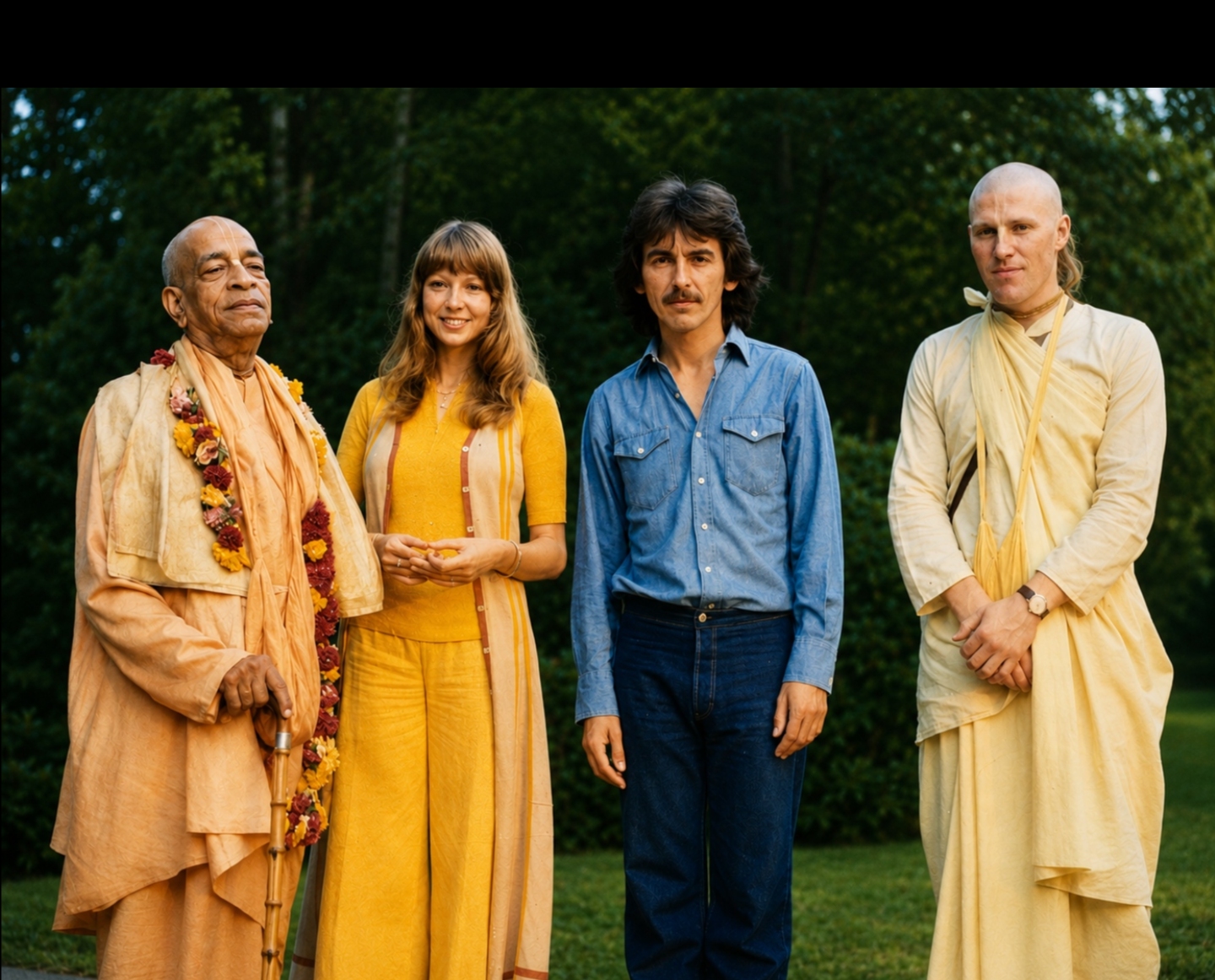
His friendship with Srila Prabhupada and support for the early development of the International Society for Krishna Consciousness (ISKCON) further demonstrated that his interest in spirituality was not a passing fascination but a sincere commitment to understanding life’s deeper purpose.
In a world often focused on external achievement, Harrison’s music reminds listeners that genuine fulfillment comes from inner realization and spiritual awakening. His songs continue to inspire reflection on timeless truths concerning the self, duty, consciousness, and our relationship with the Supreme.
Through melody, poetry, and devotion, George Harrison transformed popular music into a vehicle for spiritual inquiry—leaving behind a legacy that continues to guide seekers toward higher understanding.
library.vedavarsity.com || www.vedavarsity.com
Deepen your Bhakti-yoga practice, harmonize relationships, and receive guided coaching — all at Vedavarsity.com