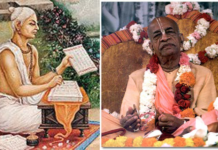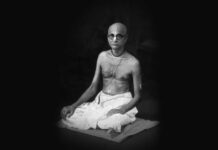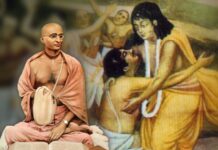
Śrī Gaurasiromaṇi Ṭhākura appeared between 1813 and 1818 CE in the village of Gudāpāḍā, also known as Citāhaṭi, under the Kutugrāma police station near Kāṭoā in Bengal. He took birth in an orthodox brāhmaṇa family upholding high standards of learning and ritual purity and was the grandson of the illustrious scholar Śrī Guruprasāda Mukhopādhyāya Vidyānidhi. Guruprasāda’s son Dhanakṛṣṇa had six sons—Gauracandra (Siromaṇi), Īśvara, Navadvīpa, Hariścandra (Cūḍāmaṇi), Giriśa, and Umeśa—and one daughter named Parijāta-devī.
Early life and education
Up to about the age of twenty, Gauracandra did not receive formal education and passed his days in simple village amusements, being detached from the scholarly pursuits of his respectable lineage. Chastised by the villagers for neglecting the family’s learned tradition, he immediately reformed himself and dedicated his life to study. He first studied under a village paṇḍita in Tāipura, then entered the Sanskrit school of Pañcanana Tarkaratna of Eyopura, Kāṭoā, and later took up systematic study of bhakti-śāstra under Śrī Sakhicaraṇa dāsa Paṇḍita Bābājī of Gaurāṅgapāḍā.
Family life and transformation to Vaiṣṇavism
Gauracandra married Śrīmatī Rāmadāsī, a chaste and devoted lady from an orthodox brāhmaṇa family of Oragrāma near the Guskara railway station in the Burdwan district. Orphaned in infancy when her father died and her mother entered the funeral pyre as a satī, Rāmadāsī grew up with a vow that she would be given in marriage to Gauracandra, as expressed by her mother before embracing death. From their marriage were born several sons, among whom Rasavallabha Bhaktibhūṣaṇa and Vaiṣṇavacaraṇa Bhagavat-bhūṣaṇa became well known for their devotional learning.
Although born in a Śākta family, Gaurasiromaṇi came to recognize the supreme excellence of Kṛṣṇa-mantra and received kṛṣṇa-dīkṣā from Śrī Vinodilāla Ṭhākura of Faridpura in the Nadia district. From that time his home became a place of intense Vaiṣṇava-sevā; he would eagerly honor the remnants of food and even water touched by Vaiṣṇavas, regardless of caste considerations. The local brāhmaṇa community criticized him for accepting the ucciṣṭa of devotees from all backgrounds, but he remained completely indifferent to social reproach and continued fearlessly in his devotional practices.
Rāmadāsī-devī herself was an elevated devotee, eager for Vaiṣṇava-sevā and for honoring the remnants of devotees. Following her husband’s mood, she did not accept jeweler’s ornaments, wearing only simple shell bangles, and personally washed the feet of visiting Vaiṣṇavas, often being mistaken by younger guests for a maidservant.
Awakening of exclusive bhakti
On one occasion Gauracandra visited Kāṭoā with many students, took bath in the Gaṅgā, and stayed at the nāṭya-maṇḍira of Lord Gaurāṅga’s temple. There he observed the late-afternoon kīrtana and iṣṭa-goṣṭhī of exalted devotees such as Gopīvallabha Ṭhākura, Venīmādhava Ṭhākura, and Sundarananda Ṭhākura, whose lives centered around nāma-kīrtana, Tulasi-parikramā, and constant service to Lord Gaurāṅga. Simply by their association his conception of bhakti changed overnight, and he resolved to immerse himself exclusively in Gauḍīya Vaiṣṇava literature.
Returning home, he ordered his students to procure various Gauḍīya Vaiṣṇava śāstras and became absorbed in their study, deeply appreciating their language, poetry, and devotional conclusions. He soon returned to Kāṭoā with his students and books to again seek the association of the foremost Vaiṣṇavas there and gave up the study and teaching of other śāstras, dedicating himself solely to Śrīmad-Bhāgavatam and related works.
Daily life at Kāṭoā
In Kāṭoā his daily schedule was fully absorbed in sādhana and service. He would attend maṅgala-ārati, engage in smaraṇa-kīrtana, bathe in the Gaṅgā, chant japa, and meditate on the Lord’s divine līlā until midday. Thereafter he personally cleaned the toilets used by Vaiṣṇavas and swept the path leading to the Gaṅgā, again bathed, visited Lord Gaurāṅga’s temple, offered respects to Vaiṣṇavas and Gosvāmīs, and took a few grains of Vaiṣṇava ucciṣṭa kept in a special place. His own meal consisted of a small quantity of rice and simple boiled vegetables, offered to his worshipable Deity Giridhārī, and he stated that his stomach would tolerate nothing more elaborate.
He was attached to a simple-hearted devotee named Khepa Ṭhākura, who acted as a messenger and sometimes jokingly claimed to be Gaurasiromaṇi’s own teacher. Gaurasiromaṇi was a master of the “Aṣṭādaśa-sāhasrī” (the eighteen-thousand-verse commentary) and its ṭīkā, and would teach without consulting texts, invariably concluding his lessons by glorifying Lord Gaurāṅga.
Emphasis on Vaiṣṇava-sevā
A decisive moment in his life occurred when Venīmādhava Ṭhākura, while serving many Vrajavāsī Vaiṣṇavas at Kāṭoā, found himself without provisions and, in complete detachment, pulled down the wooden doors and windows of his house to sell them for the sake of feeding the devotees. Witnessing such renunciation and eagerness to serve Vaiṣṇavas, Gaurasiromaṇi fainted in ecstasy, and upon regaining consciousness took a firm vow to consider Vaiṣṇava-sevā as his life’s primary duty.
He maintained an intimate circle (goṣṭhī) of Vaiṣṇavas at Kāṭoā, including Vrndāvanacandra Gosvāmī and Jagadbandhu Prabhu, descendants of Advaita Ācārya who had renounced worldly life and taken veśā-āśraya from Kisoradāsa Bābājī. At Venīmādhava’s request, Gaurasiromaṇi once delivered a three-hour daily exposition for thirty-five consecutive days on the single verse “janmādy asya yataḥ” from the first canto of Śrīmad-Bhāgavatam, causing Venīmādhava to remark that he was surely favored by the mercy of the Six Gosvāmīs.
Strictness in worship and purity
On another occasion he visited the village of Badogrāma near Burdwan to recite Śrīmad-Bhāgavatam in the house of the Banerjee family. Discovering that the village had neither a Viṣṇu temple nor worship of Śālagrāma-śilā, he declared that he would not even drink water in such a place. In great anxiety, the villagers arranged for a Śālagrāma to be brought from a distant village, offered bhoga, and only then did Gaurasiromaṇi agree to honor the prasāda of Lord Viṣṇu.
He also displayed firm opposition to animal slaughter and tantric practices contrary to Vaiṣṇava principles. When invited by certain tantric brāhmaṇas of Kagrāma to recite Śrīmad-Bhāgavatam, he became distressed upon learning that they intended to hold animal sacrifice for Kālī on the same site and fervently prayed to Gaura-Govinda. The sacrifice was mysteriously obstructed—each animal required two strikes instead of one—and the frightened sacrificers later received a warning in a dream from the goddess herself and came repenting to Gaurasiromaṇi, who directed them to bathe in the Gaṅgā and subsequently initiated them into genuine Vaiṣṇava-dharma.
Humility and resolution of disputes
During his time, a prolonged controversy arose in the community over the relative status of Gosvāmīs and other Vaiṣṇavas. Both parties finally requested Gaurasiromaṇi to mediate, promising to accept his verdict, but he replied with deep humility: “Take me as your son. When parents quarrel, the grown son should not be present. Sometimes marital love deepens when a couple differs with one another.” His gentle words melted the hearts of both sides, who abandoned their quarrel and jointly chanted the holy name.
Vision of Gaurāṅga in the Bhāgavatam
An important account preserved in Śrī Śrī Sadguru-saṅga describes how Gaurasiromaṇi, though greatly learned in scripture, once objected to a Bhāgavatam reciter’s practice of beginning the narration with Gauravandana, the glorification of Lord Gaurāṅga. When the reciter asserted that his glorification of Gaurāṅga was actually present in the Śrīmad-Bhāgavatam, specifically in the blank spaces between the printed lines, Gaurasiromaṇi angrily challenged him. The reciter then instructed that if Gaurasiromaṇi would accept dīkṣā from a qualified Vaiṣṇava and follow prescribed practices for seven days, he would perceive the truth for himself.
Being internally sincere, Gaurasiromaṇi at once took dīkṣā from Siddha Caitanyadāsa Bābājī and carefully followed the instructions. On the eighth day, when the Bhāgavatam was opened before him, he saw the Gauravandana written in brilliant golden letters in the intervening spaces, and overwhelmed with repentance and divine emotion, he rolled on the ground, weeping. Immediately he renounced his previous way of life and set out on foot for Vṛndāvana, where he remained absorbed in bhajana.
Residence and bhajana in Vṛndāvana
In Vṛndāvana, Gaurasiromaṇi reduced his public recitation and focused on intimate teaching of Śrīmad-Bhāgavatam to Vrajavāsī devotees, often explaining the deepest topics of the Fourth Canto, such as the pastime of Dakṣa-yajña. On one occasion, when a question arose about how Lord Śiva could dance carrying the burnt body of Satī, a Vaiṣṇava sitting beside him demonstrated the reality of yogic mysticism by entering meditation, invoking fire from his own toe, and leaving his body in flames before the astonished assembly, after which Gaurasiromaṇi gave up public teachings and chose an even more secluded life of bhajana.
Many exalted Vaiṣṇavas were present in Vṛndāvana during his stay, including Śrī Brahmānanda Gosvāmī of Śṛṅgāra-vaṭa, Śrī Nṛsiṁhānanda Prabhu, Śrī Nīlamani Gosvāmī (a descendant of Advaita Prabhu), Śrī Haracandra Gosvāmī, and the renowned kīrtana singers such as Hajra Mahāśaya and Vaiṣṇavacaraṇa dāsa. They all held Gaurasiromaṇi in deep respect as a genuine Vaiṣṇava of great realization.
On one occasion, when invited by Śrī Brahmānanda Prabhu to honor prasāda at Govinda-ghāṭa, Gaurasiromaṇi was offered a special elevated seat and silver plates, but he refused, requesting instead a simple leaf plate and suggesting that Brahmānanda himself, as his revered “Prabhupāda,” should take the honored seat. In this way he consistently minimized his own status and emphasized the Vaiṣṇava relationship of “prabhu” and “dāsa.”
Veśāśraya, austerities, and guru-sevā
After a period of illness in Vṛndāvana, understanding that his remaining days were few, Gaurasiromaṇi accepted veśāśraya (babājī-veśa) from Siddha Nityānanda dāsa Bābājī of Śrī Madanamohana-ṭhākur’s temple. Even while housebound by physical weakness, he wore the kāṇṭhī of Sanātana Gosvāmī’s followers and endeavored to live like a bhajananandī Vaiṣṇava, but when he went to receive the blessings of Siddha Balarāma dāsa Bābājī at Jhadumaṇḍala, he was sharply chastised for still being attached to cooked rice and thus unfit to wear such external signs. In tears of humility, he begged for mercy and thereafter increased his austerities, subsisting on the simplest prasāda of Girirāja—broken pulses and a little rice with salt and black pepper.
He arranged for daily recitations of scripture for the benefit of resident and visiting Vaiṣṇavas and showed equal respect to all—from infants in the laps of acārya-descendants to the poorest devotees unable to go out for madhukārī. No one could easily touch his feet or offer obeisances before him; he would immediately offer daṇḍavat to others first, even repeatedly bowing to animals, men, women, and the Deities on the roadside.
Humility in practice
Gaurasiromaṇi’s conduct practically illustrated the verse “tṛṇād api sunīcena,” often referred to by later Vaiṣṇavas as embodied in his character. When questioned by his disciples why he addressed the female sweeper as “mother,” he replied that from childhood till that day she had been cleaning his bodily filth and thus was truly his maintainer and benefactress, worthy of his deepest respect.
He showed extreme deference to descendants of great acāryas. When Harimohana Gosvāmī, an eighth-generation descendant of Jagannātha Vaiṣṇava Ācārya Gosvāmī, came seeking instruction on Gauratattva, Gaurasiromaṇi for fifteen days only offered him repeated daṇḍavats, refusing to speak, considering him worshipable as the son of an acārya. Only when Harimohana, then a mere boy, insisted with grave words—declaring himself ready to fall into hell if that would please the Vaiṣṇavas—did Gaurasiromaṇi embrace him and reveal to him the truths of Gauratattva, which Harimohana later realized fully.
Association with disciples and householders
Many householder devotees, including Advaita dāsa (Annada Prasād Rāya) and his brother Banamāli Rāya, were rescued from skepticism and non-Vaiṣṇava influences by Gaurasiromaṇi’s association and guidance. When Annada contemplated converting to Christianity, his mother brought him to Gaurasiromaṇi, whose saintly behavior changed his heart and led him to accept initiation as Advaita dāsa and dedicate his life to bhakti.
Gaurasiromaṇi also advised Banamāli Rāya, a powerful zamindar, that Kṛṣṇa-prema cannot be attained without Vaiṣṇava-sevā and that such service primarily means arranging for regular Hari-kathā and practical care for aged, blind, or infirm Vaiṣṇavas unable to collect their own bhikṣā. Banamāli took this as a life-command and attempted, within his means, to establish schools for the study of Gosvāmī-granthas and facilities for serving devotees, sowing the seeds of later institutions of bhakti education.
Gaurasiromaṇi remained indifferent to caste criticism, keeping the association of sincere devotees regardless of social background. For example, he accepted the service of Rājanīdāsa, a Kaivarta by caste from Pabna, who carried his prasāda and faithfully served him, despite objections from conservative Vaiṣṇavas.
Spirit of atonement and reform
When some devotees once refused to take prasāda in the same row as a Vaiṣṇava who had committed a serious misdeed, Gaurasiromaṇi pacified them by openly confessing all the faults he could find in his own life, thereby softening everyone’s hearts and inspiring the erring Vaiṣṇava to genuine repentance.
On another occasion, after he had accepted gifts from the Queen of Hetampur—cloth, coconuts, fruits, and money—the Vṛndāvana Vaiṣṇavas excommunicated him according to their standard of renunciation. He accepted their judgment without protest and begged for punishment, upon which they ordered him to recite Śrīmad-Bhāgavatam in every temple in Vṛndāvana for one full year, a task requiring him to give several recitations each day since Vṛndāvana then had thousands of temples. Gaurasiromaṇi carried out this order as the greatest blessing, further purifying his own heart and sanctifying the dhāma with continuous Bhāgavatam-kathā.
Departure from this world
In 1890 CE, when Śrī Rādhikānātha Gosvāmī left Vraja-maṇḍala for a tour of Gauḍa-maṇḍala, Gaurasiromaṇi went with Annada, Banamāli, and others to the Mathurā railway station to see him off. As the train departed, he wept so profusely out of separation from the Vaiṣṇavas that he lost consciousness. Shortly thereafter he fell ill with a high fever and, after four or five days, gave up his body in Vṛndāvana, deeply lamented by all who knew him.
In earlier years he had seen Siddha Caitanyadāsa Bābājī in a dream at the very time of the latter’s departure and had arranged an āsana for him, later placing the samādhi of the “Bāḍa Prabhu” of Kāṭoā beside that of Siddha Bābā. After Gaurasiromaṇi’s own disappearance, his relatives placed his samādhi beside that of Bāḍa Prabhu, and to this day bhoga and worship are regularly offered there, the place being revered as the resting place of a genuine Gauḍīya Vaiṣṇava saint.
Deepen your Bhakti-yoga practice, harmonize relationships, and receive guided coaching — all at Vedavarsity.com