


Śrī Caitanya Mahāprabhu continued, “The Supreme Personality of Godhead is the central point of all relationships, acting in devotional service to Him is one’s real occupation, and the attainment of love of Godhead is the ultimate goal of life. These three subject matters are described in the Vedic literature. (178) “If one tries to explain the Vedic literature in a different way, he is indulging in imagination. Any interpretation of the self- evident Vedic version is simply imaginary. (179) “Actually there is no fault on the part of Śaṅkarācārya. He simply carried out the order of the Supreme Personality of Godhead. He had to imagine some kind of interpretation, and therefore he presented a kind of Vedic literature that is full of atheism. (180) “[Addressing Lord Śiva, the Supreme Personality of Godhead said:] ‘Please make the general populace averse to Me by imagining your own interpretation of the Vedas. Also, cover Me in such a way that people will take more interest in advancing material civilization just to propagate a population bereft of spiritual knowledge.’ (181)
“[Lord Śiva informed goddess Durgā, the superintendent of the material world:] ‘In the Age of Kali I take the form of a brāhmaṇa and explain the Vedas through false scriptures in an atheistic way, similar to Buddhist philosophy.’” (182) Sārvabhauma Bhaṭṭācārya became very much astonished upon hearing this. He became stunned and said nothing. (183) Lord Śrī Caitanya Mahāprabhu then told him, “Do not be astonished. Actually, devotional service unto the Supreme Personality of Godhead is the highest perfection of human activity. (184) “Even the self- satisfied sages perform devotional service to the Supreme Lord. Such are the transcendental qualities of the Lord. They are full of inconceivable spiritual potency. (185) “‘Those who are self- satisfied and unattracted by external material desires are also attracted to the loving service of Śrī Kṛṣṇa, whose qualities are transcendental and whose activities are wonderful. Hari, the Personality of Godhead, is called Kṛṣṇa because He has such transcendentally attractive features.’” (186)
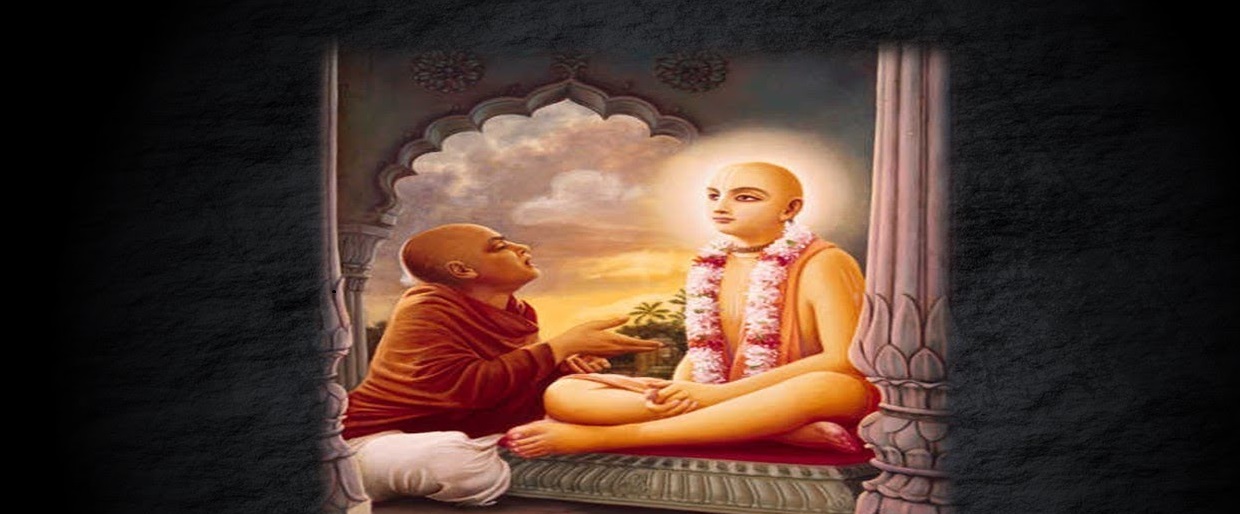
After hearing the ātmārāma verse, Sārvabhauma Bhaṭṭācārya addressed Śrī Caitanya Mahāprabhu, “My dear Sir, please explain this verse. I have a great desire to hear Your explanation of it.” (187) The Lord replied, “First let Me hear your explanation. After that, I shall try to explain what little I know.” (188) Sārvabhauma Bhaṭṭācārya then began to explain the ātmārāma verse, and according to the principles of logic, he put forward various propositions. (189) The Bhaṭṭācārya explained the ātmārāma verse in nine different ways on the basis of scripture. After hearing his explanation, Śrī Caitanya Mahāprabhu, smiling a little, began to speak. (190) Śrī Caitanya Mahāprabhu said, “My dear Bhaṭṭācārya, you are exactly like Bṛhaspati, the priest of the heavenly kingdom. Indeed, no one within this world has the power to explain the scriptures in such a way. (191) “My dear Bhaṭṭācārya, you have certainly explained this verse by the prowess of your vast learning, but you should know that, besides this scholarly explanation, there is another purport to this verse.” (192)
Upon the request of Sārvabhauma Bhaṭṭācārya, Lord Caitanya Mahāprabhu began to explain the verse, without touching upon the nine explanations given by the Bhaṭṭācārya. (193) There are eleven words in the ātmārāma verse, and Śrī Caitanya Mahāprabhu explained each word, one after the other. (194) Lord Caitanya Mahāprabhu took each word specifically and combined it with the word “ātmārāma.” He thus explained the word “ātmārāma” in eighteen different ways. (195) Śrī Caitanya Mahāprabhu said, “The Supreme Personality of Godhead, His different potencies and His transcendental qualities all have inconceivable prowess. It is not possible to explain them fully. (196) “These three items attract the mind of a perfect student engaged in spiritual activities and overcome all other processes of spiritual activity.” (197) Śrī Caitanya Mahāprabhu explained the meaning of the verse by giving evidence concerning Śukadeva Gosvāmī and the four ṛṣis Sanaka, Sanat- kumāra, Sanātana and Sanandana. Thus the Lord gave various meanings and explanations. (198)
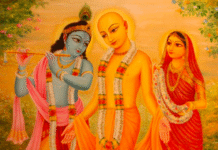
Upon hearing Caitanya Mahāprabhu’s explanation of the ātmārāma verse, Sārvabhauma Bhaṭṭācārya was struck with wonder. He then understood Lord Śrī Caitanya Mahāprabhu to be Kṛṣṇa in person, and he thus condemned himself in the following words. (199) “Caitanya Mahāprabhu is certainly Lord Kṛṣṇa Himself. Because I could not understand Him and was very proud of my own learning, I have committed many offenses.” (200) When Sārvabhauma Bhaṭṭācārya denounced himself as an offender and took shelter of the Lord, the Lord desired to show him mercy. (201) To show him mercy, Śrī Caitanya Mahāprabhu allowed him to see His Viṣṇu form. Thus He immediately assumed four hands. (202) Śrī Caitanya Mahāprabhu first showed him the four- handed form and then appeared before him in His original form of Kṛṣṇa, with a blackish complexion and a flute to His lips. (203) When Sārvabhauma Bhaṭṭācārya saw the form of Lord Kṛṣṇa manifested in Caitanya Mahāprabhu, he immediately fell down flat to offer Him obeisances. Then he stood up and with folded hands began to offer prayers. (204)
By the mercy of the Lord, all truths were revealed to Sārvabhauma Bhaṭṭācārya, and he could understand the importance of chanting the holy name and distributing love of Godhead everywhere. (205) Sārvabhauma Bhaṭṭācārya composed one hundred verses in a very short time. Indeed, not even Bṛhaspati, the priest of the heavenly planets, could compose verses as quickly. (206) After hearing the one hundred verses, Śrī Caitanya Mahāprabhu happily embraced Sārvabhauma Bhaṭṭācārya, who was immediately overwhelmed in ecstatic love of Godhead and fell unconscious. (207) Out of ecstatic love of God, the Bhaṭṭācārya shed tears, and his body was stunned. He exhibited an ecstatic mood, and he perspired, shook and trembled. He sometimes danced, sometimes chanted, sometimes cried and sometimes fell down to touch the lotus feet of the Lord. (208) While Sārvabhauma Bhaṭṭācārya was in this ecstasy, Gopīnātha Ācārya was very pleased. The associates of Śrī Caitanya Mahāprabhu all laughed to see the Bhaṭṭācārya dance so. (209)
Gopīnātha Ācārya told Lord Caitanya Mahāprabhu, “Sir, You have brought all this upon Sārvabhauma Bhaṭṭācārya.” (210) Śrī Caitanya Mahāprabhu replied, “You are a devotee. Because of your association, Lord Jagannātha has shown him mercy.” (211) After this, Śrī Caitanya Mahāprabhu pacified the Bhaṭṭācārya, and when he was quieted, he offered many prayers to the Lord. (212) Sārvabhauma Bhaṭṭācārya said, “My dear Sir, You have delivered the entire world, but that is not a very great task. However, You have also delivered me, and that is certainly the work of very wonderful powers. (213) “I had become dull- headed due to reading too many books on logic. Consequently I had become like an iron bar. Nonetheless, You have melted me, and therefore Your influence is very great.” (214) After hearing the prayers offered by Sārvabhauma Bhaṭṭācārya, Śrī Caitanya Mahāprabhu returned to His residence, and the Bhaṭṭācārya, through Gopīnātha Ācārya, induced the Lord to accept lunch there. (215)
Early the following morning, Śrī Caitanya Mahāprabhu went to see Lord Jagannātha in the temple, and He saw the Lord rise from His bed. (216) The priest there presented Him with garlands and prasādam that had been offered to Lord Jagannātha. This pleased Caitanya Mahāprabhu very much. (217) Carefully tying the prasādam and garlands in a cloth, Caitanya Mahāprabhu hastened to the house of Sārvabhauma Bhaṭṭācārya. (218) He arrived at the Bhaṭṭācārya’s house a little before sunrise, just when the Bhaṭṭācārya was arising from bed. (219) As Sārvabhauma Bhaṭṭācārya arose from bed, he distinctly chanted, “Kṛṣṇa, Kṛṣṇa.” Lord Caitanya was very pleased to hear him chant the holy name of Kṛṣṇa. (220) The Bhaṭṭācārya noticed Śrī Caitanya Mahāprabhu outside, and with great haste he went to Him and offered prayers unto His lotus feet. (221) The Bhaṭṭācārya offered a carpet for the Lord to sit upon, and both of them sat there. Then Śrī Caitanya Mahāprabhu opened the prasādam and placed it in the hands of the Bhaṭṭācārya. (222)
At that time the Bhaṭṭācārya had not even washed his mouth, nor had he taken his bath or finished his morning duties. Nonetheless, he was very pleased to receive the prasādam of Lord Jagannātha. (223) By the mercy of Śrī Caitanya Mahāprabhu, all the dullness in the mind of Sārvabhauma Bhaṭṭācārya was eradicated. After reciting the following two verses, he ate the prasādam offered to him. (224) The Bhaṭṭācārya said, “‘One should eat the mahā- prasādam of the Lord immediately upon receiving it, even though it is dried up, stale or brought from a distant country. One should consider neither time nor place. (225) “‘The prasādam of Lord Kṛṣṇa is to be eaten by gentlemen as soon as it is received; there should be no hesitation. There are no regulative principles concerning time and place. This is the order of the Supreme Personality of Godhead.’” (226) Śrī Caitanya Mahāprabhu was very pleased to see this. He became ecstatic in love of Godhead and embraced Sārvabhauma Bhaṭṭācārya. (227) The Lord and the servant embraced each other and began to dance. Simply by touching each other, they became ecstatic. (228)
Deepen your Bhakti-yoga practice, harmonize relationships, and receive guided coaching — all at Vedavarsity.com