The next day Gopīnātha Ācārya took Lord Caitanya Mahāprabhu to see the early rising of Lord Jagannātha. (67)Gopīnātha Ācārya then took Mukunda Datta with him and went to Sārvabhauma’s house. When they arrived, Sārvabhauma addressed Mukunda Datta as follows. (68) “The sannyāsī is very meek and humble by nature, and His person is very beautiful to see. Consequently my affection for Him increases. (69) “From which sampradāya has He accepted the sannyāsa order, and what is His name?” (70) Gopīnātha Ācārya replied, “The Lord’s name is Śrī Kṛṣṇa Caitanya, and His sannyāsa preceptor is the greatly fortunate Keśava Bhāratī.”(71) Sārvabhauma Bhaṭṭācārya said, “‘Śrī Kṛṣṇa’ is a very good name, but He belongs to the Bhāratī community. Therefore He is a second- class sannyāsī.” (72)
Gopīnātha Ācārya replied, “Śrī Kṛṣṇa Caitanya Mahāprabhu does not rely on any external formality. There is no need for Him to accept the sannyāsa order from a superior sampradāya.” (73) The Bhaṭṭācārya inquired, “Śrī Caitanya Mahāprabhu is in His full- fledged youthful life. How can He keep the principles of sannyāsa? (74) “I shall continually recite Vedānta philosophy before Caitanya Mahāprabhu so that He may remain fixed in His renunciation and thus enter upon the path of monism.” (75) Sārvabhauma Bhaṭṭācārya then suggested, “If Śrī Caitanya Mahāprabhu would like, I could bring Him into a first- class sampradāya by offering Him saffron cloth and performing the reformatory process again.” (76) Gopīnātha Ācārya and Mukunda Datta became very unhappy when they heard this. Gopīnātha Ācārya therefore addressed Sārvabhauma Bhaṭṭācārya as follows. (77) “My dear Bhaṭṭācārya, you do not know the greatness of Lord Caitanya Mahāprabhu. All the symptoms of the Supreme Personality of Godhead are found in Him to the highest degree.” (78)
Gopīnātha Ācārya continued, “Lord Caitanya Mahāprabhu is celebrated as the Supreme Personality of Godhead. Those who are ignorant in this connection find the conclusion of knowledgeable men very difficult to understand.” (79) The disciples of Sārvabhauma Bhaṭṭācārya retaliated, “By what evidence do you conclude that Śrī Caitanya Mahāprabhu is the Supreme Lord?” Gopīnātha Ācārya replied, “The statements of authorized ācāryas who understand the Supreme Personality of Godhead are proof.” (80) The disciples of the Bhaṭṭācārya said, “We derive knowledge of the Absolute Truth by logical hypothesis.” Gopīnātha Ācārya replied, “One cannot attain real knowledge of the Supreme Personality of Godhead by such logical hypothesis and argument.” (81) Gopīnātha Ācārya continued, “One can understand the Supreme Personality of Godhead only by His mercy, not by guesswork or hypothesis.” (82) The Ācārya continued, “If one receives but a tiny bit of the Lord’s favor by dint of devotional service, he can understand the nature of the Supreme Personality of Godhead. (83)
“‘My Lord, if one is favored by even a slight trace of the mercy of Your lotus feet, he can understand the greatness of Your personality. But those who speculate in order to understand the Supreme Personality of Godhead are unable to know You, even though they continue to study the Vedas for many years.’” (84) Gopīnātha Ācārya then addressed Sārvabhauma Bhaṭṭācārya: “You are a great scholar and a teacher of many disciples. Indeed, there is no other scholar like you on earth. Nonetheless, because you are bereft of even a pinch of the Lord’s mercy, you cannot understand Him, even though He is present in your home. (85-86) “It is not your fault; it is the verdict of the scriptures. You cannot understand the Supreme Personality of Godhead simply by scholarship.” (87) Sārvabhauma Bhaṭṭācārya replied, “My dear Gopīnātha Ācārya, please speak with great care. What is the proof that you have received the mercy of the Lord?” (88) Gopīnātha Ācārya replied, “Knowledge of the summum bonum, the Absolute Truth, is evidence of the mercy of the Supreme Lord.” (89)
Gopīnātha Ācārya continued, “You have seen the symptoms of the Supreme Personality of Godhead in the body of Śrī Caitanya Mahāprabhu during His absorption in an ecstatic mood. (90) “Despite directly perceiving the symptoms of the Supreme Lord in the body of Śrī Caitanya Mahāprabhu, you cannot understand Him. This is commonly called illusion. (91) “A person influenced by the external energy is called bahirmukha jana, a mundane person, because despite his perception, he cannot understand the real substance.” Hearing Gopīnātha Ācārya say this, Sārvabhauma Bhaṭṭācārya smiled and began to speak as follows. (92) The Bhaṭṭācārya said, “We are just having a discussion among friends and considering the points described in the scriptures. Do not become angry. I am simply speaking on the strength of the śāstras. Please don’t take any offense. (93) “Śrī Caitanya Mahāprabhu is certainly a great, uncommon devotee, but we cannot accept Him as an incarnation of Lord Viṣṇu because, according to śāstra, there is no incarnation in this Age of Kali. (94) “Another name for Lord Viṣṇu is Triyuga because there is no incarnation of Lord Viṣṇu in Kali- yuga. Indeed, this is the verdict of the revealed scriptures.” (95)
Upon hearing this, Gopīnātha Ācārya became very unhappy. He said to the Bhaṭṭācārya, “You consider yourself the knower of all Vedic scriptures. (96) “Śrīmad- Bhāgavatam and the Mahābhārata are the two most important Vedic scriptures, but you have paid no attention to their statements. (97) “In Śrīmad- Bhāgavatam and Mahābhārata it is stated that the Lord appears directly, but you say that in this age there is no manifestation or incarnation of Lord Viṣṇu. (98) “In this Age of Kali there is no līlā- avatāra of the Supreme Personality of Godhead; therefore He is known as Triyuga. That is one of His holy names.” (99) Gopīnātha Ācārya continued, “There is certainly an incarnation in every age, and such an incarnation is called the yuga- avatāra. But your heart has become so hardened by logic and argument that you cannot consider all these facts. (100) “‘In the past, your son has had bodies of three different colors, according to the age. These colors were white, red and yellow. In this age [Dvāpara- yuga] He has accepted a blackish body.’ (101)
“‘In the Age of Kali, as well as in Dvāpara- yuga, the people offer prayers to the Supreme Personality of Godhead by various mantras and observe the regulative principles of the supplementary Vedic literatures. Now please hear of this from me. (102) “‘In this Age of Kali, those who are intelligent perform the congregational chanting of the Hare Kṛṣṇa mahā- mantra, worshiping the Supreme Personality of Godhead, who appears in this age always describing the glories of Kṛṣṇa. That incarnation is yellowish in hue and is always associated with His plenary expansions [such as Śrī Nityānanda Prabhu] and personal expansions [such as Gadādhara], as well as His devotees and associates [such as Svarūpa Dāmodara].’ (103) “‘The Lord [in the incarnation of Gaurasundara] has a golden complexion. Indeed, His entire body, which is very nicely constituted, is like molten gold. Sandalwood pulp is smeared all over His body. He will take the fourth order of spiritual life [sannyāsa] and will be very much self- controlled. He will be distinguished from Māyāvādī sannyāsīs in that He will be fixed in devotional service and will spread the saṅkīrtana movement.’” (104)
Gopīnātha Ācārya then said, “There is no need to quote so much evidence from the śāstras, for you are a very dry speculator. There is no need to sow seeds in barren land. (105) “When the Lord will be pleased with you, you will also understand these conclusions and will quote from the śāstras. (106) “The false arguments and philosophical word jugglery of your disciples are not faults of theirs. They have simply received the benediction of Māyāvāda philosophy. (107) “‘I offer my respectful obeisances unto the Supreme Personality of Godhead, who is full of unlimited qualities and whose different potencies bring about agreement and disagreement between disputants. Thus the illusory energy again and again covers the self- realization of both disputants.’ (108) “‘In almost all cases, whatever learned brāhmaṇas speak becomes accepted; nothing is impossible for one who takes shelter of My illusory energy and speaks under her influence.’” (109) After hearing this from Gopīnātha Ācārya, Sārvabhauma Bhaṭṭācārya said, “First go to the place where Śrī Caitanya Mahāprabhu is staying and invite Him here with His associates. Ask Him on my account. (110)
“Take jagannātha- prasādam and first give it to Caitanya Mahāprabhu and His associates. After that, come back here and teach me well.” (111) Gopīnātha Ācārya was the brother- in- law of Sārvabhauma Bhaṭṭācārya; therefore their relationship was very sweet and intimate. Under the circumstances, Gopīnātha Ācārya taught him by sometimes blaspheming him, sometimes praising him and sometimes laughing at him. This had been going on for some time. (112) Śrīla Mukunda Datta felt very satisfied to hear the conclusive statements of Gopīnātha Ācārya, but he became very unhappy and angry to hear the statements put forward by Sārvabhauma Bhaṭṭācārya. (113) According to the instructions of Sārvabhauma Bhaṭṭācārya, Gopīnātha Ācārya went to Śrī Caitanya Mahāprabhu and invited Him on the Bhaṭṭācārya’s behalf. (114) The Bhaṭṭācārya’s statements were discussed before Śrī Caitanya Mahāprabhu. Gopīnātha Ācārya and Mukunda Datta disapproved of the Bhaṭṭācārya’s statements because they caused mental pain. (115)
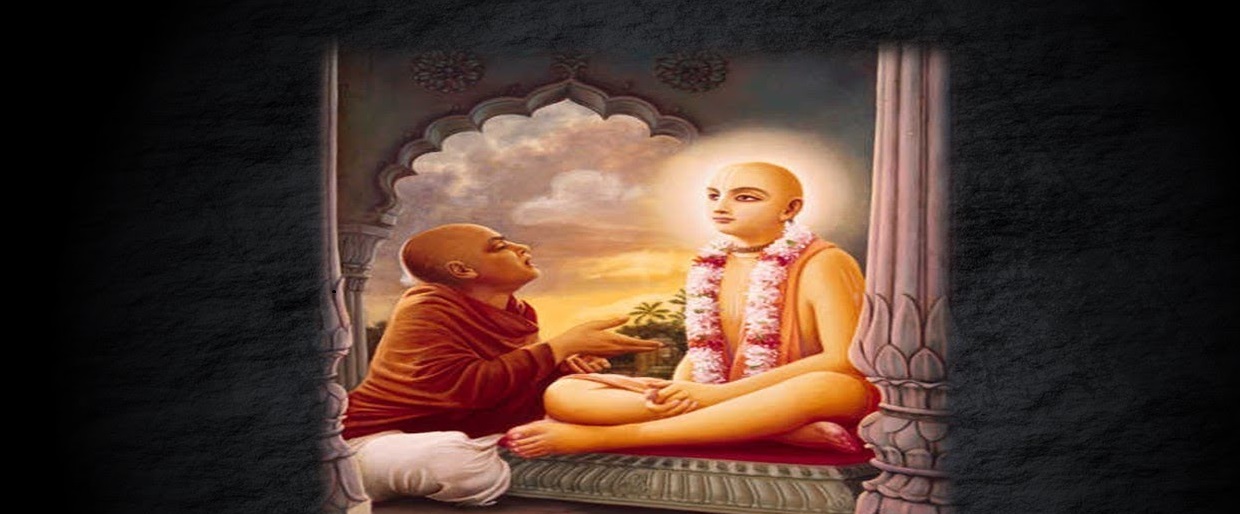
Hearing this, Śrī Caitanya Mahāprabhu said, “Do not speak like that. Sārvabhauma Bhaṭṭācārya has shown great affection and mercy toward Me. (116) “Out of paternal affection for Me, he wants to protect Me and see that I follow the regulative principles of a sannyāsī. What fault is there in this?” (117) The next morning, Śrī Caitanya Mahāprabhu and Sārvabhauma Bhaṭṭācārya together visited the temple of Lord Jagannātha. Both of them were in a very pleasant mood. (118) When they entered the temple, Sārvabhauma Bhaṭṭācārya offered Caitanya Mahāprabhu a seat, while he himself sat down on the floor out of due respect for a sannyāsī. (119) He then began to instruct Lord Caitanya Mahāprabhu on Vedānta philosophy, and out of affection and devotion, he spoke to the Lord as follows. (120)
Deepen your Bhakti-yoga practice, harmonize relationships, and receive guided coaching — all at Vedavarsity.com