He said, “My Lord, You are the protector of brahminical culture, and You are also very merciful. Therefore, kindly show Your great mercy by protecting the religious principles of us two brāhmaṇas. (88) “My dear Lord, I am not thinking to become happy by getting the daughter as a bride. I am simply thinking that the brāhmaṇa has broken his promise, and that is giving me great pain.” (89) The young brāhmaṇa continued, “My dear Sir, You are very merciful and You know everything. Therefore, kindly be a witness in this case. A person who knows things as they are and still does not bear witness becomes involved in sinful activities.” (90) Lord Kṛṣṇa replied, “My dear brāhmaṇa, go back to your home and call a meeting of all the men. In that meeting, just try to remember Me. (91)
“I shall certainly appear there, and at that time I shall protect the honor of both you brāhmaṇas by bearing witness to the promise.” (92) The young brāhmaṇa replied, “My dear sir, even if You appear there as a four- handed Viṣṇu Deity, still, none of those people will believe in Your words. (93) “Only if You go there in this form of Gopāla and speak the words from Your beautiful face will Your testimony be heard by all the people.” (94) Lord Kṛṣṇa said, “I’ve never heard of a Deity’s walking from one place to another.” The brāhmaṇa replied, “That is true, but how is it that You are speaking to me, although You are a Deity? (95) “My dear Lord, You are not a statue; You are directly the son of Mahārāja Nanda. Now, for the sake of the old brāhmaṇa, You can do something You have never done before.” (96) Śrī Gopālajī then smiled and said, “My dear brāhmaṇa, just listen to Me. I shall walk behind you, and in this way I shall go with you.” (97) The Lord continued, “Do not try to see Me by turning around. As soon as you see Me, I shall remain stationary in that very place. (98)
“You will know that I am walking behind you by the sound of My ankle bells. (99) “Cook one kilogram of rice daily and offer it. I shall eat that rice and follow behind you.” (100) The next day, the brāhmaṇa begged permission from Gopāla and started for his country. Gopāla followed him, step by step. (101) While Gopāla followed the young brāhmaṇa, the tinkling sound of His ankle bells could be heard. The brāhmaṇa became very pleased, and he cooked first- class rice for Gopāla to eat. (102) The young brāhmaṇa walked and walked in this way until he eventually arrived in his own country. When he neared his own village, he began to think as follows. (103) “I have now come to my village, and I shall go to my home and tell all the people that the witness has arrived.” (104)
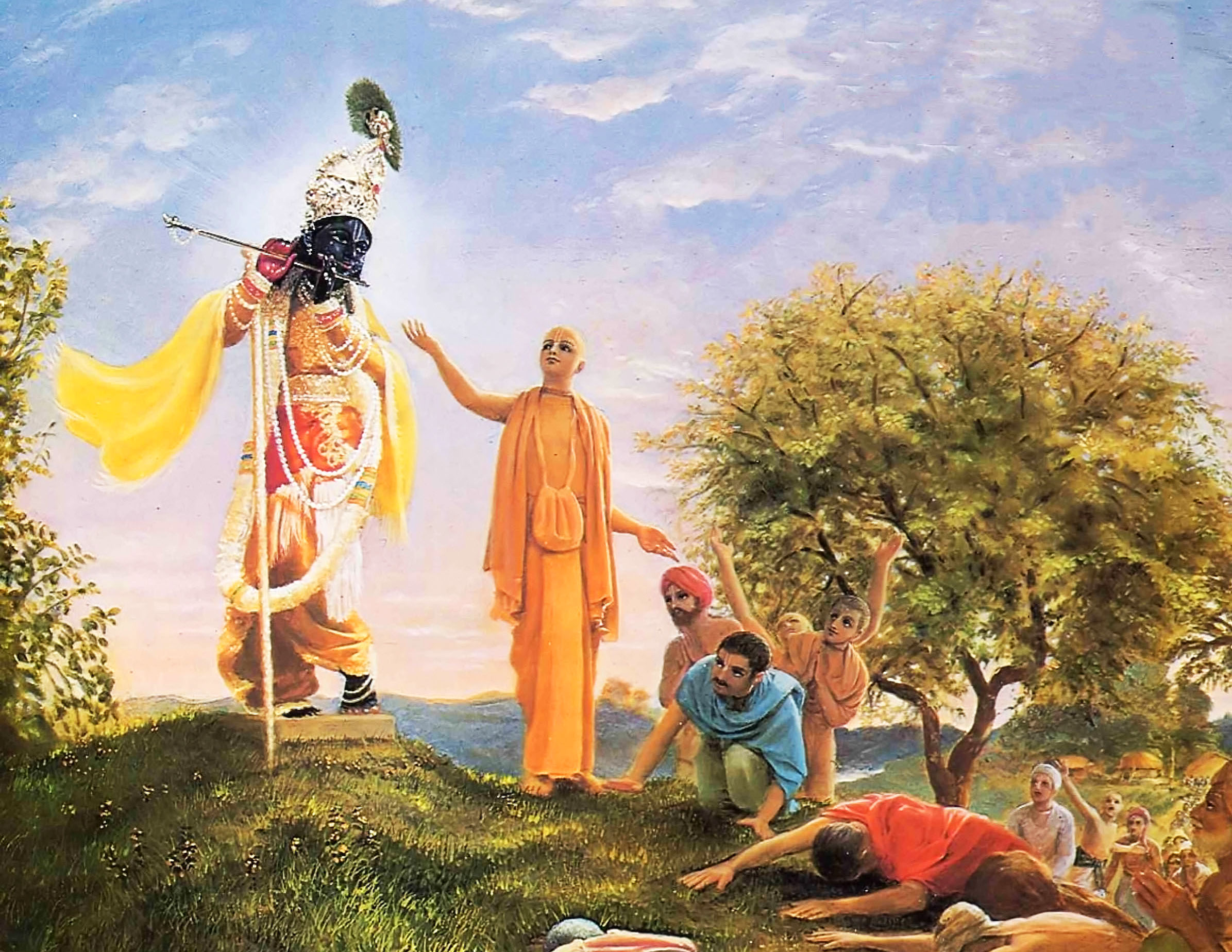
The brāhmaṇa then began to think that if the people didn’t directly see the Gopāla Deity, they would not believe that He had arrived. “But even if Gopāla stays here,” he thought, “there is still nothing to fear.” (105) Thinking this, the brāhmaṇa turned to look back, and He saw that Gopāla, the Supreme Personality of Godhead, was standing there smiling. (106) The Lord told the brāhmaṇa, “Now you can go home. I shall stay here and shall not leave.” (107) The young brāhmaṇa then went to the town and informed all the people about Gopāla’s arrival. Hearing this, the people were struck with wonder. (108) All the townspeople went to see the witness Gopāla, and when they saw the Lord actually standing there, they all offered their respectful obeisances. (109) When the people arrived, they were very pleased to see the beauty of Gopāla, and when they heard that He had actually walked there, they were all surprised. (110) Then the elderly brāhmaṇa, being very pleased, came forward and immediately fell like a stick in front of Gopāla. (111)
Thus in the presence of all the townspeople, Lord Gopāla bore witness that the elderly brāhmaṇa had offered his daughter in charity to the young brāhmaṇa. (112) After the marriage ceremony was performed, the Lord informed both brāhmaṇas, “You two brāhmaṇas are My eternal servants, birth after birth.” (113) The Lord continued, “I have become very much pleased by the truthfulness of you both. Now you can ask for a benediction.” Thus with great pleasure the two brāhmaṇas begged for a benediction. (114) The brāhmaṇas said, “Please remain here so that people all over the world will know how merciful You are to Your servants.” (115) Lord Gopāla stayed, and the two brāhmaṇas engaged in His service. After hearing of the incident, many people from different countries began to come to see Gopāla. (116) Eventually the King of that country heard this wonderful story, and he also came to see Gopāla and thus became very satisfied. (117)
The King constructed a nice temple, and regular service was executed. Gopāla became very famous under the name of Sākṣi- gopāla [the witness Gopāla]. (118) Thus Sākṣi- gopāla stayed in Vidyānagara and accepted service for a very long time. (119) Later there was a fight, and this country was conquered by King Puruṣottama- deva of Orissa. (120) That King was victorious over the King of Vidyānagara, and he took possession of his throne, the Māṇikya- siṁhāsana, which was bedecked with many jewels. (121) King Puruṣottama- deva was a great devotee and was advanced in the civilization of the Āryans. He begged at the lotus feet of Gopāla, “Please come to my kingdom.” (122) When the King begged Him to come to his kingdom, Gopāla, who was already obliged for his devotional service, accepted his prayer. Thus the King took the Gopāla Deity and went back to Kaṭaka. (123)
After winning the Māṇikya throne, King Puruṣottama- deva took it to Jagannātha Purī and presented it to Lord Jagannātha. In the meantime, he also established regular worship of the Gopāla Deity at Kaṭaka. (124) When the Gopāla Deity was installed at Kaṭaka, the Queen of Puruṣottama- deva went to see Him and, with great devotion, presented various kinds of ornaments. (125) The Queen had a very valuable pearl, which she wore on her nose, and she wished to give it to Gopāla. She then began to think as follows. (126) “If there were a hole in the Deity’s nose, I could transfer the pearl to Him.” (127) Considering this, the Queen offered her obeisances to Gopāla and returned to her palace. That night she dreamed that Gopāla appeared and began to speak to her as follows. (128) “During My childhood My mother made a hole in My nose and with great endeavor set a pearl there. (129)
“That very hole is still there, and you can use it to set the pearl you desired to give Me.” (130) After dreaming this, the Queen explained it to her husband, the King. Both the King and the Queen then went to the temple with the pearl. (131) Seeing the hole in the nose of the Deity, they set the pearl there and, being very pleased, held a great festival. (132) Since then, Gopāla has been situated in the city of Kaṭaka [Cuttak], and He has been known ever since as Sākṣi- gopāla. (133) Thus Śrī Caitanya Mahāprabhu heard the narration of Gopāla’s activities. Both He and His personal devotees became very pleased. (134) When Śrī Caitanya Mahāprabhu was sitting before the Gopāla Deity, all the devotees saw Him and the Deity as being of the same form. (135) They were of the same complexion, and both had gigantic bodies. Both wore saffron cloth, and both were very grave. (136)
The devotees saw that both Lord Caitanya Mahāprabhu and Gopāla were brilliantly effulgent and had eyes like lotuses. They were both absorbed in ecstasy, and both Their faces resembled full moons. (137) When Nityānanda saw the Gopāla Deity and Śrī Caitanya Mahāprabhu in that way, He began to exchange remarks with the devotees, all of whom were smiling. (138) Thus with great pleasure Lord Śrī Caitanya Mahāprabhu passed that night in the temple. After seeing the maṅgala- ārati ceremony in the morning, He started on His journey. (139) [In his book Caitanya- bhāgavata] Śrīla Vṛndāvana dāsa Ṭhākura has very vividly described the places visited by the Lord on the way to Bhuvaneśvara. (140) When Śrī Caitanya Mahāprabhu arrived at Kamalapura, He took His bath in the Bhārgīnadī River and left His sannyāsa staff in the hands of Lord Nityānanda. (141) When Lord Caitanya Mahāprabhu went to the temple of Lord Śiva known as Kapoteśvara, Nityānanda Prabhu, who was keeping His sannyāsa staff in custody, broke the staff in three parts and threw it into the river Bhārgīnadī. Later this river became known as Daṇḍa- bhāṅgā- nadī. (142-143)
After seeing the temple of Jagannātha from a distant place, Śrī Caitanya Mahāprabhu immediately became ecstatic. After offering obeisances to the temple, He began to dance in the ecstasy of love of God. (144) All the devotees became ecstatic in the association of Lord Caitanya, and thus absorbed in love of God, they were dancing and singing while going along the main road. (145) Śrī Caitanya Mahāprabhu laughed, cried, danced and made many ecstatic vibrations and sounds. Although the temple was only six miles away, to Him the distance seemed thousands of miles. (146) Thus walking and walking, the Lord eventually arrived at the place known as Āṭhāranālā. Arriving there, He expressed His external consciousness, speaking to Śrī Nityānanda Prabhu. (147) When Lord Caitanya Mahāprabhu had thus regained external consciousness, He asked Lord Nityānanda Prabhu, “Please return My staff.” Nityānanda Prabhu then replied, “It has been broken into three parts.” (148) Nityānanda Prabhu said, “When You fell down in ecstasy, I caught You, but both of Us together fell upon the staff. (149) “Thus the staff broke under Our weight. Where the pieces have gone, I cannot say. (150)
“It is certainly because of My offense that Your staff was broken. Now You can punish Me on this account as You think proper.”(151) After hearing the story about how His staff had been broken, the Lord expressed a little sadness and, displaying a bit of anger, began to speak as follows. (152) Caitanya Mahāprabhu said, “You have all benefited Me by bringing Me to Nīlācala. However, My only possession was that one staff, and you have not kept it. (153) “So all of you should go before or behind Me to see Lord Jagannātha. I shall not go with you.” (154) Mukunda Datta told Śrī Caitanya Mahāprabhu, “My Lord, You should go ahead and allow all the others to follow. We shall not go with You.” (155) Śrī Caitanya Mahāprabhu then began to walk very swiftly before all the other devotees. No one could understand the real purpose of the two Lords, Caitanya Mahāprabhu and Nityānanda Prabhu. (156)
The devotees could not understand why Nityānanda Prabhu broke the staff, why Śrī Caitanya Mahāprabhu permitted Him to do so, or why, after permitting Him, Caitanya Mahāprabhu became angry. (157) The pastime of the breaking of the staff is very deep. Only one whose devotion is fixed upon the lotus feet of the two Lords can understand it. (158) The glories of Lord Gopāla, who is merciful to brāhmaṇas, are very great. The narration of Sākṣi- gopāla was spoken by Nityānanda Prabhu and heard by Śrī Caitanya Mahāprabhu. (159) One who hears this narration of Lord Gopāla with faith and love very soon attains the lotus feet of Lord Gopāla.(160) Praying at the lotus feet of Śrī Rūpa and Śrī Raghunātha, always desiring their mercy, I, Kṛṣṇadāsa, narrate Śrī Caitanya- caritāmṛta, following in their footsteps. (161)
Deepen your Bhakti-yoga practice, harmonize relationships, and receive guided coaching — all at Vedavarsity.com