


I offer my respectful obeisances unto the Supreme Personality of God [brahmaṇya- deva], who appeared as Sākṣi- gopāla to benefit a brāhmaṇa. For one hundred days He traveled through the country, walking on His own legs. Thus His activities are wonderful. (1) All glories to Lord Śrī Caitanya Mahāprabhu! All glories to Lord Nityānanda Prabhu! All glories to Śrī Advaita Prabhu! And all glories to all the devotees of Śrī Caitanya Mahāprabhu! (2) Walking and walking, Śrī Caitanya Mahāprabhu and His party finally arrived at Yājapura, on the river Vaitaraṇī. There He saw the temple of Varāhadeva and offered His obeisances unto Him. (3) In the temple of Varāhadeva, Śrī Caitanya Mahāprabhu engaged in chanting and dancing and offered prayers. He passed that night in the temple. (4)
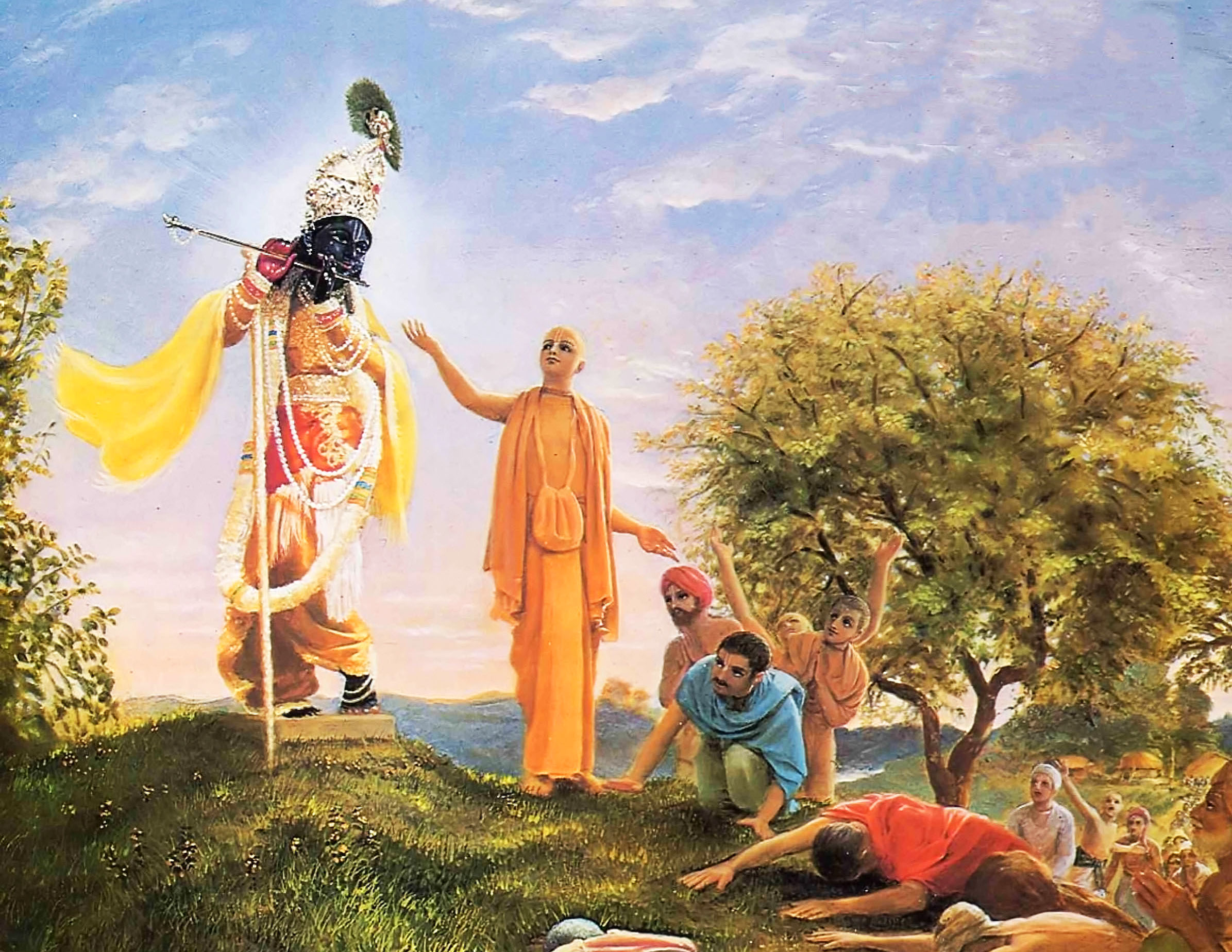
Afterwards, Śrī Caitanya Mahāprabhu went to the town of Kaṭaka to see the temple of the witness Gopāla. When He saw the Deity of Gopāla, He was very much pleased by His beauty. (5) While there, Śrī Caitanya Mahāprabhu engaged in chanting and dancing for some time, and being overwhelmed, He offered many prayers to Gopāla. (6) That night Śrī Caitanya Mahāprabhu stayed in the temple of Gopāla, and along with all the devotees, He heard the narration of the witness Gopāla with great pleasure. (7) Previously, when Nityānanda Prabhu had toured all over India to see different places of pilgrimage, He also had come to see Sākṣi- gopāla at Kaṭaka. (8) At that time, Nityānanda Prabhu had heard the story of Sākṣi- gopāla from the townspeople. He now recited this again, and Lord Caitanya Mahāprabhu heard the narration with great pleasure. (9)
Formerly at Vidyānagara in South India there were two brāhmaṇas who made a long tour to see different places of pilgrimage. (10) First of all they visited Gayā, then Kāśī, then Prayāga. Finally, with great pleasure, they came to Mathurā. (11) After reaching Mathurā, they started visiting the different forests of Vṛndāvana and came to Govardhana Hill. They visited all twelve forests [vanas] and at last came to the town of Vṛndāvana. (12) In the village of Pañcakrośī Vṛndāvana, at the site where the Govinda temple is now situated, there was a great temple where gorgeous worship of Gopāla was performed. (13) After taking baths at different bathing places along the river Yamunā, such as Keśī- ghāṭa and Kāliya- ghāṭa, the pilgrims visited the temple of Gopāla. Afterwards, they took rest in that temple. (14) The beauty of the Gopāla Deity stole away their minds, and feeling great happiness, they remained there for two or four days. (15)
One of the two brāhmaṇas was an old man, and the other was young. The young man was assisting the old one. (16) Indeed, the young brāhmaṇa always rendered service to the older one, and the old man, being very satisfied with his service, was pleased with him. (17) The older man told the younger, “You have rendered various types of service to me. You have assisted me in traveling to all these places of pilgrimage. (18) “Even my own son does not render such service. By your mercy, I did not become fatigued while on this tour. (19) “If I did not show you any respect, I would be ungrateful. Therefore, I promise to give you my daughter in charity.” (20) The younger brāhmaṇa replied, “My dear sir, please hear me. You are saying something very unusual. Such a thing never happens. (21) “You are a most aristocratic family man, well educated and very rich. I am not at all aristocratic, and I am without a decent education and have no wealth. (22)
“Sir, I am not a suitable bridegroom for your daughter. I render service to you only for the satisfaction of Kṛṣṇa. (23) “Lord Kṛṣṇa is very much pleased by service rendered to brāhmaṇas, and when the Lord is pleased, the opulence of one’s devotional service increases.” (24) The older brāhmaṇa replied, “My dear boy, do not doubt me. I will give you my daughter in charity. I have already decided this.” (25) The young brāhmaṇa said, “You have a wife and sons, and you have a large circle of relatives and friends. (26) “Without the consent of all your friends and relatives, it is not possible to give me your daughter in charity. Just consider the story of Queen Rukmiṇī and her father, Bhīṣmaka. (27) “King Bhīṣmaka wanted to give his daughter, Rukmiṇī, in charity to Kṛṣṇa, but Rukmī, his eldest son, objected. Therefore he could not carry out his decision.” (28)
The elderly brāhmaṇa said, “My daughter is my own property. If I choose to give my property to someone, who has the power to stop me? (29) “My dear boy, I will give my daughter to you in charity, and I will neglect the position of all others. Don’t doubt me in this regard; just accept my proposal.” (30) The younger brāhmaṇa replied, “If you have decided to give your young daughter to me, then say so before the Gopāla Deity.” (31) Coming before Gopāla, the elderly brāhmaṇa said, “My dear Lord, please witness that I have given my daughter to this boy.” (32) Then the younger brāhmaṇa addressed the Deity, saying, “My dear Lord, You are my witness. I shall call for You to testify if it is necessary later on.” (33) After these talks, the two brāhmaṇas started for home. As usual, the young brāhmaṇa accompanied the elderly brāhmaṇa as if the older brāhmaṇa were a guru [spiritual master] and rendered him service in various ways. (34)
After returning to Vidyānagara, each brāhmaṇa went to his respective home. After some time, the elderly brāhmaṇa became very anxious. (35) He began to think, “I have given my word to a brāhmaṇa in a holy place, and what I promised will certainly come to pass. I must now disclose this to my wife, sons, other relatives and friends.” (36) Thus one day the elderly brāhmaṇa called for a meeting of all his relatives and friends, and before them all he narrated what had taken place in front of Gopāla. (37) When those who belonged to the family circle heard the narration of the old brāhmaṇa, they made exclamations showing their disappointment. They all requested that he not make such a proposal again. (38) They unanimously agreed, “If you offer your daughter to a degraded family, your aristocracy will be lost. When people hear of this, they will make jokes and laugh at you.” (39) The elderly brāhmaṇa said, “How can I undo the promise I made in a holy place while on pilgrimage? Whatever may happen, I must give him my daughter in charity.” (40)
The relatives unanimously said, “If you give your daughter to that boy, we shall give up all connection with you.” Indeed, his wife and sons declared, “If such a thing happens, we shall take poison and die.” (41) The elderly brāhmaṇa said, “If I do not give my daughter to the young brāhmaṇa, he will call Śrī Gopālajī as a witness. Thus he will take my daughter by force, and in that case my religious principles will become meaningless.” (42) His son replied, “The Deity may be a witness, but He is in a distant country. How can He come to bear witness against you? Why are you so anxious over this? (43) “You do not have to flatly deny that you spoke such a thing. There is no need to make a false statement. Simply say that you do not remember what you said. (44) “If you simply say, ‘I do not remember,’ I shall take care of the rest. By argument, I shall defeat the young brāhmaṇa.” (45) When the elderly brāhmaṇa heard this, his mind became very much agitated. Feeling helpless, he simply turned his attention to the lotus feet of Gopāla. (46)
The elderly brāhmaṇa prayed, “My dear Lord Gopāla, I have taken shelter of Your lotus feet, and therefore I request You to please protect my religious principles from disturbance and at the same time save my kinsmen from dying.” (47) The next day, the elderly brāhmaṇa was thinking deeply about this matter when the young brāhmaṇa came to his house. (48) The young brāhmaṇa came to him and offered respectful obeisances. Then, very humbly folding his hands, he spoke as follows. (49) “You have promised to give your daughter in charity to me. Now you do not say anything. What is your conclusion?” (50) After the young brāhmaṇa submitted this statement, the elderly brāhmaṇa remained silent. Taking this opportunity, his son immediately came out with a stick to strike the younger man. (51) The son said, “Oh, you are most degraded! You want to marry my sister, just like a dwarf who wants to catch the moon!” (52)
Seeing a stick in the hand of the son, the younger brāhmaṇa fled. The next day, however, he gathered together all the people of the village. (53) All the people of the village then called for the elderly brāhmaṇa and brought him to their meeting place. The young brāhmaṇa then began to speak before them as follows. (54) “This gentleman has promised to hand over his daughter to me, yet now he does not follow his promise. Please ask him about his behavior.” (55) All the people gathered there asked the elderly brāhmaṇa, “If you have already promised to give him your daughter in charity, why are you not fulfilling your promise? You have given your word of honor.” (56) The elderly brāhmaṇa said, “My dear friends, please hear what I have to submit. I do not exactly remember making a promise like that.” (57)
Deepen your Bhakti-yoga practice, harmonize relationships, and receive guided coaching — all at Vedavarsity.com