After accepting the sannyāsa order of life, Lord Caitanya Mahāprabhu, out of intense love for Kṛṣṇa, wanted to go to Vṛndāvana, but apparently by mistake He wandered in the Rāḍha- deśa. Later He arrived at Śāntipura and enjoyed Himself there with His devotees. I offer my respectful obeisances to Śrī Caitanya Mahāprabhu. (1) All glories to Śrī Caitanya Mahāprabhu! All glories to Nityānanda! All glories to Advaita Prabhu! And all glories to all the devotees of Lord Caitanya, headed by Śrīvāsa! (2) At the end of His twenty- fourth year, in the month of Māgha, Śrī Caitanya Mahāprabhu accepted the sannyāsa order during the waxing period of the moon. (3)
After accepting the sannyāsa order, Caitanya Mahāprabhu, out of intense love for Kṛṣṇa, started for Vṛndāvana. However, He mistakenly wandered about in a trance continuously for three days in the tract of land known as Rāḍha- deśa. (4) Passing through the tract of land known as Rāḍha- deśa, Śrī Caitanya Mahāprabhu recited the following verse in ecstasy. (5) “[As a brāhmaṇa from Avantī- deśa said:] ‘I shall cross over the insurmountable ocean of nescience by being firmly fixed in the service of the lotus feet of Kṛṣṇa. This was approved by the previous ācāryas, who were fixed in firm devotion to the Lord, Paramātmā, the Supreme Personality of Godhead.’” (6) Śrī Caitanya Mahāprabhu approved the purport of this verse on account of the determination of the mendicant devotee to engage in the service of Lord Mukunda. He gave His approval of this verse, indicating that it was very good. (7)
The real purpose of accepting sannyāsa is to dedicate oneself to the service of Mukunda. By serving Mukunda, one can actually be liberated from the bondage of material existence. (8) After accepting the sannyāsa order, Śrī Caitanya Mahāprabhu decided to go to Vṛndāvana and engage Himself wholly and solely in the service of Mukunda in a solitary place. (9) As Śrī Caitanya Mahāprabhu was en route to Vṛndāvana, all the ecstatic symptoms became manifest, and He did not know in which direction He was going, nor did He know whether it was day or night. (10) When Śrī Caitanya Mahāprabhu went toward Vṛndāvana, Nityānanda Prabhu, Candraśekhara and Prabhu Mukunda followed Him. (11) When Śrī Caitanya Mahāprabhu passed through Rāḍha- deśa, whoever saw Him in ecstasy exclaimed, “Hari! Hari!” As they chanted this with the Lord, all the unhappiness of material existence diminished. (12)
All the cowherd boys who saw Śrī Caitanya Mahāprabhu passing joined with Him and began to shout loudly, “Hari! Hari!” (13) When He heard all the cowherd boys also chanting “Hari! Hari!” Śrī Caitanya Mahāprabhu was very pleased. He approached them, put His hand on their heads and said, “Go on chanting like that.” (14) Śrī Caitanya Mahāprabhu thus blessed them all, saying that they were all fortunate. In this way He praised them, and He felt very successful because they chanted the holy name of Lord Hari. (15) Calling all the boys in confidence and telling a reasonable story, Nityānanda Prabhu instructed them as follows. (16) “If Śrī Caitanya Mahāprabhu asks you about the path to Vṛndāvana, please show Him the path on the bank of the Ganges instead.” (17)
When the cowherd boys were questioned by Lord Caitanya Mahāprabhu about the path to Vṛndāvana, the boys showed Him the path on the bank of the Ganges, and the Lord went that way in ecstasy. (18-19) As the Lord proceeded along the bank of the Ganges, Śrī Nityānanda Prabhu requested Ācāryaratna [Candraśekhara Ācārya] to go immediately to the house of Advaita Ācārya. (20) Śrī Nityānanda Gosvāmī told him, “I shall take Śrī Caitanya Mahāprabhu to the bank of the Ganges at Śāntipura, and Advaita Ācārya should carefully stay there on shore with a boat. (21) “After that,” Nityānanda Prabhu continued, “I shall go to Advaita Ācārya’s house, and you should go to Navadvīpa and return with mother Śacī and all the other devotees.” (22) After sending Ācāryaratna to the house of Advaita Ācārya, Śrī Nityānanda Prabhu went before Lord Caitanya Mahāprabhu and gave notice of His coming. (23)
Śrī Caitanya Mahāprabhu was in ecstasy, and He asked where Nityānanda Prabhu was going. Nityānanda replied that He was going with Him toward Vṛndāvana. (24) When the Lord asked Nityānanda Prabhu how far it was to Vṛndāvana, Nityānanda replied, “Just see! Here is the river Yamunā.” (25) Saying this, Nityānanda Prabhu took Caitanya Mahāprabhu near the Ganges, and the Lord, in His ecstasy, accepted the river Ganges as the river Yamunā. (26) The Lord said, “Oh, what good fortune! Now I have seen the river Yamunā.” Thus thinking the Ganges to be the river Yamunā, Caitanya Mahāprabhu began to offer prayers to it. (27) “O river Yamunā, you are the blissful spiritual water that gives love to the son of Nanda Mahārāja. You are the same as the water of the spiritual world, for you can vanquish all our offenses and the sinful reactions incurred in life. You are the creator of all auspicious things for the world. O daughter of the sun- god, kindly purify us by your pious activities.” (28) After reciting this mantra, Śrī Caitanya Mahāprabhu offered obeisances and took His bath in the Ganges. At that time He had on only one piece of underwear, for there was no second garment. (29)
While Śrī Caitanya Mahāprabhu was standing there without a second garment, Śrī Advaita Ācārya arrived in a boat, bringing with Him new underwear and external garments. (30) When Advaita Ācārya arrived, He stood before the Lord and offered His obeisances. After seeing Him, the Lord began to wonder about the entire situation. (31) Still in His ecstasy, the Lord asked Advaita Ācārya, “Why did You come here? How did You know that I was in Vṛndāvana?” (32) Advaita Ācārya disclosed the whole situation, telling Śrī Caitanya Mahāprabhu, “Wherever You are, that is Vṛndāvana. Now it is My great fortune that You have come to the bank of the Ganges.” (33) Śrī Caitanya Mahāprabhu then said, “Nityānanda has cheated Me. He has brought Me to the bank of the Ganges and told Me that it was the Yamunā.” (34) When Śrī Caitanya Mahāprabhu accused Nityānanda of cheating Him, Śrīla Advaita Ācārya said, “Whatever Nityānanda Prabhu has told You is not false. You have indeed just now taken Your bath in the river Yamunā.” (35)
Advaita Ācārya then explained that at that spot the Ganges and Yamunā flow together. On the western side was the Yamunā, and on the eastern side was the Ganges. (36) Advaita Ācārya then suggested that since Caitanya Mahāprabhu had taken His bath in the river Yamunā and His underwear was now wet, the Lord should change His underwear for dry garments. (37) Advaita Ācārya said, “You have been fasting continuously for three days in Your ecstasy of love for Kṛṣṇa. I therefore invite You to My home, where You may kindly take Your alms. Come with Me to My residence.” (38) Advaita Prabhu continued, “At My home I have just cooked one palmful of rice. The vegetables are always very simple. There is no luxurious cooking—simply a little liquid vegetable and spinach.” (39)
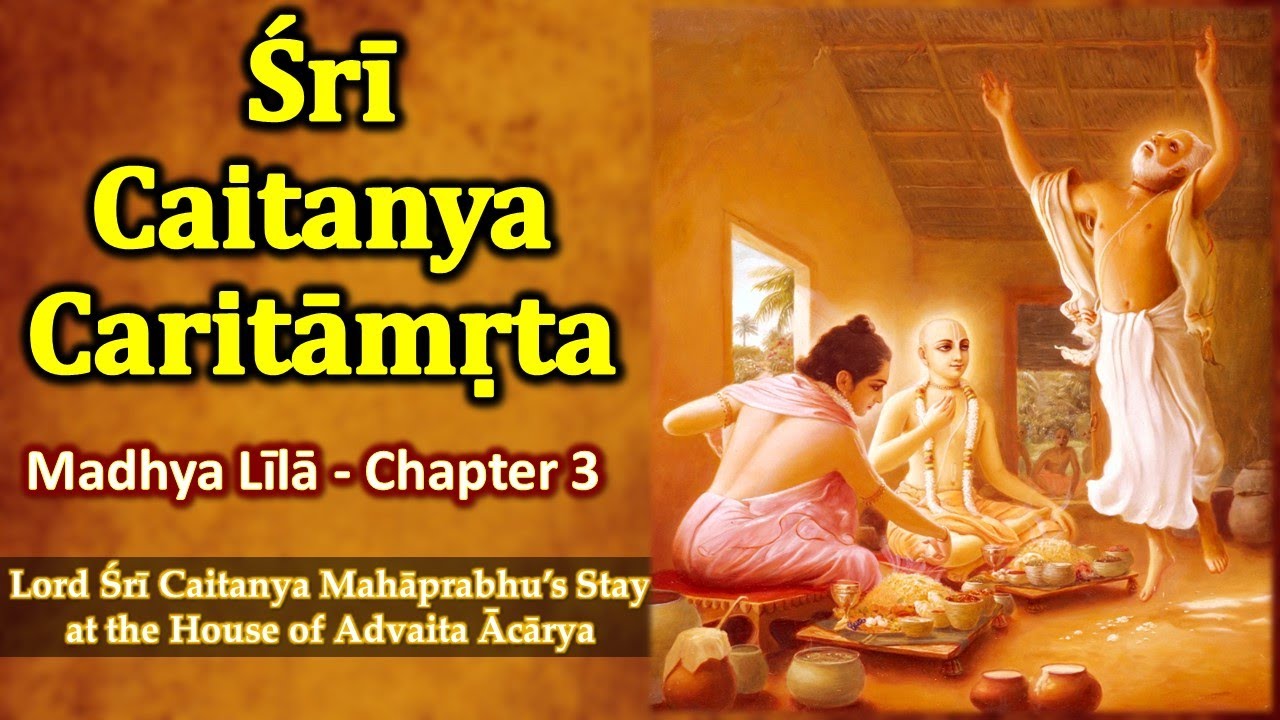
Saying this, Śrī Advaita Ācārya took the Lord into the boat and brought the Lord to His residence. There Advaita Ācārya washed the feet of the Lord and was consequently very happy within. (40) All the eatables were first cooked by the wife of Advaita Ācārya. Then Śrīla Advaita Ācārya personally offered everything to Lord Viṣṇu. (41) All the prepared food was divided into three equal parts. One part was arranged on a metal plate for offering to Lord Kṛṣṇa. (42) Of the three divisions, one was arranged on a metal plate, and the other two were arranged on plantain leaves. These leaves were not bifurcated, and they were taken from a banana tree that held at least thirty- two bunches of bananas. The two plates were filled very nicely with the kinds of food described below. (43) The cooked rice was a stack of very fine grains nicely cooked, and in the middle was yellow clarified butter from the milk of cows. Surrounding the stack of rice were pots made of the skins of banana trees, and in these pots were varieties of vegetables and mung dhal. (44)
Among the cooked vegetables were paṭolas, squash, mānakacu and a salad made with pieces of ginger and various types of spinach. (45) There was sukhta, bitter melon mixed with all kinds of vegetables, defying the taste of nectar. There were five types of bitter and pungent sukhtas. (46) Amongst the various vegetables were newly grown leaves of nimba trees fried with eggplant. The fruit known as paṭola was fried with phulabaḍi, a kind of dhal preparation first mashed and then dried in the sun. There was also a preparation known as kuṣmāṇḍa- mānacāki. (47) The preparation made with coconut pulp mixed with curd and rock candy was very sweet. There was a curry made of banana flowers and squash boiled in milk, all in great quantity. (48) There were small cakes in sweet and sour sauce and five or six kinds of sour preparations. All the vegetables were so made that everyone present could take prasādam. (49)
There were soft cakes made with mung dhal, soft cakes made with ripe bananas, and soft cakes made with urad dhal. There were various kinds of sweetmeats, condensed milk mixed with rice cakes, a coconut preparation and every kind of cake desirable. (50) All the vegetables were served in pots made of banana leaves taken from trees producing at least thirty- two bunches of bananas. These pots were very strong and big and did not tilt or totter. (51) All around the three eating places were a hundred pots filled with various kinds of vegetables. (52)
Along with the various vegetables was sweet rice mixed with ghee. This was kept in new earthen pots. Earthen pots filled with highly condensed milk were placed in three places. (53) Besides the other preparations, there were chipped rice made with milk and mixed with bananas, and also white squash boiled in milk. Indeed, it is not possible to describe all the preparations that were made. (54) In two places there were earthen pots filled with another preparation made with yogurt, sandeśa [a sweetmeat made with curd] and banana. I am unable to describe it all. (55) Upon the stack of boiled rice and all the vegetables were flowers of the tulasī trees. There were also pots filled with scented rosewater. (56)
Deepen your Bhakti-yoga practice, harmonize relationships, and receive guided coaching — all at Vedavarsity.com