


“Udghūrṇā [unsteadiness] and vivaśa- ceṣṭā [boastful activities] are aspects of transcendental madness. In separation from Kṛṣṇa, one experiences the manifestation of Kṛṣṇa, and one thinks oneself to be Kṛṣṇa. (61) “In conjugal love [śṛṅgāra] there are two departments— meeting and separation. On the platform of meeting, there are unlimited varieties that are beyond description. (62) “Vipralambha has four divisions—pūrva- rāga, māna, pravāsa and prema- vaicittya. (63) “Of the four kinds of separation, three [pūrva- rāga, pravāsa and māna] are celebrated in Śrīmatī Rādhārāṇī and the gopīs. In Dvārakā, among the queens, feelings of prema- vaicittya are very prominent. (64) “‘My dear friend kurarī, it is now night, and Lord Śrī Kṛṣṇa is sleeping. You yourself are not asleep or resting but are lamenting. Should I presume that you, like us, are affected by the smiling, liberal, playful glances of lotus- eyed Kṛṣṇa? If so, your heart is deeply pierced. Is that why you are showing these signs of sleepless lamentation?’ (65)
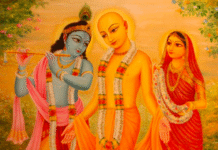
“Lord Kṛṣṇa, the Supreme Personality of Godhead, who appeared as the son of Nanda Mahārāja, is the supreme hero in all dealings. Similarly, Śrīmatī Rādhārāṇī is the topmost heroine in all dealings. (66) “‘Kṛṣṇa is the Supreme Personality of Godhead Himself, and He is the crown jewel of all heroes. In Kṛṣṇa, all transcendental permanently good situated.’ qualities (67) are “‘The transcendental goddess Śrīmatī Rādhārāṇī is the direct counterpart of Lord Śrī Kṛṣṇa. She is the central figure for all the goddesses of fortune. She possesses all the attraction to attract the all- attractive Personality of Godhead. She is the primeval internal potency of the Lord.’ (68) “The transcendental qualities of Lord Kṛṣṇa are unlimited. Out of these, sixty- four are considered prominent. The ears of the devotees are satisfied simply by hearing all these qualities one after the other. (69) “‘Kṛṣṇa, the supreme hero, has the most beautiful transcendental body. This body possesses all good features. It is radiant and very pleasing to the eyes. His body is powerful, strong and youthful. (70)
“‘Kṛṣṇa is the linguist of all wonderful languages. He is a truthful and very pleasing speaker. He is expert in speaking, and He is a very wise, learned scholar and a genius. (71) “‘Kṛṣṇa is very expert in artistic enjoyment. He is highly cunning, expert, grateful and firmly determined in His vows. He knows how to deal according to time, person and country, and He sees through the scriptures and authoritative books. He is very clean and self- controlled. (72) “‘Lord Kṛṣṇa is steady, His senses are controlled, and He is forgiving, grave and calm. He is also equal to all. Moreover, He is magnanimous, religious, chivalrous and kind. He is always respectful to respectable people. (73) “‘Kṛṣṇa is very simple and liberal, He is humble and bashful, and He is the protector of the surrendered souls. He is very happy, and He is always the well- wisher of His devotees. He is all- auspicious, and He is submissive to love. (74)
“‘Kṛṣṇa is very influential and famous, and He is the object of attachment for everyone. He is the shelter of the good and the virtuous. He is attractive to the minds of women, and He is worshiped by everyone. He is very, very rich. (75) “‘Kṛṣṇa is the Supreme, and He is always glorified as the Supreme Lord and controller. Thus all the previously mentioned transcendental qualities are in Him. The fifty qualities of the Supreme Personality of Godhead mentioned above are as deep as an ocean. In other words, they are difficult to fully comprehend. (76) “‘These qualities are sometimes very minutely exhibited in living beings, but they are fully manifested in the Supreme Personality of Godhead.’ (77) “‘Apart from these fifty qualities, there are five other qualities found in the Supreme Personality of Godhead that are partially present in demigods like Śiva. (78)
“‘These qualities are (1) the Lord is always situated in His original position, (2) He is omniscient, (3) He is always fresh and youthful, (4) He is the concentrated form of eternity, knowledge and bliss, and (5) He is the possessor of all mystic perfection. There are another five qualities, which exist in the Vaikuṇṭha planets in Nārāyaṇa, the Lord of Lakṣmī. These qualities are also present in Kṛṣṇa, but they are not present in demigods like Lord Śiva or in other living entities. These are (1) the Lord possesses inconceivable supreme power, (2) He generates innumerable universes from His body, (3) He is the original source of all incarnations, (4) He bestows salvation upon enemies He kills, and (5) He has the ability to attract exalted persons who are satisfied in themselves. Although these qualities are present in Nārāyaṇa, the dominating Deity of the Vaikuṇṭha planets, they are even more wonderfully present in Kṛṣṇa. (79-81)
“‘Apart from these sixty transcendental qualities, Kṛṣṇa has an additional four transcendental qualities, which are not manifested even in the personality of Nārāyaṇa. These are: (1) Kṛṣṇa is like an ocean filled with waves of pastimes that evoke wonder within everyone in the three worlds. (2) In His activities of conjugal love, He is always surrounded by His dear devotees who possess unequaled love for Him. (3) He attracts the minds of all three worlds with the melodious vibration of His flute. (4) His personal beauty and opulence are beyond compare. No one is equal to Him, and no one is greater than Him. Thus the Personality of Godhead astonishes all living entities, both moving and nonmoving, within the three worlds. He is so beautiful that He is called Kṛṣṇa. (82-83)
“‘Above Nārāyaṇa, Kṛṣṇa has four specific transcendental qualities—His wonderful pastimes, an abundance of wonderful associates who are very dear to Him [like the gopīs], His wonderful beauty and the wonderful vibration of His flute. Lord Kṛṣṇa is more exalted than ordinary living beings and demigods like Lord Śiva. He is even more exalted than His personal expansion Nārāyaṇa. In all, the Supreme Personality of Godhead has sixty- four transcendental qualities in full.’ (84-85) “Similarly, Śrīmatī Rādhārāṇī has unlimited transcendental qualities, of which twenty- five are principal. Śrī Kṛṣṇa is controlled by these transcendental qualities of Śrīmatī Rādhārāṇī. (86)
“‘Śrīmatī Rādhārāṇī’s twenty- five chief transcendental qualities are: (1) She is very sweet. (2) She is always freshly youthful. (3) Her eyes are restless. (4) She smiles brightly. (5) She has beautiful, auspicious lines. (6) She makes Kṛṣṇa happy with Her bodily aroma. (7) She is very expert in singing. (8) Her speech is charming. (9) She is very expert in joking and speaking pleasantly. (10) She is very humble and meek. (11) She is always full of mercy. (12) She is cunning. (13) She is expert in executing Her duties. (14) She is shy. (15) She is always respectful. (16) She is always calm. (17) She is always grave. (18) She is expert in enjoying life. (19) She is situated at the topmost level of ecstatic love. (20) She is the reservoir of loving affairs in Gokula. (21) She is the most famous of submissive devotees. (22) She is very affectionate to elderly people. (23) She is very submissive to the love of Her friends. (24) She is the chief gopī. (25) She always keeps Kṛṣṇa under Her control. In short, She possesses unlimited transcendental qualities, just as Lord Kṛṣṇa does.’ (87-91)
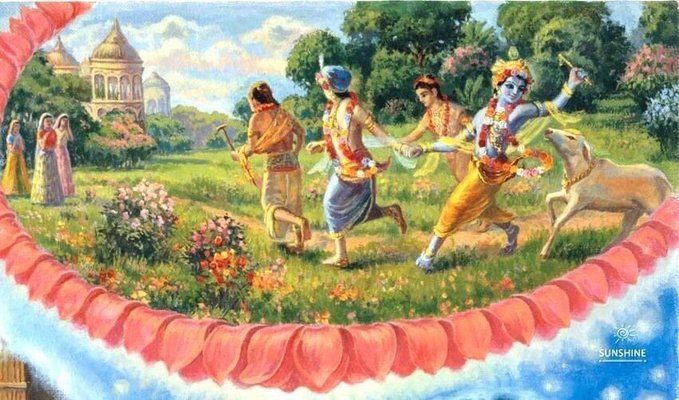
“The basis of all transcendental mellows is the hero and the heroine, and Śrīmatī Rādhārāṇī and Lord Kṛṣṇa, the son of Mahārāja Nanda, are the best. (92) “Just as Lord Kṛṣṇa and Śrīmatī Rādhārāṇī are the object and shelter of the mellow of conjugal love, so, in the mellow of servitorship, Kṛṣṇa, the son of Mahārāja Nanda, is the object, and servants like Citraka, Raktaka and Patraka are the shelter. Similarly, in the transcendental mellow of friendship, Lord Kṛṣṇa is the object, and friends like Śrīdāmā, Sudāmā and Subala are the shelter. In the transcendental mellow of parental affection, Kṛṣṇa is the object, and mother Yaśodā and Mahārāja Nanda are the shelter. (93) “Now hear how the mellows appear and how they are realized by the devotees on different transcendental platforms. (94)
“‘For those who are completely washed of all material contamination by pure devotional service, who are always satisfied and brightly enlightened in the heart, who are always attached to understanding the transcendental meaning of Śrīmad- Bhāgavatam, who are always eager to associate with advanced devotees, whose happiness in the service of the lotus feet of Govinda is their very life, who always discharge the confidential activities of love—for such advanced devotees, who are by nature situated in bliss, the seed of love [rati] is expanded in the heart by previous and current reformatory processes. Thus the mixture of ecstatic ingredients becomes tasty and, being within the perception of the devotee, reaches the highest platform of wonder and deep bliss.’ (95-98) “The exchange between Kṛṣṇa and different devotees situated in different transcendental mellows is not to be experienced by nondevotees. Advanced devotees can understand and appreciate the different varieties of devotional service reciprocated with the Supreme Personality of Godhead. (99)
“‘Nondevotees cannot understand the exchange of transcendental mellows between the devotees and the Lord. In all respects, this is very difficult to understand, but one who has dedicated everything to the lotus feet of Kṛṣṇa can taste the transcendental mellows.’ (100) “This brief description is an elaboration of the ultimate goal of life. Indeed, this is the fifth and ultimate goal, which is beyond the platform of liberation. It is called kṛṣṇa- prema- dhana, the treasure of love for Kṛṣṇa. (101) “Previously I empowered your brother Rūpa Gosvāmī to understand these mellows. I did this while instructing him at the Daśāśvamedha- ghāṭa in Prayāga. (102) “O Sanātana, you should broadcast the revealed scriptures on devotional service and excavate the lost places of pilgrimage in the district of Mathurā. (103) “Establish devotional service to Lord Kṛṣṇa and Rādhārāṇī in Vṛndāvana. You should also compile bhakti scriptures and preach the bhakti cult from Vṛndāvana.” (104) Śrī Caitanya Mahāprabhu then told Sanātana Gosvāmī about proper renunciation according to a particular situation, and the Lord forbade dry renunciation and speculative knowledge in all respects. (105)
“‘One who is not envious but is a kind friend to all living entities, who does not think himself a proprietor and is free from false ego, who is equal in both happiness and distress, who is always satisfied, forgiving and self- controlled, and who is engaged in devotional service with determination, his mind and intelligence dedicated to Me—such a devotee of Mine is very dear to Me. (106-107) “‘He by whom no one is put into difficulty or anxiety and who is not disturbed by anyone, who is liberated from jubilation, anger, fear and anxiety, is very dear to Me. (108) “‘A devotee who is not dependent on others but is dependent solely on Me, who is clean inwardly and outwardly, who is expert, indifferent to material things, without cares and free from all pains, and who rejects all pious and impious activities is very dear to Me. (109) “One who is free of all material jubilation, hatred, lamentation and desire, who renounces both materially auspicious and materially inauspicious things, and who is devoted to Me is very dear to Me. (110)
“‘One who is equal to friends and enemies, who is equipoised in honor and dishonor, heat and cold, happiness and distress, fame and infamy, who is always free from attachment to material things and always grave and satisfied in all circumstances, who doesn’t care for any residence, and who is always fixed in devotional service—such a person is very dear to Me. (111-112) “‘Devotees who follow these imperishable religious principles of Kṛṣṇa consciousness with great faith and devotion, fully accepting Me as the supreme goal, are very, very dear to Me.’ (113) “‘Are there no torn clothes lying on the common road? Do the trees, which exist for maintaining others, no longer give alms in charity? Do the rivers, being dried up, no longer supply water to the thirsty? Are the caves of the mountains now closed, or, above all, does the unconquerable Supreme Personality of Godhead not protect the fully surrendered souls? Why then should learned persons like devotees go to flatter those who are intoxicated by hard- earned wealth?’” (114)
Thereafter Sanātana Gosvāmī inquired from Śrī Caitanya Mahāprabhu about all the conclusive statements concerning devotional service, and the Lord very vividly explained all the confidential meanings of Śrīmad- Bhāgavatam. (115) In the revealed scripture Hari- vaṁśa, there is a description of Goloka Vṛndāvana, the planet where Lord Śrī Kṛṣṇa eternally resides. This information was given by King Indra when he surrendered to Kṛṣṇa and offered prayers after Kṛṣṇa had raised Govardhana Hill. (116) Illusory stories opposed to the conclusions of Kṛṣṇa consciousness concern the destruction of the Yadu dynasty, Kṛṣṇa’s disappearance, the story that Kṛṣṇa and Balarāma arise from a black hair and a white hair of Kṣīrodakaśāyī Viṣṇu, and the story about the kidnapping of the queens. Śrī Caitanya Mahāprabhu explained to Sanātana Gosvāmī the proper conclusions of these stories. (117-118)
Sanātana Gosvāmī then humbly accepted his position as lower than a piece of straw, and symbolically holding some straw in his mouth, he fell down, clasped the lotus feet of Śrī Caitanya Mahāprabhu and submitted the following petition. (119) Sanātana Gosvāmī said, “My dear Lord, I am a very lowborn person. Indeed, I am a servant to lowborn people; therefore I am very, very downtrodden. Nonetheless, You have taught me conclusions unknown even to Lord Brahmā. (120) “The conclusions that You have told me are the ocean of the ambrosia of truth. My mind is unable to approach even a drop of that ocean. (121) “If You want to make a lame man like me dance, kindly bestow Your transcendental blessings by placing Your lotus feet on my head. (122)
“Now, will You please tell me, ‘Let whatever I have instructed all be fully manifested unto you.’ By blessing me in this way, You will give me strength to describe all this.” (123) Śrī Caitanya Mahāprabhu then placed His hand on Sanātana Gosvāmī’s head and blessed him, saying, “Let all these instructions be manifested to you.” (124) Thus I have briefly described a discussion of the ultimate goal of life, love of Godhead. The mercy of Śrī Caitanya Mahāprabhu cannot be described expansively. (125) Whoever hears these instructions given to Sanātana Gosvāmī by the Lord comes very soon to realize love of God, Kṛṣṇa. (126) Praying at the lotus feet of Śrī Rūpa and Śrī Raghunātha, always desiring their mercy, I, Kṛṣṇadāsa, narrate Śrī Caitanya- caritāmṛta, following in their footsteps. (127)
Deepen your Bhakti-yoga practice, harmonize relationships, and receive guided coaching — all at Vedavarsity.com