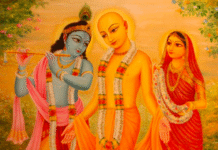



The most munificent Supreme Personality of Godhead, known as Gaurakṛṣṇa, distributed to everyone—even the lowest of men—His own confidential treasury in the form of the nectar of love of Himself and the holy name. This was never given to the people at any time before. I therefore offer my respectful obeisances unto Him. (1) All glories to Śrī Caitanya Mahāprabhu! All glories to Lord Nityānanda! All glories to Advaita Ācārya! And all glories to all the devotees of Lord Caitanya Mahāprabhu! (2) Śrī Caitanya Mahāprabhu continued, “Now hear, O Sanātana, about the result of devotional service, which is love of Godhead, life’s ultimate goal. One who hears this description will be enlightened in the transcendental mellows of devotional service. (3) “When affection for Kṛṣṇa becomes deeper, one attains love of Godhead in devotional service. Such a position is called sthāyi- bhāva, permanent enjoyment of the mellows of devotional service to Kṛṣṇa. (4)
“‘When devotional service is executed on the transcendental platform of pure goodness, it is like a sun- ray of love for Kṛṣṇa. At such a time, devotional service causes the heart to be softened by various tastes, and one is then situated in bhāva [emotion].’ (5) “Bhāva [emotion] has two different symptoms— constitutional and marginal. Now, My dear Sanātana, listen to the symptoms of love. (6) “‘When that bhāva softens the heart completely, becomes endowed with a great feeling of possessiveness in relation to the Lord and becomes very much condensed and intensified, it is called prema [love of Godhead] by learned scholars. (7) “‘When one develops an unflinching sense of ownership or possessiveness in relation to Lord Viṣṇu, or, in other words, when one thinks Viṣṇu and no one else to be the only object of love, such an awakening is called bhakti [devotion] by exalted persons like Bhīṣma, Prahlāda, Uddhava and Nārada.’ (8) “If, by good fortune, a living entity develops faith in Kṛṣṇa, he begins to associate with devotees. (9)
“When one is encouraged in devotional service by the association of devotees, one becomes free from all unwanted contamination by following the regulative principles and chanting and hearing. (10) “When one is freed from all unwanted contamination, he advances with firm faith. When firm faith in devotional service awakens, a taste for hearing and chanting also awakens. (11) “After taste is awakened, a deep attachment arises, and from that attachment the seed of love for Kṛṣṇa grows in the heart. (12) “When that ecstatic emotional stage intensifies, it is called love of Godhead. Such love is life’s ultimate goal and the reservoir of all pleasure. (13) “‘In the beginning there must be faith. Then one becomes interested in associating with pure devotees. Thereafter one is initiated by the spiritual master and executes the regulative principles under his orders. Thus one is freed from all unwanted habits and becomes firmly fixed in devotional service. Thereafter, one develops taste and attachment. This is the way of sādhana- bhakti, the execution of devotional service according to the regulative principles. Gradually emotions intensify, and finally there is an awakening of love. This is the gradual development of love of Godhead for the devotee interested in Kṛṣṇa consciousness.’ (14-15)
“‘The spiritually powerful message of Godhead can be properly discussed only in a society of devotees, and it is greatly pleasing to hear in that association. If one hears from devotees, the way of transcendental experience quickly opens, and gradually one attains firm faith that in due course develops into attraction and devotion.’ (16) “If one actually has the seed of transcendental emotion in his heart, the symptoms will be visible in his activities. That is the verdict of all revealed scriptures. (17) “‘When the seed of ecstatic emotion for Kṛṣṇa fructifies, the following nine symptoms manifest in one’s behavior: forgiveness, concern that time should not be wasted, detachment, absence of false prestige, hope, eagerness, a taste for chanting the holy name of the Lord, attachment to descriptions of the transcendental qualities of the Lord, and affection for those places where the Lord resides—that is, a temple or a holy place like Vṛndāvana. These are all called anubhāva, subordinate signs of ecstatic emotion. They are visible in a person in whose heart the seed of love of God has begun to fructify.’ (18-19) “If love for Kṛṣṇa in a seedling state has fructified in one’s heart, one is not agitated by material things. (20)
“‘O brāhmaṇas, just accept me as a completely surrendered soul, and let mother Ganges, the representative of the Lord, also accept me in that way, for I have already taken the lotus feet of the Lord into my heart. Let the snakebird—or whatever magical thing the brāhmaṇa created—bite me at once. I only desire that you all continue singing the deeds of Lord Viṣṇu.’ (21) “Not a moment should be lost. Every moment should be utilized for Kṛṣṇa or connected with Him. (22) “‘With their words, they offer prayers to the Lord. With their minds, they always remember the Lord. With their bodies, they offer obeisances to the Lord. Despite all these activities, they are still not satisfied. This is the nature of pure devotees. Shedding tears from their eyes, they dedicate their whole lives to the Lord’s service.’ (23) “In the material field, people are interested in material enjoyment, mystic power and sense gratification. But these things do not appeal to the devotee at all. (24) “‘King Bharata was very eager to attain the association of the Supreme Personality of Godhead, Kṛṣṇa, who is called Uttamaḥśloka because poems and prayers are offered to Him for His favor. In his youth, King Bharata gave up his attractive wife and children, as well as his beloved friends and opulent kingdom, just as one gives up stool after passing it.’ (25)
“Although a pure devotee’s standard is above all, he still considers himself to be in the lowest stage of life. (26) “‘Bharata Mahārāja always carried affection for Kṛṣṇa within his heart. Although Bharata Mahārāja was the crown jewel of kings, he was still wandering about and begging alms in the city of his enemies. He was even offering respects to caṇḍālas, low- class men who eat dogs.’ (27) “A fully surrendered devotee always hopes that Lord Kṛṣṇa will be kind to him. This hope is very firm in him. (28) “‘O my Lord, I do not have any love for You, nor am I qualified for discharging devotional service by chanting and hearing. Nor do I possess the mystic power of a Vaiṣṇava, knowledge or pious activities. Nor do I belong to a very high- caste family. On the whole, I do not possess anything. Still, O beloved of the gopīs, because You bestow Your mercy on the most fallen, I have an unbreakable hope that is constantly in my heart. That hope is always giving me pain.’ (29) “This eagerness is chiefly characterized by an ardent desire to associate with the Lord. (30)
“‘O Kṛṣṇa, O flute- player, the sweetness of Your early age is wonderful within these three worlds. You know My unsteadiness, and I know Yours. No one else knows about this. I want to see Your beautiful, attractive face somewhere in a solitary place, but how can this be accomplished?’ (31) “Due to having great relish for the holy name, one is inclined to chant the Hare Kṛṣṇa mahā- mantra constantly. (32) “‘O Govinda, this youthful girl named Rādhikā is today constantly pouring forth tears like nectar falling from flowers as She sings Your holy names in a sweet voice.’ (33) “At this stage of bhāva, a devotee has awakened the tendency to chant and describe the transcendental qualities of the Lord. He has attachment for this process. (34) “‘O my Lord, the transcendental body of Kṛṣṇa is very sweet, and His face is even sweeter than His body. But His soft smile, which has the fragrance of honey, is sweeter still.’ (35) “A devotee absorbed in ecstatic emotion for Kṛṣṇa always resides in a place where Kṛṣṇa’s pastimes were performed. (36)
“‘O Lord Puṇḍarīkākṣa, while chanting Your holy name with tears in my eyes, when shall I dance in ecstasy on the bank of the Yamunā?’ (37) “These are the symptoms of a person who has developed attraction [bhāva] for Kṛṣṇa. Now let Me describe the symptoms of a person who is actually elevated to love of Kṛṣṇa. O Sanātana, please hear this from Me. (38) “Even the most learned man cannot understand the words, activities and symptoms of a person situated in love of Godhead. (39) “‘Even a most learned scholar cannot understand the activities and symptoms of an exalted personality in whose heart love of Godhead has awakened.’ (40) “‘When a person is actually advanced and takes pleasure in chanting the holy name of the Lord, who is very dear to him, he is agitated and loudly chants the holy name. He also laughs, cries, becomes agitated and chants just like a madman, not caring for outsiders.’ (41) “Love of Godhead increases and is manifested as affection, counterlove, love, attachment, subattachment, ecstasy and sublime ecstasy. (42)
“This development is compared to sugarcane seeds, sugarcane plants, sugarcane juice, molasses, crude sugar, refined sugar, sugar candy and rock candy. (43) “One should understand that just as the taste of sugar increases as it is gradually purified, so when love of Godhead increases from rati, which is compared to the beginning seed, its taste increases. (44) “According to the candidate possessing these transcendental qualities [sneha, māna and so on], there are five transcendental mellows—neutrality, servitorship, friendship, parental love and conjugal love. (45) “These five transcendental mellows exist permanently. The devotee may be attracted to one of these mellows, and thus he becomes happy. Kṛṣṇa also becomes inclined toward such a devotee and comes under his control. (46) “When the permanent ecstasies [neutrality, servitorship and so on] are mixed with other ingredients, devotional service in love of Godhead is transformed and becomes composed of transcendental mellows. (47) “Permanent ecstasy becomes a more and more tasteful transcendental mellow through the mixture of special ecstasy, subordinate ecstasy, natural ecstasy and transitory ecstasy. (48)
“Yogurt mixed with sugar candy, black pepper and camphor is very palatable and tasty. Similarly, when permanent ecstasy mixes with other ecstatic symptoms, it becomes unprecedentedly tasty. (49) “There are two kinds of particular ecstasies [vibhāva]. One is called the support, and the other is called the awakening. The vibration of Kṛṣṇa’s flute is an example of the awakening, and Lord Kṛṣṇa Himself is an example of the support. (50) “The subordinate ecstasies are smiling, dancing and singing, as well as different manifestations in the body. The natural ecstasies, such as being stunned, are considered among the subordinate ecstasies [anubhāva]. (51) “There are other ingredients, beginning with complete despondency and jubilation. Altogether there are thirty- three varieties, and when these combine, the mellow becomes very wonderful. (52) “There are five transcendental mellows—neutrality, servitorship, friendship, parental affection and conjugal love, which is also known as the mellow of sweetness. Conjugal love excels all the others. (53)
“The position of neutrality increases up to the point where one can appreciate love of Godhead. The mellow of servitorship gradually increases to the point of spontaneous love of Godhead. (54) “After the mellow of servitorship, there are the mellows of friendship and parental love, which increase to subordinate spontaneous love. The greatness of the love found in friends like Subala extends to the standard of ecstatic love of Godhead. (55) “There are two divisions of each of the five mellows— yoga [connection] and viyoga [separation]. Among the mellows of friendship and parental affection, there are many divisions of connection and separation. (56)
“Only in the conjugal mellow are there two ecstatic symptoms called rūḍha [advanced] and adhirūḍha [highly advanced]. The advanced ecstasies are found among the queens of Dvārakā, and the highly advanced ecstasies are found among the gopīs.(57) “Highly advanced ecstasy is divided into two categories—mādana and mohana. Meeting together is called mādana, and separation is called mohana. (58) “On the mādana platform there are kissing and many other symptoms, which are unlimited. In the mohana stage, there are two divisions—udghūrṇā [unsteadiness] and citra- jalpa [varieties of mad emotional talks]. (59) “Mad emotional talks include ten divisions, called prajalpa and other names. An example of this is the ten verses spoken by Śrīmatī Rādhārāṇī called ‘The Song to the Bumblebee.’ (60)
Deepen your Bhakti-yoga practice, harmonize relationships, and receive guided coaching — all at Vedavarsity.com