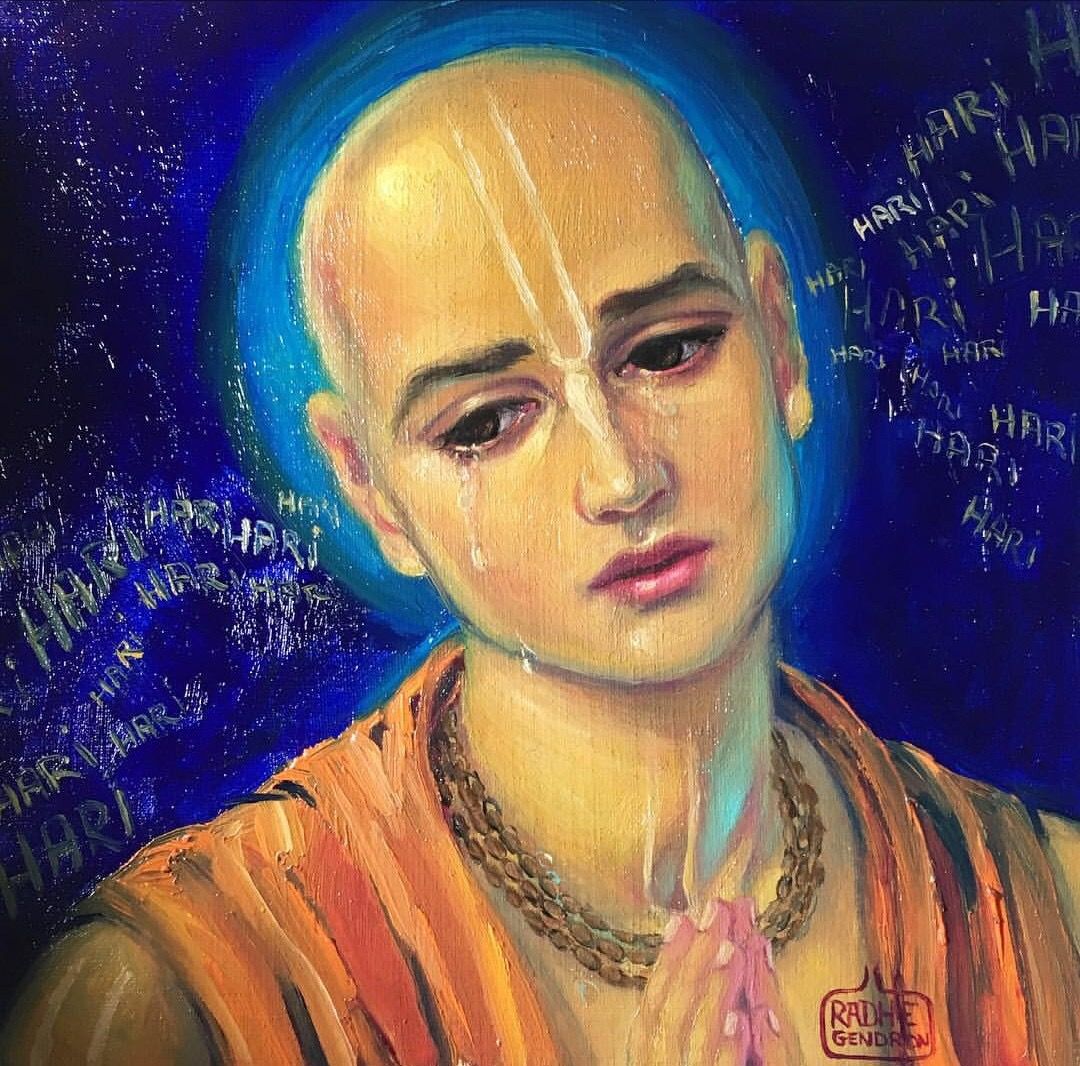
In this way, Lord Caitanya used to revel in ecstasy day after day and exhibit these ecstasies before Svarūpa and Rāmānanda Rāya. Externally there appeared severe tribulation, as if He were suffering from poisonous effects, but internally He was experiencing bliss. This is characteristic of transcendental love of Kṛṣṇa. (50) If one tastes such love of Godhead, he can compare it to hot sugarcane. When one chews hot sugarcane, his mouth burns, yet he cannot give it up. Similarly, if one has but a little love of Godhead, he can perceive its powerful effects. It can only be compared to poison and nectar mixed together. (51)
Lord Caitanya Mahāprabhu spoke, “‘My dear beautiful friend, if one develops love of Godhead, love of Kṛṣṇa, the son of Nanda Mahārāja, all the bitter and sweet influences of this love will manifest in one’s heart. Such love of Godhead acts in two ways. The poisonous effects of love of Godhead defeat the severe and fresh poison of the serpent. Yet there is simultaneously transcendental bliss, which pours down and defeats the pride of nectar and diminishes its value. In other words, love of Kṛṣṇa is so powerful that it simultaneously defeats the poisonous effects of a snake, as well as the happiness derived from pouring nectar on one’s head. It is perceived as doubly effective, simultaneously poisonous and nectarean.’” (52)
When Śrī Caitanya Mahāprabhu would see Jagannātha along with Balarāma and Subhadrā, He would immediately think that He had reached Kurukṣetra, where all of them had come. He would think that His life was successful because He had seen the lotus- eyed one, whom, if seen, pacifies the body, mind and eyes. (53) Staying near the Garuḍa- stambha, the Lord would look upon Lord Jagannātha. What can be said about the strength of that love? On the ground beneath the column of the Garuḍa- stambha was a deep ditch, and that ditch was filled with the water of His tears. (54) When coming from the Jagannātha temple to return to His house, Śrī Caitanya Mahāprabhu used to sit on the ground and mark it with His nails. At such times He would be greatly morose and would cry, “Alas, where is Vṛndāvana? Where is Kṛṣṇa, the son of the King of the cowherd men? Where is that person who plays the flute?” (55)
Śrī Caitanya Mahāprabhu used to lament by saying, “Where is Śrī Kṛṣṇa, whose form is curved in three places? Where is the sweet song of His flute, and where is the bank of the Yamunā? Where is the rāsa dance? Where is that dancing, singing, and laughing? Where is My Lord, Madana- mohana, the enchanter of Cupid?” (56) In this way various ecstatic emotions evolved, and the mind of Caitanya Mahāprabhu filled with anxiety. He could not escape even for a moment. In this way, because of fierce feelings of separation, His patience began to totter, and He began to recite various verses. (57) “‘O My Lord, O Supreme Personality of Godhead, O friend of the helpless! You are the only ocean of mercy! Because I have not met You, My inauspicious days and nights have become unbearable. I do not know how I shall pass the time.’ (58) “All these inauspicious days and nights are not passing, for I have not met You. It is difficult to know how to pass all this time. But You are the friend of the helpless and an ocean of mercy. Kindly give Me Your audience, for I am in a precarious position.” (59)
In this way, the Lord’s restlessness was awakened by ecstatic feelings, and His mind became agitated. No one could understand what course such ecstasy would take. Because Lord Caitanya could not meet the Supreme Personality of Godhead, Kṛṣṇa, His mind burned. He began to ask Kṛṣṇa about the means by which He could reach Him. (60) “‘O Kṛṣṇa, O flute- player, the sweetness of Your early age is wonderful within these three worlds. You know My unsteadiness, and I know Yours. No one else knows about this. I want to see Your beautiful attractive face somewhere in a solitary place, but how can this be accomplished?’ (61) “My dear Kṛṣṇa, only You and I know the strength of Your beautiful features and, because of them, My unsteadiness. Now, this is My position; I do not know what to do or where to go. Where can I find You? I am asking You to give directions.” (62)
Because of the various kinds of ecstasy, contradictory states of mind occurred, and this resulted in a great fight between different types of ecstasy. Anxiety, impotence, humility, anger and impatience were all like soldiers fighting, and the madness of love of Godhead was the cause. (63) The body of the Lord was just like a field of sugarcane into which the mad elephants of ecstasy entered. There was a fight amongst the elephants, and in the process the entire field of sugarcane was destroyed. Thus transcendental madness was awakened in the body of the Lord, and He experienced despondency in mind and body. In this ecstatic condition, He began to speak as follows. (64) “‘O My Lord! O dearest one! O only friend of the universe! O Kṛṣṇa, O restless one, O only ocean of mercy! O My Lord, O My enjoyer, O beloved to My eyes! Alas, when will You again be visible to Me?’” (65)
The symptoms of madness served as an impetus for remembering Kṛṣṇa. The mood of ecstasy awoke love, disdain, defamation by words, pride, honor and indirect prayer. Thus Śrī Kṛṣṇa was sometimes blasphemed and sometimes honored. (66) [In the attitude of Rādhārāṇī, Śrī Caitanya Mahāprabhu addressed Kṛṣṇa:] “My dear Lord, You are engaged in Your pastimes, and You utilize all the women in the universe according to Your desire. You are so kind to Me. Please divert Your attention to Me, for by fortune You have appeared before Me. (67) “My dear Lord, You attract all the women of the universe, and You make adjustments for all of them when they appear. You are Lord Kṛṣṇa, and You can enchant everyone, but on the whole, You are nothing but a debauchee. Who can honor You? (68)
“My dear Kṛṣṇa, Your mind is always restless. You cannot remain in one place, but You are not at fault for this. You are actually the ocean of mercy, the friend of My heart. Therefore I have no reason to be angry with You. (69) “My dear Lord, You are the master and the life and soul of Vṛndāvana. Kindly arrange for the deliverance of Vṛndāvana. We have no leisure hours away from our many activities. Actually, You are My enjoyer. You have appeared just to give Me happiness, and this is one of Your expert activities. (70) “Taking My words as defamation, Lord Kṛṣṇa has left Me. I know that He is gone, but kindly hear My prayers in praise: ‘You are the satisfaction of My eyes. You are My wealth and My life. Alas, please give Me your audience once again.’” (71)
There were different transformations of the body of Lord Caitanya Mahāprabhu: being stunned, trembling, perspiring, fading away of color, weeping, and choking of the voice. In this way His whole body was pervaded by transcendental joy. As a result, sometimes Caitanya Mahāprabhu would laugh, sometimes cry, sometimes dance and sometimes sing. Sometimes He would get up and run here and there, and sometimes fall on the ground and lose consciousness. (72) When Śrī Caitanya Mahāprabhu was thus unconscious, He happened to meet the Supreme Personality of Godhead. Consequently He got up and immediately made a tumultuous sound, very loudly declaring, “Now Kṛṣṇa, the great personality, is present.” In this way, because of Kṛṣṇa’s sweet qualities, Caitanya Mahāprabhu made different types of mistakes in His mind. Thus by reciting the following verse, He ascertained the presence of Lord Kṛṣṇa. (73)
In the attitude of Rādhārāṇī, Śrī Caitanya Mahāprabhu addressed the gopīs: “‘My dear friends, where is that Kṛṣṇa, Cupid personified, who has the effulgence of a kadamba flower, who is sweetness itself, the nectar of My eyes and mind, He who loosens the hair of the gopīs, who is the supreme source of transcendental bliss and My life and soul? Has He come before My eyes again?’” (74) Śrī Caitanya Mahāprabhu then began to talk like this: “Is Cupid personified present with the effulgence and reflection of the kadamba tree? Is He the same person, personified sweetness, who is the pleasure of My eyes and mind, who is My life and soul? Has Kṛṣṇa actually come before My eyes?” (75) As the spiritual master chastises the disciple and teaches him the art of devotional service, so all the ecstatic symptoms of Lord Caitanya Mahāprabhu—including despondency, moroseness, humility, restlessness, joy, endurance and anger— instructed His body and mind. In this way, Śrī Caitanya Mahāprabhu passed His time. (76)
He also passed His time reading the books and singing the songs of Caṇḍīdāsa and Vidyāpati, and listening to quotations from the Jagannātha- vallabha- nāṭaka, Kṛṣṇa- karṇāmṛta and Gīta- govinda. Thus in the association of Svarūpa Dāmodara and Rāya Rāmānanda, Śrī Caitanya Mahāprabhu passed His days and nights chanting and hearing with great pleasure. (77) Among His associates, Lord Caitanya Mahāprabhu enjoyed paternal loving affection from Paramānanda Purī, friendly affection with Rāmānanda Rāya, unalloyed service from Govinda and others, and humors of conjugal love with Gadādhara, Jagadānanda and Svarūpa Dāmodara. Śrī Caitanya Mahāprabhu enjoyed all these four mellows, and thus He remained obliged to His devotees. (78) Līlāśuka [Bilvamaṅgala Ṭhākura] was an ordinary human being, yet he developed many ecstatic symptoms in his body. What, then, is so astonishing about these symptoms’ being manifest in the body of the Supreme Personality of Godhead? In the ecstatic mood of conjugal love, Śrī Caitanya Mahāprabhu was on the highest platform; therefore, all the exuberant ecstasies were naturally visible in His body. (79)
During His previous pastimes in Vṛndāvana, Lord Kṛṣṇa desired to enjoy the three different types of ecstasy, but despite great endeavor, He could not taste them. Such ecstasies are the monopoly of Śrīmatī Rādhārāṇī. Therefore, in order to taste them, Śrī Kṛṣṇa accepted the position of Śrīmatī Rādhārāṇī in the form of Śrī Caitanya Mahāprabhu. (80) By personally tasting the mellows of love of Godhead, Caitanya Mahāprabhu taught His direct disciples the process. Śrī Caitanya Mahāprabhu is a wealthy capitalist possessing the touchstone of love of God. Not considering whether one is a proper or improper recipient, He gives His treasure to anyone and everyone. Thus He is the most munificent. (81) No one, not even Lord Brahmā, can ascertain or even taste a drop of this confidential ocean of ecstasy, but Śrī Caitanya Mahāprabhu, out of His causeless mercy, has distributed this love of Godhead all over the world. Thus there cannot be any incarnation more munificent than Śrī Caitanya Mahāprabhu. There is no greater donor. Who can describe His transcendental qualities? (82)
Such topics are not to be discussed freely because if they are, no one will understand them. Such are the wonderful pastimes of Śrī Caitanya Mahāprabhu. Unto one who is able to understand, Śrī Caitanya Mahāprabhu has shown mercy by giving him the association of the servant of His own servant. (83) The pastimes of Śrī Caitanya Mahāprabhu are the topmost of jewels. They have been kept in the storehouse of Svarūpa Dāmodara Gosvāmī, who has explained them to Raghunātha dāsa Gosvāmī, who has repeated them to me. Whatever little I have heard from Raghunātha dāsa Gosvāmī I have described in this book, which is presented to all devotees. (84) If one says that Śrī Caitanya- caritāmṛta is full of Sanskrit verses and therefore not understandable by a common man, I reply that what I have described are the pastimes of Śrī Caitanya Mahāprabhu and that for me to satisfy everyone is not possible. (85)
In this Caitanya- caritāmṛta there is no contradictory conclusion, nor is anyone else’s opinion accepted. I have written this book to describe the simple substance as I have heard it from superiors. If I become involved in someone’s likes and dislikes, I cannot possibly write the simple truth. (86) If one does not understand in the beginning but continues to hear again and again, the wonderful effects of Lord Caitanya’s pastimes will bring love for Kṛṣṇa. Gradually one will come to understand the loving affairs between Kṛṣṇa and the gopīs and other associates of Vṛndāvana. Everyone is advised to continue to hear over and over again in order to greatly benefit. (87) In reply to those critics who say that Śrī Caitanya- caritāmṛta is full of Sanskrit verses, it can be said that Śrīmad- Bhāgavatam is also full of Sanskrit verses, as are the commentaries on Śrīmad- Bhāgavatam. Nonetheless, Śrīmad- Bhāgavatam can be understood by everyone, as well as by advanced devotees who study the Sanskrit commentaries. Why, then, will people not understand the Caitanya- caritāmṛta? There are only a few Sanskrit verses, and these have been explained in the Bengali vernacular. What is the difficulty in understanding? (88)
I have already given a synopsis of all the facts and figures of Lord Śrī Caitanya Mahāprabhu’s last pastimes, and I have a desire to describe them elaborately. If I remain longer and am fortunate enough to receive the mercy of Lord Śrī Caitanya Mahāprabhu, I shall try to describe them again more elaborately. (89) I have now become too old and disturbed by invalidity. While I write, my hands tremble. I cannot remember anything, nor can I see or hear properly. Still I write, and this is a great wonder. (90) In this chapter I have to some extent described the essence of the pastimes of Lord Caitanya at the end. If I die in the meantime and cannot describe them in detail, at least the devotees will have this transcendental treasure. (91) In this chapter I have briefly described the Antya līlā- līlā. Whatever I have not described I shall describe extensively in the future. If by Śrī Caitanya Mahāprabhu’s mercy I live for so many days that I can fulfill my desires, I will give full consideration to these pastimes. (92)
I worship herewith the lotus feet of all kinds of devotees, both advanced and neophyte. I request all of them to be satisfied with me. I am faultless because I have written herein whatever I have understood from Svarūpa Dāmodara Gosvāmī and Rūpa and Raghunātha dāsa Gosvāmīs. I have neither added to nor subtracted from their version. (93) According to the paramparā system, I wish to take the dust from the lotus feet of Śrī Caitanya Mahāprabhu, Nityānanda Prabhu, Advaita Prabhu, and all the associates of Śrī Caitanya Mahāprabhu like Svarūpa Dāmodara, Rūpa Gosvāmī, Sanātana Gosvāmī and Raghunātha dāsa Gosvāmī. I wish to take the dust of their lotus feet upon my head. In this way I wish to be blessed with their mercy. (94) Receiving orders from the above authorities and the Vaiṣṇavas of Vṛndāvana, especially from Haridāsa, the priest of Govindajī, I, Kṛṣṇadāsa Kavirāja Gosvāmī, have tried to describe one small particle of one drop of one wave of the ocean of the pastimes of Śrī Caitanya Mahāprabhu. (95)
Deepen your Bhakti-yoga practice, harmonize relationships, and receive guided coaching — all at Vedavarsity.com