


There was a great Māyāvādī sannyāsī named Prakāśānanda Sarasvatī, who used to teach Vedānta philosophy to a great assembly of followers. (104) A brāhmaṇa who saw the wonderful behavior of Śrī Caitanya Mahāprabhu came to Prakāśānanda Sarasvatī and described the Lord’s characteristics. (105) The brāhmaṇa told Prakāśānanda Sarasvatī, “There is a sannyāsī who has come from Jagannātha Purī, and I cannot describe His wonderful influence and glories. (106) “Everything is wonderful about that sannyāsī. He has a very well built and luxuriant body, and His complexion is like purified gold. (107) “He has arms that extend to His knees, and His eyes are like the petals of a lotus. In His person are all the transcendental symptoms of the Supreme Personality of Godhead. (108)
“When one sees all these features, one takes Him to be Nārāyaṇa Himself. Whoever sees Him immediately begins to chant the holy name of Kṛṣṇa. (109) “We have heard about the symptoms of a first- class devotee in Śrīmad- Bhāgavatam, and all those symptoms are manifest in the body of Śrī Caitanya Mahāprabhu. (110) “His tongue is always chanting the holy name of Kṛṣṇa, and from His eyes tears incessantly fall like the flowing Ganges. (111) “Sometimes He dances, laughs, sings and cries, and sometimes He roars like a lion. (112) “His name, Kṛṣṇa Caitanya, is all- auspicious for the world. Everything about Him—His name, form and qualities—is unparalleled. (113) “Simply by seeing Him, one understands that He possesses all the characteristics of the Supreme Personality of Godhead. Such characteristics are certainly uncommon. Who will believe it?” (114)
Prakāśānanda Sarasvatī laughed very much to hear this description. Joking and laughing at the brāhmaṇa, he began to speak as follows. (115) Prakāśānanda Sarasvatī said, “Yes, I have heard about Him. He is a sannyāsī from Bengal, and He is very sentimental. I have also heard that He belongs to the Bhāratī- sampradāya, for He is a disciple of Keśava Bhāratī. However, He is only a pretender.” (116) Prakāśānanda Sarasvatī continued, “I know that His name is Caitanya and that He is accompanied by many sentimentalists. His followers dance with Him, and He tours from country to country and village to village. (117) “Whoever sees Him accepts Him as the Supreme Personality of Godhead. Since He has some mystic power by which He hypnotizes people, everyone who sees Him becomes illusioned. (118)
“Sārvabhauma Bhaṭṭācārya was a very learned scholar, but I have heard that he also has become a madman due to his association with this Caitanya. (119) “This Caitanya is a sannyāsī in name only. Actually He is a first- class magician. In any case, His sentimentalism cannot be very much in demand here in Kāśī. (120) “Do not go to see Caitanya. Just continue hearing Vedānta. If you associate with upstarts, you will be lost in this world and in the next.” (121) When the brāhmaṇa heard Prakāśānanda Sarasvatī speak like this about Śrī Caitanya Mahāprabhu, he became very much grief- stricken. Chanting the holy name of Kṛṣṇa, he immediately left. (122) The mind of the brāhmaṇa was already purified by his seeing the Supreme Personality of Godhead, Śrī Caitanya Mahāprabhu. He therefore went to Śrī Caitanya Mahāprabhu and described what had taken place before the Māyāvādī sannyāsī Prakāśānanda. (123)
Hearing this, Śrī Caitanya Mahāprabhu mildly smiled. The brāhmaṇa then spoke again to the Lord. (124) The brāhmaṇa said, “As soon as I uttered Your name before him, he immediately confirmed the fact that he knew Your name. (125) “While finding fault with You, he uttered Your name three times, saying ‘Caitanya, Caitanya, Caitanya.’ (126) “Although he spoke Your name three times, he did not utter the name ‘Kṛṣṇa.’ Because he uttered Your name in contempt, I was very much aggrieved. (127) “Why could Prakāśānanda not utter the names ‘Kṛṣṇa’ and ‘Hari’? He chanted the name ‘Caitanya’ thrice. As far as I am concerned, simply by seeing You I am moved to chant the holy names ‘Kṛṣṇa’ and ‘Hari.’” (128) Śrī Caitanya Mahāprabhu replied, “The Māyāvādī impersonalists are great offenders unto Lord Kṛṣṇa; therefore they simply utter the words ‘Brahman,’ ‘ātmā’ and ‘caitanya.’ (129) “Because they are offenders unto Kṛṣṇa, the Supreme Personality of Godhead, who is identical with His holy name, the holy name ‘Kṛṣṇa’ does not manifest in their mouths. (130)
“The Lord’s holy name, His form and His personality are all one and the same. There is no difference between them. Since all of them are absolute, they are all transcendentally blissful. (131) “There is no difference between Kṛṣṇa’s body and Himself or between His name and Himself. But as far as the conditioned soul is concerned, one’s name is different from one’s body, from one’s original form and so on. (132) “‘The holy name of Kṛṣṇa is transcendentally blissful. It bestows all spiritual benedictions, for it is Kṛṣṇa Himself, the reservoir of all pleasure. Kṛṣṇa’s name is complete, and it is the form of all transcendental mellows. It is not a material name under any condition, and it is no less powerful than Kṛṣṇa Himself. Since Kṛṣṇa’s name is not contaminated by the material qualities, there is no question of its being involved with māyā. Kṛṣṇa’s name is always liberated and spiritual; it is never conditioned by the laws of material nature. This is because the name of Kṛṣṇa and Kṛṣṇa Himself are identical.’ (133)
“The holy name of Kṛṣṇa, His body and His pastimes cannot be understood by the blunt material senses. They are manifested independently. (134) “Kṛṣṇa’s holy name, transcendental qualities and transcendental pastimes are all equal to Lord Kṛṣṇa Himself. They are all spiritual and full of bliss. (135) “‘Therefore material senses cannot appreciate Kṛṣṇa’s holy name, form, qualities and pastimes. When a conditioned soul is awakened to Kṛṣṇa consciousness and renders service by using his tongue to chant the Lord’s holy name and taste the remnants of the Lord’s food, the tongue is purified, and one gradually comes to understand who Kṛṣṇa really is.’ (136) “The mellows of Lord Kṛṣṇa’s pastimes, which are full of bliss, attract the jñānī from the pleasure of Brahman realization and conquer him. (137)
“‘Let me offer my respectful obeisances unto my spiritual master, the son of Vyāsadeva, Śukadeva Gosvāmī. It is he who defeats all inauspicious things within this universe. Although in the beginning he was absorbed in the happiness of Brahman realization and was living in a secluded place, giving up all other types of consciousness, he became attracted by the most melodious pastimes of Lord Śrī Kṛṣṇa. He therefore mercifully spoke the supreme Purāṇa, known as Śrīmad- Bhāgavatam, which is the bright light of the Absolute Truth and which describes the activities of Lord Kṛṣṇa.’ (138) “The transcendental qualities of Śrī Kṛṣṇa are completely blissful and relishable. Consequently Lord Kṛṣṇa’s qualities attract even the minds of self- realized persons from the bliss of self- realization. (139)
“‘Those who are self- satisfied and unattracted by external material desires are also attracted to the loving service of Śrī Kṛṣṇa, whose qualities are transcendental and whose activities are wonderful. Hari, the Personality of Godhead, is called Kṛṣṇa because He has such transcendentally attractive features.’ (140) “Apart from the pastimes of Lord Kṛṣṇa, when tulasī leaves are offered at the lotus feet of Śrī Kṛṣṇa, even the aroma of the leaves attracts the minds of self- realized persons. (141) “‘When the breeze carrying the aroma of tulasī leaves and saffron from the lotus feet of the lotus- eyed Personality of Godhead entered through the nostrils into the hearts of those sages [the Kumāras], they experienced a change in both body and mind, even though they were attached to the impersonal Brahman understanding.’ (142)
“Because the Māyāvādīs are great offenders and atheistic philosophers, the holy name of Kṛṣṇa does not come from their mouths. (143) “I have come here to sell My emotional ecstatic sentiments in this city of Kāśī, but I cannot find any customers. If they are not sold, I must take them back home. (144) “I have brought a heavy load to sell in this city. To take it back again is a very difficult job; therefore if I get but a fraction of the price, I shall sell it here in this city of Kāśī.” (145) After saying this, Śrī Caitanya Mahāprabhu accepted that brāhmaṇa as His devotee. The next morning, rising very early, the Lord started for Mathurā. (146) When Śrī Caitanya Mahāprabhu started for Mathurā, all three devotees started to go with Him. But the Lord forbade them to accompany Him, and from a distance He asked them to return home. (147) Feeling separation from the Lord, the three used to meet and glorify the holy qualities of the Lord. Thus they were absorbed in ecstatic love. (148)
Śrī Caitanya Mahāprabhu then went to Prayāga, where He bathed at the confluence of the Ganges and the Yamunā. He then visited the temple of Veṇī Mādhava and chanted and danced there in ecstatic love. (149) As soon as Śrī Caitanya Mahāprabhu saw the river Yamunā, He threw Himself into it. Balabhadra Bhaṭṭācārya hastily caught the Lord and very carefully raised Him up again. (150) The Lord stayed at Prayāga for three days. He delivered the holy name of Kṛṣṇa and ecstatic love. Thus He delivered many people. (151) Wherever the Lord stopped to rest on the way to Mathurā, He delivered the holy name of Kṛṣṇa and ecstatic love of Kṛṣṇa. Thus He made the people dance. (152) When the Lord toured South India, He delivered many people, and when He traveled in the western sector, He similarly converted many people to Vaiṣṇavism. (153)
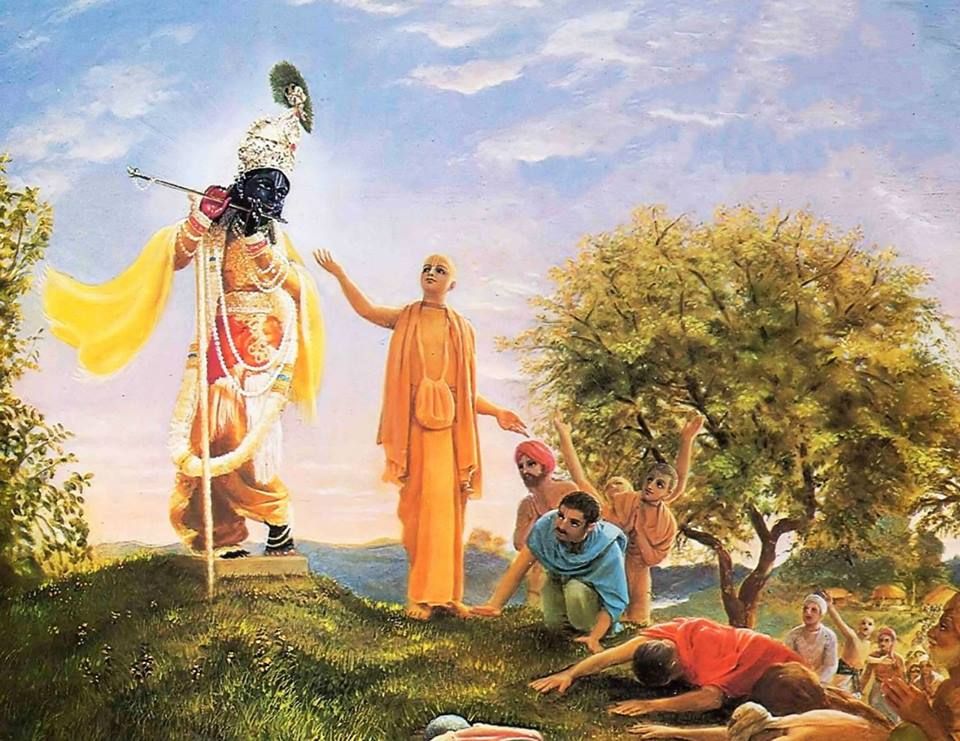
While the Lord was going to Mathurā, He came across the river Yamunā several times, and as soon as He saw the river Yamunā, He would immediately jump in, falling unconscious in the water in the ecstasy of love of Kṛṣṇa. (154) When He approached Mathurā and saw the city, He immediately fell to the ground and offered obeisances with great ecstatic love. (155) When Śrī Caitanya Mahāprabhu entered the city of Mathurā, He took His bath at Viśrāma- ghāṭa. He then visited the birthplace of Kṛṣṇa and saw the Deity named Keśavajī. He offered His respectful obeisances to this Deity. (156) When Śrī Caitanya Mahāprabhu chanted, danced and made loud vibrations, all the people were astonished to see His ecstatic love. (157)
One brāhmaṇa fell at the lotus feet of Śrī Caitanya Mahāprabhu and then began to dance with Him in ecstatic love. (158) The two of them danced in ecstatic love and embraced each other. Raising their arms, they said, “Chant the holy names of Hari and Kṛṣṇa!” (159) All the people then began to chant, “Hari! Hari!” and there was a great uproar. The priest in Lord Keśava’s service offered Śrī Caitanya Mahāprabhu a garland. (160) When the people saw Śrī Caitanya Mahāprabhu’s dancing and chanting, they were struck with wonder, and they all said, “Such transcendental love is never an ordinary thing.” (161)
Deepen your Bhakti-yoga practice, harmonize relationships, and receive guided coaching — all at Vedavarsity.com