


Arriving in that way, the Muslim governor was respectfully brought before Śrī Caitanya Mahāprabhu by the mahā- pātra. The governor then stood before the Lord with folded hands, and he chanted the holy name of Kṛṣṇa. (180) The governor then submissively asked, “Why was I born in a Muslim family? This is considered a low birth. Why didn’t supreme Providence grant me a birth in a Hindu family? (181) “If I had taken birth in a Hindu family, it would have been easy for me to remain near Your lotus feet. Since my body is now useless, let me die immediately.” (182) Upon hearing the governor’s submissive statement, the mahā- pātra was overwhelmed with joy. He clasped the lotus feet of Śrī Caitanya Mahāprabhu and began to offer the following prayers. (183)
“Simply by hearing Your holy name, a caṇḍāla, the lowest of men, can be purified. Now this conditioned soul has received Your personal interview. (184) “It is no wonder that this Muslim governor has attained such results. Simply by seeing You, all this is possible. (185) “‘To say nothing of the spiritual advancement of persons who see the Supreme Person face to face, even a person born in a family of dog- eaters becomes immediately eligible to perform Vedic sacrifices if he once utters the holy name of the Supreme Personality of Godhead or chants about Him, hears about His pastimes, offers Him obeisances or even remembers Him.’” (186) Śrī Caitanya Mahāprabhu then glanced with mercy at the Muslim governor. Giving him assurance, He asked him to chant the holy names “Kṛṣṇa” and “Hari.” (187)
The Muslim governor then said, “Since You have so kindly accepted me, please give me some order so that I can render You some service.” (188) The Muslim governor then prayed for liberation from the unlimited sinful reactions he had previously incurred by being envious of brāhmaṇas and Vaiṣṇavas and killing cows. (189) Mukunda Datta then told the Muslim governor, “My dear sir, please hear. Śrī Caitanya Mahāprabhu wishes to go to the bank of the Ganges. (190) “Please give Him all assistance so that He can go there. This is your first great order, and if you can comply, you will render a great service.” (191) After this, the Muslim governor offered prayers to the lotus feet of Śrī Caitanya Mahāprabhu, as well as to the lotus feet of all His devotees. After that, the governor departed. Indeed, he was very pleased. (192)
Before the governor left, the mahā- pātra embraced him and offered him many gifts. He thus established a friendship with him. (193) The next morning the governor sent his secretary with many nicely decorated boats to bring Śrī Caitanya Mahāprabhu to the other side of the river. (194) The mahā- pātra crossed the river with Śrī Caitanya Mahāprabhu, and when they reached the other shore, the Muslim governor personally received the Lord and worshiped His lotus feet. (195) One of the boats had been newly constructed, and it had a room in the middle. It was on this boat that they put Śrī Caitanya Mahāprabhu and His associates. (196) Finally Śrī Caitanya Mahāprabhu bade farewell to the mahā- pātra. Standing on the riverbank and looking at the boat, the mahā- pātra began to cry. (197)
The Muslim governor then personally accompanied Śrī Caitanya Mahāprabhu. Because of pirates, the governor took ten boats full of many soldiers. (198) The Muslim governor accompanied Śrī Caitanya Mahāprabhu past Mantreśvara. This place was very dangerous due to pirates. He took the Lord to a place named Pichaldā, which was near Mantreśvara. (199) Finally Śrī Caitanya Mahāprabhu bade the governor farewell. The intense ecstatic love exhibited by the governor cannot be described. (200) Lord Śrī Caitanya Mahāprabhu’s pastimes are all uncommon. Whoever listens to His activities becomes glorious, and his life becomes perfect. (201) The Lord finally reached Pānihāṭi, and as an act of mercy He gave the captain of the boat one of His personal garments. (202)
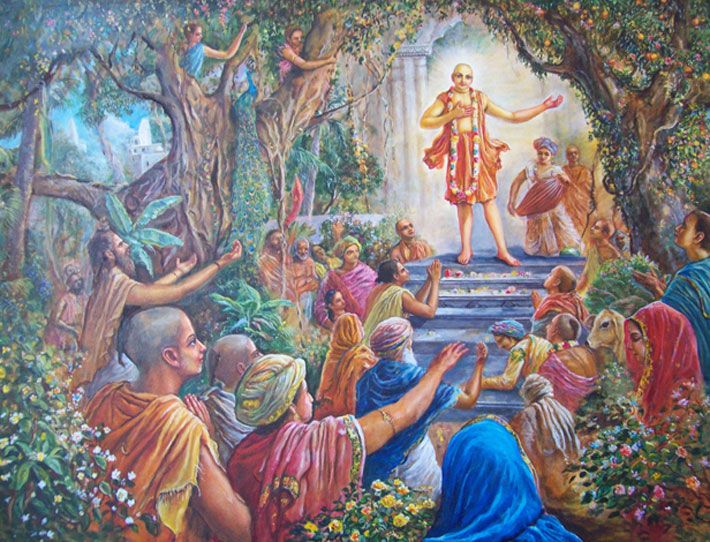
The place called Pānihāṭi was located on the bank of the Ganges. After hearing that Śrī Caitanya Mahāprabhu had arrived, all kinds of men assembled both on land and on the water. (203) At length Śrī Caitanya Mahāprabhu was taken away by Rāghava Paṇḍita. There was a great crowd assembled along the way, and the Lord reached Rāghava Paṇḍita’s residence with great difficulty. (204) The Lord stayed at Rāghava Paṇḍita’s place for only one day. The next morning, He went to Kumārahaṭṭa, where Śrīvāsa Ṭhākura lived. (205) From the house of Śrīvāsa Ṭhākura, the Lord went to the house of Śivānanda Sena and then to the house of Vāsudeva Datta. (206) The Lord remained some time at the house of Vidyā- vācaspati, but then, because it was too crowded, He went to Kuliyā. (207)
When the Lord stayed at the house of Mādhava dāsa, many hundreds of thousands of people came to see Him. (208) The Lord stayed there for seven days and delivered all kinds of offenders and sinners. (209) After leaving Kuliyā, Śrī Caitanya Mahāprabhu visited the house of Advaita Ācārya at Śāntipura. It was there that the Lord’s mother, Śacīmātā, met Him and was thus relieved of her great unhappiness. (210) The Lord then visited the village known as Rāmakeli and the place known as Kānāi Nāṭaśālā. From there He returned to Śāntipura. (211) Śrī Caitanya Mahāprabhu stayed in Śāntipura for ten days. This has all been described very elaborately by Vṛndāvana dāsa Ṭhākura. (212)
I will not narrate these incidents because they have already been described by Vṛndāvana dāsa Ṭhākura. There is no need to repeat the same information, for such repetition would unlimitedly increase the size of this book. (213) Those narrations tell how Śrī Caitanya Mahāprabhu met the brothers Rūpa and Sanātana and how Nṛsiṁhānanda decorated the road. I have already described these in an earlier synopsis of this book; therefore I will not repeat the narrations here. (214-215) When Śrī Caitanya Mahāprabhu returned to Śāntipura, Raghunātha dāsa came to meet Him. (216) Two brothers named Hiraṇya and Govardhana, who were residents of Saptagrāma, had an annual income of 1,200,000 rupees. (217)
Both Hiraṇya Majumadāra and Govardhana Majumadāra were very opulent and magnanimous. They were well behaved and devoted to brahminical culture. They belonged to an aristocratic family, and among religionists they were predominant. (218) Practically all the brāhmaṇas residing in Nadia were dependent on the charity of Hiraṇya and Govardhana, who gave them money, land and villages. (219) Nīlāmbara Cakravartī, the grandfather of Śrī Caitanya Mahāprabhu, was much worshiped by the two brothers, but Nīlāmbara Cakravartī used to treat them as his own brothers. (220) Formerly, these two brothers had rendered much service to Miśra Purandara, the father of Śrī Caitanya Mahāprabhu. Because of this, the Lord knew them very well. (221)
Raghunātha dāsa was the son of Govardhana Majumadāra. From childhood, he was uninterested in material enjoyment. (222) When Śrī Caitanya Mahāprabhu returned to Śāntipura after accepting the renounced order, Raghunātha dāsa met Him. (223) When Raghunātha dāsa went to see Śrī Caitanya Mahāprabhu, he fell at the Lord’s lotus feet in ecstatic love. Showing him mercy, the Lord touched him with His feet. (224) Raghunātha dāsa’s father, Govardhana, always rendered much service to Advaita Ācārya. Consequently Advaita Ācārya was very pleased with the family. (225) When Raghunātha dāsa was there, Advaita Ācārya favored him by giving him the food remnants left by the Lord. Raghunātha dāsa was thus engaged for five or seven days in rendering service to the Lord’s lotus feet. (226)
After bidding farewell to Raghunātha dāsa, Śrī Caitanya Mahāprabhu returned to Jagannātha Purī. After returning home, Raghunātha dāsa became mad with ecstatic love. (227) Raghunātha dāsa used to run away from home again and again to go to Jagannātha Purī, but his father kept binding him and bringing him back. (228) His father even had five watchmen guard him day and night. Four personal servants were employed to look after his comfort, and two brāhmaṇas were employed to cook for him. (229) In this way, eleven people were incessantly keeping Raghunātha dāsa under control. Thus he could not go to Jagannātha Purī, and because of this he was very unhappy. (230)
Deepen your Bhakti-yoga practice, harmonize relationships, and receive guided coaching — all at Vedavarsity.com