


At the end of the four- month Cāturmāsya period, Caitanya Mahāprabhu again consulted with Nityānanda Prabhu daily in a solitary place. No one could understand what Their consultation was about. (59) Then Śrīla Advaita Ācārya said something to Caitanya Mahāprabhu through gestures and read some poetic passages, which no one understood. (60) Seeing the face of Advaita Ācārya, Lord Śrī Caitanya Mahāprabhu smiled. Understanding that the Lord had accepted the proposal, Advaita Ācārya started to dance. (61) No one knew what Advaita Ācārya requested or what the Lord ordered. After embracing the Ācārya, Śrī Caitanya Mahāprabhu bade Him farewell. (62) Śrī Caitanya Mahāprabhu then told Nityānanda Prabhu, “Please hear Me, O holy man: I now request something of You. Kindly grant My request. (63) “Do not come to Jagannātha Purī every year, but stay in Bengal and fulfill My desire.” (64)
Śrī Caitanya Mahāprabhu continued, “You can perform a task that even I cannot do. But for You, I cannot find anyone in Gauḍa- deśa who can fulfill My mission there.” (65) Nityānanda Prabhu replied, “O Lord, You are the life, and I am the body. There is no difference between the body and life itself, but life is more important than the body. (66) “By Your inconceivable energy, You can do whatever You like, and whatever You make Me do, I do without restriction.” (67) In this way, Śrī Caitanya Mahāprabhu embraced Nityānanda Prabhu and bade Him farewell. He then bade farewell to all the other devotees. (68) As in the previous year, one of the inhabitants of Kulīna- grāma submitted a petition to the Lord, saying, “My Lord, kindly tell me what my duty is and how I should execute it.” (69) The Lord replied, “You should engage yourself in the service of the servants of Kṛṣṇa and always chant the holy name of Kṛṣṇa. If you do these two things, you will very soon attain shelter at Kṛṣṇa’s lotus feet.” (70)
The inhabitant of Kulīna- grāma said, “Please let me know who is actually a Vaiṣṇava and what his symptoms are.” Understanding his mind, Śrī Caitanya Mahāprabhu smiled and gave the following reply. (71) “A person who is always chanting the holy name of the Lord is to be considered a first- class Vaiṣṇava, and your duty is to serve his lotus feet.” (72) The following year, the inhabitants of Kulīna- grāma again asked the Lord the same question. Hearing this question, Śrī Caitanya Mahāprabhu again taught them about the different types of Vaiṣṇavas. (73) Śrī Caitanya Mahāprabhu said, “A first- class Vaiṣṇava is he whose very presence makes others chant the holy name of Kṛṣṇa.” (74) In this way, Śrī Caitanya Mahāprabhu taught the distinctions between different types of Vaiṣṇavas—the Vaiṣṇava, Vaiṣṇavatara and Vaiṣṇavatama. He thus successively explained all the symptoms of a Vaiṣṇava to the inhabitants of Kulīna- grāma. (75) Finally all the Vaiṣṇavas returned to Bengal, but that year Puṇḍarīka Vidyānidhi remained at Jagannātha Purī. (76)
Svarūpa Dāmodara Gosvāmī and Puṇḍarīka Vidyānidhi had a friendly, intimate relationship, and as far as discussing topics about Kṛṣṇa, they were situated on the same platform. (77) Puṇḍarīka Vidyānidhi initiated Gadādhara Paṇḍita for the second time, and on the day of Oḍana- ṣaṣṭhī Puṇḍarīka Vidyānidhi saw the festival. (78) When Puṇḍarīka Vidyānidhi saw that Lord Jagannātha was given a starched garment, he became a little hateful. In this way his mind was polluted. (79) That night the brothers Lord Jagannātha and Balarāma came to Puṇḍarīka Vidyānidhi and, smiling, began to slap him. (80) Although his cheeks were swollen from the slapping, Puṇḍarīka Vidyānidhi was very happy within. This incident has been elaborately described by Ṭhākura Vṛndāvana dāsa. (81) Every year the devotees of Bengal would come and stay with Śrī Caitanya Mahāprabhu to see the Ratha- yātrā festival. (82) Whatever happened during those years that is worth noting shall be described later. (83) Thus Śrī Caitanya Mahāprabhu passed four years. He spent the first two years on His tour in South India. (84)
The other two years, Śrī Caitanya Mahāprabhu wanted to go to Vṛndāvana, but He could not leave Jagannātha Purī because of Rāmānanda Rāya’s tricks. (85) During the fifth year, the devotees from Bengal came to see the Ratha- yātrā festival. After seeing it, they did not stay but returned to Bengal. (86) Then Śrī Caitanya Mahāprabhu placed a proposal before Sārvabhauma Bhaṭṭācārya and Rāmānanda Rāya. He embraced them and spoke sweet words. (87) Caitanya Mahāprabhu said, “My desire to go to Vṛndāvana has very much increased. Because of your tricks, I have not been able to go there for the past two years. (88) “This time I must go. Will you please give Me permission? Save for you two, I have no other resort. (89) “In Bengal I have two shelters—My mother and the river Ganges. Both of them are very merciful. (90) “I shall go to Vṛndāvana through Bengal and see both My mother and the river Ganges. Now would you two be pleased to give Me permission?” (91) When Sārvabhauma Bhaṭṭācārya and Rāmānanda Rāya heard these words, they began to consider that it was not at all good that they had played so many tricks on the Lord. (92)
They both said, “Now that the rainy season is here, it will be difficult for You to travel. It is better to wait for Vijayā- daśamī before departing for Vṛndāvana.” (93) Śrī Caitanya Mahāprabhu was very pleased to thus receive their permission. He waited until the rainy season passed, and when the day of Vijayā- daśamī arrived, He departed for Vṛndāvana. (94) The Lord collected whatever remnants of food were left by Lord Jagannātha. He also took remnants of the Lord’s kaḍāra ointment, sandalwood and ropes with Him. (95) After taking Lord Jagannātha’s permission early in the morning, Śrī Caitanya Mahāprabhu departed, and all the devotees of Orissa began following Him. (96) With great care Caitanya Mahāprabhu forbade the Orissan devotees to follow Him. Then, accompanied by His personal associates, He first went to Bhavānīpura. (97) After Lord Caitanya reached Bhavānīpura, Rāmānanda Rāya arrived on his palanquin, and Vāṇīnātha Rāya had a large quantity of prasādam sent to the Lord. (98)
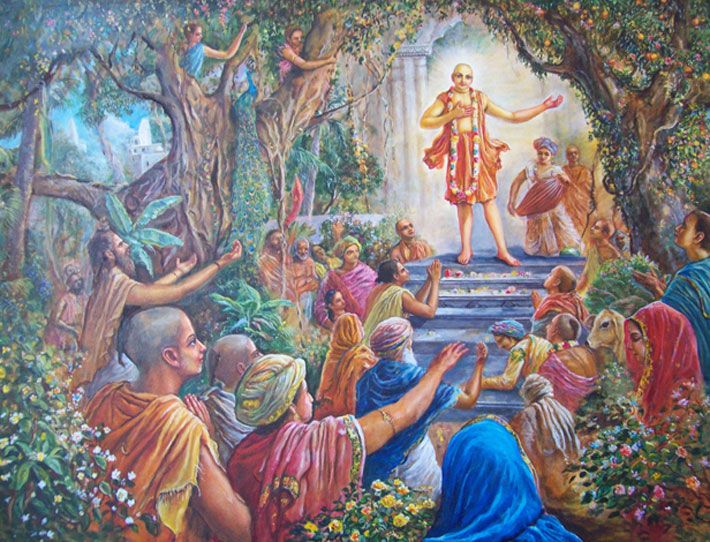
After taking prasādam, Śrī Caitanya Mahāprabhu remained there for the night. Early in the morning He began walking, and finally He reached Bhuvaneśvara. (99) After reaching the city of Kaṭaka, He saw the temple of Gopāla, and a brāhmaṇa there named Svapneśvara invited the Lord to eat. (100) Rāmānanda Rāya invited all the others for their meals, and Śrī Caitanya Mahāprabhu made His resting place in a garden outside the temple. (101) While Śrī Caitanya Mahāprabhu was taking rest beneath a bakula tree, Rāmānanda Rāya immediately went to Mahārāja Pratāparudra. (102) The King was very happy to hear the news, and he hastily went there. Upon seeing the Lord, he fell flat to offer Him obeisances. (103) Being overwhelmed with love, the King again and again got up and fell down. When he offered prayers, his whole body shivered, and tears fell from his eyes. (104)
Śrī Caitanya Mahāprabhu was very pleased to see the devotion of the King, and He therefore stood up and embraced him. (105) When the Lord embraced the King, the King again and again offered prayers and obeisances. In this way, the Lord’s mercy brought tears from the King, and the Lord’s body was bathed with these tears. (106) Finally Rāmānanda Rāya pacified the King and made him sit down. The Lord bestowed mercy upon him through His body, mind and words. (107) Śrī Caitanya Mahāprabhu showed such mercy to the King that from that day on the Lord became known as Pratāparudra- santrātā, the deliverer of Mahārāja Pratāparudra. (108) All the governmental officers also paid their respects to the Lord, and finally the King and his men were bade farewell by the son of mother Śacī. (109) The King then went outside and had orders written down and sent to the government servants within his kingdom. (110)
His orders read: “In every village you should construct new residences, and in five or seven new houses you should store all kinds of food. (111) “You should personally take the Lord to these newly constructed houses. Day and night you should engage in His service with a stick in your hands.” (112) The King ordered two respectable officers named Haricandana and Mardarāja to do whatever was necessary to carry out these orders. (113) The King also ordered them to maintain a new boat on the banks of the river, and wherever Śrī Caitanya Mahāprabhu took His bath or crossed to the other side of the river, they should establish a memorial column and make that place a great place of pilgrimage. “Indeed,” said the King, “I will take my bath there. And let me also die there.” (114 115)
The King continued, “At Caturdvāra, please construct new residential quarters. Now, Rāmānanda, you can return to Śrī Caitanya Mahāprabhu.” (116) When the King heard that the Lord was leaving that evening, he immediately made arrangements for some elephants with small tents on their backs to be brought there. Then all the ladies of the palace got on the elephants. (117) All these ladies went to the road the Lord was taking and remained there in a line. That evening, the Lord departed with His devotees. (118) When Śrī Caitanya Mahāprabhu went to the bank of the river Citrotpalā to take His bath, all the queens and ladies of the palace offered their obeisances to Him. (119) Upon seeing the Lord, they all felt themselves overwhelmed with love of Godhead, and, tears pouring from their eyes, they began to chant the holy name, “Kṛṣṇa! Kṛṣṇa!” (120)
Deepen your Bhakti-yoga practice, harmonize relationships, and receive guided coaching — all at Vedavarsity.com