Śrī Caitanya Mahāprabhu felt unlimited happiness upon hearing these descriptions, and He again and again requested Svarūpa Dāmodara to continue speaking. (154) Dāmodara Gosvāmī said, “Kṛṣṇa is the master of all transcendental mellows and the taster of all transcendental mellows, and His body is composed of transcendental bliss. (155) “Kṛṣṇa is full of ecstatic love and always subordinate to the love of His devotees. The gopīs are very much experienced in pure love and in the dealings of transcendental mellows. (156) “There is no flaw or adulteration in the love of the gopīs; therefore they give Kṛṣṇa the highest pleasure. (157) “‘Lord Śrī Kṛṣṇa, who is the Absolute Truth, enjoyed His rāsa dance every night during the autumn season. He performed this dance in the moonlight and with full transcendental mellows. He used poetic words and surrounded Himself with women who were very much attracted to Him.’ (158)
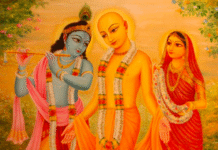
“The gopīs can be divided into a left wing and a right wing. Both wings induce Kṛṣṇa to taste transcendental mellows by various manifestations of ecstatic love. (159) “Of all the gopīs, Śrīmatī Rādhārāṇī is the chief. She is a jewel mine of ecstatic love and the source of all purified transcendental conjugal mellows. (160) “Rādhārāṇī is grown up, and Her character is equipoised. She is always deeply absorbed in ecstatic love and always feeling in the mood of a left- wing gopī. (161) “Because She is a left- wing gopī, Her womanly anger is always awakening, but Kṛṣṇa derives transcendental bliss from Her activities. (162) “‘The progress of loving affairs between a young boy and a young girl is by nature crooked, like the movement of a snake. Because of this, two types of anger arise between a young boy and girl—anger with a cause and anger without a cause.’” (163)
As Śrī Caitanya Mahāprabhu heard these talks, His ocean of transcendental bliss increased. He therefore told Svarūpa Dāmodara, “Go on speaking, go on speaking.” And thus Svarūpa Dāmodara continued. (164) “Śrīmatī Rādhārāṇī’s love is a highly advanced ecstasy. All Her dealings are completely pure and devoid of material tinge. Indeed, Her dealings are ten times purer than gold. (165) “As soon as Rādhārāṇī gets a chance to see Kṛṣṇa, Her body is suddenly decorated with various ecstatic ornaments. (166) “The transcendental ornaments of Śrīmatī Rādhārāṇī’s body include the eight sāttvikas, or transcendental symptoms, the thirty- three vyabhicārī- bhāvas, beginning with harṣa, or jubilation in natural love, and the twenty bhāvas, or ecstatic emotional ornaments. (167) “Some of the symptoms critically explained in the following verses are kila- kiñcita, kuṭṭamita, vilāsa, lalita, vivvoka, moṭṭāyita, maugdhya and cakita. (168)
“When Śrīmatī Rādhārāṇī’s body manifests the ornaments of many ecstatic symptoms, the ocean of Kṛṣṇa’s happiness immediately displays transcendental waves. (169) “Now hear a description of different ecstasies, beginning with kila- kiñcita. With these ecstatic ornaments, Śrīmatī Rādhārāṇī enchants the mind of Kṛṣṇa. (170) “When Śrī Kṛṣṇa sees Śrīmatī Rādhārāṇī and wants to touch Her body, He prohibits Her from going to the spot where one can cross the river Yamunā. (171) “Approaching Her, Kṛṣṇa prohibits Śrīmatī Rādhārāṇī from picking flowers. He may also touch Her in front of Her friends. (172) “At such times, the ecstatic symptoms of kila- kiñcita are awakened. First there is jubilation in ecstatic love, which is the root cause of these symptoms. (173) “‘Pride, ambition, weeping, smiling, envy, fear and anger are the seven ecstatic loving symptoms manifested by a jubilant shrinking away, and these symptoms are called kila- kiñcita- bhāva.’ (174)
“There are seven other transcendental ecstatic symptoms, and when they combine on the platform of jubilation, the combination is called mahā- bhāva. (175) “The seven combined ingredients of mahā- bhāva are pride, ambition, fear, dry artificial crying, anger, envy and mild smiling. (176) “There are eight symptoms of ecstatic love on the platform of transcendental jubilation, and when they are combined and tasted by Kṛṣṇa, the Lord’s mind is completely satisfied. (177) “Indeed, they are compared to a combination of yogurt, candy, ghee, honey, black pepper, camphor and cardamom, which, when mixed together, are very tasty and sweet. (178) “Lord Śrī Kṛṣṇa is thousands upon thousands of times more satisfied when He sees Śrīmatī Rādhārāṇī’s face light up from this combination of ecstatic love than He is by direct union with Her. (179)
“‘May the sight of Śrīmatī Rādhārāṇī’s kila- kiñcita ecstasy, which is like a bouquet, bring good fortune to all. When Śrī Kṛṣṇa blocked Rādhārāṇī’s way to the dāna- ghāṭi, there was laughter within Her heart. Her eyes grew bright, and fresh tears flowed from Her eyes, reddening them. Due to Her sweet relationship with Kṛṣṇa, Her eyes were enthusiastic, and when Her crying subsided, She appeared even more beautiful.’ (180) “‘Agitated by tears, Śrīmatī Rādhārāṇī’s eyes were tinged with red, just like the eastern horizon at sunrise. Her lips began to move with jubilation and lusty desire. Her eyebrows curved, and Her lotuslike face smiled mildly. Seeing Rādhārāṇī’s face exhibit such emotion, Lord Śrī Kṛṣṇa felt a million times happier than when He embraced Her. Indeed, Lord Śrī Kṛṣṇa’s happiness is not at all mundane.’” (181) Upon hearing this, Śrī Caitanya Mahāprabhu became very happy, and being absorbed in this happiness, He embraced Svarūpa Dāmodara Gosvāmī. (182)
Śrī Caitanya Mahāprabhu then asked Svarūpa Dāmodara, “Please speak of the ecstatic ornaments decorating the body of Śrīmatī Rādhārāṇī, by which She enchants the mind of Śrī Govinda.” (183) Being thus requested, Svarūpa Dāmodara began to speak. All the devotees of Śrī Caitanya Mahāprabhu were very happy to hear him. (184) “Sometimes when Śrīmatī Rādhārāṇī is sitting or when She is going to Vṛndāvana, She sees Kṛṣṇa. (185) “The symptoms of various ecstasies that become manifest at that time are called vilāsa. (186) “‘The various symptoms manifested in a woman’s face, eyes and the other parts of her body and the way she moves, stands or sits when she meets her beloved are called vilāsa.’” (187) Svarūpa Dāmodara said, “Timidity, jubilation, ambition, respect, fear and the characteristics of the left- wing gopīs are all ecstatic symptoms that combine to agitate Śrīmatī Rādhārāṇī. (188)
“‘When Śrīmatī Rādhārāṇī saw Lord Kṛṣṇa just before Her, Her progress stopped and She assumed an attitude of opposition. Although Her face was slightly covered by a blue garment, Her two starry eyes were agitated, being wide and curved. Thus She was decorated with the ornaments of vilāsa, and Her beauty increased to give pleasure to Śrī Kṛṣṇa, the Supreme Personality of Godhead.’ (189) “When Śrīmatī Rādhārāṇī stands before Kṛṣṇa, She stands bent in three places—Her neck, waist and legs— and Her eyebrows dance. (190) “When there is an awakening of the various ecstatic features on Śrīmatī Rādhārāṇī’s face and in Her eyes that are appropriate to a charming feminine attitude, the lalita ornament is manifest. (191) “‘When the bodily features are delicate and expertly curved, and when the eyebrows are very beautifully agitated, the ornament of feminine charm, called lalita alaṅkāra, is manifest.’ (192)
“When Lord Śrī Kṛṣṇa happens to see Śrīmatī Rādhārāṇī decorated with these lalita ornaments, They both eagerly want to meet each other. (193) “‘When Śrīmatī Rādhārāṇī was decorated with the ornament of lalita alaṅkāra, just to increase Śrī Kṛṣṇa’s love, an attractive curve was manifested by Her neck, knees and waist. This was brought about by Her timidity and apparent desire to avoid Kṛṣṇa. The flickering movements of Her eyebrows could conquer the powerful bow of Cupid. To increase the joy of Her beloved, Her body was decorated with the ornaments of lalita alaṅkāra.’ (194) “When Kṛṣṇa comes forward and greedily snatches at the border of Her sari, Śrīmatī Rādhārāṇī is actually very pleased within, but still She tries to stop Him. (195) “This ecstatic attitude of Śrīmatī Rādhārāṇī’s is called kuṭṭamita. When this ecstatic ornament is manifested, Rādhārāṇī externally tries to avoid Kṛṣṇa, and She apparently becomes angry, although She is very happy within. (196) “‘When the border of Her sari and the cloth veiling Her face are caught, She externally appears offended and angry, but within Her heart She is very happy. Learned scholars call this attitude kuṭṭamita.’ (197)
“Although Śrīmatī Rādhārāṇī was checking Kṛṣṇa with Her hand, internally She was thinking, ‘Let Kṛṣṇa satisfy His desires.’ In this way She was very pleased within, although She externally displayed opposition and anger. (198) “Śrīmatī Rādhārāṇī externally displays a kind of dry crying, as if She is offended. Then She mildly smiles and admonishes Lord Kṛṣṇa. (199) “‘Actually She has no desire to stop Kṛṣṇa’s endeavor to touch Her body with His hands, yet Śrīmatī Rādhārāṇī, whose thighs are like the trunk of a baby elephant, protests His advances and, sweetly smiling, admonishes Him. At such times She cries without tears on Her charming face.’ (200) “In this way, Śrīmatī Rādhārāṇī is ornamented and decorated with various ecstatic symptoms, which attract the mind of Śrī Kṛṣṇa. (201)
“It is not at all possible to describe the unlimited pastimes of Śrī Kṛṣṇa, even though He Himself describes them in His incarnation of Sahasra- vadana, the thousand- mouthed Śeṣa Nāga.” (202) At this time, Śrīvāsa Ṭhākura smiled and told Svarūpa Dāmodara, “My dear sir, please hear! Just see how opulent my goddess of fortune is! (203) “As far as Vṛndāvana’s opulence is concerned, it consists of a few flowers and twigs, some minerals from the hills, a few peacock feathers and the plant known as guñjā. (204) “When Jagannātha decided to see Vṛndāvana, He went there, and upon hearing this, the goddess of fortune experienced restlessness and jealousy. (205) “She wondered, ‘Why did Lord Jagannātha give up so much opulence and go to Vṛndāvana?’ To make Him a laughingstock, the goddess of fortune made arrangements for much decoration. (206)
“Then the maidservants of the goddess of fortune said to the servants of Lord Jagannātha, ‘Why did your Lord Jagannātha abandon the great opulence of the goddess of fortune and, for the sake of a few leaves, fruits and flowers, go see the flower garden of Śrīmatī Rādhārāṇī? (207) ‘Your master is so expert at everything, but why does He do such things? Now bring your master before the goddess of fortune.’ (208) “In this way all the maidservants of the goddess of fortune arrested the servants of Jagannātha, bound them around the waist and brought them before the goddess of fortune. (209) “When all the maidservants brought Lord Jagannātha’s servants before the lotus feet of the goddess of fortune, the Lord’s servants were fined and forced to submit. (210) “All the maidservants began to beat the Ratha car with sticks, and they treated the servants of Lord Jagannātha almost like thieves. (211)
“Finally all of Lord Jagannātha’s servants submitted to the goddess of fortune with folded hands, assuring her that they would bring Lord Jagannātha before her the very next day. (212) “Being thus pacified, the goddess of fortune returned to her apartment. Just see! My goddess of fortune is opulent beyond all description.” (213) Śrīvāsa Ṭhākura continued to address Svarūpa Dāmodara: “Your gopīs are engaged in boiling milk and churning it into yogurt, but my mistress, the goddess of fortune, sits on a throne made of jewels and gems.” (214) Śrīvāsa Ṭhākura, who was enjoying the mood of Nārada Muni, thus made jokes. Hearing him, all the personal servants of Śrī Caitanya Mahāprabhu began to smile. (215) Śrī Caitanya Mahāprabhu then told Śrīvāsa Ṭhākura, “My dear Śrīvāsa, your nature is exactly like that of Nārada Muni. The Supreme Personality of Godhead’s opulence is having a direct influence upon you. (216) “Svarūpa Dāmodara is a pure devotee of Vṛndāvana. He does not even know what opulence is, for he is simply absorbed in pure devotional service.” (217)
Svarūpa Dāmodara then retorted, “My dear Śrīvāsa, please hear me with attention. You have forgotten the transcendental opulence of Vṛndāvana. (218) “The natural opulence of Vṛndāvana is just like an ocean. The opulence of Dvārakā and Vaikuṇṭha is not even to be compared to a drop. (219) “Śrī Kṛṣṇa is the Supreme Personality of Godhead, full of all opulences, and His complete opulences are exhibited only in Vṛndāvana- dhāma. (220) “Vṛndāvana- dhāma is made of transcendental touchstone. Its entire surface is the source of all valuable jewels, and the cintāmaṇi stone is used to decorate the lotus feet of the maidservants of Vṛndāvana. (221) “Vṛndāvana is a natural forest of desire trees and creepers, and the inhabitants do not want anything but the fruits and flowers of those desire trees. (222)
“In Vṛndāvana there are cows that fulfill all desires [kāma- dhenus], and their number is unlimited. They graze from forest to forest and deliver only milk. The people want nothing else. (223) “In Vṛndāvana, the natural speech of the people sounds like music, and their natural motion resembles a dance. (224) “The water in Vṛndāvana is nectar, and the brahmajyoti effulgence, which is full of transcendental bliss, is directly perceived there in its form. (225) “The gopīs there are also goddesses of fortune, and they surpass the goddess of fortune who abides in Vaikuṇṭha. In Vṛndāvana, Lord Kṛṣṇa is always playing His transcendental flute, which is His dear companion. (226) “‘The damsels of Vṛndāvana, the gopīs, are super goddesses of fortune. The enjoyer in Vṛndāvana is the Supreme Personality of Godhead, Kṛṣṇa. The trees there are all wish- fulfilling trees, and the land is made of transcendental touchstone. The water is all nectar, the talking is singing, the walking is dancing, and the constant companion of Kṛṣṇa is His flute. The effulgence of transcendental bliss is experienced everywhere. Therefore Vṛndāvana- dhāma is the only relishable abode.’ (227)
“‘The anklets on the damsels of Vraja- bhūmi are made of cintāmaṇi stone. The trees are wish- fulfilling trees, and they produce flowers with which the gopīs decorate themselves. There are also wish- fulfilling cows [kāma- dhenus], which deliver unlimited quantities of milk. These cows constitute the wealth of Vṛndāvana. Thus Vṛndāvana’s opulence is blissfully exhibited.’” (228) Śrīvāsa Ṭhākura then began to dance in ecstatic love. He vibrated sounds by slapping his armpits with the palms of his hands, and he laughed very loudly. (229) Thus Śrī Caitanya Mahāprabhu heard these discussions about the pure transcendental mellow of Śrīmatī Rādhārāṇī. Absorbed in transcendental ecstasy, the Lord began to dance. (230) While Śrī Caitanya Mahāprabhu was dancing in ecstatic love and Svarūpa Dāmodara was singing, the Lord said, “Go on singing! Go on singing!” The Lord then extended His own ears. (231) Thus Śrī Caitanya Mahāprabhu’s ecstatic love was awakened by hearing the songs of Vṛndāvana. In this way He inundated Puruṣottama, Jagannātha Purī, with love of Godhead. (232)
Deepen your Bhakti-yoga practice, harmonize relationships, and receive guided coaching — all at Vedavarsity.com