


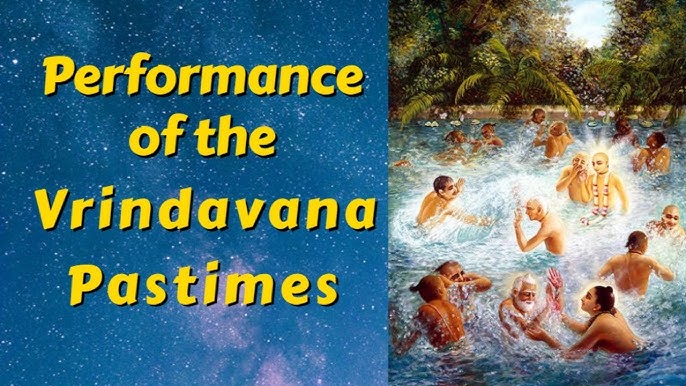
There were many gardens near the Guṇḍicā temple, and Śrī Caitanya Mahāprabhu and His devotees used to perform the pastimes of Vṛndāvana in each of them. In the lake named Indradyumna, He sported in the water. (75) The Lord personally splashed all the devotees with water, and the devotees, surrounding Him on all sides, also splashed the Lord. (76) While in the water they sometimes formed one circle and sometimes many circles, and while in the water they used to play cymbals and imitate the croaking of frogs. (77) Sometimes two would pair off to fight in the water. One would emerge victorious and the other defeated, and the Lord would watch all this fun. (78)
The first sporting took place between Advaita Ācārya and Nityānanda Prabhu, who threw water upon each other. Advaita Ācārya was defeated, and He later began to rebuke Nityānanda Prabhu, calling Him ill names. (79) Svarūpa Dāmodara and Vidyānidhi also threw water upon each other, and Murāri Gupta and Vāsudeva Datta also sported in that way. (80) Another duel took place between Śrīvāsa Ṭhākura and Gadādhara Paṇḍita, and yet another between Rāghava Paṇḍita and Vakreśvara Paṇḍita. Thus they all engaged in throwing water. (81) Indeed, Sārvabhauma Bhaṭṭācārya engaged in water sports with Śrī Rāmānanda Rāya, and they both lost their gravity and became like children. (82)
When Śrī Caitanya Mahāprabhu saw the exuberance of Sārvabhauma Bhaṭṭācārya and Rāmānanda Rāya, He smiled and spoke to Gopīnātha Ācārya. (83) “Tell the Bhaṭṭācārya and Rāmānanda Rāya to stop their childish play because they are both learned scholars and very grave and great personalities.” (84) Gopīnātha Ācārya replied, “I believe that one drop of the ocean of Your great mercy has swelled up upon them. (85) “A drop from the ocean of Your mercy can drown great mountains like Sumeru and Mandara. Since these two gentlemen are little hills by comparison, it is no wonder that they are being drowned in the ocean of Your mercy. (86) “Logic is like a dry oil cake from which all the oil has been extracted. The Bhaṭṭācārya passed his life in eating such dry cakes, but now You have made him drink the nectar of transcendental pastimes. It is certainly Your great mercy upon him.” (87)
After Gopīnātha Ācārya finished talking, Śrī Caitanya Mahāprabhu smiled and, calling for Advaita Ācārya, made Him act like the Śeṣa Nāga bed. (88) Lying down on Advaita Prabhu, who was floating on the water, Śrī Caitanya Mahāprabhu demonstrated the pastime of Śeṣaśāyī Viṣṇu. (89) Manifesting His personal potency, Advaita Ācārya floated about on the water, carrying Śrī Caitanya Mahāprabhu. (90) After sporting in the water for some time, Śrī Caitanya Mahāprabhu returned to His place at Aiṭoṭā, accompanied by His devotees. (91) Paramānanda Purī, Brahmānanda Bhāratī and all the other chief devotees of Śrī Caitanya Mahāprabhu took lunch at the invitation of Advaita Ācārya. (92) Whatever extra prasādam was brought by Vāṇīnātha Rāya was taken by the other associates of Śrī Caitanya Mahāprabhu. (93)
In the afternoon, Śri Caitanya Mahāprabhu went to the Guṇḍicā temple to visit the Lord and dance. At night He went to the garden to take rest. (94) The next day, Śrī Caitanya Mahāprabhu also went to the temple of Guṇḍicā and saw the Lord. He then chanted and danced in the yard for some time. (95) Accompanied by His devotees, Śrī Caitanya Mahāprabhu then went into the garden and enjoyed the pastimes of Vṛndāvana. (96) There were multifarious trees and creepers in the garden, and they were all jubilant to see Śrī Caitanya Mahāprabhu. Indeed, the birds were chirping, the bees were buzzing, and a cool breeze was blowing. (97) As Śrī Caitanya Mahāprabhu danced beneath each and every tree, Vāsudeva Datta sang alone. (98)
As Vāsudeva Datta sang a different song beneath each and every tree, Śrī Caitanya Mahāprabhu danced there alone in great ecstasy. (99) Śrī Caitanya Mahāprabhu then ordered Vakreśvara Paṇḍita to dance, and as he began to dance, the Lord began to sing. (100) Then devotees like Svarūpa Dāmodara and other kīrtana performers began to sing along with Śrī Caitanya Mahāprabhu. Being inundated with ecstatic love, they lost all consideration of time and circumstance. (101) After thus performing pastimes in the garden for some time, they all went to a lake called Narendra- sarovara and there enjoyed sporting in the water. (102) After sporting in the water, Śrī Caitanya Mahāprabhu returned to the garden and accepted prasādam with the devotees. (103) For nine continuous days His Lordship Śrī Jagannātha- deva stayed at the Guṇḍicā temple. During this time Śrī Caitanya Mahāprabhu also stayed there and performed the pastimes with His devotees that have already been described. (104)
The garden of His pastimes was very large and was named Jagannātha- vallabha. Śrī Caitanya Mahāprabhu took His rest there for nine days. (105) Knowing that the Herā- pañcamī festival was drawing near, King Pratāparudra attentively talked with Kāśī Miśra. (106) “Tomorrow will be the function of Herā- pañcamī or Lakṣmī- vijaya. Hold this festival in a way that it has never been held before.” (107) King Pratāparudra said, “Hold this festival in such a gorgeous way that upon seeing it Caitanya Mahāprabhu will be completely pleased and astonished. (108) “Take as many printed cloths, small bells, umbrellas and cāmaras as there are in my storehouse and in the Deity’s storehouse. (109) “Collect all kinds of small and large flags and ringing bells. Then decorate the carrier and have various musical and dancing parties accompany it. In this way decorate the carrier attractively. (110)
“You should also double the quantity of prasādam. Make so much that it will even surpass the Ratha- yātrā festival. (111) “Arrange the festival in such a way that Śrī Caitanya Mahāprabhu may freely go with His devotees to visit the Deity without difficulty.” (112) In the morning, Śrī Caitanya Mahāprabhu took His personal associates with Him to see Lord Jagannātha at Sundarācala. (113) Then Śrī Caitanya Mahāprabhu and His personal devotees returned to Nīlācala with great eagerness to see the Herā- pañcamī festival. (114) Kāśī Miśra received Caitanya Mahāprabhu with great respect, and taking the Lord and His associates to a very nice place, he had them seated. (115) After taking His seat, Śrī Caitanya Mahāprabhu wanted to hear about a particular mellow of devotional service; therefore, mildly smiling, He began to question Svarūpa Dāmodara. (116) “Although Lord Jagannātha enjoys His pastimes at Dvārakā- dhāma and naturally manifests sublime liberality there, still, once a year He becomes unlimitedly eager to see Vṛndāvana.” (117-118)
Pointing out the neighboring gardens, Śrī Caitanya Mahāprabhu said, “All these gardens exactly resemble Vṛndāvana; therefore Lord Jagannātha is very eager to see them again. (119) “Externally He gives the excuse that He wants to participate in the Ratha- yātrā festival, but actually He wants to leave Jagannātha Purī to go to Sundarācala, the Guṇḍicā temple, a replica of Vṛndāvana. (120) “The Lord enjoys His pastimes day and night in various flower gardens there. But why does He not take Lakṣmīdevī, the goddess of fortune, with Him?” (121) Svarūpa Dāmodara replied, “My dear Lord, please hear the reason for this. Lakṣmīdevī, the goddess of fortune, cannot be admitted to the pastimes of Vṛndāvana. (122) “In the pastimes of Vṛndāvana, the only assistants are the gopīs. But for the gopīs, no one can attract the mind of Kṛṣṇa.” (123) The Lord said, “Using the car festival as an excuse, Kṛṣṇa goes there with Subhadrā and Baladeva. (124)
“All the pastimes with the gopīs that take place in those gardens are very confidential ecstasies of Lord Kṛṣṇa. No one knows them. (125) “Since there is no fault at all in Kṛṣṇa’s pastimes, why does the goddess of fortune become angry?” (126) Svarūpa Dāmodara replied, “It is the nature of a girl afflicted by love to become immediately angry upon finding any neglect on the part of her lover.” (127) While Svarūpa Dāmodara and Śrī Caitanya Mahāprabhu were talking, the procession of the goddess of fortune came by. She was riding upon a golden palanquin carried by four men and bedecked with a variety of jewels. (128) The palanquin was also surrounded by people carrying umbrellas, cāmara whisks and flags, and it was preceded by musicians and dancing girls. (129)
The maidservants were carrying water pitchers, cāmara whisks and boxes for betel nuts. There were hundreds of maidservants, all attractively dressed and wearing valuable necklaces. (130) In an angry mood, the goddess of fortune arrived at the main gate of the temple accompanied by many members of her family, all of whom exhibited uncommon opulence. (131) When the procession arrived, the maidservants of the goddess of fortune began to arrest all the principal servants of Lord Jagannātha. (132) The maidservants bound the servants of Jagannātha, handcuffed them and made them fall down at the lotus feet of the goddess of fortune. Indeed, they were arrested just like thieves who have all their riches taken away. (133) When the servants fell down before the lotus feet of the goddess of fortune, they almost fell unconscious. They were chastised and made the butt of jokes and loose language. (134)
When Śrī Caitanya Mahāprabhu’s associates saw such impudence exhibited by the maidservants of the goddess of fortune, they covered their faces with their hands and began to smile. (135) Svarūpa Dāmodara said, “There is no egoistic pride like this within the three worlds. At least I have never seen it or heard of it. (136) “When a woman is neglected and disappointed, out of egoistic pride she gives up her ornaments and morosely sits down on the ground, marking lines on it with her nails. (137) “I have heard of this kind of pride in Satyabhāmā, Kṛṣṇa’s proudest queen, and I have also heard of it in the gopīs of Vṛndāvana, who are the reservoirs of all transcendental mellows. (138) “But in the case of the goddess of fortune, I see a different kind of pride. She manifests her own opulences and even goes with her soldiers to attack her husband.” (139) Śrī Caitanya Mahāprabhu said, “Please tell me of the varieties of egoistic pride manifested in Vṛndāvana.” Svarupa Dāmodara replied, “The pride of the gopīs is like a river flowing with hundreds of tributaries. (140)
“The characteristics and modes of love are different in different women. Their jealous anger also takes on different varieties and qualities. (141) “It is not possible to give a complete statement about the different types of jealous anger manifest by the gopīs, but a few principles may serve as an indication. (142) “There are three types of women experiencing jealous anger: sober women, restless women and women both restless and sober. (143) “When a sober heroine sees her hero approaching from a distance, she immediately stands up to receive him. When he comes near, she immediately offers him a place to sit. (144) “The sober heroine conceals her anger within her heart and externally speaks sweet words. When her lover embraces her, she returns his embrace. (145) “The sober heroine is very simple in her behavior. She keeps her jealous anger within her heart, but with mild words and smiles she rejects the advances of her lover. (146)
“The restless heroine, however, sometimes chastises her lover with cruel words, sometimes pulls his ear and sometimes binds him with a flower garland. (147) “The heroine who is a combination of sobriety and restlessness always jokes with equivocal words. She sometimes praises her lover, sometimes blasphemes him and sometimes remains indifferent. (148) “Heroines may also be classified as captivated, intermediate and impudent. The captivated heroine does not know very much about the cunning intricacies of jealous anger. (149) “The captivated heroine simply covers her face and goes on crying. When she hears sweet words from her lover, she is very satisfied. (150) “Both the intermediate and impudent heroines can be classified as sober, restless and both sober and restless. All their characteristics can be further classified in three divisions. (151) “Some of these heroines are very talkative, some are mild, and some are equipoised. Each heroine, according to her own character, increases Śrī Kṛṣṇa’s loving ecstasy. (152) “Although some of the gopīs are talkative, some mild and some equipoised, all of them are transcendental and faultless. They please Kṛṣṇa by their unique characteristics.” (153)
Deepen your Bhakti-yoga practice, harmonize relationships, and receive guided coaching — all at Vedavarsity.com