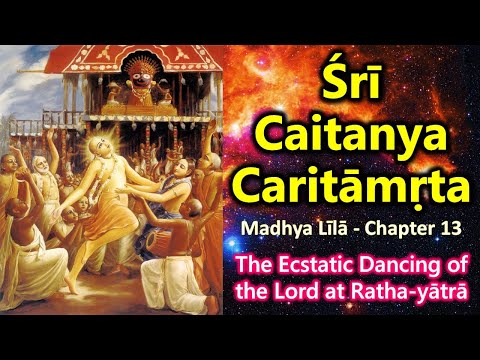
Now please hear about Lord Jagannātha’s going to the Guṇḍicā temple while Śrī Caitanya Mahāprabhu danced before the Ratha car. (70) The Lord performed kīrtana for some time and, through His own endeavor, inspired all the devotees to dance. (71) When the Lord Himself wanted to dance, all seven groups combined together. (72) The Lord’s devotees— including Śrīvāsa, Rāmāi, Raghu, Govinda, Mukunda, Haridāsa, Govindānanda, Mādhava and Govinda—all combined together. (73) When Śrī Caitanya Mahāprabhu desired to jump high while dancing, He placed these nine people in the charge of Svarūpa Dāmodara. (74) These devotees [Svarūpa Dāmodara and the devotees in his charge] sang along with the Lord, and they also ran beside Him. All the other groups of men also sang. (75)
Offering obeisances to the Lord with folded hands, Śrī Caitanya Mahāprabhu raised His face toward Jagannātha and prayed as follows. (76) “‘Let me offer my respectful obeisances unto Lord Kṛṣṇa, who is the worshipable Deity for all brahminical men, who is the well- wisher of cows and brāhmaṇas, and who is always benefiting the whole world. I offer my repeated obeisances to the Personality of Godhead, known as Kṛṣṇa and Govinda.’ (77) “‘All glories unto the Supreme Personality of Godhead, who is known as the son of Devakī! All glories to the Supreme Personality of Godhead, who is known as the light of the dynasty of Vṛṣṇi! All glories to the Supreme Personality of Godhead, whose bodily luster is like that of a new cloud, and whose body is as soft as a lotus flower! All glories to the Supreme Personality of Godhead, who appeared on this planet to deliver the world from the burden of demons, and who can offer liberation to everyone!’ (78)
“‘Lord Śrī Kṛṣṇa is He who is known as jana- nivāsa, the ultimate resort of all living entities, and who is also known as Devakī- nandana or Yaśodā- nandana, the son of Devakī and Yaśodā. He is the guide of the Yadu dynasty, and with His mighty arms He kills everything inauspicious, as well as every man who is impious. By His presence He destroys all things inauspicious for all living entities, moving and inert. His blissful smiling face always increases the lusty desires of the gopīs of Vṛndāvana. May He be all- glorious and happy!’ (79) “‘I am not a brāhmaṇa, I am not a kṣatriya, I am not a vaiśya or a śūdra. Nor am I a brahmacārī, a householder, a vānaprastha or a sannyāsī. I identify Myself only as the servant of the servant of the servant of the lotus feet of Lord Śrī Kṛṣṇa, the maintainer of the gopīs. He is like an ocean of nectar, and He is the cause of universal transcendental bliss. He is always existing with brilliance.’” (80)
Having recited all these verses from scripture, the Lord again offered His obeisances, and all the devotees, with folded hands, also offered prayers to the Supreme Personality of Godhead. (81) When Śrī Caitanya Mahāprabhu danced and jumped high, roaring like thunder and moving in a circle like a wheel, He appeared like a circling firebrand. (82) Wherever Śrī Caitanya Mahāprabhu stepped while dancing, the whole earth, with its hills and seas, appeared to tilt. (83) When Caitanya Mahāprabhu danced, He displayed various blissful transcendental changes in His body. Sometimes He appeared as though stunned. Sometimes the hairs of His body stood on end. Sometimes He perspired, cried, trembled and changed color, and sometimes He exhibited symptoms of helplessness, pride, exuberance and humility. (84) When Śrī Caitanya Mahāprabhu fell down with a crash while dancing, He would roll on the ground. At such times it appeared that a golden mountain was rolling on the ground. (85)
Nityānanda Prabhu would stretch out His two hands and try to catch the Lord when He was running here and there. (86) Advaita Ācārya would walk behind the Lord and loudly chant “Haribol! Haribol!” again and again. (87) Just to check the crowds from coming too near the Lord, the devotees formed three circles. The first circle was guided by Nityānanda Prabhu, who is Balarāma Himself, the possessor of great strength. (88) All the devotees headed by Kāśīśvara and Govinda linked hands and formed a second circle around the Lord. (89) Mahārāja Pratāparudra and his personal assistants formed a third circle around the two inner circles just to check the crowds from coming too near. (90) With his hands on the shoulders of Haricandana, King Pratāparudra could see Lord Caitanya Mahāprabhu dancing, and the King felt great ecstasy. (91) While the King beheld the dancing, Śrīvāsa Ṭhākura, standing in front of him, became ecstatic as he saw the dancing of Śrī Caitanya Mahāprabhu. (92)
Seeing Śrīvāsa Ṭhākura standing before the King, Haricandana touched Śrīvāsa with his hand and requested him to step aside. (93) Absorbed in watching Śrī Caitanya Mahāprabhu dance, Śrīvāsa Ṭhākura could not understand why he was being touched and pushed. After he was pushed again and again, he became angry. (94) Śrīvāsa Ṭhākura slapped Haricandana to stop him from pushing him. In turn, this made Haricandana angry. (95) As the angered Haricandana was about to speak to Śrīvāsa Ṭhākura, Pratāparudra Mahārāja personally stopped him. (96) King Pratāparudra said, “You are very fortunate, for you have been graced by the touch of Śrīvāsa Ṭhākura. I am not so fortunate. You should feel obliged to him.” (97) Everyone was astonished by the dancing of Caitanya Mahāprabhu, and even Lord Jagannātha became extremely happy to see Him. (98) The car came to a complete standstill and remained immobile while Lord Jagannātha, with unblinking eyes, watched the dancing of Śrī Caitanya Mahāprabhu. (99) The goddess of fortune, Subhadrā, and Lord Balarāma both felt great happiness and ecstasy within their hearts. Indeed, they were seen smiling at the dancing. (100)
When Caitanya Mahāprabhu danced and jumped high, eight wonderful transformations indicative of divine ecstasy were seen in His body. All these symptoms were visible simultaneously. (101) His skin erupted with goose pimples, and the hairs of His body stood on end. His body resembled the śimulī [silk cotton tree], all covered with thorns. (102) Indeed, the people became afraid just to see His teeth chatter, and they even thought that His teeth would fall out. (103) Śrī Caitanya Mahāprabhu’s whole body flowed with perspiration and at the same time oozed blood. He made the sounds “jaja gaga, jaja gaga” in a voice choked with ecstasy. (104) Tears came forcefully from the eyes of the Lord, as if from a syringe, and all the people surrounding Him became wet. (105) Everyone saw the complexion of His body change from white to pink, so that His luster resembled that of the mallikā flower. (106) Sometimes He appeared stunned, and sometimes He rolled on the ground. Indeed, sometimes His legs and hands became as hard as dry wood, and He did not move. (107)
When the Lord fell to the ground, sometimes His breathing almost stopped. When the devotees saw this, their lives also became very feeble. (108) Water flowed from His eyes and sometimes through His nostrils, and foam fell from His mouth. These flowings appeared to be torrents of nectar descending from the moon. (109) The foam that fell from the mouth of Śrī Caitanya Mahāprabhu was taken and drunk by Śubhānanda because he was very fortunate and expert in relishing the mellow of ecstatic love of Kṛṣṇa. (110) After Śrī Caitanya Mahāprabhu had performed His devastating dance for some time, His mind entered into a mood of ecstatic love. (111) After abandoning the dancing, the Lord ordered Svarūpa Dāmodara to sing. Understanding His mind, Svarūpa Dāmodara began to sing as follows. (112) “‘Now I have gained the Lord of My life, in the absence of whom I was being burned by Cupid and was withering away.’” (113) When this refrain was loudly sung by Svarūpa Dāmodara, Śrī Caitanya Mahāprabhu again began rhythmically dancing in transcendental bliss. (114)
The car of Lord Jagannātha began to move slowly while the son of mother Śacī went ahead and danced in front. (115) While dancing and singing, all the devotees in front of Lord Jagannātha kept their eyes on Him. Caitanya Mahāprabhu then went to the end of the procession with the saṅkīrtana performers. (116) His eyes and mind fully absorbed in Lord Jagannātha, Caitanya Mahāprabhu began to play the drama of the song with His two arms. (117) When Caitanya Mahāprabhu was dramatically enacting the song, He would sometimes fall behind in the procession. At such times, Lord Jagannātha would come to a standstill. When Caitanya Mahāprabhu again went forward, Lord Jagannātha’s car would slowly start again. (118) Thus there was a sort of competition between Caitanya Mahāprabhu and Lord Jagannātha in seeing who would lead, but Caitanya Mahāprabhu was so strong that He made Lord Jagannātha wait in His car. (119)
While Śrī Caitanya Mahāprabhu was dancing, His ecstasy changed. Raising His two arms, He began to recite the following verse in a loud voice. (120) “‘That very personality who stole away my heart during my youth is now again my master. These are the same moonlit nights of the month of Caitra. The same fragrance of mālatī flowers is there, and the same sweet breezes are blowing from the kadamba forest. In our intimate relationship, I am also the same lover, yet still my mind is not happy here. I am eager to go back to that place on the bank of the Revā under the Vetasī tree. That is my desire.’” (121) This verse was recited by Śrī Caitanya Mahāprabhu again and again. But for Svarūpa Dāmodara, no one could understand its meaning. (122) I have already explained this verse. Now I shall simply describe it in brief. (123) Formerly, all the gopīs of Vṛndāvana were very pleased when they met with Kṛṣṇa in the holy place Kurukṣetra. (124)
Similarly, after seeing Lord Jagannātha, Śrī Caitanya Mahāprabhu awoke with the ecstasy of the gopīs. Being absorbed in this ecstasy, He asked Svarūpa Dāmodara to sing the refrain. (125) Śrī Caitanya Mahāprabhu spoke thus to Lord Jagannātha: “You are the same Kṛṣṇa, and I am the same Rādhārāṇī. We are meeting again in the same way that We met in the beginning of Our lives. (126) “Although We are both the same, My mind is still attracted to Vṛndāvana- dhāma. I wish that You will please again appear with Your lotus feet in Vṛndāvana. (127) “In Kurukṣetra there are crowds of people, elephants and horses, and also the rattling of chariots. But in Vṛndāvana there are flower gardens, and the humming of the bees and chirping of the birds can be heard. (128) “Here at Kurukṣetra You are dressed like a royal prince, accompanied by great warriors, but in Vṛndāvana You appeared just like an ordinary cowherd boy, accompanied only by Your beautiful flute. (129) “Here there is not even a drop of the ocean of transcendental happiness that I enjoyed with You in Vṛndāvana. (130)
“I therefore request You to come to Vṛndāvana and enjoy pastimes with Me. If You do so, My ambition will be fulfilled.” (131) I have already described in brief Śrīmatī Rādhārāṇī’s statement from Śrīmad- Bhāgavatam. (132) In that ecstatic mood, Śrī Caitanya Mahāprabhu recited many other verses, but people in general could not understand their meaning. (133) The meaning of those verses was known to Svarūpa Dāmodara Gosvāmī, but he did not reveal it. However, Śrī Rūpa Gosvāmī has broadcast the meaning. (134) While dancing, Śrī Caitanya Mahāprabhu began to recite the following verse, which He tasted in the association of Svarūpa Dāmodara Gosvāmī. (135) “[The gopīs spoke thus:] ‘Dear Lord, whose navel is just like a lotus flower, Your lotus feet are the only shelter for those who have fallen into the deep well of material existence. Your feet are worshiped and meditated upon by great mystic yogīs and highly learned philosophers. We wish that these lotus feet may also be awakened within our hearts, although we are only ordinary persons engaged in household affairs.’” (136)
Speaking in the mood of Śrīmatī Rādhārāṇī, Caitanya Mahāprabhu said, “For most people, the mind and heart are one, but because My mind is never separated from Vṛndāvana, I consider My mind and Vṛndāvana to be one. My mind is already Vṛndāvana, and since You like Vṛndāvana, will You please place Your lotus feet there? I would deem that Your full mercy. (137) “My dear Lord, kindly hear My true submission. My home is Vṛndāvana, and I wish Your association there. But if I do not get it, then it will be very difficult for Me to keep My life.(138) “My dear Kṛṣṇa, formerly, when You were staying in Mathurā, You sent Uddhava to teach Me speculative knowledge and mystic yoga. Now You Yourself are speaking the same thing, but My mind doesn’t accept it. There is no place in My mind for jñāna- yoga or dhyāna- yoga. Although You know Me very well, You are still instructing Me in jñāna- yoga and dhyāna- yoga. It is not right for You to do so.” (139)
Caitanya Mahāprabhu continued, “I would like to withdraw My consciousness from You and engage it in material activities, but even though I try, I cannot do so. I am naturally inclined to You only. Your instructions for Me to meditate on You are therefore simply ludicrous. In this way, You are killing Me. It is not very good for You to think of Me as a candidate for Your instructions. (140) “The gopīs are not like the mystic yogīs. They will never be satisfied simply by meditating on Your lotus feet and imitating the so- called yogīs. Teaching the gopīs about meditation is another kind of duplicity. When they are instructed to undergo mystic yoga practice, they are not at all satisfied. On the contrary, they become more and more angry with You.” (141)
Śrī Caitanya Mahāprabhu continued, “The gopīs have fallen into the great ocean of separation and are being devoured by the timiṅgila fish of their ambition to serve You. The gopīs are to be delivered from the mouths of these timiṅgila fish, for they are pure devotees. Since they have no material conception of life, why should they aspire for liberation? The gopīs do not want that liberation desired by yogīs and jñānīs, for they are already liberated from the ocean of material existence. (142) “It is amazing that You have forgotten the land of Vṛndāvana. And how is it that You have forgotten Your father, mother and friends? How have You forgotten Govardhana Hill, the bank of the Yamunā and the forest where You enjoyed the rāsa- līlā dance? (143) “Kṛṣṇa, You are certainly a refined gentleman with all good qualities. You are well- behaved, softhearted and merciful. I know that there is not even a tinge of fault to be found in You. Yet Your mind does not even remember the inhabitants of Vṛndāvana. This is only My misfortune, and nothing else. (144)
“I do not care for My personal unhappiness, but when I see the morose face of mother Yaśodā and the hearts of all the inhabitants of Vṛndāvana breaking because of You, I wonder whether You want to kill them all. Or do You want to enliven them by coming there? Why are You simply keeping them alive in a state of suffering? (145) “The inhabitants of Vṛndāvana do not want You dressed like a prince, nor do they want You to associate with great warriors in a different country. They cannot leave the land of Vṛndāvana, and without Your presence, they are all dying. What is their condition to be? (146)
“My dear Kṛṣṇa, You are the life and soul of Vṛndāvana- dhāma. You are especially the life of Nanda Mahārāja. You are the only opulence in the land of Vṛndāvana, and You are very merciful. Please come and let all the residents of Vṛndāvana live. Kindly keep Your lotus feet again in Vṛndāvana.” (147) After hearing Śrīmatī Rādhārāṇī’s statements, Lord Kṛṣṇa’s love for the inhabitants of Vṛndāvana was evoked, and His body and mind became very much perturbed. After hearing of their love for Him, He immediately thought Himself to be always indebted to the residents of Vṛndāvana. Then Kṛṣṇa began to pacify Śrīmatī Rādhārāṇī as follows. (148) “My dearest Śrīmatī Rādhārāṇī, please hear Me. I am speaking the truth. I cry day and night simply upon remembering all you inhabitants of Vṛndāvana. No one knows how unhappy this makes Me.” (149)
Deepen your Bhakti-yoga practice, harmonize relationships, and receive guided coaching — all at Vedavarsity.com