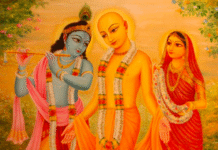
The prince, just entering upon his youth, was very beautiful. He was blackish in complexion and had large lotus eyes. (58) The prince was dressed in yellow cloth, and there were jeweled ornaments decorating his body. Therefore anyone who saw him would remember Lord Kṛṣṇa. (59) Seeing the boy, Śrī Caitanya Mahāprabhu immediately remembered Kṛṣṇa. Meeting the boy in ecstatic love, the Lord began to speak. (60)“Here is a great devotee,” Śrī Caitanya Mahāprabhu said. “Upon seeing him, everyone can remember the Supreme Personality of Godhead, Kṛṣṇa, son of Mahārāja Nanda.” (61) Śrī Caitanya Mahāprabhu continued, “I have become very much obligated just by seeing this boy.” After saying this, the Lord again embraced the prince. (62)
As soon as the prince was touched by Lord Śrī Caitanya Mahāprabhu, symptoms of ecstatic love immediately manifested themselves in his body. These symptoms included perspiration, trembling, tears, being stunned and jubilation. (63) The boy began to cry and dance, and he chanted, “Kṛṣṇa! Kṛṣṇa!” Upon seeing his bodily symptoms and his chanting and dancing, all the devotees praised him for his great spiritual fortune. (64) At that time, Śrī Caitanya Mahāprabhu calmed the youth and ordered him to come there daily to meet Him. (65) Rāmānanda Rāya and the boy then departed from Śrī Caitanya Mahāprabhu, and Rāmānanda took him back to the King’s palace. The King was very happy when he heard of his son’s activities. (66) Just by embracing his son, the King was filled with ecstatic love, just as if he had touched Śrī Caitanya Mahāprabhu directly. (67) From then on, the fortunate prince was one of the most intimate devotees of the Lord. (68) Thus Śrī Caitanya Mahāprabhu acted in the society of His pure devotees, performing His pastimes and spreading the saṅkīrtana movement. (69)
Some of the prominent devotees like Advaita Ācārya used to invite Śrī Caitanya Mahāprabhu to take His meals at their homes. The Lord accepted such invitations accompanied by His devotees. (70) In this way, the Lord passed some days in great jubilation. Then the car festival of Lord Jagannātha approached. (71) Śrī Caitanya Mahāprabhu first of all called for Kāśī Miśra, then for the superintendent of the temple, then for Sārvabhauma Bhaṭṭācārya. (72) When these three people came before the Lord, He begged them for permission to wash the temple known as Guṇḍicā. (73) Upon hearing the Lord’s request for permission to wash the Guṇḍicā temple, the paḍichā, the superintendent of the temple, said, “My dear Sir, we are all Your servants. Whatever You desire is our duty to perform. (74) “The King gave a special order for me to do without delay whatever Your Lordship orders. (75)
“My dear Lord, washing the temple is not service befitting You. Nonetheless, if You wish to do so, it is to be accepted as one of Your pastimes. (76) “To wash the temple, You need many waterpots and brooms. Therefore order me. I can immediately bring all these things to You.” (77) As soon as the superintendent understood the desire of the Lord, he immediately delivered a hundred new waterpots and a hundred brooms for sweeping the temple. (78) The next day, early in the morning, the Lord took His personal associates with Him and, with His own hand, smeared sandalwood pulp on their bodies. (79) He then gave each devotee a broom with His own hand, and taking all of them personally with Him, the Lord went to Guṇḍicā. (80) In this way the Lord and His associates went to cleanse the Guṇḍicā temple. At first they cleansed the temple with the brooms. (81) The Lord cleansed everything inside the temple very nicely, including the ceiling. He then took up the sitting place [siṁhāsana], cleansed it and again put it in its original place. (82)
Thus the Lord and His companions cleansed and swept all the temple’s buildings, big and small, and finally cleansed the area between the temple and the kīrtana hall. (83) Indeed, hundreds of devotees were engaged in cleansing all around the temple, and Śrī Caitanya Mahāprabhu was personally carrying out the operation just to instruct others. (84) Śrī Caitanya Mahāprabhu washed and cleansed the temple in great jubilation, chanting the holy name of Lord Kṛṣṇa all the time. Similarly, all the devotees were also chanting and at the same time performing their respective duties. (85) The entire beautiful body of the Lord was covered with dust and dirt. In this way it became transcendentally beautiful. At times, when cleansing the temple, the Lord shed tears, and in some places He even cleansed with those tears. (86) After this, the place where the Deity’s food was kept [bhoga- mandira] was cleansed. Then the yard was cleansed, and then all the residential quarters, one after the other. (87) After Śrī Caitanya Mahāprabhu collected all the straw, dust and grains of sand in one place, He gathered it all in His cloth and threw it outside. (88) Following the example of Śrī Caitanya Mahāprabhu, all the devotees, in great jubilation, began to gather straws and dust with their own cloths and throw them outside the temple. (89)
The Lord then told the devotees, “I can tell how much you have labored and how well you have cleansed the temple simply by seeing all the straw and dust you have collected outside.” (90) Even though all the devotees collected dirt in one pile, the dirt collected by Śrī Caitanya Mahāprabhu was much greater. (91) After the inside of the temple was cleansed, the Lord again allotted areas for the devotees to cleanse. (92) The Lord then ordered everyone to cleanse the inside of the temple very perfectly by taking finer dust, straws and grains of sand and throwing them outside. (93) After Śrī Caitanya Mahāprabhu and all the Vaiṣṇavas cleansed the temple for the second time, Śrī Caitanya Mahāprabhu was very happy to see the cleansing work. (94) While the temple was being swept, about a hundred men stood ready with filled waterpots, and they simply awaited the Lord’s order to throw the water from them. (95)
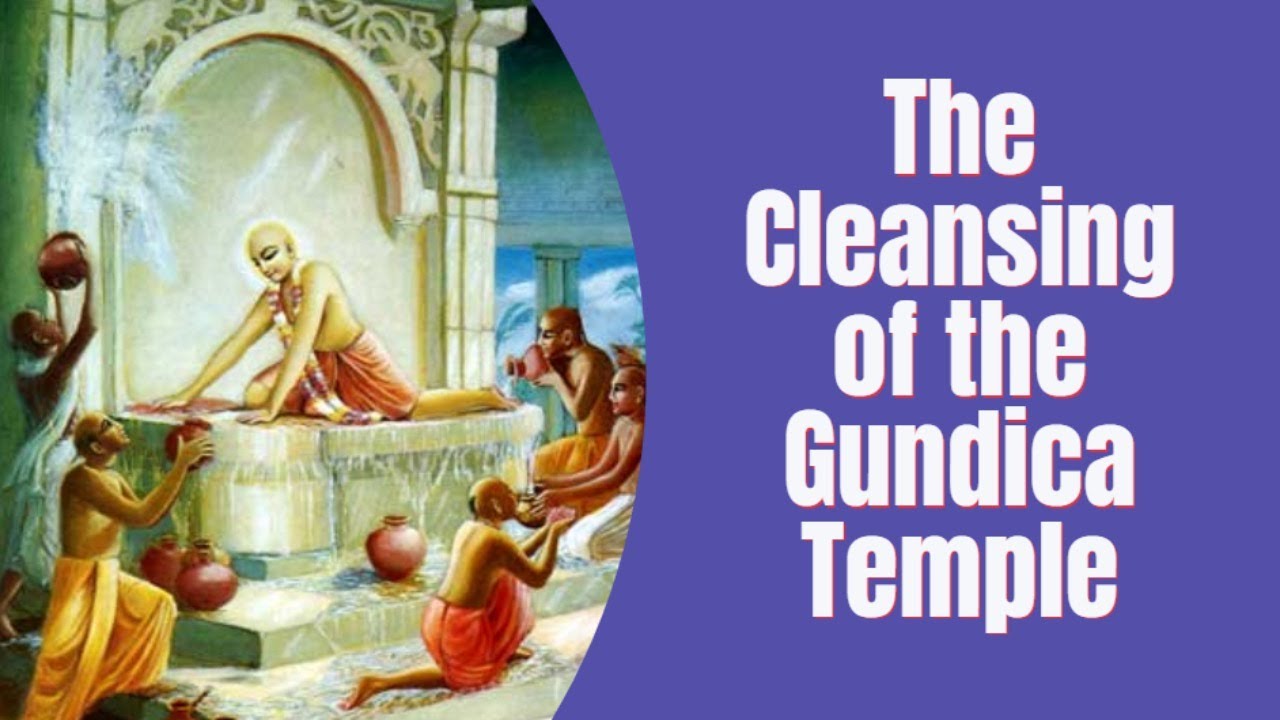
As soon as Śrī Caitanya Mahāprabhu called for water, all the men immediately brought the hundred waterpots, which were completely filled, and delivered them before the Lord. (96) In this way, Śrī Caitanya Mahāprabhu first washed the main temple and then thoroughly washed the ceiling, the walls, the floor, the sitting place [siṁhāsana] and everything else within the room. (97) Śrī Caitanya Mahāprabhu Himself and His devotees began to throw water onto the ceiling. When this water fell, it washed the walls and floor. (98) Then Śrī Caitanya Mahāprabhu began to wash the sitting place of Lord Jagannātha with His own hands, and all the devotees began to bring water to the Lord. (99) All the devotees within the temple began to wash. Each one had a broom in his hand, and in this way they cleansed the temple of the Lord. (100) Someone brought water to pour into the hands of Śrī Caitanya Mahāprabhu, and someone poured water on His lotus feet. (101)
The water that fell from the lotus feet of Śrī Caitanya Mahāprabhu was drunk by someone who hid himself. Someone else begged for that water, and another person was giving that water in charity. (102) After the room was washed, the water was let out through an outlet, and it then flowed and filled the yard outside. (103) The Lord mopped the rooms with His own clothes, and He polished the throne with them also. (104) (101) The water that fell from the lotus feet of Śrī Caitanya Mahāprabhu was drunk by someone who hid himself. Someone else begged for that water, and another person was giving that water in charity. (102) After the room was washed, the water was let out through an outlet, and it then flowed and filled the yard outside. (103) The Lord mopped the rooms with His own clothes, and He polished the throne with them also. (104)
Deepen your Bhakti-yoga practice, harmonize relationships, and receive guided coaching — all at Vedavarsity.com