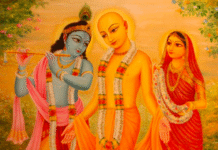
'Sri Chaitanya Mahaprabhu then placed His hand on Sanatana Goswami's head and benedicted him, saying, "Let all these instructions be manifest to you."'
-Excerpt from Chaitanya-caritamrita, Madhya-lila, 23.120-124
The ten men returned home, and Raghunātha dāsa’s father and mother were filled with anxiety. (183) Raghunātha dāsa, who had been resting at the milkman’s house, got up early in the morning. Instead of going to the east, he turned his face south and proceeded. (184) He crossed Chatrabhoga, but instead of going on the general path, he proceeded on the path that went from village to village. (185) Not caring about eating, he traveled all day. Hunger was not an impediment, for his mind was concentrated upon obtaining shelter at the lotus feet of Śrī Caitanya Mahāprabhu. (186) Sometimes he chewed fried grains, sometimes he cooked, and sometimes he drank milk. In this way he kept his life and soul together with whatever was available wherever he went. (187)
He reached Jagannātha Purī in twelve days but could eat only for three days on the way. (188) When Raghunātha dāsa met Śrī Caitanya Mahāprabhu, the Lord was sitting with His companions, headed by Svarūpa Dāmodara. (189) Staying at a distant place in the courtyard, he fell down to offer obeisances. Then Mukunda Datta said, “Here is Raghunātha.” (190) As soon as Śrī Caitanya Mahāprabhu heard these words, He immediately welcomed Raghunātha dāsa. “Come here,” He said. Raghunātha dāsa then clasped the lotus feet of the Lord, but the Lord stood up and embraced him out of His causeless mercy. (191) Raghunātha dāsa offered prayers at the lotus feet of all the devotees, headed by Svarūpa Dāmodara Gosvāmī. Seeing the special mercy Śrī Caitanya Mahāprabhu had bestowed upon Raghunātha dāsa, they embraced him also. (192)
Lord Śrī Caitanya Mahāprabhu said, “The mercy of Lord Kṛṣṇa is stronger than anything else. Therefore the Lord has delivered you from the ditch of materialistic life, which is like a hole into which people pass stool.” (193) Raghunātha dāsa answered within his mind, “I do not know who Kṛṣṇa is. I simply know that Your mercy, O my Lord, has saved me from my family life.” (194) The Lord continued, “Your father and his elder brother are both related as brothers to My grandfather, Nīlāmbara Cakravartī. Therefore I consider them My grandfathers. (195) “Since your father and his elder brother are younger brothers of Nīlāmbara Cakravartī, I may joke about them in this way. (196) “My dear Raghunātha dāsa, your father and his elder brother are just like worms in stool in the ditch of material enjoyment, for the great disease of the poison of material enjoyment is what they consider happiness. (197)
“Although your father and uncle are charitable to brāhmaṇas and greatly help them, they are nevertheless not pure Vaiṣṇavas. However, they are almost like Vaiṣṇavas. (198) “Those who are attached to materialistic life and are blind to spiritual life must act in such a way that they are bound to repeated birth and death by the actions and reactions of their activities. (199) “By His own free will, Lord Kṛṣṇa has delivered you from such a condemned materialistic life. Therefore the glories of Lord Kṛṣṇa’s causeless mercy cannot be expressed.” (200) Seeing Raghunātha dāsa skinny and dirty because of having traveled for twelve days and fasted, Lord Śrī Caitanya Mahāprabhu, His heart melting due to causeless mercy, spoke to Svarūpa Dāmodara. (201) “My dear Svarūpa,” He said, “I entrust this Raghunātha dāsa to you. Please accept him as your son or servant. (202) “There are now three Raghunāthas among My associates. From this day forward, this Raghunātha should be known as the Raghu of Svarūpa Dāmodara.” (203)
Saying this, Śrī Caitanya Mahāprabhu grasped the hand of Raghunātha dāsa and entrusted him to the hands of Svarūpa Dāmodara Gosvāmī. (204) Svarūpa Dāmodara Gosvāmī accepted Raghunātha dāsa, saying, “Śrī Caitanya Mahāprabhu, whatever You order is accepted.” He then embraced Raghunātha dāsa again. (205) I cannot properly express the affection of Śrī Caitanya Mahāprabhu for His devotees. Being merciful toward Raghunātha dāsa, the Lord spoke as follows to Govinda. (206) “On the way, Raghunātha dāsa has fasted and undergone hardships for many days. Therefore, take good care of him for some days so that he may eat to his satisfaction.” (207) Then Śrī Caitanya Mahāprabhu told Raghunātha dāsa, “Go bathe in the sea. Then see Lord Jagannātha in the temple and return here to take your meal.” (208)
After saying this, Śrī Caitanya Mahāprabhu got up and went to perform His midday duties, and Raghunātha met all the devotees present. (209) Having seen the causeless mercy of Śrī Caitanya Mahāprabhu upon Raghunātha dāsa, all the devotees, struck with wonder, praised his good fortune. (210) Raghunātha dāsa took his bath in the sea and saw Lord Jagannātha. Then he returned to Govinda, the personal servant of Śrī Caitanya Mahāprabhu. (211) Govinda offered him a plate with the remnants of food left by Śrī Caitanya Mahāprabhu, and Raghunātha dāsa accepted the prasādam with great happiness. (212) Raghunātha dāsa stayed under the care of Svarūpa Dāmodara Gosvāmī, and Govinda supplied him remnants of Śrī Caitanya Mahāprabhu’s food for five days. (213)
Beginning from the sixth day, Raghunātha dāsa would stand at the gate known as Siṁha- dvāra to beg alms after the puṣpa- añjali ceremony, in which flowers were offered to the Lord. (214) After finishing their prescribed duties, the many servants of Lord Jagannātha, who are known as viṣayīs, return home at night. (215) If they see a Vaiṣṇava standing at the Siṁha- dvāra begging alms, out of mercy they arrange with the shopkeepers to give him something to eat. (216) Thus it is a custom for all time that a devotee who has no other means of support stands at the Siṁha- dvāra gate to receive alms from the servants. (217) A completely dependent Vaiṣṇava thus chants the holy name of the Lord all day and sees Lord Jagannātha with full freedom. (218)
It is a custom for some Vaiṣṇavas to beg from the charity booths and eat whatever they obtain, whereas others stand at night at the Siṁha- dvāra gate, begging alms from the servants. (219) Renunciation is the basic principle sustaining the lives of Śrī Caitanya Mahāprabhu’s devotees. Seeing this renunciation, Śrī Caitanya Mahāprabhu, the Supreme Personality of Godhead, is extremely satisfied. (220) Govinda said to Śrī Caitanya Mahāprabhu, “Raghunātha dāsa no longer takes prasādam here. Now he stands at the Siṁha- dvāra, where he begs some alms to eat.” (221) When Śrī Caitanya Mahāprabhu heard this, He was greatly satisfied. “Raghunātha dāsa has done well,” He said. “He has acted suitably for a person in the renounced order. (222) “A person in the renounced order should always chant the holy name of the Lord. He should beg some alms to eat, and he should sustain his life in this way. (223)
“A vairāgī [a person in the renounced order] should not depend on others. If he does so, he will be unsuccessful, and he will be neglected by Kṛṣṇa. (224) “If a renunciant is eager for his tongue to taste different foods, his spiritual life will be lost, and he will be subservient to the tastes of his tongue. (225) “The duty of a person in the renounced order is to chant the Hare Kṛṣṇa mantra always. He should satisfy his belly with whatever vegetables, leaves, fruits and roots are available. (226) “One who is subservient to the tongue and who thus goes here and there, devoted to the genitals and the belly, cannot attain Kṛṣṇa.” (227) The next day, Raghunātha dāsa inquired at the lotus feet of Svarūpa Dāmodara about his duty. (228) “I do not know why I have given up household life,” he said. “What is my duty? Kindly give me instructions.” (229) Raghunātha dāsa never even spoke a word before the Lord. Instead, he informed the Lord of his desires through Svarūpa Dāmodara Gosvāmī and Govinda. (230)
The next day, Svarūpa Dāmodara Gosvāmī submitted to Lord Śrī Caitanya Mahāprabhu, “Raghunātha dāsa has this to say at Your lotus feet. (231) “‘I do not know my duty or the goal of my life. Therefore, please personally give me instructions from Your transcendental mouth.'” (232) Smiling, Śrī Caitanya Mahāprabhu told Raghunātha dāsa, “I have already appointed Svarūpa Dāmodara Gosvāmī as your instructor. (233) “You may learn from him what your duty is and how to discharge it. I do not know as much as he. (234) “Nevertheless, if you want to take instructions from Me with faith and love, you may ascertain your duties from the following words. (235) “Do not talk like people in general or hear what they say. You should not eat very palatable food, nor should you dress very nicely. (236)
“Do not expect honor, but offer all respect to others. Always chant the holy name of Lord Kṛṣṇa, and within your mind render service to Rādhā and Kṛṣṇa in Vṛndāvana. (237) “I have briefly given you My instructions. Now you will get all details about them from Svarūpa Dāmodara. (238) “One who thinks himself lower than grass, who is more tolerant than a tree, and who does not expect personal honor but is always prepared to give respect to others can very easily always chant the holy name of the Lord.” (239) Having heard this, Raghunātha dāsa offered prayers at the lotus feet of Śrī Caitanya Mahāprabhu, and the Lord, out of great mercy, embraced him. (240)
Deepen your Bhakti-yoga practice, harmonize relationships, and receive guided coaching — all at Vedavarsity.com