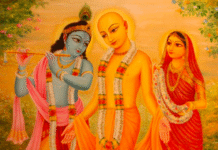
'Sri Chaitanya Mahaprabhu then placed His hand on Sanatana Goswami's head and benedicted him, saying, "Let all these instructions be manifest to you."'
-Excerpt from Chaitanya-caritamrita, Madhya-lila, 23.120-124
With the ropes of His causeless mercy, Śrī Kṛṣṇa Caitanya Mahāprabhu employed a trick to deliver Raghunātha dāsa Gosvāmī from the blind well of contemptible family life. He made Raghunātha dāsa Gosvāmī one of His personal associates, placing him under the charge of Svarūpa Dāmodara Gosvāmī. I offer my obeisances unto Him. (1) All glories to Lord Caitanya Mahāprabhu! All glories to Lord Nityānanda! All glories to Śrī Advaita Ācārya! And all glories to all the devotees of Lord Śrī Caitanya Mahāprabhu! (2) Thus Lord Gauracandra performed various pastimes with His associates at Jagannātha Purī in varieties of transcendental pleasure. (3) Although Śrī Caitanya Mahāprabhu felt pangs of separation from Kṛṣṇa, He did not manifest His feelings externally, for He feared the unhappiness of His devotees. (4)
The transformations undergone by the Lord when He manifested severe unhappiness due to separation from Kṛṣṇa cannot be described. (5) When the Lord acutely felt pangs of separation from Kṛṣṇa, only Śrī Rāmānanda Rāya’s talks about Kṛṣṇa and the sweet songs of Svarūpa Dāmodara kept Him alive. (6) Because the Lord associated with various devotees during the day, His mind was somewhat diverted, but at night the pangs of separation from Kṛṣṇa increased very rapidly. (7) Two people-Rāmānanda Rāya and Svarūpa Dāmodara Gosvāmī-stayed with the Lord to pacify Him by reciting various verses about Kṛṣṇa’s pastimes and by singing appropriate songs for His satisfaction. (8) Previously, when Lord Kṛṣṇa was personally present, Subala, one of His cowherd boyfriends, gave Him happiness when He felt separation from Rādhārāṇī. Similarly, Rāmānanda Rāya helped give happiness to Lord Śrī Caitanya Mahāprabhu. (9)
Previously, when Śrīmatī Rādhārāṇī felt the pangs of separation from Kṛṣṇa, Her constant companion Lalitā kept Her alive by helping Her in many ways. Similarly, when Śrī Caitanya Mahāprabhu felt Rādhārāṇī’s emotions, Svarūpa Dāmodara Gosvāmī helped Him maintain His life. (10) To describe the fortunate position of Rāmānanda Rāya and Svarūpa Dāmodara Gosvāmī is extremely difficult. They were renowned as intimately confidential friends of Śrī Caitanya Mahāprabhu. (11) The Lord thus enjoyed His life with His devotees. O devotees of Lord Śrī Caitanya Mahāprabhu, now hear how Raghunātha dāsa Gosvāmī met the Lord. (12) When Raghunātha dāsa, during his family life, went to meet Śrī Caitanya Mahāprabhu at Śāntipura, the Lord gave him worthy instructions by His causeless mercy. (13)
Instead of becoming a so- called renunciant, Raghunātha dāsa, following the instructions of the Lord, returned home and played exactly like a pounds- and- shillings man. (14) Raghunātha dāsa was inwardly completely renounced, even in family life, but he did not express his renunciation externally. Instead, he acted just like an ordinary businessman. Seeing this, his father and mother were satisfied. (15) When he received a message that Lord Śrī Caitanya Mahāprabhu had returned from Mathurā City, Raghunātha dāsa endeavored to go to the lotus feet of the Lord. (16) At that time there was a Muslim official collecting the taxes of Saptagrāma. (17) When Hiraṇya dāsa, Raghunātha dāsa’s uncle, made an agreement with the government to collect taxes, the Muslim caudhurī, or tax collector, having lost his position, became extremely envious of him. (18)
Hiraṇya dāsa was collecting 2,000,000 coins and therefore should have delivered 1,500,000 to the government. Instead, he was giving only 1,200,000, thus making an extra profit of 300,000 coins. Seeing this, the Muslim caudhurī, who was a Turk, became his rival. (19) After sending a confidential account to the government treasury, the caudhurī brought the minister in charge. The caudhurī came, wanting to arrest Hiraṇya dāsa, but Hiraṇya dāsa had left home. Therefore the caudhurī arrested Raghunātha dāsa. (20) Every day, the Muslim would chastise Raghunātha dāsa and tell him, “Bring your father and his elder brother. Otherwise you will be punished.” (21) The caudhurī wanted to beat him, but as soon as he saw Raghunātha’s face, his mind changed, and he could not beat him. (22)
Indeed, the caudhurī was afraid of Raghunātha dāsa because Raghunātha dāsa belonged to the kāyastha community. Although the caudhurī would chastise him with oral vibrations, he was afraid to beat him. (23) While this was going on, Raghunātha dāsa thought of a tricky method of escape. Thus he humbly submitted this plea at the feet of the Muslim caudhurī. (24) “My dear sir, my father and his elder brother are your brothers. All brothers always fight about something. (25) “Sometimes brothers fight among themselves, and sometimes they have very friendly dealings. There is no certainty when such changes will take place. Thus I am sure that although today you are fighting, tomorrow you three brothers will be sitting together in peace. (26) Just as I am my father’s son, so I am also yours. I am your dependent, and you are my maintainer. (27) “For a maintainer to punish the person he maintains is not good. You are expert in all the scriptures. Indeed, you are like a living saint.” (28)
When the Muslim heard Raghunātha dāsa’s appealing voice, his heart softened. He began to cry, and tears glided down his beard. (29) The Muslim caudhurī told Raghunātha dāsa, “You are my son from this day on. Today, by some means, I shall have you released.” (30) After informing the minister, the caudhurī released Raghunātha dāsa and then began to speak to him with great affection. (31) “Your father’s elder brother is less intelligent,” he said. “He enjoys 800,000 coins, but since I am also a shareholder, he should give some portion of it to me. (32) “Now you go arrange a meeting between me and your uncle. Let him do whatever he thinks best. I shall completely depend on his decision.” (33) Raghunātha dāsa arranged a meeting between his uncle and the caudhurī. The matter was settled, and everything was peaceful. (34) In this way Raghunātha dāsa passed one year exactly like a first- class business manager, but the next year he again decided to leave home. (35) He got up alone one night and left, but his father caught him in a distant place and brought him back. (36)
This became almost a daily affair. Raghunātha would run away from home, and his father would again bring him back. Then Raghunātha dāsa’s mother spoke to his father as follows. (37) “Our son has become mad,” she said. “Just keep him by binding him with ropes.” His father, being very unhappy, replied to her as follows. (38) “Raghunātha dāsa, our son, has opulences like Indra, the heavenly King, and his wife is as beautiful as an angel. Yet all this could not tie down his mind. (39) “How then could we keep this boy home by binding him with ropes? It is not possible even for one’s father to nullify the reactions of one’s past activities. (40) “Lord Śrī Caitanya Mahāprabhu has fully bestowed His mercy on him. Who can keep home such a madman of Caitanyacandra?” (41)
Then Raghunātha dāsa considered something in his mind, and the next day he went to Nityānanda Gosāñi. (42) In the village of Pānihāṭi, Raghunātha dāsa obtained an interview with Nityānanda Prabhu, who was accompanied by many kīrtana performers, servants and others. (43) Sitting on a rock under a tree on the bank of the Ganges, Lord Nityānanda seemed as effulgent as hundreds of thousands of rising suns. (44) Many devotees sat on the ground surrounding Him. Seeing the influence of Nityānanda Prabhu, Raghunātha dāsa was astonished. (45) Raghunātha dāsa offered his obeisances by falling prostrate at a distant place, and the servant of Nityānanda Prabhu pointed out, “There is Raghunātha dāsa, offering You obeisances.” (46) Hearing this, Lord Nityānanda Prabhu said, “You are a thief. Now you have come to see Me. Come here, come here. Today I shall punish you!” (47)
The Lord called him, but Raghunātha dāsa did not go near the Lord. Then the Lord forcibly caught him and placed His lotus feet upon Raghunātha dāsa’s head. (48) Lord Nityānanda was by nature very merciful and funny. Being merciful, He spoke to Raghunātha dāsa as follows. (49) “You are just like a thief, for instead of coming near, you stay away at a distant place. Now that I have captured you, I shall punish you. (50) “Make a festival and feed all My associates yogurt and chipped rice.” Hearing this, Raghunātha dāsa was greatly pleased. (51) Raghunātha dāsa immediately sent his own men to the village to purchase all kinds of eatables and bring them back. (52) Raghunātha dāsa brought chipped rice, yogurt, milk, sweetmeats, sugar, bananas and other eatables and placed them all around. (53)
As soon as they heard that a festival was going to be held, all kinds of brāhmaṇas and other gentlemen began to arrive. Thus there were innumerable people. (54) Seeing the crowd increasing, Raghunātha dāsa arranged to get more eatables from other villages. He also brought two to four hundred large, round earthen pots. (55) He also obtained five or seven especially large earthen pots, and in these pots a brāhmaṇa began soaking chipped rice for the satisfaction of Lord Nityānanda. (56) In one place, chipped rice was soaked in hot milk in each of the large pots. Then half the rice was mixed with yogurt, sugar and bananas. (57)
The other half was mixed with condensed milk and a special type of banana known as cāṅpā- kalā. Then sugar, clarified butter and camphor were added. (58) After Nityānanda Prabhu had changed His cloth for a new one and sat on a raised platform, the brāhmaṇa brought before Him the seven huge pots. (59) On that platform, all the most important associates of Śrī Nityānanda Prabhu, as well as other important men, sat down in a circle around the Lord. (60) Among them were Rāmadāsa, Sundarānanda, Gadādhara dāsa, Murāri, Kamalākara, Sadāśiva and Purandara. (61) Dhanañjaya, Jagadīśa, Parameśvara dāsa, Maheśa, Gaurīdāsa and Hoḍa Kṛṣṇadāsa were also there. (62)
Deepen your Bhakti-yoga practice, harmonize relationships, and receive guided coaching — all at Vedavarsity.com