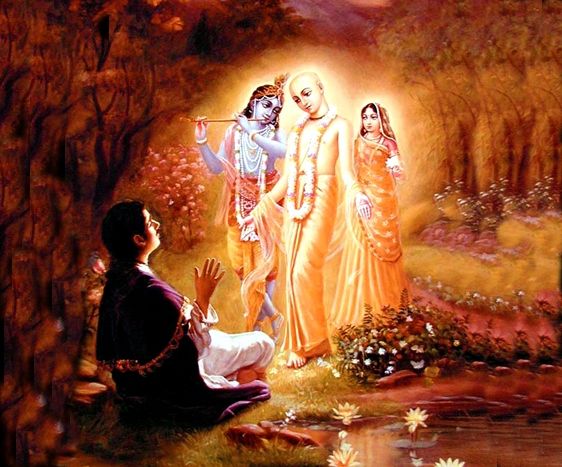
Thereupon Rāmānanda Rāya gradually began speaking on topics of Kṛṣṇa. Thus the ocean of the transcendental mellows of those topics became agitated. (63) He began personally posing questions and then answering them with conclusive statements. When afternoon came, the topics still did not end. (64) The speaker and listener spoke and heard in ecstatic love. Thus they forgot their bodily consciousness. How, then, could they perceive the end of the day? (65) The servant informed them, “The day has already ended.” Then Rāmānanda Rāya ended his discourses about Kṛṣṇa. (66) Rāmānanda Rāya paid great respect to Pradyumna Miśra and bade him farewell. Pradyumna Miśra said, “I have become very satisfied.” He then began to dance. (67)
After returning home, Pradyumna Miśra bathed and ate his meal. In the evening he came to see the lotus feet of Śrī Caitanya Mahāprabhu. (68) In great happiness he worshiped the lotus feet of Śrī Caitanya Mahāprabhu. The Lord inquired, “Have you heard topics about Kṛṣṇa?” (69) Pradyumna Miśra said, “My dear Lord, You have made me extremely obliged to You because You have drowned me in a nectarean ocean of talks about Kṛṣṇa. (70) “I cannot properly describe the discourses of Rāmānanda Rāya, for he is not an ordinary human being. He is fully absorbed in the devotional service of the Lord. (71) “There is one other thing Rāmānanda Rāya said to me: ‘Do not consider me the speaker in these talks about Kṛṣṇa. (72)
“‘Whatever I speak is personally spoken by Lord Śrī Caitanya Mahāprabhu. Like a stringed instrument, I vibrate whatever He causes me to speak. (73) “‘In this way the Lord speaks through my mouth to preach the cult of Kṛṣṇa consciousness. Within the world, who will understand this pastime of the Lord’s?’ (74) “What I have heard from Rāmānanda Rāya is like a nectarean ocean of discourses about Kṛṣṇa. Even the demigods, beginning with Lord Brahmā, cannot understand all these topics. (75) “My dear Lord, You have made me drink this transcendental nectar of kṛṣṇa- kathā. Therefore I am sold to Your lotus feet, life after life.” (76) Śrī Caitanya Mahāprabhu said, “Rāmānanda Rāya is a mine of great humility. Therefore he has attributed his own words to another’s intelligence. (77) “This is a natural characteristic of those advanced in devotional service. They do not personally speak of their own good qualities.” (78)
I have described but a fraction of the transcendental attributes of Rāmānanda Rāya, as revealed when he instructed Pradyumna Miśra. (79) Although Rāmānanda Rāya was a householder, he was not under the control of the six kinds of bodily changes. Although apparently a pounds- and- shillings man, he advised even persons in the renounced order. (80) To demonstrate the transcendental attributes of Rāmānanda Rāya, Śrī Caitanya Mahāprabhu sent Pradyumna Miśra to hear discourses about Kṛṣṇa from him. (81) The Supreme Personality of Godhead, Śrī Caitanya Mahāprabhu, knows very well how to demonstrate the qualities of His devotees. Therefore, acting like an artistic painter, He does so in various ways and considers this His personal profit. (82) There is yet another characteristic of Lord Śrī Caitanya Mahāprabhu. O devotees, listen carefully to how He manifests His opulence and characteristics, although they are exceptionally deep. (83)
To vanquish the false pride of so- called renunciants and learned scholars, He spreads real religious principles, even through a śūdra, or lowborn, fourth- class man. (84) Śrī Caitanya Mahāprabhu preached about devotional service, ecstatic love and the Absolute Truth by making Rāmānanda Rāya, a gṛhastha born in a low family, the speaker. Then Śrī Caitanya Mahāprabhu Himself, the exalted brāhmaṇa- sannyāsī, and Pradyumna Miśra, the purified brāhmaṇa, both became the hearers of Rāmānanda Rāya. (85) Śrī Caitanya Mahāprabhu exhibited the glories of the holy name of the Lord through Haridāsa Ṭhākura, who was born in a Muslim family. Similarly, He exhibited the essence of devotional service through Sanātana Gosvāmī, who had almost been converted into a Muslim. (86) Also, the Lord fully exhibited the ecstatic love and transcendental pastimes of Vṛndāvana through Śrīla Rūpa Gosvāmī. Considering all this, who can understand the deep plans of Lord Śrī Caitanya Mahāprabhu? (87)
The activities of Śrī Caitanya Mahāprabhu are just like an ocean of nectar. Even a drop of this ocean can inundate all the three worlds. (88) O devotees, relish daily the nectar of Śrī Caitanya- caritāmṛta and the pastimes of Śrī Caitanya Mahāprabhu, for by doing so one can merge in transcendental bliss and attain full knowledge of devotional service. (89) Thus Lord Śrī Caitanya Mahāprabhu, accompanied by His associates, His pure devotees, enjoyed transcendental bliss in Jagannātha Purī [Nīlācala] by preaching the bhakti cult in many ways. (90) A brāhmaṇa from Bengal wrote a drama about the characteristics of Śrī Caitanya Mahāprabhu and came with his manuscript to induce the Lord to hear it. (91) The brāhmaṇa was acquainted with Bhagavān Ācārya, one of the devotees of Śrī Caitanya Mahāprabhu. Therefore after meeting him at Jagannātha Purī, the brāhmaṇa made his residence at Bhagavān Ācārya’s home. (92)
First the brāhmaṇa induced Bhagavān Ācārya to hear the drama, and then many other devotees joined Bhagavān Ācārya in listening to it. (93) All the Vaiṣṇavas praised the drama, saying, “Very good, very good.” They also desired that Śrī Caitanya Mahāprabhu hear the drama. (94) Customarily, anyone who composed a song, verse, literary composition or poem about Śrī Caitanya Mahāprabhu first had to bring it to Svarūpa Dāmodara Gosvāmī to be heard. (95) If passed by Svarūpa Dāmodara Gosvāmī, it could be presented for Śrī Caitanya Mahāprabhu to hear. (96) If there were a hint that transcendental mellows overlapped in a manner contrary to the principles of the bhakti cult, Śrī Caitanya Mahāprabhu would not tolerate it and would become very angry. (97) Therefore Śrī Caitanya Mahāprabhu would not hear anything before Svarūpa Dāmodara heard it first. The Lord made this etiquette a regulative principle. (98)
Bhagavān Ācārya submitted to Svarūpa Dāmodara Gosvāmī, “A good brāhmaṇa has prepared a drama about Śrī Caitanya Mahāprabhu that appears exceptionally well composed. (99) “First you hear it, and if it is acceptable to your mind, I shall request Śrī Caitanya Mahāprabhu to hear it.” (100) Svarūpa Dāmodara Gosvāmī replied, “Dear Bhagavān Ācārya, you are a very liberal cowherd boy. Sometimes the desire awakens within you to hear any kind of poetry. (101) “In the writings of so- called poets there is generally a possibility of overlapping transcendental mellows. When the mellows thus go against the conclusive understanding, no one likes to hear such poetry. (102) “A so- called poet who has no knowledge of transcendental mellows and the overlapping of transcendental mellows cannot cross the ocean of the conclusions of devotional service. (103)
“A poet who does not know the grammatical regulative principles, who is unfamiliar with metaphorical ornaments, especially those employed in drama, and who does not know how to present the pastimes of Lord Kṛṣṇa is condemned. Moreover, the pastimes of Śrī Caitanya Mahāprabhu are especially difficult to understand. (104-105) “One who has accepted the lotus feet of Śrī Caitanya Mahāprabhu as his life and soul can describe the pastimes of Lord Kṛṣṇa or the pastimes of Lord Śrī Caitanya Mahāprabhu. (106) “Hearing the poetry of a person who has no transcendental knowledge and who writes about the relationships between man and woman simply causes unhappiness, whereas hearing the words of a devotee fully absorbed in ecstatic love causes great happiness. (107)
“The standard for writing dramas has been set by Rūpa Gosvāmī. If a devotee hears the introductory portions of his two dramas, they enhance his transcendental pleasure.” (108) Despite the explanation of Svarūpa Dāmodara, Bhagavān Ācārya requested, “Please hear the drama once. If you hear it, you can consider whether it is good or bad.” (109) For two or three days Bhagavān Ācārya continually asked Svarūpa Dāmodara Gosvāmī to hear the poetry. Because of his repeated requests, Svarūpa Dāmodara Gosvāmī wanted to hear the poetry written by the brāhmaṇa from Bengal. (110) Svarūpa Dāmodara Gosvāmī sat down with other devotees to hear the poetry, and then the poet began to read the introductory verse. (111)
“The Supreme Personality of Godhead has assumed a golden complexion and has become the soul of the body named Lord Jagannātha, whose blooming lotus eyes are widely expanded. Thus He has appeared in Jagannātha Purī and brought dull matter to life. May that Lord, Śrī Kṛṣṇa Caitanyadeva, bestow all good fortune upon you.” (112) When everyone present heard the verse, they all commended the poet, but Svarūpa Dāmodara Gosvāmī requested him, “Kindly explain this verse.” (113) The poet said, “Lord Jagannātha is a most beautiful body, and Śrī Caitanya Mahāprabhu, who is exceptionally grave, is the owner of that body. (114) “Śrī Caitanya Mahāprabhu has appeared here in Nīlācala [Jagannātha Purī] to spiritualize the entire dull material world.” (115) Hearing this, everyone present was greatly happy. But Svarūpa Dāmodara, who alone was very unhappy, began to speak in great anger. (116)
Deepen your Bhakti-yoga practice, harmonize relationships, and receive guided coaching — all at Vedavarsity.com