


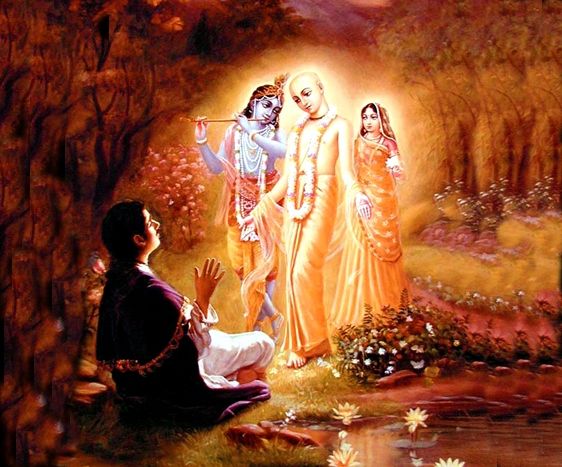
I am infected by the germs of material activity and am suffering from the boils of envy. Therefore, falling in an ocean of humility, I take shelter of the great physician Lord Śrī Caitanya Mahāprabhu. (1) All glories to Śrī Caitanya Mahāprabhu, the son of mother Śacī! All glories to Śrī Nityānanda Prabhu! Indeed, He is the most glorious and merciful. (2) I offer my respectful obeisances unto Advaita Prabhu, the ocean of mercy, and to all the devotees, such as Svarūpa Dāmodara Gosvāmī, Gadādhara Paṇḍita, Śrī Rūpa Gosvāmī and Śrī Sanātana Gosvāmī. (3) One day Pradyumna Miśra came to see Śrī Caitanya Mahāprabhu, offering his respects and inquiring from Him with great submission. (4)
My Lord,” he said, “kindly hear me. I am a cripple- minded householder, the most fallen of men, but somehow, by my good fortune, I have received the shelter of Your lotus feet, which are rarely to be seen. (5) “I wish to hear topics concerning Lord Kṛṣṇa constantly. Be merciful unto me and kindly tell me something about Kṛṣṇa.” (6) Śrī Caitanya Mahāprabhu replied, “I do not know about topics concerning Lord Kṛṣṇa. I think that only Rāmānanda Rāya knows, for I hear these topics from him. (7) “It is your good fortune that you are inclined to hear topics regarding Kṛṣṇa. The best course for you would be to go to Rāmānanda Rāya and hear these topics from him. (8) “I see that you have acquired a taste for hearing talks regarding Kṛṣṇa. Therefore you are extremely fortunate. Not only you but anyone who has awakened such a taste is considered most fortunate. (9)
“‘A person who properly performs his regulative duties according to varṇa and āśrama but does not develop his dormant attachment for Kṛṣṇa or awaken his taste for hearing and chanting about Kṛṣṇa is certainly laboring fruitlessly.'” (10) Pradyumna Miśra, being thus advised by Śrī Caitanya Mahāprabhu, went to the home of Rāmānanda Rāya. There the servant of Rāmānanda Rāya gave him a proper place to sit down. (11) Unable to see Rāmānanda Rāya immediately, Pradyumna Miśra inquired from the servant, who then described what Śrī Rāmānanda Rāya was doing. (12) “There are two dancing girls who are extremely beautiful. They are very youthful, and they are expert in dancing and singing. (13) “Śrīla Rāmānanda Rāya has taken these two girls to a solitary place in his garden, where he is teaching and directing them to dance according to the songs he has composed for his drama. (14)
“Please sit here and wait for a few moments. As soon as he comes, he will execute whatever order you give him.” (15) While Pradyumna Miśra remained seated there, Rāmānanda Rāya took the two girls to a solitary place. (16) With his own hand, Śrī Rāmānanda Rāya massaged their bodies with oil and bathed them with water. Indeed, Rāmānanda Rāya cleansed their entire bodies with his own hand. (17) Although he dressed the two young girls and decorated their bodies with his own hand, he remained unchanged. Such is the mind of Śrīla Rāmānanda Rāya. (18) While touching the young girls, he was like a person touching wood or stone, for his body and mind were unaffected. (19) Śrīla Rāmānanda Rāya used to act in that way because he thought of himself in his original position as a maidservant of the gopīs. Thus although externally he appeared to be a man, internally, in his original spiritual position, he considered himself a maidservant and considered the two girls gopīs. (20)
The greatness of the devotees of Śrī Caitanya Mahāprabhu is exceedingly difficult to understand. Śrī Rāmānanda Rāya is unique among them all, for he showed how one can extend his ecstatic love to the extreme limit. (21) Rāmānanda Rāya directed the two girls how to dance and express the deep meaning of his songs through dramatic performances. (22) He taught them how to express the symptoms of continuous, natural and transitional ecstasies with the movements of their faces, their eyes and the other parts of their bodies. (23) Through the feminine poses and dances they were taught by Rāmānanda Rāya, the two girls precisely exhibited all these expressions of ecstasy before Lord Jagannātha. (24) Then Rāmānanda Rāya fed the two girls sumptuous prasādam and sent them to their homes unexposed. (25) Every day he trained the two deva- dāsīs how to dance. Who among the small living entities, their minds always absorbed in material sense gratification, could understand the mentality of Śrī Rāmānanda Rāya? (26)
When the servant informed Rāmānanda Rāya of Pradyumna Miśra’s arrival, Rāmānanda Rāya immediately went to the assembly room. (27) He offered his obeisances to Pradyumna Miśra with all respect and then, with great humility, spoke as follows. (28) “Sir, you came here long ago, but no one informed me. Therefore I have certainly become an offender at your lotus feet. (29) “My entire home has been purified by your arrival. Kindly order me. What can I do for you? I am your servant.” (30) Pradyumna Miśra replied, “I came simply to see you. Now I have purified myself by seeing Your Honor.” (31) Because Pradyumna Miśra saw that it was late, he did not say anything else to Rāmānanda Rāya. Instead, he took leave of him and returned to his own home. (32) The next day, when Pradyumna Miśra arrived in the presence of Śrī Caitanya Mahāprabhu, the Lord inquired, “Have you heard talks about Kṛṣṇa from Śrī Rāmānanda Rāya?” (33)
Pradyumna Miśra thereupon described the activities of Śrī Rāmānanda Rāya. After hearing about these activities, Śrī Caitanya Mahāprabhu began to speak. (34) “I am a sannyāsī,” He said, “and I certainly consider Myself renounced. But what to speak of seeing a woman, if I even hear the name of a woman, I feel changes in My mind and body. Therefore who could remain unmoved by the sight of a woman? It is very difficult. (35-36) “Everyone please hear these topics about Rāmānanda Rāya, although they are so wonderful and uncommon that they should not be spoken. (37) “The two professional dancing girls are beautiful and youthful, yet Śrī Rāmānanda Rāya personally massages their entire bodies with oil. (38) “He personally bathes and dresses them and decorates them with ornaments. In this way, he naturally sees and touches the private parts of their bodies. (39)
“Nevertheless, the mind of Śrī Rāmānanda Rāya never changes, although he teaches the girls how to physically express all the transformations of ecstasy. (40) “His mind is as steady as wood or stone. Indeed, it is wonderful that even when he touches such young girls, his mind never changes. (41) “The authority for such acts is the prerogative of Rāmānanda Rāya alone, for I can understand that his body is not material but has been completely transformed into a spiritual entity. (42) “He alone, and no one else, can understand the position of his mind. (43) “But I can make a guess in terms of directions from the śāstra. The Vedic scripture Śrīmad- Bhāgavatam gives the direct evidence in this matter. (44) “When one hears or describes with great faith the pastimes of Lord Kṛṣṇa, such as His rāsa dance with the gopīs, the disease of lusty desires in his heart and the agitation caused by the three modes of material nature are immediately nullified, and he becomes sober and silent. (45-46)
“Tasting transcendental, effulgent, sweetly ecstatic love of Kṛṣṇa, such a person can enjoy life twenty- four hours a day in the transcendental bliss of the sweetness of Kṛṣṇa’s pastimes. (47) “‘A transcendentally sober person who, with faith and love, continually hears from a realized soul about the activities of Lord Kṛṣṇa in His rāsa dance with the gopīs, or one who describes such activities, can attain full transcendental devotional service at the lotus feet of the Supreme Personality of Godhead. Thus lusty material desires, which are the heart disease of all materialistic persons, are for him quickly and completely vanquished.’ (48)
“If a transcendentally situated person, following in the footsteps of Śrīla Rūpa Gosvāmī, hears and speaks about the rāsa- līlā dance of Kṛṣṇa and is always absorbed in thoughts of Kṛṣṇa while serving the Lord day and night within his mind, what shall I say about the result? It is so spiritually exalted that it cannot be expressed in words. Such a person is an eternally liberated associate of the Lord, and his body is completely spiritualized. Although he is visible to material eyes, he is spiritually situated, and all his activities are spiritual. By the will of Kṛṣṇa, such a devotee is understood to possess a spiritual body. (49-50) “Śrīla Rāmānanda Rāya is situated on the path of spontaneous love of Godhead. Therefore he is in his spiritual body, and his mind is not materially affected. (51) “I also hear topics about Kṛṣṇa from Rāmānanda Rāya. If you want to hear such topics, go to him again. (52)
“You can mention My name before him, saying, ‘He has sent me to hear about Lord Kṛṣṇa from you.’ (53) “Go hastily, while he is in the assembly room.” Hearing this, Pradyumna Miśra immediately departed. (54) Pradyumna Miśra went to Rāmānanda Rāya, who offered him respectful obeisances and said, “Please order me. For what purpose have you come?” (55) Pradyumna Miśra answered, “Śrī Caitanya Mahāprabhu has sent me to hear topics about Lord Kṛṣṇa from you.” (56) Hearing this, Rāmānanda Rāya became absorbed in ecstatic love and began to speak with great transcendental pleasure. (57) “Following the instruction of Śrī Caitanya Mahāprabhu, you have come to hear about Kṛṣṇa. This is my great fortune. How else would I get such an opportunity?” (58)
Saying this, Śrī Rāmānanda Rāya took Pradyumna Miśra to a secluded place and inquired from him, “What kind of kṛṣṇa- kathā do you want to hear from me?” (59) Pradyumna Miśra replied, “Kindly tell me about the same topics you spoke about at Vidyānagara. (60) “You are an instructor even for Śrī Caitanya Mahāprabhu, what to speak of others. I am but a beggar brāhmaṇa, and you are my maintainer. (61) “I do not know how to inquire, for I do not know what is good and what is bad. Seeing me to be poor in knowledge, kindly speak whatever is good for me by your own good will.” (62)
Deepen your Bhakti-yoga practice, harmonize relationships, and receive guided coaching — all at Vedavarsity.com