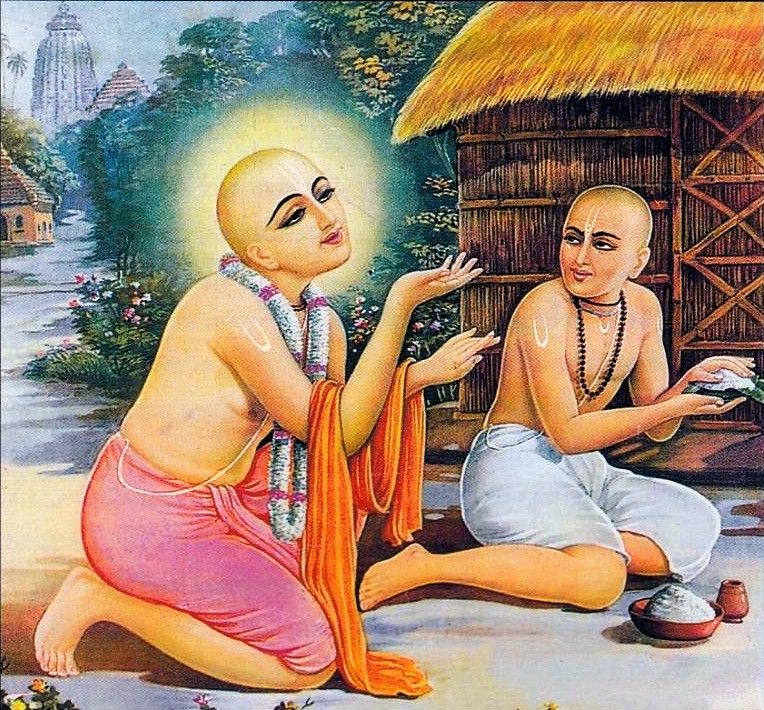
Śrīla Rūpa Gosvāmī had been delayed in Bengal for a year because he was dividing his money among his relatives to situate them in their proper positions. (214) He collected whatever money he had accumulated in Bengal and divided it among his relatives, the brāhmaṇas and the temples. (215) Thus after finishing all the tasks he had on his mind, he returned to Vṛndāvana fully satisfied. (216) The brothers met at Vṛndāvana, where they stayed to execute the will of Śrī Caitanya Mahāprabhu. (217) Śrīla Rūpa Gosvāmī and Sanātana Gosvāmī collected many revealed scriptures, and from the evidence in those scriptures they excavated all the lost sites of pilgrimage. Thus they established temples for the worship of Lord Kṛṣṇa. (218)
Śrīla Sanātana Gosvāmī compiled the Bṛhad- bhāgavatāmṛta. From this book one can understand who is a devotee, what is the process of devotional service, and who is Kṛṣṇa, the Absolute Truth. (219) Śrīla Sanātana Gosvāmī wrote a commentary on the Tenth Canto known as Daśama- ṭippanī, from which we can understand the transcendental pastimes and ecstatic love of Lord Kṛṣṇa. (220) He also compiled the Hari- bhakti- vilāsa, from which we can understand the standard behavior of a devotee and the full extent of a Vaiṣṇava’s duty. (221) Śrīla Sanātana Gosvāmī also compiled many other books. Who can enumerate them? The basic principle of all these books is to show us how to love Madana- mohana and Govindajī. (222)
Śrīla Rūpa Gosvāmī also wrote many books, the most famous of which is the Bhakti- rasāmṛta- sindhu. From that book one can understand the essence of devotional service to Kṛṣṇa and the transcendental mellows one can derive from such service. (223) Śrīla Rūpa Gosvāmī also compiled the book named Ujjvala- nīlamaṇi, from which one can understand, to the fullest limits, the loving affairs of Śrī Śrī Rādhā and Kṛṣṇa. (224) Śrīla Rūpa Gosvāmī also compiled two important dramas named Vidagdha- mādhava and Lalita- mādhava, from which one can understand all the mellows derived from the pastimes of Lord Kṛṣṇa. (225) Śrīla Rūpa Gosvāmī compiled 100,000 verses, beginning with the book Dāna- keli- kaumudī. In all these scriptures he elaborately explained the transcendental mellows of the activities of Vṛndāvana. (226)
The son of Śrī Vallabha, or Anupama, Śrīla Rūpa Gosvāmī’s younger brother, was the great learned scholar named Śrīla Jīva Gosvāmī. (227) After renouncing everything, Śrīla Jīva Gosvāmī went to Vṛndāvana. Later he also wrote many books on devotional service and expanded the work of preaching. (228) In particular, Śrīla Jīva Gosvāmī compiled the book named Bhāgavata- sandarbha, or Ṣaṭ- sandarbha, which is the essence of all scriptures. From this book one can obtain a conclusive understanding of devotional service and the Supreme Personality of Godhead. (229) He also compiled the book named Gopāla- campū, which is the essence of all Vedic literature. In this book he has exhibited the ecstatic loving transactions and pastimes of Rādhā and Kṛṣṇa in Vṛndāvana. (230)
In the Ṣaṭ- sandarbha Śrīla Jīva Gosvāmī set forth the truths about transcendental love of Kṛṣṇa. In this way he expanded 400,000 verses in all his books. (231) When Jīva Gosvāmī wanted to go to Mathurā from Bengal, he requested permission from Śrīla Nityānanda Prabhu. (232) Because of Jīva Gosvāmī’s relationship with Rūpa Gosvāmī and Sanātana Gosvāmī, who were greatly favored by Śrī Caitanya Mahāprabhu, Lord Nityānanda Prabhu placed His feet on the head of Śrīla Jīva Gosvāmī and embraced him. (233) Lord Nityānanda Prabhu ordered, “Yes, go soon to Vṛndāvana. That place has been awarded to your family, to your father and uncles, by Śrī Caitanya Mahāprabhu, and therefore you must go there immediately.” (234)
By the order of Nityānanda Prabhu, he went to Vṛndāvana and actually achieved the result of His order, for he compiled many books for a long time and preached the cult of bhakti from there. (235) These three-Rūpa Gosvāmī, Sanātana Gosvāmī and Jīva Gosvāmī-are my spiritual masters, and so also is Raghunātha dāsa Gosvāmī. I therefore offer prayers at their lotus feet, for I am their servant. (236) Thus I have described how the Lord again met with Sanātana Gosvāmī. By hearing this I can understand the Lord’s desire. (237) These characteristics of Śrī Caitanya Mahāprabhu are like sugar cane that one can chew to relish transcendental juice. (238) Praying at the lotus feet of Śrī Rūpa and Śrī Raghunātha, always desiring their mercy, I, Kṛṣṇadāsa, narrate Śrī Caitanya- caritāmṛta, following in their footsteps. (239)
Deepen your Bhakti-yoga practice, harmonize relationships, and receive guided coaching — all at Vedavarsity.com