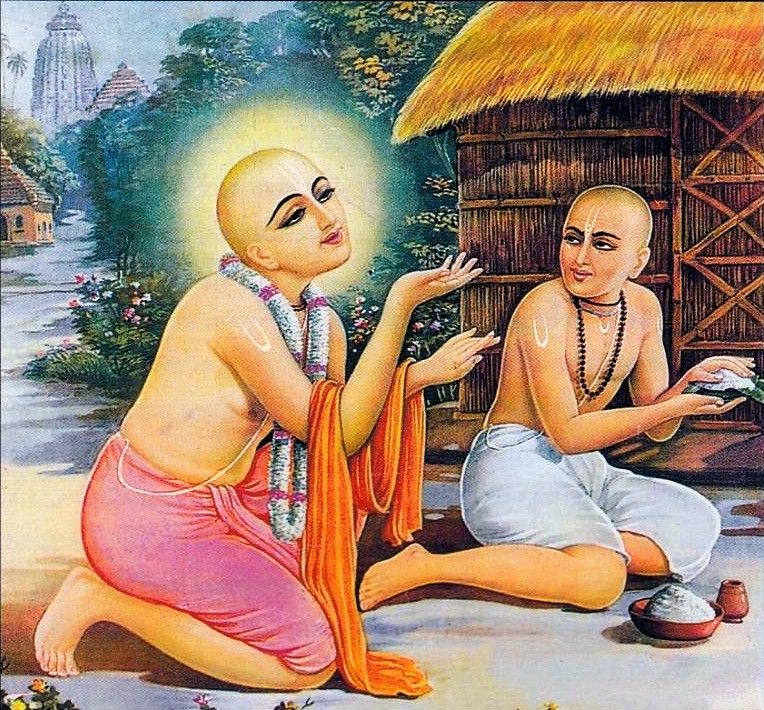
Hearing this, Śrī Caitanya Mahāprabhu, in an angry mood, began to chastise Jagadānanda Paṇḍita. (157) “Jagā [Jagadānanda Paṇḍita] is only a new boy, but he has become so proud that he thinks himself competent to advise a person like you. (158) “In affairs of spiritual advancement and even in ordinary dealings, you are on the level of his spiritual master. Yet not knowing his own value, he dares to advise you. (159) “My dear Sanātana, you are on the level of My advisor, for you are an authorized person. But Jagā wants to advise you. This is but the impudence of a naughty boy.” (160) When Śrī Caitanya Mahāprabhu was thus chastising Jagadānanda Paṇḍita, Sanātana Gosvāmī fell at the Lord’s feet and said, “I can now understand the fortunate position of Jagadānanda. (161)
“I can also understand my misfortune. No one in this world is as fortunate as Jagadānanda. (162) “Sir, You are making Jagadānanda drink the nectar of affectionate relationships, whereas by offering me honorable prayers, You are making me drink the bitter juice of nimba and niśindā. (163) “It is my misfortune that You have not accepted me as one of Your intimate relations. But You are the completely independent Supreme Personality of Godhead.” (164) Hearing this, Śrī Caitanya Mahāprabhu was somewhat ashamed. Just to satisfy Sanātana Gosvāmī, He spoke the following words. (165) “My dear Sanātana, please do not think that Jagadānanda is more dear to Me than you. However, I cannot tolerate transgressions of the standard etiquette. (166) “You are an experienced authority in the śāstras, whereas Jagā is just a young boy. (167) “You have the power to convince even Me. In many places you have already convinced Me about ordinary behavior and devotional service. (168) “Jagā’s advising you is intolerable for Me. Therefore I am chastising him. (169)
“I offer you praise not because I think of you as being outside an intimate relationship with Me but because you are actually so qualified that one is forced to praise your qualities. (170) “Although one has affection for many persons, different types of ecstatic love awaken according to the nature of one’s personal relationships. (171) “You consider your body dangerous and awful, but I think that your body is like nectar. (172) “Actually your body is transcendental, never material. You are thinking of it, however, in terms of a material conception. (173) “Even if your body were material, I still could not neglect it, for the material body should be considered neither good nor bad. (174) “‘Anything not conceived in relationship to Kṛṣṇa should be understood to be illusion [māyā]. None of the illusions uttered by words or conceived in the mind are factual. Because illusion is not factual, there is no distinction between what we think is good and what we think is bad. When we speak of the Absolute Truth, such speculations do not apply.’ (175)
“In the material world, conceptions of good and bad are all mental speculations. Therefore, saying ‘This is good’ and ‘This is bad’ is all a mistake. (176) “‘The humble sages, by virtue of true knowledge, see with equal vision a learned and gentle brāhmaṇa, a cow, an elephant, a dog and a dog- eater.’ (177) “‘One who is fully satisfied in knowledge obtained and practically applied in life, who is always determined and fixed in his spiritual position, who completely controls his senses, and who sees pebbles, stones and gold on the same level is understood to be a perfect yogī.’ (178) “Since I am in the renounced order, My duty is to make no distinctions and be equipoised. My knowledge must be equally disposed toward sandalwood pulp and dirty mud. (179)
“For this reason, I cannot reject you. If I hated you, I would deviate from My occupational duty.” (180) Haridāsa said, “My dear Lord, what You have spoken deals with external formalities. I do not accept it. (181) “My Lord, we are all fallen, but You have accepted us due to Your attribute of being merciful to the fallen. This is well known all over the world.” (182) Lord Caitanya smiled and said, “Listen, Haridāsa and Sanātana. Now I am speaking the truth about how My mind is attached to you. (183) “My dear Haridāsa and Sanātana, I think of you as My little boys, to be maintained by Me. The maintainer never takes seriously any faults of the maintained. (184) “I always think of Myself as deserving no respect, but because of affection I always consider you to be like My little children. (185) “When a child passes stool and urine that touch the body of the mother, the mother never hates the child. On the contrary, she takes much pleasure in cleansing him. (186)
“The stool and urine of the maintained child appear like sandalwood pulp to the mother. Similarly, when the foul moisture oozing from the sores of Sanātana touches My body, I have no hatred for him.” (187) Haridāsa Ṭhākura said, “My dear Sir, You are the Supreme Personality of Godhead and are most merciful toward us. No one can understand what is within Your deeply affectionate heart. (188) “You embraced the leper Vāsudeva, whose body was fully infected by worms. You are so kind that in spite of his condition You embraced him. (189) “By embracing him You made his body as beautiful as that of Cupid. We cannot understand the waves of Your mercy.” (190) Śrī Caitanya Mahāprabhu said, “The body of a devotee is never material. It is considered to be transcendental, full of spiritual bliss. (191) “At the time of initiation, when a devotee fully surrenders unto the service of the Lord, Kṛṣṇa accepts him to be as good as Himself. (192)
“When the devotee’s body is thus transformed into spiritual existence, the devotee, in that transcendental body, renders service to the lotus feet of the Lord. (193) “‘The living entity who is subjected to birth and death attains immortality when he gives up all material activities, dedicates his life to the execution of My order, and acts according to My directions. In this way he becomes fit to enjoy the spiritual bliss derived from exchanging loving mellows with Me.’ (194) “Kṛṣṇa somehow or other manifested these itching sores on the body of Sanātana Gosvāmī and sent him here to test Me. (195) “If I had hated Sanātana Gosvāmī and had not embraced him, I would certainly have been chastised for offenses to Kṛṣṇa. (196) “Sanātana Gosvāmī is one of the associates of Kṛṣṇa. There could not be any bad odor from his body. On the first day I embraced him, I smelled the aroma of catuḥsama [a mixture of sandalwood pulp, camphor, aguru and musk].” (197)
In fact, however, when Śrī Caitanya Mahāprabhu embraced the body of Sanātana Gosvāmī, by the Lord’s touch alone there was manifested a fragrance exactly like that of sandalwood pulp. (198) Śrī Caitanya Mahāprabhu continued, “My dear Sanātana, do not be aggrieved, for when I embrace you I actually get great pleasure. (199) “Stay with Me at Jagannātha Purī for one year, and after that I shall send you to Vṛndāvana.” (200) After saying this, Śrī Caitanya Mahāprabhu again embraced Sanātana Gosvāmī. Thus immediately Sanātana’s sores disappeared, and his entire body resembled the color of gold. (201) Seeing the change, Haridāsa Ṭhākura, greatly astonished, told the Lord, “This is Your pastime. (202) “My dear Lord, You made Sanātana Gosvāmī drink the water of Jhārikhaṇḍa, and You actually generated the consequent itching sores on his body. (203)
“After thus causing these itching sores, You examined Sanātana Gosvāmī. No one can understand Your transcendental pastimes.” (204) After embracing both Haridāsa Ṭhākura and Sanātana Gosvāmī, Śrī Caitanya Mahāprabhu returned to His residence. Then Haridāsa Ṭhākura and Sanātana Gosvāmī, in great ecstatic love, began to describe the Lord’s transcendental attributes. (205) In this way Sanātana Gosvāmī stayed under the care of Śrī Caitanya Mahāprabhu and discussed the transcendental qualities of Śrī Caitanya Mahāprabhu with Haridāsa Ṭhākura. (206) After they saw the Dola- yātrā festival, Śrī Caitanya Mahāprabhu instructed Sanātana Gosvāmī fully about what to do in Vṛndāvana and bade him farewell. (207) The scene of separation that took place when Sanātana Gosvāmī and Śrī Caitanya Mahāprabhu took leave of each other is so piteous that it cannot be described herein. (208)
Sanātana Gosvāmī decided to go to Vṛndāvana by the very forest path Śrī Caitanya Mahāprabhu had traversed. (209) Sanātana Gosvāmī noted from Balabhadra Bhaṭṭācārya all the villages, rivers and hills where Śrī Caitanya Mahāprabhu had performed His pastimes. (210) Sanātana Gosvāmī met all the devotees of Śrī Caitanya Mahāprabhu and then, traveling by that same path, visited the places through which Śrī Caitanya Mahāprabhu had passed. (211) As soon as Sanātana Gosvāmī visited a place where Śrī Caitanya Mahāprabhu had performed His pastimes on the way, he was immediately filled with ecstatic love. (212) In this way Sanātana Gosvāmī reached Vṛndāvana. Later Rūpa Gosvāmī came and met him. (213)
Deepen your Bhakti-yoga practice, harmonize relationships, and receive guided coaching — all at Vedavarsity.com