


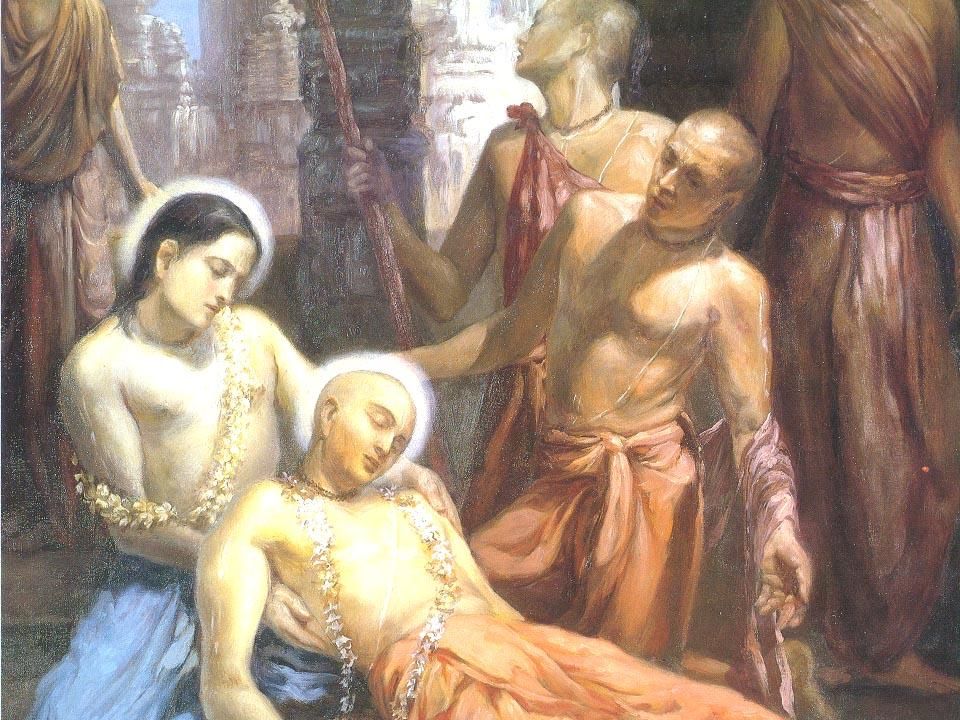
Svarūpa Dāmodara and Rāmānanda Rāya then devised various means to pacify the Lord. They sang songs of meeting that transformed His heart and made His mind peaceful. (54) As Śrī Caitanya Mahāprabhu lamented in this way, half the night passed. Then Svarūpa Dāmodara made the Lord lie down in the room known as the Gambhīrā. (55) After the Lord was made to lie down, Rāmānanda Rāya returned home, and Svarūpa Dāmodara and Govinda lay down at the door of the Gambhīrā. (56) Śrī Caitanya Mahāprabhu stayed awake all night, chanting the Hare Kṛṣṇa mahā- mantra, His mind overwhelmed by spiritual ecstasy. (57) Feeling separation from Kṛṣṇa, Śrī Caitanya Mahāprabhu was so distraught that in great anxiety He stood up and began rubbing His face against the walls of the Gambhīrā. (58) Blood oozed from the many injuries on His mouth, nose and cheeks, but due to His ecstatic emotions, the Lord did not know it. (59)
In ecstasy, Śrī Caitanya Mahāprabhu rubbed His face against the walls all night long, making a peculiar sound, “goṅ- goṅ,” which Svarūpa Dāmodara could hear through the door. (60) Lighting a lamp, Svarūpa Dāmodara and Govinda entered the room. When they saw the Lord’s face, they were filled with sorrow. (61) They brought the Lord to His bed, calmed Him and then asked, “Why have You done this to Yourself?” (62) Śrī Caitanya Mahāprabhu replied, “I was in such anxiety that I could not stay in the room. I wanted to go out, and therefore I wandered about the room, looking for the door. (63) “Unable to find the door, I kept hitting the four walls with My face. My face was injured, and it bled, but I still could not get out.” (64) In this state of madness, Śrī Caitanya Mahāprabhu’s mind was unsteady. Whatever He said or did was all symptomatic of madness. (65)
Svarūpa Dāmodara was very anxious, but then he had an idea. The following day, he and the other devotees considered it together. (66) After consulting with one another, they entreated Śrī Caitanya Mahāprabhu to allow Śaṅkara Paṇḍita to lie down in the same room with Him. (67) Thus Śaṅkara Paṇḍita lay at the feet of Śrī Caitanya Mahāprabhu, and the Lord placed His legs upon Śaṅkara’s body. (68) Śaṅkara became celebrated by the name Prabhu- pādopādhāna [“the pillow of Śrī Caitanya Mahāprabhu”]. He was like Vidura, as Śukadeva Gosvāmī previously described him. (69) “When submissive Vidura, the resting place of the legs of Lord Kṛṣṇa, had thus spoken to Maitreya, Maitreya began speaking, his hair standing on end due to the transcendental pleasure of discussing topics concerning Lord Kṛṣṇa.” (70) Śaṅkara massaged the legs of Śrī Caitanya Mahāprabhu, but while massaging he would fall asleep and thus lie down. (71)
He would lie asleep without a covering on his body, and Śrī Caitanya Mahāprabhu would get up and wrap him with His own quilt. (72) Śaṅkara Paṇḍita would always fall asleep, but he would quickly awaken, sit up and again begin massaging the legs of Śrī Caitanya Mahāprabhu. In this way he would stay awake the entire night. (73) Out of fear of Śaṅkara, Śrī Caitanya Mahāprabhu could neither leave His room nor rub His lotuslike face against the walls. (74) This pastime of Śrī Caitanya Mahāprabhu’s has been described very nicely by Raghunātha dāsa Gosvāmī in his book known as Gaurāṅga- stava- kalpavṛkṣa. (75) “Because of separation from His many friends in Vṛndāvana, who were like His own life, Śrī Caitanya Mahāprabhu spoke like a madman. His intelligence was transformed. Day and night He rubbed His moonlike face against the walls, and blood flowed from the injuries. May that Śrī Caitanya Mahāprabhu rise in my heart and make me mad with love.” (76) In this way Śrī Caitanya Mahāprabhu stayed immersed day and night in an ocean of ecstatic love for Kṛṣṇa. Sometimes He was submerged, and sometimes He floated. (77)
One full- moon night in the month of Vaiśākha [April May], Śrī Caitanya Mahāprabhu went to a garden. (78) The Lord, along with His devotees, entered one of the nicest gardens, called Jagannātha- vallabha. (79) In the garden were fully blossomed trees and creepers exactly like those in Vṛndāvana. Bumblebees and birds like the śuka, śārī and pika talked with one another. (80) A mild breeze was blowing, carrying the fragrance of aromatic flowers. The breeze had become a guru and was teaching all the trees and creepers how to dance. (81) Brightly illuminated by the full moon, the trees and creepers glittered in the light. (82) The six seasons, especially spring, seemed present there. Seeing the garden, Śrī Caitanya Mahāprabhu, the Supreme Personality of Godhead, was very happy. (83) In this atmosphere, the Lord had His associates sing the verse from the Gīta- govinda beginning with the words “lalita- lavaṅga- latā” as He danced and wandered about with them. (84)
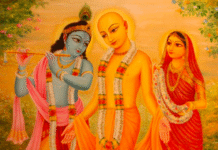
As He thus wandered around every tree and creeper, He came beneath an aśoka tree and suddenly saw Lord Kṛṣṇa. (85) When He saw Kṛṣṇa, Śrī Caitanya Mahāprabhu began running very swiftly, but Kṛṣṇa smiled and disappeared. (86) Having gotten Kṛṣṇa and then lost Him, Śrī Caitanya Mahāprabhu fell to the ground unconscious. (87) The entire garden was filled with the scent of Lord Śrī Kṛṣṇa’s transcendental body. When Śrī Caitanya Mahāprabhu smelled it, He fell unconscious at once. (88) But the scent of Kṛṣṇa’s body incessantly entered His nostrils, and the Lord became mad to relish it. (89) Śrīmatī Rādhārāṇī once spoke a verse to Her gopī friends describing how She hankers for the transcendental scent of Kṛṣṇa’s body. Śrī Caitanya Mahāprabhu recited that same verse and made its meaning clear. (90)
“‘The scent of Kṛṣṇa’s transcendental body surpasses the aroma of musk and attracts the minds of all women. The eight lotuslike parts of His body distribute the fragrance of lotuses mixed with that of camphor. His body is anointed with aromatic substances like musk, camphor, sandalwood and aguru. O My dear friend, that Personality of Godhead, also known as the enchanter of Cupid, always increases the desire of My nostrils.’ (91) “The scent of Kṛṣṇa’s body surpasses the fragrances of musk and the bluish lotus flower. Spreading throughout the fourteen worlds, it attracts everyone and makes the eyes of all women blind. (92) “My dear friend, the scent of Kṛṣṇa’s body enchants the entire world. It especially enters the nostrils of women and remains seated there. Thus it captures them and forcibly brings them to Kṛṣṇa. (93) “Kṛṣṇa’s eyes, navel and face, hands and feet are like eight lotus flowers on His body. From those eight lotuses emanates a fragrance like a mixture of camphor and lotus. That is the scent associated with His body. (94)
“When sandalwood pulp is mixed with aguru, kuṅkuma, musk and camphor and spread on Kṛṣṇa’s body, it combines with Kṛṣṇa’s own original bodily perfume and seems to cover it. (95)”The scent of Kṛṣṇa’s transcendental body is so attractive that it enchants the bodies and minds of all women. It bewilders their nostrils, loosens their belts and hair, and makes them madwomen. All the women of the world come under its influence, and therefore the scent of Kṛṣṇa’s body is like a plunderer. (96) “Falling completely under its influence, the nostrils yearn for it continuously, although sometimes they obtain it and sometimes not. When they do they drink their fill, though they still want more and more, but if they don’t, out of thirst they die. (97)
“The dramatic actor Madana- mohana has opened a shop of scents that attract the women of the world to be His customers. He delivers the scents freely, but they make the women all so blind they cannot find the path returning home.” (98) Śrī Caitanya Mahāprabhu, His mind thus stolen by the scent of Kṛṣṇa’s body, ran here and there like a bumblebee. He ran to the trees and plants, hoping that Lord Kṛṣṇa would appear, but instead He found only that scent. (99) Both Svarūpa Dāmodara and Rāmānanda Rāya sang to the Lord, who danced and enjoyed happiness until the morning arrived. Then the Lord’s two associates devised a plan to bring Him to external consciousness. (100) Thus, I, Kṛṣṇadāsa, the servant of Śrīla Rūpa Gosvāmī, have sung of four divisions of the Lord’s pastimes in this chapter: the Lord’s devotion to His mother, His words of madness, His rubbing His face against the walls at night, and His dancing at the appearance of Lord Kṛṣṇa’s fragrance. (101) Śrī Caitanya Mahāprabhu thus returned to external consciousness. He then bathed and went to see Lord Jagannātha. (102)
The pastimes of Lord Kṛṣṇa are uncommonly full of transcendental potency. It is a characteristic of such pastimes that they do not fall within the jurisdiction of experimental logic and arguments. (103) When transcendental love of Kṛṣṇa awakens in someone’s heart, even a learned scholar cannot comprehend his activities. (104) “The activities and symptoms of that exalted personality in whose heart love of Godhead has awakened cannot be understood even by the most learned scholar.” (105) The activities of Śrī Caitanya Mahāprabhu are undoubtedly uncommon, especially His talking like a madman. Therefore, one who hears of these pastimes should not put forward mundane arguments. He should simply hear the pastimes with full faith. (106) The evidence of the truth of these talks is found in Śrīmad- Bhāgavatam. There, in the section of the Tenth Canto known as the Bhramara- gīta, “The Song to the Bumblebee,” Śrīmatī Rādhārāṇī speaks insanely in ecstatic love for Kṛṣṇa. (107)
The songs of the queens at Dvārakā, which are mentioned at the end of the Tenth Canto of Śrīmad- Bhāgavatam, have a very special meaning. They are not understood even by the most learned scholars. (108) If one becomes a servant of the servants of Śrī Caitanya Mahāprabhu and Lord Nityānanda Prabhu and is favored by Them, he can believe in all these discourses. (109) Just try to hear these topics with faith, for there is great pleasure even in hearing them. That hearing will destroy all miseries pertaining to the body, mind and other living entities, and the unhappiness of false arguments as well. (110) Śrī Caitanya- caritāmṛta is ever- increasingly fresh. For one who hears it again and again, the heart and ear become pacified. (111) Praying at the lotus feet of Śrī Rūpa and Śrī Raghunātha, always desiring their mercy, I, Kṛṣṇadāsa, narrate Śrī Caitanya- caritāmṛta, following in their footsteps. (112)
Deepen your Bhakti-yoga practice, harmonize relationships, and receive guided coaching — all at Vedavarsity.com