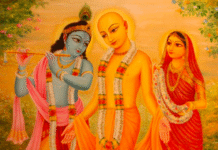




When Śrī Caitanya Mahāprabhu saw the transcendental beauty of Kṛṣṇa, He fell down on the ground unconscious. At that time, all the devotees, headed by Svarūpa Dāmodara Gosvāmī, joined Him in the garden. (57) Just as before, they saw all the symptoms of transcendental ecstatic love manifested in the body of Śrī Caitanya Mahāprabhu. Although externally He appeared bewildered, He was tasting transcendental bliss within. (58) Once again all the devotees brought Śrī Caitanya Mahāprabhu back to consciousness by a concerted effort. Then the Lord got up and began wandering here and there, looking all around. (59) Caitanya Mahāprabhu said, “Where has My Kṛṣṇa gone? I saw Him just now, and His beauty has captivated My eyes and mind. (60)
“Why can’t I again see Kṛṣṇa holding His flute to His lips? My eyes are wandering in hopes of seeing Him once more.” (61) Śrī Caitanya Mahāprabhu then recited the following verse, which was spoken by Śrīmatī Rādhārāṇī to Her dear friend Viśākhā. (62) “‘My dear friend, the luster of Kṛṣṇa’s body is more brilliant than that of a newly formed cloud, and His yellow dress is more attractive than newly arrived lightning. A peacock feather decorates His head, and on His neck hangs a lovely necklace of brilliant pearls. As He holds His charming flute to His lips, His face looks as beautiful as the full autumn moon. By such beauty, Madana- mohana, the enchanter of Cupid, is increasing the desire of My eyes to see Him.'” (63)
Caitanya Mahāprabhu continued, “Śrī Kṛṣṇa’s complexion is as polished as powdered eye ointment. It surpasses the beauty of a newly formed cloud and is softer than a blue lotus flower. Indeed, His complexion is so pleasing that it attracts the eyes and minds of everyone, and it is so powerful that it defies all comparison. (64) “My dear friend, please tell Me what I should do. Kṛṣṇa is as attractive as a wonderful cloud, and My eyes are just like cātaka birds, which are dying of thirst because they do not see such a cloud. (65) “Kṛṣṇa’s yellow garments look exactly like restless lightning in the sky, and the pearl necklace on His neck appears like a line of ducks flying below a cloud. Both the peacock feather on His head and His vaijayantī garland [containing flowers of five colors] resemble rainbows. (66)
“The luster of Kṛṣṇa’s body is as beautiful as the glow of a spotless full moon that has just risen, and the vibration of His flute sounds exactly like the sweet thundering of a newly formed cloud. When the peacocks in Vṛndāvana hear that vibration, they all begin to dance. (67) “The cloud of Kṛṣṇa’s pastimes is drenching the fourteen worlds with a shower of nectar. Unfortunately, when that cloud appeared, a whirlwind arose and blew it away from Me. Being unable to see the cloud, the cātaka bird of My eyes is almost dead from thirst.” (68) In a faltering voice, Śrī Caitanya Mahāprabhu again said, “Alas, go on reciting, Rāma Rāya.” Thus Rāmānanda Rāya began to recite a verse. While listening to this verse, the Lord was sometimes very jubilant and sometimes overcome by lamentation. Afterwards the Lord personally explained the verse. (69)
“‘Dear Kṛṣṇa, by seeing Your beautiful face decorated with tresses of hair, by seeing the beauty of Your earrings falling on Your cheeks, and by seeing the nectar of Your lips, the beauty of Your smiling glances, Your two arms, which assure complete fearlessness, and Your broad chest, whose beauty arouses conjugal attraction, we have simply surrendered ourselves to becoming Your maidservants.'” (70) Śrī Caitanya Mahāprabhu said, “After conquering the moon and the lotus flower, Kṛṣṇa wished to capture the doelike gopīs. Thus He spread the noose of His beautiful face, and within that noose He placed the bait of His sweet smile to misguide the gopīs. The gopīs fell prey to that trap and became Kṛṣṇa’s maidservants, giving up their homes, families, husbands and prestige. (71) “My dear friend, Kṛṣṇa acts just like a hunter. This hunter does not care for piety or impiety; He simply creates many devices to conquer the cores of the hearts of the doelike gopīs. (72)
“The earrings dancing on Kṛṣṇa’s cheeks are shaped like sharks, and they shine very brightly. These dancing earrings attract the minds of all women. Over and above this, Kṛṣṇa pierces the hearts of women with the arrows of His sweetly smiling glances. He is not at all afraid to kill women in this way. (73) “On Kṛṣṇa’s chest are the ornaments of the Śrīvatsa marks, indicating the residence of the goddess of fortune. His chest, which is as broad as a plunderer’s, attracts thousands upon thousands of damsels of Vraja, conquering their minds and breasts by force. Thus they all become maidservants of the Supreme Personality of Godhead. (74) “The two very beautiful arms of Kṛṣṇa are just like long bolts. They also resemble the bodies of black snakes that enter the space between the two hill- like breasts of women and bite their hearts. The women then die from the burning poison. (75)
“The combined cooling effect of camphor, roots of khasakhasa and sandalwood is surpassed by the coolness of Kṛṣṇa’s palms and the soles of His feet, which are cooler and more pleasing than millions upon millions of moons. If women are touched by them even once, their minds are enticed, and the burning poison of lusty desire for Kṛṣṇa is immediately vanquished.” (76) Lamenting in ecstatic love, Śrī Caitanya Mahāprabhu then recited the following verse, which was spoken by Śrīmatī Rādhārāṇī while exposing the lamentation of Her heart to Her friend Śrīmatī Viśākhā. (77) “‘My dear friend, Kṛṣṇa’s chest is as broad and attractive as a door made of indranīla gems, and His two arms, as strong as bolts, can relieve the mental anguish of young girls distressed by lusty desires for Him. His body is cooler than the moon, sandalwood, the lotus flower and camphor. In this way, Madana- mohana, the attractor of Cupid, is increasing the desire of My breasts.'” (78) Śrī Caitanya Mahāprabhu then said, “I just now had Kṛṣṇa, but unfortunately I have lost Him again. (79)
“By nature, Kṛṣṇa is very restless; He does not stay in one place. He meets with someone, enchants his mind and then disappears. (80) “‘The gopīs became proud of their great fortune. To subdue their sense of superiority and show them special favor, Keśava, the subduer of even Lord Brahmā and Lord Śiva, disappeared from the rāsa dance.'” (81) Śrī Caitanya Mahāprabhu then said to Svarūpa Dāmodara Gosvāmī, “Please sing a song that will bring consciousness to My heart.” (82) Thus for the pleasure of Śrī Caitanya Mahāprabhu, Svarūpa Dāmodara Gosvāmī began very sweetly singing the following verse from the Gīta- govinda. (83) “‘Here in the arena of the rāsa dance, I remember Kṛṣṇa, who is always fond of joking and performing pastimes.'” (84) When Svarūpa Dāmodara Gosvāmī sang this special song, Śrī Caitanya Mahāprabhu immediately got up and began to dance in ecstatic love. (85)
At that time, all eight kinds of spiritual transformations became manifest in Lord Caitanya’s body. The thirty- three symptoms of vyabhicāri- bhāva, beginning with lamentation and jubilation, became prominent as well. (86) All the ecstatic symptoms, such as bhāvodaya, bhāva- sandhi and bhāva- śābalya, awakened in the body of Śrī Caitanya Mahāprabhu. A great fight arose between one emotion and another, and each of them became prominent. (87) Lord Caitanya Mahāprabhu had Svarūpa Dāmodara sing the same verse again and again. Each time he sang it, the Lord tasted it anew, and thus He danced again and again. (88) After the Lord had been dancing for a long time, Svarūpa Dāmodara Gosvāmī stopped singing the verse. (89) Over and over again Śrī Caitanya Mahāprabhu said, “Go on! Sing! Sing!” But Svarūpa Dāmodara, seeing the Lord’s fatigue, did not resume singing. (90)
When the devotees heard Śrī Caitanya Mahāprabhu say “Go on singing!” they all gathered around Him and began to chant the holy name of Hari in unison. (91) At that time, Rāmānanda Rāya made the Lord sit down and dissipated His fatigue by fanning Him. (92) Then all the devotees took Śrī Caitanya Mahāprabhu to the beach and bathed Him. Finally, they brought Him back home. (93) After they fed Him lunch, they made Him lie down. Then all the devotees, headed by Rāmānanda Rāya, returned to their respective homes. (94) Thus I have described Śrī Caitanya Mahāprabhu’s pastimes in the garden, which He entered, mistaking it for Vṛndāvana. (95) There He exhibited transcendental madness and ecstatic ravings, which Śrī Rūpa Gosvāmī has described very nicely in his Stava- mālā as follows. (96)
“Śrī Caitanya Mahāprabhu is the topmost of all devotees. Sometimes, while walking on the beach, He would see a beautiful garden nearby and mistake it for the forest of Vṛndāvana. Thus He would be completely overwhelmed by ecstatic love of Kṛṣṇa and begin to chant the holy name and dance. His tongue worked incessantly as He chanted, ‘Kṛṣṇa! Kṛṣṇa!’ Will He again become visible before the path of my eyes?” (97) The pastimes of Śrī Caitanya Mahāprabhu are unlimited; it is not possible to write of them properly. I can give only an indication of them as I try to introduce them. (98) Praying at the lotus feet of Śrī Rūpa and Śrī Raghunātha, always desiring their mercy, I, Kṛṣṇadāsa, narrate Śrī Caitanya- caritāmṛta, following in their footsteps. (99)
Deepen your Bhakti-yoga practice, harmonize relationships, and receive guided coaching — all at Vedavarsity.com