Let me offer my respectful obeisances unto Lord Śrī Caitanya Mahāprabhu, who is always pleased to accept anything given with faith and love by His devotees and is always ready to bestow mercy upon them. (1) All glories to Śrī Caitanya Mahāprabhu! All glories to Lord Nityānanda Prabhu! All glories to Advaitacandra! And all glories to all the devotees of Lord Caitanya! (2) The next year, all the devotees were very pleased to go to Jagannātha Purī [Nīlācala] to see Śrī Caitanya Mahāprabhu. (3) Advaita Ācārya Gosāñi led the party from Bengal. He was followed by Ācāryaratna, Ācāryanidhi, Śrīvāsa Ṭhākura and other glorious devotees. (4) Śrī Caitanya Mahāprabhu had ordered Lord Nityānanda to stay in Bengal, but nevertheless, because of ecstatic love, Lord Nityānanda also went to see Him. (5)
Indeed, it is a symptom of real affection that one breaks the order of the Supreme Personality of Godhead, not caring for the regulative principles, to associate with Him. (6) During the rāsa dance, Kṛṣṇa asked all the gopīs to return home, but they neglected His order and stayed there for His association. (7) If one carries out Kṛṣṇa’s order, Kṛṣṇa is certainly pleased, but if one sometimes breaks His order due to ecstatic love, that gives Him millions of times greater happiness. (8) Vāsudeva Datta, Murāri Gupta, Gaṅgādāsa, Śrīmān Sena, Śrīmān Paṇḍita, Akiñcana Kṛṣṇadāsa, Murāri Gupta, Garuḍa Paṇḍita, Buddhimanta Khān, Sañjaya Puruṣottama, Bhagavān Paṇḍita, Śuklāmbara Brahmacārī, Nṛsiṁhānanda Brahmacārī and many others joined together to go to Jagannātha Purī. It would be impossible to mention the names of them all. (9-11) The inhabitants of Kulīna- grāma and Khaṇḍa also came and joined. Śivānanda Sena took the leadership and thus started taking care of them all. (12)
Rāghava Paṇḍita came with bags full of food prepared very nicely by his sister, Damayantī. (13) Damayantī made varieties of unparalleled food just suitable for Lord Śrī Caitanya Mahāprabhu to eat. The Lord ate it continually for one year. (14) These are the names of some of the pickles and condiments in the bags of Rāghava Paṇḍita: āmra- kāśandi, ādā- kāśandi, jhāla- kāśandi, nembu- ādā, āmra- koli, āmsi, āma- khaṇḍa, tailāmra and āma- sattā. With great attention, Damayantī also made dried bitter vegetables into a powder. (15-16) Do not neglect sukutā because it is a bitter preparation. Śrī Caitanya Mahāprabhu derived more happiness from eating this sukutā than from drinking pañcāmṛta [a preparation of milk, sugar, ghee, honey and yogurt]. (17) Since Śrī Caitanya Mahāprabhu is the Supreme Personality of Godhead, He extracts the purpose from everything. He accepted Damayantī’s affection for Him, and therefore He derived great pleasure even from the dried bitter leaves of sukutā and from kāśandi [a sour condiment]. (18)
Because of her natural love for Śrī Caitanya Mahāprabhu, Damayantī considered the Lord an ordinary human being. Therefore she thought that He would become sick by overeating and there would be mucus within His abdomen. (19) Because of sincere affection, she thought that eating this sukutā would cure the Lord’s disease. Considering these affectionate thoughts of Damayantī, the Lord was very pleased. (20) “A dear lover strung a garland and placed it on the shoulder of his beloved in the presence of her co- wives. She had raised breasts and was very beautiful, yet although the garland was tainted with mud, she did not reject it, for its value lay not in material things but in love.” (21) Damayantī powdered coriander and anise seeds, cooked them with sugar and made them into sweetmeats in the shape of small balls. (22) She made sweetmeat balls with dried ginger to remove mucus caused by too much bile. She put all these preparations separately into small cloth bags. (23)
She made a hundred varieties of condiments and pickles. She also made koli- śuṇṭhi, koli- cūrṇa, koli- khaṇḍa and many other preparations. How many should I name? (24) She made many sweetmeats in the shape of balls. Some were made with powdered coconut, and others looked as white as the water of the Ganges. In this way she made many varieties of long- lasting sugar confections. (25) She made long- lasting cheese, many varieties of sweetmeats with milk and cream, and many other varied preparations, such as amṛta- karpūra. (26) She made flat rice from fine, unboiled, śāli paddy and filled a large bag made of new cloth. (27) She made some of the flat rice into puffed rice, fried it in ghee, cooked it in sugar juice, mixed in some camphor and rolled it into balls. (28) She powdered fried grains of fine rice, moistened the powder with ghee and cooked it in a solution of sugar. Then she added camphor, black pepper, cloves, cardamom and other spices and rolled the mixture into balls that were very palatable and aromatic. (29-30)
She took parched rice from fine paddy, fried it in ghee, cooked it in a sugar solution, mixed in some camphor and thus made a preparation called ukhḍā or muḍki. (31) Another variety of sweet was made with fused peas that were powdered, fried in ghee and then cooked in sugar juice. Camphor was added, and then the mixture was rolled into balls. (32) I could not mention the names of all these wonderful eatables, even in a lifetime. Damayantī made hundreds and thousands of varieties. (33) Damayantī made all these preparations following the order of her brother, Rāghava Paṇḍita. Both of them had unlimited affection for Śrī Caitanya Mahāprabhu and were advanced in devotional service. (34) Damayantī took earth from the Ganges, dried it, powdered it, strained it through a fine cloth, mixed in aromatic ingredients and rolled it into small balls. (35)
The condiments and similar items were put into thin earthen pots, and everything else was put into small cloth bags. (36) From small bags Damayantī made bags that were twice as large. Then with great attention she filled all the large ones with the small ones. (37) She then wrapped and sealed each and every bag with great attention. The bags were carried by three bearers, one after another. (38) Thus I have briefly described the bags that have become famous as rāghavera jhāli. (39) The superintendent for all those bags was Makaradhvaja Kara, who kept them with great attention like his very life. (40) Thus all the Vaiṣṇavas from Bengal went to Jagannātha Purī. By chance, they arrived on the day when Lord Jagannātha performs pastimes in the water. (41) Boarding a boat in the water of Narendra- sarovara, Lord Govinda performed His water pastimes with all the devotees. (42)
Then Śrī Caitanya Mahāprabhu arrived with His personal associates to see the jubilant pastimes of Lord Jagannātha in Narendra- sarovara. (43) At the same time, all the devotees from Bengal arrived at the lake and had a great meeting with the Lord. (44) All the devotees immediately fell at the lotus feet of Śrī Caitanya Mahāprabhu, and the Lord lifted and embraced every one of them. (45) The Gauḍīya- sampradāya, consisting of all the devotees from Bengal, began congregational chanting. When they met the Lord, they began to cry loudly in ecstatic love. (46) Because of the pastimes in the water, there was great jubilation on the shore, with music, singing, chanting and dancing creating a tumultuous sound. (47) Indeed, the chanting and crying of the Gauḍīyā Vaiṣṇavas mixed and created a tumultuous sound vibration that filled the entire universe. (48)
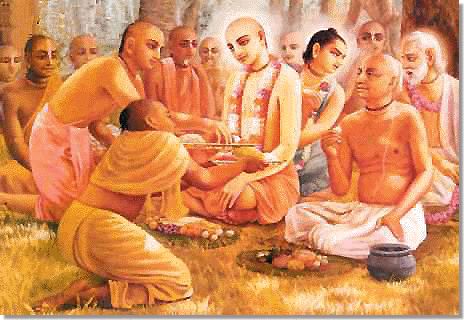
Śrī Caitanya Mahāprabhu entered the water with His devotees and began His pastimes with them in great jubilation. (49) In his Caitanya- maṅgala [now known as Caitanya- bhāgavata], Vṛndāvana dāsa Ṭhākura has given a detailed description of the activities the Lord performed in the water. (50) There is no use in again describing here the activities of the Lord. It would simply be repetitious and would increase the size of this book. (51) After concluding His pastimes in the water, Lord Govinda returned to His residence. Then Śrī Caitanya Mahāprabhu went to the temple, taking all His devotees with Him. (52) When Śrī Caitanya Mahāprabhu returned to His residence after visiting the temple of Jagannātha, He asked for a large quantity of Lord Jagannātha’s prasādam, which He then distributed among His devotees so that they could eat sumptuously. (53) After talking with all the devotees for some time, Śrī Caitanya Mahāprabhu asked them to occupy the individual residences in which they had lived the previous year. (54)
Deepen your Bhakti-yoga practice, harmonize relationships, and receive guided coaching — all at Vedavarsity.com