


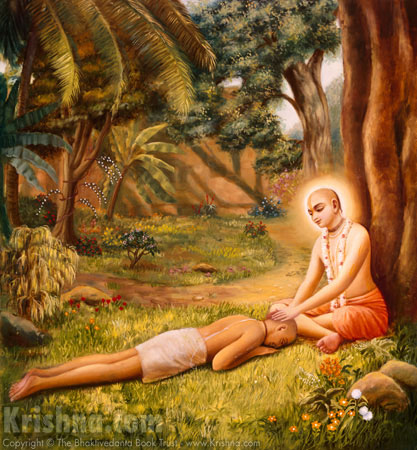
'Sri Chaitanya Mahaprabhu then placed His hand on Sanatana Goswami's head and benedicted him, saying, "Let all these instructions be manifest to you."'
-Excerpt from Chaitanya-caritamrita, Madhya-lila, 23.120-124
I offer my respectful obeisances to Śrī Kṛṣṇa Caitanya Mahāprabhu, by whose mercy even a lame man can cross over a mountain and a dumb man recite Vedic literature. (1) My path is very difficult. I am blind, and my feet are slipping again and again. Therefore, may the saints help me by granting me the stick of their mercy as my support. (2) I pray to the lotus feet of the six Gosvāmīs-Śrī Rūpa, Sanātana, Bhaṭṭa Raghunātha, Śrī Jīva, Gopāla Bhaṭṭa and Dāsa Raghunātha-so that all impediments to my writing this literature will be annihilated and my real desire will be fulfilled. (3-4) Glory to the all- merciful Rādhā and Madana- mohana! I am lame and ill advised, yet They are my directors, and Their lotus feet are everything to me. (5)
In a temple of jewels in Vṛndāvana, underneath a desire tree, Śrī Śrī Rādhā- Govinda, served by Their most confidential associates, sit upon an effulgent throne. I offer my humble obeisances unto Them. (6) Śrī Śrīla Gopīnātha, who originated the transcendental mellow of the rāsa dance, stands on the shore at Vaṁśīvaṭa and attracts the attention of the cowherd damsels with the sound of His celebrated flute. May they all confer upon us their benediction. (7) All glories to Lord Śrī Caitanya Mahāprabhu! All glories to Lord Nityānanda! All glories to Advaita Ācārya! And all glories to all the devotees of Lord Śrī Caitanya Mahāprabhu! (8) I have briefly described the pastimes of Śrī Caitanya Mahāprabhu known as Madhya-līlā-lila. Now I shall attempt to describe something about His last pastimes, which are known as the Antya-līlā- līlā (9) I have briefly described the Antya-līlā within the description of the Madhya-līlā. (10)
I am now almost an invalid because of old age, and I know that at any līlā. (11) In accordance with the synopsis previously written, I shall describe in detail whatever I have not mentioned. (12) When Śrī Caitanya Mahāprabhu returned to Jagannātha Purī from Vṛndāvana, Svarūpa Dāmodara Gosāñi immediately sent news of the Lord’s arrival to the devotees in Bengal. (13) Upon hearing this news, mother Śacī and all the other devotees of Navadvīpa were very joyful, and they all departed together for Nīlācala [Jagannātha Purī]. (14) Thus all the devotees of Kulīna- grāma and Śrī Khaṇḍa, as well as Advaita Ācārya, came together to meet Śivānanda Sena. (15) Śivānanda Sena arranged for the journey. He maintained everyone and provided residential quarters. (16) While going to Jagannātha Purī, Śivānanda Sena allowed a dog to go with him. He supplied it food to eat and maintained it. (17)
One day, when they needed to cross a river, an Orissan boatman would not allow the dog to get in the boat. (18) Śivānanda Sena, unhappy that the dog had to stay behind, paid the boatman ten paṇa of conchshells to take the dog across the river. (19) One day while Śivānanda was detained by a tollman, his servant forgot to give the dog its cooked rice. (20) At night, when Śivānanda Sena returned and was taking his meal, he inquired from the servant whether the dog had gotten its meals. (21) When he learned that the dog had not been supplied food in his absence, he was very unhappy. He then immediately sent ten men to find the dog. (22) When the men returned without success, Śivānanda Sena became very unhappy and fasted for the night. (23)
In the morning they looked for the dog, but it could not be found anywhere. All the Vaiṣṇavas were astonished. (24) Thus in great anxiety they all walked to Jagannātha Purī, where Śrī Caitanya Mahāprabhu met them as usual. (25) Śrī Caitanya Mahāprabhu went with them to see the Lord in the temple, and on that day He also took lunch in the company of all those devotees. (26) As previously, the Lord provided them all with residential quarters. And the next morning all the devotees came to see the Lord. (27) When all the devotees came to the place of Śrī Caitanya Mahāprabhu, they saw the same dog sitting a little apart from the Lord. (28) Furthermore, Śrī Caitanya Mahāprabhu was throwing remnants of green coconut pulp to the dog. Smiling in His own way, He was saying to the dog, “Chant the holy names ‘Rāma,’ ‘Kṛṣṇa’ and ‘Hari.'” (29) Seeing the dog eating the green coconut pulp and chanting “Kṛṣṇa, Kṛṣṇa” again and again, all the devotees present were very surprised. (30) When he saw the dog sitting in that way and chanting the name of Kṛṣṇa, Śivānanda, because of his natural humility, immediately offered his obeisances to the dog just to counteract his offenses to it. (31)
The next day, no one saw that dog, for it had obtained its spiritual body and departed for Vaikuṇṭha, the spiritual kingdom. (32) Such are the transcendental pastimes of Śrī Caitanya Mahāprabhu, the son of mother Śacī. He even delivered a dog simply by inducing it to chant the mahā- mantra, Hare Kṛṣṇa. (33) Meanwhile, following the order of Śrī Caitanya Mahāprabhu, Śrīla Rūpa Gosvāmī returned to Vṛndāvana. He desired to write dramas concerning the pastimes of Lord Kṛṣṇa. (34) In Vṛndāvana, Rūpa Gosvāmī began to write a drama. In particular, he composed the introductory verses to invoke good fortune. (35) On his way to Gauḍa- deśa, Rūpa Gosvāmī had been thinking of how to write the action of the drama. Thus he had made some notes and begun to write. (36) In this way the two brothers Rūpa and Anupama reached Bengal, but when they arrived there Anupama died. (37)
Rūpa Gosvāmī then departed to see Śrī Caitanya Mahāprabhu, for he was very eager to see Him. (38) There was some delay because of the death of Anupama, and therefore when Rūpa Gosvāmī went to Bengal to see the devotees there, he could not get in touch with them because they had already left. (39) In the province of Orissa there is a place known as Satyabhāmā- pura. Śrīla Rūpa Gosvāmī rested for a night in that village on his way to Jagannātha Purī. (40) While resting in Satyabhāmā- pura, he dreamed that a celestially beautiful woman came before him and very mercifully gave him the following order. (41) “Write a separate drama about me,” she said. “By my mercy it will be extraordinarily beautiful.” (42) After having that dream, Śrīla Rūpa Gosvāmī considered, “It is the order of Satyabhāmā that I write a separate drama for her. (43) “I have brought together in one work all the pastimes performed by Lord Kṛṣṇa in Vṛndāvana and in Dvārakā. Now I shall have to divide them into two dramas.” (44)
Thus absorbed in thought, he quickly reached Jagannātha Purī. When he arrived, he approached the hut of Haridāsa Ṭhākura. (45) Out of affectionate love and mercy, Haridāsa Ṭhākura told Śrīla Rūpa Gosvāmī, “Śrī Caitanya Mahāprabhu has already informed me that you would come here.” (46) After seeing the upala- bhoga ceremony at the Jagannātha temple, Lord Śrī Caitanya Mahāprabhu would regularly come to see Haridāsa every day. Thus He suddenly arrived there. (47) When the Lord arrived, Rūpa Gosvāmī immediately offered his obeisances. Haridāsa informed the Lord, “This is Rūpa Gosvāmī offering You obeisances,” and the Lord embraced him. (48) Śrī Caitanya Mahāprabhu then sat down with Haridāsa and Rūpa Gosvāmī. They inquired from one another about auspicious news and then continued to talk together for some time. (49) When Śrī Caitanya Mahāprabhu inquired about Sanātana Gosvāmī, Rūpa Gosvāmī replied, “I did not meet him. (50)
“I came by the path on the bank of the Ganges, whereas Sanātana Gosvāmī came by the public road. Therefore we did not meet. (51) “In Prayāga I heard that he had already gone to Vṛndāvana.” Rūpa Gosvāmī next informed the Lord about the death of Anupama. (52) After allotting residential quarters there to Rūpa Gosvāmī, Śrī Caitanya Mahāprabhu left. Then all of the Lord’s personal associates met Śrīla Rūpa Gosvāmī. (53) On the next day, Caitanya Mahāprabhu again met Rūpa Gosvāmī, and with great mercy the Lord introduced him to all the devotees. (54) Śrīla Rūpa Gosvāmī offered his respectful obeisances unto the lotus feet of them all, and all the devotees, by their mercy, embraced him. (55) Śrī Caitanya Mahāprabhu told Advaita Ācārya and Nityānanda Prabhu, “You should both show Your mercy wholeheartedly to Rūpa Gosvāmī. (56)
“May Rūpa Gosvāmī, by Your mercy, become so powerful that he will be able to describe the transcendental mellows of devotional service.” (57) Thus Rūpa Gosvāmī became the object of love and affection for all the devotees of the Lord, including those who came from Bengal and those who resided in Orissa. (58) Every day Śrī Caitanya Mahāprabhu would go to see Rūpa Gosvāmī, and whatever prasādam He received from the temple He would deliver to Rūpa Gosvāmī and Haridāsa Ṭhākura. (59) He would talk for some time with them both and then leave to perform His noontime duties. (60) In this way Lord Caitanya Mahāprabhu’s dealings with them continued every day. Thus receiving the transcendental favor of the Lord, Śrīla Rūpa Gosvāmī felt unlimited pleasure. (61)
Deepen your Bhakti-yoga practice, harmonize relationships, and receive guided coaching — all at Vedavarsity.com