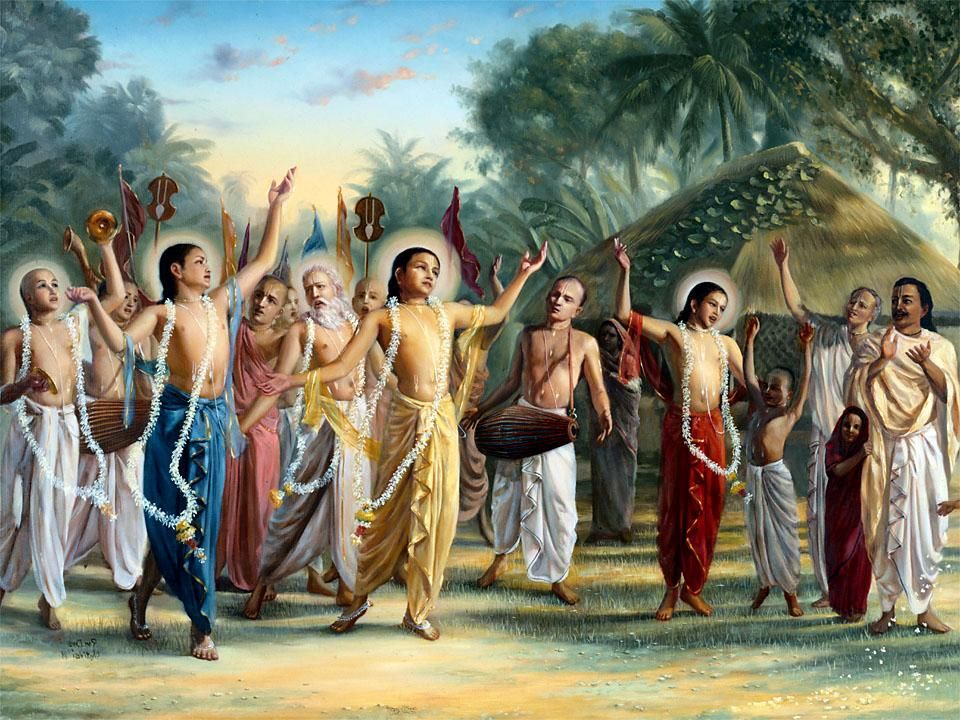
Lord Śrī Kṛṣṇa Caitanya is the initiator of saṅkīrtana [congregational chanting of the holy name of the Lord]. One who worships Him through saṅkīrtana is fortunate indeed. (77) Such a person is truly intelligent, whereas others, who have but a poor fund of knowledge, must endure the cycle of repeated birth and death. Of all sacrificial performances, the chanting of the Lord’s holy name is the most sublime. (78) One who says that ten million aśvamedha sacrifices are equal to the chanting of the holy name of Lord Kṛṣṇa is undoubtedly an atheist. He is sure to be punished by Yamarāja. (79)
In the auspicious introduction to the Bhāgavata- sandarbha, Śrīla Jīva Gosvāmī has given the following verse as an explanation. (80) “I take shelter of Lord Śrī Kṛṣṇa Caitanya Mahāprabhu, who is outwardly of a fair complexion but is inwardly Kṛṣṇa Himself. In this Age of Kali He displays His expansions [His aṅgas and upāṅgas] by performing congregational chanting of the holy name of the Lord.” In the Upapurāṇas we hear Śrī Kṛṣṇa showing His mercy to Vyāsadeva by speaking to him as follows. (82) “O learned brāhmaṇa, sometimes I accept the renounced order of life to induce the fallen people of the Age of Kali to accept devotional service to the Lord.” (83) Śrīmad- Bhāgavatam, the Mahābhārata, the Purāṇas and other Vedic literatures all give evidence to prove that Lord Śrī Kṛṣṇa Caitanya Mahāprabhu is the incarnation of Kṛṣṇa. (84)
One can also directly see Lord Caitanya’s manifest influence in His uncommon deeds and uncommon Kṛṣṇa conscious realization. (85) But faithless unbelievers do not see what is clearly evident, just as owls do not see the rays of the sun. (86) “O my Lord, those influenced by demoniac principles cannot realize You, although You are clearly the Supreme by dint of Your exalted activities, forms, character and uncommon power, which are confirmed by all the revealed scriptures in the quality of goodness and the celebrated transcendentalists in the divine nature.” (87) Lord Śrī Kṛṣṇa tries to hide Himself in various ways, but nevertheless His pure devotees know Him as He is. (88)
“O my Lord, everything within material nature is limited by time, space and thought. Your characteristics, however, being unequaled and unsurpassed, are always transcendental to such limitations. You sometimes cover such characteristics by Your own energy, but nevertheless Your unalloyed devotees are always able to see You under all circumstances.” (89) Those whose nature is demoniac cannot know Kṛṣṇa at any time, but He cannot hide Himself from His pure devotees. (90) “There are two classes of men in the created world. One consists of the demoniac and the other of the godly. The devotees of Lord Viṣṇu are the godly, whereas those who are just the opposite are called demons.” (91) Advaita Ācārya Gosvāmī is an incarnation of the Lord as a devotee. His loud calling was the cause for Kṛṣṇa’s incarnation. (92)
Whenever Śrī Kṛṣṇa desires to manifest His incarnation on earth, first He creates the incarnations of His respectable predecessors. (93) Thus respectable personalities such as His father, mother and spiritual master all take birth on earth first. (94) Mādhavendra Purī, Īśvara Purī, Śrīmatī Śacīmātā and Śrīla Jagannātha Miśra all appeared with Śrī Advaita Ācārya. (95) Advaita Ācārya having appeared, He found the world devoid of devotional service to Śrī Kṛṣṇa because people were engrossed in material affairs. (96) Everyone was engaged in material enjoyment, whether sinfully or virtuously. No one was interested in the transcendental service of the Lord, which can give total relief from the repetition of birth and death. (97) Seeing the activities of the world, the Ācārya felt compassion and began to ponder how He could act for the people’s benefit. (98)
[Advaita Ācārya thought:] “If Śrī Kṛṣṇa were to appear as an incarnation, He Himself could preach devotion by His personal example. (99) “In this Age of Kali there is no religion other than the chanting of the holy name of the Lord, but how in this age will the Lord appear as an incarnation? (100) “I shall worship Kṛṣṇa in a purified state of mind. I shall constantly petition Him in humbleness. (101) “My name, ‘Advaita,’ will be fitting if I am able to induce Kṛṣṇa to inaugurate the movement of the chanting of the holy name.” (102) While He was thinking about how to propitiate Kṛṣṇa by worship, the following verse came to His mind. (103) “Śrī Kṛṣṇa, who is very affectionate toward His devotees, sells Himself to a devotee who offers Him merely a tulasī leaf and a palmful of water.” (104) Advaita Ācārya considered the meaning of the verse in this way: “Not finding any way to repay the debt He owes to one who offers Him a tulasī leaf and water, Lord Kṛṣṇa thinks, ‘There is no wealth in My possession that is equal to a tulasī leaf and water.’ (105-106)
“Thus the Lord liquidates the debt by offering Himself to the devotee.” Considering in this way, the Ācārya began worshiping the Lord. (107) Thinking of the lotus feet of Śrī Kṛṣṇa, He constantly offered tulasī buds in water from the Ganges. (108) He appealed to Śrī Kṛṣṇa with loud calls and thus made it possible for Kṛṣṇa to appear. (109) Therefore the principal reason for Śrī Caitanya’s descent is this appeal by Advaita Ācārya. The Lord, the protector of religion, appears by the desire of His devotee. (110) “O my Lord, You always dwell in the vision and hearing of Your pure devotees. You also live in their lotuslike hearts, which are purified by devotional service. O my Lord, who are glorified by exalted prayers, You show special favor to Your devotees by manifesting Yourself in the eternal forms in which they welcome You.” (111)
The essence of the meaning of this verse is that Lord Kṛṣṇa appears in all His innumerable eternal forms because of the desires of His pure devotees. (112) Thus I have surely determined the meaning of the fourth verse. Lord Gaurāṅga [Lord Caitanya] appeared as an incarnation to preach unalloyed love of God. (113) Praying at the lotus feet of Śrī Rūpa and Śrī Raghunātha, always desiring their mercy, I, Kṛṣṇadāsa, narrate Śrī Caitanya- caritāmṛta, following in their footsteps. (114)
Deepen your Bhakti-yoga practice, harmonize relationships, and receive guided coaching — all at Vedavarsity.com