


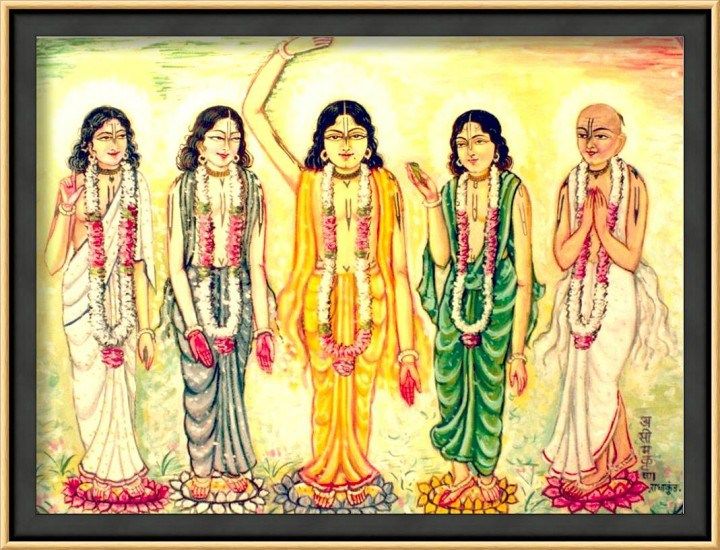
Having offered obeisances unto the Lord and all His associates, I shall now try to explain these six diversities in one. (43) Although I know that my spiritual master is a servitor of Śrī Caitanya, I know Him also as a plenary manifestation of the Lord. (44) According to the deliberate opinion of all revealed scriptures, the spiritual master is nondifferent from Kṛṣṇa. Lord Kṛṣṇa in the form of the spiritual master delivers His devotees. (45)
“One should know the ācārya as Myself and never disrespect him in any way. One should not envy him, thinking him an ordinary man, for he is the representative of all the demigods.” (46) One should know the instructing spiritual master to be the Personality of Kṛṣṇa. Lord Kṛṣṇa manifests Himself as the Supersoul and as the greatest devotee of the Lord. (47) “O my Lord! Transcendental poets and experts in spiritual science could not fully express their indebtedness to You, even if they were endowed with the prolonged lifetime of Brahmā, for You appear in two features-externally as the ācārya and internally as the Supersoul-to deliver the embodied living being by directing him how to come to You.” (48) “To those who are constantly devoted to serving Me with love, I give the understanding by which they can come to Me.” (49)
The Supreme Personality of Godhead [svayaṁ bhagavān] taught Brahmā and made him self- realized. (50) “Please hear attentively what I shall speak to you, for transcendental knowledgee about Me is not only scientific but also full of mysteries. (51) “By My causeless mercy, be enlightened in truth about My personality, manifestations, qualities and pastimes. (52) “Prior to the cosmic creation, only I exist, and no phenomena exist, either gross, subtle or primordial. After creation, only I exist in everything, and after annihilation, only I remain eternally. (53) “What appears to be truth without Me is certainly My illusory energy, for nothing can exist without Me. It is like a reflection of a real light in the shadows, for in the light there are neither shadows nor reflections. (54) “As the material elements enter the bodies of all living beings and yet remain outside them all, I exist within all material creations and yet am not within them. (55) “A person interested in transcendental knowledge must therefore always directly and indirectly inquire about it to know the all- pervading truth.” (56)
“All glories to Cintāmaṇi and my initiating spiritual master, Somagiri. All glories to my instructing spiritual master, the Supreme Personality of Godhead, who wears peacock feathers in His crown. Under the shade of His lotus feet, which are like desire trees, Jayaśrī [Rādhārāṇī] enjoys the transcendental mellow of an eternal consort.” (57) Since one cannot visually experience the presence of the Supersoul, He appears before us as a liberated devotee. Such a spiritual master is none other than Kṛṣṇa Himself. (58) One should therefore avoid bad company and associate only with devotees. With their realized instructions, such saints can cut the knot connecting one with activities unfavorable to devotional service.” (59) “The spiritually powerful message of Godhead can be properly discussed only in a society of devotees, and it is greatly pleasing to hear in that association. If one hears from devotees, the way of transcendental experience quickly opens, and gradually one attains firm faith that in due course develops into attraction and devotion.” (60) A pure devotee constantly engaged in the loving service of the Lord is identical with the Lord, who is always seated in his heart. (61)
“Saints are My heart, and only I am their hearts. They do not know anyone but Me, and therefore I do not recognize anyone besides them as Mine.” (62) “Saints of your caliber are themselves places of pilgrimage. Because of their purity, they are constant companions of the Lord, and therefore they can purify even the places of pilgrimage.” (63) Such pure devotees are of two types: personal associates [pāriṣats] and neophyte devotees [sādhakas]. (64) There are three categories of incarnations of Godhead: partial incarnations, qualitative incarnations and empowered incarnations. The puruṣas and Matsya are examples of partial incarnations. (65-66) Brahmā, Viṣṇu and Śiva are qualitative incarnations. Empowered incarnations are those like the Kumāras, King Pṛthu and Mahā- muni Vyāsa [the compiler of the Vedas].(67) The Personality of Godhead exhibits Himself in two kinds of forms: prakāśa and vilāsa. (68) When the Personality of Godhead expands Himself in many forms, all nondifferent in Their features, as Lord Kṛṣṇa did when He married sixteen thousand queens and when He performed His rāsa dance, such forms of the Lord are called manifested forms [prakāśa- vigrahas]. (69-70)
“It is astounding that Lord Śrī Kṛṣṇa, who is one without a second, expanded Himself in sixteen thousand similar forms to marry sixteen thousand queens in their respective homes.” (71) “When Lord Kṛṣṇa, surrounded by groups of cowherd girls, began the festivities of the rāsa dance, the Lord of all mystic powers placed Himself between each two girls.” (72) “When the cowherd girls and Kṛṣṇa thus joined together, each girl thought that Kṛṣṇa was dearly embracing her alone. To behold this wonderful pastime of the Lord’s, the denizens of heaven and their wives, all very eager to see the dance, flew in the sky in their hundreds of airplanes. They showered flowers and beat sweetly on drums.” (73-74) “If numerous forms, all equal in their features, are displayed simultaneously, such forms are called prakāśa- vigrahas of the Lord.” (75)
But when the numerous forms are slightly different from one another, they are called vilāsa- vigrahas. (76) “When the Lord displays numerous forms with different features by His inconceivable potency, such forms are called vilāsa- vigrahas.” (77) Examples of such vilāsa- vigrahas are Baladeva, Nārāyaṇa in Vaikuṇṭha- dhāma, and the catur- vyūha-Vāsudeva, Saṅkarṣaṇa, Pradyumna and Aniruddha. (78) The energies [consorts] of the Supreme Lord are of three kinds: the Lakṣmīs in Vaikuṇṭha, the queens in Dvārakā and the gopīs in Vṛndāvana. The gopīs are the best of all, for they have the privilege of serving Śrī Kṛṣṇa, the primeval Lord, the son of the King of Vraja. (79-80) The personal associates of the primeval Lord, Śrī Kṛṣṇa, are His devotees, who are identical with Him. He is complete with His entourage of devotees. (81)
Deepen your Bhakti-yoga practice, harmonize relationships, and receive guided coaching — all at Vedavarsity.com