


Mail ID: contact@vedavarsity.com

Contact: +91 9634998911

Google search engineGoogle search engine
Home Blog Page 64

Chaitanya Charitamrta | Madhya Lila | Chapter 8 | Section 78

0

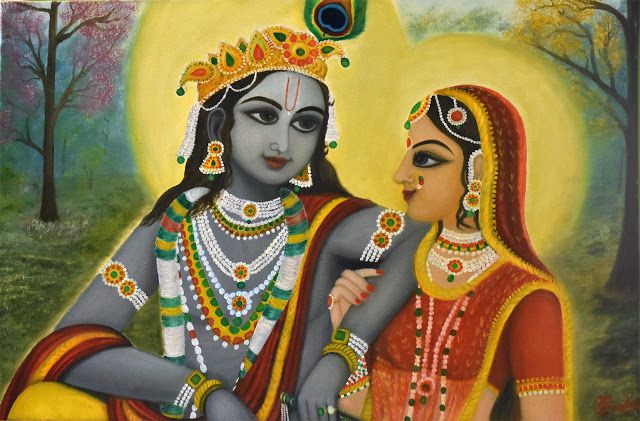
My dear friends, just see, Krsna is enjoying the season of spring! With the gopīs embracing each of His limbs, He is like amorous love personified. With His transcendental pastimes, He enlivens all the gopīs and the entire creation. With His soft bluish black arms and legs, which resemble blue lotus flowers, He has created a festival for Cupid.’ (144) “He also attracts Nārāyaṇa, who is the incarnation of Saṅkarṣaṇa and the husband of the goddess of fortune. He attracts not only Nārāyaṇa but also all women, headed by the goddess of fortune, the consort of Nārāyaṇa. (145) “[Addressing Kṛṣṇa and Arjuna, Lord Mahā- Viṣṇu (the Mahāpuruṣa) said:] ‘I wanted to see both of you, and therefore I have brought the sons of the brāhmaṇa here. Both of you have appeared in the material world to reestablish religious principles, and you have both appeared here with all your potencies. After killing all the demons, please quickly return to the spiritual world.’ (146) “‘O Lord, we do not know how the serpent Kāliya attained such an opportunity to be touched by the dust of Your lotus feet. For this end, the goddess of fortune performed austerities for centuries, giving up all other desires and observing austere vows. Indeed, we do not know how this serpent Kāliya got such an opportunity.’ (147)

“Lord Kṛṣṇa’s sweetness is so attractive that it steals away His own mind. Thus even He wants to embrace Himself. (148) “‘Upon seeing His own reflection in a bejeweled pillar of His Dvārakā palace, Kṛṣṇa desired to embrace it, saying, “Alas, I have never seen such a person before. Who is He? Just by seeing Him I have become eager to embrace Him, exactly like Śrīmatī Rādhārāṇī.”’” (149) Śrī Rāmānanda Rāya then said, “I have thus briefly explained the original form of the Supreme Personality of Godhead. Now let me describe the position of Śrīmatī Rādhārāṇī. (150) “Kṛṣṇa has unlimited potencies, which can be divided into three main parts. These are the spiritual potency, the material potency and the marginal potency, which is known as the living entities. (151) “In other words, these are all potencies of God—internal, external and marginal. But the internal potency is the Lord’s personal energy and stands over the other two. (152) “‘The original potency of Lord Viṣṇu is superior, or spiritual, and the living entity actually belongs to that superior energy. But there is another energy, called the material energy, and this third energy is full of ignorance.’ (153)

“Originally Lord Kṛṣṇa is sac- cid- ānanda- vigraha, the transcendental form of eternity, bliss and knowledge; therefore His personal potency, the internal potency, has three different forms. (154) “Hlādinī is His aspect of bliss; sandhinī, of eternal existence; and samvit of cognizance, which is also accepted as knowledge. (155) “‘My dear Lord, You are the transcendental reservoir of all transcendental qualities. Your pleasure potency, existence potency and knowledge potency are actually all one internal spiritual potency. The conditioned soul, although actually spiritual, sometimes experiences pleasure, sometimes pain and sometimes a mixture of pain and pleasure. This is due to his being touched by matter. But because You are above all material qualities, these are not found in You. Your superior spiritual potency is completely transcendental, and for You there is no such thing as relative pleasure, pleasure mixed with pain, or pain itself.’ (156) “The potency called hlādinī gives Kṛṣṇa transcendental pleasure. Through this pleasure potency, Kṛṣṇa personally tastes all spiritual pleasure. (157)

“Lord Kṛṣṇa tastes all kinds of transcendental happiness, although He Himself is happiness personified. The pleasure relished by His pure devotees is also manifested by His pleasure potency. (158) “The most essential part of this pleasure potency is love of Godhead [prema]. Consequently, the explanation of love of Godhead is also a transcendental mellow full of pleasure. (159) “The essential part of love of Godhead is called mahābhāva, transcendental ecstasy, and that ecstasy is represented by Śrīmatī Rādhārāṇī. (160) “‘Among the gopīs of Vṛndāvana, Śrīmatī Rādhārāṇī and another gopī are considered chief. But when we compare the gopīs, it appears that Śrīmatī Rādhārāṇī is most important because Her real feature expresses the highest ecstasy of love. The ecstasy of love experienced by the other gopīs cannot be compared to that of Śrīmatī Rādhārāṇī.’ (161) “The body of Śrīmatī Rādhārāṇī is a veritable transformation of love of Godhead; She is the dearmost friend of Kṛṣṇa, and this is known throughout the world. (162)

“‘I worship Govinda, the primeval Lord, who resides in His own realm, Goloka, with Rādhā, who resembles His own spiritual figure and who embodies the ecstatic potency [hlādinī]. Their companions are Her confidantes, who embody extensions of Her bodily form and who are imbued and permeated with ever- blissful spiritual rasa.’ (163) “That supreme ecstasy of Śrīmatī Rādhārāṇī is the essence of spiritual life. Her only business is to fulfill all the desires of Kṛṣṇa. (164) “Śrīmatī Rādhārāṇī is the topmost spiritual gem, and the other gopīs—Lalitā, Viśākhā and so on—are expansions of Her spiritual body. (165) “Śrīmatī Rādhārāṇī’s transcendental body is brilliant in luster and full of all transcendental fragrances. Lord Kṛṣṇa’s affection for Her is like a perfumed massage. (166) “Śrīmatī Rādhārāṇī takes Her first bath in the shower of the nectar of compassion, and She takes Her second bath in the nectar of youth. (167) “After Her midday bath, Rādhārāṇī takes another bath in the nectar of bodily luster, and She puts on the garment of shyness, which is Her black silk sari. (168)

“Śrīmatī Rādhārāṇī’s affection for Kṛṣṇa is Her upper garment, which is pinkish in color. She then covers Her breasts with another garment, composed of affection and anger toward Kṛṣṇa. (169) “Śrīmatī Rādhārāṇī’s personal beauty is the reddish powder known as kuṅkuma, Her affection for Her associates is sandalwood pulp, and the sweetness of Her smile is camphor. All these, combined together, are smeared over Her body. (170) “Conjugal love for Kṛṣṇa is an abundance of musk, and with that musk Her whole body is decorated. (171) “Craftiness and covered anger constitute the arrangement of Her hair. The quality of anger due to jealousy is the silk garment covering Her body. (172) “Her attachment for Kṛṣṇa is the reddish color of betel nuts on Her brilliant lips. Her double- dealings in loving affairs constitute the black ointment around Her eyes. (173) “The ornaments decorating Her body are the blazing ecstasies of goodness and the constantly existing ecstasies, headed by jubilation. All these ecstasies are the ornaments all over Her body. (174)

“Also ornamenting Her body are the twenty kinds of ecstatic symptoms beginning with kila- kiñcita. Her transcendental qualities constitute the flower garland hanging in fullness over Her body. (175) “The tilaka of good fortune is on Her beautiful broad forehead. Her various loving affairs are a gem, and Her heart is the locket. (176) “Śrīmatī Rādhārāṇī’s gopī friends are Her mental activities, which are concentrated on the pastimes of Śrī Kṛṣṇa. She keeps Her hand on the shoulder of a friend, who represents youth. (177) “Śrīmatī Rādhārāṇī’s bedstead is pride itself, and it is situated in the abode of Her bodily aroma. She is always seated there thinking of Kṛṣṇa’s association. (178) “Śrīmatī Rādhārāṇī’s earrings are the name, fame and qualities of Lord Kṛṣṇa. The glories of Lord Kṛṣṇa’s name, fame and qualities are always inundating Her speech. (179) “Śrīmatī Rādhārāṇī induces Kṛṣṇa to drink the honey of the conjugal relationship. She is therefore engaged in satisfying all the lusty desires of Kṛṣṇa. (180) “Śrīmatī Rādhārāṇī is a mine filled with valuable jewels of love for Kṛṣṇa. Her transcendental body is complete with unparalleled spiritual qualities. (181)

“‘If one asks about the origin of love of Kṛṣṇa, the answer is that the origin is in Śrīmatī Rādhārāṇī alone. Who is the most dear friend of Kṛṣṇa? The answer again is Śrīmatī Rādhārāṇī alone. No one else. Śrīmatī Rādhārāṇī’s hair is very curly, Her two eyes are always moving to and fro, and Her breasts are firm. Since all transcendental qualities are manifested in Śrīmatī Rādhārāṇī, She alone is able to fulfill all the desires of Kṛṣṇa. No one else.’ (182) “Even Satyabhāmā, one of the queens of Śrī Kṛṣṇa, desires the fortunate position and excellent qualities of Śrīmatī Rādhārāṇī. All the gopīs learn the art of dressing from Śrīmatī Rādhārāṇī, and even the goddess of fortune, Lakṣmī, and the wife of Lord Śiva, Pārvatī, desire Her beauty and qualities. Indeed, Arundhatī, the celebrated chaste wife of Vasiṣṭha, also wants to imitate the chastity and religious principles of Śrīmatī Rādhārāṇī. (183-184) “Even Lord Kṛṣṇa Himself cannot reach the limit of the transcendental qualities of Śrīmatī Rādhārāṇī. How, then, can an insignificant living entity count them?” (185) Lord Śrī Caitanya Mahāprabhu replied, “Now I have come to understand the truth of the loving affairs between Rādhā and Kṛṣṇa. Nonetheless, I still want to hear how both of Them gloriously enjoy such love.” (186)

Chaitanya Charitamrta | Madhya Lila | Chapter 8 | Section 77

0

Śrī Caitanya Mahāprabhu, who is known as Gaurāṅga, is the ocean of all conclusive knowledge in devotional service. He empowered Śrī Rāmānanda Rāya, who may be likened to a cloud of devotional service. This cloud was filled with the water of all the conclusive purports of devotional service and was empowered by the ocean to spread this water over the sea of Śrī Caitanya Mahāprabhu Himself. Thus the ocean of Caitanya Mahāprabhu became filled with the jewels of the knowledge of pure devotional service. (1) All glories to Lord Śrī Caitanya Mahāprabhu! All glories to Lord Nityānanda! All glories to Advaita Ācārya! And all glories to all the devotees of Lord Śrī Caitanya Mahāprabhu! (2) According to His previous program, Lord Śrī Caitanya Mahāprabhu went forward on His tour and after some days arrived at the place of pilgrimage known as Jiyaḍa- nṛsiṁha. (3) Upon seeing the Deity of Lord Nṛsiṁha in the temple, Śrī Caitanya Mahāprabhu offered His respectful obeisances by falling flat. Then, in ecstatic love, He performed various dances, chanted, and offered prayers. (4)

“‘All glories to Nṛsiṁhadeva! All glories to Nṛsiṁhadeva, who is the Lord of Prahlāda Mahārāja and, like a honeybee, is always engaged in beholding the lotuslike face of the goddess of fortune.’ (5) “‘Although very ferocious, the lioness is very kind to her cubs. Similarly, although very ferocious to nondevotees like Hiraṇyakaśipu, Lord Nṛsiṁhadeva is very, very soft and kind to devotees like Prahlāda Mahārāja.’” (6) In this way Lord Śrī Caitanya Mahāprabhu recited different verses from the śāstra. The priest of Lord Nṛsiṁhadeva then brought garlands and the remnants of the Lord’s food and offered them to Śrī Caitanya Mahāprabhu. (7) As usual, a brāhmaṇa offered Śrī Caitanya Mahāprabhu an invitation. The Lord passed the night in the temple and then commenced His tour again. (8)

The next morning, in the great ecstasy of love, Lord Śrī Caitanya Mahāprabhu started on His tour with no knowledge of the proper direction, and He continued the whole day and night. (9) As previously, Śrī Caitanya Mahāprabhu converted to Vaiṣṇavism many people He met on the road. After some days, the Lord reached the banks of the river Godāvarī. (10) When He saw the river Godāvarī, the Lord remembered the river Yamunā, and when He saw the forest on the banks of the river, He remembered Śrī Vṛndāvana- dhāma. (11) After performing His usual chanting and dancing for some time in this forest, the Lord crossed the river and took His bath on the other bank. (12) After bathing in the river, the Lord walked a little distance from the bathing place and engaged in chanting the holy name of Kṛṣṇa. (13) At that time, accompanied by the sounds of music, Rāmānanda Rāya came there on a palanquin to take his bath. (14)

Many brāhmaṇas following the Vedic principles accompanied Rāmānanda Rāya. According to the Vedic rituals, Rāmānanda Rāya took his bath and offered oblations to his forefathers. (15) Śrī Caitanya Mahāprabhu could understand that the person who had come to bathe in the river was Rāmānanda Rāya. The Lord wanted so much to meet him that His mind immediately began running after him. (16) Although Śrī Caitanya Mahāprabhu was running after him mentally, He patiently remained sitting. Rāmānanda Rāya, seeing the wonderful sannyāsī, then came to see Him. (17) Śrīla Rāmānanda Rāya then saw Śrī Caitanya Mahāprabhu to be as brilliant as a hundred suns. The Lord was covered by a saffron garment. He was large in body and very strongly built, and His eyes were like lotus petals. (18)

When Rāmānanda Rāya saw the wonderful sannyāsī, he was struck with wonder. He went to Him and immediately offered his respectful obeisances, falling down flat like a rod. (19) The Lord stood up and asked Rāmānanda Rāya to arise and chant the holy name of Kṛṣṇa. Indeed, Śrī Caitanya Mahāprabhu was very eager to embrace him. (20) Śrī Caitanya Mahāprabhu then inquired whether he was Rāmānanda Rāya, and he replied, “Yes, I am Your very low servant, and I belong to the śūdra community.” (21) Śrī Caitanya Mahāprabhu then embraced Śrī Rāmānanda Rāya very firmly. Indeed, both the master and the servant almost lost consciousness due to ecstatic love. (22) Their natural love for each other was awakened in them both, and they embraced and fell to the ground. (23) When they embraced each other, ecstatic symptoms—paralysis, perspiration, tears, shivering, paleness and standing up of the bodily hairs—appeared. The word “Kṛṣṇa” came from their mouths falteringly. (24) When the stereotyped, ritualistic brāhmaṇas who were following the Vedic principles saw this ecstatic manifestation of love, they were struck with wonder. All these brāhmaṇas began to reflect as follows. (25)

The brāhmaṇas thought, “We can see that this sannyāsī has a luster like the effulgence of Brahman, but how is it He is crying upon embracing a śūdra, a member of the fourth caste in the social order?” (26) They thought, “This Rāmānanda Rāya is the Governor of Madras, a highly learned and grave person, a mahā-paṇḍita, but upon touching this sannyāsī he has become restless like a madman.” (27) While the brāhmaṇas were thinking in this way about the activities of Śrī Caitanya Mahāprabhu and Rāmānanda Rāya, Śrī Caitanya Mahāprabhu saw those outsiders and restrained His transcendental emotions. (28) When they regained their sanity, they both sat down, and Śrī Caitanya Mahāprabhu smiled and began to speak as follows. (29) “Sārvabhauma Bhaṭṭācārya spoke of your good qualities, and he made a great endeavor to convince Me to meet you. (30)

“Indeed, I have come here just to meet you. It is very good that even without making an effort I have gotten your interview here.” (31) Rāmānanda Rāya replied, “Sārvabhauma Bhaṭṭācārya thinks of me as his servant. Even in my absence he is very careful to do me good. (32) “By his mercy I have received Your interview here. Consequently I consider that today I have become a successful human being. (33) “I can see that You have bestowed special mercy upon Sārvabhauma Bhaṭṭācārya. Therefore You have touched me, although I am untouchable. This is due only to his love for You. (34) “You are the Supreme Personality of Godhead, Nārāyaṇa Himself, and I am only a government servant interested in materialistic activities. Indeed, I am the lowest among men of the fourth caste. (35)

“You do not fear the Vedic injunctions stating that You should not associate with a śūdra. You were not contemptuous of my touch, although in the Vedas You are forbidden to associate with śūdras. (36) “You are the Supreme Personality of Godhead Himself; therefore no one can understand Your purpose. By Your mercy You are touching me, although this is not sanctioned by the Vedas. (37) “You have come here specifically to deliver me. You are so merciful that You alone can deliver all fallen souls. (38) “It is the general practice of all saintly people to deliver the fallen. Therefore they go to people’s houses, although they have no personal business there. (39) “‘My dear Lord, sometimes great saintly persons go to the homes of householders, although these householders are generally low-minded. When a saintly person visits their homes, one can understand that it is for no other purpose than to benefit the householders.’ (40)

“Along with me there are about a thousand men—including the brāhmaṇas—and all of them appear to have had their hearts melted simply by seeing You. (41) “I hear everyone chanting the holy name of Kṛṣṇa. Everyone’s body is thrilled with ecstasy, and there are tears in everyone’s eyes. (42) “My dear Sir, according to Your behavior and bodily features, You are the Supreme Personality of Godhead. It is impossible for ordinary living beings to possess such transcendental qualities.” (43) The Lord replied to Rāmānanda Rāya, “Sir, you are the best of the topmost devotees; therefore simply the sight of you has melted everyone’s heart. (44) “Although I am a Māyāvādī sannyāsī, a nondevotee, I am also floating in the ocean of love of Kṛṣṇa simply by touching you. And what to speak of others? (45) “Sārvabhauma Bhaṭṭācārya knew this would happen, and thus to rectify My heart, which is very hard, he asked Me to meet you.” (46)

In this way each of them praised the qualities of the other, and both of them were pleased to see each other. (47) At this time a brāhmaṇa Vaiṣṇava following the Vedic principles came and offered obeisances. He fell flat before Śrī Caitanya Mahāprabhu and invited Him for lunch. (48) Lord Śrī Caitanya Mahāprabhu accepted the invitation, knowing the brāhmaṇa to be a devotee, and slightly smiling, He spoke as follows to Rāmānanda Rāya. (49) “I wish to hear from you about Lord Kṛṣṇa. Indeed, My mind is inclined to desire this; therefore I wish to see you again.” (50) Rāmānanda Rāya replied, “My Lord, although You have come to correct me, a fallen soul, my mind is not yet purified simply by seeing You. Please stay for five or seven days and kindly cleanse my polluted mind. After that much time, my mind will certainly be pure.” (51 52) Although neither could tolerate separation from the other, Rāmānanda Rāya nonetheless offered his obeisances to Lord Śrī Caitanya Mahāprabhu and departed. (53) Lord Śrī Caitanya Mahāprabhu then went to the house of the brāhmaṇa who had invited Him and took His lunch there. When the evening of that day arrived, both Rāmānanda Rāya and the Lord were eager to meet each other again. (54)

After finishing His evening bath, Śrī Caitanya Mahāprabhu sat down and waited for Rāmānanda Rāya to come. Then Rāmānanda Rāya, accompanied by one servant, came to meet Him. (55) Rāmānanda Rāya approached Lord Śrī Caitanya and offered his respectful obeisances, and the Lord embraced him. Then they began to discuss Kṛṣṇa in a secluded place. (56) Śrī Caitanya Mahāprabhu ordered Rāmānanda Rāya, “Recite a verse from the revealed scriptures concerning the ultimate goal of life.” Rāmānanda replied, “If one executes the prescribed duties of his social position, he awakens his original Kṛṣṇa consciousness. (57) “‘The Supreme Personality of Godhead, Lord Viṣṇu, is worshiped by the proper execution of prescribed duties in the system of varṇa and āśrama. There is no other way to satisfy the Supreme Personality of Godhead. One must be situated in the institution of the four varṇas and āśramas.’” (58)

The Lord replied, “This is external. You had better tell Me of some other means.” Rāmānanda replied, “To offer the results of one’s activities to Kṛṣṇa is the essence of all perfection.” (59) Rāmānanda Rāya continued, “‘My dear son of Kuntī, whatever you do, whatever you eat, whatever you offer in sacrifice, whatever you give in charity, and whatever austerities you perform, all the results of such activities should be offered to Me, Kṛṣṇa, the Supreme Personality of Godhead.’” (60) “This is also external,” Śrī Caitanya Mahāprabhu said. “Please proceed and speak further on this matter.” Rāmānanda Rāya replied, “To give up one’s occupational duties in the varṇāśrama system is the essence of perfection.” (61) Rāmānanda Rāya continued, “‘Occupational duties are described in the religious scriptures. If one analyzes them, he can fully understand their qualities and faults and then give them up completely to render service unto the Supreme Personality of Godhead. Such a person is considered a first-class man.’ (62)

“As stated in scripture [Bg. 18.66], ‘After giving up all kinds of religious and occupational duties, if you come to Me, the Supreme Personality of Godhead, and take shelter, I will give you protection from all of life’s sinful reactions. Do not worry.’” (63) After hearing Rāmānanda Rāya speak in this way, Lord Śrī Caitanya Mahāprabhu again rejected his statement and said, “Go ahead and say something more.” Rāmānanda Rāya then replied, “Devotional service mixed with empiric knowledge is the essence of perfection.” (64) Rāmānanda Rāya continued, “According to the Bhagavad-gītā, ‘One who is thus transcendentally situated at once realizes the Supreme Brahman and becomes fully joyful. He never laments or desires to have anything. He is equally disposed toward every living entity. In that state he attains pure devotional service unto Me.’” (65) After hearing this, the Lord, as usual, rejected it, considering it to be external devotional service. He again asked Rāmānanda Rāya to speak further, and Rāmānanda Rāya replied, “Pure devotional service without any touch of speculative knowledge is the essence of perfection.” (66)

Rāmānanda Rāya continued, “Lord Brahmā said, ‘My dear Lord, those devotees who have thrown away the impersonal conception of the Absolute Truth and have therefore abandoned discussing empiric philosophical truths should hear from self realized devotees about Your holy name, form, pastimes and qualities. They should completely follow the principles of devotional service and remain free from illicit sex, gambling, intoxication and animal slaughter. Surrendering themselves fully with body, words and mind, they can live in any āśrama or social status. Indeed, You are conquered by such persons, although You are always unconquerable.’” (67) At this point, Śrī Caitanya Mahāprabhu replied, “This is all right, but still you can speak more on the subject.” Rāmānanda Rāya then replied, “Ecstatic love for the Supreme Personality of Godhead is the essence of all perfection.” (68) Rāmānanda Rāya continued, “‘As long as there is hunger and thirst within the stomach, varieties of food and drink make one feel very happy. Similarly, when the Lord is worshiped with pure love, the various activities performed in the course of that worship awaken transcendental bliss in the heart of the devotee.’ (69)

“‘Pure devotional service in Kṛṣṇa consciousness cannot be had even by pious activity in hundreds and thousands of lives. It can be attained only by paying one price—that is, intense greed to obtain it. If it is available somewhere, one must purchase it without delay.’” (70) Hearing up to the point of spontaneous love, the Lord said, “This is all right, but if you know more, please tell Me.” In reply, Rāmānanda Rāya said, “Spontaneous loving service in servitude—as exchanged by master and servant—is the highest perfection. (71) “‘A man becomes purified simply by hearing the holy name of the Supreme Personality of Godhead, whose lotus feet create the holy places of pilgrimage. Therefore what remains to be attained by those who have become His servants?’ (72) “‘By serving You constantly, one is freed from all material desires and is completely pacified. When shall I engage as Your permanent eternal servant and always feel joyful to have such a perfect master?’” (73) Hearing this from Rāmānanda Rāya, the Lord again requested him to go a step further. In reply, Rāmānanda Rāya said, “Loving service to Kṛṣṇa rendered in fraternity is the highest perfection. (74)

“‘Neither those engaged in the self-realization of appreciating the Brahman effulgence of the Lord, nor those engaged in devotional service while accepting the Supreme Personality of Godhead as master, nor those under the clutches of Māyā, thinking the Lord an ordinary person, can understand that certain exalted personalities, after accumulating volumes of pious activities, are now playing with the Lord in friendship as cowherd boys.’” (75) The Lord said, “This statement is very good, but please proceed even further.” Rāmānanda Rāya then replied, “Loving service to the Lord in the parental relationship is the highest perfectional stage.” (76) Rāmānanda Rāya continued, “‘O brāhmaṇa, what pious activities did Nanda Mahārāja perform by which he received the Supreme Personality of Godhead Kṛṣṇa as his son? And what pious activities did mother Yaśodā perform that made the Absolute Supreme Personality of Godhead Kṛṣṇa call her “Mother” and suck her breasts?’ (77) “‘The favor mother Yaśodā obtained from Śrī Kṛṣṇa, the bestower of liberation, was never obtained even by Lord Brahmā or Lord Śiva, nor even by the goddess of fortune, who always remains on the chest of the Supreme Personality of Godhead Viṣṇu.’” (78)

The Lord said, “Your statements are certainly getting better and better one after the other, but surpassing all of them is another transcendental mellow, and you can speak of that as the most sublime.” Rāmānanda Rāya then replied, “Conjugal attachment for Kṛṣṇa is the topmost position in love of Godhead. (79) “‘When Lord Śrī Kṛṣṇa was dancing with the gopīs in the rāsa-līlā, the gopīs were embraced around the neck by the Lord’s arms. This transcendental favor was never bestowed upon the goddess of fortune or the other consorts in the spiritual world. Nor was such a thing ever imagined by the most beautiful girls in the heavenly planets, girls whose bodily luster and aroma resemble the beauty and fragrance of lotus flowers. And what to speak of worldly women, who may be very, very beautiful according to material estimation?’ (80) “‘Suddenly, due to their feelings of separation, Lord Kṛṣṇa appeared among the gopīs dressed in yellow garments and wearing a flower garland. His lotus face was smiling, and He was directly attracting the mind of Cupid.’ (81)

“There are various means and processes by which one may attain the favor of Lord Kṛṣṇa. All those transcendental processes will be studied from the viewpoint of comparative importance. (82) “It is true that whatever relationship a particular devotee has with the Lord is the best for him; still, when we study all the different methods from a neutral position, we can understand that there are higher and lower degrees of love. (83) “‘Increasing love is experienced in various tastes, one above another. But that love which has the highest taste in the gradual succession of desires manifests itself in the form of conjugal love.’ (84) “There is a gradual order of improvement in transcendental mellows from the initial ones to the later ones. In each subsequent mellow the qualities of the previous mellows are manifested, counting from two, then three, and up to the point of five complete qualities. (85) “As the qualities increase, so the taste also increases in each and every mellow. Therefore the qualities found in śānta-rasa, dāsya-rasa, sakhya-rasa and vātsalya-rasa are all manifested in conjugal love [mādhurya-rasa]. (86) “The qualities in the material elements—sky, air, fire, water and earth—increase one after another by a gradual process of one, two and three, and at the last stage, in the element earth, all five qualities are completely visible. (87)

“Complete attainment of the lotus feet of Lord Kṛṣṇa is made possible by love of Godhead, specifically mādhurya-rasa, or conjugal love. Lord Kṛṣṇa is indeed captivated by this standard of love. This is stated in Śrīmad-Bhāgavatam. (88) “Lord Kṛṣṇa told the gopīs, ‘The means of attaining My favor is loving service unto Me, and fortunately you are all thus engaged. Those living beings who render service unto Me are eligible to be transferred to the spiritual world and attain eternal life with knowledge and bliss.’ (89) “Lord Kṛṣṇa has made a firm promise for all time. If one renders service unto Him, Kṛṣṇa correspondingly gives him an equal amount of success in devotional service to the Lord. (90) “[According to Lord Kṛṣṇa in the Bhagavad-gītā (4.11):] ‘As all surrender unto Me, I reward them accordingly. Everyone follows My path in all respects, O son of Pṛthā.’ (91) “In Śrīmad-Bhāgavatam [10.32.22] it is said that Lord Kṛṣṇa cannot proportionately reciprocate devotional service in the mādhurya-rasa; therefore He always remains a debtor to such devotees. (92)

“When the gopīs were overwhelmed with dissatisfaction due to Lord Kṛṣṇa’s absence from the rāsa-līlā, Kṛṣṇa returned to them and told them, ‘My dear gopīs, our meeting is certainly free of all material contamination. I must admit that in many lives it would be impossible for Me to repay My debt to you because you have cut off the bondage of family life just to search for Me. Consequently I am unable to repay you. Therefore please be satisfied with your honest activities in this regard.’ (93) “Although Kṛṣṇa’s unparalleled beauty is the topmost sweetness of love of Godhead, His sweetness increases unlimitedly when He is in the company of the gopīs. Consequently Kṛṣṇa’s exchange of love with the gopīs is the topmost perfection of love of Godhead. (94) “‘Although the son of Devakī, the Supreme Personality of Godhead, is the reservoir of all kinds of beauty, when He is among the gopīs He nonetheless becomes more beautiful, for He resembles a marakata jewel surrounded by gold and other jewels.’” (95) Lord Caitanya Mahāprabhu replied, “This is certainly the limit of perfection, but please be merciful to Me and speak more if there is more.” (96)

Rāya Rāmānanda replied, “Until this day I did not know anyone within this material world who could inquire beyond this perfectional stage of devotional service. (97) “Among the loving affairs of the gopīs,” Rāmānanda Rāya continued, “Śrīmatī Rādhārāṇī’s love for Śrī Kṛṣṇa is topmost. Indeed, the glories of Śrīmatī Rādhārāṇī are highly esteemed in all revealed scriptures. (98) “‘Just as Śrīmatī Rādhārāṇī is most dear to Śrī Kṛṣṇa, Her bathing place [Rādhā-kuṇḍa] is also dear to Him. Among all the gopīs, Śrīmatī Rādhārāṇī is supermost and very dear to Lord Kṛṣṇa.’ (99) “[When the gopīs began to talk among themselves, they said:] ‘Dear friends, the gopī who has been taken away by Kṛṣṇa to a secluded place must have worshiped the Lord more than anyone else.’” (100) Lord Śrī Caitanya Mahāprabhu said, “Please speak on. I am very happy to hear you because a river of unprecedented nectar is flowing from your mouth. (101) “During the rāsa dance Śrī Kṛṣṇa did not exchange loving affairs with Śrīmatī Rādhārāṇī due to the presence of the other gopīs. Because of the dependence of the others, the intensity of love between Rādhā and Kṛṣṇa was not manifest. Therefore He stole Her away. (102)

“If Lord Kṛṣṇa rejected the company of the other gopīs for Śrīmatī Rādhārāṇī, we can understand that Lord Śrī Kṛṣṇa has intense affection for Her.” (103) Rāmānanda Rāya continued, “Please therefore hear from me about the glories of Śrīmatī Rādhārāṇī’s loving affairs. They are beyond compare within these three worlds. (104) “Finding Herself treated equally with all the other gopīs, Śrīmatī Rādhārāṇī displayed Her tricky behavior and left the circle of the rāsa dance. Missing Śrīmatī Rādhārāṇī’s presence, Kṛṣṇa became very unhappy and began to lament and wander throughout the forest to search Her out. (105) “‘Lord Kṛṣṇa, the enemy of Kaṁsa, took Śrīmatī Rādhārāṇī within His heart, for He desired to dance with Her. Thus He left the arena of the rāsa dance and the company of all the other beautiful damsels of Vraja. (106) “‘Being afflicted by the arrow of Cupid and unhappily regretting His mistreating Śrīmatī Rādhārāṇī, Mādhava, Lord Kṛṣṇa, began to search for Her along the banks of the Yamunā River. When He failed to find Her, He entered the bushes of Vṛndāvana and began to lament.’ (107)

“Simply by considering these two verses one can understand what nectar there is in such dealings. It is exactly like freeing a mine of nectar. (108) “Although Kṛṣṇa was in the midst of hundreds of thousands of gopīs during the rāsa dance, He still kept Himself in one of His transcendental forms by the side of Śrīmatī Rādhārāṇī. (109) “Lord Kṛṣṇa is equal to everyone in His general dealings, but due to the conflicting ecstatic love of Śrīmatī Rādhārāṇī, there were opposing elements. (110) “‘The progress of loving affairs between a young boy and a young girl is like the movement of a snake. On account of this, two types of anger arise between a young boy and girl—anger with cause and anger without cause.’ (111) “When Rādhārāṇī left the rāsa dance out of anger and resentment, Lord Śrī Kṛṣṇa became very anxious because He could not see Her. (112) “Lord Kṛṣṇa’s desire in the rāsa-līlā circle is perfectly complete, but Śrīmatī Rādhārāṇī is the binding link in that desire. (113) “The rāsa dance does not shine in the heart of Kṛṣṇa without Śrīmatī Rādhārāṇī. Therefore, He also gave up the circle of the rāsa dance and went out to search for Her. (114)

“When Kṛṣṇa went out to search for Śrīmatī Rādhārāṇī, He wandered here and there. Not finding Her, He became afflicted by the arrow of Cupid and began to lament. (115) “Since Kṛṣṇa’s lusty desires were not satisfied even in the midst of hundreds of thousands of gopīs and He was thus searching after Śrīmatī Rādhārāṇī, we can easily imagine how transcendentally qualified She is.” (116) After hearing this, Lord Caitanya Mahāprabhu said to Rāmānanda Rāya, “That for which I have come to your residence has now become an object of truth in My knowledge. (117) “Now I have come to understand the sublime goal of life and the process of achieving it. Nevertheless, I think that there is something more ahead, and My mind is desiring to have it. (118) “Kindly explain the transcendental features of Kṛṣṇa and Śrīmatī Rādhārāṇī. Also explain the truth of transcendental mellows and the transcendental form of love of Godhead. (119) “Kindly explain all these truths to Me. But for yourself, no one can ascertain them.” (120) Śrī Rāmānanda Rāya replied, “I do not know anything about this. I simply vibrate the sound You make me speak. (121) “I simply repeat like a parrot whatever instructions You have given me. You are the Supreme Personality of Godhead Himself. Who can understand Your dramatic performances? (122)

“You inspire me within the heart and make me speak with the tongue. I do not know whether I am speaking well or badly.” (123)Lord Caitanya Mahāprabhu said, “I am a Māyāvādī in the renounced order of life, and I do not even know what transcendental loving service to the Lord is. I simply float in the ocean of Māyāvāda philosophy. (124) “Due to the association of Sārvabhauma Bhaṭṭācārya, My mind became enlightened. Therefore I asked him about the truths of transcendental loving service to Kṛṣṇa. (125) “Sārvabhauma Bhaṭṭācārya told me, ‘I do not actually know about the topics of Lord Kṛṣṇa. They are all known only to Rāmānanda Rāya, but he is not present here.’” (126) Lord Śrī Caitanya Mahāprabhu continued, “After hearing about your glories, I have come to your place. But you are offering Me words of praise out of respect for a sannyāsī, one in the renounced order of life. (127) “Whether one is a brāhmaṇa, a sannyāsī or a śūdra—regardless of what he is—he can become a spiritual master if he knows the science of Kṛṣṇa.” (128)

Śrī Caitanya Mahāprabhu continued, “Please do not try to cheat Me, thinking of Me as a learned sannyāsī. Please satisfy My mind by just describing the truth of Rādhā and Kṛṣṇa.” (129) Śrī Rāmānanda Rāya was a great devotee of the Lord and a lover of God, and although his mind could not be covered by Kṛṣṇa’s illusory energy, and although he could understand the mind of the Lord, which was very strong and intense, Rāmānanda’s mind became a little agitated. (130-131) Śrī Rāmānanda Rāya said, “I am just a dancing puppet, and You pull the strings. Whichever way You make me dance, I will dance. (132) “My dear Lord, my tongue is just like a stringed instrument, and You are its player. Therefore I simply vibrate whatever arises in Your mind.” (133) Rāmānanda Rāya then began to speak on kṛṣṇa-tattva. “Kṛṣṇa is the Supreme Personality of Godhead,” he said. “He is personally the original Godhead, the source of all incarnations and the cause of all causes. (134) “There are innumerable Vaikuṇṭha planets, as well as innumerable incarnations. In the material world also there are innumerable universes, and Kṛṣṇa is the supreme resting place for all of them. (135)

“The transcendental body of Śrī Kṛṣṇa is eternal and full of bliss and knowledge. He is the son of Nanda Mahārāja. He is full of all opulences and potencies, as well as all spiritual mellows. (136) “‘Kṛṣṇa, who is known as Govinda, is the supreme controller. He has an eternal, blissful, spiritual body. He is the origin of all. He has no other origin, for He is the prime cause of all causes.’ (137) “In the spiritual realm of Vṛndāvana, Kṛṣṇa is the spiritual, ever-fresh Cupid. He is worshiped by the chanting of the Kāma-gāyatrī mantra, with the spiritual seed klīm. (138) “The very name Kṛṣṇa means that He attracts even Cupid. He is therefore attractive to everyone—male and female, moving and inert living entities. Indeed, Kṛṣṇa is known as the all-attractive one. (139)

“‘When Kṛṣṇa left the rāsa-līlā dance, the gopīs became very morose, and when they were grieving, Kṛṣṇa reappeared dressed in yellow garments. Wearing a flower garland and smiling, He was attractive even to Cupid. In this way Kṛṣṇa appeared among the gopīs.’ (140) “Each and every devotee has a certain type of transcendental mellow in relation to Kṛṣṇa. But in all transcendental relationships the devotee is the worshiper [āśraya] and Kṛṣṇa is the object of worship [viṣaya]. (141) “‘Let Kṛṣṇa, the Supreme Personality of Godhead, be glorified! By virtue of His expanding attractive features, He subjugated the gopīs named Tārakā and Pāli and absorbed the minds of Śyāmā and Lalitā. He is the most attractive lover of Śrīmatī Rādhārāṇī and is the reservoir of pleasure for devotees in all transcendental mellows.’ (142) “Kṛṣṇa is all-attractive for devotees in all mellows because He is the personification of the conjugal mellow. Kṛṣṇa is attractive not only to all the devotees, but to Himself as well. (143)

Chaitanya Charitamrta | Madhya Lila | Chapter 7 | Section 76

0

In whatever village Śrī Caitanya Mahāprabhu stayed to accept alms, many people came to see Him. (106) By the mercy of the Supreme Lord, Śrī Caitanya Mahāprabhu, everyone became a first- class devotee. Later they became teachers or spiritual masters and liberated the entire world. (107) In this way the Lord went to the extreme southern part of India, and He converted all the provinces to Vaiṣṇavism. (108) Lord Śrī Caitanya Mahāprabhu did not manifest His spiritual potencies at Navadvīpa, but He did manifest them in South India and liberated all the people there. (109) Lord Śrī Caitanya Mahāprabhu’s empowering of others can be understood by one who is actually a devotee of the Lord and who has received His mercy. (110)

If one does not believe in the uncommon transcendental pastimes of the Lord, he is vanquished both in this world and in the next. (111) Whatever I have stated about the beginning of the Lord’s tour should also be understood to hold for as long as the Lord toured South India. (112) When Lord Śrī Caitanya Mahāprabhu came to the holy place known as Kūrma- kṣetra, He saw the Deity and offered prayers and obeisances. (113) While at this place, Lord Śrī Caitanya Mahāprabhu was in His usual ecstasy of love of Godhead and was laughing, crying, dancing and chanting. Everyone who saw Him was astonished. (114) After hearing of these wonderful occurrences, everyone came to see Him there. When they saw the beauty of the Lord and His ecstatic condition, they were all struck with wonder. (115) Just by seeing Lord Caitanya Mahāprabhu, everyone became a devotee. They began to chant “Kṛṣṇa” and “Hari” and all the holy names. They all were merged in a great ecstasy of love, and they began to dance, raising their arms. (116)

Always hearing them chant the holy names of Lord Kṛṣṇa, the residents of all the other villages also became Vaiṣṇavas. (117) By hearing the holy name of Kṛṣṇa, the entire country became Vaiṣṇava. It was as if the nectar of the holy name of Kṛṣṇa overflooded the entire country. (118) After some time, when Lord Śrī Caitanya Mahāprabhu manifested His external consciousness, a priest of the Lord Kūrma Deity gave Him various offerings. (119) Śrī Caitanya Mahāprabhu’s mode of preaching has already been explained, and I shall not repeat the explanation. In whichever village the Lord entered, His behavior was the same. (120) In one village there was a Vedic brāhmaṇa named Kūrma. He invited Lord Caitanya Mahāprabhu to his home with great respect and devotion. (121) This brāhmaṇa brought Lord Caitanya Mahāprabhu to his home, washed His lotus feet and, with his family members, drank that water. (122)

With great affection and respect, that Kūrma brāhmaṇa made Śrī Caitanya Mahāprabhu eat all kinds of food. After that, the remnants were shared by all the members of the family. (123) The brāhmaṇa then began to pray, “O my Lord, Your lotus feet are meditated upon by Lord Brahmā, and these very lotus feet have come into my home. (124) “My dear Lord, there is no limit to my great fortune. It cannot be described. Today my family, birth and riches have all been glorified.” (125) The brāhmaṇa begged Lord Caitanya Mahāprabhu, “My dear Lord, kindly show me favor and let me go with You. I can no longer tolerate the waves of misery caused by materialistic life.” (126) Śrī Caitanya Mahāprabhu replied, “Don’t speak like that again. Better to remain at home and chant the holy name of Kṛṣṇa always. (127) “Instruct everyone to follow the orders of Lord Śrī Kṛṣṇa as they are given in the Bhagavad- gītā and Śrīmad- Bhāgavatam. In this way become a spiritual master and try to liberate everyone in this land.” (128)

Śrī Caitanya Mahāprabhu further advised the brāhmaṇa Kūrma, “If you follow this instruction, your materialistic life at home will not obstruct your spiritual advancement. Indeed, if you follow these regulative principles, we will again meet here, or, rather, you will never lose My company.” (129) At whosever house Śrī Caitanya accepted His alms by taking prasādam, He would convert the dwellers to His saṅkīrtana movement and advise them just as He advised the brāhmaṇa named Kūrma. (130) While on His tour, Śrī Caitanya Mahāprabhu would spend the night at a temple or on the roadside. Whenever He accepted food from a person, He would give him the same advice He gave the brāhmaṇa named Kūrma. He adopted this process until He returned to Jagannātha Purī from His South Indian tour. (131-132)

Thus I have described the Lord’s behavior elaborately in the case of Kūrma. In this way, you will know Śrī Caitanya Mahāprabhu’s dealings throughout South India. (133) Thus Lord Śrī Caitanya Mahāprabhu would remain at night in one place, and the next morning, after bathing, He would start again. (134) When Śrī Caitanya Mahāprabhu left, the brāhmaṇa Kūrma followed Him a great distance, but eventually Lord Caitanya took care to send him back home. (135) There was also a brāhmaṇa named Vāsudeva, who was a great person but was suffering from leprosy. Indeed, his body was filled with living worms. (136) Although suffering from leprosy, the brāhmaṇa Vāsudeva was enlightened. As soon as one worm fell from his body, he would pick it up and place it back again in the same location. (137) Then one night Vāsudeva heard of Lord Caitanya Mahāprabhu’s arrival, and in the morning he came to see the Lord at the house of Kūrma. (138)

When the leper Vāsudeva came to Kūrma’s house to see Caitanya Mahāprabhu, he was informed that the Lord had already left. The leper then fell to the ground unconscious. (139) When Vāsudeva, the leper brāhmaṇa, was lamenting due to not being able to see Caitanya Mahāprabhu, the Lord immediately returned to that spot and embraced him. (140) When Śrī Caitanya Mahāprabhu touched him, both the leprosy and his distress went to a distant place. Indeed, Vāsudeva’s body became very beautiful, to his great happiness. (141) The brāhmaṇa Vāsudeva was astonished to behold the wonderful mercy of Śrī Caitanya Mahāprabhu, and he began to recite a verse from Śrīmad- Bhāgavatam, touching the Lord’s lotus feet. (142) He said, “‘Who am I? A sinful, poor friend of a brāhmaṇa. And who is Kṛṣṇa? The Supreme Personality of Godhead, full in six opulences. Nonetheless, He has embraced me with His two arms.’” (143)

The brāhmaṇa Vāsudeva continued, “O my merciful Lord, such mercy is not possible for ordinary living entities. Such mercy can be found only in You. Upon seeing me, even a sinful person goes away due to my bad bodily odor. Yet You have touched me. Such is the independent behavior of the Supreme Personality of Godhead.” (144-145) Being meek and humble, the brāhmaṇa Vāsudeva worried that he would become proud after being cured by the grace of Śrī Caitanya Mahāprabhu. (146) To protect the brāhmaṇa, Śrī Caitanya Mahāprabhu advised him to chant the Hare Kṛṣṇa mantra incessantly. By doing so, he would never become unnecessarily proud. (147)

Śrī Caitanya Mahāprabhu also advised Vāsudeva to preach about Kṛṣṇa and thus liberate living entities. As a result, Kṛṣṇa would very soon accept him as His devotee. (148) After instructing the brāhmaṇa Vāsudeva in that way, Śrī Caitanya Mahāprabhu disappeared from that place. Then the two brāhmaṇas, Kūrma and Vāsudeva, embraced each other and began to cry, remembering the transcendental qualities of Śrī Caitanya Mahāprabhu. (149) Thus I have described how Śrī Caitanya Mahāprabhu reclaimed the leper Vāsudeva and so received the name Vāsudevāmṛta- prada. (150) Thus I end my description of the beginning of the tour of Śrī Caitanya Mahāprabhu, His visiting the temple of Kūrma and His liberating the leper brāhmaṇa Vāsudeva. (151) One who hears these pastimes of Śrī Caitanya Mahāprabhu with great faith will surely very soon attain the lotus feet of Lord Śrī Caitanya Mahāprabhu. (152) I admit that I do not know the beginning or the end of Śrī Caitanya Mahāprabhu’s pastimes. However, whatever I have written I have heard from the mouths of great personalities. (153) O devotees, please do not consider my offenses in this regard. Your lotus feet are my only shelter. (154) Praying at the lotus feet of Śrī Rūpa and Śrī Raghunātha, always desiring their mercy, I, Kṛṣṇadāsa, narrate Śrī Caitanya- caritāmṛta, following in their footsteps. (155)

Chaitanya Charitamrta | Madhya Lila | Chapter 7 | Section 75

0

After staying five days at the home of Sārvabhauma Bhaṭṭācārya, Śrī Caitanya Mahāprabhu personally asked his permission to depart for South India. (54) After receiving the Bhaṭṭācārya’s permission, Lord Caitanya Mahāprabhu went to see Lord Jagannātha in the temple. He took the Bhaṭṭācārya with Him. (55) Seeing Lord Jagannātha, Śrī Caitanya Mahāprabhu also begged His permission. The priest then immediately delivered prasādam and a garland to Lord Caitanya. (56) Thus receiving Lord Jagannātha’s permission in the form of a garland, Śrī Caitanya Mahāprabhu offered obeisances, and then in great jubilation He prepared to depart for South India. (57)

Accompanied by His personal associates and Sārvabhauma Bhaṭṭācārya, Śrī Caitanya Mahāprabhu circumambulated the altar of Jagannātha. The Lord then departed on His South Indian tour. (58) While the Lord was going along the path to Ālālanātha, which was located on the seashore, Sārvabhauma Bhaṭṭācārya gave the following orders to Gopīnātha Ācārya. (59) “Bring the four sets of loincloths and outer garments I keep at home, and also some prasādam of Lord Jagannātha. You may carry these things with the help of some brāhmaṇa.” (60) While Lord Śrī Caitanya Mahāprabhu was departing, Sārvabhauma Bhaṭṭācārya submitted the following at His lotus feet: “My Lord, I have one final request that I hope You will kindly fulfill. (61) “In the town of Vidyānagara, on the bank of the Godāvarī, there is a responsible government officer named Rāmānanda Rāya. (62) “Please do not neglect him, thinking he belongs to a śūdra family engaged in material activities. It is my request that You meet him without fail.” (63)

Sārvabhauma Bhaṭṭācārya continued, “Rāmānanda Rāya is a fit person to associate with You; no other devotee can compare with him in knowledge of the transcendental mellows. (64) “He is a most learned scholar as well as an expert in devotional mellows. Actually he is most exalted, and if You talk with him, You will see how glorious he is. (65) “I could not realize when I first spoke with Rāmānanda Rāya that his topics and endeavors were all transcendentally uncommon. I made fun of him simply because he was a Vaiṣṇava.” (66) The Bhaṭṭācārya said, “By Your mercy I can now understand the truth about Rāmānanda Rāya. In talking with him, You also will acknowledge his greatness.” (67) Lord Śrī Caitanya Mahāprabhu accepted Sārvabhauma Bhaṭṭācārya’s request that He meet Rāmānanda Rāya. Bidding Sārvabhauma farewell, the Lord embraced him. (68) Śrī Caitanya Mahāprabhu asked the Bhaṭṭācārya to bless Him while he engaged in the devotional service of Lord Kṛṣṇa at home, so that by Sārvabhauma’s mercy the Lord could return to Jagannātha Purī. (69)

Saying this, Śrī Caitanya Mahāprabhu departed on His tour, and Sārvabhauma Bhaṭṭācārya immediately fainted and fell to the ground. (70) Although Sārvabhauma Bhaṭṭācārya fainted, Śrī Caitanya Mahāprabhu did not take notice of him. Rather, He left quickly. Who can understand the mind and intention of Śrī Caitanya Mahāprabhu? (71) This is the nature of the mind of an uncommon personality. Sometimes it is soft like a flower, but sometimes it is as hard as a thunderbolt. (72) “The hearts of those above common behavior are sometimes harder than a thunderbolt and sometimes softer than a flower. How can one accommodate such contradictions in great personalities?” (73) Lord Nityānanda Prabhu raised Sārvabhauma Bhaṭṭācārya and with the help of His men saw him to his home. (74) Immediately all the devotees came and partook of Śrī Caitanya Mahāprabhu’s company. Afterwards, Gopīnātha Ācārya came with the garments and prasādam. (75) All the devotees followed Śrī Caitanya Mahāprabhu to a place known as Ālālanātha. There they all offered respects and various prayers. (76) In great ecstasy, Śrī Caitanya Mahāprabhu danced and chanted for some time. Indeed, all the neighbors came to see Him. (77)

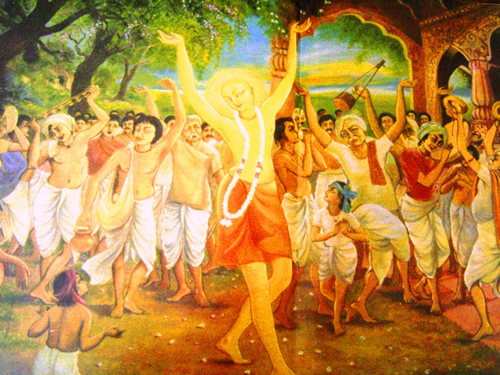
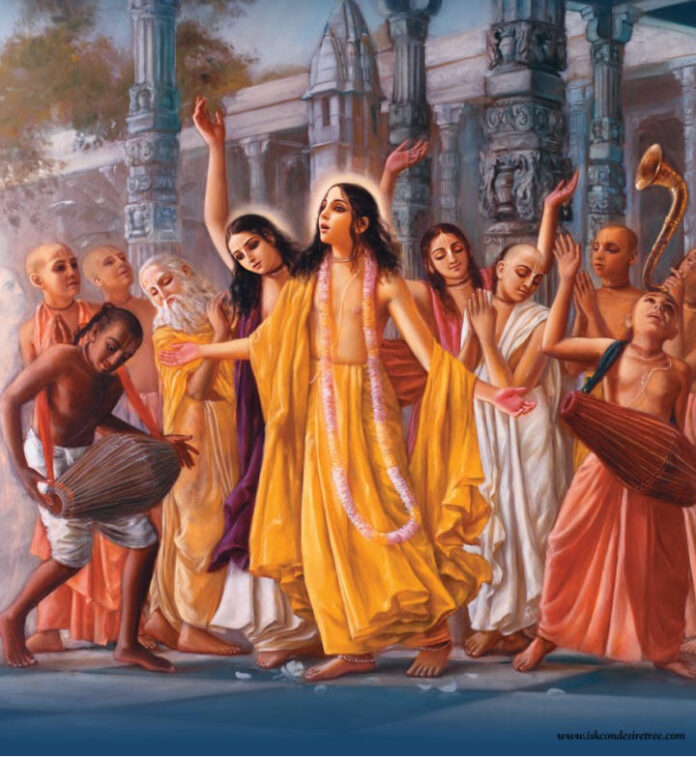
All around Śrī Caitanya Mahāprabhu, who is also known as Gaurahari, people began to shout the holy name of Hari. Lord Caitanya, immersed in His usual ecstasy of love, danced in the midst of them. (78) The body of Śrī Caitanya Mahāprabhu was naturally very beautiful. It was like molten gold dressed in saffron cloth. Indeed, He was most beautiful for being ornamented with the ecstatic symptoms, which caused His bodily hair to stand on end, tears to well up in His eyes, and His body to tremble and perspire all over. (79) Everyone present was astonished to see Śrī Caitanya Mahāprabhu’s dancing and His bodily transformations. Whoever came did not want to return home. (80) Everyone— including children, old men and women— began to dance and to chant the holy names of Śrī Kṛṣṇa and Gopāla. In this way they all floated in the ocean of love of Godhead. (81) Upon seeing the chanting and dancing of Lord Śrī Caitanya Mahāprabhu, Lord Nityānanda predicted that later there would be dancing and chanting in every village. (82)

Seeing that it was already getting late, Lord Nityānanda Prabhu, the spiritual master, invented a means to disperse the crowd. (83) When Lord Nityānanda Prabhu took Śrī Caitanya Mahāprabhu for lunch at noon, everyone came running around Them. (84) After finishing Their baths, They returned at noon to the temple. Admitting His own men, Śrī Nityānanda Prabhu closed the outside door. (85) Gopīnātha Ācārya then brought prasādam for the two Lords to eat, and after They had eaten, the remnants of the food were distributed to all the devotees. (86) Hearing about this, everyone there came to the outside door and began chanting the holy name, “Hari! Hari!” Thus there was a tumultuous sound. (87)

After lunch, Śrī Caitanya Mahāprabhu made them open the door. In this way everyone received His audience with great pleasure. (88) The people came and went until evening, and all of them became Vaiṣṇava devotees and began to chant and dance. (89) Śrī Caitanya Mahāprabhu then passed the night there and discussed the pastimes of Lord Kṛṣṇa with His devotees with great pleasure. (90) The next morning, after taking His bath, Śrī Caitanya Mahāprabhu started on His South Indian tour. He bade farewell to the devotees by embracing them. (91) Although they all fell to the ground unconscious, the Lord did not turn to see them but proceeded onward. (92) In separation, the Lord became very much perturbed and walked on unhappily. His servant, Kṛṣṇadāsa, who was carrying His waterpot, followed behind. (93) All the devotees remained there and fasted, and the next day they all unhappily returned to Jagannātha Purī. (94)

Almost like a mad lion, Lord Śrī Caitanya Mahāprabhu went on His tour filled with ecstatic love and performing saṅkīrtana, chanting Kṛṣṇa’s names as follows. (95) The Lord chanted: Kṛṣṇa! Kṛṣṇa! Kṛṣṇa! Kṛṣṇa! Kṛṣṇa! Kṛṣṇa! Kṛṣṇa! He – Kṛṣṇa! Kṛṣṇa! Kṛṣṇa! Kṛṣṇa! Kṛṣṇa! Kṛṣṇa! Kṛṣṇa! He – Kṛṣṇa! Kṛṣṇa! Kṛṣṇa! Kṛṣṇa! Kṛṣṇa! Kṛṣṇa! rakṣa mām – Kṛṣṇa! Kṛṣṇa! Kṛṣṇa! Kṛṣṇa! Kṛṣṇa! Kṛṣṇa! pāhi mām – That is, “O Lord Kṛṣṇa, please protect Me and maintain Me.” He also chanted: Rāma! Rāghava! Rāma! Rāghava! Rāma! Rāghava! rakṣa mām – Kṛṣṇa! Keśava! Kṛṣṇa! Keśava! Kṛṣṇa! Keśava! pāhi mām – That is, “O Lord Rāma, descendant of King Raghu, please protect Me. O Kṛṣṇa, O Keśava, killer of the Keśī demon, please maintain Me.” (96) Chanting this verse, Lord Śrī Caitanya Mahāprabhu, known as Gaurahari, went on His way. As soon as He saw someone, He would request him to chant “Hari! Hari!” (97) Whoever heard Lord Caitanya Mahāprabhu chant “Hari! Hari!” also chanted the holy name of Lord Hari and Kṛṣṇa. In this way they all followed the Lord, very eager to see Him. (98)

After some time the Lord would embrace these people and bid them return home, having invested each of them with spiritual potency. (99) Each of these empowered persons would return to his own village, always chanting the holy name of Kṛṣṇa and sometimes laughing, crying and dancing. (100) Such an empowered person would request everyone and anyone— whomever he saw—to chant the holy name of Kṛṣṇa. In this way all the villagers would also become devotees of the Supreme Personality of Godhead. (101) People from different villages who came to see such an empowered individual would become like him simply by seeing him and receiving the mercy of his glance. (102) When each of these newly empowered individuals returned to his own village, he also converted the villagers into devotees. And when others came from different villages to see him, they were also converted. (103) In this way, as empowered men went from one village to another, all the people of South India became devotees. (104) Thus many hundreds of people became Vaiṣṇavas when they passed the Lord on the way and were embraced by Him. (105)

Chaitanya Charitamrta | Madhya Lila | Chapter 7 | Section 74

0

Lord Caitanya Mahāprabhu, being very compassionate toward a brāhmaṇa named Vāsudeva, cured him of leprosy. He transformed him into a beautiful man satisfied with devotional service. I offer my respectful obeisances unto the glorious Lord Śrī Caitanya Mahāprabhu. (1) All glories to Lord Caitanya Mahāprabhu! All glories to Lord Nityānanda Prabhu! All glories to Advaita Ācārya! And all glories to all the devotees of Lord Caitanya! (2) After delivering Sārvabhauma Bhaṭṭācārya, the Lord desired to go to South India to preach. (3) Śrī Caitanya Mahāprabhu accepted the renounced order during the waxing fortnight of the month of Māgha. During the following month, Phālguna, He went to Jagannātha Purī and resided there. (4) At the end of the month of Phālguna, He witnessed the Dola- yātrā ceremony, and in His usual ecstatic love of God, He chanted and danced in various ways on the occasion. (5)

During the month of Caitra, while living at Jagannātha Purī, the Lord delivered Sārvabhauma Bhaṭṭācārya, and at the beginning of the next month (Vaiśākha), He decided to go to South India. (6) Śrī Caitanya Mahāprabhu called all His devotees together and, holding them by the hand, humbly informed them, “You are all more dear to Me than My life. I can give up My life, but to give you up is difficult for Me. (7-8) “You are all My friends, and you have properly executed the duties of friends by bringing Me here to Jagannātha Purī and giving Me the chance to see Lord Jagannātha in the temple. (9) “I now beg all of you for one bit of charity. Please give Me permission to leave for a tour of South India. (10) “I shall go to search out Viśvarūpa. Please forgive Me, but I want to go alone; I do not wish to take anyone with Me. (11) “Until I return from Setubandha, all of you dear friends should remain at Jagannātha Purī.” (12)

Knowing everything, Śrī Caitanya Mahāprabhu was aware that Viśvarūpa had already passed away. A pretense of ignorance was necessary, however, so that He could go to South India and liberate the people there. (13) Upon hearing this message from Śrī Caitanya Mahāprabhu, all the devotees became very unhappy and remained silent with sullen faces. (14) Nityānanda Prabhu then said, “How is it possible for You to go alone? Who can tolerate this? (15) “Let one or two of us go with You; otherwise You may fall into the clutches of thieves and rogues along the way. They may be whomever You like, but two persons should go with You. (16) “Indeed, I know all the paths to the different places of pilgrimage in South India. Just order Me, and I shall go with You.” (17) The Lord replied, “I am simply a dancer, and You are the wire- puller. However You pull the wires to make Me dance, I shall dance in that way. (18) “After accepting the sannyāsa order, I decided to go to Vṛndāvana, but You took Me instead to the house of Advaita Prabhu. (19) “While on the way to Jagannātha Purī, You broke My sannyāsa staff. I know that all of you have great affection for Me, but such things disturb My activities. (20)

“Jagadānanda wants Me to enjoy bodily sense gratification, and out of fear I do whatever he tells Me. (21) “If I sometimes do something against his desire, out of anger he will not talk to Me for three days. (22) “Being a sannyāsī, I have a duty to lie down on the ground and to take a bath three times a day, even during the winter. But Mukunda becomes very unhappy when he sees My severe austerities. (23) “Of course, Mukunda does not say anything, but I know that he is very unhappy within, and upon seeing him unhappy, I become twice as unhappy. (24) “Although I am in the renounced order of life and Dāmodara is a brahmacārī, he still keeps a stick in his hand just to educate Me. (25) “According to Dāmodara, I am still a neophyte as far as social etiquette is concerned; therefore he does not like My independent nature. (26) “Dāmodara Paṇḍita and others are more advanced in receiving the mercy of Lord Kṛṣṇa; therefore they are independent of public opinion. As such, they want Me to enjoy sense gratification, even though it be unethical. But since I am a poor sannyāsī, I cannot abandon the duties of the renounced order, and therefore I follow them strictly. (27)

“You should all therefore remain here in Nīlācala for some days while I tour the sacred places of pilgrimage alone.” (28) Actually the Lord was controlled by the good qualities of all His devotees. On the pretense of attributing faults, He tasted all these qualities. (29) No one can properly describe Lord Śrī Caitanya Mahāprabhu’s affection for His devotees. He always tolerated all kinds of personal unhappiness resulting from His acceptance of the renounced order of life. (30) The regulative principles observed by Caitanya Mahāprabhu were sometimes intolerable, and all the devotees became greatly affected by them. Although strictly observing the regulative principles, Caitanya Mahāprabhu could not tolerate the unhappiness felt by His devotees. (31) Therefore, to prevent them from accompanying Him and becoming unhappy, Śrī Caitanya Mahāprabhu declared their good qualities to be faults. (32)

Four devotees then humbly insisted that they go with the Lord, but Śrī Caitanya Mahāprabhu, being the independent Supreme Personality of Godhead, did not accept their request. (33) Thereupon Lord Nityānanda said, “Whatever You order is My duty, regardless of whether it results in happiness or unhappiness. (34) “Yet I still submit one petition to You. Please consider it, and if You think it proper, please accept it. (35) “You must take with You a loincloth, external clothes and a waterpot. You should take nothing more than this. (36) “Since Your two hands will always be engaged in chanting and counting the holy names, how will You be able to carry the waterpot and external garments? (37) “When, along the way, You fall unconscious in ecstatic love of Godhead, who will protect Your belongings—the waterpot, garments and so forth?” (38) Śrī Nityānanda Prabhu continued, “Here is a simple brāhmaṇa named Kṛṣṇadāsa. Please accept him and take him with You. That is My request. (39) “He will carry Your waterpot and garments. You may do whatever You like; he will not say a word.” (40)

Accepting the request of Lord Nityānanda Prabhu, Lord Caitanya took all His devotees and went to the house of Sārvabhauma Bhaṭṭācārya. (41) As soon as they entered his house, Sārvabhauma Bhaṭṭācārya offered the Lord obeisances and a place to sit. After seating all the others, the Bhaṭṭācārya took his seat. (42) After they had discussed various topics about Lord Kṛṣṇa, Śrī Caitanya Mahāprabhu informed Sārvabhauma Bhaṭṭācārya, “I have come to your place just to receive your order. (43) “My elder brother, Viśvarūpa, has taken sannyāsa and gone to South India. Now I must go search for Him. (44) “Please permit Me to go, for I must tour South India. With your permission, I shall soon return very happily.” (45) Upon hearing this, Sārvabhauma Bhaṭṭācārya became very much agitated. Catching hold of the lotus feet of Caitanya Mahāprabhu, he gave this sorrowful reply. (46)

“After many births, due to some pious activity I got Your association. Now providence is breaking this invaluable association. (47) “If a thunderbolt falls on my head or if my son dies, I can tolerate it. But I cannot endure the unhappiness of separation from You. (48) “My dear Lord, You are the independent Supreme Personality of Godhead. Certainly You will depart. I know that. Still, I ask You to stay here a few days more so that I can see Your lotus feet.” (49) Upon hearing Sārvabhauma Bhaṭṭācārya’s request, Caitanya Mahāprabhu relented. He stayed a few days longer and did not depart. (50) The Bhaṭṭācārya eagerly invited Lord Caitanya Mahāprabhu to his home and fed Him very nicely. (51) The Bhaṭṭācārya’s wife, whose name was Ṣāṭhīmātā (the mother of Ṣāṭhī), did the cooking. The narrations of these pastimes are very wonderful. (52) Later I shall tell about this in elaborate detail, but at present I wish to describe Śrī Caitanya Mahāprabhu’s South Indian tour. (53)

Significance For India–Russia Spiritual Diplomacy

0

Prime Minister Narendra Modi’s decision to gift a Russian edition of the Bhagavad-gītā to President Vladimir Putin during the latter’s state visit to India carries deep spiritual and historical significance for India–Russia relations. The book presented is the Russian translation of Bhagavad-gītā As It Is by His Divine Grace A. C. Bhaktivedanta Swami Prabhupāda, founder-ācārya of ISKCON, whose commentary has become one of the most widely read editions of the Gītā worldwide.​

Modi–Putin meeting and the Gītā

Welcoming President Putin at Delhi’s Palam Airport on 4 December 2025, Prime Minister Modi stepped beyond usual protocol by personally receiving him with a warm embrace and accompanying him in the same car to a private dinner at his residence. During this interaction, he presented a Russian copy of Bhagavad-gītā As It Is and later wrote on his official X account that the teachings of the Gītā offer inspiration to millions across the world.​

Putin is in India for a two-day visit to attend the 23rd India–Russia Annual Summit, during which the two sides are expected to sign more than ten inter-governmental agreements and over fifteen commercial MoUs. His programme includes paying homage at Mahatma Gandhi’s memorial at Rajghat, holding bilateral talks with the Prime Minister, and participating in a business forum focused on expanding economic cooperation.​

About “Bhagavad-gītā As It Is”

Bhagavad-gītā As It Is is the translation and commentary on the Bhagavad-gītā by A. C. Bhaktivedanta Swami Prabhupāda, who is revered in the Gauḍīya Vaiṣṇava tradition as the founder-ācārya of the International Society for Krishna Consciousness (ISKCON). First published by the Bhaktivedanta Book Trust in 1968, this edition has since been translated into around eighty languages, including Russian, with more than one hundred million copies distributed globally.

The Russian edition gifted to President Putin represents the same disciplic understanding of the Gītā that has guided the worldwide Hare Krishna movement, making it not only a state gift but also a spiritual bridge between Indian Vaiṣṇava paramparā and Russian readers. Scholars and diplomats have often noted that Prabhupāda’s edition is distinctive because it presents the original Sanskrit, transliteration, word-for-word meanings, translation, and extensive purports that explain the text through the lens of bhakti-yoga.

Earlier controversy and its resolution in Russia

The gifting of Bhagavad-gītā As It Is in Russian also recalls an important episode in recent India–Russia cultural history. In 2011, a public prosecutor in Tomsk, Russia, sought to have the Russian edition of Bhagavad-gītā As It Is declared “extremist” literature, alleging that certain commentaries incited religious hatred, which led to widespread concern in India and among international Hindu communities.

The case triggered strong reactions from Indian Parliament, religious leaders of multiple faiths, and the academic community in both countries, who emphasized that the Gītā is a revered scripture promoting self-discipline, duty, and spiritual harmony. In December 2011, the district court rejected the plea to ban the book, and in March 2012 the appeal court upheld this decision, after which Russian prosecutors dropped further challenges—an outcome welcomed as a victory for religious freedom and for the dignity of the Gītā in Russia.

Significance for India–Russia spiritual diplomacy

Presenting Bhagavad-gītā As It Is in Russian translation at the highest political level symbolizes how India’s spiritual heritage is being placed at the center of its contemporary diplomacy with Russia. The gesture underscores that the Gītā is not merely a Hindu scripture confined to India but a universal text that has deeply influenced seekers, scholars, and leaders across cultures, including in Russia where translations have circulated since the eighteenth century.​

For the Vaiṣṇava community and devotees associated with ISKCON and similar institutions, the fact that the edition chosen is by ISKCON’s founder-ācārya highlights the continuing role of Prabhupāda’s translations in carrying the message of Kṛṣṇa-bhakti to foreign lands. For platforms like Vedavarsity, this event offers a contemporary example of how classical śāstra, presented “as it is” in the paramparā, can serve as a living link between nations, peoples, and civilisations in the modern world.​

Chaitanya Charitamrta | Madhya Lila | Chapter 6 | Section 73

0

As they danced and embraced, spiritual symptoms manifested in their bodies. They perspired, trembled and shed tears, and the Lord began to speak in His ecstasy. (229) Śrī Caitanya Mahāprabhu said, “Today I have conquered the three worlds very easily. Today I have ascended to the spiritual world.” (230) Caitanya Mahāprabhu continued, “I think that today all My desires have been fulfilled because I see that Sārvabhauma Bhaṭṭācārya has acquired faith in the mahā- prasādam of Lord Jagannātha. (231) “Indeed, today you have undoubtedly taken shelter of the lotus feet of Kṛṣṇa, and Kṛṣṇa, without reservation, has become very merciful toward you. (232) “My dear Bhaṭṭācārya, today you have been released from material bondage in the bodily conception of life; you have cut to pieces the shackles of the illusory energy. (233) “Today your mind has become fit to take shelter of the lotus feet of Kṛṣṇa because, surpassing the Vedic regulative principles, you have eaten the remnants of food offered to the Lord. (234)

“‘When a person takes shelter of the lotus feet of the Supreme Personality of Godhead without reservation, the unlimited, merciful Lord bestows His causeless mercy upon him. Thus he can pass over the insurmountable ocean of nescience. Those whose intelligence is fixed in the bodily conception, who think, “I am this body,” are fit food for dogs and jackals. The Supreme Lord never bestows His mercy upon such people.’” (235) After speaking to Sārvabhauma Bhaṭṭācārya in this way, Śrī Caitanya Mahāprabhu returned to His residence. From that day on, the Bhaṭṭācārya was free because his false pride had been dismantled. (236) From that day on, Sārvabhauma Bhaṭṭācārya did not know anything but the lotus feet of Lord Caitanya Mahāprabhu, and from that day he could explain the revealed scriptures only in accordance with the process of devotional service. (237) Seeing that Sārvabhauma Bhaṭṭācārya was firmly fixed in the cult of Vaiṣṇavism, Gopīnātha Ācārya, his brother- in- law, began to dance, clap his hands and chant, “Hari! Hari!” (238) The next day, the Bhaṭṭācārya went to visit the temple of Lord Jagannātha, but before he reached the temple, he went to see Caitanya Mahāprabhu. (239)

When he met Lord Caitanya Mahāprabhu, the Bhaṭṭācārya fell down flat to offer Him respects. After offering various prayers to Him, he spoke of his previous bad disposition with great humility. (240) Then the Bhaṭṭācārya asked Caitanya Mahāprabhu, “Which item is most important in the execution of devotional service?” The Lord replied that the most important item was the chanting of the holy name of the Lord. (241) “‘In this age of quarrel and hypocrisy, the only means of deliverance is the chanting of the holy names of the Lord. There is no other way. There is no other way. There is no other way.’” (242) Śrī Caitanya Mahāprabhu very elaborately explained the harer nāma verse of the Bṛhan- nāradīya Purāṇa, and Sārvabhauma Bhaṭṭācārya was struck with wonder to hear His explanation. (243) Gopīnātha Ācārya reminded Sārvabhauma Bhaṭṭācārya, “My dear Bhaṭṭācārya, what I foretold to you has now taken place.” (244)

Offering his obeisances to Gopīnātha Ācārya, the Bhaṭṭācārya said, “Because I am related to you and you are a devotee, by your mercy the Lord has shown mercy to me. (245) “You are a first- class devotee, whereas I am in the darkness of logical arguments. Because of your relationship with the Lord, the Lord has bestowed His benediction upon me.” (246) Śrī Caitanya Mahāprabhu was very pleased with this humble statement. After embracing the Bhaṭṭācārya, He said, “Now go see Lord Jagannātha in the temple.” (247) After visiting the temple of Lord Jagannātha, Sārvabhauma Bhaṭṭācārya returned home with Jagadānanda and Dāmodara. (248) The Bhaṭṭācārya brought large quantities of excellent food remnants blessed by Lord Jagannātha. All this prasādam was given to his own brāhmaṇa servant, along with Jagadānanda and Dāmodara. (249) Sārvabhauma Bhaṭṭācārya then composed two verses on the leaf of a palm tree. Giving the palm leaf to Jagadānanda Prabhu, the Bhaṭṭācārya requested him to deliver it to Śrī Caitanya Mahāprabhu. (250)

Jagadānanda and Dāmodara then returned to Śrī Caitanya Mahāprabhu, bringing Him both the prasādam and the palm leaf on which the verses were composed. But Mukunda Datta took the palm leaf from the hands of Jagadānanda before he could deliver it to Śrī Caitanya Mahāprabhu. (251) Mukunda Datta then copied the two verses on the wall outside the room. After this, Jagadānanda took the palm leaf from Mukunda Datta and delivered it to Lord Caitanya Mahāprabhu. (252) As soon as Lord Caitanya Mahāprabhu read the two verses, He immediately tore up the palm leaf. However, all the devotees read these verses on the outside wall, and they all kept them within their hearts. The verses read as follows. (253) “Let me take shelter of the Supreme Personality of Godhead, Śrī Kṛṣṇa, who has descended in the form of Lord Caitanya Mahāprabhu to teach us real knowledge, His devotional service and detachment from whatever does not foster Kṛṣṇa consciousness. He has descended because He is an ocean of transcendental mercy. Let me surrender unto His lotus feet. (254)

“Let my consciousness, which is like a honeybee, take shelter of the lotus feet of the Supreme Personality of Godhead, who has just now appeared as Śrī Kṛṣṇa Caitanya Mahāprabhu to teach the ancient system of devotional service to Himself. This system had almost been lost due to the influence of time.” (255) These two verses composed by Sārvabhauma Bhaṭṭācārya will always declare his name and fame as loudly as a pounding drum, for they have become pearl necklaces around the necks of all devotees. (256) Indeed, Sārvabhauma Bhaṭṭācārya became an unalloyed devotee of Caitanya Mahāprabhu; he did not know anything but the service of the Lord. (257) The Bhaṭṭācārya always chanted the holy name of Śrī Kṛṣṇa Caitanya, son of mother Śacī and reservoir of all good qualities. Indeed, chanting the holy names became his meditation. (258)

One day Sārvabhauma Bhaṭṭācārya came before Caitanya Mahāprabhu and, after offering obeisances, began to recite a verse. (259) He began to quote one of Lord Brahmā’s prayers from Śrīmad- Bhāgavatam, but he changed two syllables at the end of the verse. (260) The Bhaṭṭācārya recited, “‘One who seeks Your compassion and thus tolerates all kinds of adverse conditions due to the karma of his past deeds, who engages always in Your devotional service with his mind, words and body, and who always offers obeisances unto You is certainly a bona fide candidate for becoming Your unalloyed devotee.’” (261) Śrī Caitanya Mahāprabhu immediately pointed out, “In that verse the word is ‘mukti- pade,’ but you have changed it to ‘bhakti- pade.’ What is your intention?” (262) Sārvabhauma Bhaṭṭācārya replied, “The awakening of pure love of Godhead, which is the result of devotional service, far surpasses liberation from material bondage. For those averse to devotional service, merging into the Brahman effulgence is a kind of punishment.” (263)

The Bhaṭṭācārya continued, “The impersonalists, who do not accept the transcendental form of Lord Śrī Kṛṣṇa, and the demons, who are always engaged in blaspheming and fighting with Him, are punished by being merged into the Brahman effulgence. But that does not happen to the person engaged in the devotional service of the Lord. (264-265) “There are five kinds of liberation: sālokya, sāmīpya, sārūpya, sārṣṭi and sāyujya. (266) “If there is a chance to serve the Supreme Personality of Godhead, a pure devotee sometimes accepts the sālokya, sārūpya, sāmīpya or sārṣṭi forms of liberation, but never sāyujya. (267) “A pure devotee does not like even to hear about sāyujya- mukti, which inspires him with fear and hatred. Indeed, the pure devotee would rather go to hell than merge into the effulgence of the Lord.” (268) Sārvabhauma Bhaṭṭācārya continued, “There are two kinds of sāyujya- mukti: merging into the Brahman effulgence and merging into the personal body of the Lord. Merging into the Lord’s body is even more abominable than merging into His effulgence.” (269)

Sārvabhauma Bhaṭṭācārya concluded, “‘Even though he is offered all kinds of liberation, the pure devotee does not accept them. He is fully satisfied engaging in the service of the Lord.’” (270) Lord Śrī Caitanya Mahāprabhu replied, “The word ‘mukti- pade’ has another meaning. ‘Mukti- pada’ directly refers to the Supreme Personality of Godhead. (271) “All kinds of liberation exist under the feet of the Supreme Personality of Godhead; therefore He is known as mukti- pada. According to another meaning, mukti is the ninth subject, and the Supreme Personality of Godhead is the shelter of liberation. (272) “Since I can understand Kṛṣṇa according to these two meanings,” Caitanya Mahāprabhu said, “what point is there in changing the verse?” Sārvabhauma Bhaṭṭācārya replied, “I was not able to give that reading to the verse. (273) “Although Your explanation is correct, it should not be used, because there is ambiguity in the word ‘mukti- pada.’ (274) “The word ‘mukti’ refers to five kinds of liberation. But its direct meaning usually conveys the idea of becoming one with the Lord. (275)

“The very sound of the word ‘mukti’ immediately induces hate and fear, but when we say the word ‘bhakti,’ we naturally feel transcendental bliss within the mind.” (276) Upon hearing this explanation, the Lord began to laugh and, with great pleasure, immediately embraced Sārvabhauma Bhaṭṭācārya very firmly. (277) Indeed, that very person who had been accustomed to reading and teaching Māyāvāda philosophy was now even hating the word “mukti.” This was possible only by the mercy of Śrī Caitanya Mahāprabhu. (278) As long as it does not turn iron into gold by its touch, no one can recognize an unknown stone to be a touchstone. (279)

Upon seeing transcendental Vaiṣṇavism in Sārvabhauma Bhaṭṭācārya, everyone could understand that Lord Caitanya was none other than Kṛṣṇa, the son of Nanda Mahārāja. (280) After this incident, all the inhabitants of Jagannātha Purī, headed by Kāśī Miśra, came to take shelter of the lotus feet of the Lord. (281) Later I shall describe how Sārvabhauma Bhaṭṭācārya always engaged in the service of the Lord. (282) I shall also describe in full detail how Sārvabhauma Bhaṭṭācārya perfectly rendered service to Śrī Caitanya Mahāprabhu by offering Him alms. (283) If one hears with faith and love these pastimes concerning Lord Caitanya Mahāprabhu’s meeting with Sārvabhauma Bhaṭṭācārya, he very soon is freed from the net of speculation and fruitive activity and attains the shelter of Śrī Caitanya Mahāprabhu’s lotus feet. (284-285) Praying at the lotus feet of Śrī Rūpa and Śrī Raghunātha, always desiring their mercy, I, Kṛṣṇadāsa, narrate Śrī Caitanya- caritāmṛta, following in their footsteps. (286)

Chaitanya Charitamrta | Madhya Lila | Chapter 6 | Section 72

0

Śrī Caitanya Mahāprabhu continued, “The Supreme Personality of Godhead is the central point of all relationships, acting in devotional service to Him is one’s real occupation, and the attainment of love of Godhead is the ultimate goal of life. These three subject matters are described in the Vedic literature. (178) “If one tries to explain the Vedic literature in a different way, he is indulging in imagination. Any interpretation of the self- evident Vedic version is simply imaginary. (179) “Actually there is no fault on the part of Śaṅkarācārya. He simply carried out the order of the Supreme Personality of Godhead. He had to imagine some kind of interpretation, and therefore he presented a kind of Vedic literature that is full of atheism. (180) “[Addressing Lord Śiva, the Supreme Personality of Godhead said:] ‘Please make the general populace averse to Me by imagining your own interpretation of the Vedas. Also, cover Me in such a way that people will take more interest in advancing material civilization just to propagate a population bereft of spiritual knowledge.’ (181)

“[Lord Śiva informed goddess Durgā, the superintendent of the material world:] ‘In the Age of Kali I take the form of a brāhmaṇa and explain the Vedas through false scriptures in an atheistic way, similar to Buddhist philosophy.’” (182) Sārvabhauma Bhaṭṭācārya became very much astonished upon hearing this. He became stunned and said nothing. (183) Lord Śrī Caitanya Mahāprabhu then told him, “Do not be astonished. Actually, devotional service unto the Supreme Personality of Godhead is the highest perfection of human activity. (184) “Even the self- satisfied sages perform devotional service to the Supreme Lord. Such are the transcendental qualities of the Lord. They are full of inconceivable spiritual potency. (185) “‘Those who are self- satisfied and unattracted by external material desires are also attracted to the loving service of Śrī Kṛṣṇa, whose qualities are transcendental and whose activities are wonderful. Hari, the Personality of Godhead, is called Kṛṣṇa because He has such transcendentally attractive features.’” (186)

After hearing the ātmārāma verse, Sārvabhauma Bhaṭṭācārya addressed Śrī Caitanya Mahāprabhu, “My dear Sir, please explain this verse. I have a great desire to hear Your explanation of it.” (187) The Lord replied, “First let Me hear your explanation. After that, I shall try to explain what little I know.” (188) Sārvabhauma Bhaṭṭācārya then began to explain the ātmārāma verse, and according to the principles of logic, he put forward various propositions. (189) The Bhaṭṭācārya explained the ātmārāma verse in nine different ways on the basis of scripture. After hearing his explanation, Śrī Caitanya Mahāprabhu, smiling a little, began to speak. (190) Śrī Caitanya Mahāprabhu said, “My dear Bhaṭṭācārya, you are exactly like Bṛhaspati, the priest of the heavenly kingdom. Indeed, no one within this world has the power to explain the scriptures in such a way. (191) “My dear Bhaṭṭācārya, you have certainly explained this verse by the prowess of your vast learning, but you should know that, besides this scholarly explanation, there is another purport to this verse.” (192)

Upon the request of Sārvabhauma Bhaṭṭācārya, Lord Caitanya Mahāprabhu began to explain the verse, without touching upon the nine explanations given by the Bhaṭṭācārya. (193) There are eleven words in the ātmārāma verse, and Śrī Caitanya Mahāprabhu explained each word, one after the other. (194) Lord Caitanya Mahāprabhu took each word specifically and combined it with the word “ātmārāma.” He thus explained the word “ātmārāma” in eighteen different ways. (195) Śrī Caitanya Mahāprabhu said, “The Supreme Personality of Godhead, His different potencies and His transcendental qualities all have inconceivable prowess. It is not possible to explain them fully. (196) “These three items attract the mind of a perfect student engaged in spiritual activities and overcome all other processes of spiritual activity.” (197) Śrī Caitanya Mahāprabhu explained the meaning of the verse by giving evidence concerning Śukadeva Gosvāmī and the four ṛṣis Sanaka, Sanat- kumāra, Sanātana and Sanandana. Thus the Lord gave various meanings and explanations. (198)

Upon hearing Caitanya Mahāprabhu’s explanation of the ātmārāma verse, Sārvabhauma Bhaṭṭācārya was struck with wonder. He then understood Lord Śrī Caitanya Mahāprabhu to be Kṛṣṇa in person, and he thus condemned himself in the following words. (199) “Caitanya Mahāprabhu is certainly Lord Kṛṣṇa Himself. Because I could not understand Him and was very proud of my own learning, I have committed many offenses.” (200) When Sārvabhauma Bhaṭṭācārya denounced himself as an offender and took shelter of the Lord, the Lord desired to show him mercy. (201) To show him mercy, Śrī Caitanya Mahāprabhu allowed him to see His Viṣṇu form. Thus He immediately assumed four hands. (202) Śrī Caitanya Mahāprabhu first showed him the four- handed form and then appeared before him in His original form of Kṛṣṇa, with a blackish complexion and a flute to His lips. (203) When Sārvabhauma Bhaṭṭācārya saw the form of Lord Kṛṣṇa manifested in Caitanya Mahāprabhu, he immediately fell down flat to offer Him obeisances. Then he stood up and with folded hands began to offer prayers. (204)

By the mercy of the Lord, all truths were revealed to Sārvabhauma Bhaṭṭācārya, and he could understand the importance of chanting the holy name and distributing love of Godhead everywhere. (205) Sārvabhauma Bhaṭṭācārya composed one hundred verses in a very short time. Indeed, not even Bṛhaspati, the priest of the heavenly planets, could compose verses as quickly. (206) After hearing the one hundred verses, Śrī Caitanya Mahāprabhu happily embraced Sārvabhauma Bhaṭṭācārya, who was immediately overwhelmed in ecstatic love of Godhead and fell unconscious. (207) Out of ecstatic love of God, the Bhaṭṭācārya shed tears, and his body was stunned. He exhibited an ecstatic mood, and he perspired, shook and trembled. He sometimes danced, sometimes chanted, sometimes cried and sometimes fell down to touch the lotus feet of the Lord. (208) While Sārvabhauma Bhaṭṭācārya was in this ecstasy, Gopīnātha Ācārya was very pleased. The associates of Śrī Caitanya Mahāprabhu all laughed to see the Bhaṭṭācārya dance so. (209)

Gopīnātha Ācārya told Lord Caitanya Mahāprabhu, “Sir, You have brought all this upon Sārvabhauma Bhaṭṭācārya.” (210) Śrī Caitanya Mahāprabhu replied, “You are a devotee. Because of your association, Lord Jagannātha has shown him mercy.” (211) After this, Śrī Caitanya Mahāprabhu pacified the Bhaṭṭācārya, and when he was quieted, he offered many prayers to the Lord. (212) Sārvabhauma Bhaṭṭācārya said, “My dear Sir, You have delivered the entire world, but that is not a very great task. However, You have also delivered me, and that is certainly the work of very wonderful powers. (213) “I had become dull- headed due to reading too many books on logic. Consequently I had become like an iron bar. Nonetheless, You have melted me, and therefore Your influence is very great.” (214) After hearing the prayers offered by Sārvabhauma Bhaṭṭācārya, Śrī Caitanya Mahāprabhu returned to His residence, and the Bhaṭṭācārya, through Gopīnātha Ācārya, induced the Lord to accept lunch there. (215)

Early the following morning, Śrī Caitanya Mahāprabhu went to see Lord Jagannātha in the temple, and He saw the Lord rise from His bed. (216) The priest there presented Him with garlands and prasādam that had been offered to Lord Jagannātha. This pleased Caitanya Mahāprabhu very much. (217) Carefully tying the prasādam and garlands in a cloth, Caitanya Mahāprabhu hastened to the house of Sārvabhauma Bhaṭṭācārya. (218) He arrived at the Bhaṭṭācārya’s house a little before sunrise, just when the Bhaṭṭācārya was arising from bed. (219) As Sārvabhauma Bhaṭṭācārya arose from bed, he distinctly chanted, “Kṛṣṇa, Kṛṣṇa.” Lord Caitanya was very pleased to hear him chant the holy name of Kṛṣṇa. (220) The Bhaṭṭācārya noticed Śrī Caitanya Mahāprabhu outside, and with great haste he went to Him and offered prayers unto His lotus feet. (221) The Bhaṭṭācārya offered a carpet for the Lord to sit upon, and both of them sat there. Then Śrī Caitanya Mahāprabhu opened the prasādam and placed it in the hands of the Bhaṭṭācārya. (222)

At that time the Bhaṭṭācārya had not even washed his mouth, nor had he taken his bath or finished his morning duties. Nonetheless, he was very pleased to receive the prasādam of Lord Jagannātha. (223) By the mercy of Śrī Caitanya Mahāprabhu, all the dullness in the mind of Sārvabhauma Bhaṭṭācārya was eradicated. After reciting the following two verses, he ate the prasādam offered to him. (224) The Bhaṭṭācārya said, “‘One should eat the mahā- prasādam of the Lord immediately upon receiving it, even though it is dried up, stale or brought from a distant country. One should consider neither time nor place. (225) “‘The prasādam of Lord Kṛṣṇa is to be eaten by gentlemen as soon as it is received; there should be no hesitation. There are no regulative principles concerning time and place. This is the order of the Supreme Personality of Godhead.’” (226) Śrī Caitanya Mahāprabhu was very pleased to see this. He became ecstatic in love of Godhead and embraced Sārvabhauma Bhaṭṭācārya. (227) The Lord and the servant embraced each other and began to dance. Simply by touching each other, they became ecstatic. (228)

Chaitanya Charitamrta | Madhya Lila | Chapter 6 | Section 71

0

The Bhaṭṭācārya said, “Hearing Vedānta philosophy is a sannyāsī’s main business. Therefore without hesitation You should study Vedānta philosophy, hearing it without cessation from a superior person.” (121) Lord Caitanya replied, “You are very merciful to Me, and therefore I think it is My duty to obey your order.” (122) Thus for seven days continually, Śrī Caitanya Mahāprabhu listened to the Vedānta philosophy expounded by Sārvabhauma Bhaṭṭācārya. However, Caitanya Mahāprabhu did not say anything and did not indicate whether it was right or wrong. He simply sat there and listened to the Bhaṭṭācārya. (123) On the eighth day, Sārvabhauma Bhaṭṭācārya said to Caitanya Mahāprabhu, “You have been listening to Vedānta philosophy from me continually for seven days. (124)

“You have simply been listening, fixed in Your silence. Since You do not say whether You think it is right or wrong, I cannot know whether You are actually understanding Vedānta philosophy or not.” (125) Śrī Caitanya Mahāprabhu replied, “I am a fool, and consequently I do not study the Vedānta- sūtra. I am just trying to hear it from you because you have ordered Me. (126) “Only for the sake of executing the duties of the renounced order of sannyāsa do I listen. Unfortunately, I cannot in the least understand the meaning you are presenting.” (127) Sārvabhauma Bhaṭṭācārya replied, “I accept that You do not understand, yet even one who does not understand inquires about the subject matter. (128) “You are hearing again and again, yet You keep silent. I cannot understand what is actually within Your mind.” (129)

Śrī Caitanya Mahāprabhu then revealed His mind, saying, “I can understand the meaning of each sūtra very clearly, but your explanations have simply agitated My mind. (130) “The meaning of the aphorisms in the Vedānta- sūtra contain clear purports in themselves, but other purports you presented simply covered the meaning of the sūtras like a cloud. (131) “You do not explain the direct meaning of the Brahma- sūtras. Indeed, it appears that your business is to cover their real meaning.” (132) Caitanya Mahāprabhu continued, “The Vedānta- sūtra is the summary of all the Upaniṣads; therefore whatever direct meaning is there in the Upaniṣads is also recorded in the Vedānta- sūtra, or Vyāsa- sūtra. (133) “For each sūtra the direct meaning must be accepted without interpretation. However, you simply abandon the direct meaning and proceed with your imaginative interpretation. (134) “Although there is other evidence, the evidence given in the Vedic version must be taken as foremost. Vedic versions understood directly are first- class evidence.” (135)

Caitanya Mahāprabhu continued, “Conchshells and cow dung are nothing but the bones and the stool of some living entities, but according to the Vedic version they are both considered very pure. (136) “The Vedic statements are self- evident. Whatever is stated there must be accepted. If we interpret according to our own imagination, the authority of the Vedas is immediately lost.” (137) Śrī Caitanya Mahāprabhu continued, “The Brahma- sūtra, compiled by Śrīla Vyāsadeva, is as radiant as the sun. One who tries to interpret its meaning simply covers that sunshine with a cloud. (138) “All the Vedas and literature that strictly follows the Vedic principles explain that the Supreme Brahman is the Absolute Truth, the greatest of all, and a feature of the Supreme Lord. (139) “Actually, the Supreme Absolute Truth is a person, the Supreme Personality of Godhead, full with all opulences. You are trying to explain Him as impersonal and formless. (140)

“Wherever there is an impersonal description in the Vedas, the Vedas mean to establish that everything belonging to the Supreme Personality of Godhead is transcendental and free of mundane characteristics.” (141) Śrī Caitanya Mahāprabhu continued, “‘Whatever Vedic mantras describe the Absolute Truth impersonally only prove in the end that the Absolute Truth is a person. The Supreme Lord is understood in two features—impersonal and personal. If one considers the Supreme Personality of Godhead in both features, he can actually understand the Absolute Truth. He knows that the personal understanding is stronger because we see that everything is full of variety. No one can see anything that is not full of variety.’ (142) “Everything in the cosmic manifestation emanates from the Absolute Truth, remains in the Absolute Truth, and after annihilation again enters the Absolute Truth. (143) “The personal features of the Supreme Personality of Godhead are categorized in three cases— namely ablative, instrumental and locative.” (144)

Śrī Caitanya Mahāprabhu continued, “When the Supreme Personality of Godhead wished to become many, He glanced over the material energy. Before the creation there were no mundane eyes or mind; therefore the transcendental nature of the Absolute Truth’s mind and eyes is confirmed. (145-146) “The word ‘Brahman’ indicates the complete Supreme Personality of Godhead, who is Śrī Kṛṣṇa. That is the verdict of all Vedic literature. (147) “The confidential meaning of the Vedas is not easily understood by common men; therefore that meaning is supplemented by the words of the Purāṇas. (148) “‘How greatly fortunate are Nanda Mahārāja, the cowherd men and all the inhabitants of Vrajabhūmi! There is no limit to their fortune, because the Absolute Truth, the source of transcendental bliss, the eternal Supreme Brahman, has become their friend.’ (149) “The Vedic ‘apāṇi- pāda’ mantra rejects material hands and legs, yet it states that the Lord goes very fast and accepts everything offered to Him. (150) “All these mantras confirm that the Absolute Truth is personal, but the Māyāvādīs, throwing away the direct meaning, interpret the Absolute Truth as impersonal. (151)

“Are you describing as formless that Supreme Personality of Godhead whose transcendental form is complete with six transcendental opulences? (152) “The Supreme Personality of Godhead has three primary potencies. Are you trying to prove that He has no potencies? (153) “‘The internal potency of the Supreme Lord, Viṣṇu, is spiritual, as verified by the śāstras. There is another spiritual potency, known as kṣetra- jña, or the living entity. The third potency, which is known as nescience, makes the living entity godless and fills him with fruitive activity. (154) “‘O King, the kṣetra- jña- śakti is the living entity. Although he has the facility to live in either the material or spiritual world, he suffers the threefold miseries of material existence because he is influenced by the avidyā [nescience] potency, which covers his constitutional position. (155) “‘This living entity, covered by the influence of nescience, exists in different forms in the material condition. O King, he is thus proportionately freed from the influence of material energy, to a greater or lesser degree.’ (156)

“‘The Supreme Personality of Godhead is sac- cid- ānanda- vigraha. This means that He originally has three potencies—the pleasure potency, the potency of eternality and the potency of knowledge. Together these are called the cit potency, and they are present in full in the Supreme Lord. For the living entities, who are part and parcel of the Lord, the pleasure potency in the material world is sometimes displeasing and sometimes mixed. This is not the case with the Supreme Personality of Godhead, because He is not under the influence of the material energy or its modes.’ (157) “The Supreme Personality of Godhead in His original form is full of eternity, knowledge and bliss. The spiritual potency in these three portions [sat, cit and ānanda] assumes three different forms. (158) The three portions of the spiritual potency are called hlādinī [the bliss portion], sandhinī [the eternity portion] and samvit [the knowledge portion]. We accept knowledge of these as full knowledge of the Supreme Personality of Godhead. (159)

“The spiritual potency of the Supreme Personality of Godhead also appears in three phases— internal, marginal and external. These are all engaged in His devotional service in love. (160) “In His spiritual potency, the Supreme Lord enjoys six kinds of opulences. You do not accept this spiritual potency, and this is due to your great impudence. (161) “The Lord is the master of the potencies, and the living entity is the servant of them. That is the difference between the Lord and the living entity. However, you declare that the Lord and the living entities are one and the same. (162) “In the Bhagavad- gītā the living entity is established as the marginal potency of the Supreme Personality of Godhead. Yet you say that the living entity is completely different from the Lord. (163) “‘Earth, water, fire, air, ether, mind, intelligence and false ego are My eightfold separated energies. (164) “‘Besides these inferior energies, which are material, there is another energy, a spiritual energy, and this is the living being, O mighty- armed one. The entire material world is sustained by the living entities.’ (165)

“The transcendental form of the Supreme Personality of Godhead is complete in eternity, cognizance and bliss. However, you describe this transcendental form as a product of material goodness. (166) “One who does not accept the transcendental form of the Lord is certainly an agnostic. Such a person should be neither seen nor touched. Indeed, he is subject to be punished by Yamarāja. (167) “The Buddhists do not recognize the authority of the Vedas; therefore they are considered agnostics. However, those who have taken shelter of the Vedic scriptures yet preach agnosticism in accordance with the Māyāvāda philosophy are certainly more dangerous than the Buddhists. (168) “Śrīla Vyāsadeva presented the Vedānta philosophy for the deliverance of conditioned souls, but if one hears the commentary of Śaṅkarācārya, everything is spoiled. (169) “The Vedānta- sūtra aims at establishing that the cosmic manifestation has come into being by the transformation of the inconceivable potency of the Supreme Personality of Godhead. (170)

“The touchstone, after touching iron, produces volumes of gold without being changed. Similarly, the Supreme Personality of Godhead manifests Himself as the cosmic manifestation by His inconceivable potency, yet He remains unchanged in His eternal, transcendental form. (171) “Śaṅkarācārya’s theory states that the Absolute Truth is transformed. By accepting this theory, the Māyāvādī philosophers denigrate Śrīla Vyāsadeva by accusing him of error. They thus find fault in the Vedānta- sūtra and interpret it to try to establish the theory of illusion. (172) “The theory of illusion can be applied only when the living entity identifies himself with the body. As far as the cosmic manifestation is concerned, it cannot be called false, although it is certainly temporary. (173)

“The transcendental vibration oṁkāra is the sound form of the Supreme Personality of Godhead. All Vedic knowledge and this cosmic manifestation are produced from this sound representation of the Supreme Lord. (174) “The subsidiary vibration tat tvam asi [“you are the same”] is meant for the understanding of the living entity, but the principal vibration is oṁkāra. Not caring for oṁkāra, Śaṅkarācārya has stressed the vibration tat tvam asi.” (175) Thus Śrī Caitanya Mahāprabhu criticized Śaṅkarācārya’s Śārīraka- bhāṣya as imaginary, and He pointed out hundreds of faults in it. To defend Śaṅkarācārya, however, Sārvabhauma Bhaṭṭācārya presented unlimited opposition. (176) The Bhaṭṭācārya presented various types of false arguments with pseudo logic and tried to defeat his opponent in many ways. However, Śrī Caitanya Mahāprabhu refuted all these arguments and established His own conviction. (177)

Chaitanya Charitamrta | Madhya Lila | Chapter 6 | Section 70

0

The next day Gopīnātha Ācārya took Lord Caitanya Mahāprabhu to see the early rising of Lord Jagannātha. (67)Gopīnātha Ācārya then took Mukunda Datta with him and went to Sārvabhauma’s house. When they arrived, Sārvabhauma addressed Mukunda Datta as follows. (68) “The sannyāsī is very meek and humble by nature, and His person is very beautiful to see. Consequently my affection for Him increases. (69) “From which sampradāya has He accepted the sannyāsa order, and what is His name?” (70) Gopīnātha Ācārya replied, “The Lord’s name is Śrī Kṛṣṇa Caitanya, and His sannyāsa preceptor is the greatly fortunate Keśava Bhāratī.”(71) Sārvabhauma Bhaṭṭācārya said, “‘Śrī Kṛṣṇa’ is a very good name, but He belongs to the Bhāratī community. Therefore He is a second- class sannyāsī.” (72)

Gopīnātha Ācārya replied, “Śrī Kṛṣṇa Caitanya Mahāprabhu does not rely on any external formality. There is no need for Him to accept the sannyāsa order from a superior sampradāya.” (73) The Bhaṭṭācārya inquired, “Śrī Caitanya Mahāprabhu is in His full- fledged youthful life. How can He keep the principles of sannyāsa? (74) “I shall continually recite Vedānta philosophy before Caitanya Mahāprabhu so that He may remain fixed in His renunciation and thus enter upon the path of monism.” (75) Sārvabhauma Bhaṭṭācārya then suggested, “If Śrī Caitanya Mahāprabhu would like, I could bring Him into a first- class sampradāya by offering Him saffron cloth and performing the reformatory process again.” (76) Gopīnātha Ācārya and Mukunda Datta became very unhappy when they heard this. Gopīnātha Ācārya therefore addressed Sārvabhauma Bhaṭṭācārya as follows. (77) “My dear Bhaṭṭācārya, you do not know the greatness of Lord Caitanya Mahāprabhu. All the symptoms of the Supreme Personality of Godhead are found in Him to the highest degree.” (78)

Gopīnātha Ācārya continued, “Lord Caitanya Mahāprabhu is celebrated as the Supreme Personality of Godhead. Those who are ignorant in this connection find the conclusion of knowledgeable men very difficult to understand.” (79) The disciples of Sārvabhauma Bhaṭṭācārya retaliated, “By what evidence do you conclude that Śrī Caitanya Mahāprabhu is the Supreme Lord?” Gopīnātha Ācārya replied, “The statements of authorized ācāryas who understand the Supreme Personality of Godhead are proof.” (80) The disciples of the Bhaṭṭācārya said, “We derive knowledge of the Absolute Truth by logical hypothesis.” Gopīnātha Ācārya replied, “One cannot attain real knowledge of the Supreme Personality of Godhead by such logical hypothesis and argument.” (81) Gopīnātha Ācārya continued, “One can understand the Supreme Personality of Godhead only by His mercy, not by guesswork or hypothesis.” (82) The Ācārya continued, “If one receives but a tiny bit of the Lord’s favor by dint of devotional service, he can understand the nature of the Supreme Personality of Godhead. (83)

“‘My Lord, if one is favored by even a slight trace of the mercy of Your lotus feet, he can understand the greatness of Your personality. But those who speculate in order to understand the Supreme Personality of Godhead are unable to know You, even though they continue to study the Vedas for many years.’” (84) Gopīnātha Ācārya then addressed Sārvabhauma Bhaṭṭācārya: “You are a great scholar and a teacher of many disciples. Indeed, there is no other scholar like you on earth. Nonetheless, because you are bereft of even a pinch of the Lord’s mercy, you cannot understand Him, even though He is present in your home. (85-86) “It is not your fault; it is the verdict of the scriptures. You cannot understand the Supreme Personality of Godhead simply by scholarship.” (87) Sārvabhauma Bhaṭṭācārya replied, “My dear Gopīnātha Ācārya, please speak with great care. What is the proof that you have received the mercy of the Lord?” (88) Gopīnātha Ācārya replied, “Knowledge of the summum bonum, the Absolute Truth, is evidence of the mercy of the Supreme Lord.” (89)

Gopīnātha Ācārya continued, “You have seen the symptoms of the Supreme Personality of Godhead in the body of Śrī Caitanya Mahāprabhu during His absorption in an ecstatic mood. (90) “Despite directly perceiving the symptoms of the Supreme Lord in the body of Śrī Caitanya Mahāprabhu, you cannot understand Him. This is commonly called illusion. (91) “A person influenced by the external energy is called bahirmukha jana, a mundane person, because despite his perception, he cannot understand the real substance.” Hearing Gopīnātha Ācārya say this, Sārvabhauma Bhaṭṭācārya smiled and began to speak as follows. (92) The Bhaṭṭācārya said, “We are just having a discussion among friends and considering the points described in the scriptures. Do not become angry. I am simply speaking on the strength of the śāstras. Please don’t take any offense. (93) “Śrī Caitanya Mahāprabhu is certainly a great, uncommon devotee, but we cannot accept Him as an incarnation of Lord Viṣṇu because, according to śāstra, there is no incarnation in this Age of Kali. (94) “Another name for Lord Viṣṇu is Triyuga because there is no incarnation of Lord Viṣṇu in Kali- yuga. Indeed, this is the verdict of the revealed scriptures.” (95)

Upon hearing this, Gopīnātha Ācārya became very unhappy. He said to the Bhaṭṭācārya, “You consider yourself the knower of all Vedic scriptures. (96) “Śrīmad- Bhāgavatam and the Mahābhārata are the two most important Vedic scriptures, but you have paid no attention to their statements. (97) “In Śrīmad- Bhāgavatam and Mahābhārata it is stated that the Lord appears directly, but you say that in this age there is no manifestation or incarnation of Lord Viṣṇu. (98) “In this Age of Kali there is no līlā- avatāra of the Supreme Personality of Godhead; therefore He is known as Triyuga. That is one of His holy names.” (99) Gopīnātha Ācārya continued, “There is certainly an incarnation in every age, and such an incarnation is called the yuga- avatāra. But your heart has become so hardened by logic and argument that you cannot consider all these facts. (100) “‘In the past, your son has had bodies of three different colors, according to the age. These colors were white, red and yellow. In this age [Dvāpara- yuga] He has accepted a blackish body.’ (101)

“‘In the Age of Kali, as well as in Dvāpara- yuga, the people offer prayers to the Supreme Personality of Godhead by various mantras and observe the regulative principles of the supplementary Vedic literatures. Now please hear of this from me. (102) “‘In this Age of Kali, those who are intelligent perform the congregational chanting of the Hare Kṛṣṇa mahā- mantra, worshiping the Supreme Personality of Godhead, who appears in this age always describing the glories of Kṛṣṇa. That incarnation is yellowish in hue and is always associated with His plenary expansions [such as Śrī Nityānanda Prabhu] and personal expansions [such as Gadādhara], as well as His devotees and associates [such as Svarūpa Dāmodara].’ (103) “‘The Lord [in the incarnation of Gaurasundara] has a golden complexion. Indeed, His entire body, which is very nicely constituted, is like molten gold. Sandalwood pulp is smeared all over His body. He will take the fourth order of spiritual life [sannyāsa] and will be very much self- controlled. He will be distinguished from Māyāvādī sannyāsīs in that He will be fixed in devotional service and will spread the saṅkīrtana movement.’” (104)

Gopīnātha Ācārya then said, “There is no need to quote so much evidence from the śāstras, for you are a very dry speculator. There is no need to sow seeds in barren land. (105) “When the Lord will be pleased with you, you will also understand these conclusions and will quote from the śāstras. (106) “The false arguments and philosophical word jugglery of your disciples are not faults of theirs. They have simply received the benediction of Māyāvāda philosophy. (107) “‘I offer my respectful obeisances unto the Supreme Personality of Godhead, who is full of unlimited qualities and whose different potencies bring about agreement and disagreement between disputants. Thus the illusory energy again and again covers the self- realization of both disputants.’ (108) “‘In almost all cases, whatever learned brāhmaṇas speak becomes accepted; nothing is impossible for one who takes shelter of My illusory energy and speaks under her influence.’” (109) After hearing this from Gopīnātha Ācārya, Sārvabhauma Bhaṭṭācārya said, “First go to the place where Śrī Caitanya Mahāprabhu is staying and invite Him here with His associates. Ask Him on my account. (110)

“Take jagannātha- prasādam and first give it to Caitanya Mahāprabhu and His associates. After that, come back here and teach me well.” (111) Gopīnātha Ācārya was the brother- in- law of Sārvabhauma Bhaṭṭācārya; therefore their relationship was very sweet and intimate. Under the circumstances, Gopīnātha Ācārya taught him by sometimes blaspheming him, sometimes praising him and sometimes laughing at him. This had been going on for some time. (112) Śrīla Mukunda Datta felt very satisfied to hear the conclusive statements of Gopīnātha Ācārya, but he became very unhappy and angry to hear the statements put forward by Sārvabhauma Bhaṭṭācārya. (113) According to the instructions of Sārvabhauma Bhaṭṭācārya, Gopīnātha Ācārya went to Śrī Caitanya Mahāprabhu and invited Him on the Bhaṭṭācārya’s behalf. (114) The Bhaṭṭācārya’s statements were discussed before Śrī Caitanya Mahāprabhu. Gopīnātha Ācārya and Mukunda Datta disapproved of the Bhaṭṭācārya’s statements because they caused mental pain. (115)

Hearing this, Śrī Caitanya Mahāprabhu said, “Do not speak like that. Sārvabhauma Bhaṭṭācārya has shown great affection and mercy toward Me. (116) “Out of paternal affection for Me, he wants to protect Me and see that I follow the regulative principles of a sannyāsī. What fault is there in this?” (117) The next morning, Śrī Caitanya Mahāprabhu and Sārvabhauma Bhaṭṭācārya together visited the temple of Lord Jagannātha. Both of them were in a very pleasant mood. (118) When they entered the temple, Sārvabhauma Bhaṭṭācārya offered Caitanya Mahāprabhu a seat, while he himself sat down on the floor out of due respect for a sannyāsī. (119) He then began to instruct Lord Caitanya Mahāprabhu on Vedānta philosophy, and out of affection and devotion, he spoke to the Lord as follows. (120)

Stay Connected

16,985FansLike
12,500FollowersFollow
61,453SubscribersSubscribe