Mail ID: contact@vedavarsity.com

Contact: +91 9634998911

Google search engineGoogle search engine
Home Blog Page 33

Srimad Bhagavatam | Canto 5 Chapter 11 | Jaḍa Bharata Instructs King Rahūgaṇa

0

The brāhmaṇa Jaḍa Bharata said: My dear King, although you are not at all experi enced, you are trying to speak like a very expe rienced man. Consequently you cannot be con sidered an experienced person. An experienced person does not speak the way you are speaking about the relationship between a master and a servant or about material pains and pleasures. These are simply external activities. Any ad vanced, experienced man, considering the Ab solute Truth, does not talk in this way.(1) My dear King, talks of the relationship between the master and the servant, the king and the subject and so forth are simply talks about material ac tivities. People interested in material activities which are expounded in the Vedas are intent on performing material sacrifices and placing faith in their material activities. For such people, spiritual advancement is definitely not mani fest.(2)

A dream becomes automatically known to a person as false and immaterial, and simi larly one eventually realizes that material hap piness in this life or the next, on this planet or a higher planet, is insignificant. When one real izes this, the Vedas, although an excellent source, are insufficient to bring about direct knowledge of the truth.(3) As long as the mind of the living entity is contaminated by the three modes of material nature (goodness, passion and ignorance), his mind is exactly like an in dependent, uncontrolled elephant. It simply ex pands its jurisdiction of pious and impious ac tivities by using the senses. The result is that the living entity remains in the material world to enjoy and suffer pleasures and pains due to material activity.(4) Because the mind is ab sorbed in desires for pious and impious activi ties, it is naturally subjected to the transfor mations of lust and anger. In this way, it be comes attracted to material sense enjoyment. In other words, the mind is conducted by the modes of goodness, passion and ignorance. There are eleven senses and five material ele ments, and out of these sixteen items, the mind is the chief. Therefore the mind brings about birth in different types of bodies among demi gods, human beings, animals and birds. When the mind is situated in a higher or lower posi tion, it accepts a higher or lower material body.(5)

The materialistic mind covering the living entity’s soul carries it to different species of life. This is called continued material exist ence. Due to the mind, the living entity suffers or enjoys material distress and happiness. Be ing thus illusioned, the mind further creates pi ous and impious activities and their karma, and thus the soul becomes conditioned.(6) The mind makes the living entity within this mate rial world wander through different species of life, and thus the living entity experiences mun dane affairs in different forms as a human be ing, demigod, fat person, skinny person and so forth. Learned scholars say that bodily appear ance, bondage and liberation are caused by the mind.(7) When the living entity’s mind be comes absorbed in the sense gratification of the material world, it brings about his conditioned life and suffering within the material situation. However, when the mind becomes unattached to material enjoyment, it becomes the cause of liberation. When the flame in a lamp burns the wick improperly, the lamp is blackened, but when the lamp is filled with ghee and is burning properly, there is bright illumination. Similarly, when the mind is absorbed in material sense gratification, it causes suffering, and when de tached from material sense gratification it brings about the original brightness of Kṛṣṇa consciousness.(8)

There are five working senses and five knowledge-acquiring senses. There is also the false ego. In this way, there are eleven items for the mind’s functions. O hero, the objects of the senses [such as sound and touch], the organic activities [such as evacuation] and the different types of bodies, society, friendship and person ality are considered by learned scholars the fields of activity for the functions of the mind.(9) Sound, touch, form, taste and smell are the objects of the five knowledge-acquiring senses. Speech, touch, movement, evacuation and sexual intercourse are the objects of the working senses. Besides this, there is another conception by which one thinks, “This is my body, this is my society, this is my family, this is my nation,” and so forth. This eleventh func tion of the mind is called the false ego. Accord ing to some philosophers, this is the twelfth function, and its field of activity is the body.(10) The physical elements, nature, the original cause, culture, destiny and the time el ement are all material causes. Agitated by these material causes, the eleven functions transform into hundreds of functions and then into thou sands and then into millions. But all these trans formations do not take place automatically by mutual combination. Rather, they are under the direction of the Supreme Personality of God head.(11)

The individual soul bereft of Kṛṣṇa consciousness has many ideas and activities created in the mind by the external energy. They have been existing from time immemo rial. Sometimes they are manifest in the wak ening state and in the dream state, but during deep sleep [unconsciousness] or trance, they disappear. A person who is liberated in this life [jīvan-mukta] can see all these things viv idly.(12) There are two kinds of kṣetrajñathe living entity, as explained above, and the Supreme Personality of Godhead, who is explained as follows. He is the all-pervading cause of crea tion. He is full in Himself and is not dependent on others. He is perceived by hearing and direct perception. He is self-effulgent and does not experience birth, death, old age or disease. He is the controller of all the demigods, beginning with Lord Brahmā. He is called Nārāyaṇa, and He is the shelter of living entities after the an nihilation of this material world. He is full of all opulences, and He is the resting place of everything material. He is therefore known as Vāsudeva, the Supreme Personality of God head. By His own potency, He is present within the hearts of all living entities, just as the air or vital force is within the bodies of all beings, moving and nonmoving. In this way He con trols the body. In His partial feature, the Su preme Personality of Godhead enters all bodies and controls them.(13-14)

My dear King Rahūgaṇa, as long as the conditioned soul ac cepts the material body and is not freed from the contamination of material enjoyment, and as long as he does not conquer his six enemies and come to the platform of self-realization by awakening his spiritual knowledge, he has to wander among different places and different species of life in this material world.(15) The soul’s designation, the mind, is the cause of all tribulations in the material world. As long as this fact is unknown to the conditioned living entity, he has to accept the miserable condition of the material body and wander within this universe in different positions. Because the mind is affected by disease, lamentation, illu sion, attachment, greed and enmity, it creates bondage and a false sense of intimacy within this material world.(16) This uncontrolled mind is the greatest enemy of the living entity. If one neglects it or gives it a chance, it will grow more and more powerful and will become victorious. Although it is not factual, it is very strong. It covers the constitutional position of the soul. O King, please try to conquer this mind by the weapon of service to the lotus feet of the spiritual master and of the Supreme Per sonality of Godhead. Do this with great care.(17)

“Can The Youth Of Today Taste The Bliss Of Bhakti? — Reflections From The Navarasa Festival In Patna”

0

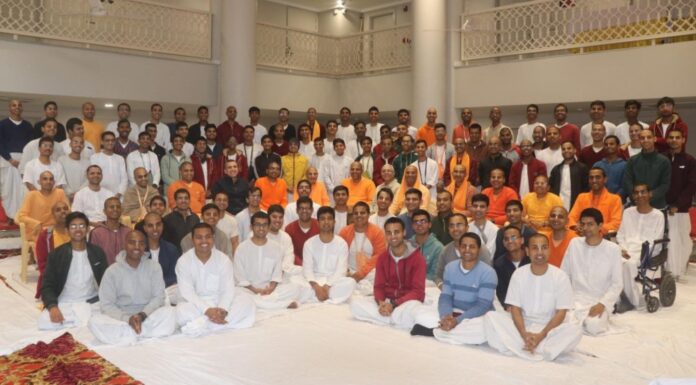
The two-day Navarasa Festival, conducted on December 20–21, 2025, under the auspices of the ISKCON Youth Forum, Patna, manifested as a joyous and spiritually surcharged celebration of devotional culture, higher values, and youth upliftment. Centered upon the elevating theme “Bliss of Bhakti,” the festival drew the heartfelt participation of more than one thousand young men and women. Adorned in traditional dhotī-kurta and marked with tilaka, the participants stood united as a visible expression of cultural rootedness and Vaiṣṇava identity.

  • Words of wisdom shared by ISKCON Leaders.

Spiritual and Intellectual Nourishment

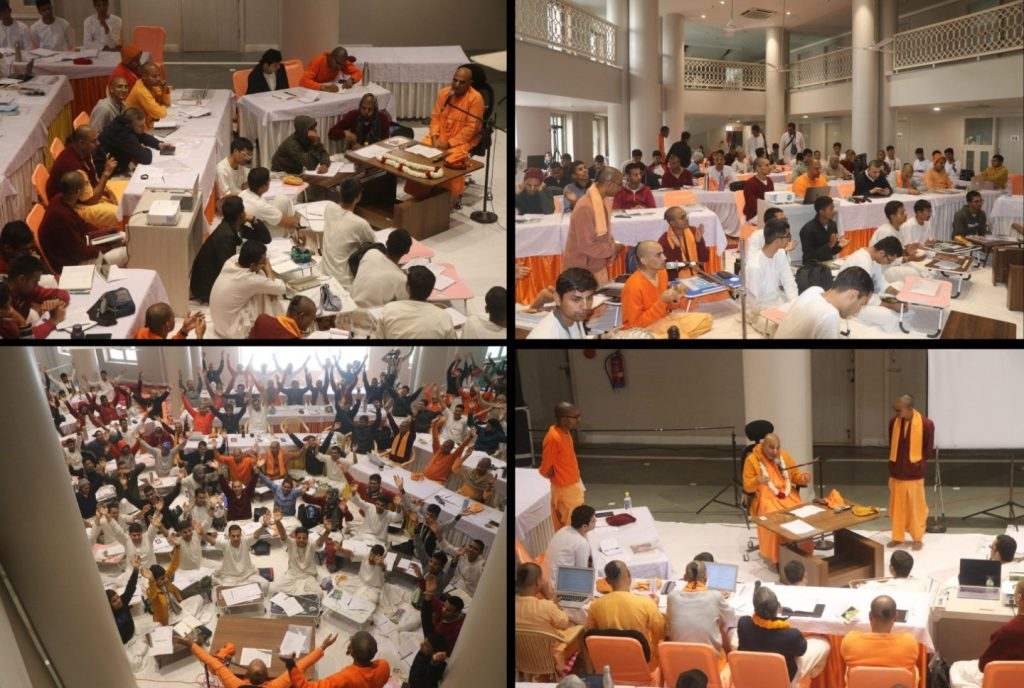
The festival was illumined by a series of profound and instructive discourses delivered by senior leaders of the International Society for Krishna Consciousness. These addresses expounded upon the science of bhakti-yoga, the discipline of spiritual life, and the practical application of eternal Vedic wisdom within the complexities of modern existence. Through attentive hearing, the assembled youth were inspired to introspect upon life’s true purpose, to realign their values, and to cultivate genuine inner transformation.

The atmosphere was further sanctified by melodious congregational chanting of the holy names of the Lord. These kīrtanas infused the gathering with transcendental joy, enabling the participants to experience the uplifting potency of collective devotional service.

Drama and debate performed by IYF devotees.

Youth-Oriented Engagements and Cultural Expression

Among the most thought-provoking segments of the festival was a youth debate entitled “Are We Spiritualists or Escapists?” This earnest and interactive forum encouraged participants to critically deliberate upon whether spiritual life constitutes a withdrawal from responsibility or, rather, a higher framework for conscious, meaningful, and accountable living. The discussion elicited enthusiastic involvement and revealed the thoughtful maturity of the participating youth.

Deeply enriching the cultural and devotional dimension of the festival was a dramatic presentation on the life of Śrī Haridāsa Ṭhākura. The performance vividly portrayed his unflinching faith, profound humility, and steadfast endurance in the face of severe adversity, leaving a lasting impression upon the audience and imparting timeless lessons of devotion, tolerance, and courage.

Addressing a pressing social concern, all participants solemnly took a collective vow to remain free from drug addiction, thereby reaffirming their resolve to pursue a healthy, disciplined, and purposeful way of life. The festival also featured an award distribution ceremony, honoring individuals and groups for their exemplary service and enthusiastic participation.

Dignitaries gathered on the stage for the lamp lighting ceremony.

Presence of Respected Vaiṣṇava Leaders

The assembly was graced by the august presence of distinguished spiritual dignitaries, including Bhakti Prachar Parivrajak Swami (Chairman, ISKCON Bhagavata Mahavidyalaya, and Co-Regional Secretary, ISKCON Patna); Rishi Kumar Dās (Zonal Supervisor for the National Capital Territory of Delhi and Special Duty Officer, ISKCON Patna); Gokuleśvara Dās (Vice President, ISKCON Juhu, and Regional Secretary Assistant, ISKCON Patna); Ādikartā Dās (President, ISKCON Ghaziabad, and Co-Chairman, TMC Patna); Jagdīśa Śyāma Dās (President, ISKCON Gaya); and Rādhāpati Caraṇa Dās (Director, IYF Patna, and TMC Member, ISKCON Patna). Their association and guidance greatly enhanced the spiritual gravity and devotional depth of the festival.

Honored Chief Guests

The occasion was further dignified by the presence of the honorable Chief Guests, Śrī Aśok Chaudhary, Minister of the Grāmin Kārya Vibhāg (RWD), Bihar, and Śrī Saayan Kunal, Member of the Dhārmik Nyās Board, Bihar. Both guests expressed heartfelt appreciation for the festival’s vision of engaging the youth through spiritual culture while constructively addressing contemporary social challenges.

Maha Harinam on the street of Patna.

Auspicious Conclusion

The Navarasa Festival concluded on a most auspicious and spiritually elevating note with a grand Mahā Harināma Saṅkīrtana, wherein the participants joyfully immersed themselves in the congregational chanting of the holy names. In its entirety, the festival stood as a compelling demonstration of how devotion, thoughtful dialogue, and regulated living can guide the youth of today toward experiencing the genuine bliss of bhakti, while remaining responsible, active, and conscientious members of society.

Bhaja Gauranga Kaha Gauranga

0

Song Name: Bhaja Gauranga Kaha Gauranga

Official Name: None

Author: Anonymous

Book Name: None

Language: Bengali

LYRICS:

(refrain)

bhaja gaurāńga kaha gaurāńga laha gaurāńgera nāma re

je jan gaurāńga bhaje, sei (hoy) āmāra prāṇa re

(1)

gaurāńga boliyā du’ bāhu tuliyā nāciyā nāciyā beḍāo re

(2)

gāurāńga bhajile gaurāńga japile hoy duḥkhera abasāna re

TRANSLATION

Refrain: Worship Lord Gauranga! Chant Gauranga! Speak about Lord Gauranga only! Those who worships Lord Gauranga is indeed my life and soul.

1) Chanting Gauranga, go out with your arms raised dancing and dancing.

2) By chanting Gauranga and worshipping Him, one’s miseries will end.

Baso Mere Nayanana Me Nandalala

0

Song Name: Baso Mere Nayanana Me Nandalala

Official Name: None

Author: Mira Bai 

Book Name: None

Language: Hindi 

LYRICS:

(1)

baso mere nayanana me nandalāla

(2)

mohana mūrati, śyāmarī sūrati, nayanā bane viśāla

(3)

adhara sudhārasa, muralī bājata, ura vaijantīmāla

(4)

kṣudra ghaṇṭikā kaṭitaṭa śobhita, nūpura śabda rasāla

(5)

mīrā prabhu santana sukhadāyī, bhakta vatsala gopāla

TRANSLATION

1) May Nandalala always be present before my eyes.

2) May the enchanting form and beautiful face of Syama always be present before my eyes.

3) His lips exude pure nectar as He plays the flute, and a vaijanti-mala adorns His chest.

4) Tiny bells adorn His waist and the sound of His anklebells is very sweet.

5) The master of Mira is Gopala, who is especially affectionate to His devotees and gives immense pleasure to the saints.

Are The Heavens Truly Expanding, Or Are The Scientists Mistaken?

0

Among the astronomers who have expressed grave reservations regarding the customary interpretation of all cosmic red shifts as mere Doppler effects is Halton Arp. Śrī Arp formerly served on the staff of the Hale Observatory at Mount Palomar and is presently engaged in research at the Max Planck Institute near Munich, in what was then West Germany. While at Palomar, Arp carefully observed numerous instances of what are termed discordant red shifts—cases that do not conform to Hubble’s celebrated law. From his meticulous analysis, he has been led to conclude that red shifts, in general, may arise from causes other than relative motion alone.

At this juncture, a thoughtful person must inquire: why do scientists so firmly insist that red shifts are produced exclusively by the Doppler effect? It is indeed acknowledged that a Doppler effect can generate a red shift. But by what conclusive reasoning is it established that every red shift must arise from this single cause? According to prevailing physical theory, the only phenomenon aside from Doppler motion known to produce a significant red shift is a powerful gravitational field. When light ascends against gravity, it loses energy and thus becomes red-shifted. Yet astronomers dismiss this explanation for stars and galaxies, reasoning that gravitational fields of unimaginable strength would be required to account for the observed magnitudes.

Arp, however, contends that he has identified objects possessing high red shifts situated in close proximity to objects with low red shifts. According to the standard theory of an expanding universe, a body with a small red shift should be relatively near, whereas one with a large red shift should lie at a great distance. Consequently, objects that are genuinely close to one another ought to exhibit similar red shifts.

Contrary to this expectation, Arp presents the example of the spiral galaxy NGC 7603, which appears connected to a companion galaxy by a luminous bridge. Yet the companion exhibits a red shift some 8,000 kilometers per second greater than that of the spiral galaxy. Judging solely by this disparity, the companion should lie approximately 478 million light-years farther away. Nevertheless, the two galaxies appear sufficiently near to one another to be physically connected. By way of comparison, our own Milky Way galaxy is said to be only about two million light-years distant from its nearest neighbor, the Andromeda galaxy.

Predictably, defenders of the standard cosmological view strongly contest Arp’s conclusions. John N. Bahcall of Princeton’s Institute for Advanced Study asserts that there is no necessity to suppose that the two galaxies are truly connected. According to his view, they are widely separated in space and merely appear close together from our particular line of sight. The luminous bridge may indeed exist, but the more distant galaxy simply happens to be aligned behind it.

To support his objection, Bahcall offers a striking illustration: a photograph of a star within our own Milky Way that seems to be connected by a luminous bridge to a distant galaxy. Are they actually related? Bahcall explains that such a connection is impossible, for the star is a bright foreground object within our galaxy, whereas the distant galaxy lies some forty-four million light-years away.

Arp replies that this example is frivolous and misleading. The galaxy displayed by Bahcall is entirely ordinary, and the so-called bridge connecting it to the star is nothing more than one of its normal spiral arms. In contrast, Arp notes that the bridge in his own example is an unusual structure, not commonly observed in such galaxies. The probability that two galaxies of this particular type would coincidentally appear in such a configuration is, he argues, exceedingly small—far smaller than the chance alignment of a foreground star with a typical background galaxy.

Arp has documented many additional cases that appear to violate the conventional understanding of red shifts. Among the most controversial is his observation of a quasar, Markarian 205, situated near the spiral galaxy NGC 4319 and apparently connected to it by a luminous bridge. The galaxy exhibits a red shift of 1,800 kilometers per second, corresponding to a distance of approximately 107 million light-years. The quasar, however, has a red shift of 21,000 kilometers per second, which by standard reckoning would place it at a distance of about 1.24 billion light-years. Arp nevertheless maintains that the two objects are genuinely connected, thereby indicating that the customary interpretation of red shift is erroneous in this instance. It may be noted, in passing, that the practice of expressing red shifts in terms of kilometers per second itself betrays a firm commitment to the Doppler interpretation.

Critics obtained their own photographs of NGC 4319 and reported that they could detect no such connecting bridge. Some went so far as to claim that the bridge seen by Arp was merely a spurious photographic artifact. Yet more recently, Jack M. Sulentic of the University of Alabama conducted extensive photometric studies of the pair and concluded that the connecting bridge is, in fact, real.

Another example cited by Arp is found in the peculiar chain of galaxies known as Vorontsov-Velyaminov 172, named after its Russian discoverers. In this chain, the smaller and more compact member exhibits a red shift twice as great as that of its companions.

Beyond such paired galaxies, Arp draws attention to an even more astonishing phenomenon: it appears that galaxies and quasars may eject other quasars and even other galaxies. For instance, the exploding galaxy NGC 520 possesses a relatively small red shift. Along a straight line extending southwest from this galaxy are four faint quasars. Arp observes that these quasars are the only ones found in that region and asks whether it is reasonable to regard their near-perfect alignment as a mere accident. He considers such a coincidence extremely unlikely and therefore suggests that the quasars were ejected from the galaxy itself.

Notably, these quasars possess red shifts far greater than that of the galaxy from which they seem to originate. According to standard theory, this would imply that they are vastly more distant. Arp, however, interprets this and similar cases by proposing that newly ejected quasars are born with intrinsically high red shifts, which gradually diminish with time.

Some scientists doubt whether galaxies could possibly eject massive objects such as other galaxies or quasars. In reply, Arp points to a remarkable photograph of the giant galaxy M87, which is observed ejecting a jet of material. When one examines the surrounding elliptical galaxies in that region—M87 itself being elliptical—one finds that they lie along a line aligned with the direction of the jet. This, Arp suggests, indicates that these galaxies were expelled by M87.

This proposal naturally raises a profound question: how can a galaxy, understood as an “island universe” composed of countless stars, gas, and dust, emit another galaxy of similar composition? Some have suggested that radio astronomy may provide a clue. It is now generally accepted that vast regions of radio emission can be ejected from galaxies, often appearing in pairs on opposite sides. To account for this, astronomers have postulated enormous rotating black holes at galactic centers, which consume nearby matter and expel material along their axis of rotation. Yet if Arp’s conclusions are correct, one must explain not merely the expulsion of tenuous emitting gas, but the ejection of entire galaxies or their precursors.

With respect to the red shifts of such ejected objects, Arp observes a consistent pattern: although these bodies lie in close proximity to their parent galaxies, they display far higher red shifts. Arp insists that this can only indicate that their red shifts are not caused by velocity—that is, they do not measure recession speed. Rather, the red shift must be related to the intrinsic physical condition of the object itself.

At present, however, the established laws of physics offer no explanation of what such a condition might be. Since a galaxy is understood to be an aggregate of stars, gas, and dust, it is difficult to conceive of any inherent property that would produce a red shift independent of motion or gravitation. Such a phenomenon cannot be accounted for by known physical principles.

This circumstance appears to demand the formulation of new physics. Yet such a step opens a veritable Pandora’s box, for modern cosmology is firmly committed to the premise that the universe can be fully explained by existing physical laws. Should those laws require fundamental revision, all cosmological models founded upon them would likewise be called into question.

Arp’s findings are therefore highly controversial, and many astronomers remain unconvinced that the associations he describes between galaxies and quasars are real. Nevertheless, his work represents a significant and sobering line of evidence suggesting that the standard interpretation of galactic red shifts may not be as final or complete as is commonly assumed.

“Is The Universe Expanding, Or Is It Interpreted So?—A Thoughtful Scientific Question”

0

Hubble’s Expanding Universe Model

The work of De Sitter created considerable discussion and agitation within the astronomical community throughout the world. Among those who were deeply attentive to these developments was Edwin Hubble. Hubble had been present in 1914 when Vesto Slipher first announced his observations concerning the motions of the galaxies before a meeting of the American Astronomical Society. Many years later, in 1928, Hubble undertook systematic research at the renowned Mount Wilson Observatory, endeavoring to bring together De Sitter’s theoretical conception of an expanding universe with Slipher’s empirical observations indicating that galaxies were receding.

Hubble’s reasoning proceeded in the following manner. If the universe were indeed expanding, then the galaxies within it should be moving away from one another. Furthermore, the greater the separation between galaxies, the more rapidly they should be receding. From this it would follow that an observer situated at any point— including the Earth—should perceive that all other galaxies are moving away, and that, on average, the more distant a galaxy is, the greater should be the velocity of its recession.

With this hypothesis in mind, Hubble undertook careful investigation to determine whether such a relationship could be detected. He found that there appeared to be a proportional connection between the distances of galaxies and the extent of their red shifts. The majority of galaxies, he observed, exhibited red shifts, and those judged to be farther away generally displayed larger red shifts.

This, however, gives rise to a most perplexing question: by what means did Hubble determine the distances of the galaxies? This problem presented great difficulty for Hubble, and it remains a formidable challenge even for astronomers of the present day. There are, after all, no physical measuring rods that extend to the stars. The fundamental approach is therefore indirect. One begins by employing various methods to estimate the distances of nearby stars. Then, step by step, one constructs what is known as a “cosmic distance ladder,” by which estimates may be made for the distances of certain galaxies. If one can further make an assessment of the intrinsic brightness of galaxies, then unknown distances may be inferred by comparing apparent brightness with known cases, in accordance with the inverse square law.

The detailed procedures involved in establishing this distance ladder are exceedingly complex and will not be elaborated upon here. It is sufficient to note that they depend upon numerous theoretical interpretations that are burdened with uncertainty and subject to revision, sometimes in unforeseen ways. As the discussion proceeds, the significance of these uncertainties will become evident.

By employing his methods of approximating galactic distances, Hubble established a proportional relationship—now known as Hubble’s law—between the degree of red shift and distance. He concluded that the galaxies most distant from the Earth exhibited the greatest red shifts and were therefore receding at the highest velocities. This conclusion he accepted as compelling evidence that the universe itself is expanding.

In time, this idea became so firmly established that astronomers began to apply it in reverse. If distance is proportional to red shift, then, it was reasoned, one could determine the distance of a galaxy simply by measuring its red shift.

Yet it must be remembered that Hubble’s distance figures were not the result of direct or precise measurements. Rather, they were derived indirectly from observations of apparent galactic brightness. Consequently, the expanding universe model is subject to two potential weaknesses. First, the brightness or dimness of celestial bodies may arise from causes other than distance alone, and thus the distances inferred from such observations may be inaccurate. Second, it is possible that red shift itself may not be directly connected with velocity.

Indeed, a number of astronomers are persuaded that certain red shifts are not produced by a Doppler effect. Some have gone even further, calling into question the very notion of an expanding universe.

Srimad Bhagavatam | Canto 5 Chapter 10 | The Discussion Between Jaḍa Bharata And Mahārāja Rahūgaṇa

0

Śukadeva Gosvāmī continued: My dear King, after this, King Rahūgaṇa, ruler of the states known as Sindhu and Sauvīra, was going to Kapilāśrama. When the King’s chief palan quin carriers reached the banks of the river Ikṣumatī, they needed another carrier. There fore they began searching for someone, and by chance they came upon Jaḍa Bharata. They considered the fact that Jaḍa Bharata was very young and strong and had firm limbs. Like cows and asses, he was quite fit to carry loads. Thinking in this way, although the great soul Jaḍa Bharata was unfit for such work, they nonetheless unhesitatingly forced him to carry the palanquin.(1) The palanquin, however, was very errati cally carried by Jaḍa Bharata due to his sense of nonviolence. As he stepped forward, he checked before him every three feet to see whether he was about to step on ants. Conse quently he could not keep pace with the other carriers. Due to this, the palanquin was shaking, and King Rahūgaṇa immediately asked the car riers, “Why are you carrying this palanquin un evenly? Better carry it properly.”(2)

When the palanquin carriers heard the threatening words of Mahārāja Rahūgaṇa, they became very afraid of his punishment and be gan to speak to him as follows.(3) O lord, please note that we are not at all negligent in discharging our duties. We have been faithfully carrying this palanquin according to your desire, but this man who has been recently en gaged to work with us cannot walk very swiftly. Therefore we are not able to carry the palanquin with him.(4)

King Rahūgaṇa could understand the speeches given by the carriers, who were afraid of being punished. He could also understand that simply due to the fault of one person, the palanquin was not being carried properly. Knowing this perfectly well and hearing their appeal, he became a little angry, although he was very advanced in political science and was very experienced. His anger arose due to his in born nature as a king. Actually King Rahūgaṇa’s mind was covered by the mode of passion, and he therefore spoke as follows to Jaḍa Bharata, whose Brahman effulgence was not clearly visible, being covered like a fire covered by ashes.(5) King Rahūgaṇa told Jaḍa Bharata: How troublesome this is, my dear brother. You certainly appear very fatigued be cause you have carried this palanquin alone without assistance for a long time and for a long distance. Besides that, due to your old age you have become greatly troubled. My dear friend, I see that you are not very firm, nor very strong and stout. Aren’t your fellow carriers cooperat ing with you?(6)

Thereafter, when the King saw that his palanquin was still being shaken by the carriers, he became very angry and said: You rascal, what are you doing? Are you dead despite the life within your body? Do you not know that I am your master? You are disregard ing me and are not carrying out my order. For this disobedience I shall now punish you just as Yamarāja, the superintendent of death, pun ishes sinful people. I shall give you proper treatment so that you will come to your senses and do the correct thing.(7) Thinking himself a king, King Rahūgaṇa was in the bodily conception and was influ enced by material nature’s modes of passion and ignorance. Due to madness, he chastised Jaḍa Bharata with uncalled-for and contradic tory words. Jaḍa Bharata was a topmost devo tee and the dear abode of the Supreme Person ality of Godhead. Although considering him self very learned, the King did not know about the position of an advanced devotee situated in devotional service, nor did he know his charac teristics. Jaḍa Bharata was the residence of the Supreme Personality of Godhead; he always carried the form of the Lord within his heart. He was the dear friend of all living beings, and he did not entertain any bodily conception. He therefore smiled and spoke the following words.(8)

The great brāhmaṇa Jaḍa Bharata said: My dear King and hero, whatever you have spoken sarcastically is certainly true. Actually these are not simply words of chastisement, for the body is the carrier. The load carried by the body does not belong to me, for I am the spirit soul. There is no contradiction in your state ments because I am different from the body. I am not the carrier of the palanquin; the body is the carrier. Certainly, as you have hinted, I have not labored carrying the palanquin, for I am de tached from the body. You have said that I am not stout and strong, and these words are befit ting a person who does not know the distinction between the body and the soul. The body may be fat or thin, but no learned man would say such things of the spirit soul. As far as the spirit soul is concerned, I am neither fat nor skinny; therefore you are correct when you say that I am not very stout. Also, if the object of this journey and the path leading there were mine, there would be many troubles for me, but be cause they relate not to me but to my body, there is no trouble at all.(9)

Fatness, thinness, bodily and mental distress, thirst, hunger, fear, disagreement, desires for material happiness, old age, sleep, attachment for material posses sions, anger, lamentation, illusion and identifi cation of the body with the self are all transfor mations of the material covering of the spirit soul. A person absorbed in the material bodily conception is affected by these things, but I am free from all bodily conceptions. Consequently I am neither fat nor skinny nor anything else you have mentioned.(10) My dear King, you have unnecessarily accused me of being dead though alive. In this regard, I can only say that this is the case everywhere because everything material has its beginning and end. As far as your thinking that you are the king and master and are thus trying to order me, this is also in correct because these positions are temporary. Today you are a king and I am your servant, but tomorrow the position may be changed, and you may be my servant and I your master. These are temporary circumstances created by providence.(11)

My dear King, if you still think that you are the King and that I am your serv ant, you should order me, and I should follow your order. I can then say that this differentia tion is temporary, and it expands only from us age or convention. I do not see any other cause. In that case, who is the master, and who is the servant? Everyone is being forced by the laws of material nature; therefore no one is master, and no one is servant. Nonetheless, if you think that you are the master and that I am the serv ant, I shall accept this. Please order me. What can I do for you?(12) My dear King, you have said, “You rascal, you dull, crazy fellow! I am going to chastise you, and then you will come to your senses.” In this regard, let me say that although I live like a dull, deaf and dumb man, I am actually a self-realized person. What will you gain by punishing me? If your calculation is true and I am a madman, then your punish ment will be like beating a dead horse. There will be no effect. When a madman is punished, he is not cured of his madness.(13)

Śukadeva Gosvāmī said: O Mahārāja Parīkṣit, when King Rahūgaṇa chastised the ex alted devotee Jaḍa Bharata with harsh words, that peaceful, saintly person tolerated it all and replied properly. Nescience is due to the bodily conception, and Jaḍa Bharata was not affected by this false conception. Out of his natural hu mility, he never considered himself a great dev otee, and he agreed to suffer the results of his past karma. Like an ordinary man, he thought that by carrying the palanquin he was destroy ing the reactions of his past misdeeds. Thinking in this way, he began to carry the palanquin as before.(14) Śukadeva Gosvāmī continued: O best of the Pāṇḍu dynasty [Mahārāja Parīkṣit], the King of the Sindhu and Sauvīra states [Mahārāja Rahūgaṇa] had great faith in discus sions of the Absolute Truth. Being thus quali fied, he heard from Jaḍa Bharata that philo sophical presentation which is approved by all scriptures on the mystic yoga process and which slackens the knot in the heart. His mate rial conception of himself as a king was thus destroyed. He immediately descended from his palanquin and fell flat on the ground with his head at the lotus feet of Jaḍa Bharata in such a way that he might be excused for his insulting words against the great brāhmaṇa. He then prayed as follows.(15)

King Rahūgaṇa said: O brāhmaṇa, you appear to be moving in this world very much covered and unknown to oth ers. Who are you? Are you a learned brāhmaṇa and saintly person? I see that you are wearing a sacred thread. Are you one of those exalted, lib erated saints such as Dattātreya and other highly advanced, learned scholars? May I ask whose disciple you are? Where do you live? Why have you come to this place? Is your mis sion in coming here to do good for us? Please let me know who you are.(16) My dear sir, I am not at all afraid of the thunderbolt of King In dra, nor am I afraid of the serpentine, piercing trident of Lord Śiva. I do not care about the punishment of Yamarāja, the superintendent of death, nor am I afraid of fire, scorching sun, moon, wind, nor the weapons of Kuvera. Yet I am afraid of offending a brāhmaṇa. I am very much afraid of this.(17)

My dear sir, it appears that the influence of your great spiritual knowledge is hidden. Factually you are bereft of all material association and fully absorbed in the thought of the Supreme. Consequently you are unlimitedly advanced in spiritual knowledge. Please tell me why you are wander ing around like a dullard. O great saintly per son, you have spoken words approved by the yogic process, but it is not possible for us to un derstand what you have said. Therefore kindly explain it.(18) I consider your good self the most exalted master of mystic power. You know the spiritual science perfectly well. You are the most exalted of all learned sages, and you have descended for the benefit of all human society. You have come to give spiritual knowledge, and you are a direct representative of Kapiladeva, the incarnation of God and the plenary portion of knowledge. I am therefore asking you, O spiritual master, what is the most secure shelter in this world?(19)

Is it not a fact that your good self is the direct representative of Kapiladeva, the incarnation of the Supreme Personality of Godhead? To examine people and see who is actually a human being and who is not, you have presented yourself to be a deaf and dumb person. Are you not moving this way upon the surface of the world? I am very at tached to family life and worldly activities, and I am blind to spiritual knowledge. Nonetheless, I am now present before you and am seeking enlightenment from you. How can I advance in spiritual life?(20) You have said, “I am not fatigued from la bor.” Although the soul is different from the body, there is fatigue because of bodily labor, and it appears to be the fatigue of the soul. When you are carrying the palanquin, there is certainly labor for the soul. This is my conjec ture. You have also said that the external be havior exhibited between the master and the servant is not factual, but although in the phe nomenal world it is not factual, the products of the phenomenal world can actually affect things. That is visible and experienced. As such, even though material activities are imper manent, they cannot be said to be untrue.(21)

King Rahūgaṇa continued: My dear sir, you have said that designations like bodily fatness and thinness are not characteristics of the soul. That is incorrect because designations like pain and pleasure are certainly felt by the soul. You may put a pot of milk and rice within fire, and the milk and rice are automatically heated one after the other. Similarly, due to bodily pains and pleasures, the senses, mind and soul are af fected. The soul cannot be completely detached from this conditioning.(22) My dear sir, you have said that the relationship between the king and the subject or between the master and the servant are not eternal, but although such rela tionships are temporary, when a person takes the position of a king his duty is to rule the cit izens and punish those who are disobedient to the laws. By punishing them, he teaches the cit izens to obey the laws of the state. Again, you have said that punishing a person who is deaf and dumb is like chewing the chewed or grind ing the pulp; that is to say, there is no benefit in it. However, if one is engaged in his own occu pational duty as ordered by the Supreme Lord, his sinful activities are certainly diminished. Therefore if one is engaged in his occupational duty by force, he benefits because he can van quish all his sinful activities in that way.(23)

Whatever you have spoken appears to me to be contradictory. O best friend of the distressed, I have committed a great offense by insulting you. I was puffed up with false prestige due to possessing the body of a king. For this I have certainly become an offender. Therefore I pray that you kindly glance at me with your cause less mercy. If you do so, I can be relieved from sinful activities brought about by insulting you.(24) O my dear lord, you are the friend of the Supreme Personality of Godhead, who is the friend of all living entities. You are there fore equal to everyone, and you are free from the bodily conception. Although I have com mitted an offense by insulting you, I know that there is no loss or gain for you due to my insult. You are fixed in your determination, but I have committed an offense. Because of this, even though I may be as strong as Lord Śiva, I shall be vanquished without delay due to my offense at the lotus feet of a Vaiṣṇava.(25)

Srimad Bhagavatam | Canto 5 Chapter 9 | The Supreme Character Of Jaḍa Bharata

0

Śrīla Śukadeva Gosvāmī continued: My dear King, after giving up the body of a deer, Bharata Mahārāja took birth in a very pure brāhmaṇa family. There was a brāhmaṇa who belonged to the dynasty of Aṅgirā. He was fully qualified with brahminical qualifications. He could control his mind and senses, and he had studied the Vedic literatures and other subsidi ary literatures. He was expert in giving charity, and he was always satisfied, tolerant, very gen tle, learned and nonenvious. He was self-real ized and engaged in the devotional service of the Lord. He remained always in a trance. He had nine equally qualified sons by his first wife, and by his second wife he begot twinsa brother and a sister, of which the male child was said to be the topmost devotee and foremost of saintly kingsBharata Mahārāja. This, then, is the story of the birth he took after giving up the body of a deer.(1-2)

Due to his being especially gifted with the Lord’s mercy, Bharata Mahārāja could remember the incidents of his past life. Alt hough he received the body of a brāhmaṇa, he was still very much afraid of his relatives and friends who were not devotees. He was always very cautious of such association because he feared that he would again fall down. Conse quently he manifested himself before the public eye as a madmandull, blind and deafso that oth ers would not try to talk to him. In this way he saved himself from bad association. Within he was always thinking of the lotus feet of the Lord and chanting the Lord’s glories, which save one from the bondage of fruitive action. In this way he saved himself from the onslaught of nondevotee associates.(3)

The brāhmaṇa father’s mind was always filled with affection for his son, Jaḍa Bharata [Bharata Mahārāja]. Therefore he was always attached to Jaḍa Bharata. Because Jaḍa Bharata was unfit to enter the gṛhastha-āśrama, he simply executed the purificatory process up to the end of the brahmacarya-āśrama. Although Jaḍa Bharata was unwilling to accept his fa ther’s instructions, the brāhmaṇa nonetheless instructed him in how to keep clean and how to wash, thinking that the son should be taught by the father.(4) Jaḍa Bharata behaved before his father like a fool, despite his father’s ade quately instructing him in Vedic knowledge. He behaved in that way so that his father would know that he was unfit for instruction and would abandon the attempt to instruct him fur ther. He would behave in a completely opposite way. Although instructed to wash his hands af ter evacuating, he would wash them before. Nonetheless, his father wanted to give him Ve dic instructions during the spring and summer. He tried to teach him the Gāyatrī mantra along with oṁkāra and vyāhṛti, but after four months his father still was not successful in instructing him.(5)

The brāhmaṇa father of Jaḍa Bharata con sidered his son his heart and soul, and therefore he was very much attached to him. He thought it wise to educate his son properly, and being absorbed in this unsuccessful endeavor, he tried to teach his son the rules and regulations of brahmacaryaincluding the execution of the Ve dic vows, cleanliness, study of the Vedas, the regulative methods, service to the spiritual master and the method of offering a fire sacri fice. He tried his best to teach his son in this way, but all his endeavors failed. In his heart he hoped that his son would be a learned scholar, but all his attempts were unsuccessful. Like everyone, this brāhmaṇa was attached to his home, and he had forgotten that someday he would die. Death, however, was not forgetful. At the proper time, death appeared and took him away.(6) Thereafter, the brāhmaṇa’s younger wife, after entrusting her twin chil drenthe boy and girlto the elder wife, departed for Patiloka, voluntarily dying with her hus band.(7)

After the father died, the nine stepbrothers of Jaḍa Bharata, who considered Jaḍa Bharata dull and brainless, abandoned the father’s at tempt to give Jaḍa Bharata a complete educa tion. The stepbrothers of Jaḍa Bharata were learned in the three Vedasthe Ṛg Veda, Sāma Veda and Yajur Vedawhich very much encour age fruitive activity. The nine brothers were not at all spiritually enlightened in devotional ser vice to the Lord. Consequently they could not understand the highly exalted position of Jaḍa Bharata.(8)

Degraded men are actually no bet ter than animals. The only difference is that an imals have four legs and such men have only two. These two-legged, animalistic men used to call Jaḍa Bharata mad, dull, deaf and dumb. They mistreated him, and Jaḍa Bharata be haved for them like a madman who was deaf, blind or dull. He did not protest or try to con vince them that he was not so. If others wanted him to do something, he acted according to their desires. Whatever food he could acquire by begging or by wages, and whatever came of its own accordbe it a small quantity, palatable, stale or tastelesshe would accept and eat. He never ate anything for sense gratification be cause he was already liberated from the bodily conception, which induces one to accept palat able or unpalatable food. He was full in the transcendental consciousness of devotional ser vice, and therefore he was unaffected by the du alities arising from the bodily conception. Ac tually his body was as strong as a bull’s, and his limbs were very muscular. He didn’t care for winter or summer, wind or rain, and he never covered his body at any time. He lay on the ground, and never smeared oil on his body or took a bath. Because his body was dirty, his spiritual effulgence and knowledge were cov ered, just as the splendor of a valuable gem is covered by dirt. He only wore a dirty loincloth and his sacred thread, which was blackish. Un derstanding that he was born in a brāhmaṇa family, people would call him a brahma bandhu and other names. Being thus insulted and neglected by materialistic people, he wan dered here and there.(9-10)

Jaḍa Bharata used to work only for food. His stepbrothers took ad vantage of this and engaged him in agricultural field work in exchange for some food, but ac tually he did not know how to work very well in the field. He did not know where to spread dirt or where to make the ground level or une ven. His brothers used to give him broken rice, oil cakes, the chaff of rice, worm-eaten grains and burned grains that had stuck to the pot, but he gladly accepted all this as if it were nectar. He did not hold any grudges and ate all this very gladly.(11) At this time, being desirous of obtaining a son, a leader of dacoits who came from a śūdra family wanted to worship the goddess Bhadra Kālī by offering her in sacrifice a dull man, who is considered no better than an animal.(12)

The leader of the dacoits captured a man-animal for sacrifice, but he escaped, and the leader ordered his followers to find him. They ran in different directions but could not find him. Wandering here and there in the middle of the night, cov ered by dense darkness, they came to a paddy field where they saw the exalted son of the Āṅgirā family [Jaḍa Bharata], who was sitting in an elevated place guarding the field against the attacks of deer and wild pigs.(13) The fol lowers and servants of the dacoit chief consid ered Jaḍa Bharata to possess qualities quite suitable for a man-animal, and they decided that he was a perfect choice for sacrifice. Their faces bright with happiness, they bound him with ropes and brought him to the temple of the goddess Kālī.(14)

After this, all the thieves, according to their imaginative ritual for killing animalistic men, bathed Jaḍa Bharata, dressed him in new clothes, decorated him with ornaments befit ting an animal, smeared his body with scented oils and decorated him with tilaka, sandalwood pulp and garlands. They fed him sumptuously and then brought him before the goddess Kālī, offering her incense, lamps, garlands, parched grain, newly grown twigs, sprouts, fruits and flowers. In this way they worshiped the deity before killing the man-animal, and they vi brated songs and prayers and played drums and bugles. Jaḍa Bharata was then made to sit down before the deity.(15) At this time, one of the thieves, acting as the chief priest, was ready to offer the blood of Jaḍa Bharata, whom they im agined to be an animal-man, to the goddess Kālī to drink as a liquor. He therefore took up a very fearsome sword, which was very sharp and, consecrating it by the mantra of Bhadra Kālī, raised it to kill Jaḍa Bharata.(16)

All the rogues and thieves who had made ar rangements for the worship of Goddess Kālī were low minded and bound to the modes of passion and ignorance. They were overpow ered by the desire to become very rich; there fore they had the audacity to disobey the in junctions of the Vedas, so much so that they were prepared to kill Jaḍa Bharata, a self-real ized soul born in a brāhmaṇa family. Due to their envy, these dacoits brought him before the goddess Kālī for sacrifice. Such people are al ways addicted to envious activities, and there fore they dared to try to kill Jaḍa Bharata. Jaḍa Bharata was the best friend of all living entities. He was no one’s enemy, and he was always ab sorbed in meditation on the Supreme Personal ity of Godhead. He was born of a good brāhmaṇa father, and killing him was forbid den, even though he might have been an enemy or aggressive person. In any case, there was no reason to kill Jaḍa Bharata, and the goddess Kālī could not bear this. She could immediately understand that these sinful dacoits were about to kill a great devotee of the Lord. Suddenly the deity’s body burst asunder, and the goddess Kālī personally emerged from it in a body burn ing with an intense and intolerable efful gence.(17)

Intolerant of the offenses commit ted, the infuriated Goddess Kālī flashed her eyes and displayed her fierce, curved teeth. Her reddish eyes glowed, and she displayed her fearsome features. She assumed a frightening body, as if she were prepared to destroy the en tire creation. Leaping violently from the altar, she immediately decapitated all the rogues and thieves with the very sword with which they had intended to kill Jaḍa Bharata. She then be gan to drink the hot blood that flowed from the necks of the beheaded rogues and thieves, as if this blood were liquor. Indeed, she drank this intoxicant with her associates, who were witches and female demons. Becoming intoxi cated with this blood, they all began to sing very loudly and dance as though prepared to an nihilate the entire universe. At the same time, they began to play with the heads of the rogues and thieves, tossing them about as if they were balls.(18)

When an envious person commits an offense before a great personality, he is always punished in the way mentioned above.(19) Śukadeva Gosvāmī then said to Mahārāja Parīkṣit: O Viṣṇudatta, those who already know that the soul is separate from the body, who are liberated from the invincible knot in the heart, who are always engaged in welfare activities for all living entities and who never contem plate harming anyone are always protected by the Supreme Personality of Godhead, who car ries His disc [the Sudarśana cakra] and acts as supreme time to kill the demons and protect His devotees. The devotees always take shelter at the lotus feet of the Lord. Therefore at all times, even if threatened by decapitation, they remain unagitated. For them, this is not at all wonder ful.(20)

Srimad Bhagavatam | Canto 5 Chapter 8 | A Description Of The Character Of Bharata Mahārāja

0

ŚrīŚukadeva Gosvāmī continued: My dear King, one day, after finishing his morning dutiesevacuating, urinating and bathing Mahārāja Bharata sat down on the bank of the river Gaṇḍakī for a few minutes and began chanting his mantra, beginning with oṁkāra.(1) O King, while Bharata Mahārāja was sitting on the bank of that river, a doe, being very thirsty, came there to drink.(2) While the doe was drinking with great satisfaction, a lion, which was very close, roared very loudly. This was frightful to every living entity, and it was heard by the doe.(3) By nature the doe was always afraid of being killed by others, and it was al ways looking about suspiciously. When it heard the lion’s tumultuous roar, it became very agitated. Looking here and there with disturbed eyes, the doe, although it had not fully satisfied itself by drinking water, suddenly leaped across the river.(4) The doe was pregnant, and when it jumped out of fear, the baby deer fell from its womb into the flowing waters of the river. Being sep arated from its flock and distressed by its mis carriage, the black doe, having crossed the river, was very much distressed. Indeed, it fell down in a cave and died immediately.(5)

The great King Bharata, while sitting on the bank of the river, saw the small deer, bereft of its mother, floating down the river. Seeing this, he felt great compassion. Like a sincere friend, he lifted the infant deer from the waves, and, knowing it to be motherless, brought it to his āśrama.(7) Gradually Mahārāja Bharata became very affectionate toward the deer. He began to raise it and maintain it by giving it grass. He was al ways careful to protect it from the attacks of ti gers and other animals. When it itched, he pet ted it, and in this way he always tried to keep it in a comfortable condition. He sometimes kissed it out of love. Being attached to raising the deer, Mahārāja Bharata forgot the rules and regulations for the advancement of spiritual life, and he gradually forgot to worship the Su preme Personality of Godhead. After a few days, he forgot everything about his spiritual advancement.(8)

The great King Mahārāja Bharata began to think: Alas, this helpless young deer, by the force of time, an agent of the Supreme Personality of Godhead, has now lost its relatives and friends and has taken shelter of me. It does not know anyone but me, as I have become its father, mother, brother and rela tives. This deer is thinking in this way, and it has full faith in me. It does not know anyone but me; therefore I should not be envious and think that for the deer my own welfare will be destroyed. I should certainly raise, protect, gratify and fondle it. When it has taken shelter with me, how can I neglect it? Even though the deer is disturbing my spiritual life, I realize that a helpless person who has taken shelter cannot be neglected. That would be a great fault.(9) Even though one is in the renounced order, one who is advanced certainly feels compassion for suffering living entities. One should certainly neglect his own personal interests, although they may be very important, to protect one who has surrendered.(10)

Due to attachment for the deer, Mahārāja Bharata lay down with it, walked about with it, bathed with it and even ate with it. Thus his heart became bound to the deer in affec tion.(11) When Mahārāja Bharata wanted to enter the forest to collect kuśa grass, flowers, wood, leaves, fruits, roots and water, he would fear that dogs, jackals, tigers and other fero cious animals might kill the deer. He would therefore always take the deer with him when entering the forest.(12) When entering the for est, the animal would appear very attractive to Mahārāja Bharata due to its childish behavior. Mahārāja Bharata would even take the deer on his shoulders and carry it due to affection. His heart was so filled with great love for the deer that he would sometimes keep it on his lap or, when sleeping, on his chest. In this way he felt great pleasure in fondling the animal.(13) When Mahārāja Bharata was actually worship ing the Lord or was engaged in some ritualistic ceremony, although his activities were unfin ished, he would still, at intervals, get up and see where the deer was. In this way he would look for it, and when he could see that the deer was comfortably situated, his mind and heart would be very satisfied, and he would bestow his blessings upon the deer, saying, “My dear calf, may you be happy in all respects.”(14)

If Bharata Mahārāja sometimes could not see the deer, his mind would be very agitated. He would become like a miser, who, having ob tained some riches, had lost them and had then become very unhappy. When the deer was gone, he would be filled with anxiety and would lament due to separation. Thus he would become illusioned and speak as follows.(15) Bharata Mahārāja would think: Alas, the deer is now helpless. I am now very unfortu nate, and my mind is like a cunning hunter, for it is always filled with cheating propensities and cruelty. The deer has put its faith in me, just as a good man who has a natural interest in good behavior forgets the miSBehavior of a cunning friend and puts his faith in him. Alt hough I have proved faithless, will this deer re turn and place its faith in me?(16)

Alas, is it possible that I shall again see this animal pro tected by the Lord and fearless of tigers and other animals? Shall I again see him wandering in the garden eating soft grass?(17) I do not know, but the deer might have been eaten by a wolf or a dog or by the boars that flock together or the tiger who travels alone.(18) Alas, when the sun rises, all auspicious things begin. Un fortunately, they have not begun for me. The sun-god is the Vedas personified, but I am be reft of all Vedic principles. That sun-god is now setting, yet the poor animal who trusted in me since its mother died has not returned.(19) That deer is exactly like a prince. When will it re turn? When will it again display its personal ac tivities, which are so pleasing? When will it again pacify a wounded heart like mine? I cer tainly must have no pious assets, otherwise the deer would have returned by now.(20)

Alas, the small deer, while playing with me and seeing me feigning meditation with closed eyes, would circumambulate me due to anger arising from love, and it would fearfully touch me with the points of its soft horns, which felt like drops of water.(21) When I placed all the sacrificial ingredients on the kuśa grass, the deer, when playing, would touch the grass with its teeth and thus pollute it. When I chastised the deer by pushing it away, it would immediately be come fearful and sit down motionless, exactly like the son of a saintly person. Thus it would stop its play.(22) After speaking like a madman in this way, Mahārāja Bharata got up and went outside. See ing the footprints of the deer on the ground, he praised the footprints out of love, saying: O un fortunate Bharata, your austerities and pen ances are very insignificant compared to the penance and austerity undergone by this earth planet. Due to the earth’s severe penances, the footprints of this deer, which are small, beauti ful, most auspicious and soft, are imprinted on the surface of this fortunate planet. This series of footprints show a person like me, who am bereaved due to loss of the deer, how the animal has passed through the forest and how I can re gain my lost wealth. By these footprints, this land has become a proper place for brāhmaṇas who desire heavenly planets or liberation to ex ecute sacrifices to the demigods.(23)

Mahārāja Bharata continued to speak like a madman. Seeing above his head the dark marks on the rising moon, which resembled a deer, he said: Can it be that the moon, who is so kind to an unhappy man, might also be kind upon my deer, knowing that it has strayed from home and has become motherless? This moon has given the deer shelter near itself just to protect it from the fearful attacks of a lion.(24) After perceiving the moonshine, Mahārāja Bharata continued speaking like a crazy person. He said: The deer’s son was so submissive and dear to me that due to its separation I am feeling separation from my own son. Due to the burn ing fever of this separation, I am suffering as if inflamed by a forest fire. My heart, which is like the lily of the land, is now burning. Seeing me so distressed, the moon is certainly splash ing its shining nectar upon mejust as a friend throws water on another friend who has a high fever. In this way, the moon is bringing me hap piness.(25)

Śukadeva Gosvāmī continued: My dear King, in this way Bharata Mahārāja was over whelmed by an uncontrollable desire which was manifest in the form of the deer. Due to the fruitive results of his past deeds, he fell down from mystic yoga, austerity and worship of the Supreme Personality of Godhead. If it were not due to his past fruitive activity, how could he have been attracted to the deer after giving up the association of his own son and family, con sidering them stumbling blocks on the path of spiritual life? How could he show such uncon trollable affection for a deer? This was defi nitely due to his past karma. The King was so engrossed in petting and maintaining the deer that he fell down from his spiritual activities. In due course of time, insurmountable death, which is compared to a venomous snake that enters the hole created by a mouse, situated it self before him.(26)

At the time of death, the King saw that the deer was sitting by his side, exactly like his own son, and was lamenting his death. Actually the mind of the King was ab sorbed in the body of the deer, and consequent lylike those bereft of Kṛṣṇa consciousnesshe left the world, the deer, and his material body and acquired the body of a deer. However, there was one advantage. Although he lost his human body and received the body of a deer, he did not forget the incidents of his past life.(27) Alt hough in the body of a deer, Bharata Mahārāja, due to his rigid devotional service in his past life, could understand the cause of his birth in that body. Considering his past and present life, he constantly repented his activities, speaking in the following way.(28)

In the body of a deer, Bharata Mahārāja began to lament: What mis fortune! I have fallen from the path of the self realized. I gave up my real sons, wife and home to advance in spiritual life, and I took shelter in a solitary holy place in the forest. I became self controlled and self-realized, and I engaged con stantly in devotional servicehearing, thinking, chanting, worshiping and remembering the Su preme Personality of Godhead, Vāsudeva. I was successful in my attempt, so much so that my mind was always absorbed in devotional service. However, due to my personal foolish ness, my mind again became attachedthis time to a deer. Now I have obtained the body of a deer and have fallen far from my devotional practices.(29)

Although Bharata Mahārāja received the body of a deer, by constant repentance he be came completely detached from all material things. He did not disclose these things to any one, but he left his mother deer in a place known as Kālañjara Mountain, where he was born. He again went to the forest of Śālagrāma and to the āśrama of Pulastya and Pulaha.(30) Remaining in that āśrama, the great King Bha rata Mahārāja was now very careful not to fall victim to bad association. Without disclosing his past to anyone, he remained in that āśrama and ate dry leaves only. He was not exactly alone, for he had the association of the Super soul. In this way he waited for death in the body of a deer. Bathing in that holy place, he finally gave up that body.(31)

Srimad Bhagavatam | Canto 5 Chapter 7 | The Activities Of King Bharata

0

Śukadeva Gosvāmī continued speaking to Mahārāja Parīkṣit: My dear King, Bharata Mahārāja was a topmost devotee. Following the orders of his father, who had already de cided to install him on the throne, he began to rule the earth accordingly. When Bharata Mahārāja ruled the entire globe, he followed the orders of his father and married Pañcajanī, the daughter of Viśvarūpa.(1) Just as the false ego creates the subtle sense objects, Mahārāja Bharata created five sons in the womb of Pañcajanī, his wife. These sons were named Sumati, Rāṣṭrabhṛta, Sudarśana, Āvaraṇa and Dhūmraketu.(2) Formerly this planet was known as Ajanābha-varṣa, but since Mahārāja Bharata’s reign it has become known as Bhārata-varṣa.(3) Mahārāja Bharata was a very learned and experienced king on this earth. He perfectly ruled the citizens, being himself engaged in his own respective duties. Mahārāja Bharata was as affectionate to the citizens as his father and grandfather had been. Keeping them engaged in their occupational duties, he ruled the earth.(4)

With great faith King Bharata per formed various kinds of sacrifice. He per formed the sacrifices known as agni-hotra, darśa, pūrṇamāsa, cāturmāsya, paśu-yajña [wherein a horse is sacrificed] and soma-yajña [wherein a kind of beverage is offered]. Some times these sacrifices were performed com pletely and sometimes partially. In any case, in all the sacrifices the regulations of cāturhotra were strictly followed. In this way Bharata Mahārāja worshiped the Supreme Personality of Godhead.(5) After performing the prelimi naries of various sacrifices, Mahārāja Bharata offered the results in the name of religion to the Supreme Personality of Godhead, Vāsudeva. In other words, he performed all the yajñas for the satisfaction of Lord Vāsudeva, Kṛṣṇa. Mahārāja Bharata thought that since the demi gods were different parts of Vāsudeva’s body, He controls those who are explained in the Ve dic mantras. By thinking in this way, Mahārāja Bharata was freed from all material contamina tion, such as attachment, lust and greed. When the priests were about to offer the sacrificial in gredients into the fire, Mahārāja Bharata ex pertly understood how the offering made to dif ferent demigods was simply an offering to the different limbs of the Lord. For instance, Indra is the arm of the Supreme Personality of God head, and Sūrya [the sun] is His eye. Thus Mahārāja Bharata considered that the oblations offered to different demigods were actually of fered unto the different limbs of Lord Vāsudeva.(6)

In this way, being purified by rit ualistic sacrifices, the heart of Mahārāja Bha rata was completely uncontaminated. His devo tional service unto Vāsudeva, Lord Kṛṣṇa, in creased day after day. Lord Kṛṣṇa, the son of Vasudeva, is the original Personality of God head manifest as the Supersoul [Paramātmā] as well as the impersonal Brahman. Yogīs medi tate upon the localized Paramātmā situated in the heart, jñānīs worship the impersonal Brah man as the Supreme Absolute Truth, and devo tees worship Vāsudeva, the Supreme Personal ity of Godhead, whose transcendental body is described in the śāstras. His body is decorated with the Śrīvatsa, the Kaustubha jewel and a flower garland, and His hands hold a conchshell, disc, club and lotus flower. Devo tees like Nārada always think of Him within their hearts.(7) Destiny fixed the time for Mahārāja Bha rata’s enjoyment of material opulence at one thousand times ten thousand years. When that period was finished, he retired from family life and divided the wealth he had received from his forefathers among his sons. He left his paternal home, the reservoir of all opulence, and started for Pulahāśrama, which is situated in Hardwar. The śālagrāma-śilās are obtainable there.(8)

At Pulaha-āśrama, the Supreme Personality of Godhead, Hari, out of His transcendental affec tion for His devotee, becomes visible to His devotee, satisfying His devotee’s desires.(9) In Pulaha-āśrama is the Gaṇḍakī River, which is the best of all rivers. The śālagrāma-śilā, the marble pebbles, purify all those places. On each and every marble pebble, up and down, circles like navels are visible.(10) In the gardens of Pu laha-āśrama, Mahārāja Bharata lived alone and collected a variety of flowers, twigs and tulasī leaves. He also collected the water of the Gaṇḍakī River, as well as various roots, fruits and bulbs. With these he offered food to the Su preme Personality of Godhead, Vāsudeva, and, worshiping Him, he remained satisfied. In this way his heart was completely uncontaminated, and he did not have the least desire for material enjoyment. All material desires vanished. In this steady position, he felt full satisfaction and was situated in devotional service.(11)

That most exalted devotee, Mahārāja Bha rata, in this way engaged constantly in the de votional service of the Lord. Naturally his love for Vāsudeva, Kṛṣṇa, increased more and more and melted his heart. Consequently he gradu ally lost all attachment for regulative duties. The hairs of his body stood on end, and all the ecstatic bodily symptoms were manifest. Tears flowed from his eyes, so much so that he could not see anything. Thus he constantly meditated on the reddish lotus feet of the Lord. At that time, his heart, which was like a lake, was filled with the water of ecstatic love. When his mind was immersed in that lake, he even forgot the regulative service to the Lord.(12)

Mahārāja Bharata appeared very beautiful. He had a wealth of curly hair on his head, which was wet from bathing three times daily. He dressed in a deerskin. He worshiped Lord Nārāyaṇa, whose body was composed of golden effulgence and who resided within the sun. Mahārāja Bharata worshiped Lord Nārāyaṇa by chanting the hymns given in the Ṛg Veda, and he recited the following verse as the sun rose.(13) “The Supreme Personality of Godhead is sit uated in pure goodness. He illuminates the en tire universe and bestows all benedictions upon His devotees. The Lord has created this uni verse from His own spiritual potency. Accord ing to His desire, the Lord entered this universe as the Supersoul, and by virtue of His different potencies He is maintaining all living entities desiring material enjoyment. Let me offer my respectful obeisances unto the Lord, who is the giver of intelligence.”(14)

Stay Connected

16,985FansLike
12,500FollowersFollow
61,453SubscribersSubscribe